Interviews are more than just a Q&A session—they’re a chance to prove your worth. This blog dives into essential Volleyball Ethics and Sportsmanship interview questions and expert tips to help you align your answers with what hiring managers are looking for. Start preparing to shine!
Questions Asked in Volleyball Ethics and Sportsmanship Interview
Q 1. Define sportsmanship in the context of volleyball.
Sportsmanship in volleyball, like in any sport, goes beyond just playing the game. It’s about demonstrating respect, integrity, and ethical conduct towards your teammates, opponents, officials, and the game itself. It involves showing grace in victory and humility in defeat, always prioritizing fair play and positive interactions. It’s about creating a positive and inclusive environment where everyone feels valued and respected, regardless of skill level or outcome.
Think of it like this: Imagine a team consistently celebrating their points respectfully, even when their opponents are clearly frustrated. They offer encouragement to both their own teammates and their opponents after tough plays. That’s exemplary sportsmanship. Conversely, arguing with the referee, taunting opponents, or showing poor behavior towards teammates exhibits poor sportsmanship.
Q 2. How would you handle a dispute over a referee’s call in a volleyball match?
Handling disputes over referee calls requires tact and professionalism. The first step is always to remain calm and respectful. Never confront the referee aggressively or argue publicly. A coach or team captain should approach the referee after the play, expressing the team’s concern in a calm and polite manner, avoiding accusatory language. It’s crucial to remember that referees are human and make mistakes; the objective is to clarify, not to challenge authority disrespectfully. If the explanation is unsatisfactory, there might be official channels within the league or governing body to address the issue further.
For instance, instead of shouting, “That was out! You’re blind!” a proper approach would be something like, “Excuse me, ref. We felt that the ball landed out of bounds. Could we possibly have a quick clarification?”
Q 3. Describe a situation where you witnessed unethical behavior in a volleyball game. How did you respond?
During a youth tournament, I witnessed a team intentionally delaying the game by repeatedly requesting timeouts right after scoring points to demoralize their opponents. This tactic was clearly intended to break their opponent’s rhythm and negatively impact their morale. I addressed the situation by speaking to the coach privately after the match. I explained that this behavior was unsportsmanlike and went against the principles of fair play. I emphasized the importance of teaching players respect for their opponents and for the integrity of the game. Fortunately, the coach was receptive to my feedback, and I believe that the team modified their approach in subsequent games.
Q 4. What are some strategies for promoting good sportsmanship among young volleyball players?
Promoting good sportsmanship among young players involves a multi-pronged approach:
- Lead by example: Coaches and parents should always exhibit good sportsmanship, modeling appropriate behavior.
- Emphasize skill development over winning: Focus on improving individual and team skills, not solely on winning. This reduces the pressure to resort to unethical tactics.
- Teach respect for opponents and officials: Regularly discuss the importance of treating opponents and officials with courtesy and respect.
- Reinforce positive behaviors: Reward and praise players for demonstrating good sportsmanship.
- Implement team-building activities: Encourage teamwork and cooperation through activities that emphasize mutual support and respect.
- Discuss ethical dilemmas: Use hypothetical scenarios to explore ethical challenges and how to respond appropriately.
Q 5. How do you address a player exhibiting poor sportsmanship during a game?
Addressing poor sportsmanship during a game requires a measured and firm response. The approach depends on the severity of the behavior. A minor infraction, like a brief outburst, might only require a verbal warning from the coach. More serious offenses, like taunting or unsportsmanlike conduct, may warrant a time-out or even removal from the game depending on the league rules. The key is consistency. All players should know that poor sportsmanship will not be tolerated, regardless of their skill level or position on the team.
It’s crucial to address the behavior privately and focus on teaching, not punishment. Explain why the behavior was inappropriate and how it negatively impacts the team and the game.
Q 6. How would you teach respect for opponents and officials to your volleyball team?
Teaching respect for opponents and officials is fundamental. It starts with emphasizing that volleyball is a game played by people, and those people deserve respect, regardless of their role. Team meetings can be used to discuss strategies for handling difficult situations, like challenging calls or frustrating losses. Role-playing scenarios can help players practice respectful communication. Highlighting positive examples of sportsmanship from professional volleyball players can inspire young athletes to emulate such behavior. Emphasizing the shared love of the game fosters mutual respect, bridging the gap between competitors and officials.
Q 7. Explain the importance of fair play in volleyball competitions.
Fair play is paramount in volleyball competitions. It ensures that the game is played fairly and that the outcome is determined by skill and strategy, not by cheating or unsportsmanlike conduct. Fair play upholds the integrity of the competition, promoting trust and respect between players, coaches, and officials. It contributes to a positive game experience for everyone involved, teaching valuable life lessons about honesty, integrity, and ethical behavior. Without fair play, the very essence of the competition is compromised, undermining its value and enjoyment.
Q 8. How do you handle pressure and maintain ethical conduct in high-stakes volleyball matches?
Maintaining ethical conduct under pressure in high-stakes volleyball is about mental fortitude and a strong moral compass. It’s not about eliminating pressure, but about managing it effectively.
My approach involves several key strategies:
- Pre-game preparation: Thorough preparation, both physically and mentally, reduces anxiety. This includes detailed game plans, reviewing opponent strategies, and visualization techniques to build confidence.
- Focus on the present: Instead of dwelling on the consequences of winning or losing, I concentrate on the current point, the current play. This mindfulness technique helps to ground me and avoid overwhelming pressure.
- Team unity and support: A strong team bond fosters mutual respect and trust. We build each other up, offering support and encouragement during crucial moments. This collaborative spirit reduces individual pressure.
- Adherence to the rules: Strict adherence to the rules of the game is paramount. Ethical conduct extends beyond merely winning; it’s about playing fairly and with integrity.
- Post-game reflection: Regardless of the outcome, I always reflect on my performance, identifying areas for improvement and celebrating successes. This helps to cultivate a growth mindset and maintain perspective.
For example, during a crucial championship point, rather than panicking, I’d focus on the execution of my next serve, trusting my training and team support.
Q 9. Describe your experience in enforcing rules and regulations related to fair play in volleyball.
Enforcing fair play in volleyball requires a combination of consistent application of rules, clear communication, and decisive action. My experience involves officiating at various levels, from youth leagues to national competitions.
I approach rule enforcement with fairness and consistency. This means:
- Thorough knowledge of the rules: Knowing the rules inside and out is crucial for fair and impartial decisions. This includes understanding nuanced interpretations and the spirit of the rules.
- Clear and concise communication: When making a call, I explain the reason clearly and respectfully to both teams, ensuring everyone understands the infraction. This promotes transparency and avoids misunderstandings.
- Consistency in judgment: Applying the rules consistently across all players and teams is paramount to maintaining fairness. This avoids accusations of bias or favoritism.
- Appropriate sanctions: Depending on the severity of the infraction, I impose the appropriate sanctions, ranging from warnings to penalty points, always adhering to the official rulebook.
- Conflict resolution: Sometimes, disagreements arise despite clear explanations. In such situations, I calmly and impartially mediate, ensuring all parties are heard and the matter is resolved fairly.
One memorable instance involved a dispute over a controversial net touch. By calmly reviewing the replay and explaining the applicable rule, I resolved the conflict and maintained the smooth flow of the game.
Q 10. What are some common ethical dilemmas faced by volleyball coaches or officials?
Volleyball coaches and officials often face complex ethical dilemmas. These challenges often arise from the pressure to win, conflicting loyalties, and interpretations of rules.
- Favoritism towards certain players: Coaches might be tempted to show favoritism towards star players, potentially harming the overall team morale and development of other players.
- Pressure to win at all costs: The intense desire for victory can lead to compromising ethical standards, such as ignoring minor rule violations or encouraging players to engage in unsportsmanlike conduct.
- Dealing with player injuries: Coaches may face the ethical dilemma of prioritizing player health versus the team’s performance, particularly under pressure to win.
- Officiating inconsistencies: Officials might face pressure to make calls that favor a particular team or player, even if it goes against their judgment.
- Confidentiality breaches: Coaches and officials have access to sensitive information about players. Maintaining player confidentiality is crucial and requires strong ethical principles.
For example, a coach might feel pressured to play an injured player because of their talent, creating an ethical conflict between winning and protecting the player’s health.
Q 11. How would you address a player who is consistently engaging in unsportsmanlike conduct?
Addressing unsportsmanlike conduct requires a multi-pronged approach that emphasizes education, understanding, and consistent consequences.
- Private conversation: I would first have a private conversation with the player, expressing my concerns and discussing the impact of their behavior on the team and the game. The conversation should focus on understanding the root cause of their behavior, rather than simply criticizing the actions.
- Positive reinforcement: Highlight the player’s positive attributes and contributions to the team. This creates a supportive environment that encourages self-reflection and improvement.
- Consequences for repeated offenses: If the unsportsmanlike conduct persists, I’d impose consequences, which could range from benching the player to suspension, depending on the severity and frequency of the infractions. Consistency in enforcing these consequences is essential.
- Team meeting: In some cases, involving the team in a discussion about sportsmanship and its importance might be beneficial. This fosters a sense of shared responsibility and helps create a culture of respect and mutual support.
- Seeking external help: If the unsportsmanlike conduct reflects a deeper issue (e.g., anger management problems), I would encourage the player to seek help from a sports psychologist or counselor.
For example, if a player consistently argues with referees, I’d address it privately, highlighting the negative impact on team morale and focusing on better communication techniques.
Q 12. What is your approach to conflict resolution in a team setting?
Conflict resolution within a team relies on open communication, active listening, and a focus on finding mutually acceptable solutions. My approach involves:
- Creating a safe space: Establishing a culture of trust and respect is paramount. Players should feel comfortable expressing their concerns without fear of retribution.
- Active listening: I actively listen to each party’s perspective, avoiding interruptions and seeking to understand their feelings and concerns.
- Facilitation, not dictation: I facilitate the discussion, guiding players to find a resolution themselves. I don’t impose solutions but help them arrive at a mutually agreeable outcome.
- Focus on shared goals: I remind the players of their shared goals and objectives, emphasizing how resolving conflicts contributes to team success.
- Follow-up: After the conflict is resolved, I follow up to ensure everyone is comfortable and the solution is working effectively.
For instance, if a disagreement arose regarding playing time, I’d facilitate a discussion between the involved players, helping them understand each other’s perspectives and arrive at a compromise that respects everyone’s contributions to the team.
Q 13. How do you ensure that your players understand the rules and regulations of volleyball?
Ensuring players understand the rules and regulations is crucial for fair play and team success. My approach is multifaceted:
- Regular rule reviews: I incorporate regular rule reviews into our training sessions. This might involve quizzes, discussions, and practical demonstrations.
- Rulebook access: Players have easy access to the official rulebook, either in physical or digital format. This promotes self-learning and independent understanding.
- Video analysis: We review game footage, analyzing situations where rules were applied correctly or incorrectly, to reinforce understanding.
- Role-playing: Simulating game situations in practice allows players to apply their knowledge of the rules in a safe and controlled environment.
- Open Q&A: I encourage players to ask questions at any time, ensuring that any uncertainties or misunderstandings are clarified promptly.
For example, we might watch a replay of a disputed call and discuss the relevant rule, helping players learn from real-life situations.
Q 14. How would you react if a player on your team was accused of cheating?
If a player on my team was accused of cheating, my response would be grounded in fairness, transparency, and due process:
- Gather information: I would carefully and thoroughly investigate the accusations, gathering all available evidence and listening to all involved parties.
- Fair hearing: The player would be given a fair opportunity to explain their side of the story and present any evidence to their defense.
- Impartial judgment: The evaluation of the evidence would be objective and impartial, avoiding preconceived notions or biases.
- Adherence to regulations: Any disciplinary action would adhere to the governing body’s regulations and the team’s code of conduct.
- Support and guidance: Regardless of the outcome, the player would receive appropriate support and guidance, focusing on future improvements and learning from the experience.
My priority would be to ensure a fair and just process while upholding the integrity of the team and the sport. If found guilty, the appropriate consequences, as per team and league rules, would be enforced.
Q 15. How do you foster a positive and supportive team environment that emphasizes ethical behavior?
Building a positive and supportive team environment in volleyball, where ethical behavior thrives, requires a multifaceted approach. It’s not just about winning; it’s about creating a culture of respect, teamwork, and personal growth.
- Open Communication: Regular team meetings, where players feel comfortable sharing concerns and feedback, are crucial. This creates a safe space for addressing issues before they escalate.
- Shared Goals and Values: Establishing clear team goals, beyond just winning games, and defining core values like respect, sportsmanship, and integrity, provides a framework for decision-making and behavior.
- Team-Building Activities: Engaging in activities outside of training, like social events or volunteer work, fosters camaraderie and strengthens team bonds. This can translate into better on-court cooperation and support.
- Positive Reinforcement: Focusing on effort, improvement, and positive actions, rather than solely on results, creates a supportive environment where players feel encouraged to take risks and learn from mistakes. Celebrating both individual and collective successes strengthens team morale and reinforces ethical behavior.
- Conflict Resolution: Implementing a fair and consistent process for resolving disagreements and addressing conflict helps to maintain a healthy team dynamic and avoid situations where ethical principles are compromised.
For example, in one team I coached, we implemented a ‘team charter’ where players collaboratively defined our values and agreed upon how to address conflicts constructively. This participatory approach fostered a strong sense of ownership and commitment to ethical conduct.
Career Expert Tips:
- Ace those interviews! Prepare effectively by reviewing the Top 50 Most Common Interview Questions on ResumeGemini.
- Navigate your job search with confidence! Explore a wide range of Career Tips on ResumeGemini. Learn about common challenges and recommendations to overcome them.
- Craft the perfect resume! Master the Art of Resume Writing with ResumeGemini’s guide. Showcase your unique qualifications and achievements effectively.
- Don’t miss out on holiday savings! Build your dream resume with ResumeGemini’s ATS optimized templates.
Q 16. What are the consequences of poor sportsmanship in volleyball?
Poor sportsmanship in volleyball carries several consequences, impacting not only the individuals involved but also the entire team and the sport’s image. These consequences can be:
- Game Penalties: Referees can issue warnings, points deductions, or even ejections for unsportsmanlike conduct, such as arguing calls, taunting opponents, or exhibiting aggressive behavior.
- Reputational Damage: A team or individual known for poor sportsmanship can damage their reputation and lose the respect of opponents, coaches, officials, and fans.
- Team Cohesion Issues: Poor sportsmanship can create friction within the team, damaging morale and hindering performance. Players may become less likely to support each other if they perceive a lack of respect from teammates.
- Disciplinary Actions: Depending on the severity of the infraction, leagues or governing bodies may impose suspensions or other disciplinary measures on players or teams exhibiting poor sportsmanship. This can extend to future opportunities or even result in long-term bans.
- Negative Impact on the Sport: Repeated displays of poor sportsmanship can damage the overall image of volleyball, discouraging participation and potentially harming the sport’s growth and popularity.
Imagine a situation where a player continuously argues with the referee, even after multiple warnings. This not only disrupts the flow of the game but also sets a negative example for younger players and undermines the integrity of the sport.
Q 17. Explain the role of a coach in promoting good sportsmanship.
A coach plays a pivotal role in fostering good sportsmanship within a volleyball team. They are essentially role models, whose actions and attitudes significantly shape the team’s culture.
- Leading by Example: Coaches must demonstrate exemplary sportsmanship in their interactions with players, opponents, officials, and spectators. This includes respectful communication, accepting of decisions (even unfavorable ones), and a focus on fair play.
- Teaching Sportsmanship: Coaches should explicitly teach and reinforce the principles of sportsmanship during practices and games. This can include discussions, role-playing, and analysis of game situations to illustrate ethical decision-making.
- Creating a Culture of Respect: Coaches should actively cultivate an environment where players respect each other, opponents, officials, and the game itself. This includes discouraging taunting, name-calling, and any form of disrespectful behavior.
- Enforcing Consequences: Coaches must establish clear consequences for unsportsmanlike conduct within the team, ensuring that actions have appropriate repercussions. This reinforces the importance of ethical behavior and its impact on team performance.
- Promoting Emotional Intelligence: Coaches should help players develop emotional intelligence, including self-awareness, self-regulation, and empathy, to better manage their emotions during competition and foster respectful interactions.
A coach who consistently demonstrates integrity and fair play will inspire their players to follow suit. Conversely, a coach who tolerates or even encourages poor sportsmanship will likely see it mirrored by their team.
Q 18. How would you encourage respectful communication among players and coaches?
Encouraging respectful communication among players and coaches requires a proactive and consistent approach. It involves creating a safe environment where players feel comfortable expressing themselves without fear of reprisal.
- Establish Communication Protocols: Implementing clear guidelines for communication, including appropriate language and tone, helps to set expectations and ensure respectful interactions. This could involve a team meeting where players and the coach collectively decide upon acceptable communication styles.
- Active Listening and Feedback: Coaches should actively listen to players’ concerns and provide constructive feedback, even when disagreeing with their opinions. This fosters a sense of mutual respect and understanding.
- Conflict Resolution Training: Providing training in conflict resolution skills helps players and coaches to effectively address disagreements and resolve conflicts constructively, avoiding escalation or damage to relationships.
- Positive Language and Tone: Emphasizing positive reinforcement and encouragement fosters a respectful environment. Coaches should use positive language and a supportive tone when interacting with players, even during challenging situations.
- Open Dialogue and Feedback Sessions: Regular one-on-one or group sessions create opportunities for open dialogue and feedback, allowing players to express concerns and receive support.
For instance, I once had a player who was struggling to communicate their needs effectively. By implementing regular one-on-one sessions and using active listening techniques, we were able to build trust, improve communication, and resolve the conflict positively.
Q 19. What resources do you use to stay current on rules and ethical guidelines in volleyball?
Staying current with volleyball rules and ethical guidelines is essential for maintaining fairness and promoting good sportsmanship. I utilize several resources to ensure my knowledge remains up-to-date:
- Official Rulebooks: I regularly review the official rulebooks published by the governing bodies of volleyball (e.g., FIVB, USA Volleyball). These documents provide comprehensive details on the rules of the game, including interpretations and clarifications.
- Coaching Clinics and Workshops: Attending coaching clinics and workshops organized by national or international volleyball organizations offers opportunities to learn about rule changes, ethical considerations, and best practices from experienced professionals.
- Online Resources: Various websites and online forums dedicated to volleyball provide updates on rule changes, interpretations, and discussions on ethical dilemmas in the sport.
- Professional Organizations: Memberships in professional coaching organizations provide access to resources, publications, and updates on rules and ethical guidelines. These organizations often host events and webinars focusing on these aspects of the game.
- Peer Networking: Networking with other coaches allows for the exchange of information, experiences, and insights on managing ethical challenges in the sport.
By combining these methods, I stay informed about any revisions or interpretations that impact my coaching practice and ensure that I’m applying the most current rules and ethical principles.
Q 20. How do you handle a situation where a player is injured during a game, considering ethical and safety aspects?
Handling player injuries during a volleyball game requires a thoughtful approach that prioritizes both the player’s safety and ethical considerations.
- Immediate Action: The first priority is the player’s safety. Stop the game immediately. Assess the injury and provide any necessary immediate first aid.
- Medical Assistance: If the injury is significant, call for qualified medical personnel immediately. This could involve a team trainer, emergency medical services, or the appropriate medical professional designated by the venue.
- Respectful Handling: Ensure the injured player is treated with care and respect. Avoid unnecessary handling of the injury site, unless properly trained to do so. Provide emotional support and comfort.
- Game Continuation: If the game continues, ensure that the process of substitution is handled fairly and in accordance with the official rules. Do not rush the process or create undue pressure on the injured player.
- Follow-Up Care: After the game, ensure the player receives appropriate follow-up medical care and support in recovery. Maintain communication with the player, their family, and medical professionals throughout the recovery process.
For example, if a player suffers a suspected concussion, it’s critical to immediately remove them from the game, assess the severity of the injury using appropriate medical protocols, and ensure they do not return to play until medically cleared. Ethical considerations demand placing the player’s long-term health and well-being above the immediate game outcome.
Q 21. Describe your understanding of the role of technology (e.g., video replay) in upholding fairness in volleyball.
Technology, such as video replay, plays an increasingly important role in upholding fairness and accuracy in volleyball. While not eliminating all subjectivity, it significantly improves officiating and minimizes human error.
- Challenge System: The challenge system allows coaches or designated officials to review contentious calls, offering a mechanism to correct obvious errors and enhance the fairness of match outcomes. This adds a level of accountability and accuracy to officiating decisions.
- Data Analysis: Video replay can be used for data analysis to improve coaching strategies and player performance. This is not directly related to ethical considerations but contributes to the improvement of game play and fair competition.
- Training Officials: Video review can serve as a valuable tool in training volleyball officials, allowing them to review calls and improve their accuracy and consistency. This reduces inconsistency and promotes fairer game play.
- Integrity of the Game: The effective use of technology in officiating should always focus on upholding the integrity of the game. It is critical to avoid the overuse of challenges which could slow the game or disrupt its flow.
- Transparency and Education: Ensuring the process of utilizing technology is transparent to all stakeholders, including players, coaches, and spectators, improves understanding and acceptance of the decisions made.
However, it’s important to remember that technology is a tool to support, not replace, the human element of officiating. The appropriate use of technology requires careful consideration of its limitations and potential for misapplication. The focus remains on maintaining the spirit of sportsmanship and fair play.
Q 22. How would you handle a situation where a parent or spectator displays unsportsmanlike conduct?
Addressing unsportsmanlike conduct from parents or spectators requires a multi-pronged approach prioritizing the safety and well-being of all involved. First, I would calmly and directly address the individual, explaining why their behavior is inappropriate and disruptive. This should be done privately if possible, to avoid escalating the situation in front of the team and other spectators. I would clearly state the rules and expectations for spectators, emphasizing the importance of respectful behavior. If the behavior continues despite this initial intervention, I would involve the event organizers or officials. Depending on the severity, this could involve a warning, ejection from the game, or even a ban from future events.
For example, if a parent verbally abuses a referee, I’d first approach them privately and explain that their comments are unacceptable and could affect the game’s fairness. If this doesn’t resolve the issue, I would then report it to the game officials who might issue a warning or ejection. Prevention is key; clear signage indicating spectator expectations and pre-game announcements reminding spectators of acceptable behavior are vital.
Q 23. How do you balance winning and ethical conduct in volleyball?
Balancing winning and ethical conduct is crucial for building a strong and respectful volleyball team. Winning shouldn’t come at the cost of compromising integrity. It’s about striving for excellence while adhering to the rules and demonstrating good sportsmanship both on and off the court. This includes respecting opponents, officials, teammates, and the game itself. Celebrating victories gracefully and accepting defeats with dignity are key aspects of ethical conduct. A team that prioritizes ethical conduct builds a positive team culture, fostering strong relationships and respect, which ultimately enhances performance in the long run. For instance, prioritizing fair play over winning a close match by employing questionable tactics would be an example of choosing ethical conduct.
Q 24. What steps would you take to ensure fair selection and playing time for all team members?
Ensuring fair selection and playing time involves transparency and objective criteria. We should establish clear selection criteria based on skill, performance, attitude, and team needs, communicated openly to all players. This could involve regular evaluations, skill tests, and tracking individual progress. Playing time should be distributed fairly based on these criteria and the requirements of each game. While star players deserve more court time due to skill, less experienced players should still get opportunities to develop and contribute. Regularly rotating positions and giving every player meaningful court time promotes team unity and morale. A clear communication system, explaining the rationale behind playing time decisions, is crucial to prevent any feelings of unfairness.
For example, I might use a points system based on practice attendance, performance in drills, and game contributions to determine playing time.
Q 25. How would you create a code of conduct for a volleyball team or league?
Creating a comprehensive code of conduct requires input from all stakeholders – players, coaches, parents, and officials. It should clearly define expectations regarding sportsmanship, respect, ethical behavior, and team commitment. The code should cover areas such as:
- Respect for opponents, officials, teammates, and coaches.
- Proper behavior on and off the court.
- Appropriate use of language.
- Commitment to fair play and adherence to the rules.
- Respect for the game and its traditions.
- Handling disputes and conflicts constructively.
- Consequences for violations of the code of conduct.
Once drafted, the code needs to be communicated clearly to all parties, and mechanisms for addressing violations should be in place. The code should be regularly reviewed and updated to reflect the team’s evolving needs and values. This process ensures that everyone understands expectations and fosters a culture of respect and responsibility within the volleyball community.
Q 26. Describe a situation where you had to make a difficult ethical decision in a volleyball setting.
In a regional tournament, a crucial point during a semi-final game saw a questionable call by the referee that went against my team. My players were visibly upset, and some even began to argue. I had to make a tough decision: either protest the call, risking further penalty and potentially jeopardizing the game, or accept the call and maintain the team’s composure. While I felt the call was unfair, I decided that prioritizing the team’s overall integrity and avoiding a contentious display of poor sportsmanship was more critical than winning that particular point. I used the opportunity to teach my players about accepting referee decisions and maintaining composure under pressure. Although we lost the game, the team learned a valuable lesson about ethical conduct and sportsmanship.
Q 27. How do you educate your players about the importance of integrity in sports?
Educating players about integrity involves fostering a holistic understanding of sports ethics beyond just winning or losing. It requires consistent reinforcement throughout the season. This involves regular discussions about the importance of honesty, fairness, respect, and responsibility. I would use real-life examples, case studies, and role-playing scenarios to help them understand the consequences of unethical actions and the rewards of acting with integrity. We can incorporate discussions about sportsmanship into team meetings and use practices to create opportunities for demonstrating ethical decision-making on the court. Creating a team culture that values sportsmanship and fair play is crucial in this aspect. Leading by example is also vital; coaches and players should consistently demonstrate integrity in their actions and attitudes.
Q 28. What is your approach to addressing doping and performance-enhancing drugs in volleyball?
Addressing doping and performance-enhancing drugs requires a zero-tolerance approach. This begins with education. Players need to be informed about the dangers and consequences of using prohibited substances, including health risks, reputational damage, and potential sanctions. The team should have clear policies regarding drug testing and prohibited substances, accessible to all players and coaches. Open communication is crucial, creating a safe space for players to ask questions and seek clarification without fear of reprisal. Compliance with national and international anti-doping regulations is paramount. Regular workshops and informational sessions, conducted by relevant experts, can reinforce the anti-doping message and encourage responsible conduct. Ultimately, a combination of education, clear policies, and consistent enforcement is essential to maintaining a clean and fair competitive environment in volleyball.
Key Topics to Learn for Volleyball Ethics and Sportsmanship Interview
- Respect for Officials and Opponents: Understanding the importance of unbiased officiating, accepting calls, and demonstrating sportsmanlike conduct towards opponents, even in defeat. Practical application: Role-playing scenarios involving contentious calls or unsportsmanlike behavior from opponents.
- Teamwork and Collaboration: Analyzing the ethical implications of individual performance versus team success. Practical application: Discussing strategies for conflict resolution within a team and fostering a positive team dynamic.
- Fair Play and Rules Adherence: Exploring the significance of adhering strictly to the rules of the game, promoting honesty and integrity, and understanding the consequences of rule violations. Practical application: Analyzing case studies of rule infractions and their ethical implications.
- Leadership and Integrity: Examining the role of ethical leadership in fostering a positive team environment and promoting fair play. Practical application: Describing examples of ethical leadership displayed by influential volleyball figures.
- Sportsmanship in Victory and Defeat: Discussing the importance of humility in victory and grace in defeat, and how to appropriately manage emotions in both scenarios. Practical application: Developing strategies for handling pressure situations and maintaining composure.
- Promoting Inclusivity and Diversity: Understanding the role of sportsmanship in fostering an inclusive environment that respects the diversity of players, coaches, and officials. Practical application: Analyzing strategies for fostering respect and creating a welcoming environment.
Next Steps
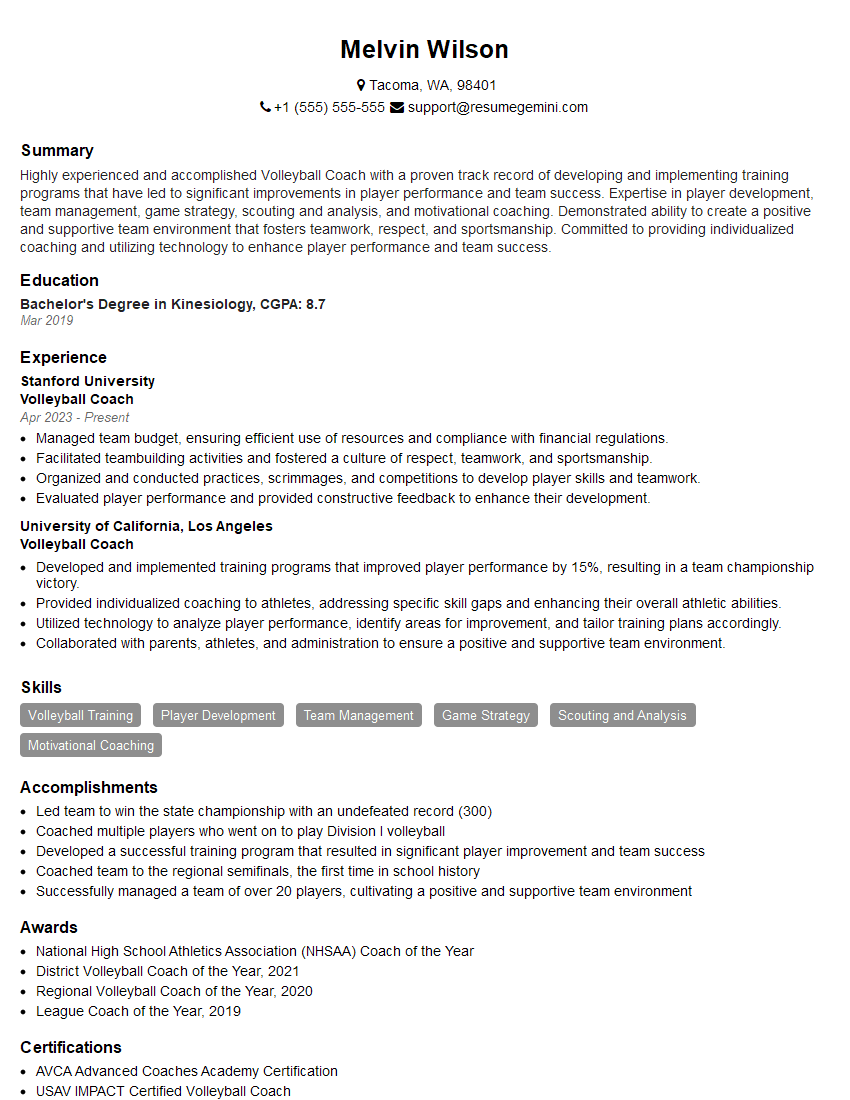
Mastering Volleyball Ethics and Sportsmanship demonstrates crucial personal and professional qualities highly valued by employers. These skills showcase your integrity, teamwork capabilities, and ability to navigate challenging situations. Building a strong, ATS-friendly resume is essential for highlighting these skills to prospective employers. ResumeGemini is a trusted resource to help you craft a compelling resume that accurately reflects your capabilities. Examples of resumes tailored to Volleyball Ethics and Sportsmanship positions are available to further guide you. Investing time in a well-structured and impactful resume significantly increases your job prospects. Start building your success story today!
Explore more articles
Users Rating of Our Blogs
Share Your Experience
We value your feedback! Please rate our content and share your thoughts (optional).
What Readers Say About Our Blog
Very informative content, great job.
good