Cracking a skill-specific interview, like one for Color Theory and Psychology, requires understanding the nuances of the role. In this blog, we present the questions you’re most likely to encounter, along with insights into how to answer them effectively. Let’s ensure you’re ready to make a strong impression.
Questions Asked in Color Theory and Psychology Interview
Q 1. Explain the difference between additive and subtractive color mixing.
Additive and subtractive color mixing are two fundamentally different approaches to creating colors. Think of it like this: additive is about adding light, while subtractive is about subtracting light.
Additive color mixing occurs when different colored lights are combined. The primary additive colors are red, green, and blue (RGB). When you combine these in varying intensities, you can create a wide spectrum of colors. This is how your computer or television screen works; tiny red, green, and blue lights combine to create the image you see. Mixing red and green light produces yellow; red and blue make magenta; green and blue make cyan. Combining all three at full intensity results in white light.
Subtractive color mixing involves mixing pigments or dyes, such as paints or inks. The primary subtractive colors are cyan, magenta, and yellow (CMY). These pigments absorb certain wavelengths of light and reflect others, creating the color we perceive. For instance, mixing cyan and magenta pigments absorbs most of the red and green light, reflecting blue. Mixing all three ideally results in black, though often a black pigment (K) is added for richer darker tones (CMYK). The more pigments you mix, the darker the resulting color becomes, as more light is absorbed.
Q 2. Describe the Munsell color system and its practical applications.
The Munsell color system is a color space that organizes colors based on three perceptual dimensions: hue, value (lightness), and chroma (saturation). Imagine a color globe, with hues arranged around the circumference like a rainbow (red, yellow, green, blue, etc.), value running from black at the bottom to white at the top, and chroma increasing as you move outwards from the center axis.
Hue refers to the pure color, like red or blue. Value indicates how light or dark a color is. Chroma represents the color’s intensity or saturation; a high-chroma color is vibrant, while a low-chroma color is dull. Each color is assigned a specific numerical notation, allowing for precise color identification and reproduction.
Practical Applications: The Munsell system is widely used in various fields:
- Paint manufacturing: Formulating consistent and accurate color matches.
- Agriculture: Assessing soil conditions and crop health based on color.
- Art and design: Selecting and coordinating colors for paintings, graphic design, and interior decorating.
- Textile industry: Matching colors in fabric dyeing and production.
Q 3. What are the psychological effects of using warm colors in a design?
Warm colors, such as reds, oranges, and yellows, evoke feelings of warmth, excitement, and energy. They are often associated with happiness, enthusiasm, and comfort.
Psychological Effects:
- Increased energy and excitement: Warm colors can stimulate the nervous system, making spaces feel more lively and dynamic. Think of a brightly lit, orange-hued restaurant designed to encourage a fast turnover of customers.
- Enhanced appetite: Red, in particular, is often used in restaurants to stimulate appetite.
- Sense of urgency: Warm colors, especially red, can create a sense of urgency or immediacy. This is why many call-to-action buttons online are red.
- Increased comfort and intimacy (in certain shades): Softer oranges and yellows can create feelings of warmth, coziness, and relaxation.
However, overuse of warm colors can also lead to feelings of overwhelm or aggression. It’s crucial to use them strategically.
Q 4. How do cool colors influence mood and perception?
Cool colors, including blues, greens, and purples, generally have a calming and soothing effect. They tend to create a sense of peace, tranquility, and stability.
Influence on Mood and Perception:
- Relaxation and calmness: Blue is often associated with relaxation and tranquility, frequently used in bedrooms and spas. Think of the serene blue of a tropical ocean.
- Trust and security: Darker blues can convey a sense of trust, professionalism, and security. Many corporate brands use dark blues to project stability.
- Creativity and freshness: Greens often represent nature, growth, and freshness, fostering feelings of creativity and renewal.
- Sophistication and luxury: Purples can represent luxury, creativity, and royalty. However, depending on the shade, it can also be associated with sadness or mystery.
Overuse of cool colors can sometimes lead to feelings of coldness or sterility. Balance is key to a successful design.
Q 5. Explain the concept of color harmony and provide examples.
Color harmony refers to the pleasing arrangement of colors in a design. It’s about creating visually appealing combinations that work well together. Several types of color harmonies exist:
- Analogous: Colors that sit next to each other on the color wheel, like blue, blue-green, and green. They create a sense of coherence and calmness.
- Complementary: Colors that are opposite each other on the color wheel, like red and green or blue and orange. They create high contrast and visual excitement.
- Triadic: Three colors equally spaced on the color wheel, such as red, yellow, and blue. They offer a vibrant and balanced palette.
- Tetradic (double complementary): Two sets of complementary colors, such as red-green and blue-orange. This offers a wide range of possibilities, but requires careful balancing.
- Split complementary: One color combined with the two colors adjacent to its complement. It provides high contrast but less tension than a strict complementary scheme.
Examples: A calming bedroom might use analogous colors like blues and greens. A vibrant logo might use a triadic scheme of red, yellow, and blue. A sophisticated website might employ a split-complementary palette.
Q 6. Discuss the impact of color contrast on visual hierarchy.
Color contrast plays a crucial role in establishing visual hierarchy, guiding the viewer’s eye to the most important elements within a design. High contrast attracts attention, while low contrast blends elements together.
Impact on Visual Hierarchy:
- Highlighting key elements: Using a high-contrast color for headings or call-to-action buttons makes them stand out and easily noticeable.
- Creating visual separation: Differing colors can separate distinct sections of a design, making it more organized and readable. Imagine a website with a clearly defined navigation bar in a contrasting color.
- Guiding the reader’s eye: A thoughtful use of color contrast can lead the reader through the design in a logical sequence, drawing their attention to each section in turn.
- Improving readability: Using sufficient contrast between text and background improves readability, especially for people with visual impairments.
For instance, a website with dark text on a light background generally has better readability than light text on a dark background. The WCAG (Web Content Accessibility Guidelines) provides specific contrast ratio recommendations to ensure accessibility.
Q 7. How can color be used to evoke specific emotions in a design?
Color is a powerful tool for evoking specific emotions in design. Different colors carry cultural and psychological associations that can be leveraged to create desired feelings.
Evoking Emotions:
- Joy and happiness: Bright yellows and oranges.
- Calmness and serenity: Light blues and greens.
- Energy and excitement: Reds and vibrant oranges.
- Trust and security: Dark blues and greens.
- Luxury and sophistication: Purples and golds.
- Sadness and melancholy: Dark blues, grays, and muted purples.
- Anger and aggression: Dark reds and browns.
For example, a children’s product might use bright, cheerful yellows and greens, while a corporate website might use calming blues and grays to project professionalism. A charity promoting environmental protection might utilize greens to evoke nature and sustainability.
It’s important to note that cultural differences can influence color perception. What evokes joy in one culture might evoke sadness in another. Consider your target audience when making color choices.
Q 8. Describe the use of color in branding and its impact on brand identity.
Color is a fundamental element in branding, acting as a silent communicator that instantly conveys brand personality, values, and emotions. A well-chosen color palette can significantly enhance brand recognition and memorability. Think of the instantly recognizable red of Coca-Cola or the green of Starbucks – these colors are deeply ingrained in our minds, synonymous with the brands themselves.
The impact on brand identity is multifaceted. For example, using blues often suggests trust and stability (think banks), while yellows can evoke feelings of happiness and optimism (think fast food chains). Reds can represent passion and excitement, greens signify nature and health, and purples often signify luxury and sophistication. The choice isn’t arbitrary; it’s a strategic decision based on target audience and desired brand perception. A consistent use of color across all brand touchpoints (logo, website, packaging, etc.) reinforces brand unity and strengthens recall.
Consider a tech startup aiming for a youthful and innovative image. They might choose a vibrant palette of blues, greens, and oranges, creating a dynamic and approachable feel. Conversely, a luxury jewelry brand might opt for a sophisticated palette of deep purples, golds, and blacks to convey elegance and exclusivity.
Q 9. How does color affect readability and user experience in web design?
Color significantly impacts readability and user experience in web design. Poor color choices can lead to reduced readability, eye strain, and a generally negative user experience. Factors like contrast, color harmony, and color psychology all play crucial roles.
High contrast between text and background is paramount for readability, especially for users with visual impairments. For example, using dark text on a light background (or vice versa) ensures legibility. Tools and guidelines exist to measure contrast ratios, ensuring sufficient differentiation. Insufficient contrast can render text difficult or impossible to read.
Color harmony is about creating visually pleasing combinations. Using analogous colors (colors next to each other on the color wheel) can create a calm and serene atmosphere, while complementary colors (opposite each other on the color wheel) can create a more vibrant and attention-grabbing effect. However, overuse of contrasting colors can be jarring and distracting.
Finally, color psychology influences user perception and emotional response. Using calming blues on a product page might promote relaxation and encourage purchase, while using bright reds might promote urgency and encourage immediate action. The use of color should be deliberate and strategic to guide the user experience.
Q 10. Explain the concept of color accessibility and WCAG guidelines.
Color accessibility ensures that websites and applications are usable by people with a wide range of visual abilities, including those with color blindness. The Web Content Accessibility Guidelines (WCAG) provide standards and recommendations to achieve this. WCAG specifically addresses color contrast ratios, ensuring sufficient difference between foreground and background colors to make text and images legible for everyone.
WCAG success criteria related to color include sufficient contrast ratios for text and images, providing alternative text for images that rely solely on color for meaning, and avoiding color as the sole means of conveying information. For instance, using both color and text to indicate a link, rather than relying solely on color change, is crucial. Color blindness affects a significant portion of the population, and neglecting accessibility can exclude a substantial user base.
Tools and resources are readily available to test color contrast ratios, ensuring that website designs meet WCAG guidelines. These tools often provide numerical scores that indicate the level of compliance. Designers should always prioritize accessibility testing as a part of their design process. Failing to do so results in websites and applications that are unusable or difficult to use for many.
Q 11. Discuss the psychological impact of using different color palettes in marketing materials.
Different color palettes evoke distinct psychological responses, making color selection crucial in marketing. Understanding these responses allows for targeted emotional engagement.
- Blues: Often associated with trust, calmness, and stability. Ideal for brands focusing on reliability and professionalism.
- Greens: Symbolize nature, growth, and health. Suitable for environmentally conscious or health-related businesses.
- Reds: Represent energy, passion, and urgency. Effective for promoting sales or highlighting important calls to action.
- Yellows: Convey happiness, optimism, and creativity. Good for brands targeting younger audiences or promoting playful products.
- Purples: Often associated with luxury, creativity, and royalty. Appropriate for high-end brands or products.
For example, a calming blue palette might be effective for a spa’s marketing materials, while a vibrant red might be used to drive sales for a fast-food chain’s limited-time offer. The choice of color directly affects the message conveyed and the emotional response elicited from the audience.
Q 12. How would you approach choosing a color palette for a new product launch?
Choosing a color palette for a new product launch involves a structured approach that considers the product’s attributes, target audience, and overall brand identity. The process typically involves several steps:
- Define Brand Identity and Target Audience: Understanding the brand’s personality, values, and the characteristics of the target audience is paramount. This forms the foundation for color selection.
- Mood Board Creation: Gathering visual inspiration from images, competitor analyses, and trend reports can help narrow down suitable color palettes.
- Color Palette Generation: Using color tools, create several palettes that align with the defined brand identity and target audience. Experiment with different color harmonies and contrast ratios.
- Accessibility Testing: Ensure that the chosen palette meets WCAG guidelines for color contrast and readability. Utilize accessibility testing tools.
- Testing and Iteration: Present the potential palettes to the target audience to gauge their reactions and preferences. Gather feedback and iterate based on the results.
- Final Selection and Implementation: Select the best-performing palette and apply it consistently across all marketing materials.
Throughout this process, thorough research and iterative testing are crucial for maximizing the effectiveness of the color palette in achieving the desired impact.
Q 13. Explain the concept of color symbolism and its cultural variations.
Color symbolism is the association of specific colors with particular meanings or emotions. However, it’s crucial to understand that these associations are not universal and vary significantly across cultures.
In Western cultures, for example, white is often associated with purity and innocence, while black represents mourning or evil. However, in some Asian cultures, white is associated with death and mourning, while red symbolizes good luck and prosperity. Similarly, the meaning of green can vary—representing growth and nature in some cultures, and envy or inexperience in others.
Understanding cultural variations in color symbolism is critical for effective global marketing. What might be a positive association in one culture could be negative or even offensive in another. A thorough understanding of the cultural context is essential to avoid misinterpretations and ensure that the chosen colors effectively resonate with the target audience. For instance, a color used in a logo might need to be altered or accompanied by additional visual cues to avoid negative connotations in different markets.
Q 14. What are some common color perception challenges and how can they be addressed?
Several common color perception challenges exist, impacting how individuals experience color. Addressing these challenges is vital for inclusive design.
- Color Blindness: This affects a significant portion of the population, making it difficult to distinguish certain colors. Solutions include adhering to WCAG guidelines for color contrast, using alternative visual cues, and employing color blindness simulation tools during the design process.
- Color Vision Deficiency: This encompasses a range of conditions affecting color perception, each requiring different considerations in design. For example, red-green color blindness is a common form, rendering some shades indistinguishable.
- Age-Related Vision Changes: As people age, their ability to distinguish colors can diminish. Solutions involve using higher contrast ratios and avoiding complex color palettes.
Addressing these challenges requires a proactive approach, employing accessible design principles and utilizing tools that simulate different visual impairments. This ensures that color choices are inclusive and effective for a wider audience.
Q 15. Describe the role of color in influencing purchasing decisions.
Color significantly impacts purchasing decisions by triggering emotional responses and subconscious associations. Think of it as a silent salesperson. Warm colors like reds and oranges often stimulate appetite and create a sense of urgency, perfect for fast-food restaurants or clearance sales. Conversely, cool colors like blues and greens evoke feelings of calm and trust, making them ideal for brands focusing on luxury or healthcare. For instance, a jewelry store might use deep blues to project sophistication and exclusivity, while a fast-casual restaurant might use vibrant yellows and oranges to create a cheerful and inviting atmosphere, encouraging impulse buys.
Beyond basic emotional responses, color can also influence perceived value. A product packaged in gold or silver might be perceived as more luxurious and therefore more expensive than the same product in a plain white box. This is why color choice is a crucial element in branding and marketing strategies.
Career Expert Tips:
- Ace those interviews! Prepare effectively by reviewing the Top 50 Most Common Interview Questions on ResumeGemini.
- Navigate your job search with confidence! Explore a wide range of Career Tips on ResumeGemini. Learn about common challenges and recommendations to overcome them.
- Craft the perfect resume! Master the Art of Resume Writing with ResumeGemini’s guide. Showcase your unique qualifications and achievements effectively.
- Don’t miss out on holiday savings! Build your dream resume with ResumeGemini’s ATS optimized templates.
Q 16. How can you use color to guide user attention and navigation?
Color is a powerful tool for guiding user attention and navigation in user interfaces. By strategically using color contrast and hierarchy, designers can direct users’ eyes to important elements and make navigation intuitive. Consider a website: a brightly colored call-to-action button (e.g., vibrant green or orange) instantly draws the eye, encouraging clicks. Meanwhile, primary navigation links might be a slightly darker shade of the same color, establishing visual hierarchy and guiding users through the site.
Think about using color to create visual pathways. For example, a trail of subtle color accents can lead users seamlessly through a complex form or a multi-step process. Avoid using too many bright colors as it can be overwhelming and confusing. Remember to consider accessibility guidelines, ensuring sufficient contrast for users with visual impairments. Tools like WebAIM’s contrast checker can assist in ensuring sufficient contrast between text and background colors.
Q 17. What are some common color trends in current design?
Current design trends reveal a move towards more earthy and natural palettes. Muted greens, browns, and creams are popular, reflecting a growing interest in sustainability and connection to nature. We’re also seeing a rise in vibrant, yet slightly desaturated colors, avoiding harshness while maintaining visual interest. Think of dusty rose, muted oranges, and soft teals. Another noticeable trend is the continued use of monochromatic palettes, employing various shades and tints of a single color for a cohesive and sophisticated look. There’s also a growing interest in incorporating more complex color harmonies, like split-complementary and tetradic schemes, to create visually rich and dynamic designs.
However, trends are always evolving. What’s popular today may change tomorrow. Ultimately, the best color choices depend on the specific brand, target audience, and overall design aesthetic. Following trends blindly without understanding the underlying principles of color theory is ineffective.
Q 18. Discuss the importance of color consistency across different platforms.
Maintaining color consistency across different platforms (website, mobile app, social media) is crucial for brand recognition and user experience. Inconsistent colors can confuse users and damage brand identity. Imagine a company using a vibrant blue on its website, but a completely different shade of blue on its mobile app. This inconsistency undermines trust and creates a fragmented brand experience. Color consistency reinforces brand identity, making it easily recognizable across all touchpoints.
To ensure consistency, using a centralized color palette defined in a style guide is essential. The style guide should specify exact color codes (HEX, RGB, or CMYK values) for different elements, ensuring that colors are rendered accurately across all platforms. Employing a robust color management system throughout the design and development process is critical for maintaining accuracy.
Q 19. Explain the process of creating a color style guide for a brand.
Creating a brand color style guide involves a structured process that guarantees consistency and clarity. It begins with defining the brand’s personality and target audience. What feelings and associations should the brand evoke? Once that’s established, you can start selecting primary and secondary colors aligned with those goals. For example, a brand aiming for trustworthiness might select blues and greens, while a brand focused on energy and excitement might opt for yellows and oranges.
Next, define various shades, tints, and tones of these colors, creating a comprehensive palette. This includes determining which colors will be used for backgrounds, text, calls-to-action, and other elements. Document all color codes (HEX, RGB, CMYK) precisely. The style guide should also include examples of how colors are applied in different contexts, such as website buttons, app icons, and print materials. Finally, distribute the style guide to all stakeholders and ensure consistent application across all design projects.
Q 20. Describe the differences between RGB and CMYK color models.
RGB (Red, Green, Blue) and CMYK (Cyan, Magenta, Yellow, Key/Black) are two distinct color models used in different contexts. RGB is an additive color model, meaning colors are created by adding light. It’s used for digital displays (screens, monitors) where light is emitted to produce colors. In RGB, combining all three colors at their maximum intensity produces white.
CMYK, on the other hand, is a subtractive color model used in printing. Colors are created by subtracting light from white light reflected by paper. The process involves layering cyan, magenta, yellow, and black inks to absorb specific wavelengths of light, creating a wide spectrum of colors. Combining all four inks at their maximum intensity produces black, although in practice, a separate black ink is often used for sharper blacks and better ink efficiency. Understanding the differences is crucial as colors rendered in RGB will often appear different when printed using CMYK.
Q 21. How can you effectively use color to communicate information?
Effective color communication leverages color psychology and cultural associations to convey meaning and information efficiently. Consider using color-coding in data visualizations to highlight trends or patterns. For instance, using green to represent positive values and red for negative values is a widely understood convention. In maps, different colors can represent various geographical regions or data categories, making information readily understandable.
Beyond data, color can also convey emotion and status. For instance, using red for warnings or alerts and green for success messages is intuitive and universally recognized. However, it’s vital to be mindful of cultural nuances, as color symbolism can vary significantly across different cultures. For instance, white represents purity in some cultures but mourning in others. Thorough research is essential for effective cross-cultural color communication.
Q 22. Explain the role of color in creating a sense of space and depth.
Color plays a crucial role in creating the illusion of space and depth in design. Warm colors like reds and oranges tend to advance, appearing closer to the viewer, while cool colors like blues and greens recede, creating a sense of distance. This is because of our psychological association with these colors – warm colors remind us of things close to us (like fire or sun), while cool colors often resemble the sky or faraway landscapes.
For example, using a warm-toned foreground with cooler-toned background creates a clear separation and sense of depth. Imagine a website showcasing a product: placing the product image in warm, vibrant hues against a cool, subtly textured background makes the product pop and appear closer to the viewer, immediately grabbing their attention. Conversely, using a cool background color can make a room or image feel more spacious and open.
Furthermore, the application of aerial perspective – mimicking how the atmosphere affects the appearance of distant objects – can be amplified with color. Gradually desaturating and shifting the color temperature of objects as they recede into the background creates a convincing illusion of depth, much like how mountains appear hazy and bluish in the distance compared to the richly saturated colors of the nearby foliage.
Q 23. What are some ethical considerations when using color in design?
Ethical considerations in color choice are paramount. We must be mindful of cultural associations and avoid perpetuating harmful stereotypes. What is considered beautiful or calming in one culture might be offensive or unsettling in another. For instance, certain color combinations might be associated with mourning in one culture but joy in another.
Accessibility is also crucial. Designers should prioritize color contrast to ensure readability for users with visual impairments. Sufficient contrast between text and background colors is essential, adhering to WCAG (Web Content Accessibility Guidelines) standards. This might mean avoiding using color alone to convey information, ensuring alternative text or other cues are present.
Furthermore, manipulative color usage is unethical. Using colors to subtly influence emotions or decisions without transparency is deceptive. For example, employing aggressive reds to promote impulse purchases without informing the user of the intent is an unethical application of color psychology.
Q 24. How can you measure the effectiveness of color choices in a design?
Measuring the effectiveness of color choices involves a multi-faceted approach. Qualitative methods, such as user feedback through surveys and interviews, provide insights into emotional responses and perceptions. A/B testing with different color schemes can directly compare the effectiveness of various options. Metrics like click-through rates, time spent on a page, and conversion rates can provide quantifiable data on the impact of color choices.
Eye-tracking studies can reveal where users focus their attention on a screen, helping determine if colors effectively guide the user’s gaze to key elements. Heatmaps can visually represent this data. Surveys focused on specific color-emotion associations can help assess whether the intended emotional response is being elicited by the color scheme.
Combining quantitative data (metrics, A/B testing results) with qualitative feedback (user interviews) gives a comprehensive picture of the impact. There is no single perfect metric; a balanced approach is necessary to gain a complete understanding of the effectiveness of color choices.
Q 25. Describe your experience using color software and tools.
My experience with color software and tools is extensive. I’m proficient in Adobe Creative Suite (Photoshop, Illustrator, InDesign), and I’ve also worked with Figma and Sketch, utilizing their color tools and libraries extensively. I understand color spaces (RGB, CMYK, LAB), color palettes, and the importance of color management for consistent output across various media. I’m comfortable using color pickers, color mixers, and adjusting color properties like hue, saturation, brightness, and opacity to achieve specific visual effects.
Beyond the standard software, I’ve explored specialized tools for color analysis and palette generation. These tools help to ensure color harmony and accessibility by analyzing color contrasts and suggesting optimal color palettes based on different accessibility guidelines. I also leverage online resources and libraries of pre-made color palettes, which can be a fantastic starting point for brainstorming and ideation, always tailoring them to the project’s specific needs.
Q 26. Explain how color can be used to improve user engagement.
Color significantly influences user engagement by impacting emotions, attention, and memorability. Strategic color choices can guide users through interfaces, highlight important elements, and create a positive overall experience.
For example, using a bright, cheerful color palette for a children’s website can stimulate engagement and excitement. Conversely, using calming, muted tones on a meditation app can promote relaxation and serenity. Clear visual hierarchy using color can prioritize important information, guiding users towards completing desired actions such as making a purchase or signing up for a newsletter.
Strategic use of color contrasts helps draw attention to call-to-action buttons. A high-contrast button against a contrasting background immediately makes it stand out. Using a brand’s signature color consistently throughout a website or app fosters brand recognition and strengthens brand identity, contributing to user engagement and trust.
Q 27. How do you stay updated on current trends in color theory and psychology?
Staying current in color theory and psychology involves active engagement with various resources. I regularly subscribe to design publications and blogs that cover color trends, research findings, and best practices. I actively participate in online design communities and forums, engaging in discussions and learning from other designers and experts.
Attending industry conferences and workshops provides opportunities to learn about the latest advancements and network with professionals in the field. I also actively research academic publications and books on color theory and psychology to stay informed about the scientific underpinnings of color perception and its impact on human behavior. This ensures my work is not only aesthetically pleasing but also scientifically informed and ethically sound.
Q 28. Describe a time you used color effectively to solve a design problem.
In a recent project designing a website for a mental health organization, I faced the challenge of creating a visually appealing and trustworthy design without using clichés or overwhelming imagery. The initial design was too stark and clinical, not conveying the warmth and empathy needed for the organization’s brand.
I addressed this by incorporating a subtle, muted green palette. Green is often associated with nature, growth, and healing – all relevant to mental well-being. I carefully selected different shades of green, creating a calming, yet visually engaging design. The use of texture and soft lighting further enhanced the overall feel. The result was a website that felt inviting and reassuring, conveying the organization’s values effectively. User feedback confirmed the positive impact of the color choices on their experience, highlighting the effectiveness of the design in promoting trust and creating a calming atmosphere.
Key Topics to Learn for Your Color Theory and Psychology Interview
- Color Perception & Physiology: Understand the basics of how the human eye perceives color, including additive and subtractive color mixing, and the role of opponent-process theory.
- Color Systems & Models: Become familiar with various color systems (RGB, CMYK, LAB) and their applications in different contexts (digital design, print, etc.).
- Color Psychology & Emotion: Explore the psychological effects of different colors, including cultural influences and their impact on mood, behavior, and brand perception.
- Color Harmonies & Contrast: Master the principles of color harmony (complementary, analogous, triadic, etc.) and understand how to use contrast effectively to create visual interest and hierarchy.
- Practical Application in Design: Be prepared to discuss how color theory principles are applied in various design fields (graphic design, web design, interior design, product design) and provide specific examples.
- Accessibility & Inclusivity: Understand the importance of color accessibility and inclusivity, considering color blindness and other visual impairments when designing.
- Case Studies & Portfolio Preparation: Develop a strong portfolio showcasing your understanding and application of color theory principles in past projects. Be ready to discuss your creative process and problem-solving approaches.
- Color Trends & Current Research: Stay updated on current trends in color theory and relevant research to demonstrate your ongoing commitment to learning and development.
Next Steps
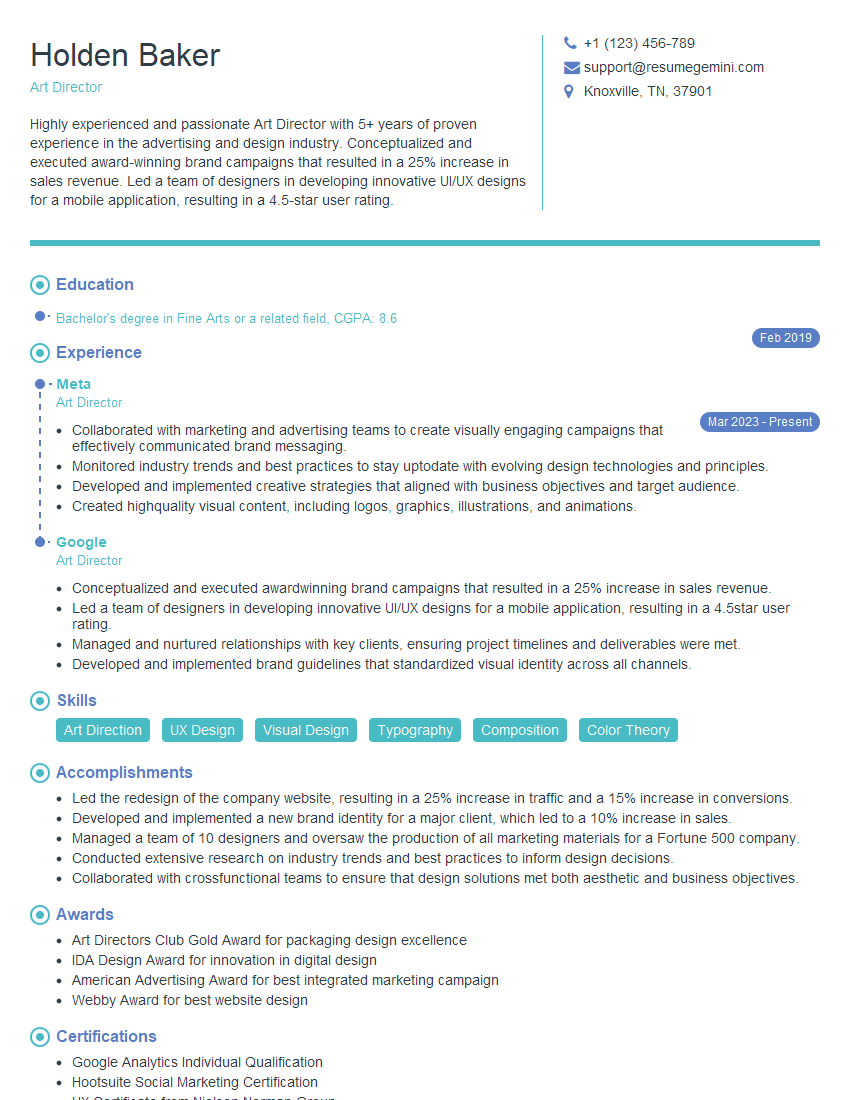
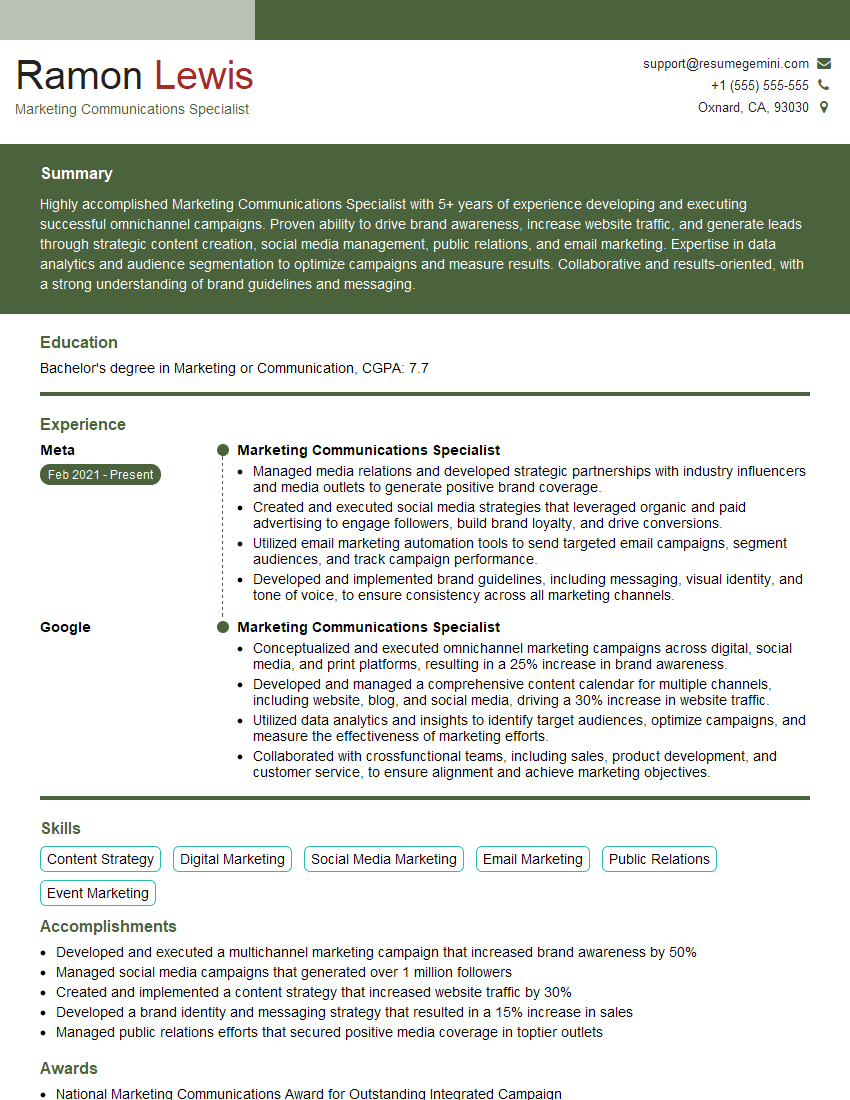
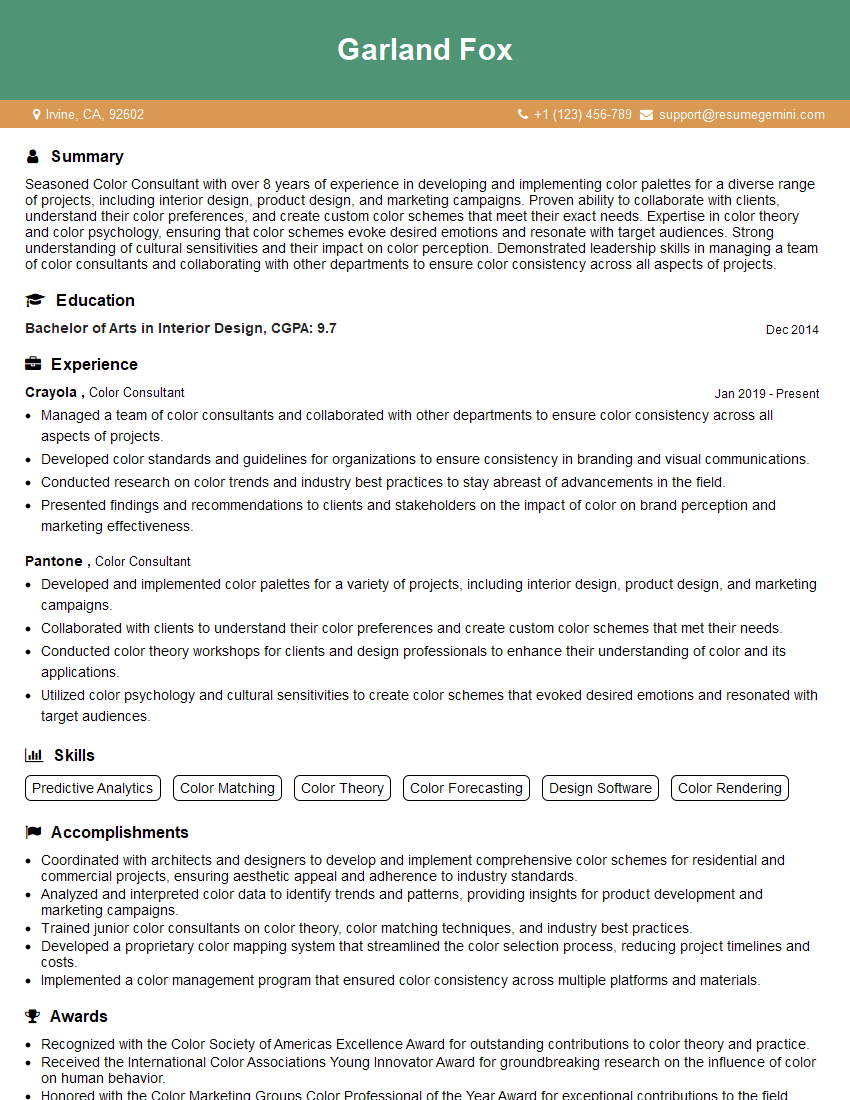
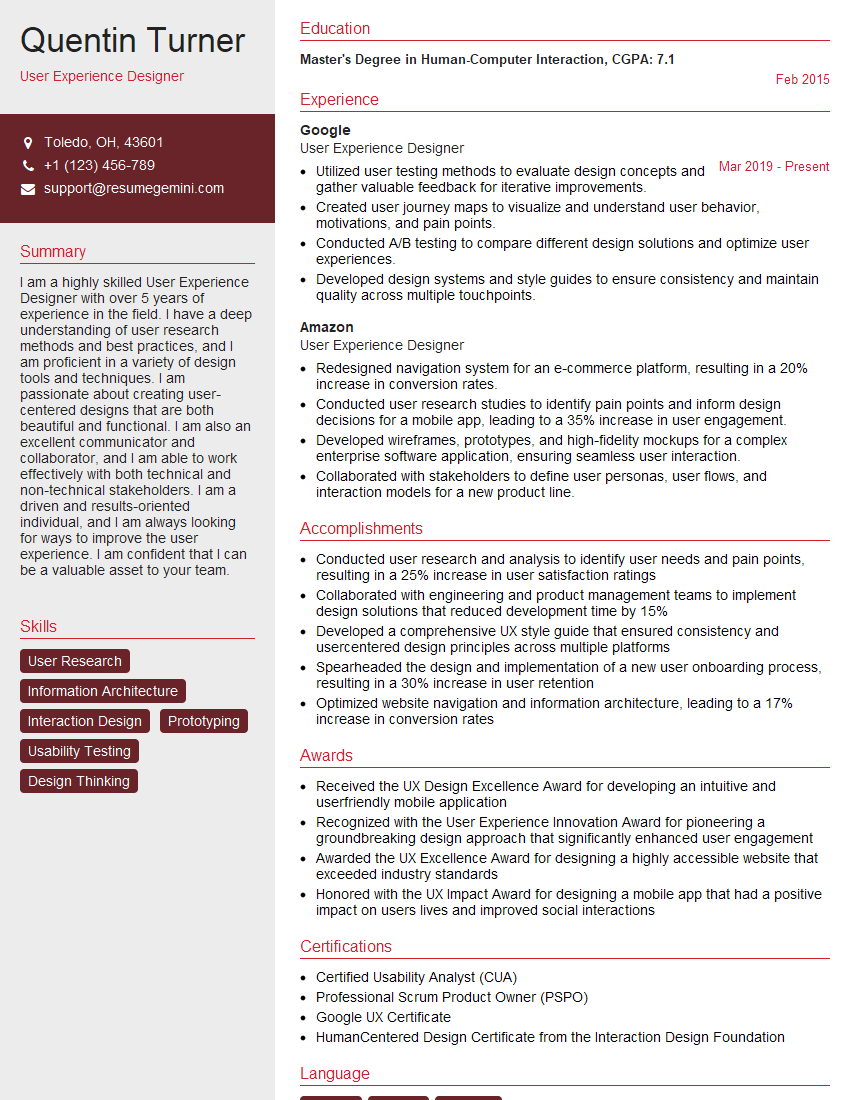
Mastering Color Theory and Psychology is crucial for career advancement in various creative fields. A strong understanding of these principles allows you to create impactful and engaging designs, making you a highly sought-after candidate. To significantly improve your job prospects, it’s vital to create an ATS-friendly resume that highlights your skills and experience effectively. ResumeGemini is a trusted resource that can help you build a professional and impactful resume tailored to the specific requirements of your target roles. Examples of resumes tailored to Color Theory and Psychology are provided to guide you in this process.


Explore more articles
Users Rating of Our Blogs
Share Your Experience
We value your feedback! Please rate our content and share your thoughts (optional).
What Readers Say About Our Blog
Very informative content, great job.
good