The thought of an interview can be nerve-wracking, but the right preparation can make all the difference. Explore this comprehensive guide to Color Trend Analysis and Forecasting interview questions and gain the confidence you need to showcase your abilities and secure the role.
Questions Asked in Color Trend Analysis and Forecasting Interview
Q 1. Explain the process of identifying emerging color trends.
Identifying emerging color trends is a multifaceted process that blends data analysis with intuitive understanding of cultural shifts. It’s like being a detective, piecing together clues to predict the next big thing. We start by scouring a vast array of sources.
- Runway Shows: Observing the colors used in high-fashion runway shows provides a glimpse into the future aspirations of designers.
- Trade Shows and Exhibitions: Events like Heimtextil (textiles) and Maison et Objet (home decor) showcase upcoming color palettes from manufacturers and brands.
- Social Media Analysis: We use tools to track trending hashtags, color usage in user-generated content, and popular filters to gauge consumer preferences.
- Retail Analysis: Examining what colors are selling well in different market segments gives crucial insights into current consumer demand. This involves studying sales data, inventory levels, and consumer reviews.
- Color Forecasting Agencies: We collaborate with reputable agencies like Pantone, predicting future trends based on their extensive research and data.
This data is then analyzed to identify recurring colors, color families, and overall color directions. For example, a surge in earthy tones across multiple sectors might signal a move towards nature-inspired palettes.
Q 2. How do you analyze color palettes from past seasons to predict future trends?
Analyzing past seasons’ color palettes is akin to studying historical trends to predict the future. We don’t simply look at which colors were popular; we delve into the why behind their success or failure.
- Color Family Analysis: We group colors into families (e.g., analogous, complementary) to understand their relationships and how they evolve over time. Did cool tones dominate one year, only to be replaced by warm tones the next? This reveals cyclical patterns.
- Saturation and Value Shifts: We track changes in the saturation (intensity) and value (lightness/darkness) of dominant colors. A shift from highly saturated to muted tones could indicate a change in consumer mood.
- Contextual Analysis: We consider the socio-cultural context of each season. A color’s popularity might be tied to specific events or trends. For example, a preference for bright, optimistic colors might correlate with periods of economic growth.
By combining quantitative data (e.g., sales figures) with qualitative observations (e.g., social media sentiment), we can identify patterns and predict how these color families might evolve in future seasons. For instance, if a muted green was successful, we might predict a rise in darker, more saturated greens in subsequent seasons.
Q 3. Describe your experience using color trend forecasting software or tools.
I have extensive experience using various color trend forecasting software and tools, including Pantone Connect and Adobe Color. These tools allow for efficient color palette creation, analysis, and management.
Pantone Connect, for example, provides access to a comprehensive color library, enabling us to easily explore different color schemes and their historical context. We can digitally create and analyze color palettes, ensuring consistency across different platforms and projects. Adobe Color allows us to explore color harmonies and extract color schemes from images, making the process of identifying key color trends from diverse sources very efficient.
These software platforms allow for efficient color communication across design teams. This ensures everyone is aligned on the color story, which is particularly valuable in collaborative projects spanning multiple designers and departments.
Q 4. How do you incorporate consumer insights into your color trend forecasting?
Incorporating consumer insights is crucial for accurate color trend forecasting; it’s about understanding the ‘pulse’ of the market. We utilize several strategies:
- Surveys and Focus Groups: We conduct surveys and focus groups to directly gather consumer feedback on color preferences, associations, and emotional responses to various hues.
- Social Media Listening: We analyze social media conversations, hashtags, and user-generated content to understand emerging trends and consumer sentiment regarding specific colors.
- Market Research Reports: We consult market research reports that examine consumer behavior, purchasing patterns, and lifestyle trends to identify correlations between color preferences and broader societal shifts.
- Data Analytics: We use data analytics tools to analyze sales data, website traffic, and other relevant data to understand consumer demand for products featuring specific colors.
For example, if social media reveals a growing interest in sustainable practices, we might anticipate a rise in the popularity of earthy and natural-looking colors.
Q 5. What are some key indicators you look for when identifying a potential color trend?
Identifying a potential color trend involves recognizing several key indicators:
- Frequency of Appearance: The color’s recurring appearance across different sectors (fashion, interiors, automotive) suggests widespread appeal.
- Cross-Cultural Adoption: If a color gains popularity across different cultures and geographic regions, it likely reflects a broader trend.
- Association with Key Trends: Does the color align with current socio-cultural trends, such as a focus on sustainability or technological advancements? For example, muted greens might align with an eco-conscious trend.
- Influence of Influencers: Are prominent designers, celebrities, or social media influencers embracing the color?
- Visual Appeal and Emotional Impact: A color’s aesthetic appeal and its ability to evoke specific emotions (e.g., calmness, energy) contribute to its potential for widespread adoption.
For instance, the consistent appearance of a particular shade of blue in multiple fashion collections and home decor magazines, coupled with positive consumer feedback, might signal an upcoming color trend.
Q 6. How do cultural and societal influences impact color trends?
Cultural and societal influences profoundly shape color trends. They act as the underlying current that dictates the flow of color preferences. Think of it as a powerful undertow in the ocean of style.
- Cultural Symbolism: Colors carry different meanings across cultures. For instance, red symbolizes good fortune in some cultures but might be associated with mourning in others. Trend forecasters must carefully consider these cultural nuances.
- Societal Events and Movements: Major historical events, social movements, and technological advancements can significantly influence color preferences. For example, periods of economic uncertainty might lead to a preference for muted and understated colors.
- Technological Advancements: New technologies can impact color trends by enabling the creation of novel colors or finishes. For example, advances in textile technology allowed for the production of brighter and more vibrant colors.
- Environmental Concerns: Growing awareness of environmental issues has led to a surge in popularity of colors associated with nature, such as earthy tones and greens.
For example, the rise of minimalist design aesthetics has led to an increased preference for neutral and monochromatic color palettes.
Q 7. Explain the difference between macro and micro trends in color.
Macro and micro trends in color represent different scales of influence and longevity:
- Macro Trends: These are large-scale, long-term shifts in color preferences that affect multiple industries and last for several years. They represent broader societal or cultural shifts. Think of the overall shift from bold, bright colors in the early 2000s towards more muted and natural tones in recent years.
- Micro Trends: These are smaller, shorter-term trends that are often niche or specific to a particular industry or consumer group. They might emerge and fade within a single season. For example, a particular shade of pink might become popular within a specific subculture of fashion enthusiasts for a limited time.
Understanding both macro and micro trends is crucial for a comprehensive approach to color forecasting. Macro trends provide the overall direction, while micro trends offer valuable insights into specific market segments and emerging subcultures.
Q 8. How do you present your color trend predictions to clients or stakeholders?
Presenting color trend predictions involves more than just stating colors; it’s about telling a compelling story. I begin by understanding the client’s specific needs – are they a fashion house needing palettes for a new collection, a home décor company seeking inspiration for their next line, or a tech firm looking for brand-consistent hues? My presentation is tailored accordingly.
I usually start with a mood board showcasing the key colors, supplemented by trend reports, imagery from relevant sources (runways, art installations, nature), and even fabric swatches or paint chips for tactile engagement. I then explain the rationale behind each color selection, referencing supporting data like social media trends, market research, and cultural influences. For example, if I predict a rise in earthy tones, I’ll justify it by showing the growing interest in sustainability and the shift toward natural living as reflected in online searches and consumer surveys. Finally, I present the predictions in a structured format—perhaps a visual calendar showcasing color evolution throughout the year or a palette library easily adaptable to different applications. This holistic approach ensures the client not only understands the *what* but also the *why*, strengthening the credibility and utility of the forecast.
Q 9. Describe your understanding of color psychology and its application in forecasting.
Color psychology is crucial for accurate forecasting. It’s the study of how colors affect human behavior, emotions, and perceptions. Understanding this helps me predict which colors will resonate with consumers and influence trends. For example, blues often evoke feelings of calm and trust, making them popular for corporate brands aiming for stability. Conversely, vibrant yellows and oranges can convey energy and excitement, ideal for brands targeting a younger demographic. My forecasting process integrates color psychology by analyzing current social and cultural shifts. If there’s a rise in anxiety, I might predict a surge in calming colors like muted greens and blues. If optimism is prevalent, brighter shades might dominate.
I employ various tools, including questionnaires and focus groups to gauge public emotional response to colors, alongside analyzing existing market trends and competitor’s palettes to understand the existing color landscape. This helps me anticipate potential shifts and predict emerging trends based not only on aesthetics but also on the psychological impact of color choices.
Q 10. How do you incorporate Pantone color systems into your work?
The Pantone Color System is an indispensable tool in my work. It provides a universal language for color communication, ensuring consistent color reproduction across different mediums. I use Pantone color references throughout my forecasting process, from initial color inspiration to final client presentations. For instance, if I identify a key color trend as ‘dusty rose,’ I’ll specify it using its exact Pantone code (e.g., 16-1349 TPX), avoiding ambiguity. This precision is essential for accurate replication by designers, manufacturers, and marketers. Pantone’s yearly color reports are a valuable resource, providing insights into emerging trends and helping me refine my own predictions. Furthermore, analyzing Pantone’s color choices in past years and their correlation to concurrent cultural and societal changes informs my understanding of the historical and predictive patterns in color trends.
Q 11. What methods do you use to validate your color trend forecasts?
Validating my forecasts involves a multi-faceted approach. I don’t rely solely on intuition; I back it up with data. I use several methods: Firstly, quantitative analysis involves tracking online searches for specific color terms, analyzing sales data of products using particular colors, and monitoring social media sentiment around those colors. Secondly, qualitative research incorporates focus groups and surveys to gauge consumer opinions and preferences for color palettes. Thirdly, I actively monitor industry publications, runway shows, art exhibitions, and design awards to gauge the adoption rate of my predicted colors in the real world. This triangulation of data – quantitative, qualitative, and observational – provides a robust validation framework, ensuring my predictions are grounded in reality.
Q 12. How do you anticipate potential challenges in your color trend predictions?
Predicting color trends is inherently challenging because of the unpredictable nature of consumer preferences and global events. One significant challenge is the impact of unforeseen circumstances like economic downturns or global crises. These events can dramatically shift consumer behavior, influencing color preferences toward more practical or emotionally resonant hues. Another challenge is the speed and influence of social media. Viral trends can quickly elevate or diminish a color’s popularity, making accurate long-term predictions difficult. To mitigate these risks, I incorporate flexibility into my forecasts, offering a range of likely scenarios and incorporating contingency plans to adapt my predictions if unforeseen circumstances arise. Continuous monitoring and data analysis are critical for timely adjustments to my forecasts.
Q 13. Describe your experience with color specification and communication (e.g., Pantone, CMYK).
I possess extensive experience with color specification and communication across various systems. Pantone, as discussed, is paramount, but I also work fluently with CMYK (Cyan, Magenta, Yellow, Key/Black) for print applications and RGB (Red, Green, Blue) for digital media. Understanding the nuances and limitations of each system is critical. For instance, a Pantone color may not have an exact CMYK equivalent due to limitations in print processes. My expertise allows me to bridge this gap, suggesting the closest possible match while communicating potential discrepancies to clients. I also leverage software like Adobe Illustrator and Photoshop to accurately reproduce and manipulate colors across various color spaces. This ensures consistency and avoids costly mismatches during the production process. My approach involves clearly specifying color codes and providing detailed instructions and examples, minimizing the risk of misinterpretations and production errors.
Q 14. How do you stay updated on the latest color trends?
Staying updated on color trends is a continuous process that demands proactive engagement. I actively monitor several key sources: Trade publications such as WGSN and TrendWatching offer comprehensive trend reports and analyses. I regularly attend industry events, such as fashion weeks and design fairs, to gain firsthand insight into emerging trends. I follow key influencers and brands on social media platforms like Instagram and Pinterest to track color usage and consumer reception. Moreover, I conduct regular online searches and analyze website analytics to identify rising color preferences and their association with specific products, demographics, and trends. Finally, I subscribe to color trend forecasting services from reputable sources, supplementing my independent research with their expert insights. This multi-pronged approach ensures a comprehensive and current understanding of the evolving color landscape.
Q 15. What are some examples of unsuccessful color forecasts and what lessons were learned?
Unsuccessful color forecasts often stem from a disconnect between trend analysis and market realities. For example, a forecast heavily emphasizing a specific shade of green might fail if consumers simultaneously show a preference for warmer tones. Another instance could be predicting a niche trend that doesn’t gain sufficient traction within the target market. In one project, we predicted a surge in deep burgundy for fall fashion, but the actual market preferred muted earth tones. The key takeaway was to diversify our research methods, incorporating not only runway shows and social media analysis but also direct consumer feedback and sales data. This helped us refine our approach to better gauge true consumer sentiment.
Lessons learned from such instances emphasize the importance of:
- Diversified Data Sources: Relying on multiple sources provides a more holistic view.
- Consumer Feedback: Direct interaction with the target audience is crucial.
- Market Analysis: Understanding economic factors and broader societal influences.
- Agility and Adaptation: A willingness to adjust the forecast based on emerging data is paramount.
Career Expert Tips:
- Ace those interviews! Prepare effectively by reviewing the Top 50 Most Common Interview Questions on ResumeGemini.
- Navigate your job search with confidence! Explore a wide range of Career Tips on ResumeGemini. Learn about common challenges and recommendations to overcome them.
- Craft the perfect resume! Master the Art of Resume Writing with ResumeGemini’s guide. Showcase your unique qualifications and achievements effectively.
- Don’t miss out on holiday savings! Build your dream resume with ResumeGemini’s ATS optimized templates.
Q 16. Explain the relationship between color trends and consumer purchasing behavior.
Color trends significantly influence consumer purchasing behavior. Colors evoke emotions and associations, directly impacting brand perception and product appeal. Think of the calming effect of blue in a spa setting versus the energy associated with a bright yellow in a children’s toy. This psychological impact translates into purchasing decisions. Consumers are more likely to buy products whose colors resonate with their personal style, current mood, or perceived brand image. For instance, a clothing retailer might see a spike in sales of clothing items in a trending color, even if the style remains consistent. Similarly, a home goods company can leverage the power of seasonal color trends to refresh their product lines, thereby attracting new customers and bolstering sales.
We often use color psychology models and market research to understand these correlations. For instance, if a color is associated with luxury (like deep emerald green), incorporating it in a product line can justify a premium price point.
Q 17. How do you collaborate with cross-functional teams during the color trend development process?
Collaboration is the cornerstone of successful color trend development. My process involves close interaction with various teams, including:
- Marketing: Understanding the brand’s positioning and target audience is key. Marketing teams provide insights into consumer preferences and branding strategies.
- Product Development: Translating color trends into tangible product designs is crucial. This requires close collaboration to ensure feasibility and aesthetic alignment.
- Sales: Sales data provides valuable feedback, allowing us to assess the market’s actual response to the forecasted colors.
- Supply Chain: This team ensures that the selected colors are feasible to produce, considering factors like dye availability and manufacturing costs.
We employ regular meetings, shared documents, and collaborative design tools to maintain clear communication and ensure everyone is aligned with the direction of the color forecast.
Q 18. Describe a situation where you had to adapt your color forecast due to changing market conditions.
During a project for a home furnishings company, our initial forecast emphasized bold jewel tones for the upcoming season. However, midway through the development process, we observed a significant shift in consumer behavior towards more sustainable and natural aesthetics. Sales data reflected a decrease in demand for vibrant colors and a concurrent increase in muted earth tones. We quickly adapted our forecast by incorporating more muted greens, browns, and creams, while reducing the emphasis on the initially predicted jewel tones. This involved close collaboration with the product development team to revise existing designs and introduce new items reflecting the revised palette. The adaptation required flexibility and quick decision-making, but it ultimately ensured the forecast remained relevant and commercially viable. The result was a successful collection that aligned with the evolving market preferences.
Q 19. How do you measure the success of a color trend forecast?
Measuring the success of a color forecast goes beyond simply observing whether the predicted colors appear in the market. We utilize a multi-faceted approach:
- Sales Data Analysis: Tracking sales figures of products featuring the forecasted colors.
- Market Share: Analyzing our client’s market share against competitors.
- Consumer Feedback: Monitoring reviews, social media engagement and survey data to gauge consumer perception.
- Industry Recognition: Assessing media coverage and recognition of our forecasts within the industry.
- Lead Time Reduction: Analyzing the efficiency in product development achieved by early color selection.
By combining quantitative and qualitative data, we gain a comprehensive understanding of the forecast’s effectiveness and identify areas for improvement.
Q 20. What is your experience with trend forecasting methodologies?
My experience encompasses a variety of trend forecasting methodologies. I utilize both quantitative and qualitative approaches. Quantitative methods include:
- Data Mining: Analyzing large datasets from sources like social media, e-commerce platforms, and fashion shows.
- Statistical Analysis: Identifying patterns and trends in color usage across various industries.
Qualitative methods include:
- Trend Reports and Publications: Analyzing reports from industry experts and trend forecasting agencies.
- Expert Interviews: Gathering insights from designers, stylists, and other industry professionals.
- Consumer Research: Conducting surveys, focus groups, and interviews to understand consumer preferences.
I often combine these methods, creating a holistic approach that integrates both data-driven insights and expert judgment.
Q 21. Describe your familiarity with different color systems (e.g., RGB, LAB).
I am proficient in various color systems, understanding their strengths and limitations.
- RGB (Red, Green, Blue): An additive color model used for screen displays.
RGB(255, 0, 0)represents pure red. This model is essential for digital design and online applications. - LAB (L*a*b*): A device-independent color space that describes color in terms of lightness (L*), red-green (a*), and blue-yellow (b*).
L*a*b*(50, 20, -30)represents a specific color, regardless of the device used for display. LAB is crucial for ensuring color consistency across different mediums and devices. This is particularly relevant for print design and manufacturing where accurate color reproduction is vital. - CMYK (Cyan, Magenta, Yellow, Key/Black): A subtractive color model used for printing. It’s crucial to understand the differences between additive (RGB) and subtractive (CMYK) systems to avoid color discrepancies when translating digital designs to print.
Understanding these color systems allows for accurate color communication and facilitates seamless collaboration across different teams and technologies.
Q 22. How would you explain complex color theory concepts to a non-technical audience?
Color theory can seem daunting, but at its core, it’s about understanding how colors interact and affect our perception. Think of it like a painter’s palette: you have primary colors (red, yellow, blue) that can be mixed to create secondary colors (green, orange, purple), and then tertiary colors through further mixing. Beyond that, we have concepts like:
Hue: This is the pure color – think the name of the color, like ‘red’ or ‘blue’.
Saturation: This refers to the intensity or purity of a color. A highly saturated color is vibrant, while a less saturated color is muted or dull.
Value/Brightness: This is how light or dark a color is. A high-value color is light, while a low-value color is dark.
Color Temperature: Colors can be ‘warm’ (reds, oranges, yellows) or ‘cool’ (blues, greens, purples). This impacts the feeling a color evokes – warm colors often feel energetic and inviting, while cool colors can feel calm and serene.
Color Harmonies: Certain color combinations create visually pleasing effects. Examples include complementary colors (opposite each other on the color wheel), analogous colors (next to each other on the color wheel), and triadic colors (equally spaced on the color wheel).
For example, imagine designing a website. Using complementary colors like blue and orange can create a visually striking contrast, while using analogous colors like blues and greens might evoke a sense of calmness and tranquility.
Q 23. How do you incorporate sustainability considerations into your color selections?
Sustainability is paramount in my color selections. I consider the entire lifecycle of a product, from material sourcing to disposal. This involves:
Eco-friendly pigments: Opting for pigments made from recycled materials or natural sources reduces environmental impact. I research and specify pigments with lower toxicity and better biodegradability.
Reduced energy consumption: Certain color choices might require less energy during the manufacturing process. For example, lighter colors often need less dye, reducing the energy used in production.
Durable colors: Choosing colors that resist fading reduces the need for frequent re-application or replacement, minimizing waste and extending product lifespan. I would consider factors like UV resistance and colorfastness.
Recyclable materials: I collaborate with manufacturers to select packaging and materials that are easily recyclable, minimizing landfill waste.
For instance, when working on a textile project, I prioritize organic cotton and dyes that meet GOTS (Global Organic Textile Standard) certification. This ensures the sustainability of the entire process, from fiber to final product.
Q 24. Describe your experience in analyzing competitor color palettes.
Analyzing competitor color palettes is a crucial part of my work. I use a systematic approach:
Identify key competitors: I start by defining the target market and identifying the main competitors in that space.
Gather data: I collect visual data – images of their products, packaging, and marketing materials – to analyze their color choices. I might use image analysis software to extract precise color codes (e.g., Pantone, Hex).
Categorize and interpret: I categorize the colors by hue, saturation, value, and temperature. This helps me understand the overall aesthetic and messaging. I also consider the cultural context and target audience.
Identify trends and gaps: By comparing competitor palettes, I can identify emerging trends and areas where there are opportunities for differentiation. For example, I might see a gap in the market for a more sustainable or innovative color palette.
For example, recently I analyzed the color palettes of several skincare brands. I identified a trend towards earth tones and muted pastels but a gap in bold, vibrant colors that could appeal to a younger demographic.
Q 25. How familiar are you with different market segments and their respective color preferences?
Understanding market segments and their color preferences is vital. My knowledge spans various sectors, including:
Fashion: Different age groups, styles (e.g., streetwear, luxury), and seasons have distinct color preferences. Younger generations might favor vibrant and experimental colors, while older demographics may prefer more classic and sophisticated shades.
Home Décor: Color preferences vary depending on the style (e.g., minimalist, bohemian, traditional) and cultural context. Scandinavian design often features light neutrals, while traditional styles might use richer, bolder colors.
Food and Beverage: Colors play a critical role in branding and consumer perception. Certain colors are associated with specific flavors or emotions – red might signal excitement, while green suggests freshness.
Automotive: Color preferences in the automotive industry shift over time and are influenced by geographic location and cultural trends. Certain colors might project luxury or sportiness.
My approach involves market research, analyzing sales data, and understanding cultural nuances to tailor color selections for specific target audiences.
Q 26. What are the ethical implications of color trends and forecasting?
The ethical implications of color trends and forecasting are significant. We must consider:
Cultural appropriation: Using colors associated with specific cultures without understanding or respecting their significance can be highly offensive.
Environmental impact: The production of certain pigments and dyes can have a negative environmental impact, so choosing sustainable alternatives is crucial.
Accessibility: Color choices should consider accessibility for individuals with visual impairments. Adequate contrast and careful color selection are essential for inclusivity.
Transparency and traceability: Knowing the origin of pigments and dyes and ensuring fair labor practices in their production is essential.
By prioritizing ethical sourcing, promoting inclusivity, and considering environmental responsibility, we can minimize the negative impact of color trends and ensure they benefit society as a whole.
Q 27. How do you address potential biases in color trend analysis?
Addressing potential biases in color trend analysis requires a conscious and critical approach:
Diverse data sources: I strive to use a wide range of data sources – not just Western-centric sources – to avoid perpetuating biases.
Critical self-reflection: I am aware of my own biases and actively work to mitigate their influence on my analysis. This involves seeking feedback from diverse perspectives.
Blind testing: In some cases, I conduct blind testing, where participants are not aware of the context or source of the colors, to eliminate preconceived notions.
Quantitative and qualitative data: I combine quantitative data (e.g., sales figures, color usage statistics) with qualitative data (e.g., consumer interviews, focus groups) to create a more nuanced understanding.
This multi-faceted approach helps ensure that my color trend analysis is representative and avoids perpetuating harmful stereotypes or biases.
Q 28. Describe a time you had to manage conflicting opinions on color choices.
In a recent project for a new clothing line, the design team had strongly conflicting opinions on the key color palette. Some favored a bold, vibrant palette, while others preferred a more muted, earthy range. I addressed this by:
Facilitating open discussion: I created a safe space for each team member to express their ideas and reasoning. I encouraged active listening and empathy.
Presenting data and research: I presented market research data on color trends and consumer preferences, to inform the decision-making process. This helped ground the discussion in objective evidence.
Compromise and collaboration: We explored alternative options, blending elements of both proposed palettes. This resulted in a final palette that incorporated both vibrancy and earth tones, satisfying most stakeholders.
Visual mock-ups: Creating visual mock-ups of the clothing items using each color palette allowed the team to see the tangible impact of the color choices, making the decision process more concrete and collaborative.
This situation highlighted the importance of effective communication, collaboration, and data-driven decision-making in managing conflicting viewpoints.
Key Topics to Learn for Color Trend Analysis and Forecasting Interview
- Color Theory Fundamentals: Understanding the color wheel, color harmonies (complementary, analogous, etc.), and the psychological impact of color.
- Trend Identification & Research Methods: Analyzing current and past color trends across various industries (fashion, design, interiors) through market research, social media analysis, and competitor observation. This includes understanding tools and techniques for data collection and interpretation.
- Forecasting Techniques: Developing predictive models for future color trends using qualitative and quantitative data analysis. This includes understanding different forecasting methodologies and their applications.
- Presentation & Communication of Findings: Clearly articulating your color trend analysis and forecast through compelling presentations, reports, and visual aids to diverse audiences.
- Software Proficiency: Demonstrating familiarity with relevant software for color analysis, image editing, and presentation design (e.g., Adobe Creative Suite).
- Case Studies & Practical Application: Analyzing real-world examples of successful color trend forecasting and identifying the strategies employed.
- Problem-Solving & Critical Thinking: Demonstrating the ability to analyze complex data, identify potential challenges, and propose innovative solutions related to color trends.
- Sustainability and Ethical Considerations: Understanding the environmental and social implications of color choices in design and production.
Next Steps
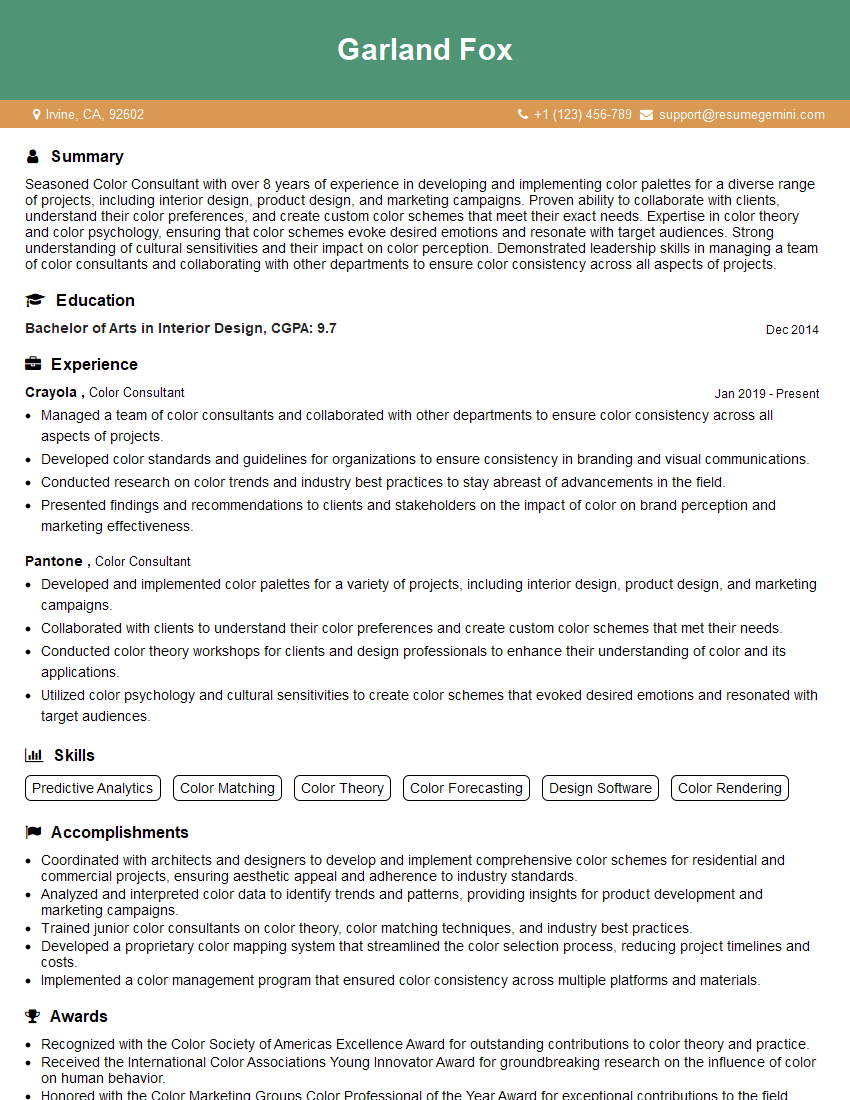
Mastering Color Trend Analysis and Forecasting opens doors to exciting and rewarding careers in various creative industries. A strong understanding of these concepts will significantly enhance your job prospects and allow you to contribute meaningfully to innovative design projects. To maximize your chances of securing your dream role, creating an ATS-friendly resume is crucial. This ensures your application stands out and gets noticed by recruiters. We highly recommend using ResumeGemini to build a professional and impactful resume that highlights your skills and experience effectively. ResumeGemini provides examples of resumes tailored specifically to Color Trend Analysis and Forecasting roles, offering valuable guidance in crafting your application materials.
Explore more articles
Users Rating of Our Blogs
Share Your Experience
We value your feedback! Please rate our content and share your thoughts (optional).
What Readers Say About Our Blog
Very informative content, great job.
good