Preparation is the key to success in any interview. In this post, we’ll explore crucial Combat Marksmanship interview questions and equip you with strategies to craft impactful answers. Whether you’re a beginner or a pro, these tips will elevate your preparation.
Questions Asked in Combat Marksmanship Interview
Q 1. Describe the fundamentals of marksmanship.
Marksmanship fundamentals are the building blocks of accurate shooting. It’s not just about pulling the trigger; it’s a holistic process involving weapon manipulation, body mechanics, and mental discipline. Think of it like a finely tuned machine – each part needs to function perfectly for optimal performance.
- Proper Stance and Grip: A stable platform and a consistent grip are essential for repeatable accuracy. Imagine trying to hit a target while standing on a wobbly stool – it’s nearly impossible. A firm, yet relaxed grip, allows for control and reduces flinching.
- Sight Alignment and Sight Picture: This is about getting your eye, front sight, and rear sight perfectly aligned. This creates a clear and precise sight picture. Picture a perfectly aligned triangle; this needs to be consistent each shot.
- Trigger Control: This is the art of smoothly pressing the trigger without disturbing the sight alignment. A jerky trigger pull will ruin your shot, similar to trying to thread a needle with a shaky hand. A smooth and deliberate press is key.
- Breath Control: Controlling your breathing helps stabilize your body and reduces movement during the shot. Think of it like holding your breath while aiming a bow and arrow – it’s all about steadiness.
- Follow Through: Maintaining proper sight alignment and grip until the shot breaks is crucial. It ensures consistency and prevents anticipation.
Mastering these fundamentals is the foundation for developing advanced marksmanship skills.
Q 2. Explain the different types of aiming systems.
Aiming systems are the methods used to align the weapon with the target. Different systems suit various situations and weapon types. The most common are:
- Iron Sights: These are the simplest, consisting of a front and rear sight integrated into the weapon. They rely on the shooter’s eye to align the sights with the target – robust and reliable, but limited in precision at long ranges. Imagine using the basic sights on a rifle – the clearer the sight picture, the better the shot.
- Optical Sights (Scopes): Scopes magnify the target and provide a clearer sight picture, drastically improving accuracy at longer ranges. These offer different magnification levels, reticles, and features. Think of using a telescope to zoom into the target – the clarity allows for precise aiming.
- Red Dot Sights: These project a small red dot onto the target, simplifying target acquisition and making them ideal for close-quarters combat and fast-moving targets. They require less precision for aiming in comparison to iron sights.
- Holographic Sights: Similar to red dot sights, but using a holographic projector for the aiming reticle. Offering increased durability and better performance in low-light conditions.
The choice of aiming system depends on factors such as the shooting distance, the type of weapon, and the shooter’s preferences and skill level.
Q 3. What are the key elements of a proper firing grip?
A proper firing grip is crucial for accuracy and control. It’s about establishing a consistent and repeatable hand position on the weapon that minimizes movement and maximizes stability. Think of it like shaking hands firmly, but not too tight.
- High on the Grip: The grip should be high on the pistol’s grip, allowing for better control of recoil.
- Firm but Relaxed: The grip should be firm enough to control the weapon but relaxed enough to avoid tension.
- Consistent Placement: Every shot should feel the same, with your hands in the exact same position for repeatability.
- Natural Point of Aim: The grip should allow you to naturally point the weapon at the target with minimal adjustments.
- Avoid Anticipation: Do not squeeze the gun too tightly when anticipating the recoil. A firm but relaxed grip is key.
Proper grip minimizes recoil, improves accuracy, and reduces fatigue during extended shooting sessions.
Q 4. How do environmental factors impact accuracy?
Environmental factors significantly impact accuracy. These external influences must be accounted for to maintain precision. Imagine shooting in a blizzard versus a calm summer day – the difference is significant.
- Wind: Wind deflects projectiles, especially at longer ranges. A strong headwind will push the bullet lower and potentially to the left or right depending on direction, range, and projectile weight.
- Temperature: Temperature affects the velocity and trajectory of projectiles. Extreme heat or cold can alter the performance of ammunition.
- Humidity: High humidity can affect the accuracy by increasing air resistance.
- Light: Poor visibility, such as low light or glare, will make it challenging to acquire and maintain the target.
- Altitude: Air density decreases with altitude, affecting projectile trajectory. The thinner the air the farther the bullet will travel, often resulting in high trajectory.
Experienced marksmen compensate for these factors through training, observation, and the use of ballistic calculators or range finders.
Q 5. Explain the concept of zeroing a weapon.
Zeroing a weapon is the process of adjusting the sights to ensure that the point of impact of the projectile matches the point of aim at a specific distance. This is essential to know the accuracy of your projectile at specific distances. This is similar to calibrating a scale – you need to know the accuracy for it to function reliably.
The process typically involves firing several shots at a known distance, observing the point of impact, and then adjusting the sights (either windage or elevation) to bring the point of impact closer to the center of the target. This is usually repeated until the point of impact is consistently hitting where the sights are aimed.
Zeroing is essential for consistent accuracy and is done at a specific range, typically 25 or 100 yards, depending on the firearm. The zeroing process will differ depending on the type of sight being used on the firearm.
Q 6. Describe various shooting positions and their advantages/disadvantages.
Shooting positions affect stability and accuracy. Each position has advantages and disadvantages depending on the situation. Think of them as different tools for different jobs.
- Standing: Least stable but most versatile, offering quick target acquisition. Disadvantages include susceptibility to sway and recoil.
- Kneeling: More stable than standing, offering a good balance of stability and speed. Disadvantage is that it might be slower than standing.
- Sitting: Provides more stability than standing or kneeling, especially on uneven ground. This position can be more cumbersome.
- Prone: Most stable position, ideal for long-range shooting. It requires more time to setup and is more difficult to transition into than the other positions.
- Supported (e.g., using a rest): Offers the highest stability and accuracy, especially beneficial at long ranges. This is the most time consuming setup.
The optimal position depends on the shooting situation, available time, and the shooter’s capabilities.
Q 7. Discuss the importance of breath control in marksmanship.
Breath control is crucial for accuracy because it minimizes movement during the shot. Imagine trying to hit a small target while coughing – it’s nearly impossible. Consistent breathing allows for stable body position and smooth trigger pull.
The best method is to take a natural breath, exhale partially, and hold your breath at a comfortable point during the shot. Avoid holding your breath too long, which can cause muscle tension and affect aim. After the shot, resume normal breathing.
Proper breath control helps eliminate the movement caused by natural respiratory function, making it an essential component of consistent marksmanship.
Q 8. Explain different types of ammunition and their applications.
Ammunition selection is crucial for effective combat marksmanship. Different cartridges are designed for specific purposes, impacting accuracy, range, and lethality. Let’s examine some common types:
- Full Metal Jacket (FMJ): This common round features a lead core encased in a metal jacket. It’s designed for penetration and is often used in military applications due to its consistent performance and relatively low cost. However, its limited expansion reduces its stopping power compared to other rounds. Think of it like a precise, hard-hitting punch.
- Hollow Point (HP): A hollow cavity in the bullet’s tip causes it to expand upon impact, increasing its stopping power. This makes it suitable for law enforcement and self-defense scenarios where immediate incapacitation is paramount. This is like a forceful blow that spreads its energy more widely.
- Soft Point (SP): Similar to hollow points but with a softer, exposed lead tip. It offers a balance between penetration and expansion. Think of it as a happy medium between FMJ and HP.
- Armor-Piercing (AP): These rounds are designed to penetrate armor and are often restricted for civilian use. They pose significant safety risks due to their increased penetration capabilities.
The choice of ammunition depends heavily on the mission. For target practice, FMJ is often preferred due to cost-effectiveness and consistent performance. For self-defense, HP rounds are generally favored for their stopping power. Choosing the wrong ammunition can severely impact your effectiveness and potentially endanger yourself and others.
Q 9. What are the safety rules for handling firearms?
Firearm safety is paramount. Negligence can have devastating consequences. The four fundamental rules of firearm safety are:
- Treat every firearm as if it were loaded: Always assume a firearm is loaded, regardless of what you’ve been told. This prevents accidental discharges due to complacency.
- Never point a firearm at anything you are not willing to destroy: This seemingly obvious rule prevents accidental injury or damage. Maintain control of the firearm’s muzzle direction at all times.
- Keep your finger off the trigger until your sights are on the target and you have made the decision to shoot: This prevents accidental discharges caused by trigger manipulation.
- Be sure of your target and what is beyond it: This emphasizes target identification and risk assessment. Understand the potential consequences of a missed shot.
Beyond these four rules, always practice safe storage, maintain your firearm meticulously, and never consume alcohol or drugs before handling a firearm. Remember, firearm safety is a continuous process of vigilance and responsible behavior.
Q 10. How do you diagnose and troubleshoot malfunctions in various weapon systems?
Diagnosing and troubleshooting malfunctions requires a methodical approach. The first step is to understand the weapon’s operating mechanism. Malfunctions can be broadly categorized as:
- Failure to Feed: The next round doesn’t chamber correctly.
- Failure to Fire: The firearm fails to detonate the round.
- Failure to Eject: The spent cartridge case doesn’t eject properly.
- Double Feed: Two rounds are simultaneously fed into the chamber.
Troubleshooting usually involves:
- Safety First: Ensure the firearm is pointed in a safe direction and the weapon is unloaded.
- Visual Inspection: Examine the firearm for obvious obstructions or damage.
- Tactics, Techniques, and Procedures (TTP): Recall the standard operating procedures (SOPs) for your weapon system.
- Systematic Elimination: Address each potential cause systematically, e.g., clearing a stoppage, checking for ammunition issues, or verifying the function of internal components.
Regular cleaning and maintenance are preventative measures that minimize malfunctions. Knowing your weapon system intimately and practicing malfunction clearances under controlled conditions are essential skills for any competent marksman.
Q 11. Describe different types of weapon cleaning and maintenance procedures.
Weapon cleaning and maintenance are crucial for reliable performance and longevity. The process varies depending on the firearm type and ammunition used. Generally, it involves:
- Disassembly: Carefully disassemble the firearm according to the manufacturer’s instructions. This might involve removing the magazine, bolt carrier group, and barrel.
- Cleaning: Use appropriate solvents and brushes to remove fouling, residue, and lubricant. Pay attention to critical areas like the chamber and bore. Avoid abrasive materials that can scratch the metal.
- Lubrication: Apply a high-quality gun lubricant to moving parts to reduce friction and wear. Avoid over-lubrication, as it can attract dirt and grit.
- Reassembly: Carefully reassemble the firearm, ensuring all components are correctly aligned and secured. Double-check your work before handling live ammunition.
The frequency of cleaning depends on use; after each range session is a good rule of thumb. Regular inspections for damage or wear are also critical. Proper maintenance prolongs the weapon’s service life and ensures safe, reliable operation.
Q 12. Explain the importance of sight alignment and sight picture.
Sight alignment and sight picture are fundamental to accurate shooting. They create the foundation for consistent bullet placement.
- Sight Alignment: This refers to the proper relationship between the front sight post, rear sight aperture, and the shooter’s eye. The front sight should be centered in the rear sight aperture. Imagine it as perfectly framing the target.
- Sight Picture: This is what the shooter sees through the sights. The front sight, aligned in the rear aperture, should be focused sharply. The target should be slightly blurred, focusing your eyes on the front sight.
Proper sight alignment and sight picture ensure consistent aiming, leading to better accuracy. Poor sight alignment and picture lead to inconsistent shots, negatively impacting precision. Think of it like this: if your front sight isn’t aligned correctly, even if you point at the target, your bullet will go somewhere else.
Q 13. What are the principles of effective range estimation?
Accurate range estimation is critical for effective marksmanship, especially in combat situations. Several methods exist:
- Known Distances: If you’re familiar with the area, utilize known markers of distance, like fence posts or building sizes.
- Mil-Dot Reticles: Scopes and some iron sights incorporate mil-dot reticles that allow for range estimation based on the target’s size and the angle subtended by the reticle.
- Target Size: Estimating the size of a known object (e.g., a person, vehicle) helps determine distance.
- Environmental Clues: Factors like visibility, atmospheric conditions, and terrain can affect how accurately you can estimate range. These can help to build a mental model of range.
Practicing range estimation in various environments and under different conditions is essential for developing accurate judgement. It’s a skill that improves with experience. Combining these techniques is vital to minimize errors in estimation.
Q 14. How do you apply the principles of marksmanship in low-light conditions?
Low-light shooting presents unique challenges, requiring adaptation of marksmanship principles. Key considerations include:
- Weapon-Mounted Lights: Using a weapon-mounted light allows target illumination while maintaining situational awareness. However, it’s crucial to avoid shining it directly into your eyes.
- Night Vision Devices (NVDs): NVDs amplify available light, enhancing target identification. Proper use and maintenance are critical for effective operation.
- Maintaining proper Sight Picture and Alignment: These are as important in low-light as in daylight conditions. Focus on the front sight; it remains the most important aspect.
- Slow, Deliberate Aiming: Rushing shots is more likely to lead to misses in low-light. Maintain control, and take your time to get accurate shots.
- Proper Use of Cover and Concealment: Darkness might limit your visibility of threats but can still offer cover, especially for flanking maneuvers or defensive positions.
Training in low-light conditions is vital to adapt to the challenges and develop effective techniques. Developing good habits in other aspects of marksmanship improves your ability to shoot accurately under any conditions.
Q 15. Describe different shooting techniques for close-quarters combat.
Close-quarters combat (CQC) shooting demands different techniques than long-range engagements. The primary focus shifts from precision to speed and immediate threat neutralization. Space is severely limited, and rapid target acquisition is paramount. Common techniques include:
- Point Shooting: Instead of aiming with sights, the shooter points the firearm at the target, using their body’s natural alignment and instinct to guide the shot. This is incredibly fast but less accurate at longer ranges. Think of it like throwing a fastball—you don’t aim with precise calculations, but rather with practiced muscle memory and a sense of target acquisition. This is best for very close-range threats.
- The CQB Stance: A slightly wider stance than standard, offering greater stability and agility in confined spaces. This can involve the use of cover or partial concealment, minimizing the shooter’s exposure.
- Multiple Target Engagement: CQC often involves multiple threats. Techniques like the use of short bursts or controlled pairs of shots, combined with rapid target transitions, are vital for efficient engagement in such situations.
- Supplemental Techniques: Using the firearm in various positions such as a low ready, or utilizing cover/concealment while still maintaining ability to return fire quickly.
Training is essential for proficiency in these techniques. Extensive dry-fire practice and live-fire simulations in realistic CQC environments are crucial to develop muscle memory and decision-making skills under pressure.
Career Expert Tips:
- Ace those interviews! Prepare effectively by reviewing the Top 50 Most Common Interview Questions on ResumeGemini.
- Navigate your job search with confidence! Explore a wide range of Career Tips on ResumeGemini. Learn about common challenges and recommendations to overcome them.
- Craft the perfect resume! Master the Art of Resume Writing with ResumeGemini’s guide. Showcase your unique qualifications and achievements effectively.
- Don’t miss out on holiday savings! Build your dream resume with ResumeGemini’s ATS optimized templates.
Q 16. What are the ethical considerations surrounding the use of firearms?
The ethical considerations surrounding firearms are complex and demand careful reflection. At the core lies the responsibility to use lethal force only when absolutely necessary and proportionate to the threat. This involves:
- Respect for Human Life: The utmost priority should always be the preservation of life. Firearms should be treated as tools capable of causing irreparable harm.
- Legal and Regulatory Compliance: Strict adherence to all relevant laws and regulations pertaining to firearm ownership, carrying, and use is non-negotiable.
- Self-Control and Discipline: Even under extreme stress, maintaining self-control and restraint is crucial to prevent accidental injuries or unnecessary escalation.
- Training and Proficiency: Competent firearm handling and marksmanship skills mitigate the risk of accidental discharge or mishaps. This includes regular training, including safety briefings, maintenance and clearing drills.
- Accountability: Taking full responsibility for the actions taken with a firearm.
Ethical decision-making in situations involving firearms necessitates a clear understanding of the potential consequences and an unwavering commitment to responsible action. It’s not enough to know *how* to use a firearm, one must also know *when* and *why* it is ethical to do so.
Q 17. Explain the concept of reactive shooting.
Reactive shooting involves engaging targets that appear suddenly and unexpectedly. It prioritizes speed and accuracy under pressure, emphasizing quick target acquisition, immediate response, and decisive action. It’s different from precision shooting on a static range where the shooter has ample time to aim.
Think of it like a boxer reacting to an opponent’s punch. There’s no time for elaborate calculations; the response must be instinctive and efficient. In reactive shooting, effective training focuses on:
- Rapid Target Acquisition: Quickly identifying and focusing on the threat.
- Instinctive Point Shooting: Often, sights are not utilized because of the speed required.
- Stress Inoculation: Training under stressful conditions to build resilience and maintain accuracy under pressure. This can involve the use of surprise elements in training exercises or simulating the physiological and psychological stress responses found in real-world scenarios.
- Movement and Maneuvering: Combining shooting with movement to evade further threats.
Successful reactive shooting demands a high degree of proficiency and mental preparedness. It’s not just about physical skills; mental fortitude and decision-making are equally crucial.
Q 18. How do you assess a target’s vulnerability and prioritize engagements?
Assessing target vulnerability and prioritizing engagements requires a rapid, systematic approach. The process involves:
- Immediate Threat Assessment: Identify the most imminent danger. A shooter actively firing presents a more urgent threat than one merely posing a threat.
- Target Vulnerability Assessment: Evaluate the target’s exposed body areas, the distance, and cover present. A shot to the chest or head is more likely to incapacitate compared to a shot to the leg, for instance.
- Prioritization of Engagements: Prioritize threats based on their immediate danger. Engage the most dangerous threat first. This could involve neutralizing a person wielding a firearm before engaging someone using a knife.
- Situational Awareness: Maintain awareness of the surrounding environment, including potential secondary threats and civilian presence.
This assessment is often done in a fraction of a second; clear and effective training is pivotal in developing the ability to quickly assess situations, prioritize targets, and make decisive shooting decisions under pressure. Remember that accuracy is important, but speed and effectiveness in taking down a threat is paramount in life-or-death situations.
Q 19. Describe the process of developing a marksmanship training program.
Developing a comprehensive marksmanship training program involves a phased approach. It starts with establishing learning objectives and progresses through various stages:
- Needs Assessment: Identify the specific skills and knowledge required for the target audience (e.g., law enforcement, military, civilian).
- Curriculum Development: Design a structured curriculum that progressively builds skills. This should include classroom instruction, dry-fire practice, and live-fire exercises.
- Safety Briefing and Procedures: Prioritize safety, establishing clear rules and guidelines. This must be the absolute top priority.
- Fundamentals Training: Focus on firearm safety, handling, basic shooting stances, grip, sight alignment, and trigger control.
- Advanced Techniques: Introduce more advanced concepts like reactive shooting, moving targets, and low-light shooting.
- Assessment and Evaluation: Implement regular assessments to track progress and identify areas for improvement. This might involve timed qualification tests or practical scenarios.
- Continuous Improvement: The program must adapt to the changing needs and demands of the trainees. Regular feedback and assessment is essential.
A well-structured program ensures trainees develop the necessary skills, knowledge, and confidence to handle firearms safely and effectively. Regular review and adjustment are necessary to optimize effectiveness.
Q 20. What are the common causes of poor accuracy?
Poor accuracy in shooting can stem from a multitude of factors, often intertwining. These include:
- Improper Grip: An inconsistent or incorrect grip affects trigger control and sight alignment.
- Poor Stance: An unstable stance leads to inconsistent shot placement.
- Incorrect Sight Alignment: Failure to align the sights properly results in misses.
- Trigger Control Issues: Jerking the trigger instead of a smooth press leads to inaccurate shots.
- Breathing Problems: Holding your breath or improper breathing patterns can affect steadiness.
- Improper Follow Through: Not maintaining sight alignment after the trigger is pressed.
- Physiological Factors: Fatigue, stress, and even vision issues can negatively affect performance.
- Equipment Issues: Malfunctioning firearm or inappropriate ammunition can also affect accuracy.
Addressing these issues involves thorough training, practice, and individualized feedback. A skilled instructor can identify and correct individual flaws, leading to improved accuracy and consistency.
Q 21. How do you address a weapons malfunction under pressure?
Addressing a weapons malfunction under pressure requires calm, decisive action. The process, known as the ‘Malfunction Clearance Drill,’ generally follows these steps:
- Tap-Rack-Ready: The most common method.
- Tap: Tap the magazine to ensure it’s seated properly.
- Rack: Rack the slide/bolt to cycle the action and chamber a round.
- Ready: Re-assess the situation and resume engagement or secure the weapon and clear the area.
- Immediate Action Drills: Training on these drills is absolutely crucial. There is not time to think under pressure – the correct response must be ingrained through repetitive drills.
- Assess and Identify Malfunction: Determine the specific type of malfunction (e.g., stovepipe, double feed, failure to extract) and then execute the appropriate remedial action.
- Safety First: Always prioritize safety. If unsure, clear the weapon and seek assistance.
- Controlled Breathing and Focus: Maintain a calm demeanor even under pressure to increase effective action.
These techniques should be drilled extensively under various conditions of stress to ensure fluid and effective execution when under duress. Relying on muscle memory will be crucial in preventing a lethal situation from worsening.
Q 22. Explain your experience with various types of firearms.
My experience with firearms spans a wide range, encompassing various calibers and platforms. I’m proficient with handguns, including semi-automatic pistols like the Glock 17 and 19, and revolvers such as the Smith & Wesson Model 686. My rifle experience includes bolt-action rifles like the Remington 700, semi-automatic rifles such as the AR-15 platform, and precision rifles like the Accuracy International AX. I’ve also extensively trained with shotguns, utilizing both pump-action and semi-automatic models for various tactical applications. This diverse experience allows me to effectively adapt to different firearm characteristics and operational requirements.
For example, the nuances of trigger control and recoil management differ significantly between a lightweight handgun and a heavy-barreled precision rifle. Understanding these differences is crucial for consistent accuracy and safe handling. My training includes extensive live-fire exercises and dry-fire practice to ensure proficiency across all these weapon systems.
Q 23. Describe your experience with different types of scopes and sighting systems.
My experience with scopes and sighting systems is extensive, covering a spectrum from simple iron sights to advanced long-range optics. I’m familiar with various red dot sights, holographic weapon sights, low-power variable optical sights (LPVOs), and high-magnification telescopic sights. I understand the principles of parallax, field of view, and magnification, and how these factors influence target acquisition and accuracy at different ranges. I’ve worked with various reticles, including mil-dot, MOA, and BDC reticles, and can efficiently utilize ballistic calculators and range finders to compensate for environmental factors.
For instance, in close-quarters scenarios, a red dot sight offers rapid target acquisition, while a high-magnification scope is essential for precision shots at extended distances. Choosing the right optic depends heavily on the mission parameters and the expected engagement distances.
Q 24. How do you maintain situational awareness while engaging targets?
Maintaining situational awareness while engaging targets is paramount to safety and mission success. It’s a constant process that involves a combination of visual scanning, auditory observation, and intuitive anticipation. I employ a systematic approach, continually scanning my surroundings – 360 degrees – while maintaining a focus on the immediate threat. This involves actively listening for sounds that may indicate additional threats or changes in the environment. I also anticipate potential secondary threats based on the layout and the overall situation.
Imagine this scenario: You’ve engaged a target, but haven’t completely neutralized the threat. You must continue scanning your surroundings to ensure no other attackers are emerging from cover or flanking your position while simultaneously maintaining your focus on the target. This requires discipline and constant, deliberate effort.
Q 25. Discuss your knowledge of ballistic trajectory and its impact on accuracy.
Ballistic trajectory is the curved path a projectile follows from muzzle to target. Understanding this is critical for long-range shooting accuracy. Gravity pulls the projectile downwards, while air resistance slows it and affects its trajectory. Other factors include bullet weight, muzzle velocity, and the angle of departure. I utilize ballistic calculators and software to determine the necessary adjustments for these factors at various distances. This process involves calculating bullet drop, wind drift, and other environmental corrections.
For example, a heavier bullet, traveling at a slower velocity, will have a steeper trajectory and experience greater drop than a lighter, faster bullet at the same distance. Ignoring these factors will result in significant misses at longer ranges. I constantly practice these calculations to ensure accuracy in various conditions.
Q 26. Explain the role of wind in long-range shooting.
Wind is a significant factor in long-range shooting, causing the bullet to drift off course. The strength and direction of the wind impact the bullet’s trajectory, especially at longer ranges. I account for wind by observing its speed and direction, using a wind meter or wind flags to estimate its effect on the bullet’s flight path. I then use this information, along with data from my ballistic calculator, to adjust my aim accordingly. The wind’s effect is not linear, varying with bullet velocity and range, requiring precise calculation and experience to compensate.
Think of it like throwing a baseball: a strong headwind will cause the ball to drop sooner and shorter, while a tailwind will prolong its flight. The same principle applies to bullets, albeit in a more complex way due to the factors mentioned above.
Q 27. How do you handle unexpected scenarios during a firing exercise?
Handling unexpected scenarios during a firing exercise requires adaptability and sound decision-making. This might involve malfunctions, unexpected targets, or changes in the environment. My training emphasizes responding calmly and methodically. For malfunctions, I’m proficient in immediate action drills for clearing stoppages. For unexpected targets, I reassess the situation, prioritizing threats, and adapting my firing position and tactics as needed. Changes in the environment, like sudden shifts in wind, require immediate adjustments to my aim and ballistic calculations.
A real-world example could be a malfunction during a critical engagement. Panicking will only worsen the situation. Instead, my focus remains on swiftly clearing the malfunction and continuing the engagement with calm precision, which means a deeper understanding of the weapon and a strong training regime in the application of these skills.
Q 28. Describe your experience in conducting risk assessments related to firearms.
Conducting thorough risk assessments is crucial in any firearms operation. My approach involves identifying potential hazards, evaluating their likelihood and severity, and implementing appropriate control measures. This begins with a comprehensive analysis of the environment, the personnel involved, the types of firearms being used, and the planned activity. I consider factors like the presence of bystanders, potential for unintended discharge, and the safe storage and handling of weapons. After identification, control measures are devised, employing risk mitigation strategies including range safety rules, proper weapon handling techniques, and environmental controls.
For example, before a live-fire exercise, I would carefully examine the firing range for obstacles, ensure that backstops are sufficient, and verify the safety measures are in place. I also brief all participants on safety protocols, ensuring they understand and adhere to the established procedures.
Key Topics to Learn for Combat Marksmanship Interview
- Fundamentals of Firearm Safety: Understanding and applying the four rules of firearm safety in various combat scenarios. This includes safe handling, storage, and clearing procedures.
- Weapon Systems and Maintenance: Demonstrating knowledge of different weapon systems, their capabilities, limitations, and proper maintenance procedures. Practical application includes describing troubleshooting techniques and preventative maintenance.
- Marksmanship Principles: A strong understanding of stance, grip, sight picture, trigger control, and breathing techniques. Be prepared to discuss how these principles translate to accuracy and speed under pressure.
- Combat Shooting Techniques: Knowledge of various shooting positions (prone, kneeling, standing, etc.), movement while shooting, and engaging multiple targets. This includes understanding the advantages and disadvantages of each technique.
- Ammunition Selection and Ballistics: Understanding the characteristics of different ammunition types and their impact on accuracy, range, and penetration. This includes the ability to explain the principles of ballistics and their practical implications.
- Zeroing and Adjustment: Demonstrate understanding of the process of zeroing a weapon and adjusting for various factors like wind, range, and elevation. Be prepared to discuss practical applications and troubleshooting.
- Stress Management and Combat Mindset: Discuss strategies for managing stress and maintaining a clear head under pressure, including techniques for maintaining focus and composure in high-stakes situations.
- Advanced Techniques (if applicable): Depending on the specific role, you may need to demonstrate knowledge of advanced techniques such as tactical reloading, malfunction clearances, and shooting from cover/concealment.
Next Steps
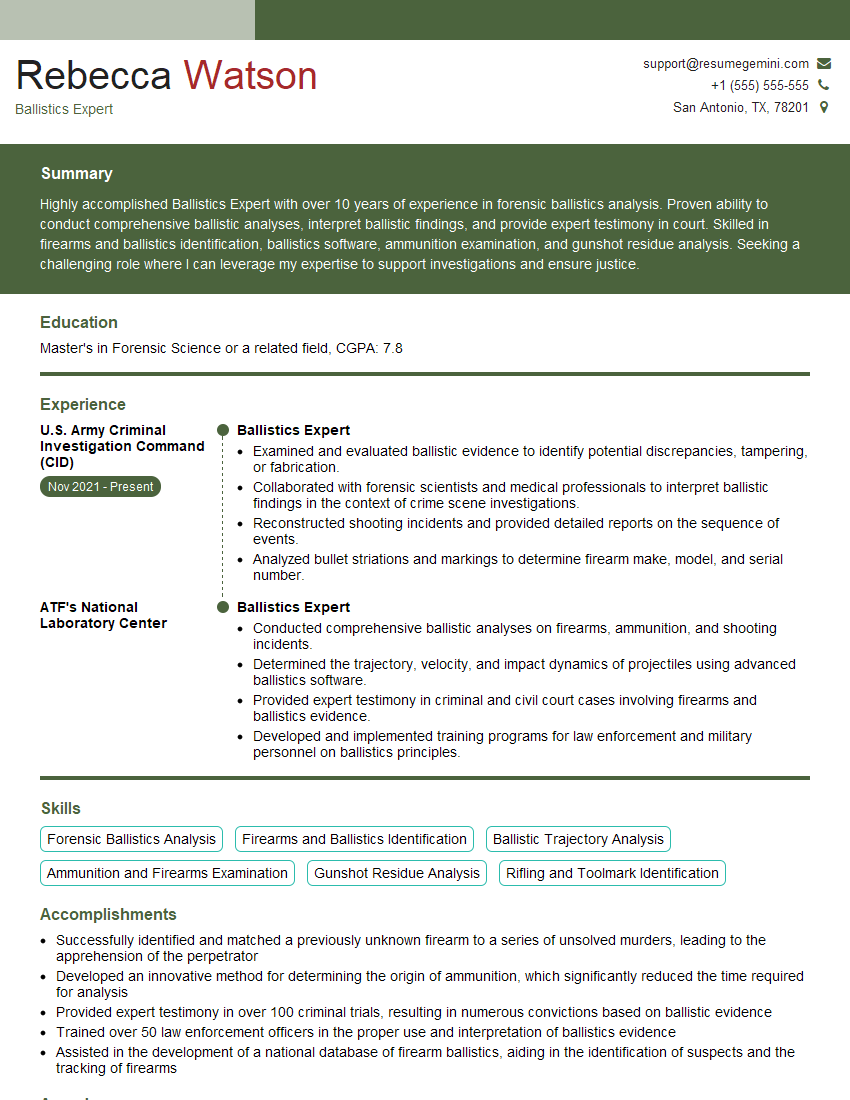
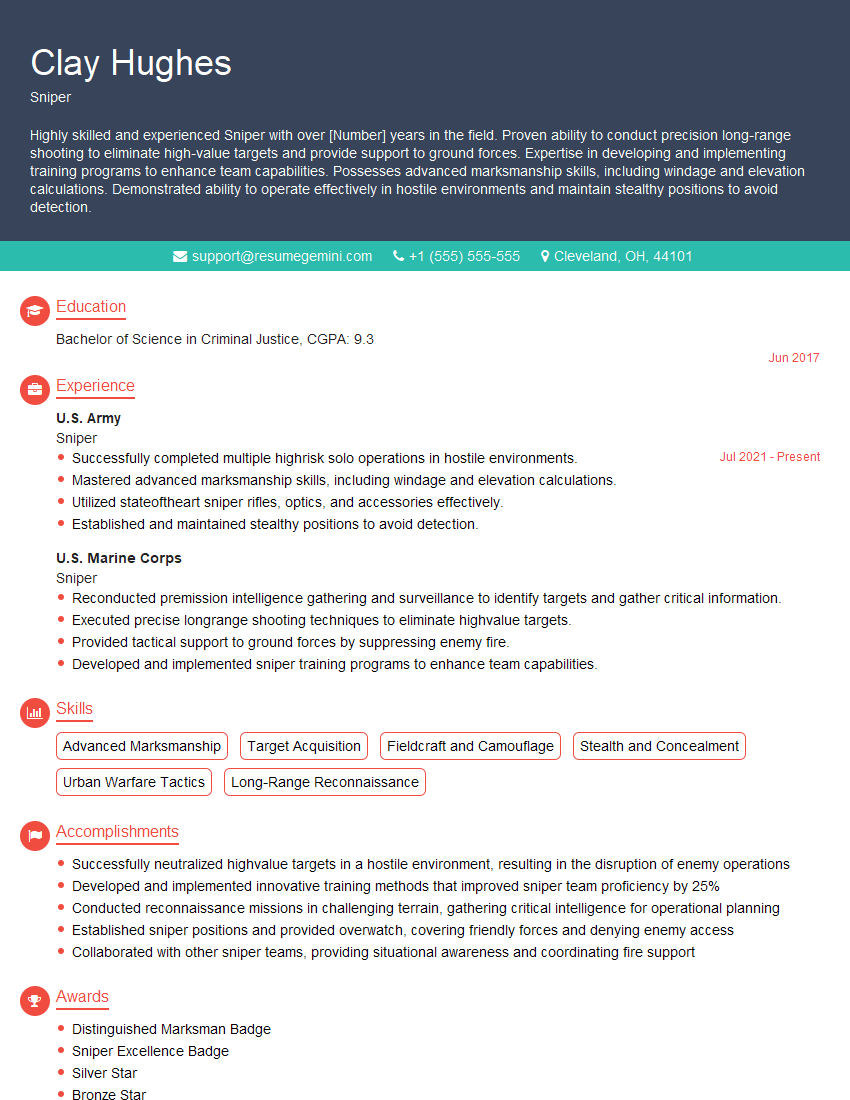
Mastering Combat Marksmanship is crucial for career advancement in many fields requiring precision and tactical expertise. A strong understanding of these principles will significantly improve your interview performance and overall job prospects. To increase your chances of landing your dream role, it’s vital to present your skills effectively through a well-crafted, ATS-friendly resume. ResumeGemini is a trusted resource to help you build a professional resume that highlights your qualifications and experience. Examples of resumes tailored to Combat Marksmanship are available to guide you in showcasing your expertise. Invest in your future – build a resume that gets noticed.
Explore more articles
Users Rating of Our Blogs
Share Your Experience
We value your feedback! Please rate our content and share your thoughts (optional).
What Readers Say About Our Blog
Attention music lovers!
Wow, All the best Sax Summer music !!!
Spotify: https://open.spotify.com/artist/6ShcdIT7rPVVaFEpgZQbUk
Apple Music: https://music.apple.com/fr/artist/jimmy-sax-black/1530501936
YouTube: https://music.youtube.com/browse/VLOLAK5uy_noClmC7abM6YpZsnySxRqt3LoalPf88No
Other Platforms and Free Downloads : https://fanlink.tv/jimmysaxblack
on google : https://www.google.com/search?q=22+AND+22+AND+22
on ChatGPT : https://chat.openai.com?q=who20jlJimmy20Black20Sax20Producer
Get back into the groove with Jimmy sax Black
Best regards,
Jimmy sax Black
www.jimmysaxblack.com
Hi I am a troller at The aquatic interview center and I suddenly went so fast in Roblox and it was gone when I reset.
Hi,
Business owners spend hours every week worrying about their website—or avoiding it because it feels overwhelming.
We’d like to take that off your plate:
$69/month. Everything handled.
Our team will:
Design a custom website—or completely overhaul your current one
Take care of hosting as an option
Handle edits and improvements—up to 60 minutes of work included every month
No setup fees, no annual commitments. Just a site that makes a strong first impression.
Find out if it’s right for you:
https://websolutionsgenius.com/awardwinningwebsites
Hello,
we currently offer a complimentary backlink and URL indexing test for search engine optimization professionals.
You can get complimentary indexing credits to test how link discovery works in practice.
No credit card is required and there is no recurring fee.
You can find details here:
https://wikipedia-backlinks.com/indexing/
Regards
NICE RESPONSE TO Q & A
hi
The aim of this message is regarding an unclaimed deposit of a deceased nationale that bears the same name as you. You are not relate to him as there are millions of people answering the names across around the world. But i will use my position to influence the release of the deposit to you for our mutual benefit.
Respond for full details and how to claim the deposit. This is 100% risk free. Send hello to my email id: lukachachibaialuka@gmail.com
Luka Chachibaialuka
Hey interviewgemini.com, just wanted to follow up on my last email.
We just launched Call the Monster, an parenting app that lets you summon friendly ‘monsters’ kids actually listen to.
We’re also running a giveaway for everyone who downloads the app. Since it’s brand new, there aren’t many users yet, which means you’ve got a much better chance of winning some great prizes.
You can check it out here: https://bit.ly/callamonsterapp
Or follow us on Instagram: https://www.instagram.com/callamonsterapp
Thanks,
Ryan
CEO – Call the Monster App
Hey interviewgemini.com, I saw your website and love your approach.
I just want this to look like spam email, but want to share something important to you. We just launched Call the Monster, a parenting app that lets you summon friendly ‘monsters’ kids actually listen to.
Parents are loving it for calming chaos before bedtime. Thought you might want to try it: https://bit.ly/callamonsterapp or just follow our fun monster lore on Instagram: https://www.instagram.com/callamonsterapp
Thanks,
Ryan
CEO – Call A Monster APP
To the interviewgemini.com Owner.
Dear interviewgemini.com Webmaster!
Hi interviewgemini.com Webmaster!
Dear interviewgemini.com Webmaster!
excellent
Hello,
We found issues with your domain’s email setup that may be sending your messages to spam or blocking them completely. InboxShield Mini shows you how to fix it in minutes — no tech skills required.
Scan your domain now for details: https://inboxshield-mini.com/
— Adam @ InboxShield Mini
support@inboxshield-mini.com
Reply STOP to unsubscribe
Hi, are you owner of interviewgemini.com? What if I told you I could help you find extra time in your schedule, reconnect with leads you didn’t even realize you missed, and bring in more “I want to work with you” conversations, without increasing your ad spend or hiring a full-time employee?
All with a flexible, budget-friendly service that could easily pay for itself. Sounds good?
Would it be nice to jump on a quick 10-minute call so I can show you exactly how we make this work?
Best,
Hapei
Marketing Director
Hey, I know you’re the owner of interviewgemini.com. I’ll be quick.
Fundraising for your business is tough and time-consuming. We make it easier by guaranteeing two private investor meetings each month, for six months. No demos, no pitch events – just direct introductions to active investors matched to your startup.
If youR17;re raising, this could help you build real momentum. Want me to send more info?
Hi, I represent an SEO company that specialises in getting you AI citations and higher rankings on Google. I’d like to offer you a 100% free SEO audit for your website. Would you be interested?
Hi, I represent an SEO company that specialises in getting you AI citations and higher rankings on Google. I’d like to offer you a 100% free SEO audit for your website. Would you be interested?