Are you ready to stand out in your next interview? Understanding and preparing for Comedy interview questions is a game-changer. In this blog, we’ve compiled key questions and expert advice to help you showcase your skills with confidence and precision. Let’s get started on your journey to acing the interview.
Questions Asked in Comedy Interview
Q 1. Explain your comedic style and its influences.
My comedic style is best described as observational with a dash of absurdist. I focus on finding the humor in everyday situations and experiences, often twisting them into unexpected and slightly surreal scenarios. My influences are diverse. I draw heavily from the witty observational humor of comedians like Bill Bryson and Jerry Seinfeld, their ability to find the funny in the mundane being a major inspiration. The surreal and slightly dark humor of Monty Python and early British sketch comedy also plays a significant role, shaping my approach to unexpected juxtapositions and wordplay. Finally, the sharp social commentary of George Carlin and the more character-driven humor of Tina Fey and Amy Poehler have also informed my style, pushing me to experiment with both observational and character-based approaches.
Q 2. Describe your process for developing comedic material.
Developing comedic material is an iterative process, much like sculpting. It begins with observation. I keep a notebook where I jot down funny snippets of overheard conversations, absurd news headlines, or strange situations I encounter. These observations form the raw material. Next, I spend time refining these ideas, exploring different angles and perspectives. I might start with a simple premise – say, the frustration of waiting in a long line – and then build it up, adding layers of detail, unexpected twists, and perhaps a relatable anecdote from my own experience. I often find that the best jokes arise from unexpected connections between seemingly unrelated ideas. Once I have a few strong outlines, I test them out on small audiences – friends, family, or open mic nights – refining them based on audience reactions. This process of trial and error is crucial; seeing what works and what doesn’t allows me to hone the material until it’s sharp and effective.
Q 3. How do you adapt your comedy for different audiences?
Adapting my comedy for different audiences is a key skill. My core material remains consistent – focusing on universally relatable themes like relationships, work, and daily frustrations – but the delivery and emphasis shift depending on the context. For instance, a corporate event requires a cleaner, more polished approach than a late-night stand-up show. I tailor my language, avoiding potentially offensive terms or inside jokes that a specific audience wouldn’t understand. I also pay close attention to the audience’s energy. A more subdued audience might require a more gentle, observational approach, whereas an energetic crowd might allow for a more improvisational and interactive performance. Understanding the audience’s demographics and expectations informs every aspect of my performance, from joke selection to pacing and overall tone.
Q 4. What is your experience with improvisation?
Improvisation is an integral part of my comedic process. Years of participation in improv workshops and troupes have honed my ability to think on my feet and react spontaneously to unexpected situations. Improv has taught me to embrace the unexpected, to build on others’ ideas, and to find humor in the unplanned. It’s a crucial skill not only for live performances – where dealing with hecklers or unexpected audience reactions is unavoidable – but also for scriptwriting. The flexibility and spontaneity cultivated through improv inform my writing process, making my scripts more dynamic and less rigid. The ability to quickly generate ideas and adapt to changing circumstances is something I utilize constantly.
Q 5. How do you handle hecklers or negative audience reactions?
Handling hecklers is a vital aspect of stand-up comedy. My approach involves a combination of wit, diplomacy, and audience management. I try to defuse the situation with humor, often turning the heckler’s comment into a joke. For instance, if someone shouts something irrelevant, I might acknowledge it playfully: “Ah yes, the migratory patterns of the spotted owl. A fascinating topic, but perhaps not for tonight.” If the heckling becomes disruptive, I address it directly but with a smile, reminding the audience that we are all here to enjoy the show. Ultimately, the goal is not to silence the heckler but to regain control of the performance and bring the audience back on board. Sometimes, ignoring the heckler entirely is the best approach if their comments aren’t too disruptive. The key is to remain calm, confident, and in control of the narrative.
Q 6. Describe your experience writing comedic scripts or sketches.
My experience writing comedic scripts and sketches is extensive. I’ve written for various platforms, from short online videos to longer stage productions. My writing process closely mirrors my stand-up development: it starts with a strong concept and then builds from there. I always prioritize character development and a clear narrative arc, even in shorter sketches. I often employ techniques like misdirection, unexpected plot twists, and satirical exaggeration to create a comedic effect. I find collaborative writing very beneficial. Bouncing ideas off colleagues and working through different approaches is an excellent way to refine the material and achieve a polished final product. Collaborations often spark new ideas and insights that I may not have arrived at on my own. I also heavily revise my scripts, often going through several drafts before I feel it’s ready.
Q 7. How do you incorporate current events or social commentary into your comedy?
Incorporating current events and social commentary into my comedy adds a layer of relevance and allows me to connect with audiences on a deeper level. However, I avoid overly preachy or didactic approaches. My aim is to use humor to highlight absurdities, inconsistencies, or hypocrisies within the current socio-political landscape. Instead of lecturing, I prefer to use satire, irony, and observational humor to shed light on these issues, prompting reflection and encouraging laughter at the shared experience. A recent example would be my bit about the absurdity of certain political debates, using exaggerated scenarios to highlight the disconnect between political rhetoric and real-world consequences. It’s crucial to balance topicality with timelessness; a joke that’s highly specific to one moment may not resonate long term, so I always strive to connect the current event to more universal themes and observations.
Q 8. What are some common pitfalls to avoid in comedy writing?
One of the biggest pitfalls in comedy writing is relying on tired tropes and clichés. Audiences crave originality and fresh perspectives. Another common mistake is not understanding your target audience. Humor is subjective; what one group finds hilarious, another might find offensive or simply unfunny.
- Over-reliance on stereotypes: Using simplistic and outdated stereotypes can be offensive and unoriginal. Instead, focus on universal human experiences that resonate with a broader audience.
- Ignoring pacing and timing: Jokes need to be structured correctly, with appropriate pauses and build-up. Poor pacing can kill even the best joke.
- Poor punchline delivery: A perfectly crafted joke can be ruined by weak delivery. The punchline needs to land with impact.
- Lack of specificity: Vague jokes are often less funny than those with specific, vivid details. Instead of saying “I had a bad day,” describe the specific events that made it bad.
For example, a joke about a grumpy old man might be funny if it focuses on relatable aspects of aging, like forgetting things, rather than relying on negative stereotypes.
Q 9. How do you ensure your comedic material remains fresh and relevant?
Keeping comedic material fresh and relevant requires a constant awareness of current events, social trends, and cultural shifts. It’s also crucial to actively engage with your audience and seek feedback.
- Stay current: Read widely, watch news and satire, listen to diverse voices, and immerse yourself in current cultural dialogues. This will provide inspiration for new jokes and help you avoid outdated references.
- Observe everyday life: Pay attention to the funny things happening around you. The mundane can be a goldmine for observational comedy.
- Gather feedback: Test your material regularly in front of live audiences and solicit constructive criticism. This is invaluable for identifying what works and what doesn’t.
- Experiment with different formats: Don’t be afraid to experiment with different styles and approaches. Maybe your observational material could be spun into a satirical piece, or vice-versa.
- Embrace improvisation: Improv helps cultivate spontaneity and adaptability, essential for reacting to audience responses and keeping material feeling fresh.
For instance, a comedian who solely relies on jokes about dial-up internet in 2024 would clearly be out of touch. Staying current ensures your jokes feel timely and engaging, not stale and predictable.
Q 10. Explain your understanding of comedic timing and pacing.
Comedic timing and pacing are crucial for successful joke delivery. Timing refers to the precise moment a punchline is delivered, while pacing involves the rhythm and speed at which the joke unfolds.
Think of it like this: a perfectly timed punchline is like a perfectly thrown punch – it lands with maximum impact. Poor timing is like a missed punch; it falls flat. Pacing is the build-up – a slow, deliberate build-up creates anticipation and increases the payoff of the punchline. Too fast, and the audience can’t keep up. Too slow, and the joke drags.
Effective comedic timing often involves pauses, which are as important as the words themselves. A well-placed pause allows the audience to process the setup and anticipate the punchline, amplifying the comedic effect. This skillful use of pauses is what separates a master comedian from an amateur.
For example, a comedian might deliberately slow down before the punchline, emphasizing a key word or phrase. Alternatively, they might use a rapid-fire delivery for a joke relying on wordplay or quick wit.
Q 11. How familiar are you with different comedic genres (e.g., observational, absurdist, satirical)?
I’m very familiar with various comedic genres, each with its unique approach and audience appeal.
- Observational comedy: This genre uses humor to highlight the absurdities and ironies of everyday life. It often involves witty commentary on human behavior and societal norms. Examples include Jerry Seinfeld and Bill Burr.
- Absurdist comedy: This style uses illogical and nonsensical situations and characters to create humor. It often challenges expectations and defies logic, creating a surreal and unpredictable experience. Think Monty Python or Mitch Hedberg.
- Satirical comedy: This uses humor to critique societal issues, politics, or current events. It often employs irony, sarcasm, and parody to expose hypocrisy and absurdity. Examples include Jon Stewart and Samantha Bee.
- Self-deprecating comedy: Humor derived from making fun of oneself. It can be relatable and disarm the audience. Examples include many stand-up comedians who turn their personal flaws into jokes.
- Dark comedy: Humor that deals with taboo subjects like death, violence, or illness. It requires careful handling to avoid being offensive, but can be extremely effective when done well. Examples include the work of comedians like dark comedians like Bill Hicks or Bo Burnham.
Understanding the nuances of each genre allows me to tailor my writing and performance to suit specific audiences and contexts.
Q 12. Describe your experience with stage presence and delivery.
Stage presence and delivery are vital for a successful comedic performance. They are not merely about telling jokes, but about connecting with the audience, establishing rapport, and creating a memorable experience.
A strong stage presence involves commanding the space confidently, connecting visually with audience members, using body language effectively, and maintaining an engaging demeanor. It’s about projecting energy and enthusiasm, even when delivering a more subdued joke. It’s also about handling any unexpected audience reactions with grace and humor.
Effective delivery involves clear articulation, precise pacing and timing, modulation of voice, and purposeful use of gestures. It’s about being expressive and conveying the full range of emotions and nuances within the joke, whether it’s subtle wit or a big, bold punchline. I am experienced in adapting my delivery to different venues and audience sizes.
Think of a comedian like Eddie Murphy; his commanding stage presence is just as important as his jokes. His physicality, his vocal range, and his interactions with the audience contribute greatly to his performance.
Q 13. How do you manage the pressure of performing live?
Managing the pressure of performing live involves careful preparation, mental strategies, and a positive mindset.
- Thorough rehearsal: Practicing the material extensively helps build confidence and familiarity, reducing anxiety on stage. This includes practicing in front of a mirror, friends, or smaller audiences.
- Visualization: Mentally rehearsing the performance, visualizing a successful outcome, can reduce pre-performance anxiety.
- Positive self-talk: Replacing negative thoughts with positive affirmations can help manage pre-performance nerves. Instead of worrying about mistakes, focus on what you’re good at.
- Breathing techniques: Deep, controlled breathing can help calm nerves and improve focus.
- Embrace imperfection: Accept that mistakes are inevitable and learn to laugh them off. A little spontaneity can make a performance more engaging, and audience often forgive small mistakes as long as the performer handles them with humour.
Remember, even seasoned comedians experience nerves before performing. The key is to develop coping strategies to manage them effectively, turning anxiety into excitement.
Q 14. How do you measure the success of your comedic performances?
Measuring the success of a comedic performance goes beyond simply counting the laughs. It’s a multifaceted assessment that considers various factors.
- Audience response: This is the most obvious indicator, though not always the most reliable. Genuine laughter, engagement, and positive feedback are crucial indicators of success.
- Personal satisfaction: Did I deliver the material in a way I felt was my best? Did I achieve my creative goals for the performance?
- Critical reviews: Feedback from critics, though subjective, can provide valuable insights into areas of improvement.
- Social media engagement: Monitoring social media activity surrounding the performance can help gauge its impact and resonance with the audience.
- Booking and repeat engagements: Repeat invitations to perform are a strong indication of a successful and enjoyable performance.
Ultimately, success is a combination of audience appreciation, personal fulfillment, and professional recognition. It’s a dynamic process, constantly evolving based on the specific performance and the artist’s growth.
Q 15. What are some of your favorite comedic influences and why?
My comedic influences are diverse, reflecting a broad appreciation for the art form’s many facets. Early on, I was heavily influenced by the observational humor of George Carlin. His ability to dissect societal norms with wit and precision was incredibly inspiring. I learned from him the power of sharp writing and fearless delivery. Then there’s the absurdist genius of Monty Python – their willingness to embrace the completely unexpected, to push boundaries, taught me the importance of creativity and embracing the unconventional. More recently, I’ve been captivated by the nuanced character work of comedians like Phoebe Waller-Bridge, who demonstrates how vulnerability and honesty can be incredibly funny. Each of these influences has contributed to my own comedic voice, shaping my approach to writing, performance, and the overall construction of a comedic narrative.
Career Expert Tips:
- Ace those interviews! Prepare effectively by reviewing the Top 50 Most Common Interview Questions on ResumeGemini.
- Navigate your job search with confidence! Explore a wide range of Career Tips on ResumeGemini. Learn about common challenges and recommendations to overcome them.
- Craft the perfect resume! Master the Art of Resume Writing with ResumeGemini’s guide. Showcase your unique qualifications and achievements effectively.
- Don’t miss out on holiday savings! Build your dream resume with ResumeGemini’s ATS optimized templates.
Q 16. Describe your experience working collaboratively on comedy projects.
Collaborative comedy is where the magic truly happens. My experience has shown me that the best comedic projects emerge from a dynamic interplay of ideas and perspectives. I thrive in environments where open communication and mutual respect are paramount. Typically, our process involves brainstorming sessions – often wildly chaotic, but ultimately generative – where we toss around ideas, build upon each other’s suggestions, and refine concepts through rigorous critique. We use shared online documents to track progress, ensuring everyone can contribute and track edits. For example, on one project, a seemingly silly suggestion about a character’s quirk evolved into a central plot point, demonstrating the unexpected ways collaborative efforts can elevate material. Constructive criticism is vital; we aim for an atmosphere where everyone feels comfortable sharing their honest opinions without fear of judgment, leading to stronger, funnier outcomes.
Q 17. How do you handle constructive criticism of your comedic work?
Constructive criticism is essential for growth, not something to be feared. I approach it with a mindset of learning and improvement. My first response is to actively listen and understand the feedback, asking clarifying questions if needed. I try to separate the critique from any personal attack – focusing solely on the work itself. Then, I analyze the feedback objectively, determining whether the points are valid and how they can inform revisions. For instance, if a joke consistently falls flat, I might reconsider the setup, the punchline, or the delivery. Sometimes, it’s about tweaking a detail; other times, it might necessitate a more significant rewrite. The process isn’t always easy, but embracing the feedback allows me to refine my work and become a better comedian.
Q 18. What strategies do you use to overcome creative blocks?
Creative blocks are a common hurdle. My strategies involve a multi-pronged approach. First, I step away from the project entirely – sometimes just for a few minutes, other times for a day or two. This allows for fresh perspective. I might engage in activities unrelated to comedy to clear my mind; going for a walk, listening to music, or simply letting my thoughts wander. I also actively seek inspiration from other sources – reading books, watching movies, listening to podcasts, engaging in conversations. Sometimes, freewriting or mind-mapping helps unlock ideas. If I’m working on a particular skit, I might even try to write a completely different type of joke or focus on a different aspect of the same idea. The key is to keep trying different approaches until the creative flow returns.
Q 19. What is your approach to marketing and promoting your comedic work?
Marketing and promotion are crucial for reaching audiences. My strategy utilizes a blend of online and offline methods. Online, I leverage social media platforms like Twitter and Instagram to share snippets of my work, behind-the-scenes content, and engage with my followers. I also maintain a website showcasing my portfolio and upcoming performances. A strong email list is important for communicating directly with fans about events and new material. Offline, I network actively within the comedy community, attending industry events and open mics. Building relationships with other comedians, promoters, and venue owners is invaluable. I also explore collaborations with other artists and businesses for cross-promotion opportunities. The goal is to create a consistent and engaging presence across multiple platforms, building anticipation and attracting new audiences.
Q 20. How familiar are you with the legal aspects of comedy (copyright, intellectual property)?
I have a working understanding of the legal aspects of comedy, particularly copyright and intellectual property. I know that all original comedic material, including jokes, scripts, and characters, is automatically protected under copyright law. I’m aware of the importance of registering copyrights, especially for larger projects, to establish formal legal ownership and provide stronger protection against infringement. I also understand the nuances of fair use, knowing that limited use of copyrighted material might be permissible under specific circumstances, but that this is a complex area best navigated with legal counsel. I’m cautious to avoid plagiarism and always ensure that my work is original, and if I’m referencing existing material, I do so properly. In short, while I don’t have a formal law degree, I understand the basics and prioritize working ethically and legally.
Q 21. Describe your experience with different comedic platforms (e.g., live shows, podcasts, online videos).
I’ve had the opportunity to work across various comedic platforms, each offering unique experiences. Live shows provide the immediate energy and feedback of a live audience. The connection is unparalleled; you can gauge your material’s effectiveness in real-time and adapt your performance accordingly. Podcasts offer a more intimate setting, allowing for longer-form comedic narratives and character development. You can experiment with different soundscapes and editing techniques to enhance the listening experience. Online video platforms like YouTube present a broader reach, enabling you to connect with audiences globally. Creating engaging video content demands a different skill set, blending comedic writing and visual storytelling. Each platform offers unique advantages and challenges; mastering each helps to broaden one’s comedic voice and audience reach.
Q 22. How do you use audience feedback to improve your comedic material?
Audience feedback is the lifeblood of stand-up comedy. It’s not just about hearing laughter; it’s about understanding why people laugh (or don’t). I actively solicit feedback, both implicitly (observing reactions) and explicitly (through post-show chats or online surveys). For example, if a joke bombs consistently, I analyze why. Was it the delivery? The setup? The punchline itself? Was it culturally insensitive or too niche? I might rewrite the joke entirely, simplify the setup, or even cut it completely. Conversely, if a joke consistently gets a strong reaction, I might incorporate similar elements into other parts of my act. The key is meticulous observation and a willingness to adapt – comedy is a constantly evolving process shaped by audience response.
I also utilize tools like recording my sets to later analyze my performance. This allows for a more objective view of timing, delivery, and audience reactions I might have missed during the live performance.
Q 23. Explain your understanding of comedic structure and narrative.
Comedic structure and narrative are intertwined. Think of a joke as a miniature story with a beginning (setup), a middle (building anticipation), and an end (punchline). The setup introduces the premise, the middle develops it, often creating a false expectation, and the punchline subverts that expectation, creating humor. A larger comedic performance, like a stand-up routine, follows a similar arc, employing a narrative structure. It might start with an introduction, establishing a persona or theme. Then, jokes are strung together, often building on previous bits or exploring related themes, creating a satisfying overall arc. There are various narrative structures that can be effective, from linear narratives to more fragmented or experimental approaches. The key is to build anticipation, create relatable situations, and deliver satisfying payoffs – laughter is the reward for a well-told comedic story.
For instance, a common structure is the ‘rule of three’. You set up a pattern with two similar elements, then break the pattern with a surprising third, creating humor through unexpectedness. A well-structured narrative will also use pacing effectively, shifting between slower, more observational humor and quicker, more punchy jokes to maintain audience engagement.
Q 24. Describe your process for editing and refining comedic material.
My editing process is iterative. After a performance, I review my notes, recordings, and audience feedback. I identify jokes that didn’t land and try to pinpoint the issue. Is it a pacing problem? A poorly constructed joke? A misjudged audience? I then try different approaches: rewriting, restructuring, or cutting the material altogether. Successful jokes are also examined; I identify elements that resonated and incorporate those elements elsewhere in the set. This refining process isn’t just about polishing; it’s about ensuring a coherent and engaging narrative flow.
I often test new material in smaller venues or open mics to get a feel for how audiences respond. This allows me to experiment, make adjustments, and refine my material in a low-pressure environment before performing in larger venues. It’s a continuous process of testing, refining, and ultimately crafting a cohesive and effective comedic performance.
Q 25. What is your experience with using comedic techniques to achieve specific outcomes (e.g., persuasion, education)?
Comedy is incredibly powerful for persuasion and education. Humor can disarm audiences, making them more receptive to information. Satire, for example, can effectively criticize societal issues by highlighting absurdities, prompting reflection and possibly change. I have used comedic techniques to promote environmentally conscious practices, for example, by crafting humorous scenarios illustrating the negative consequences of inaction. The key is to avoid being preachy; the humor should be the vehicle for the message, not the other way around.
Similarly, I’ve used humorous analogies and anecdotes to explain complex technical concepts to diverse audiences. By simplifying complex information into easily digestible, relatable scenarios, I made the learning process more accessible and enjoyable. The success lies in finding the right balance between humor and information, ensuring the comedic element strengthens, not detracts from, the educational goal.
Q 26. How do you stay updated on current trends and developments in the comedy industry?
Staying current in the comedy industry requires a multifaceted approach. I regularly watch stand-up specials from diverse comedians, paying attention to their style, structure, and topicality. I also listen to comedy podcasts, which often feature interviews with successful comedians, offering insights into their careers and approaches. Attending live comedy shows allows me to experience different comedic styles firsthand and network with fellow comedians and industry professionals. Online platforms, like social media and comedy websites, are invaluable resources for tracking trends and emerging voices. Essentially, it’s a constant process of active engagement and critical analysis of the comedic landscape.
Q 27. What are your career goals within the comedy field?
My career goals are multifaceted. Short-term, I aim to consistently refine my comedic craft, performing at larger venues and expanding my audience reach. Long-term, I aspire to create and star in my own comedy special. Beyond performance, I’m interested in exploring writing opportunities – perhaps writing for television or film. Ultimately, I’m driven by a desire to create and share humor that entertains, engages, and potentially even inspires positive change. The comedy world is vast and offers numerous creative avenues, and I aim to explore as many of them as possible.
Q 28. Describe your experience with budgeting and managing resources for a comedy project.
Budgeting for comedy projects, even smaller ones, is crucial. For a small-scale show, it might involve costs for venue rental, sound and lighting equipment (if not provided), marketing materials, and potential compensation for other performers or technicians. It’s essential to create a detailed budget outlining all expected expenses, factoring in potential contingencies. For example, I’ve used spreadsheets to meticulously track income (from ticket sales, sponsorships, etc.) and expenses. I also research different venue options to find the best fit for the budget and the desired audience. Resource management involves securing necessary equipment and personnel efficiently and negotiating favorable rates. Finding sponsors or securing grants can also help manage resources effectively and reduce the overall financial burden of a project.
Key Topics to Learn for Your Comedy Interview
- Understanding comedic timing and pacing: Explore the theoretical concepts of rhythm and beat in comedy writing and delivery. Practice applying these principles to various comedic styles.
- Mastering comedic techniques: Learn about different comedic approaches like observational humor, satire, slapstick, and character-based comedy. Develop your ability to adapt your style to different audiences and platforms.
- Audience engagement and interaction: Understand the importance of reading an audience and responding effectively. Practice techniques for improvisation and adapting your performance based on audience reaction.
- Writing comedic material: Study the structure of jokes, storytelling techniques, and the art of crafting punchlines. Practice writing different types of comedic material, such as stand-up routines, scripts, or sketches.
- Character development and performance: Explore techniques for creating believable and engaging characters. Practice embodying these characters and delivering compelling performances.
- Understanding comedic styles and genres: Research various comedic styles, such as dark humor, absurdist comedy, and political satire. Learn to identify the nuances of each style and apply them appropriately.
- Improvisation and quick wit: Develop your improvisational skills to enhance your ability to think on your feet and respond creatively to unexpected situations. Practice exercises to improve your spontaneity and quick thinking.
- Self-awareness and critical analysis: Develop the ability to objectively assess your own comedic strengths and weaknesses. Learn to analyze your performances and identify areas for improvement.
Next Steps
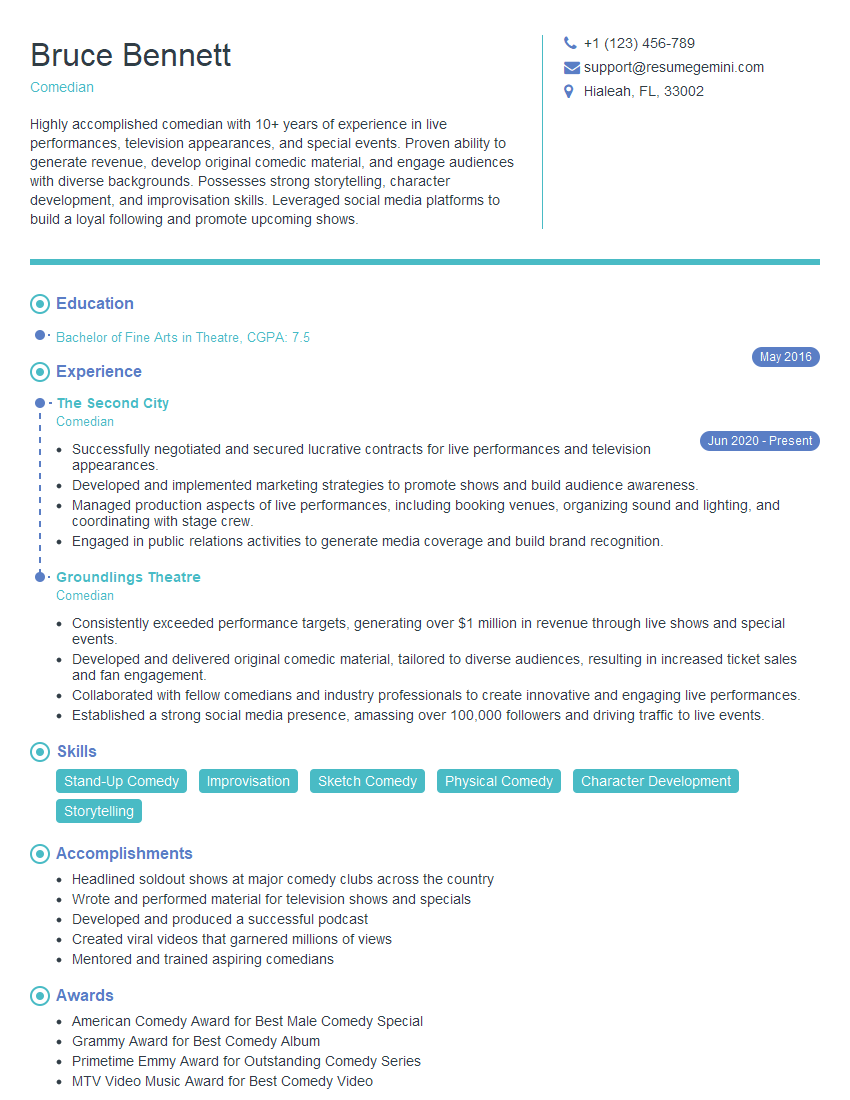
A successful career in comedy requires more than just talent; it demands strong professional presentation. Mastering the art of comedic performance is crucial, but showcasing your abilities effectively is equally important. An ATS-friendly resume is your first step to landing that dream interview. To make sure your resume highlights your unique comedic skills and experience, use ResumeGemini. ResumeGemini provides a user-friendly platform and offers examples of resumes tailored to the Comedy industry, ensuring your application stands out from the crowd.
Explore more articles
Users Rating of Our Blogs
Share Your Experience
We value your feedback! Please rate our content and share your thoughts (optional).
What Readers Say About Our Blog
Attention music lovers!
Wow, All the best Sax Summer music !!!
Spotify: https://open.spotify.com/artist/6ShcdIT7rPVVaFEpgZQbUk
Apple Music: https://music.apple.com/fr/artist/jimmy-sax-black/1530501936
YouTube: https://music.youtube.com/browse/VLOLAK5uy_noClmC7abM6YpZsnySxRqt3LoalPf88No
Other Platforms and Free Downloads : https://fanlink.tv/jimmysaxblack
on google : https://www.google.com/search?q=22+AND+22+AND+22
on ChatGPT : https://chat.openai.com?q=who20jlJimmy20Black20Sax20Producer
Get back into the groove with Jimmy sax Black
Best regards,
Jimmy sax Black
www.jimmysaxblack.com
Hi I am a troller at The aquatic interview center and I suddenly went so fast in Roblox and it was gone when I reset.
Hi,
Business owners spend hours every week worrying about their website—or avoiding it because it feels overwhelming.
We’d like to take that off your plate:
$69/month. Everything handled.
Our team will:
Design a custom website—or completely overhaul your current one
Take care of hosting as an option
Handle edits and improvements—up to 60 minutes of work included every month
No setup fees, no annual commitments. Just a site that makes a strong first impression.
Find out if it’s right for you:
https://websolutionsgenius.com/awardwinningwebsites
Hello,
we currently offer a complimentary backlink and URL indexing test for search engine optimization professionals.
You can get complimentary indexing credits to test how link discovery works in practice.
No credit card is required and there is no recurring fee.
You can find details here:
https://wikipedia-backlinks.com/indexing/
Regards
NICE RESPONSE TO Q & A
hi
The aim of this message is regarding an unclaimed deposit of a deceased nationale that bears the same name as you. You are not relate to him as there are millions of people answering the names across around the world. But i will use my position to influence the release of the deposit to you for our mutual benefit.
Respond for full details and how to claim the deposit. This is 100% risk free. Send hello to my email id: lukachachibaialuka@gmail.com
Luka Chachibaialuka
Hey interviewgemini.com, just wanted to follow up on my last email.
We just launched Call the Monster, an parenting app that lets you summon friendly ‘monsters’ kids actually listen to.
We’re also running a giveaway for everyone who downloads the app. Since it’s brand new, there aren’t many users yet, which means you’ve got a much better chance of winning some great prizes.
You can check it out here: https://bit.ly/callamonsterapp
Or follow us on Instagram: https://www.instagram.com/callamonsterapp
Thanks,
Ryan
CEO – Call the Monster App
Hey interviewgemini.com, I saw your website and love your approach.
I just want this to look like spam email, but want to share something important to you. We just launched Call the Monster, a parenting app that lets you summon friendly ‘monsters’ kids actually listen to.
Parents are loving it for calming chaos before bedtime. Thought you might want to try it: https://bit.ly/callamonsterapp or just follow our fun monster lore on Instagram: https://www.instagram.com/callamonsterapp
Thanks,
Ryan
CEO – Call A Monster APP
To the interviewgemini.com Owner.
Dear interviewgemini.com Webmaster!
Hi interviewgemini.com Webmaster!
Dear interviewgemini.com Webmaster!
excellent
Hello,
We found issues with your domain’s email setup that may be sending your messages to spam or blocking them completely. InboxShield Mini shows you how to fix it in minutes — no tech skills required.
Scan your domain now for details: https://inboxshield-mini.com/
— Adam @ InboxShield Mini
support@inboxshield-mini.com
Reply STOP to unsubscribe
Hi, are you owner of interviewgemini.com? What if I told you I could help you find extra time in your schedule, reconnect with leads you didn’t even realize you missed, and bring in more “I want to work with you” conversations, without increasing your ad spend or hiring a full-time employee?
All with a flexible, budget-friendly service that could easily pay for itself. Sounds good?
Would it be nice to jump on a quick 10-minute call so I can show you exactly how we make this work?
Best,
Hapei
Marketing Director
Hey, I know you’re the owner of interviewgemini.com. I’ll be quick.
Fundraising for your business is tough and time-consuming. We make it easier by guaranteeing two private investor meetings each month, for six months. No demos, no pitch events – just direct introductions to active investors matched to your startup.
If youR17;re raising, this could help you build real momentum. Want me to send more info?
Hi, I represent an SEO company that specialises in getting you AI citations and higher rankings on Google. I’d like to offer you a 100% free SEO audit for your website. Would you be interested?
Hi, I represent an SEO company that specialises in getting you AI citations and higher rankings on Google. I’d like to offer you a 100% free SEO audit for your website. Would you be interested?