Interviews are opportunities to demonstrate your expertise, and this guide is here to help you shine. Explore the essential Command, Control, and Communications interview questions that employers frequently ask, paired with strategies for crafting responses that set you apart from the competition.
Questions Asked in Command, Control, and Communications Interview
Q 1. Describe your experience with various communication protocols (e.g., TCP/IP, UDP).
My experience encompasses a wide range of communication protocols, primarily focusing on TCP/IP and UDP, within the context of command and control (C2) systems. TCP/IP, the foundation of the internet, provides reliable, ordered delivery of data—ideal for situations requiring guaranteed message arrival, such as mission-critical command instructions. However, its overhead can impact speed and efficiency in some scenarios. UDP, on the other hand, prioritizes speed over reliability. It’s less resource-intensive, making it suitable for time-sensitive applications like real-time video feeds or sensor data transmission where the occasional packet loss is acceptable. In practice, I’ve worked on systems integrating both protocols. For instance, we used TCP/IP for secure command transmission and UDP for streaming high-bandwidth surveillance data. I also have experience with other protocols like SIP (Session Initiation Protocol) for VoIP communications and various encryption protocols (TLS/SSL) to ensure secure data transfer.
For example, in a previous role involving a large-scale distributed sensor network, we employed UDP for transmitting sensor readings due to its efficiency, while TCP/IP was utilized for managing the network infrastructure and transmitting configuration changes. The selection of protocol was always dictated by the specific application requirements and the need to balance reliability, speed, and bandwidth efficiency.
Q 2. Explain the concept of a kill chain in the context of cybersecurity and command and control.
The kill chain is a linear model that describes the stages an attacker goes through to compromise a target. In the context of C2 and cybersecurity, understanding the kill chain allows us to proactively defend against attacks. It typically involves seven phases: Reconnaissance, Weaponization, Delivery, Exploitation, Installation, Command and Control (C2), and Actions on Objectives. Each phase presents an opportunity to disrupt the attack.
Imagine a burglar trying to rob a house: Reconnaissance is casing the joint; Weaponization is preparing tools (lockpicks); Delivery is getting to the house; Exploitation is picking the lock; Installation is gaining access; C2 is the burglar’s communication with an accomplice (potentially based on compromised systems); and Actions on Objectives are stealing valuables. Our defense strategies can focus on detecting and preventing activities in any of these stages – for example, intrusion detection systems can detect reconnaissance activity, while endpoint security can thwart exploitation attempts.
In a C2 environment, we actively monitor each stage of the kill chain using a variety of tools and techniques – security information and event management (SIEM) systems, network intrusion detection systems, and endpoint detection and response (EDR) solutions. By identifying anomalies and suspicious behavior at any phase, we can effectively disrupt the attack before it reaches its objectives.
Q 3. How would you handle a communication system failure during a critical incident?
A communication system failure during a critical incident requires a swift and structured response. My approach follows a tiered strategy:
- Immediate Actions: First, I’d activate pre-defined contingency plans. This might include switching to backup communication systems (satellite phones, HF radio, etc.), or utilizing alternative communication pathways already established during planning phases. Simultaneously, I’d assess the nature and extent of the failure – is it a total outage, a partial disruption, or a specific network segment affected?
- Diagnosis and Repair: Once the immediate communication gap is bridged, a dedicated team would diagnose the root cause of the failure. This involves analyzing logs, checking network infrastructure, and coordinating with technical support as needed. Parallel efforts will focus on repairing the primary system while keeping the secondary systems functional.
- Communication Restoration: Repair efforts are prioritized based on criticality. Restoring essential communication channels is paramount. We’d then gradually restore other communication capabilities.
- Post-Incident Analysis: A comprehensive review would be conducted to identify vulnerabilities, update contingency plans, and implement measures to prevent recurrence. This might include redundancy enhancements, improved network resilience, or enhanced security protocols.
For instance, during a military operation, if the primary satellite communication link goes down, we might immediately switch to high-frequency (HF) radio for essential communications, while concurrently working to restore the satellite link. The key is to have well-rehearsed procedures and robust redundancy.
Q 4. What are the key components of a robust command and control system?
A robust C2 system comprises several key components:
- Command Element: The decision-making authority, responsible for setting objectives and issuing orders.
- Control Element: Manages and directs the resources required to achieve objectives, including monitoring and adjusting operations as needed.
- Communication Element: Ensures reliable and secure transmission of information between all elements of the C2 system. This includes data links, networks, and communication protocols.
- Information Element: Collects, processes, and disseminates data essential for decision-making – this often involves sensors, data fusion techniques, and sophisticated displays.
- Situation Awareness Element: Provides real-time awareness of the operational environment through various information sources (Intelligence, Surveillance, and Reconnaissance – ISR), enabling informed decisions.
The interaction of these elements is crucial. Effective communication ensures that the command element’s directives are correctly transmitted and understood by the control element, which in turn, uses the information element to monitor progress and adjust operations accordingly. All of this is underpinned by robust network security and resilience.
Q 5. Describe your experience with network security best practices within a C2 environment.
My experience in network security best practices within a C2 environment emphasizes a layered, multi-faceted approach. This includes:
- Network Segmentation: Dividing the network into smaller, isolated segments to limit the impact of a security breach. This reduces the attack surface and prevents lateral movement within the network.
- Intrusion Detection and Prevention Systems (IDPS): Deploying robust IDPS to monitor network traffic, detect malicious activity, and prevent unauthorized access.
- Firewalls: Implementing multiple firewalls to filter traffic and control network access. This ensures that only authorized traffic is allowed into the C2 network.
- Encryption: Encrypting all sensitive communications, both in transit and at rest, using strong encryption algorithms to protect against eavesdropping and data breaches. This protects commands, intelligence data, and other sensitive information.
- Regular Security Audits and Penetration Testing: Conducting regular security assessments to identify vulnerabilities and test the effectiveness of security controls.
- Access Control: Implementing strict access control mechanisms to ensure that only authorized personnel have access to sensitive information and systems – this involves role-based access control (RBAC) and multi-factor authentication (MFA).
For example, in a previous project, we implemented a zero-trust security model which assumes no implicit trust, requiring every user and device to be authenticated and authorized before accessing network resources, regardless of network location.
Q 6. How do you ensure situational awareness in a dynamic operational environment?
Ensuring situational awareness in a dynamic operational environment requires a multi-sensory approach and a robust information management system. This involves:
- Data Fusion: Combining data from multiple sources – sensors, intelligence feeds, human reports – to create a holistic picture of the environment.
- Real-time Data Analysis: Processing data in real-time to quickly identify trends, anomalies, and critical events.
- Effective Communication: Establishing clear communication channels to ensure that relevant information is shared rapidly between all stakeholders. This might involve dedicated communication platforms or a common operating picture.
- Visualization Tools: Utilizing interactive maps and dashboards to provide a clear and concise representation of the operational environment, allowing operators to quickly grasp the situation.
- Predictive Analytics: Employing predictive modeling to anticipate future events based on current trends and historical data. This allows for proactive responses and improved decision-making.
For example, a military commander might use a combination of satellite imagery, drone feeds, ground reports, and intelligence reports to gain a comprehensive understanding of the battlefield and make informed decisions about troop deployment and resource allocation.
Q 7. Explain your understanding of data fusion and its importance in C2 systems.
Data fusion is the process of integrating information from multiple sources to create a more complete and accurate understanding of a situation. In C2 systems, it is critical for generating a comprehensive common operating picture. This involves combining data from diverse sources, such as sensors, intelligence reports, and human input, to provide a more accurate and detailed picture than any single source could offer on its own. This results in improved decision-making and more effective resource allocation.
Different levels of data fusion exist – low-level fusion combines raw data from similar sensors, such as multiple radar systems; mid-level fusion combines processed data from different sensor types; and high-level fusion combines data from various sources including human intelligence. For instance, a C2 system might fuse data from radar, satellite imagery, and ground-based sensors to track the movement of enemy forces, allowing commanders to anticipate their actions and respond effectively. The importance is not just in combining data, but also in managing the inherent uncertainty and potential biases within each data source to generate the most accurate and reliable picture possible. This often involves probabilistic reasoning and techniques to deal with incomplete or conflicting information.
Q 8. What are the different types of command structures and their advantages/disadvantages?
Command structures are the organizational frameworks that dictate how information flows and decisions are made within a command and control (C2) system. Several types exist, each with its strengths and weaknesses.
- Centralized Command: All authority and decision-making reside with a single commander.
- Advantages: Clear chain of command, efficient in simple, predictable environments.
- Disadvantages: Bottlenecks, slow response to rapidly changing situations, vulnerable to single points of failure.
- Decentralized Command: Authority and decision-making are distributed among multiple commanders or units.
- Advantages: Faster response times, better adaptability to complex situations, increased resilience.
- Disadvantages: Potential for conflicting orders, coordination challenges, less efficient in simple environments.
- Hybrid Command: A combination of centralized and decentralized approaches, balancing authority and flexibility.
- Advantages: Adaptable to varied situations, leverages strengths of both centralized and decentralized structures.
- Disadvantages: Requires careful planning and coordination to avoid confusion.
For example, a military operation might utilize a centralized command structure for strategic planning but a decentralized structure for tactical execution in the field. A large corporation might employ a hybrid approach, with a central executive team setting overall strategy while individual departments maintain operational autonomy.
Q 9. How would you prioritize tasks in a high-pressure situation with competing demands?
Prioritizing tasks in high-pressure situations requires a structured approach. I use a method combining urgency and importance, often visualized using a matrix.
Step 1: Identify All Tasks: Make a complete list of all demands, no matter how small they seem.
Step 2: Assess Urgency and Importance: Assign each task a level of urgency (immediate, short-term, long-term) and importance (critical, important, less important) based on potential impact and deadlines.
Step 3: Prioritize Using a Matrix: A 2×2 matrix with urgency and importance as axes helps visually organize. Focus on tasks in the ‘urgent and important’ quadrant first. Delegate or defer less important or less urgent tasks.
Step 4: Continuous Monitoring and Adjustment: The situation is dynamic; reassess and readjust priorities as new information emerges or circumstances change. Communication is key; transparently communicate priorities and decisions to team members.
For instance, during a cyberattack, prioritizing the immediate containment of the breach (urgent and important) takes precedence over investigating the root cause (important, but potentially less urgent initially).
Q 10. Describe your experience with incident response and recovery in a C2 context.
My experience with incident response and recovery in a C2 context involves developing and implementing comprehensive plans to mitigate and recover from system failures, cyberattacks, or natural disasters. This includes:
- Incident detection and analysis: Utilizing security information and event management (SIEM) systems and network monitoring tools to detect and analyze security incidents in real-time.
- Containment and eradication: Isolating affected systems to prevent further damage and removing malware or vulnerabilities.
- Recovery and restoration: Restoring systems and data from backups or utilizing disaster recovery plans.
- Post-incident activity: Conducting a thorough post-incident review to identify vulnerabilities and improve future response capabilities.
In one instance, we experienced a Distributed Denial of Service (DDoS) attack targeting our main C2 server. Through rapid response, utilizing redundant servers and implementing traffic filtering, we minimized service disruption and prevented data loss.
Q 11. What are some common challenges in integrating disparate C2 systems?
Integrating disparate C2 systems presents several challenges, primarily stemming from differences in:
- Data formats and protocols: Different systems may use incompatible data formats or communication protocols, hindering seamless data exchange.
- Security architectures: Inconsistencies in security protocols and access control mechanisms can create security vulnerabilities and hinder interoperability.
- System architectures: Differences in system architectures, such as client-server versus peer-to-peer, can make integration complex.
- Legacy systems: Integrating outdated systems can be difficult and expensive, often requiring significant upgrades or replacements.
To overcome these, solutions include using middleware, establishing standardized data formats (like XML or JSON), implementing robust security gateways, and adopting a phased integration approach. A common example involves integrating legacy air defense systems with newer, networked systems, requiring careful planning and protocol conversion.
Q 12. Explain your understanding of information assurance principles and their application in C2.
Information assurance (IA) principles are fundamental to secure C2 operations. They encompass confidentiality, integrity, and availability (CIA triad).
- Confidentiality: Ensuring only authorized personnel have access to sensitive information. This involves implementing access control mechanisms (role-based access control, encryption).
- Integrity: Guaranteeing the accuracy and completeness of data and preventing unauthorized modification. This is achieved through data validation, digital signatures, and intrusion detection systems.
- Availability: Ensuring timely and reliable access to information and resources. This requires redundancy, disaster recovery planning, and robust infrastructure.
In C2, IA is applied through secure communication channels, data encryption, system hardening, regular security audits, and incident response plans. Failure to apply these principles could result in compromised operational effectiveness, mission failure, or even catastrophic consequences.
Q 13. How do you ensure the security and integrity of critical command and control data?
Ensuring the security and integrity of critical C2 data requires a multi-layered approach:
- Data encryption: Encrypting data both in transit and at rest using strong encryption algorithms.
- Access control: Implementing robust access control mechanisms, such as role-based access control (RBAC), to restrict access to authorized personnel only.
- Data validation and integrity checks: Implementing mechanisms to verify data integrity, such as checksums or digital signatures.
- Regular security audits and vulnerability assessments: Regularly auditing systems for vulnerabilities and ensuring security patches are applied promptly.
- Intrusion detection and prevention systems: Deploying intrusion detection and prevention systems to monitor network traffic for malicious activity and prevent unauthorized access.
- Data backups and disaster recovery planning: Regularly backing up critical data and having a comprehensive disaster recovery plan in place to ensure business continuity.
Consider a scenario where a military command center needs to protect sensitive operational plans. A combination of encryption, access control via secure logins and clearances, and regular vulnerability scans ensures the plans remain confidential and reliable.
Q 14. Describe your experience with crisis communication strategies.
Crisis communication strategies are crucial for effective C2 during emergencies. They involve:
- Rapid Assessment and Information Gathering: Quickly assess the situation and gather accurate, reliable information.
- Develop Key Messages: Craft clear, concise, and consistent messages for different audiences (internal staff, the public, media).
- Establish Communication Channels: Utilize multiple communication channels (e.g., email, phone, social media, press conferences) to ensure message dissemination.
- Transparency and Honesty: Maintain open and honest communication; address concerns directly and promptly. Avoid speculation or misinformation.
- Regular Updates: Provide regular updates to stakeholders, even if there’s limited new information. Consistency helps manage anxiety and build trust.
- Post-Crisis Review: After the crisis, conduct a thorough review to identify lessons learned and improve future communication strategies.
During a natural disaster, for example, a well-defined communication plan ensures timely and accurate information reaches affected populations and emergency responders, fostering coordinated relief efforts.
Q 15. What is your experience with command automation and decision support tools?
My experience with command automation and decision support tools spans over a decade, encompassing the design, implementation, and maintenance of systems for various clients in both military and civilian sectors. I’ve worked extensively with tools that automate routine tasks, such as troop deployment scheduling, resource allocation, and threat assessment. These tools typically leverage AI and machine learning to analyze large datasets, providing commanders with predictive analytics and optimized solutions. For example, I was involved in a project where we developed a system that automatically routed emergency response units based on real-time traffic data and incident severity, significantly reducing response times. Another example involves the utilization of simulation software to model various scenarios and assess the effectiveness of different strategies before their deployment in the real world, reducing risk and improving decision-making efficiency. My expertise also includes the integration of these tools with existing communication networks and data repositories to ensure seamless data flow and accessibility.
Career Expert Tips:
- Ace those interviews! Prepare effectively by reviewing the Top 50 Most Common Interview Questions on ResumeGemini.
- Navigate your job search with confidence! Explore a wide range of Career Tips on ResumeGemini. Learn about common challenges and recommendations to overcome them.
- Craft the perfect resume! Master the Art of Resume Writing with ResumeGemini’s guide. Showcase your unique qualifications and achievements effectively.
- Don’t miss out on holiday savings! Build your dream resume with ResumeGemini’s ATS optimized templates.
Q 16. How familiar are you with different types of network topologies (e.g., star, mesh, bus)?
My familiarity with network topologies is extensive. I understand their strengths and weaknesses within the context of C2 systems. A star topology, with a central hub connecting all nodes, is simple to manage but suffers from a single point of failure. A mesh topology offers high redundancy and fault tolerance as each node has multiple connections, ideal for critical C2 systems but is complex to manage and can be expensive. A bus topology is cost-effective and easy to implement but is vulnerable to single points of failure and bandwidth limitations, not ideal for demanding C2 operations. I’ve also worked with ring and tree topologies and understand how to select the best topology based on factors such as scalability, reliability, security, and cost considerations. Choosing the right topology is crucial in designing a robust and efficient C2 architecture. For instance, in a battlefield scenario, a mesh topology might be preferred to ensure continued communication even if some nodes are damaged or disabled. In a less critical environment, a star topology could suffice.
Q 17. Describe your experience troubleshooting network connectivity issues.
Troubleshooting network connectivity issues is a core competency in my field. My approach is systematic and follows a structured methodology. I start by identifying the affected systems and the nature of the problem – is it a complete outage, intermittent connectivity, or slow performance? I then utilize network monitoring tools like Wireshark and SolarWinds to analyze network traffic, pinpoint bottlenecks, and identify faulty components. I systematically check cabling, network devices (routers, switches, firewalls), and software configurations. For example, a recent issue involved intermittent connectivity in a remote location. By analyzing network logs and performing ping tests, I identified a faulty network interface card (NIC) which was promptly replaced, restoring full functionality. I also leverage remote access and diagnostic tools to quickly troubleshoot issues across geographically dispersed systems. In addition, I have experience working with different protocols such as TCP/IP and UDP, allowing for swift diagnosis and remediation of protocol-specific issues.
Q 18. Explain the role of redundancy and failover in a resilient C2 architecture.
Redundancy and failover are paramount for a resilient C2 architecture. Redundancy involves having backup systems or components ready to take over if the primary system fails. Failover is the process of switching from the primary system to the backup. For example, a resilient C2 system might have redundant servers, network paths, and power supplies. If the primary server fails, the system automatically switches to the backup server with minimal disruption. This is crucial for maintaining communication and operational capabilities during critical events. The implementation might involve techniques like hot standby, warm standby, or cold standby, each with different recovery times and resource requirements. This design approach ensures high availability and minimizes downtime, which is critical in scenarios where constant communication and control are essential, such as during emergency situations or military operations.
Q 19. How do you maintain data integrity and consistency in a distributed C2 system?
Maintaining data integrity and consistency in a distributed C2 system is challenging but crucial. I utilize several strategies to address this. First, data replication across multiple servers ensures data availability even if one server fails. Second, we use version control systems to track changes and revert to previous versions if needed. Third, strong data validation and error-checking mechanisms ensure the accuracy of data entering the system. Finally, encryption protects data from unauthorized access and modification. We might use techniques like database mirroring, checksums, and digital signatures to confirm data integrity throughout the entire lifecycle. For instance, a checksum is calculated for each data packet and compared at the receiving end to detect any corruption during transmission. A robust approach to data management is vital to prevent inconsistencies and maintain the reliability and trust in the information used for decision making.
Q 20. What are the key performance indicators (KPIs) you would use to evaluate the effectiveness of a C2 system?
Key performance indicators (KPIs) for evaluating a C2 system’s effectiveness include: latency (the time it takes to transmit information), bandwidth (the amount of data transmitted per unit of time), availability (the percentage of time the system is operational), reliability (the frequency of failures), and security (the system’s resistance to attacks). Other important KPIs include the mean time to recovery (MTTR) after failures, user satisfaction, and cost-effectiveness. By tracking these KPIs, we can identify areas for improvement and optimize the system’s performance. For example, high latency might indicate network congestion, requiring us to optimize network configuration or increase bandwidth. Low availability might necessitate improving redundancy or failover mechanisms. Regular monitoring of these KPIs is vital for ensuring a high-performing and reliable C2 system.
Q 21. Explain your understanding of different encryption methods and their security implications.
My understanding of encryption methods encompasses both symmetric and asymmetric encryption. Symmetric encryption, like AES (Advanced Encryption Standard), uses the same key for encryption and decryption, offering high speed but requiring secure key exchange. Asymmetric encryption, like RSA (Rivest-Shamir-Adleman), uses a pair of keys – a public key for encryption and a private key for decryption – which solves the key exchange problem, but it’s computationally slower. Choosing the right encryption method depends on the security requirements and performance considerations. For example, AES might be suitable for encrypting large volumes of data within a secure network, while RSA might be preferred for secure key exchange or digital signatures. The security implications of using weak encryption methods are considerable, including data breaches and unauthorized access. Using strong encryption algorithms and protocols, coupled with secure key management practices, is crucial to maintain data confidentiality and integrity within the C2 system. Staying up to date with the latest cryptographic advancements and best practices is essential to counteract evolving security threats.
Q 22. How do you handle conflicting information from multiple sources in a crisis?
Conflicting information in a crisis is a common challenge. My approach is systematic and prioritizes verification and triangulation. First, I establish a clear chain of command for information validation. Each source is assessed for its credibility and reliability based on its history, the expertise of the source, and the method of information gathering. For example, a report from a verified sensor is prioritized over an unverified social media post.
Next, I use a process of cross-referencing and comparing details from different sources. Discrepancies are highlighted, and I investigate the reasons for the conflict. This might involve contacting the source directly for clarification or seeking additional evidence. Finally, I synthesize the validated information into a coherent picture, clearly identifying areas of uncertainty. This integrated picture then informs decision-making. Think of it like a detective piecing together clues – you need to validate each piece before forming a conclusion.
In a real-world scenario, imagine responding to a large-scale natural disaster. We might receive reports of flooding from various sources: emergency responders, weather services, and citizen reports. My approach would prioritize weather service reports for the overall flood extent, while using emergency responder reports to understand the immediate impact on human lives and infrastructure. Citizen reports might be used to fill in gaps but would require careful verification.
Q 23. Describe your experience with developing and maintaining C2 system documentation.
I have extensive experience developing and maintaining C2 system documentation, crucial for effective operation, training, and troubleshooting. This includes creating and updating system architecture diagrams, operational procedures, user manuals, and troubleshooting guides. I use a combination of tools and techniques, including UML modeling for system diagrams, and structured writing methods for procedural documentation to ensure clarity and consistency. Version control systems, such as Git, are essential for managing document updates and collaborating with teams.
For instance, in a previous role, I led the documentation effort for a large-scale military C2 system upgrade. We implemented a wiki-based system to facilitate collaborative document creation and version control. This allowed us to track changes, resolve conflicts, and ensure everyone was using the most up-to-date information. The success of this project was largely due to our commitment to clear, concise, and easily accessible documentation. This ensured efficient training of new personnel and rapid troubleshooting during critical operational periods.
Q 24. What are some ethical considerations related to command and control systems?
Ethical considerations in command and control systems are paramount. Key concerns revolve around privacy, accountability, and bias. Privacy concerns arise from the potential for surveillance and data collection. It’s crucial to design systems that minimize unnecessary data collection and implement strong data protection measures, adhering to all relevant regulations and privacy policies. Accountability requires clear lines of responsibility for actions taken based on C2 system outputs. This might involve auditing system usage and decisions to ensure transparency and prevent misuse.
Bias is another critical aspect; algorithms and data used in C2 systems can reflect and amplify existing biases, potentially leading to unfair or discriminatory outcomes. Rigorous testing and validation are needed to identify and mitigate potential biases. For example, an automated decision-making system used for resource allocation during an emergency should be carefully tested to ensure it doesn’t disproportionately favor certain populations.
Furthermore, there are ethical implications related to the deployment of autonomous systems within C2 environments. Careful consideration must be given to the level of autonomy allowed, the potential for unintended consequences, and the establishment of clear mechanisms for human oversight and intervention. The ethical frameworks governing the use of AI and autonomous weapons systems are constantly evolving and require continuous review and adaptation.
Q 25. How would you assess the risk associated with implementing a new C2 technology?
Assessing risk associated with implementing new C2 technology involves a multi-faceted approach. I would employ a structured risk assessment framework, such as a Failure Modes and Effects Analysis (FMEA), to identify potential failure points. This involves systematically examining each component of the new system, considering its potential failure modes, and the resulting consequences.
The framework allows for quantification of the likelihood and severity of each failure mode. This analysis helps prioritize mitigation strategies. For example, a high-likelihood, high-severity failure would require immediate attention and robust mitigation measures. A key aspect of this assessment involves evaluating the integration with existing systems; any compatibility issues or interoperability challenges would be highlighted.
Additionally, security risks need careful evaluation, including vulnerability to cyberattacks, data breaches, and unauthorized access. Consideration should also be given to the training requirements for personnel, potential impacts on workflows, and the overall cost-benefit analysis. A phased rollout and robust testing plan should always be incorporated to mitigate risks and ensure a smooth transition.
Q 26. Describe your experience with capacity planning for communication and control systems.
Capacity planning for communication and control systems is crucial for ensuring reliable and efficient operations. This involves forecasting future needs based on anticipated growth, technology upgrades, and potential disruptions. My approach combines qualitative and quantitative methods. Quantitative analysis involves using historical data and performance metrics to model future demands on the system. This includes factors such as user growth, data volume, and bandwidth requirements. Qualitative analysis involves understanding user needs, anticipating future challenges, and incorporating best practices.
For instance, while planning for a new air traffic control system, I would analyze historical data on flight volume, communication traffic, and processing demands. This data would inform the design and sizing of the network infrastructure, ensuring adequate capacity to handle projected increases in traffic. Understanding peak demand periods and anticipated disruptions would also be key in allocating sufficient capacity to prevent service degradation during critical times. The process involves considering not just the current needs but projecting future demands, ensuring the system remains scalable and resilient. Regular capacity reviews are essential to adapt to changes and maintain optimal system performance.
Q 27. How do you ensure interoperability between different C2 systems?
Ensuring interoperability between different C2 systems is paramount for seamless information sharing and coordinated actions. This requires adherence to standardized protocols and data formats. I usually advocate for using open standards wherever possible, promoting flexibility and avoiding vendor lock-in. This allows for easy integration of different systems from various vendors.
Effective interoperability also demands careful attention to data mapping and transformation. Different systems might use different data structures or formats, requiring appropriate transformations to ensure consistent data exchange. For example, different command centers might utilize different data formats for representing location data. A robust interoperability plan should address these challenges through the use of data translation and mapping tools. Regular testing and validation are essential to verify successful data exchange between systems. This often involves simulating real-world scenarios and evaluating system performance under various stress conditions. A well-defined architecture, using middleware or enterprise service buses, can facilitate communication between diverse systems.
Q 28. What are your experiences in managing and mitigating cyber threats within a C2 system?
Managing and mitigating cyber threats within a C2 system requires a multi-layered approach. This starts with a strong security architecture based on the principles of defense in depth. This involves implementing various security controls, including firewalls, intrusion detection systems, and access control mechanisms. Regular security audits and vulnerability assessments are essential to identify and address potential weaknesses.
Incident response planning is crucial for handling security incidents effectively. This involves establishing clear procedures for identifying, containing, and recovering from cyberattacks. Security awareness training for personnel is vital to mitigate risks associated with human error, such as phishing attacks and social engineering. Employing security information and event management (SIEM) systems allows for centralized monitoring and analysis of security logs from various system components, enabling timely detection and response to security incidents. Finally, a robust cybersecurity posture demands continuous monitoring, updating, and adaptation to the ever-evolving threat landscape.
In a practical scenario, imagine a scenario where a C2 system experiences a distributed denial-of-service (DDoS) attack. My approach would involve immediately engaging the incident response team, isolating affected system components, and working with network security personnel to mitigate the attack. Post-incident analysis would be conducted to understand the attack vectors, identify weaknesses in the system’s security, and implement appropriate countermeasures to prevent similar incidents in the future. Ongoing monitoring and threat intelligence analysis are crucial for maintaining a proactive cybersecurity posture.
Key Topics to Learn for Command, Control, and Communications Interview
- Network Architectures and Protocols: Understanding various network topologies (e.g., star, mesh, bus), routing protocols (e.g., BGP, OSPF), and communication protocols (e.g., TCP/IP, UDP) is crucial. Consider their practical application in securing and optimizing communication pathways.
- System Integration and Interoperability: Explore the challenges and solutions involved in integrating different communication systems and ensuring seamless data exchange. Focus on practical examples of overcoming interoperability issues in complex environments.
- Cybersecurity in C3 Systems: Delve into the vulnerabilities and threats facing Command, Control, and Communication systems. Understand security protocols, threat mitigation strategies, and incident response procedures. Practice problem-solving scenarios related to data breaches and system compromises.
- Data Management and Analysis: Explore techniques for collecting, processing, and analyzing large datasets from diverse sources within a C3 context. This includes data visualization, real-time data processing, and decision-making based on data-driven insights.
- Human Factors in C3: Understand the importance of human-computer interaction (HCI) and human-system integration in effective C3 operations. Consider the impact of stress, fatigue, and cognitive load on decision-making and communication efficiency.
- Emergency Response and Crisis Management: Analyze the role of C3 in managing critical incidents and emergencies. Explore best practices for communication, coordination, and resource allocation during crisis situations.
- Command and Control Structures and Processes: Familiarize yourself with different command structures (e.g., hierarchical, decentralized) and decision-making processes within C3 systems. Be prepared to discuss the advantages and disadvantages of each approach.
Next Steps
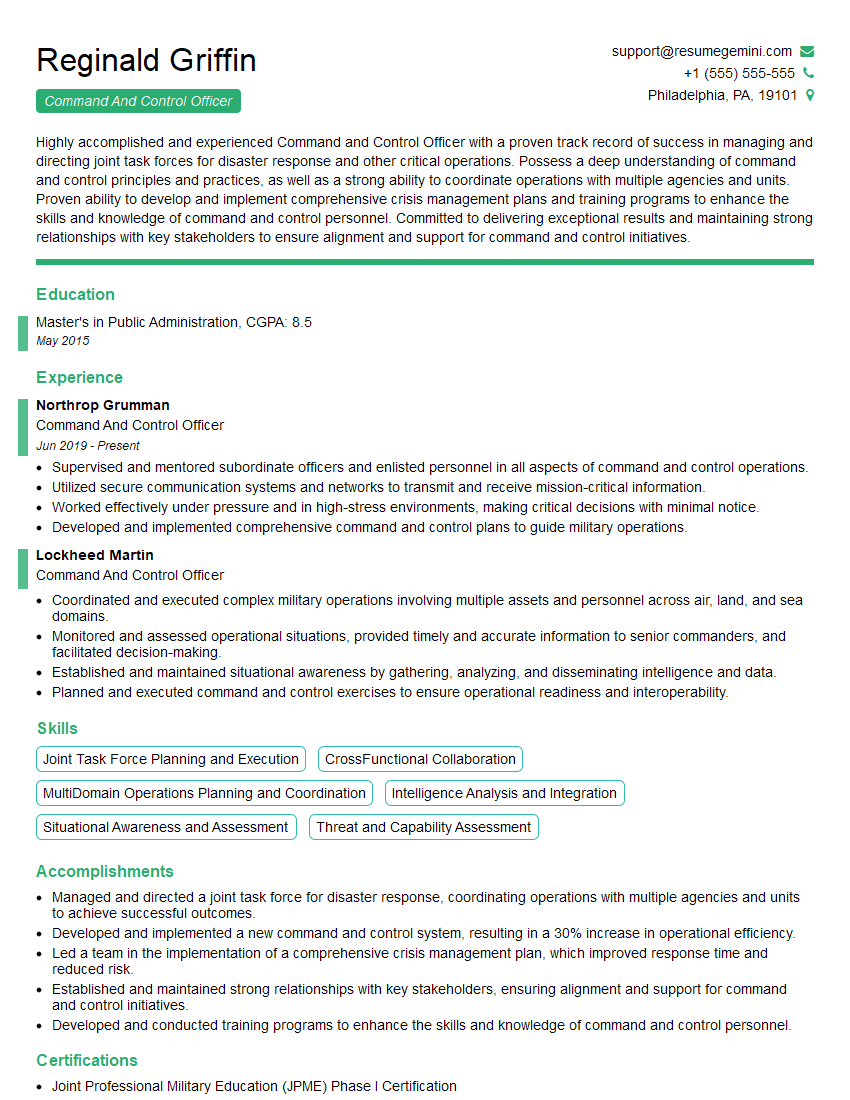
Mastering Command, Control, and Communications skills is essential for a successful and rewarding career in numerous high-demand fields. Strong C3 expertise opens doors to leadership roles and significant contributions to critical infrastructure and national security. To maximize your job prospects, it’s crucial to present your skills effectively. Creating an ATS-friendly resume is key to getting your application noticed. ResumeGemini is a trusted resource that can significantly enhance your resume-building experience. We provide examples of resumes tailored to Command, Control, and Communications to help you showcase your qualifications. Invest the time to create a powerful resume—it’s an investment in your future.
Explore more articles
Users Rating of Our Blogs
Share Your Experience
We value your feedback! Please rate our content and share your thoughts (optional).
What Readers Say About Our Blog
Hello,
we currently offer a complimentary backlink and URL indexing test for search engine optimization professionals.
You can get complimentary indexing credits to test how link discovery works in practice.
No credit card is required and there is no recurring fee.
You can find details here:
https://wikipedia-backlinks.com/indexing/
Regards
NICE RESPONSE TO Q & A
hi
The aim of this message is regarding an unclaimed deposit of a deceased nationale that bears the same name as you. You are not relate to him as there are millions of people answering the names across around the world. But i will use my position to influence the release of the deposit to you for our mutual benefit.
Respond for full details and how to claim the deposit. This is 100% risk free. Send hello to my email id: [email protected]
Luka Chachibaialuka
Hey interviewgemini.com, just wanted to follow up on my last email.
We just launched Call the Monster, an parenting app that lets you summon friendly ‘monsters’ kids actually listen to.
We’re also running a giveaway for everyone who downloads the app. Since it’s brand new, there aren’t many users yet, which means you’ve got a much better chance of winning some great prizes.
You can check it out here: https://bit.ly/callamonsterapp
Or follow us on Instagram: https://www.instagram.com/callamonsterapp
Thanks,
Ryan
CEO – Call the Monster App
Hey interviewgemini.com, I saw your website and love your approach.
I just want this to look like spam email, but want to share something important to you. We just launched Call the Monster, a parenting app that lets you summon friendly ‘monsters’ kids actually listen to.
Parents are loving it for calming chaos before bedtime. Thought you might want to try it: https://bit.ly/callamonsterapp or just follow our fun monster lore on Instagram: https://www.instagram.com/callamonsterapp
Thanks,
Ryan
CEO – Call A Monster APP
To the interviewgemini.com Owner.
Dear interviewgemini.com Webmaster!
Hi interviewgemini.com Webmaster!
Dear interviewgemini.com Webmaster!
excellent
Hello,
We found issues with your domain’s email setup that may be sending your messages to spam or blocking them completely. InboxShield Mini shows you how to fix it in minutes — no tech skills required.
Scan your domain now for details: https://inboxshield-mini.com/
— Adam @ InboxShield Mini
Reply STOP to unsubscribe
Hi, are you owner of interviewgemini.com? What if I told you I could help you find extra time in your schedule, reconnect with leads you didn’t even realize you missed, and bring in more “I want to work with you” conversations, without increasing your ad spend or hiring a full-time employee?
All with a flexible, budget-friendly service that could easily pay for itself. Sounds good?
Would it be nice to jump on a quick 10-minute call so I can show you exactly how we make this work?
Best,
Hapei
Marketing Director
Hey, I know you’re the owner of interviewgemini.com. I’ll be quick.
Fundraising for your business is tough and time-consuming. We make it easier by guaranteeing two private investor meetings each month, for six months. No demos, no pitch events – just direct introductions to active investors matched to your startup.
If youR17;re raising, this could help you build real momentum. Want me to send more info?
Hi, I represent an SEO company that specialises in getting you AI citations and higher rankings on Google. I’d like to offer you a 100% free SEO audit for your website. Would you be interested?
Hi, I represent an SEO company that specialises in getting you AI citations and higher rankings on Google. I’d like to offer you a 100% free SEO audit for your website. Would you be interested?
good