Interviews are more than just a Q&A session—they’re a chance to prove your worth. This blog dives into essential Communication Jamming interview questions and expert tips to help you align your answers with what hiring managers are looking for. Start preparing to shine!
Questions Asked in Communication Jamming Interview
Q 1. Explain the fundamental principles of communication jamming.
Communication jamming is the intentional disruption of communication signals to prevent their reception or understanding. It works by injecting noise or interfering signals into the communication channel, effectively drowning out the desired message. Imagine trying to have a conversation in a crowded, noisy room – the jamming signal is like the loud chatter that makes it hard to hear your conversation partner.
The fundamental principle is simple: overwhelm the intended receiver’s ability to demodulate the signal by introducing a stronger, unwanted signal. This can be achieved through various techniques, depending on the specific communication system being targeted.
Q 2. Describe different types of communication jamming techniques.
Communication jamming techniques are broadly categorized, but often overlap in practice. Key types include:
- Noise Jamming: This involves transmitting wideband noise across the frequency spectrum used by the target communication system. It’s like throwing a handful of gravel into a finely tuned machine – it disrupts everything.
- Sweep Jamming: The jammer rapidly scans across a range of frequencies, disrupting multiple communication channels sequentially. Think of it as a spotlight rapidly moving across a dark room, momentarily blinding anything in its path.
- Tone Jamming: A specific, narrowband signal is transmitted at the exact frequency of the target communication. This is highly effective against systems using a single, predictable frequency.
- Barker Jamming: This is a sophisticated method using a short pulse sequence with a good autocorrelation function. It offers a high jamming-to-signal ratio with relatively low power compared to noise jamming.
- Repeat Jamming: The jammer intercepts and repeats the target communication signal with a slight delay, causing destructive interference at the receiver.
- Deception Jamming: This technique involves transmitting false signals designed to mislead the target system, potentially causing it to malfunction or miss critical information. Imagine sending a false alarm signal to a fire department.
The choice of technique depends on factors like the target’s bandwidth, frequency range, and the jammer’s power capabilities.
Q 3. What are the legal and ethical considerations surrounding communication jamming?
Legal and ethical considerations surrounding communication jamming are significant and vary widely depending on jurisdiction and context. In many countries, jamming civilian communication systems is illegal without proper authorization. This is because it can disrupt essential services, endanger lives (e.g., in emergency situations), and violate privacy rights.
Ethical concerns center on the potential for misuse and the disproportionate impact on vulnerable populations. Jamming can be used to suppress dissent, prevent access to vital information, or facilitate criminal activities. Therefore, the development and deployment of jamming technology must be guided by strict regulations and a strong ethical framework. Exceptions might exist for military applications during wartime, but even then, strict adherence to the laws of armed conflict is paramount.
Q 4. How do you identify and characterize jamming signals?
Identifying and characterizing jamming signals requires specialized electronic warfare (EW) equipment and expertise. The process often involves:
- Signal Detection: Using receivers capable of detecting signals across a wide range of frequencies and analyzing their characteristics (amplitude, frequency, modulation type).
- Signal Analysis: Applying signal processing techniques to determine the jammer’s waveform, power level, modulation type, and other parameters. Sophisticated signal analysis software can be employed to perform these calculations.
- Direction Finding: Employing directional antennas or arrays to pinpoint the geographical location of the jammer.
- Signal Classification: Distinguishing the jamming signal from other sources of interference and identifying the specific type of jamming employed.
By carefully analyzing these parameters, EW experts can effectively characterize the jamming signal and develop countermeasures.
Q 5. Explain the concept of signal-to-noise ratio (SNR) in the context of jamming.
The signal-to-noise ratio (SNR) is a crucial metric in communication systems, representing the ratio of the desired signal’s power to the power of unwanted noise. In the context of jamming, the noise includes both naturally occurring noise and the intentional interference from the jammer.
A high SNR means the desired signal is significantly stronger than the noise, leading to clear communication. Conversely, a low SNR indicates poor communication quality, potentially resulting in data loss or communication failure. Jamming aims to reduce the SNR below a threshold that renders the communication unusable. Therefore, understanding and managing the SNR is essential for both jamming and anti-jamming techniques. A strong jammer will strive to reduce the SNR to a point where the communication system fails. Conversely, anti-jamming systems will focus on increasing the SNR to regain communication reliability.
Q 6. Describe different types of jamming waveforms.
Jamming waveforms vary greatly depending on the desired effect and the characteristics of the target system. Some common examples include:
- White Noise: A broadband signal with equal power across a wide frequency range. It’s simple but less effective against narrowband systems.
- Pink Noise: Similar to white noise but with a power spectral density inversely proportional to frequency. It’s often more effective than white noise in masking signals.
- Sweep Frequency Jamming: The frequency of the jamming signal continuously sweeps across a range of frequencies.
- Barker Codes: Sequences of pulses carefully designed to have good autocorrelation properties for high jamming efficiency. This is a more sophisticated form of pulse jamming.
- Chirp Signals: Signals whose frequency changes linearly over time. These can be difficult for simple receivers to filter out.
The optimal waveform depends on many factors, including the power constraints, the bandwidth of the target system, and the specific countermeasures in place.
Q 7. How do you design a jamming system to effectively counter a specific communication system?
Designing a jamming system to effectively counter a specific communication system requires a thorough understanding of the target’s characteristics, including its frequency range, modulation scheme, bandwidth, and power levels. The design process involves several key steps:
- Target System Analysis: Carefully study the communication system’s specifications to determine its vulnerabilities and optimal jamming strategies. This includes examining the receiver’s sensitivity, bandwidth, and signal processing techniques.
- Jammer Waveform Selection: Choose a jamming waveform that maximizes disruption while minimizing power consumption and unintended interference. Factors such as the target’s bandwidth and the desired level of jamming effectiveness will guide this decision.
- Power Level Determination: Calculate the required jamming power to achieve the desired SNR reduction at the target receiver. This requires careful consideration of the target system’s sensitivity and the propagation environment.
- Antenna Design: Design an antenna with appropriate gain and radiation pattern to effectively target the communication system. The antenna’s design is critical for focusing the jamming power on the target and minimizing interference in other directions.
- Testing and Optimization: Rigorously test the jamming system in a simulated environment to refine its performance and ensure it effectively disrupts the target communication system. Real-world testing should also be performed, if possible and legal.
The process is iterative, with continuous adjustments based on test results and feedback.
Q 8. What are the challenges in jamming spread-spectrum communication systems?
Jamming spread-spectrum communication systems presents unique challenges due to their inherent resilience to interference. Spread-spectrum techniques, like Direct Sequence Spread Spectrum (DSSS) and Frequency Hopping Spread Spectrum (FHSS), distribute the signal across a wide bandwidth, making it difficult for a jammer to effectively disrupt the entire signal. The key challenges include:
- High Jamming Power Requirement: To effectively disrupt a spread-spectrum signal, a jammer needs significantly higher power than it would for a narrowband signal, as the jammer’s power must be spread across the same wide bandwidth as the target signal.
- Dealing with Processing Gain: Spread-spectrum systems benefit from processing gain, which improves the signal-to-noise ratio (SNR). This gain reduces the impact of noise and jamming. The jammer needs to overcome this processing gain to be effective.
- Adaptive Jamming Strategies: Spread-spectrum systems often incorporate adaptive techniques to counter jamming, such as power control and frequency hopping. Jammers must employ sophisticated strategies to adapt to these defensive measures.
- Detection and Tracking: Identifying and tracking the spread-spectrum signal within a wide bandwidth is challenging. The jammer needs advanced signal processing techniques to accurately detect and target the signal.
- Cost and Complexity: High-power jammers capable of effectively disrupting spread-spectrum systems are expensive and complex to design and operate.
Imagine trying to drown out a choir by shouting – it’s much harder than drowning out a single singer.
Q 9. Explain the role of frequency hopping in mitigating jamming effects.
Frequency hopping spread spectrum (FHSS) is a powerful technique for mitigating jamming effects. In FHSS, the communication signal rapidly switches between different frequencies according to a predefined pseudorandom sequence known to both the transmitter and receiver. This makes it difficult for a jammer to continuously target the signal because the jammer must track the frequency hops and transmit jamming power across all potential frequencies simultaneously.
Think of it like a game of hide-and-seek: the signal is constantly changing its hiding spot (frequency), making it harder for the jammer (seeker) to find it consistently. If the jammer doesn’t know the hopping sequence, its interference will be spread thinly across the frequency spectrum, significantly reducing its impact on the signal.
The effectiveness of frequency hopping depends on factors such as the hopping rate, the number of available frequencies, and the pseudorandom sequence’s complexity. A faster hopping rate and more frequencies provide better protection.
Q 10. How do you measure the effectiveness of a jamming system?
Measuring the effectiveness of a jamming system requires a multi-faceted approach. Key metrics include:
- Signal-to-Interference Ratio (SIR): This measures the ratio of the desired signal power to the jamming power at the receiver. A lower SIR indicates greater jamming effectiveness.
- Bit Error Rate (BER): This metric quantifies the percentage of bits received incorrectly due to jamming. A higher BER signifies reduced communication reliability.
- Throughput Degradation: Jamming often reduces the amount of data successfully transmitted. Measuring the percentage decrease in throughput provides another assessment of jamming effectiveness.
- Communication Outage Probability: This represents the probability that communication is completely disrupted due to jamming. A higher probability indicates more successful jamming.
These metrics are usually measured under various jamming scenarios, such as different jamming powers, bandwidths, and modulation schemes. Controlled tests against real-world communication systems are crucial for an accurate assessment.
Q 11. What are the key performance indicators (KPIs) for a jamming system?
Key Performance Indicators (KPIs) for a jamming system include:
- Jamming Range: The maximum distance at which the jamming system can effectively disrupt the target communication system.
- Jamming Power: The power output of the jammer, directly impacting its effective range and disruption capability.
- Bandwidth Coverage: The range of frequencies covered by the jammer’s output, determining its compatibility with different target systems.
- Jamming Efficiency: A measure of how much power is needed to achieve a given level of disruption. Lower power consumption for a given impact is preferred.
- Reliability: The consistency and dependability of the jammer’s performance under different conditions.
- Mean Time Between Failures (MTBF): A measure of the system’s reliability, indicating the average time before it requires maintenance or repair.
The specific KPIs selected will depend on the intended application and the performance requirements of the jamming system.
Q 12. Describe different types of jamming equipment and their applications.
Jamming equipment varies widely depending on its intended application and target. Some common types include:
- Sweep Jammers: These jammers rapidly sweep across a broad frequency range, disrupting communication signals operating within that range. They are useful against systems that use frequency hopping with a limited number of frequencies.
- Barrage Jammers: These produce a high-power, wideband signal across a specific frequency range, overwhelming the target communication signal. They are effective but less sophisticated and consume high power.
- Noise Jammers: These generate random noise to disrupt the signal. Their effectiveness depends on the signal-to-noise ratio of the target system.
- Deceptive Jammers: These attempt to mimic the desired signal to confuse the receiver. They are more sophisticated and require more advanced technology.
- Pulse Jammers: These transmit short bursts of high-power interference. They are effective against systems that are not designed to deal with pulsed interference.
Applications range from military countermeasures (disrupting enemy communications) to commercial uses (preventing unauthorized access to networks) or even law enforcement. The specific type of jammer and its parameters are selected based on the target system’s characteristics and the desired level of disruption.
Q 13. Explain the concept of anti-jamming techniques.
Anti-jamming techniques are methods used to protect communication systems against jamming. The core principle is to make it harder or impossible for the jammer to effectively disrupt the communication. These techniques can be broadly categorized into:
- Spread Spectrum Techniques: Already mentioned, these techniques distribute the signal across a wide bandwidth, reducing the impact of jamming.
- Frequency Hopping: Rapidly changing the communication frequency, making it difficult for the jammer to track the signal.
- Adaptive Coding and Modulation: Adjusting the coding and modulation schemes based on the interference level to optimize communication performance in the presence of jamming.
- Error Correction Coding: Using advanced coding schemes to correct errors caused by jamming, improving resilience to interference.
- Signal Diversity: Transmitting the signal over multiple paths or frequencies, reducing the effectiveness of a single jamming source.
- Beamforming: Focusing the transmitted signal towards the receiver to reduce interference from other directions.
- Space-Time Coding: Exploiting the spatial diversity of multiple antennas to mitigate interference and enhance signal reliability.
The choice of anti-jamming technique depends on the specific application, the level of jamming threat, and the cost and complexity constraints.
Q 14. How do you select appropriate jamming parameters (power, bandwidth, etc.)?
Selecting appropriate jamming parameters is crucial for effective jamming while minimizing resources and avoiding unintended consequences. The selection process considers:
- Target System Characteristics: Understanding the target system’s operating frequency, bandwidth, modulation scheme, and power level is essential for effective jamming. The jammer’s parameters must be tailored to overcome the target system’s anti-jamming capabilities.
- Desired Level of Disruption: The level of disruption needed dictates the required jamming power and bandwidth. Complete outage requires more power and bandwidth than simply degrading performance.
- Jamming Range: The required range determines the necessary transmitter power. Increased range necessitates higher power, impacting cost and size.
- Regulatory Restrictions: Jamming operations are often subject to strict legal and regulatory restrictions, particularly regarding frequency bands and power levels. These regulations must be strictly adhered to.
- Environmental Considerations: Factors such as atmospheric attenuation and interference from other sources affect the effectiveness of jamming. These need to be taken into account during the selection process.
A systematic approach, often involving simulations and field tests, is crucial to determine optimal jamming parameters and ensure the system meets the intended performance goals while complying with all relevant regulations.
Q 15. Discuss the importance of spectrum management in communication jamming.
Effective spectrum management is paramount in communication jamming. Think of the radio frequency spectrum as a busy highway – various communication systems (like cars) use different frequencies (lanes) to transmit data. Jamming disrupts this order by flooding a specific frequency band with noise, essentially causing a traffic jam. Without proper spectrum management, jamming efforts become inefficient and potentially illegal. This management involves identifying the target communication system’s frequency band, determining the optimal jamming power levels to avoid unintended interference with other systems, and adhering to legal regulations regarding frequency usage.
For example, a poorly managed jamming operation might unintentionally disrupt emergency services operating on an adjacent frequency. Effective spectrum management minimizes this risk through careful planning, using sophisticated signal analyzers to identify the target, and employing directional antennas to focus the jamming signal. This ensures that the jamming is targeted and avoids collateral damage to other users of the radio frequency spectrum. It also helps in avoiding legal repercussions that can arise from unauthorized spectrum use.
Career Expert Tips:
- Ace those interviews! Prepare effectively by reviewing the Top 50 Most Common Interview Questions on ResumeGemini.
- Navigate your job search with confidence! Explore a wide range of Career Tips on ResumeGemini. Learn about common challenges and recommendations to overcome them.
- Craft the perfect resume! Master the Art of Resume Writing with ResumeGemini’s guide. Showcase your unique qualifications and achievements effectively.
- Don’t miss out on holiday savings! Build your dream resume with ResumeGemini’s ATS optimized templates.
Q 16. Describe the role of signal processing in communication jamming.
Signal processing is the backbone of any sophisticated jamming system. It involves manipulating and modifying signals to achieve the desired jamming effect. This includes techniques like frequency hopping, spread spectrum, and noise generation. Sophisticated signal processing allows for adaptive jamming, where the jamming signal dynamically adjusts to counter the target signal’s characteristics.
For instance, a simple noise jammer might simply generate a broad range of noise across a frequency band. However, a more advanced system using signal processing techniques could analyze the target signal, identify its modulation scheme and then generate a counter signal specifically designed to disrupt the demodulation process at the receiver. This adaptive approach is crucial for effectiveness against sophisticated communication systems that employ techniques like frequency hopping or spread spectrum.
// Example of a simplified jamming signal generation (conceptual) // This is highly simplified and does not represent a real-world implementation. double[] jammerSignal = generateNoise(frequencyBand, powerLevel); // Generate noise signal // ...Further signal processing steps to adapt to target signal... transmitSignal(jammerSignal);Q 17. How do you analyze and interpret jamming data?
Analyzing jamming data involves a combination of signal analysis techniques and statistical methods. We use specialized equipment like spectrum analyzers to capture the radio frequency environment and identify the characteristics of the jamming signal, including its frequency, bandwidth, power level, and modulation type. Signal strength fluctuations and frequency changes are analyzed to understand the jamming strategy.
For example, we might observe a sudden increase in noise power at a specific frequency band during a communication outage. Further analysis could reveal that the jamming signal is employing frequency hopping to make it harder to detect and counter. Statistical analysis helps determine the probability of a jamming event occurring and its impact on the communication system. This allows for predicting potential jamming occurrences and developing countermeasures.
Interpreting the data requires understanding the context of the communication system under attack. This often requires in-depth knowledge of the protocols and technologies employed by the target system. Sophisticated signal processing tools and algorithms are used to filter out noise and extract relevant information from the jamming signal itself.
Q 18. What are the potential vulnerabilities of a jamming system?
Jamming systems, while effective, have inherent vulnerabilities. One major vulnerability is their susceptibility to detection and countermeasures. Sophisticated communication systems use error correction and other techniques to mitigate jamming interference. Another vulnerability is the limited range and power of jamming devices; they might be easily overwhelmed by a higher-power transmitter. Jamming systems can also be susceptible to frequency hopping or spread-spectrum techniques used by target communication systems, making them difficult to target effectively. Finally, legal and regulatory compliance issues can greatly restrict jamming operations. Unauthorized jamming is illegal in most jurisdictions.
For example, a simple wideband jammer might be easily overcome by a communication system that employs frequency hopping or spread spectrum. Also, a low-power jammer might be ineffective against a high-power transmitter. Similarly, legal limitations on jamming power and operational frequency range severely restrict its effectiveness.
Q 19. How do you address these vulnerabilities?
Addressing these vulnerabilities involves employing various strategies. Firstly, utilizing adaptive jamming techniques enables the jammer to dynamically adjust to changes in the target signal. This includes algorithms that track and respond to changes in the target’s frequency or modulation. Secondly, increasing the power and range of the jamming device is essential. Employing multiple jamming devices operating at different frequencies or locations to create a wider jamming zone is also critical. Finally, ensuring complete compliance with all relevant legal and regulatory requirements is essential to prevent legal repercussions.
For example, employing adaptive signal processing techniques, using directional antennas to focus the jamming energy, and deploying multiple jammers strategically across a geographical area enhances both effectiveness and robustness. Thorough testing and compliance monitoring are also essential to ensure the legal and operational safety of the jamming system.
Q 20. Describe your experience with different types of communication systems (e.g., cellular, satellite, radio).
My experience encompasses a wide range of communication systems. I’ve worked extensively with cellular systems, focusing on analyzing vulnerabilities in various 3G, 4G, and 5G technologies, understanding their frequency bands and modulation schemes to develop effective jamming strategies. In satellite communication, I’ve focused on understanding the unique challenges posed by the long distances and power requirements involved in disrupting satellite links. Finally, in radio systems, my experience spans various bands, including VHF and UHF, and I’ve been involved in projects concerning both narrowband and wideband radio jamming.
Each system presents unique challenges. Cellular systems often employ sophisticated anti-jamming techniques, while satellite systems require higher power levels to overcome the long distances involved. Radio systems have a simpler structure, but the vast range of frequencies and use cases requires a different approach to effective jamming. My experience across these technologies allows me to devise tailored jamming strategies for specific targets.
Q 21. How do you ensure the safety and compliance of a jamming system?
Ensuring safety and compliance is paramount in jamming system operations. Strict adherence to all relevant legal and regulatory guidelines regarding frequency usage and power levels is crucial. This includes obtaining the necessary permits and licenses for operation. Thorough risk assessment must be conducted to identify and mitigate potential hazards such as interference with essential services and harm to individuals. Comprehensive testing and verification procedures are vital to ensure that the jamming system operates as intended and remains within the specified safety limits. Regular maintenance and updates are required to minimize the risk of malfunction or unintended consequences.
A comprehensive safety plan should be developed before the operation of any jamming system. This includes procedures for emergency shutdowns and contingency plans to minimize any potential negative impact. Furthermore, thorough documentation of all activities, including frequency usage, power levels and testing results, is vital for demonstrating compliance with regulations.
Q 22. Explain the concept of cognitive radio in the context of jamming.
Cognitive radio, in the context of jamming, represents a significant advancement. It’s not just about brute-force signal disruption; it’s about intelligent, adaptive jamming. Traditional jammers blanket a frequency band with noise, disrupting all communication indiscriminately. A cognitive radio jammer, however, senses the radio environment, identifies the target communication signals (e.g., a specific cell phone tower frequency or a particular Wi-Fi channel), and then selectively jams only those specific frequencies. This targeted approach maximizes effectiveness while minimizing collateral interference and the chances of detection.
Think of it like this: a traditional jammer is a shotgun blast, while a cognitive radio jammer is a sniper rifle. The sniper can precisely target its victim, whereas the shotgun affects everything in a wide area. This targeted approach makes cognitive radio jammers more efficient and stealthier. Further, these systems can adapt to frequency hopping or other techniques used to evade jamming, providing an ongoing countermeasure. For example, if the target signal changes frequency, a cognitive radio jammer can instantly follow and continue the jamming.
Q 23. Describe your experience with different types of jamming software and hardware.
My experience spans both software-defined radio (SDR) and hardware-based jamming systems. SDR jammers offer incredible flexibility. I’ve worked extensively with GNU Radio and other platforms to design and implement custom jamming waveforms, allowing for dynamic adaptation to evolving threats. For example, we once created a system to jam a specific type of encrypted drone communication by analyzing the signal and crafting a counter-signal optimized for disruption. This software’s advantage is adaptability. We can modify jamming parameters in real-time, which was crucial in that drone case. On the hardware side, I’ve worked with a range of off-the-shelf and custom-built jammers, from simple noise generators to complex systems incorporating directional antennas for focused jamming and reducing detection probability. Each has its advantages; the hardware jammers are usually more robust but less adaptable than SDR systems.
Q 24. How do you troubleshoot and maintain a jamming system?
Troubleshooting and maintaining a jamming system involves a systematic approach. First, I assess the system’s overall performance by analyzing signal strength, interference levels, and the effectiveness of jamming. If the jamming effectiveness is low, I investigate the source – it could be an issue with the antenna alignment, a power supply problem, software glitches, or even an unexpected change in the target signal’s characteristics. I use spectrum analyzers and signal generators to pinpoint the source of the problem. Regular maintenance includes checking for loose connections, ensuring proper cooling, and validating software updates for functionality and security. I also perform periodic calibration and testing to maintain the system’s accuracy and effectiveness. Documenting every step and change is crucial for efficient troubleshooting and future maintenance.
Q 25. How do you stay current with advancements in communication jamming technology?
Staying current in communication jamming technology requires continuous learning. I attend industry conferences, workshops, and webinars to learn about new techniques and technologies. I actively follow relevant research publications and journals, particularly those focusing on advancements in signal processing, cognitive radio, and anti-jamming strategies. This research helps me understand the next generation of jamming and anti-jamming techniques. Further, maintaining a strong network with other professionals in the field helps exchange ideas and be informed of current trends and practices. Staying informed helps us anticipate and counteract advancements in technologies used to detect and counter jamming.
Q 26. Describe your experience working in a team environment on a jamming project.
Teamwork is essential in any jamming project. In one project, our team consisted of RF engineers, software developers, and signal processing specialists. We used Agile methodologies, breaking down the project into smaller, manageable tasks. Regular meetings ensured communication and coordination. Each team member brought their unique skills; the engineers designed the hardware, developers created the software algorithms for signal processing and jamming adaptation, and the specialists conducted testing and analysis. This collaborative environment encouraged problem-solving and innovation. We leveraged each member’s expertise to ensure project success and maintain effectiveness.
Q 27. How do you handle unexpected technical challenges in a jamming operation?
Unexpected challenges are common in jamming operations. A recent example involved an unexpected surge in the target signal’s power. Our initial jamming strategy became ineffective. We immediately convened a team meeting, analyzing the situation using real-time spectrum data. We then adapted our strategy, increasing the power of our jammer (within safe limits) and adjusting the jamming waveform to counteract the surge. This involved quick decision-making, collaboration, and leveraging our experience to adapt to the unforeseen circumstance. The ability to quickly adapt and analyze a situation is vital to success in this field.
Q 28. Explain the trade-offs between jamming effectiveness and detection probability.
There’s an inherent trade-off between jamming effectiveness and detection probability. A highly effective jammer, capable of completely disrupting communication, also produces a strong signal that is easily detectable. Conversely, a low-power, less effective jammer is harder to detect but offers less disruption. The optimal balance depends on the specific operational requirements. In a scenario prioritizing stealth, a weaker, less effective jammer might be preferable, even if it means incomplete communication disruption. In a scenario where absolute disruption is needed, increased jamming power and higher detection probability might be acceptable trade-offs. The decision-making process involves carefully analyzing the threat, assessing the risk of detection, and determining the acceptable level of disruption in order to develop the optimal jamming strategy.
Key Topics to Learn for Communication Jamming Interview
- Fundamentals of Communication Jamming: Understand the basic principles and techniques behind disrupting communication signals.
- Types of Jamming Techniques: Explore various methods like noise jamming, sweep jamming, and pulsed jamming, and their applications in different scenarios.
- Signal Processing and Analysis: Grasp the importance of signal analysis in identifying and characterizing communication signals for effective jamming.
- Electronic Warfare Systems: Familiarize yourself with the architecture and operation of communication jamming systems and their integration into broader EW strategies.
- Frequency Management and Spectrum Allocation: Learn how frequency bands are allocated and the legal and regulatory considerations relevant to jamming operations.
- Anti-Jamming Techniques and Mitigation Strategies: Understand how communication systems defend against jamming and the countermeasures employed.
- Practical Applications: Explore real-world applications of communication jamming in military, law enforcement, and cybersecurity contexts.
- Ethical and Legal Considerations: Discuss the ethical and legal implications of using communication jamming technology.
- Problem-Solving and Troubleshooting: Practice identifying and solving common problems encountered in the design and implementation of jamming systems.
- Advanced Jamming Techniques: Research advanced topics such as adaptive jamming, cognitive jamming, and smart jamming.
Next Steps
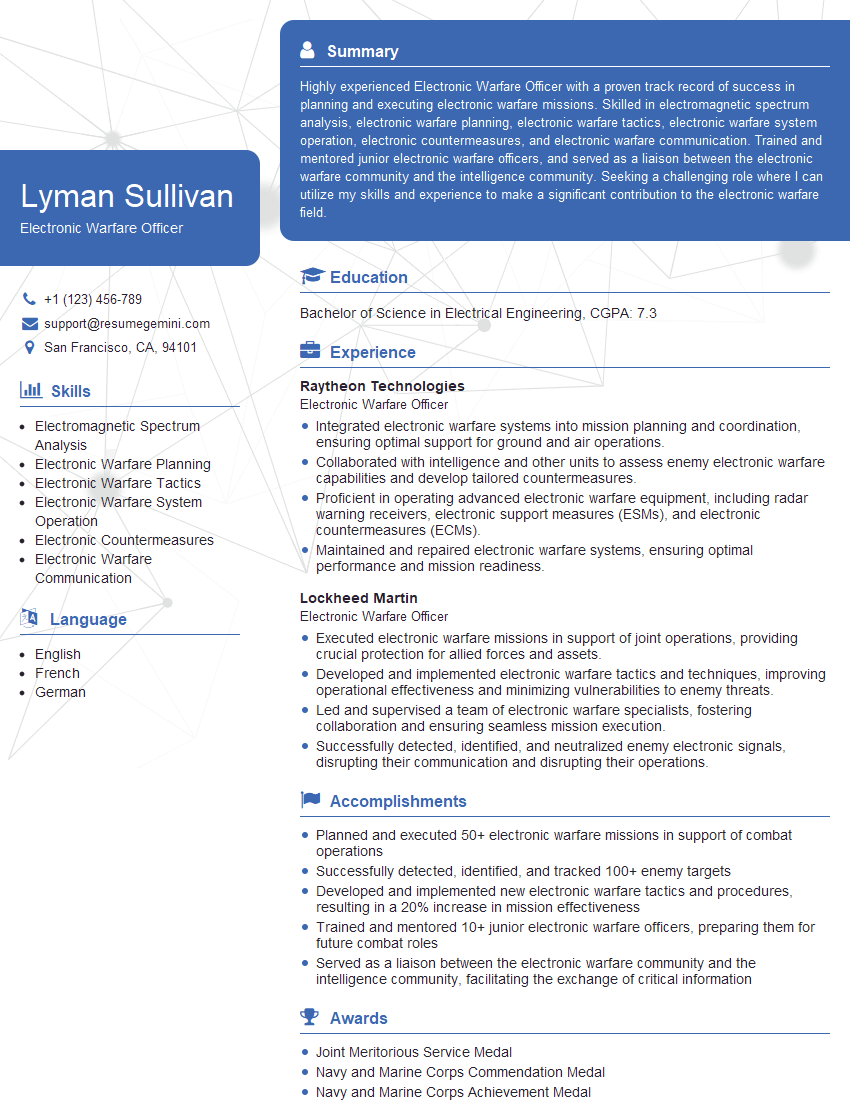
Mastering Communication Jamming opens doors to exciting and impactful careers in various sectors. A strong understanding of this field is highly sought after, leading to significant career growth and advancement opportunities. To maximize your job prospects, creating an ATS-friendly resume is crucial. ResumeGemini is a trusted resource that can help you build a professional resume tailored to highlight your skills and experience in Communication Jamming. We provide examples of resumes specifically designed for this field to give you a head start. Invest time in crafting a compelling resume—it’s your first impression with potential employers.
Explore more articles
Users Rating of Our Blogs
Share Your Experience
We value your feedback! Please rate our content and share your thoughts (optional).
What Readers Say About Our Blog
Very informative content, great job.
good