Every successful interview starts with knowing what to expect. In this blog, we’ll take you through the top Communication with Train Crews interview questions, breaking them down with expert tips to help you deliver impactful answers. Step into your next interview fully prepared and ready to succeed.
Questions Asked in Communication with Train Crews Interview
Q 1. Describe the standard communication protocols used for train crew dispatch.
Standard communication protocols for train crew dispatch are multifaceted and depend heavily on the specific railway system and technological capabilities. However, some common elements include:
- Two-way radios: These are the primary means of communication, providing near-instantaneous contact between dispatchers and train crews. Messages are typically short, clear, and follow a standardized format. For example, a dispatcher might say:
Train 123, proceed to signal 47 at restricted speed of 25 mph. - Telephone systems: Used for longer, more complex communications, particularly when detailed information needs to be conveyed or when radio communication is compromised. This could involve reporting accidents or scheduling changes.
- Computer-based systems: These are increasingly common, offering electronic train orders, schedules, and track information. Dispatchers can send messages and track train positions through these systems. This often creates a digital audit trail.
- Automatic Train Control (ATC) systems: Advanced systems that automatically control train speed and signaling, reducing the need for constant manual communication, but still needing supplementary verbal communications for safety and operational reasons.
Effective communication requires adherence to established procedures, ensuring clarity and avoiding ambiguity. Regular training and testing are crucial to maintaining proficiency in using these systems.
Q 2. Explain the importance of clear and concise language in train crew communication.
Clear and concise language is paramount in train crew communication because lives and property depend on its accuracy. Ambiguity can lead to misunderstandings that have potentially disastrous consequences. Think of it like this: a single misplaced word in a surgical instruction could have catastrophic effects – the same applies to train operations.
- Precision: Every word must convey its intended meaning without room for misinterpretation. Using standard terminology and avoiding slang or colloquialisms is crucial.
- Brevity: Time is of the essence, especially in emergencies. Messages should be succinct, eliminating unnecessary words while retaining all essential information.
- Confirmation: Always ensure the message was received and understood correctly. The crew should repeat back the critical elements of the dispatch instruction, and the dispatcher should acknowledge.
Imagine a situation where a dispatcher sends an unclear message about a speed restriction. A slight misinterpretation could lead to a derailment. Clear communication prevents such catastrophic outcomes.
Q 3. How would you handle a situation where a train crew is experiencing communication difficulties?
Communication difficulties are serious and require immediate attention. My approach would follow these steps:
- Identify the problem: Determine the cause of the communication failure – is it a radio malfunction, a geographical dead zone, or a problem with the crew’s equipment?
- Utilize alternative methods: If the radio fails, try using a backup communication system, such as a telephone or pre-arranged meeting points for physical handoff of instructions.
- Escalate the issue: Inform supervisors and maintenance personnel about the communication problem to ensure a swift resolution. In a serious emergency, alternate contact means to reach the train crew might involve trying cell phones or other emergency communication systems.
- Implement safety procedures: If communication remains impossible, I would put in place appropriate safety measures, such as stopping train operations on the affected track segment, until communications are restored.
- Document the incident: Thoroughly record the details of the communication failure, including the time, location, methods attempted, and the outcome. This documentation is vital for investigation and future prevention.
The most important aspect is to prioritize safety and ensure that the train operates only when secure communication is re-established.
Q 4. What are the most critical safety-related communication elements in train operations?
Critical safety-related communication elements in train operations include:
- Speed restrictions: Clear and unambiguous communication of speed restrictions is crucial for preventing accidents.
- Track conditions: Reporting on track conditions, such as obstructions, maintenance work, or signal malfunctions.
- Emergency situations: Efficient communication during emergencies, such as derailments, collisions, or medical events, allows for rapid response and minimizes damage.
- Signal indications: Conveying the meaning of signals accurately, ensuring crews understand the permitted movements.
- Approaching trains: Communicating the location and speed of other trains to avoid potential collisions.
- Weather alerts: Warning crews of adverse weather conditions that may affect operations.
Failure in any of these areas can have devastating consequences. A clear, consistent, and reliable communication system is essential to ensure safe train operations.
Q 5. Describe your experience using various communication technologies in rail operations.
My experience encompasses a variety of communication technologies in rail operations, including:
- Conventional VHF radios: I’m proficient in using these radios for everyday communication, understanding their limitations in terms of range and interference.
- Digital radio systems: I have experience with systems that offer improved clarity and range, along with features like encryption and automated message logging.
- Train-to-ground communication systems: I’m familiar with systems that allow communication between the train and the central control center, providing real-time data and instructions. This could include cellular, satellite and other specialized systems.
- Computer-based dispatch systems: I’m proficient in using computer-based systems for receiving and sending electronic train orders, schedules, and track information.
I have used these technologies in various scenarios, from routine dispatch to emergency response, ensuring their effective and safe use.
Q 6. How do you ensure effective communication during emergency situations?
Effective communication during emergencies relies on pre-planned procedures and a clear understanding of roles and responsibilities. My approach includes:
- Prioritize information: Focus on conveying the most critical information first, such as the location of the emergency, the nature of the incident, and the number of casualties.
- Use clear and concise language: Avoid jargon or technical terms that may not be understood by everyone involved.
- Utilize all available communication channels: Utilize multiple methods for communication to ensure information reaches all relevant parties.
- Establish a command center: Designate a central point for coordinating emergency responses.
- Maintain accurate records: Document all communication and actions taken.
Regular emergency drills and simulations are critical for ensuring efficient and coordinated responses during emergencies.
Q 7. Explain the difference between routine and emergency communication procedures.
Routine communication involves the day-to-day exchange of information related to train operations, such as scheduling, track conditions, and speed restrictions. Emergency communication, however, deals with urgent situations requiring immediate action to prevent accidents or mitigate the impact of unforeseen events.
- Routine Communication: Typically involves formal procedures with established protocols. It’s generally less time-sensitive and can use diverse communication methods.
- Emergency Communication: Follows a structured emergency response plan that prioritizes rapid and efficient information exchange. Communication is time-critical, and clear, concise, and unambiguous instructions are paramount. Radio is frequently the first means of communication, followed by phone or other means for coordination.
The key difference lies in the urgency and criticality of the situation. Routine communication focuses on efficiency and adherence to procedures, whereas emergency communication focuses on speed, clarity, and coordination to save lives and prevent major incidents.
Q 8. How do you prioritize communication tasks during high-pressure situations?
Prioritizing communication during high-pressure situations in rail operations requires a structured approach. Think of it like a triage system in a hospital – the most critical needs get immediate attention. My strategy involves a three-step process: Identify, Prioritize, and Execute.
- Identify: Quickly assess the situation to understand the immediate threats and risks. Is there an imminent safety hazard? Are there delays affecting a significant number of passengers or freight? This initial assessment guides the urgency.
- Prioritize: Once threats are identified, I prioritize messages based on their impact on safety and operational efficiency. Safety-critical messages, such as emergency instructions or immediate hazard warnings, always take precedence. For example, an instruction to stop a train due to a track obstruction is far more critical than an update about a minor delay.
- Execute: I use clear, concise language and confirm receipt and understanding. I employ established protocols for addressing safety-critical issues, such as repeating back instructions in the case of emergency stops.
For instance, if I receive multiple messages simultaneously – a report of a signal failure, a request for schedule adjustment, and a report of a minor equipment malfunction – I’d immediately address the signal failure, then the schedule adjustment (if it affects safety or significantly impacts operations), and finally the equipment malfunction. This ensures that the most critical information is handled first, maintaining safety and minimizing disruptions.
Q 9. What are some common communication barriers in rail operations, and how do you overcome them?
Communication barriers in rail operations are common and can be incredibly dangerous. These can stem from environmental factors, technological limitations, or human error. Some examples include:
- Noise and interference: Radio communication can be affected by background noise, static, or other radio signals, making it difficult to understand messages clearly.
- Jargon and technical terms: Using overly technical language that a crew may not understand can lead to misinterpretations.
- Language barriers: If crew members aren’t fluent in the language used for communication, it becomes crucial to ensure clear, concise messaging without ambiguity.
- Poor radio etiquette: Simultaneous transmission of multiple radios can cause interference and make clear communication impossible.
To overcome these, I use several strategies:
- Clear and concise language: I avoid jargon, use plain language, and speak slowly and clearly.
- Use of standard operating procedures: Adherence to standardized communication protocols ensures consistency and reduces ambiguity.
- Confirmation of message receipt and understanding: Requesting read-backs for critical instructions is paramount. This ensures that what I say is what the crew receives and interprets correctly.
- Regular radio checks: Testing the radio and confirming its functionality before each shift helps minimize communication disruptions.
- Training and education: Investing in regular training for all personnel on proper radio communication procedures is crucial for ensuring consistent communication quality and safety.
Q 10. How do you verify that a message has been received and understood by the train crew?
Verifying message receipt and understanding is critical. It’s not enough to simply send a message; you need confirmation that it has been received and understood correctly. My method involves:
- Read-backs: For crucial instructions, I always ask the crew to read back the message verbatim. This ensures they heard me correctly and understood the instructions.
- Confirmation questions: I might ask clarifying questions like, “Can you confirm you understand the speed restriction of 15 mph until mile marker 42?” This active verification goes beyond a simple read-back.
- Observation and monitoring: Where possible, I observe the train’s actions to ensure that they’re complying with the instructions given. For example, if I instruct them to proceed slowly through a certain area, I’ll monitor their speed using available tracking systems.
- Use of alternative communication methods: In cases of persistent communication issues, I will explore alternate methods of communication such as telephone or a secondary dispatch channel.
For example, instructing a train to stop immediately requires a read-back confirmation: “Train 123, stop immediately at the next available safe location. Train 123, read back.” The crew should respond: “Stopping at next available safe location.”
Q 11. Describe your experience using radio communication systems for train dispatch.
My experience with radio communication systems for train dispatching spans over [Number] years. I’m proficient in using various systems, including [List specific systems, e.g., Motorola, Kenwood], and understand their limitations. I’m familiar with frequency allocation, channel selection, and emergency procedures. My approach prioritizes clarity, conciseness, and safety.
I’ve handled diverse situations, from routine scheduling updates to emergency responses involving track obstructions, signal malfunctions, or medical emergencies on board. In each instance, my focus remains on clear and concise communication to ensure the safety of the train crew, passengers, and the rail network as a whole. I know the importance of proper radio etiquette, such as avoiding interrupting other transmissions and using standardized phrases for specific situations to avoid misunderstandings.
A memorable experience involved a sudden signal failure during a heavy storm. Utilizing the backup communication channels and following established emergency procedures, I safely guided multiple trains to a halt, preventing a potential collision. The use of clear, concise, and repeated instructions under stress highlights the importance of rigorous training and a calm demeanor in this demanding role.
Q 12. How do you adapt your communication style to different train crew members?
Adapting communication style is essential. I tailor my approach based on individual crew members’ experience levels and communication preferences. This isn’t about altering the accuracy of the information; it’s about the delivery.
- Experienced crews: With experienced crews, I can use more concise language and assume a higher level of familiarity with railway terminology and procedures.
- Newer crews: With newer crews, I employ more detailed explanations, ensure clear and simple language, and take extra care to verify their understanding. I might ask for repetition to confirm comprehension.
- Communication preferences: While maintaining clarity, I try to be mindful of individual communication preferences. Some crew members may prefer detailed instructions, whereas others are more comfortable with concise commands.
For instance, while instructing a veteran crew on a minor track diversion, I might use concise phrasing like, “Divert to Track 3 at mile marker 17.” However, with a newly trained crew, I’d add more detail: “At mile marker 17, please divert to Track 3. There will be a temporary speed reduction of 20 mph in the diverted section. Please confirm understanding before proceeding.”
Q 13. How would you handle a situation where a train crew misunderstands an instruction?
Misunderstandings are inevitable; the key is effective remedial action. My approach involves:
- Immediate clarification: I would immediately seek to clarify the misunderstanding by politely asking the crew to repeat the instructions they received. This establishes what they interpreted.
- Rephrasing instructions: I’d rephrase the instructions using different words or a simpler explanation, avoiding railway jargon if used previously. Clarity is paramount.
- Verify understanding: I’d again request a read-back to ensure the instructions are now completely clear. I might use open-ended questions to probe their understanding.
- Alternative communication: If the misunderstanding persists, I’d consider using alternate communication methods, such as a phone call or a visual aid (if feasible), to improve comprehension.
- Documentation: I’d meticulously document the incident, including the original instruction, the misunderstanding, the corrective actions taken, and the final confirmed understanding by the crew.
For instance, if the crew misunderstood a speed restriction, I would not only re-explain the restriction but also mention the reason for it (e.g., ongoing track maintenance) to reinforce the importance of adhering to it.
Q 14. What are your strategies for ensuring effective communication across different departments within a rail organization?
Effective cross-departmental communication is vital in rail operations. My strategies focus on:
- Establish clear communication channels: Defining specific communication channels and protocols for information sharing between different departments ensures a streamlined process and reduces the likelihood of miscommunication. This can include regular meetings, email distribution lists, and shared online platforms.
- Utilize shared technology platforms: Implementing centralized systems for information sharing (such as incident reporting systems, scheduling software) allows real-time updates and visibility across all departments.
- Regular training and coordination: Conducting regular cross-departmental training sessions or joint exercises enhances teamwork and coordination. Understanding how each department operates and its role within the overall operational workflow is crucial for improving communication and collaboration.
- Promote open communication and feedback mechanisms: Establishing clear feedback mechanisms enables the quick identification and resolution of communication breakdowns and fosters continuous improvement.
For example, if there’s a planned track maintenance, the maintenance department needs to communicate clearly with dispatch, operations, and potentially marketing (to inform passengers of possible delays) well in advance. Utilizing a shared platform for disseminating this information ensures that everyone is informed, reducing the risk of delays and potential accidents.
Q 15. Explain the importance of recording and documenting all train crew communication.
Recording and documenting all train crew communication is paramount for safety, operational efficiency, and regulatory compliance. It provides a crucial audit trail for investigating incidents, identifying areas for improvement, and ensuring accountability. Think of it like a flight recorder for trains – it captures everything that happens, allowing us to learn from both successes and near misses.
- Safety Investigations: In the event of an accident or near-miss, communication logs are essential for reconstructing the events leading up to the incident, identifying contributing factors, and preventing future occurrences. For example, a misunderstanding relayed via radio could be pinpointed and addressed.
- Performance Monitoring: Analyzing communication patterns can reveal inefficiencies in procedures or highlight areas where training is needed. We can track response times, clarity of communication, and adherence to protocols.
- Regulatory Compliance: Many rail regulations mandate the recording and retention of crew communications for a specified period. This ensures transparency and demonstrates adherence to safety standards.
Career Expert Tips:
- Ace those interviews! Prepare effectively by reviewing the Top 50 Most Common Interview Questions on ResumeGemini.
- Navigate your job search with confidence! Explore a wide range of Career Tips on ResumeGemini. Learn about common challenges and recommendations to overcome them.
- Craft the perfect resume! Master the Art of Resume Writing with ResumeGemini’s guide. Showcase your unique qualifications and achievements effectively.
- Don’t miss out on holiday savings! Build your dream resume with ResumeGemini’s ATS optimized templates.
Q 16. How do you maintain accurate and timely communication logs?
Maintaining accurate and timely communication logs requires a structured approach. We utilize a combination of automated systems and manual procedures to ensure completeness and reliability.
- Automated Logging Systems: Modern train dispatching systems often integrate recording capabilities for radio and telephone communications. These systems automatically timestamp and store conversations.
- Manual Log Entries: For communications that aren’t automatically captured, such as brief SMS exchanges or hand-written notes from on-site observations, meticulous manual logging is crucial. Clear, concise notes including date, time, sender, receiver, and the content of the communication are essential.
- Regular Audits: Periodic audits ensure that logs are complete, accurate, and readily accessible. Any discrepancies are investigated and corrected immediately.
- Secure Storage: Communication logs are stored securely, adhering to data protection and retention policies.
Q 17. Describe your knowledge of different communication channels used in rail operations (e.g., radio, telephone, SMS).
Rail operations employ various communication channels, each with its strengths and limitations.
- Train Radio: This is the primary communication method for immediate interaction between train crews and dispatchers. It’s vital for relaying critical information, such as speed restrictions, track conditions, and instructions concerning movement.
- Telephone: Used for more detailed conversations and non-urgent communications. It’s particularly useful for discussions involving multiple parties or complex situations.
- SMS (Text Messaging): While not ideal for time-sensitive information, SMS can be useful for confirming instructions or relaying less urgent updates. However, its use is limited due to its asynchronous nature and lack of immediate feedback.
- Computerized Dispatching Systems: These systems allow dispatchers to monitor train movements in real-time, communicate with crews electronically, and generate reports. They often integrate with other communication channels.
Choosing the appropriate channel depends on the urgency, complexity, and nature of the information being conveyed. Clear guidelines are established to ensure everyone understands when to use each channel.
Q 18. How would you train new employees on effective communication protocols?
Training new employees on effective communication protocols involves a multi-faceted approach that emphasizes both theoretical knowledge and practical application.
- Classroom Instruction: Initial training covers the various communication channels available, their limitations, and appropriate usage guidelines. It also emphasizes the importance of clear, concise, and unambiguous language.
- Simulated Scenarios: Real-life scenarios are simulated using mock dispatching systems and role-playing exercises to give trainees experience in handling different communication situations under pressure.
- On-the-Job Training: New employees are paired with experienced personnel for supervised on-the-job training, where they observe and participate in real-world communication activities.
- Regular Refresher Courses: Regular refresher courses reinforce best practices and address any changes in procedures or regulations.
- Performance Feedback: Continuous monitoring and feedback are provided to identify areas for improvement and ensure consistent adherence to protocols.
Q 19. What measures do you take to prevent communication errors?
Preventing communication errors necessitates a proactive approach involving technological safeguards, robust procedures, and effective training.
- Redundant Communication Systems: Multiple communication channels are utilized to provide backup in case of system failures.
- Clear Communication Procedures: Standardized procedures and checklists ensure that communications are consistent, unambiguous, and complete.
- Read-Back Procedures: Critical instructions are always repeated back to confirm understanding, reducing the risk of misinterpretations. For example, “Dispatcher to Train 123: Proceed to signal 45 at 15 mph. Train 123, please read back.”
- Regular System Checks: Communication equipment and systems are regularly checked to ensure they are functioning correctly.
- Use of Standard Terminology: Employing consistent terminology minimizes ambiguity and misunderstandings.
Q 20. How do you ensure all communication is compliant with relevant regulations and standards?
Ensuring compliance with relevant regulations and standards is a fundamental aspect of our operations. This involves staying updated on the latest rules and incorporating them into our communication protocols and training materials.
- Regular Regulatory Updates: We actively monitor changes in federal and industry regulations related to train crew communications.
- Internal Audits: Regular internal audits assess our compliance with these regulations and identify areas for improvement.
- Documentation: We maintain meticulous records of all communications, ensuring they meet regulatory retention requirements.
- Training Programs: Our training programs cover relevant regulatory aspects of train crew communications, highlighting best practices and emphasizing compliance.
Non-compliance can lead to severe penalties, safety risks, and operational disruptions; therefore, maintaining a robust compliance framework is crucial.
Q 21. Describe your experience using computerized dispatching systems.
I have extensive experience using computerized dispatching systems. These systems revolutionize train operations by providing real-time tracking, automated scheduling, and enhanced communication capabilities.
- Real-time Train Monitoring: The system provides a dynamic view of train locations, speeds, and status, facilitating efficient management of train movements and resource allocation.
- Automated Scheduling: Computerized systems can optimize train schedules, minimizing delays and maximizing efficiency.
- Electronic Messaging: The system allows for efficient and secure electronic messaging between dispatchers and train crews, supplementing traditional radio communications.
- Reporting and Data Analysis: The systems generate comprehensive reports that help analyze operational data, identify trends, and improve overall efficiency.
My experience includes proficiency in various dispatching software packages, understanding their functionalities, and effectively leveraging their capabilities to ensure safe and efficient rail operations.
Q 22. How do you handle conflicting communication from different sources?
Conflicting communication is a serious issue in rail operations, potentially leading to safety hazards and operational inefficiencies. My approach involves prioritizing information based on source credibility and urgency. I’d first identify the source of each communication, verifying its legitimacy (e.g., official dispatcher, automated system, crew report). Then, I’d analyze the content of each message, looking for inconsistencies or contradictory instructions. In cases of conflicting information from equally credible sources, I’d immediately escalate the issue to a senior manager for resolution, ensuring all parties involved are kept informed. For example, if a dispatcher gives instructions that differ from a pre-planned schedule, I would immediately confirm the discrepancy with both the dispatcher and the train crew, ensuring a clear understanding and a unified course of action is established before proceeding. Clear and concise communication is key to resolving these conflicts quickly and safely.
Q 23. What are the key performance indicators for effective train crew communication?
Key Performance Indicators (KPIs) for effective train crew communication focus on safety, efficiency, and compliance. These include:
- On-time performance: A high percentage of trains arriving and departing on schedule, indicating clear and timely communication throughout the process.
- Incident rate: A low number of communication-related incidents, signifying effective procedures and clear communication channels.
- Communication response time: Measured in the speed of acknowledgement and resolution to communication requests or alerts. Quick response is critical in emergency situations.
- Crew satisfaction surveys: Feedback on communication clarity, ease of access to information, and responsiveness from dispatchers and other operational teams.
- Compliance with regulations: Adherence to all communication protocols and safety regulations, confirmed through audits and reviews.
Tracking these KPIs helps identify areas for improvement in communication systems and practices. For instance, a high incident rate might indicate a need for enhanced training or improved communication technologies.
Q 24. How would you troubleshoot technical problems affecting communication systems?
Troubleshooting communication system problems requires a systematic approach. I would start by identifying the nature and scope of the problem. Is it affecting all crews, a specific location, or just one communication channel? My approach involves:
- Check for obvious issues: Verify power supply, cable connections, and the functionality of radios and other equipment.
- Isolate the problem: Determine whether the issue is hardware-related (e.g., faulty radio, damaged cables) or software-related (e.g., system glitches, software bugs).
- Consult documentation and support resources: Review system manuals, troubleshooting guides, and contact technical support for assistance.
- Implement temporary solutions: While waiting for permanent fixes, use alternative communication methods (e.g., cell phones, backup communication systems) to ensure crew safety and operational continuity.
- Document all steps: Maintaining a detailed record of troubleshooting steps is crucial for future reference and to aid in more effective problem-solving in similar situations.
For example, if experiencing widespread radio failure, I’d systematically check the repeater system’s power supply and antenna, then progress to checking the radio equipment itself. Proper documentation of the failure and subsequent repairs is essential for preventing future occurrences and improving system reliability.
Q 25. Describe your experience with crisis communication management in rail operations.
Crisis communication in rail operations demands a calm, decisive, and well-coordinated response. I’ve been involved in several situations, including derailments and severe weather events. My experience emphasizes the importance of:
- Establishing a clear chain of command: Designating roles and responsibilities for communication ensures clarity and prevents misinformation.
- Utilizing multiple communication channels: Utilizing a combination of radios, phones, and emergency alert systems ensures message reach even amidst system failures.
- Providing timely and accurate information: Regularly updating all stakeholders (crews, emergency services, management, public) with accurate information, even if that information is limited, prevents rumors and helps maintain order.
- Maintaining a calm demeanor: This is crucial for instilling confidence and ensuring effective communication in stressful situations. Using clear, simple language and providing reassurance are vital.
During one derailment, I successfully coordinated communication across various teams, ensuring emergency services arrived promptly and all crew members were accounted for and safe. This involved seamlessly transmitting location data, coordinating rescue efforts, and maintaining constant communication with affected parties to provide real-time updates.
Q 26. Explain how you maintain a positive and collaborative relationship with train crews.
Building positive and collaborative relationships with train crews is critical for effective communication. My approach focuses on:
- Open and respectful communication: Active listening and valuing their input establishes trust and mutual respect.
- Proactive communication: Providing regular updates, even if there is no significant change, ensures transparency and keeps crews informed.
- Addressing concerns promptly: Quick and effective responses to crew concerns or complaints helps demonstrate that their well-being is valued.
- Recognizing contributions: Acknowledging and appreciating the dedication of crews boosts morale and encourages cooperation.
I regularly participate in crew meetings to gather feedback and discuss communication issues. This interactive dialogue fosters a supportive environment, improves communication efficiency and builds positive relationships.
Q 27. How do you contribute to a safe and efficient communication environment?
Contributing to a safe and efficient communication environment requires continuous effort. I actively promote:
- Regular training: Ensuring all personnel are well-trained on communication protocols, emergency procedures, and the use of communication technologies.
- Clear communication standards: Implementing and enforcing standard communication procedures, including the use of clear and concise language, proper terminology, and established channels.
- Effective technology: Advocating for and implementing reliable and updated communication technologies which facilitate effective and timely communication.
- Continuous improvement: Regularly reviewing communication processes and seeking feedback from all parties involved, to help pinpoint areas for improvement and refine existing procedures.
For example, I’ve implemented a new system for tracking and resolving communication issues, leading to improved response times and reduced errors.
Q 28. Describe a time you successfully resolved a communication-related problem in rail operations.
During a severe storm, the primary communication system experienced intermittent outages affecting a significant portion of the rail network. This created a high risk of accidents and operational delays. I immediately implemented a multi-pronged approach:
- Activated backup communication systems: We switched to backup satellite communication systems to maintain essential communication links.
- Established alternative communication routes: We utilized cell phones and landlines as supplementary means for relaying critical information.
- Implemented a tiered communication protocol: We prioritized information based on urgency, focusing on safety-critical messages.
- Provided regular updates to all stakeholders: We kept all parties, including crews, dispatchers, and management, continuously updated to minimize confusion and maintain operational awareness.
By rapidly adapting and implementing these strategies, we successfully mitigated communication disruptions, ensured safety, and minimized operational delays. This situation highlighted the importance of redundancy and flexibility in communication systems and the need for thorough crisis management plans.
Key Topics to Learn for Communication with Train Crews Interview
- Effective Verbal Communication: Mastering clear, concise, and unambiguous language in high-pressure situations. This includes understanding the importance of active listening and confirming understanding.
- Non-Verbal Communication in Rail Operations: Recognizing and interpreting hand signals, light signals, and other visual cues used in train communication. Understanding how these methods supplement verbal communication and ensure safety.
- Radio Communication Protocols: Familiarize yourself with standard operating procedures for using two-way radios, including proper etiquette, terminology, and emergency procedures. This includes understanding limitations and potential for miscommunication.
- Emergency Response Communication: Practice responding calmly and efficiently during emergencies, clearly conveying critical information to relevant parties while following established protocols.
- Technological Communication Tools: Understanding the role and application of various technological communication systems used in modern rail operations (e.g., train control systems, automated messaging).
- Conflict Resolution and Teamwork: Develop skills in resolving communication breakdowns and managing conflicts within a team environment, prioritizing safety and operational efficiency.
- Documentation and Reporting: Understand the importance of accurate and timely documentation of all communication relevant to train operations, including incidents and near misses.
- Regulatory Compliance: Be aware of relevant regulations and guidelines concerning communication practices in rail transport.
Next Steps
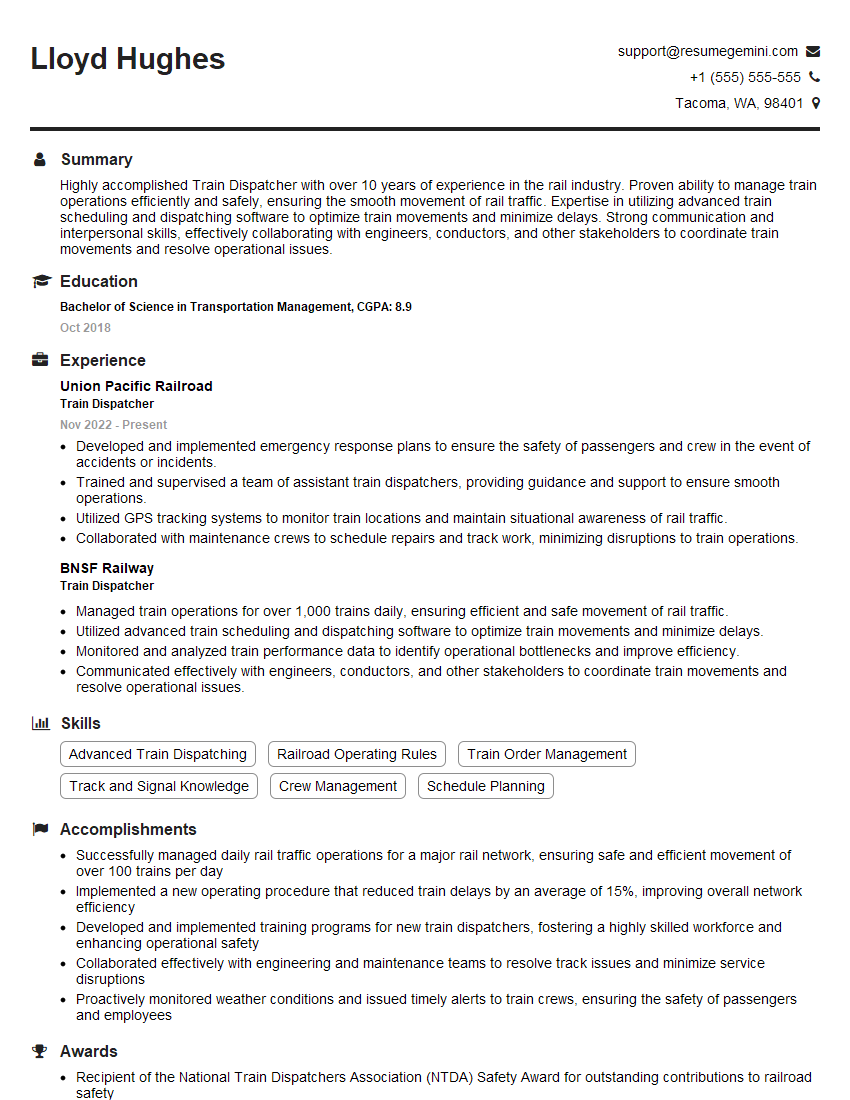
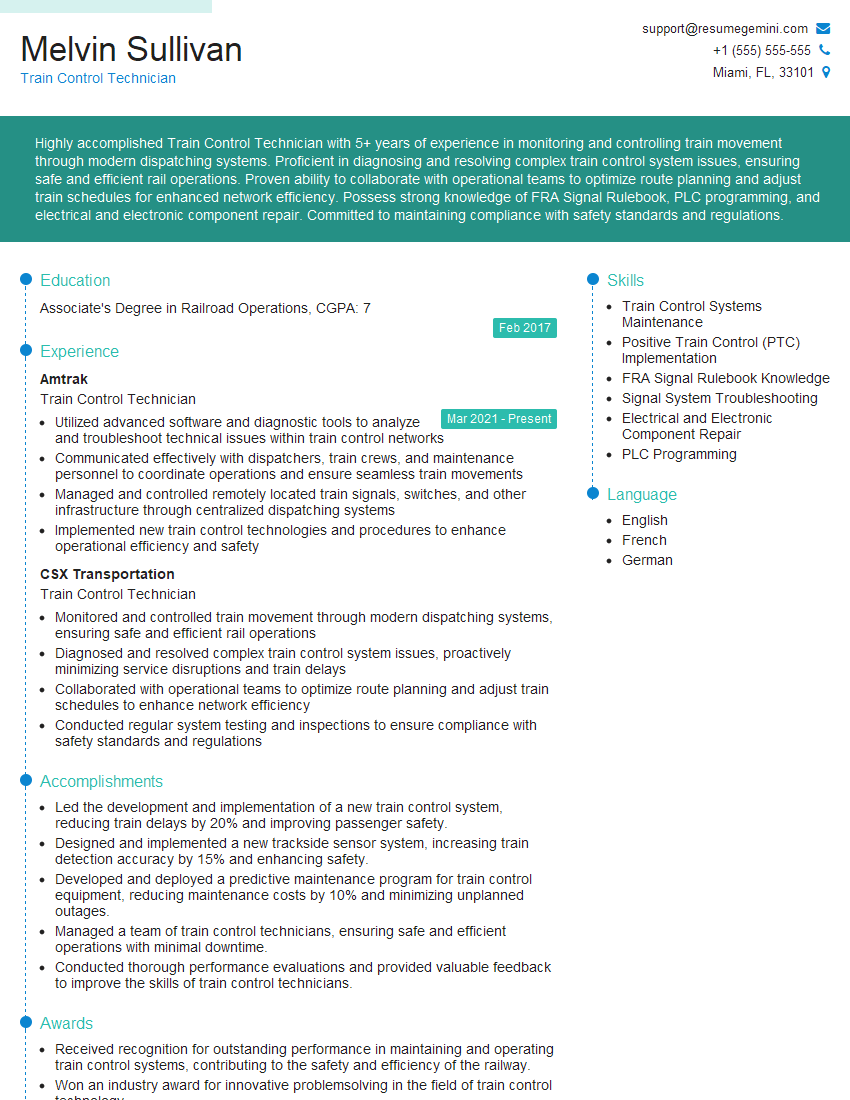
Mastering communication with train crews is vital for a successful and fulfilling career in the rail industry. Clear and effective communication ensures safety, efficiency, and seamless operations. This directly impacts your ability to contribute meaningfully to a team and advance professionally. To maximize your job prospects, creating a strong, ATS-friendly resume is crucial. ResumeGemini offers a powerful tool to build a professional resume that highlights your skills and experience effectively. We provide examples of resumes tailored to Communication with Train Crews to help you present your qualifications in the best possible light. Take the next step toward your dream career – build your resume with ResumeGemini today.
Explore more articles
Users Rating of Our Blogs
Share Your Experience
We value your feedback! Please rate our content and share your thoughts (optional).
What Readers Say About Our Blog
Very informative content, great job.
good