The right preparation can turn an interview into an opportunity to showcase your expertise. This guide to Computer Literacy (Microsoft Office Suite, Irrigation Software) interview questions is your ultimate resource, providing key insights and tips to help you ace your responses and stand out as a top candidate.
Questions Asked in Computer Literacy (Microsoft Office Suite, Irrigation Software) Interview
Q 1. Describe your experience with Microsoft Excel, including pivot tables and data analysis.
Microsoft Excel is my go-to tool for data management and analysis. I’m highly proficient in all its core functions, but my expertise particularly lies in leveraging pivot tables and advanced analytical features. Think of a pivot table as a powerful, dynamic summary tool. It allows you to quickly summarize, analyze, explore, and present your data. For instance, if I have a spreadsheet with sales data across different regions, products, and time periods, I can use a pivot table to instantly see total sales by region, average sales per product, or sales trends over time. This is far more efficient than manually calculating and organizing this information. Beyond pivot tables, I’m adept at using functions like VLOOKUP, INDEX/MATCH for data retrieval, and various statistical functions for analysis. I’ve used these skills extensively to analyze irrigation system performance data, identifying trends in water usage and pinpointing areas for optimization. For example, I once used Excel to analyze sensor data from multiple irrigation zones, identifying a malfunctioning valve based on inconsistencies in water pressure and flow rate. The data visualization tools within Excel also allow for clear communication of findings to non-technical stakeholders.
Q 2. How proficient are you with Microsoft Word’s advanced features like mail merge and track changes?
I’m very comfortable with Microsoft Word’s advanced features, especially mail merge and track changes. Mail merge is invaluable for creating personalized documents, like sending customized irrigation system proposals to multiple clients. Instead of manually typing the same information repeatedly, I can create a template document and use mail merge to populate it with data from a spreadsheet or database. This saves considerable time and ensures consistency across all documents. Track changes, on the other hand, is essential for collaborative document editing. It’s like having a built-in version control system, allowing me to track revisions, see who made which changes, and accept or reject modifications as needed. This is crucial for team projects, ensuring everyone is on the same page and facilitating a clear audit trail of edits. I’ve used this extensively to collaborate with engineering teams on irrigation system design documents, ensuring all revisions are documented and reviewed.
Q 3. Explain your experience using Microsoft PowerPoint for presentations, including creating charts and animations.
PowerPoint is my go-to for creating compelling and informative presentations. My proficiency extends beyond basic slide creation; I’m skilled in incorporating charts, graphs, and animations to enhance engagement and clarity. For instance, I can create visually appealing charts to illustrate irrigation system efficiency data or use animations to highlight key components of a system design. The ability to create custom animations brings the presentation to life, making it more memorable for the audience. I’ve regularly used PowerPoint to present irrigation system designs to clients, demonstrating the benefits of my proposed solutions in a clear, concise, and engaging manner. My presentations incorporate data visualization best practices, ensuring the key insights are easily understood, even by those who aren’t familiar with the technical details of irrigation systems.
Q 4. What irrigation software programs are you familiar with?
I’m familiar with several irrigation software programs, including [Specific Software Name], [Another Software Name], and [Yet Another Software Name]. My experience spans both design and management software, giving me a holistic understanding of the irrigation process from initial design to ongoing maintenance.
Q 5. Describe your experience designing irrigation systems using [Specific Software Name].
My experience with [Specific Software Name] is extensive. I’ve used it to design various irrigation systems, from small residential projects to large-scale agricultural installations. The software’s capabilities allow for precise design and planning, considering factors like topography, soil type, and water source. I use its features to model water flow, calculate pressure drops, and optimize pipe sizing for efficiency. A recent project involved designing a drip irrigation system for a vineyard using [Specific Software Name]. The software’s tools helped me accurately determine the required number of emitters, their spacing, and the overall pipe layout to ensure uniform water distribution. This resulted in significant water savings and improved crop yield compared to traditional methods.
Q 6. How do you troubleshoot common irrigation system problems?
Troubleshooting irrigation system problems requires a systematic approach. I typically start by visually inspecting the system for obvious issues like leaks, clogged emitters, or damaged pipes. Then, I use diagnostic tools, such as pressure gauges and flow meters, to measure water pressure and flow rates at various points in the system. Discrepancies from expected values help pinpoint the problem’s location. For instance, a low pressure reading downstream might indicate a clogged filter or a partially closed valve. If the problem isn’t readily apparent, I might use data logging devices to monitor system performance over time, looking for patterns or anomalies that point to the cause. I often collaborate with technicians and contractors, leveraging their expertise to resolve complex issues. Documentation is key—meticulously recording all steps taken during troubleshooting is crucial for future reference and efficient problem-solving.
Q 7. Explain your understanding of water pressure and flow rates in irrigation systems.
Understanding water pressure and flow rates is fundamental to irrigation system design and maintenance. Water pressure is the force exerted by water within the system, typically measured in PSI (pounds per square inch). Flow rate is the volume of water passing a given point per unit time, often expressed in gallons per minute (GPM). These two factors are intrinsically linked; changes in one affect the other. For example, a reduction in pipe diameter will increase pressure but decrease flow rate. Accurate calculations of pressure and flow rate are crucial for selecting appropriate components like pumps, pipes, and emitters. Insufficient pressure can lead to inadequate water delivery, while excessive pressure can damage the system. I regularly use specialized software and engineering principles to ensure that the designed system provides the optimal pressure and flow rates to meet the specific needs of the application, avoiding both under-watering and over-watering conditions. This is vital for efficient water use and optimal plant health.
Q 8. Describe your experience with different irrigation methods (e.g., drip, sprinkler, etc.).
My experience encompasses a range of irrigation methods, each with its own strengths and weaknesses. I’ve worked extensively with drip irrigation, which delivers water directly to plant roots, minimizing water waste and maximizing efficiency, particularly useful in arid climates or for high-value crops. I’ve also worked with sprinkler systems, both conventional and more advanced types like center pivot and linear move. Sprinklers are versatile and suitable for larger areas, but can be less efficient due to evaporation and runoff. Finally, I have experience with surface irrigation methods like flood and furrow irrigation, which are simpler and cheaper but can be less efficient and prone to waterlogging. Choosing the right method often depends on factors like soil type, crop type, topography, and water availability. For example, in a vineyard with valuable grape vines, drip irrigation would be the preferred choice due to its precision and water-saving capabilities. Whereas, in a large field of wheat, a center pivot sprinkler system might be more economical and practical.
Q 9. How familiar are you with soil types and their impact on irrigation needs?
Understanding soil types is crucial for effective irrigation management. Different soils have varying water-holding capacities and drainage rates. For instance, sandy soils drain quickly, requiring more frequent but less intense watering. Clay soils, on the other hand, retain water longer and may be prone to waterlogging if over-irrigated. Silty soils fall somewhere in between. I use soil tests and data on soil texture to determine the appropriate irrigation schedule. I also consider factors like soil organic matter, which can significantly improve water retention. Ignoring these variations can lead to either underwatering, stressing the plants, or overwatering, leading to root rot and other issues. For example, a project involving sandy soil required a drip irrigation system with frequent, short watering cycles to prevent rapid water drainage.
Q 10. What are your experiences with scheduling and optimizing irrigation systems?
Scheduling and optimizing irrigation systems are key to efficient water use. I use a combination of methods including weather data, soil moisture sensors, and crop evapotranspiration (ET) models to create precise irrigation schedules. Many irrigation systems benefit from automation through specialized software. I’m proficient in using several irrigation scheduling software packages that allow for precise control over watering duration, frequency, and other parameters. Optimizing involves fine-tuning these schedules based on real-time data and feedback. For example, a recent project involved implementing a weather-based irrigation controller, which automatically adjusted watering schedules based on daily rainfall and evapotranspiration rates, resulting in a significant reduction in water usage without compromising crop yields.
Q 11. How do you manage irrigation data and reporting?
I manage irrigation data using a combination of methods. This often includes using dedicated irrigation management software that allows data logging and reporting. The software typically collects data from sensors and controllers, providing insights into water usage, soil moisture levels, and other parameters. This data is crucial for analysis, optimization, and generating reports to demonstrate efficiency and compliance. I also utilize spreadsheets (like Microsoft Excel) to organize, analyze, and visualize data for reports and presentations. Creating clear, concise reports is critical for stakeholders, demonstrating the effectiveness of the irrigation system and justifying investments in new technology or practices. For example, I’ve used data analysis to identify areas of a field that were consistently over-irrigated and adjusted the system accordingly, saving water and costs.
Q 12. Describe your experience with creating and maintaining irrigation maps and schematics.
Creating and maintaining irrigation maps and schematics is essential for effective system management. I use CAD software (Computer-Aided Design) and GIS software (Geographic Information Systems) to create detailed maps showing the location of irrigation components such as pumps, pipelines, valves, and sprinklers or emitters. These maps are used for planning, maintenance, and troubleshooting. Accurate schematics are essential for understanding the flow of water through the system. Regular updates are important to reflect changes in the system, such as the addition of new components or repairs. I also use these maps to identify potential problem areas, such as low-pressure zones or areas prone to clogging. For example, updating an irrigation map after a pipeline repair ensured that future maintenance was targeted and efficient.
Q 13. How do you ensure accurate water usage measurements and reporting?
Accurate water usage measurement and reporting are critical for both efficiency and compliance. I use a combination of methods including flow meters installed at key points in the system, which provide real-time data on water flow rates. Some systems also utilize smart water meters that provide detailed usage data, which can be accessed remotely. This data is combined with information from weather stations and soil moisture sensors to create a comprehensive picture of water usage. I regularly calibrate and maintain flow meters to ensure accuracy and report any discrepancies. Precise data is essential for analyzing water efficiency and identifying opportunities for improvement. For instance, through regular calibration of our flow meters, we noticed a leak in a main pipeline, which was promptly repaired resulting in significant water savings.
Q 14. Explain your understanding of water conservation techniques in irrigation.
Water conservation is paramount in irrigation. Several techniques enhance efficiency. Implementing soil moisture sensors allows for irrigation only when needed, avoiding unnecessary water application. Using drip or micro-sprinkler irrigation significantly reduces evaporation and runoff compared to traditional sprinkler systems. Selecting appropriate plant species suited to the climate and soil conditions reduces the overall water demand. Regular system maintenance ensures there are no leaks or blockages that waste water. Employing proper land leveling techniques reduces uneven water distribution. These methods contribute to better water management and reduce the environmental footprint of irrigation systems. For example, a recent project involved replacing an inefficient sprinkler system with a drip system, resulting in a 40% reduction in water consumption while maintaining crop yields.
Q 15. Describe your experience working with sensors and automated irrigation control systems.
My experience with sensors and automated irrigation control systems spans several years, encompassing both installation and management. I’m proficient in working with various sensor types, including soil moisture sensors, rain sensors, and flow meters. These sensors feed data into a central control system, which I typically manage using software like (mention specific software names, e.g., Weathermatic, Rain Bird, or similar). This allows for precise control over irrigation schedules, optimizing water usage and minimizing waste. For instance, I once worked on a project where we integrated soil moisture sensors with a central controller to create a truly automated system. The controller would only activate sprinklers in zones where the soil moisture fell below a pre-defined threshold, resulting in a 25% reduction in water consumption compared to a traditional timer-based system.
My expertise also extends to troubleshooting sensor malfunctions. I’m adept at identifying faulty sensors, understanding error codes, and replacing or repairing components as needed. For example, I recently resolved an issue where a cluster of soil moisture sensors were providing inconsistent readings. After careful analysis of the data and physical inspection of the sensors and their wiring, I discovered a damaged cable causing a short circuit. Replacing the faulty cable resolved the issue immediately.
Career Expert Tips:
- Ace those interviews! Prepare effectively by reviewing the Top 50 Most Common Interview Questions on ResumeGemini.
- Navigate your job search with confidence! Explore a wide range of Career Tips on ResumeGemini. Learn about common challenges and recommendations to overcome them.
- Craft the perfect resume! Master the Art of Resume Writing with ResumeGemini’s guide. Showcase your unique qualifications and achievements effectively.
- Don’t miss out on holiday savings! Build your dream resume with ResumeGemini’s ATS optimized templates.
Q 16. How do you handle conflicts or discrepancies in irrigation data?
Discrepancies in irrigation data are often a result of sensor malfunctions, data transmission errors, or environmental factors. My approach to resolving these conflicts involves a systematic process. First, I verify the data by comparing readings from multiple sensors in the same area. If inconsistencies persist, I inspect the sensors and their cabling for any physical damage. I also check the controller’s logs for any error messages or unusual events. For instance, a sudden drop in reported soil moisture might point to a leak in the irrigation line. If the issue persists after this investigation, I check the calibration of the sensors and software settings.
Sometimes, discrepancies can arise from external factors like unusually heavy rainfall. In such cases, I might temporarily adjust the irrigation schedule to account for the excess moisture. Ultimately, careful documentation and a thorough understanding of the entire irrigation system are essential for effectively identifying and resolving data discrepancies.
Q 17. What is your experience with maintaining irrigation system logs and records?
Maintaining accurate irrigation system logs and records is crucial for efficient operation, troubleshooting, and regulatory compliance. I’m experienced in using both digital and paper-based systems for record-keeping. I meticulously document all aspects of the system, including sensor readings, irrigation schedules, maintenance activities, repair logs, chemical applications (if applicable), and water usage data.
Digitally, I typically use spreadsheets (Excel) to track key performance indicators (KPIs) such as water usage, sensor readings, and maintenance costs. This allows for easy data analysis and report generation. Furthermore, I utilize the system’s built-in logging capabilities whenever available to capture real-time data on irrigation cycles, sensor readings, and system errors. I also maintain a detailed paper-based logbook for quick referencing and recording of immediate observations in case of system failures or unexpected issues, ensuring a comprehensive record of the system’s history and performance.
Q 18. How proficient are you with creating professional reports using Microsoft Word and Excel?
I’m highly proficient in creating professional reports using Microsoft Word and Excel. My experience includes generating reports on irrigation system performance, maintenance schedules, cost analysis, and project summaries. In Word, I use styles, tables, and formatting tools to create visually appealing and easily readable documents. In Excel, I leverage formulas, pivot tables, and charting features to analyze data, summarize key findings, and create insightful visualizations. For example, I regularly use Excel to create charts illustrating water consumption over time, allowing for effective identification of trends and potential areas for optimization.
I also know how to use these tools to create professional presentations, incorporating data visualizations to communicate findings clearly and effectively, helping stakeholders understand the system’s performance. I pay close attention to detail, ensuring the reports are accurate, well-organized, and follow a consistent formatting style.
Q 19. Describe a time you had to solve a complex irrigation system problem. What steps did you take?
In one instance, a large section of an irrigation system experienced a significant drop in water pressure. Initially, I suspected a main line leak. However, after checking pressure gauges at various points, I discovered the pressure drop was localized to a specific zone. This led me to systematically investigate that zone’s components: I started by checking the valves and pump pressure to eliminate those as potential sources. The problem persisted.
Next, I inspected the sprinkler heads, checking for blockages or damage. Eventually, I discovered a build-up of sediment in one of the buried pipelines, significantly restricting water flow. Using specialized equipment, I cleared the blockage. This resolved the issue and highlighted the importance of regular system maintenance and proactive identification of potential issues. The systematic approach was key, ruling out possibilities step by step.
Q 20. How do you prioritize tasks when managing multiple irrigation systems or projects?
When managing multiple irrigation systems or projects, I prioritize tasks based on several factors, including urgency, impact, and resource availability. I use a combination of tools and techniques to manage this effectively. I typically start by creating a detailed project schedule using software like Microsoft Project or a simple spreadsheet in Excel. This helps me visualize deadlines and dependencies between tasks. I then apply a prioritization framework such as the Eisenhower Matrix (urgent/important), which helps me categorize tasks based on their urgency and importance.
High-priority tasks, such as addressing immediate system failures or urgent maintenance requests, are tackled first. I might use a Kanban board or similar visual task management tool for tracking progress and ensuring efficient allocation of resources. Regular review and adjustments to the schedule are crucial to accommodate unforeseen issues or changes in priorities. Communication with stakeholders is also vital to manage expectations and ensure alignment.
Q 21. How would you explain the basics of irrigation to a non-technical audience?
Imagine your garden needs a drink. Irrigation is simply a way of giving your garden or field that drink in a controlled and efficient manner. Instead of using a watering can for each plant, we use a system of pipes, sprinklers, or drip lines to deliver water where it’s needed. This system can be automated to water only when necessary, saving water and ensuring plants get the right amount of moisture.
Think of it like a plumbing system for your plants, using sensors and controllers to make the process smart and efficient. These systems are designed to deliver water precisely where and when it’s needed, preventing water waste and optimizing plant growth – much like a precise watering schedule for a houseplant, only on a much larger scale.
Q 22. What are some common challenges in irrigation system management, and how would you address them?
Irrigation system management presents several key challenges. One common issue is water scarcity, especially in arid or semi-arid regions. This necessitates efficient irrigation techniques and careful water allocation. Another challenge is soil variability. Different soil types have varying water retention capacities, requiring tailored irrigation strategies to prevent overwatering or underwatering. Poor pressure regulation can lead to uneven water distribution, affecting crop yields. Lastly, sensor malfunction or inaccurate data from monitoring systems can lead to incorrect irrigation scheduling and significant water waste.
To address these challenges, I would employ a multi-pronged approach. For water scarcity, I would leverage data-driven irrigation scheduling using software that integrates real-time weather data, soil moisture sensors, and crop evapotranspiration models. This allows for precise water application based on actual needs. For soil variability, I would implement zone-based irrigation, dividing the field into zones with similar characteristics and applying different water amounts to each zone. Addressing pressure regulation issues involves regular inspection and maintenance of the entire system, including pressure regulators, valves, and pipelines. Finally, I would ensure regular calibration and maintenance of sensors and monitoring systems, supplemented by manual checks to ensure data accuracy.
Q 23. How familiar are you with industry regulations and compliance requirements for irrigation?
I’m very familiar with industry regulations and compliance requirements for irrigation. This includes adherence to local, state, and federal laws concerning water rights, environmental protection, and energy efficiency. My knowledge encompasses regulations on water usage permits, pesticide application, and the safe handling and disposal of irrigation chemicals. I also understand the importance of complying with guidelines set by organizations like the USDA and relevant water management districts. For example, I’m aware of regulations related to minimizing water runoff and preventing water pollution. My experience includes working on projects that required detailed documentation and reporting of water usage and compliance with various environmental permits. I’m adept at interpreting these regulations and ensuring all projects adhere to them.
Q 24. Describe your experience with collaborating with other professionals on irrigation projects.
Collaboration is crucial in irrigation projects. I’ve worked extensively with agronomists, engineers, contractors, and farmers. In one project, I collaborated with an agronomist to determine the optimal irrigation schedule for a specific crop based on its water requirements and soil conditions. With engineers, I’ve worked on the design and implementation of efficient irrigation systems, ensuring proper installation and functionality. My experience with contractors involves overseeing the installation and maintenance of equipment, ensuring adherence to quality standards. Finally, collaboration with farmers is essential to understand their specific needs, challenges, and farming practices to tailor the irrigation system effectively. Effective communication, open discussion, and a shared understanding of project goals are fundamental to successful collaboration, something I actively promote.
Q 25. What are your strategies for staying current with the latest advancements in irrigation technology?
Staying updated on the latest advancements in irrigation technology is a continuous process. I regularly attend industry conferences and workshops, such as those hosted by the Irrigation Association, to learn about new technologies and best practices. I subscribe to relevant industry publications and journals, and actively participate in online forums and communities to exchange information with peers. Furthermore, I utilize online resources and professional development courses to expand my knowledge on topics such as precision irrigation, water-efficient technologies, and remote sensing applications in irrigation management. I’m particularly interested in the application of IoT sensors and data analytics for improved irrigation scheduling and system optimization. This proactive approach helps me remain at the forefront of the field and deliver the most effective solutions for my clients.
Q 26. Explain your understanding of different irrigation system components and their functions.
Irrigation systems comprise several key components, each with specific functions. The water source (well, river, reservoir) provides the water for irrigation. Pumps move water from the source to the distribution network. Pipelines and conduits transport water across the field. Valves and controllers regulate water flow to individual zones or areas. Emitters (sprinklers, drip lines) deliver water to the plants. Sensors (soil moisture, weather) collect data to optimize irrigation schedules. Control systems (computers, software) manage the entire irrigation system, automating water delivery based on sensor data and pre-programmed schedules. A typical example might involve a centrifugal pump drawing water from a well, which then passes through a pressure regulator and solenoid valves controlled by a computer program. This program uses data from soil moisture sensors to determine when and how much water to deliver to each zone via drip lines.
Q 27. How do you handle unexpected issues or equipment malfunctions in an irrigation system?
Unexpected issues are part of irrigation system management. My approach involves a systematic troubleshooting process. First, I assess the problem, determining the affected area and symptoms. This often involves examining sensor data, checking water pressure, and visually inspecting equipment. Next, I isolate the cause of the malfunction – is it a clogged emitter, a faulty valve, or a power outage? Based on the diagnosis, I implement appropriate solutions, which might include clearing a blockage, replacing a faulty component, or restarting the control system. Accurate record-keeping is essential, documenting the issue, its cause, and the corrective actions taken. This not only aids in future troubleshooting but also allows for analysis of recurring problems and implementing preventative measures. Finally, I communicate any significant issues and resolutions to stakeholders, keeping them informed and minimizing disruption.
Q 28. How comfortable are you with performing routine maintenance and repairs on irrigation equipment?
I’m highly comfortable performing routine maintenance and repairs on irrigation equipment. My skills encompass tasks such as cleaning and inspecting emitters, replacing worn-out parts, checking and lubricating moving parts of pumps and valves, and calibrating sensors. I’m proficient in using various hand tools and specialized equipment required for maintenance. Preventive maintenance is a crucial part of my approach, scheduling regular inspections to identify potential problems before they escalate. I also keep detailed records of maintenance activities, including dates, tasks performed, and any parts replaced. This allows for efficient scheduling of future maintenance and helps in tracking the overall health and lifespan of the irrigation system. This experience allows me to both efficiently maintain existing systems and help clients choose long-lasting, easily maintained equipment in new installations.
Key Topics to Learn for Computer Literacy (Microsoft Office Suite, Irrigation Software) Interview
- Microsoft Word Proficiency: Mastering document creation, formatting, styles, tables, mail merge, and advanced features like track changes and collaboration tools. Consider practical applications like creating professional reports, proposals, or technical documentation.
- Microsoft Excel Expertise: Focus on data entry, formula creation (including advanced formulas like VLOOKUP and pivot tables), data analysis, charting, and data visualization techniques. Practice creating spreadsheets for managing irrigation schedules, analyzing water usage data, or tracking project budgets.
- Microsoft PowerPoint Presentations: Develop skills in creating compelling presentations, incorporating visuals, animations, and effective storytelling techniques. Think about how you could present irrigation system designs, project timelines, or data-driven insights.
- Irrigation Software Fundamentals: Understand the core functionalities of the specific irrigation software used by the employer (mention if known). This includes data input, system design, scheduling, monitoring, and reporting capabilities. Practice problem-solving scenarios related to system optimization and troubleshooting.
- Data Management and Analysis: Develop skills in organizing, cleaning, and analyzing data from various sources related to irrigation, including sensor data, weather data, and soil moisture data. This includes understanding data formats and using appropriate software tools for analysis and interpretation.
- Problem-Solving and Troubleshooting: Practice identifying and resolving common issues related to irrigation systems and software. Be prepared to discuss your approach to problem-solving, highlighting your analytical and critical thinking skills.
Next Steps
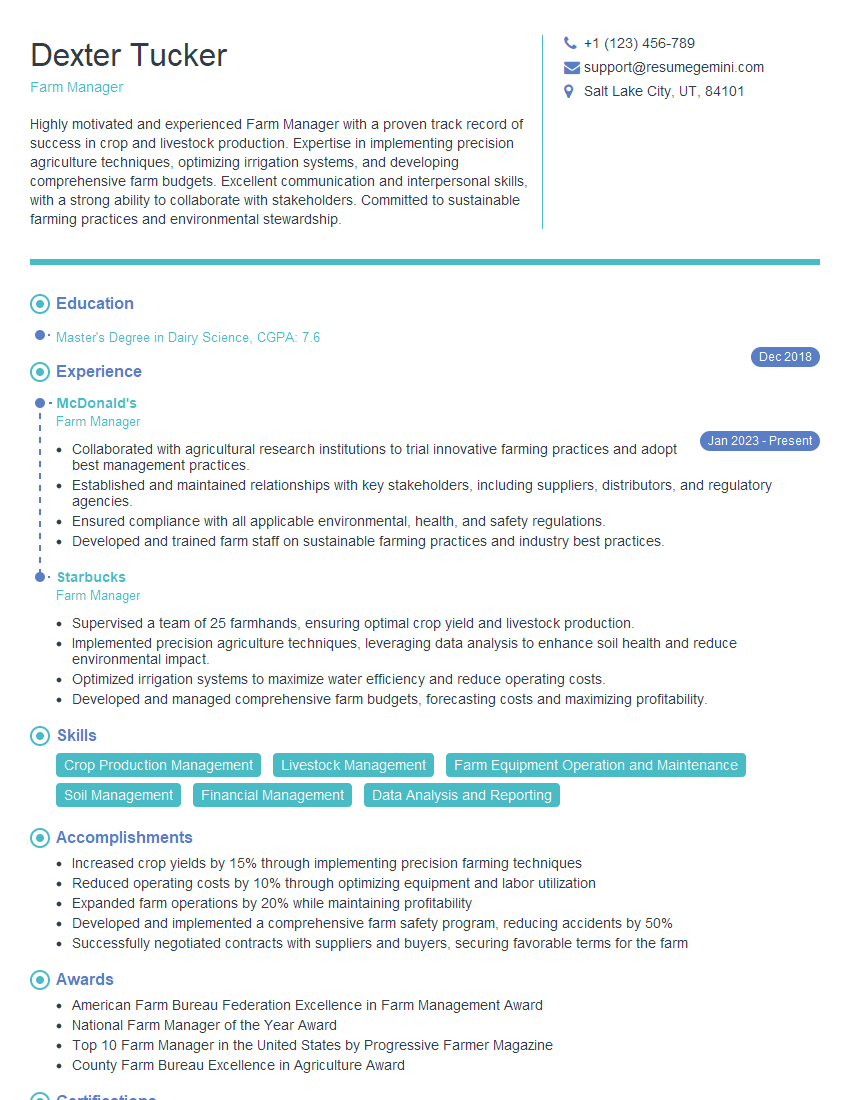
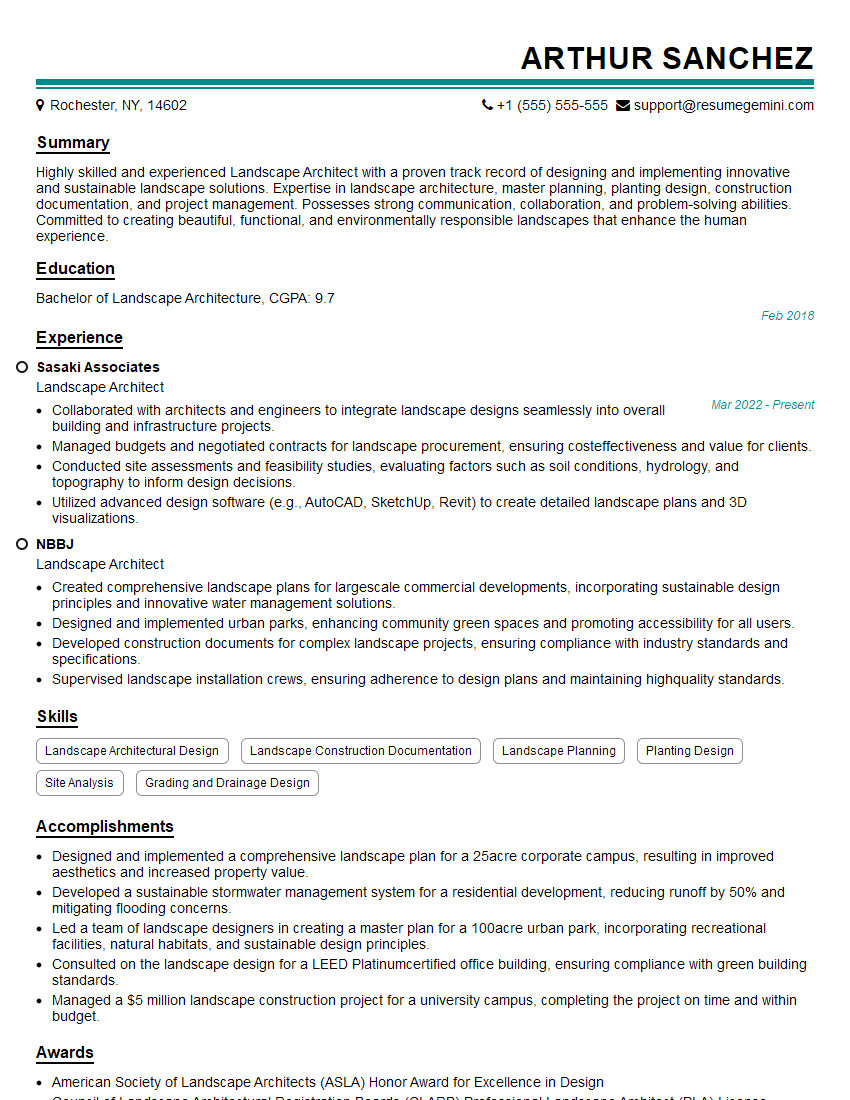
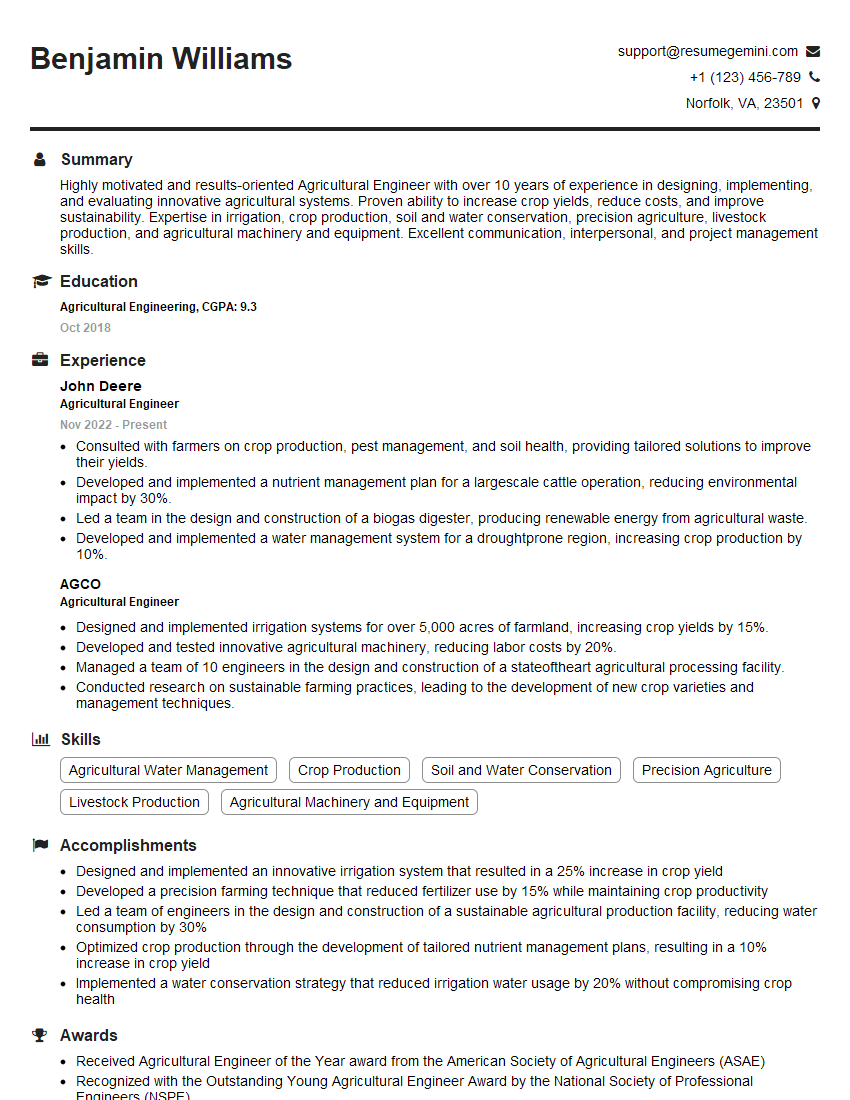
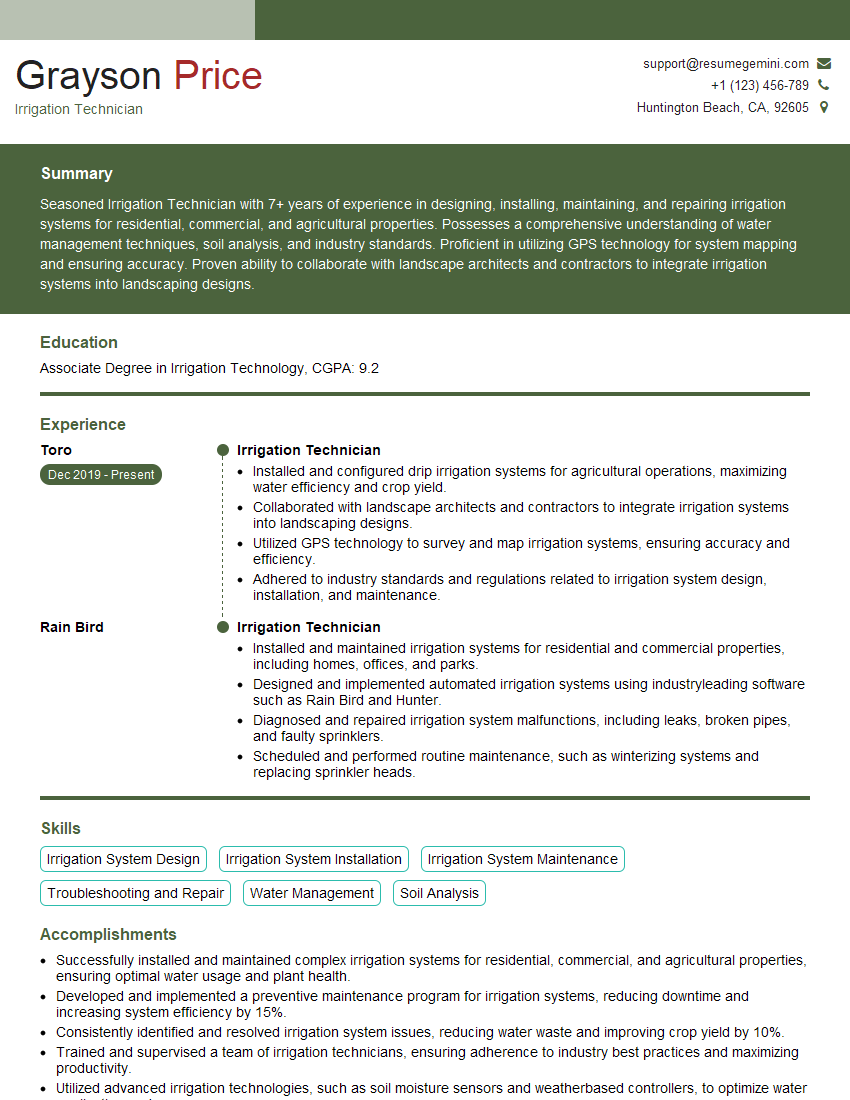
Mastering computer literacy, particularly in the Microsoft Office Suite and relevant irrigation software, is crucial for career advancement in this field. Strong computer skills demonstrate efficiency, accuracy, and the ability to manage complex data. To significantly boost your job prospects, it’s vital to create an ATS-friendly resume that effectively showcases your skills and experience. ResumeGemini is a trusted resource to help you build a professional and impactful resume that stands out from the competition. Examples of resumes tailored to Computer Literacy (Microsoft Office Suite, Irrigation Software) are available to help guide you through the process.

Explore more articles
Users Rating of Our Blogs
Share Your Experience
We value your feedback! Please rate our content and share your thoughts (optional).
What Readers Say About Our Blog
Very informative content, great job.
good