Every successful interview starts with knowing what to expect. In this blog, we’ll take you through the top Congregational Singing Leadership interview questions, breaking them down with expert tips to help you deliver impactful answers. Step into your next interview fully prepared and ready to succeed.
Questions Asked in Congregational Singing Leadership Interview
Q 1. Describe your experience leading congregational singing in various styles (hymns, contemporary worship, etc.).
My experience in leading congregational singing spans over fifteen years, encompassing a wide range of styles. I’ve led traditional hymn singing, incorporating both classic and lesser-known hymns, focusing on their theological depth and historical context. I’ve also led contemporary worship music, ranging from upbeat, modern anthems to more reflective, introspective songs. This requires adapting my style to the specific musical arrangement, sometimes utilizing a more spontaneous, less formal approach than with hymns. For example, during a traditional service, I might emphasize clear articulation and proper phrasing of the hymn text. In contrast, a contemporary worship setting might involve more dynamic phrasing and call-and-response elements to foster a sense of participation and engagement. I’ve also incorporated gospel music and spirituals into services, recognizing their rich history and powerful emotional resonance. The key is flexibility and a deep understanding of the nuances each style brings to the worship experience.
Q 2. How do you select appropriate music for different liturgical seasons and services?
Selecting appropriate music for different liturgical seasons and services requires careful consideration of the theological themes and emotional tone of the occasion. For example, during Advent, I would choose music emphasizing hope, anticipation, and the coming of Christ; this might include reflective hymns or contemporary songs with lyrics focusing on these themes. During Lent, the music might reflect themes of repentance, sacrifice, and reflection – perhaps more somber hymns or slower contemporary pieces. Easter services, on the other hand, call for joyful, celebratory music reflecting the resurrection, utilizing triumphant anthems and songs of praise. I also tailor my selections to the specific service. A children’s service might necessitate simpler, well-known songs with repetitive melodies and easily grasped lyrics. A more formal service might call for a more complex repertoire. I maintain a comprehensive library of music suitable for various occasions, and consult liturgical calendars and relevant theological resources to inform my choices.
Q 3. Explain your approach to teaching and encouraging congregational participation in singing.
My approach to teaching and encouraging congregational participation emphasizes creating a supportive and inclusive environment. I begin by modeling good vocal technique – proper breathing, posture, and articulation – through my own singing. I use simple, clear instructions, avoiding jargon. Visual cues, such as hand gestures to indicate tempo or dynamics, are also helpful. Repetition and familiarity are key; I often repeat songs or phrases until the congregation feels comfortable with them. I also encourage participation by making the music accessible. Providing lyric sheets with clear, large font is crucial. Projecting lyrics on a screen enhances visibility. For hymns, I might offer a brief historical or theological background to add depth and meaning, thereby connecting the congregation intellectually and emotionally to the song. A relaxed, encouraging atmosphere is vital to foster participation. Instead of harsh criticism, I use positive reinforcement to build confidence.
Q 4. What strategies do you employ to improve the vocal quality and blend of a congregation?
Improving the vocal quality and blend of a congregation requires a multifaceted approach. Firstly, clear and consistent leading is essential. I maintain a steady tempo and pitch, providing a clear model for the congregation to follow. Secondly, I encourage good vocal technique through simple exercises before the service begins – some gentle warm-ups for breath control and vocal range. I might subtly guide the congregation to a more unified sound by adjusting my own volume and tone to encourage balance across different sections of the congregation. Encouraging different voice parts to listen to one another and blend their voices can greatly enhance the overall sound. Finally, selecting appropriate music – songs with simpler melodies and accessible ranges – is crucial. Using a smaller group, perhaps a choir, to begin a piece can be an effective way to cue the congregation. Utilizing sound amplification with careful microphone placement can also improve the overall blend.
Q 5. How do you handle challenging singers or disruptive behaviors during services?
Handling challenging singers or disruptive behaviors requires patience, tact, and a pastoral approach. With challenging singers, I focus on encouragement and positive reinforcement. Private conversations can address specific vocal issues in a constructive manner. If a singer is struggling with pitch or rhythm, I might offer personalized guidance or suggest vocal exercises to help improve their skills. Disruptive behaviors require a more sensitive approach. I usually address the issue directly but gently, perhaps offering a word of encouragement or making a quiet request for them to be respectful to others. In persistent cases, I might involve other church leaders to provide support and address the situation more formally. The goal is to create an atmosphere of mutual respect and inclusivity where everyone feels welcome and comfortable.
Q 6. Describe your experience with leading rehearsals and managing a choir or vocal ensemble.
My experience with leading rehearsals and managing a choir or vocal ensemble involves a structured approach. Rehearsals are planned to achieve specific goals. I typically start with warm-ups to prepare the voices, followed by focused work on individual pieces. I provide clear instruction on vocal technique, interpretation, and musical style. I encourage active listening and collaborative learning among the members. I use constructive feedback to guide the ensemble toward a unified and expressive performance. I also value team building and create a supportive environment where members feel comfortable expressing their ideas and concerns. I understand the importance of balancing technical precision with the emotional expression that makes congregational singing meaningful and powerful.
Q 7. How do you adapt your leadership style to different age groups and musical abilities within a congregation?
Adapting my leadership style to different age groups and musical abilities involves flexibility and sensitivity. With younger children, I use simpler songs, lots of movement and visual aids, and keep rehearsals short and engaging. Teenagers often respond well to contemporary styles and more participatory approaches. Older adults may appreciate more traditional hymns and a slower pace. In terms of musical ability, I use a tiered approach, offering different levels of challenge within the same service. I might introduce a simple descant for those with more advanced vocal skills while keeping the main melody accessible to everyone. I always strive to include everyone, making sure that every voice feels valued and heard. It’s about creating a shared musical experience where everyone feels part of the whole, regardless of their age or musical skill.
Q 8. What software or technology are you proficient in using for music preparation and presentation?
For music preparation and presentation, I’m proficient in several software applications. My primary tools are Finale for notation and arrangement, and Logic Pro X for audio editing and production. I also utilize PowerPoint and Google Slides for creating visually engaging presentations of lyrics and chord charts. For managing digital music libraries and sharing files with the worship team, I rely on Dropbox and Google Drive. Finally, I’m comfortable using church management software like Planning Center Online to coordinate song selection and scheduling.
For example, I’ll often use Finale to create a custom arrangement of a hymn, adjusting the key or adding instrumental parts to suit our congregation’s strengths. Then, I might use Logic Pro X to add a subtle instrumental accompaniment, creating a richer sonic experience without overwhelming the congregational singing. Finally, the lyric and chord charts created in PowerPoint would be displayed via projector during the service.
Q 9. How do you incorporate technology (audio-visual aids, projection, etc.) into your services?
Technology plays a vital role in enhancing our congregational singing experience. We use a projector to display lyrics and chord charts, ensuring everyone can participate comfortably, regardless of their musical experience or sight-reading abilities. This also allows us to incorporate beautiful imagery or visual elements to complement the worship experience, enriching the emotional connection of the music. In addition, a high-quality sound system ensures clear audio for both vocalists and instrumentalists, allowing the music to be heard evenly throughout the sanctuary. We sometimes use video recordings of songs for learning or for integrating into special services, aiding in rehearsals or training.
For example, during a service focusing on missions, we might display images of mission work alongside the lyrics of a song about global outreach. This visual context significantly enhances the song’s impact and makes it more relatable for the congregation.
Q 10. Explain your understanding of music theory and its practical application in leading congregational singing.
A strong understanding of music theory is crucial for effective congregational singing leadership. It’s not about complex theoretical knowledge, but rather the practical application. This includes understanding key signatures, time signatures, chord progressions, and melodic phrasing. This knowledge enables me to select appropriate songs, transpose keys to suit the vocal range of the congregation, and offer helpful guidance to singers. I can easily identify potential challenges in a song and modify arrangements to address these issues. Understanding harmony allows me to support the congregation through skillful accompaniment, creating a balanced and pleasing sound.
For instance, if a song is too high for the congregation, I can easily transpose it to a more comfortable key using my understanding of key signatures and intervals. Similarly, identifying the key harmonic progression allows me to suggest simpler chord voicings that are easier for less experienced instrumentalists.
Q 11. How do you build relationships with other members of the worship team and the wider church community?
Building strong relationships is fundamental to effective congregational singing. I prioritize open communication and collaboration with all members of the worship team and the wider church community. This involves regular team meetings, informal social gatherings, and proactive communication through email and messaging platforms. I actively solicit feedback from the congregation and take it into consideration in my song selection and arrangements. I also make a point of personally getting to know individuals, recognizing their contributions, and celebrating their successes.
For example, I might organize a casual lunch or coffee break for the worship team to build camaraderie outside of the formal rehearsal setting. Or I might send a thank you note to individual musicians who consistently go above and beyond.
Q 12. Describe your experience with selecting and training volunteer musicians.
Selecting and training volunteer musicians involves a multi-step process. First, I actively seek out potential musicians within the church community. This may involve announcements during services, conversations with individual members, and collaborating with the church leadership. Once potential volunteers are identified, I arrange informal auditions or listening sessions where I can assess their skill level and musical style. The training program is tailored to the individual’s experience level, encompassing basic music theory, sight-reading techniques, and rehearsal etiquette. Regular feedback and constructive criticism are essential throughout the training process.
I remember one instance where a church member, with minimal musical experience, expressed interest in playing keyboard. I started with simple hymns in easy keys, gradually introducing more complex harmonies and rhythms. Through consistent practice and encouragement, this member became a valuable part of our worship team.
Q 13. How do you create a welcoming and inclusive environment for all participants in congregational singing?
Creating a welcoming and inclusive environment for congregational singing is paramount. I achieve this by selecting a diverse repertoire of music, encompassing various styles and genres to reflect the cultural diversity of our congregation. I make a conscious effort to include accessible songs that encourage participation from all skill levels. This includes utilizing chord charts, providing simple vocal arrangements, and choosing songs that allow for various instrumental accompaniment options. Furthermore, I foster a supportive and encouraging atmosphere during rehearsals and services, ensuring everyone feels comfortable and valued.
For example, we might include traditional hymns alongside contemporary Christian music, gospel songs, or even songs from other cultures. The aim is to ensure everyone feels represented and can participate meaningfully.
Q 14. What is your approach to managing the budget for music ministry resources?
Budget management for music ministry resources requires careful planning and prioritization. I start with a detailed annual budget outlining anticipated expenses, including sheet music purchases, instrument maintenance, software upgrades, and potential guest musician fees. I regularly explore cost-effective solutions, such as utilizing free online resources, collaborating with other churches to share resources, and seeking grants or donations. Transparent communication with church leadership regarding the budget is critical, ensuring their understanding and support for music ministry initiatives.
For example, instead of buying every new piece of music, I might explore borrowing scores from other churches or using readily available free arrangements. Regular maintenance of existing instruments can significantly reduce the need for expensive repairs or replacements.
Q 15. How do you assess the needs and preferences of your congregation regarding music selection?
Understanding my congregation’s musical preferences is paramount. I employ a multi-faceted approach. Firstly, I actively listen to informal conversations and feedback, paying attention to what songs congregants spontaneously hum or mention enjoying. Secondly, I conduct formal surveys, either via paper questionnaires or online forms, allowing for anonymous responses and a broader range of opinions. These surveys might include rating scales for familiar hymns, preferences for musical styles (e.g., traditional, contemporary, gospel), and open-ended questions about desired themes or emotions evoked by music. Finally, I observe congregational participation during services. Active singing, attentive listening, and enthusiastic responses to certain pieces provide invaluable real-time data. Analyzing this data helps me curate a repertoire that resonates deeply with the congregation, fostering a sense of shared worship and community.
For example, a survey revealed a strong preference for contemporary Christian music among younger members, while the older generation favored traditional hymns. This informed my approach to balancing the music selection, ensuring everyone feels included and engaged.
Career Expert Tips:
- Ace those interviews! Prepare effectively by reviewing the Top 50 Most Common Interview Questions on ResumeGemini.
- Navigate your job search with confidence! Explore a wide range of Career Tips on ResumeGemini. Learn about common challenges and recommendations to overcome them.
- Craft the perfect resume! Master the Art of Resume Writing with ResumeGemini’s guide. Showcase your unique qualifications and achievements effectively.
- Don’t miss out on holiday savings! Build your dream resume with ResumeGemini’s ATS optimized templates.
Q 16. Describe your experience in planning and implementing special music programs for holidays or events.
Planning special music programs requires meticulous organization and creativity. For holidays like Christmas or Easter, I start by identifying the thematic elements relevant to the celebration. Then, I select music reflecting those themes, considering a variety of styles to appeal to the broad spectrum of tastes within the congregation. This might involve collaborating with soloists, instrumentalists, or choirs, rehearsing extensively to achieve a polished performance. For example, for Christmas, we’ve organized programs featuring traditional carols, contemporary Christmas songs, and even orchestral pieces, involving the whole congregation in some numbers, creating a cohesive and meaningful experience. I meticulously manage schedules, resources, and communication with all participants, ensuring seamless execution. For events like weddings or funerals, I work closely with the family or individuals involved, understanding their musical preferences and integrating those into the service appropriately.
Q 17. How do you handle requests from congregants regarding specific song choices or musical styles?
Congregant requests are invaluable and deserve careful consideration. I approach them with openness and a willingness to explore options. If a request aligns with the overall worship style and thematic focus of the service, I’m happy to accommodate it. However, if it clashes with the overall liturgical context or is unsuitable for congregational singing, I engage in a respectful dialogue, explaining the reason for my decision and offering alternative suggestions. I might suggest a different arrangement of the requested song, or propose a similar song that fits the service better. The goal is to find a compromise that honors both the congregant’s request and the integrity of the worship experience. Transparency and clear communication are key to navigating these situations.
For instance, if a congregant requests a very upbeat, secular-sounding song during a solemn service, I might explain how the tone might not be suitable for that specific context, perhaps suggesting a more reflective song with similar lyrical themes.
Q 18. How do you maintain and grow your musical skills and knowledge?
Continuous professional development is crucial for a singing leader. I dedicate time to regularly practicing my own singing and instrumental skills, attending workshops and conferences related to choral conducting and music ministry. I actively engage in online learning platforms offering courses on music theory, composition, and vocal pedagogy. Furthermore, I frequently explore new music, listening to diverse genres and styles to broaden my knowledge base and identify potential additions to our repertoire. Collaborating with other musicians and sharing experiences enriches my understanding and inspires new ideas. This ongoing pursuit of knowledge ensures that my leadership remains fresh, relevant, and effective.
Q 19. What is your experience with copyright laws and music licensing?
Copyright laws and music licensing are critical aspects of my role. I am thoroughly familiar with the legal framework governing the performance and reproduction of copyrighted music. I ensure that all music used in our services is either in the public domain or appropriately licensed. This involves carefully examining music publications, obtaining licenses through organizations like CCLI (Christian Copyright Licensing International) or OneLicense, and diligently maintaining records of our licensed repertoire. Understanding and adhering to these regulations is not merely a legal obligation but also an ethical responsibility to protect the rights of songwriters and composers.
Q 20. How do you ensure accessibility for those with hearing or other physical limitations?
Accessibility is paramount. For those with hearing impairments, I ensure that lyrics are projected clearly using a large font size and adequate lighting. We use amplification systems with balanced volume levels to ensure clear audio across the sanctuary. For visually impaired members, printed song sheets are enlarged or made available in Braille, and verbal announcements are clear and concise. For those with mobility limitations, ensuring seating is readily available and easily accessible is essential. We proactively seek ways to make the worship experience inclusive for everyone, recognizing that everyone has a unique perspective and requires different accommodations to participate fully.
Q 21. Describe your approach to providing feedback to singers and musicians.
Providing constructive feedback is a vital component of fostering growth and improvement within the musical group. I aim to create a supportive and encouraging environment where feedback is welcomed as a means of advancement. My approach focuses on being specific and positive, highlighting strengths before addressing areas for improvement. I avoid generic or overly critical comments, instead concentrating on practical suggestions for improvement, focusing on technique, musicality, and interpretation. The feedback is always delivered privately and respectfully, taking into account the individual’s personality and learning style. Regular rehearsals provide opportunities for immediate feedback and ongoing mentorship.
For example, instead of saying “Your singing was flat,” I might say, “I noticed your pitch was slightly low in the last verse. Let’s focus on using your breath support to maintain a consistent tone across the range.”
Q 22. How do you handle disagreements or conflicts among members of the music team?
Disagreements within a music team are inevitable, but addressing them constructively is crucial for a harmonious and effective ministry. My approach prioritizes open communication and respectful dialogue. I believe in creating a safe space where team members feel comfortable expressing their opinions and concerns without fear of judgment.
- Active Listening: I begin by actively listening to each individual’s perspective, ensuring everyone feels heard and understood. This involves asking clarifying questions and reflecting back their feelings to validate their experiences.
- Collaborative Problem-Solving: Once all perspectives are understood, we collaboratively brainstorm solutions. This isn’t about finding a ‘winner’ but finding the best approach for the congregation’s needs and the overall musical vision. I often facilitate this process by asking questions like, ‘What are the potential benefits and drawbacks of each option?’ or ‘How can we incorporate everyone’s strengths to achieve our goals?’
- Seeking Common Ground: I emphasize identifying common goals and shared values. This helps to refocus the discussion away from individual differences and toward achieving a shared objective, enriching the worship experience.
- Mediation if Needed: In rare instances where conflict is particularly intense or unresolved, I will seek guidance from church leadership or consider bringing in an external mediator to facilitate a neutral and effective resolution.
For example, in one instance, a disagreement arose regarding the tempo of a particular hymn. By encouraging open discussion and emphasizing the importance of honoring both the traditional feel and the emotional impact of the song, we collaboratively settled on a tempo that satisfied the concerns of all team members.
Q 23. What are your strengths and weaknesses as a congregational singing leader?
My strengths as a congregational singing leader lie in my ability to connect with people through music, to build strong teams, and to adapt to diverse musical styles and preferences. I am adept at creating inclusive environments where everyone feels comfortable participating, regardless of their musical background or experience. I also possess a strong understanding of musical theory and arrangement, enabling me to effectively lead rehearsals and adapt music to suit the context of worship.
However, I recognize that my weakness is sometimes over-committing myself. My passion for music often leads me to take on additional responsibilities, which can lead to burnout. I am actively working on developing better time management and delegation skills to mitigate this.
Q 24. Describe your experience in working with diverse musical traditions or cultures.
My experience working with diverse musical traditions is extensive. I have had the opportunity to incorporate elements from Gospel, traditional hymns, contemporary Christian, and even world music into my programming. This involved understanding the cultural context and spiritual significance associated with each genre. For example, I have worked with a choir that incorporated African rhythms into their traditional gospel songs, leading to a richer, more dynamic and meaningful expression of faith for the congregation.
I find that embracing diverse musical styles enhances the congregational experience by enriching the spiritual depth and cultural sensitivity of our worship. I strive to learn from each musical tradition, ensuring respectful representation, not appropriation, of different cultural expressions of faith.
Q 25. How do you balance traditional and contemporary music styles in your programming?
Balancing traditional and contemporary music styles requires careful planning and consideration of the congregation’s diverse tastes and preferences. My approach is based on a thoughtful mix, acknowledging the importance of both styles for different members of the church body. I aim to create a program that appeals to all age groups and musical backgrounds.
I typically incorporate a balance of familiar traditional hymns alongside contemporary worship songs. The selection depends on the liturgical season, special occasions, or thematic focus of the service. For example, during Advent, I might program a mixture of classic Advent hymns with newer songs that reflect on themes of hope and anticipation. This approach creates a sense of continuity while keeping the worship experience fresh and relevant.
Q 26. Explain your understanding of the role of music in worship and spiritual formation.
Music plays a pivotal role in worship and spiritual formation. It has the power to uplift, inspire, comfort, and unite people in their faith. It acts as a conduit for expressing emotions, particularly those that may be difficult to articulate in words. Through music, we connect with God on a deeper emotional level, fostering a sense of awe, reverence, and communion.
In spiritual formation, music functions as a tool for both personal reflection and communal worship. It can shape our understanding of theological concepts, instill spiritual values, and foster a sense of belonging within the community of faith. Music can be used to teach biblical stories, reinforce spiritual truths, and encourage personal engagement with God’s word.
Q 27. What are your long-term goals as a congregational singing leader?
My long-term goals as a congregational singing leader center around fostering a vibrant and inclusive musical community within the church. This involves continually developing my musical skills, expanding my knowledge of diverse musical traditions, and refining my leadership capabilities. I aim to empower members of the congregation to participate more actively in the musical life of the church, fostering a sense of ownership and collaborative engagement.
I also aspire to create a musical ministry that actively reflects and supports the broader mission and outreach of the church, using music as a powerful tool for evangelism and social justice initiatives.
Q 28. Describe your experience in working with a church’s leadership team to set musical direction.
Working with a church’s leadership team to set musical direction requires effective communication, collaboration, and a shared understanding of the church’s overall vision and goals. I approach this by actively listening to the church leadership’s input and concerns. I then present my musical vision and proposals, clearly articulating how they align with the church’s mission and values.
The process typically involves collaborative discussions where we determine the style of music, the type of instrumentation, and the overall aesthetic of the worship service. I believe in fostering open communication, seeking feedback, and being flexible to accommodate the diverse viewpoints of the church leadership. This collaborative approach ensures a shared sense of ownership and a cohesive approach to leading congregational singing. For example, I recently collaborated with the church’s elders and pastor to develop a long-term plan for developing a new praise team, ensuring we all agreed on the team’s roles, objectives and integration with existing musical structures within the church.
Key Topics to Learn for Congregational Singing Leadership Interview
- Understanding Diverse Worship Styles: Explore various musical traditions and their application within a congregational setting. Consider how to adapt your leadership style to different preferences and needs.
- Leading Rehearsal and Practice Sessions: Develop effective techniques for teaching, coaching, and motivating singers of varying skill levels. This includes creating a positive and inclusive rehearsal environment.
- Selecting and Preparing Appropriate Music: Learn to choose hymns, anthems, and songs that are theologically sound, musically engaging, and appropriate for the congregation’s age range and musical abilities. Consider copyright and licensing issues.
- Effective Communication and Collaboration: Practice clear and concise communication with both singers and the worship team. Discuss your approach to conflict resolution and collaborative decision-making.
- Musical Accompaniment and Technology: Understand the role of instrumental accompaniment, sound reinforcement, and technology in enhancing congregational singing. Discuss your experience and comfort level with various technologies.
- Building Community and Fostering Participation: Describe your approach to creating a welcoming and inclusive environment that encourages active participation from all members of the congregation.
- Assessing Vocal Capabilities and Providing Feedback: Explore methods for evaluating singers’ abilities and providing constructive feedback in a supportive and encouraging manner.
- Understanding the Role of Music in Worship: Articulate a clear understanding of the theological and spiritual significance of music in worship and how your leadership contributes to the overall worship experience.
Next Steps
Mastering Congregational Singing Leadership significantly enhances your career prospects within faith-based communities, opening doors to a fulfilling and impactful role. A well-crafted resume is crucial for showcasing your skills and experience to potential employers. Building an ATS-friendly resume is key to getting your application noticed. We highly recommend using ResumeGemini to create a professional and impactful resume. ResumeGemini offers a streamlined process and provides examples of resumes tailored to Congregational Singing Leadership, helping you present your qualifications effectively.
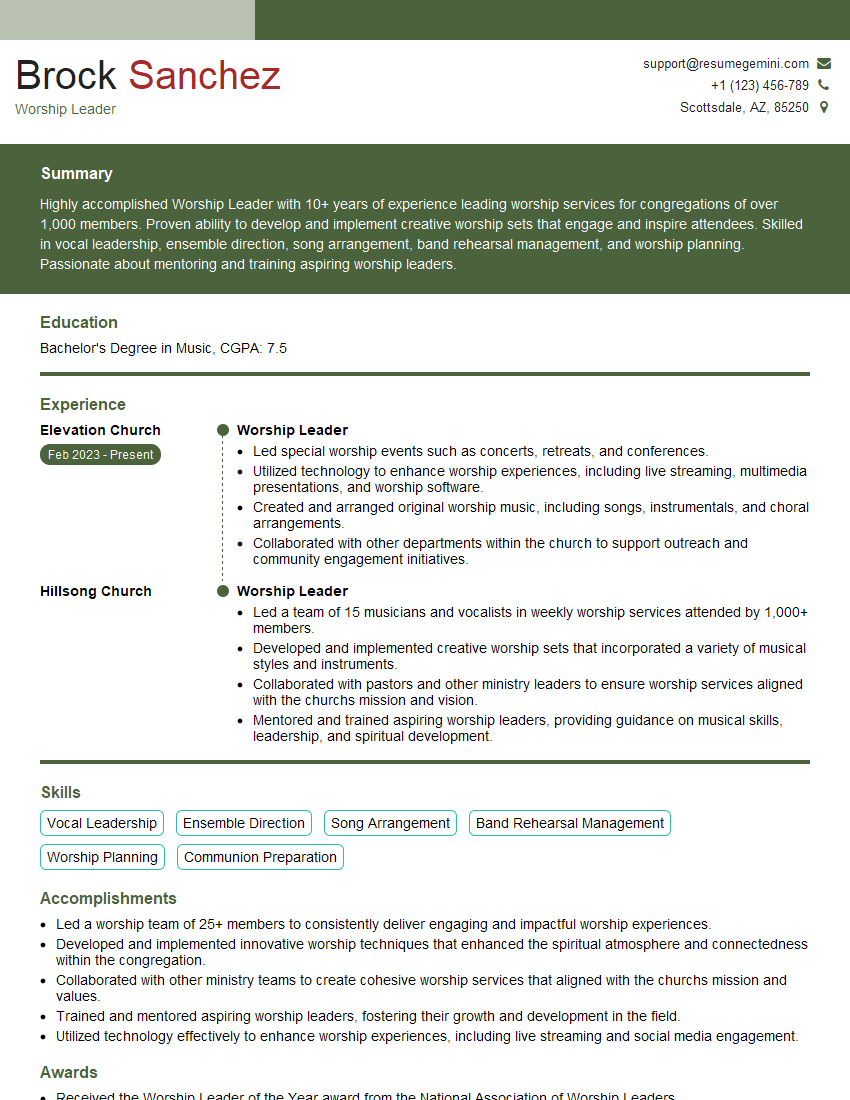
Worship Leader Resume Sample
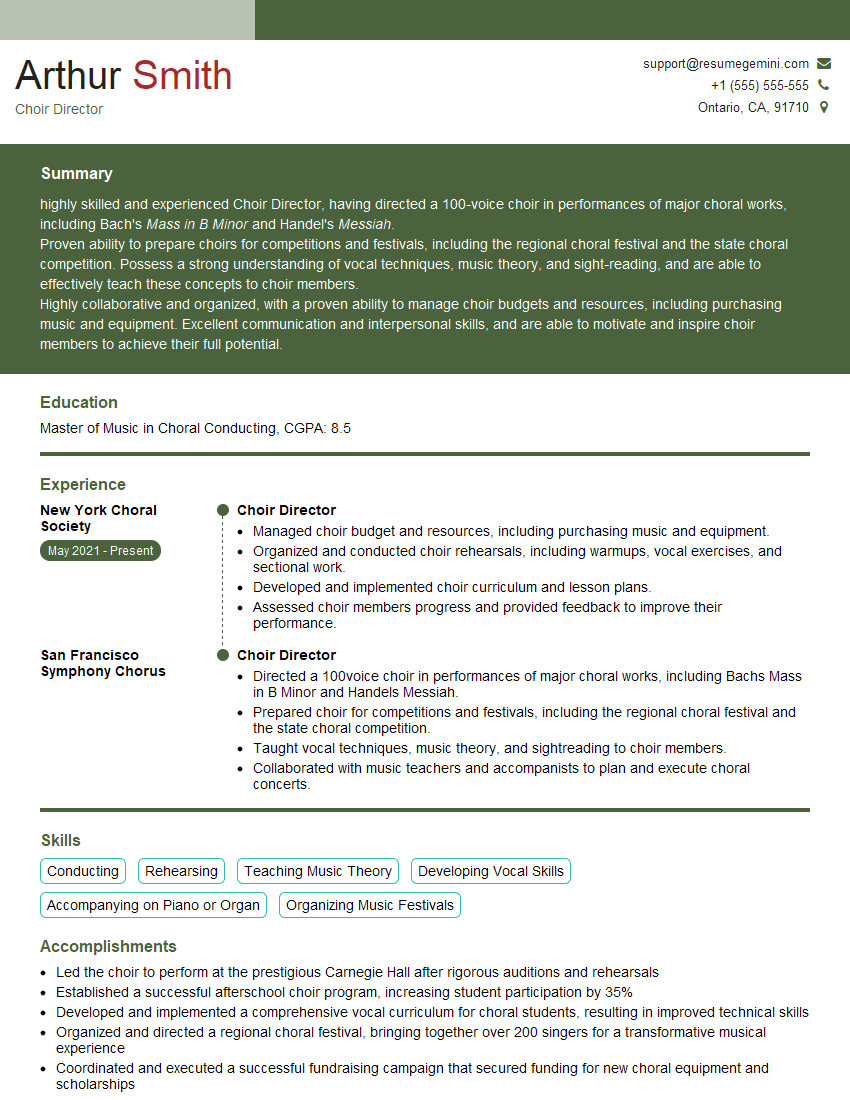
Choir Director Resume Sample
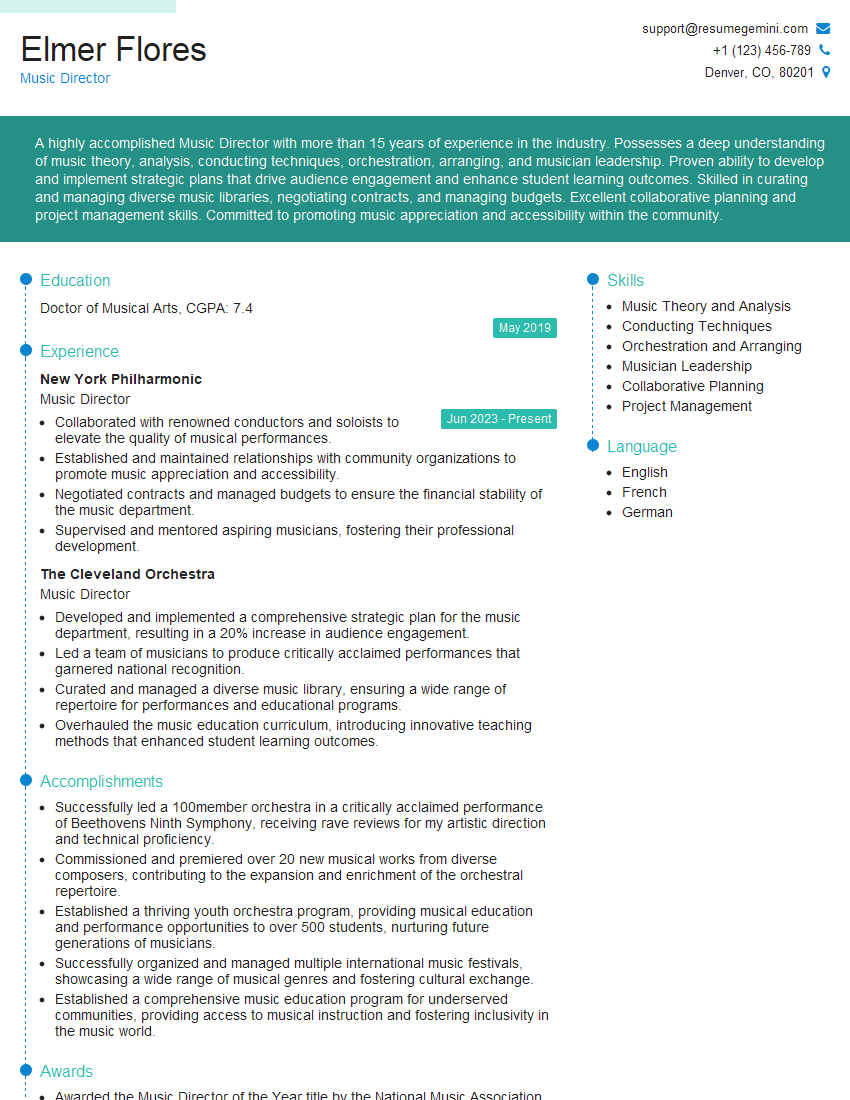
Music Director Resume Sample
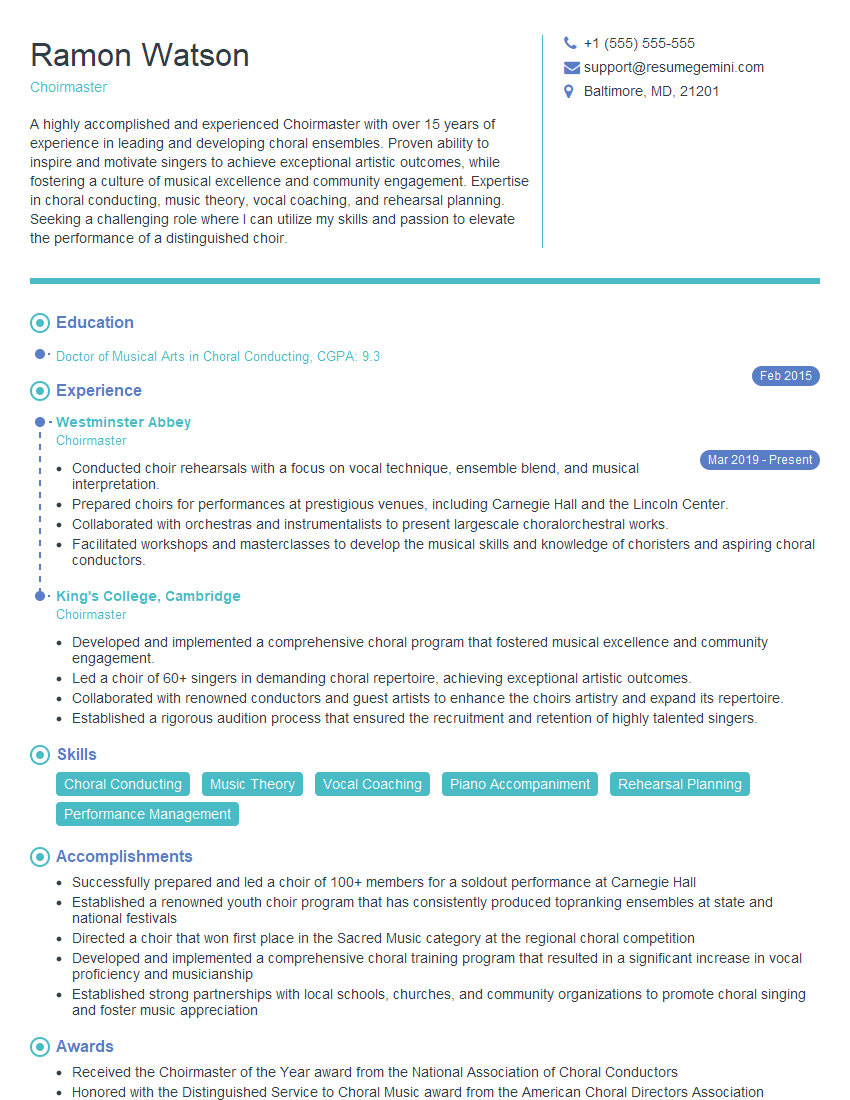
Choirmaster Resume Sample
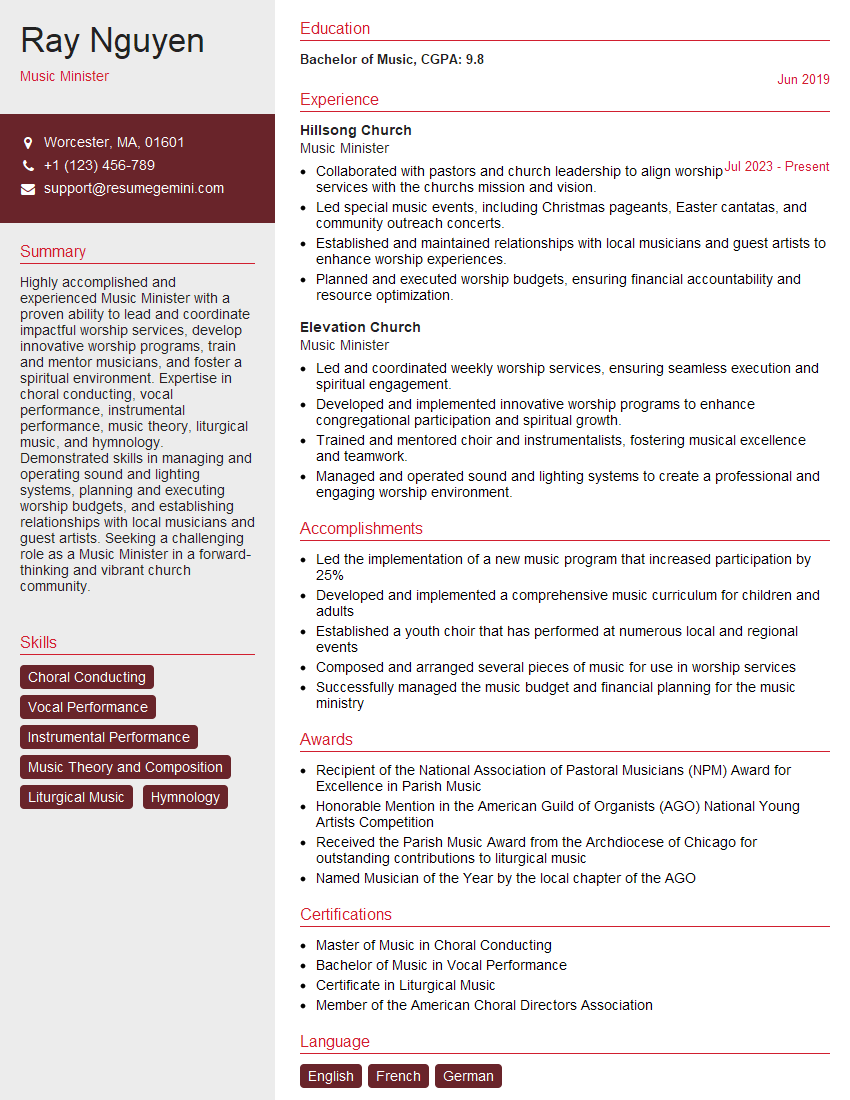
Music Minister Resume Sample
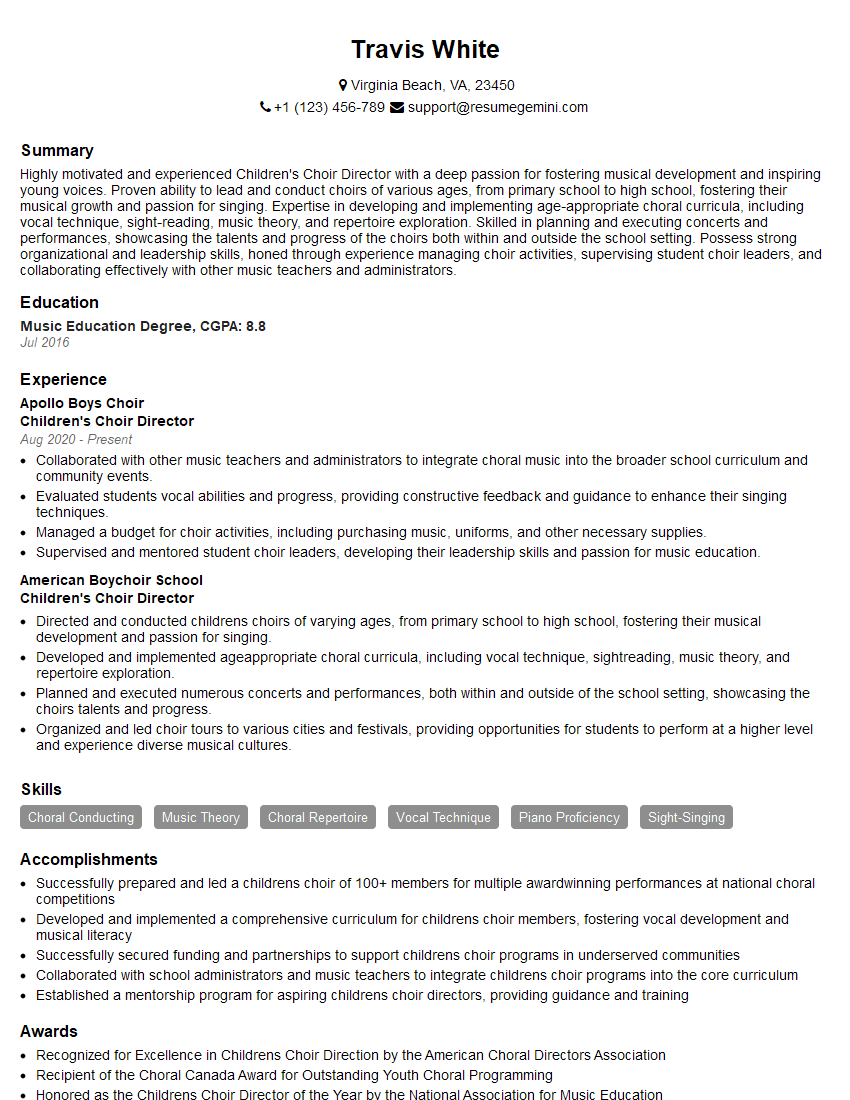
Children’s Choir Director Resume Sample
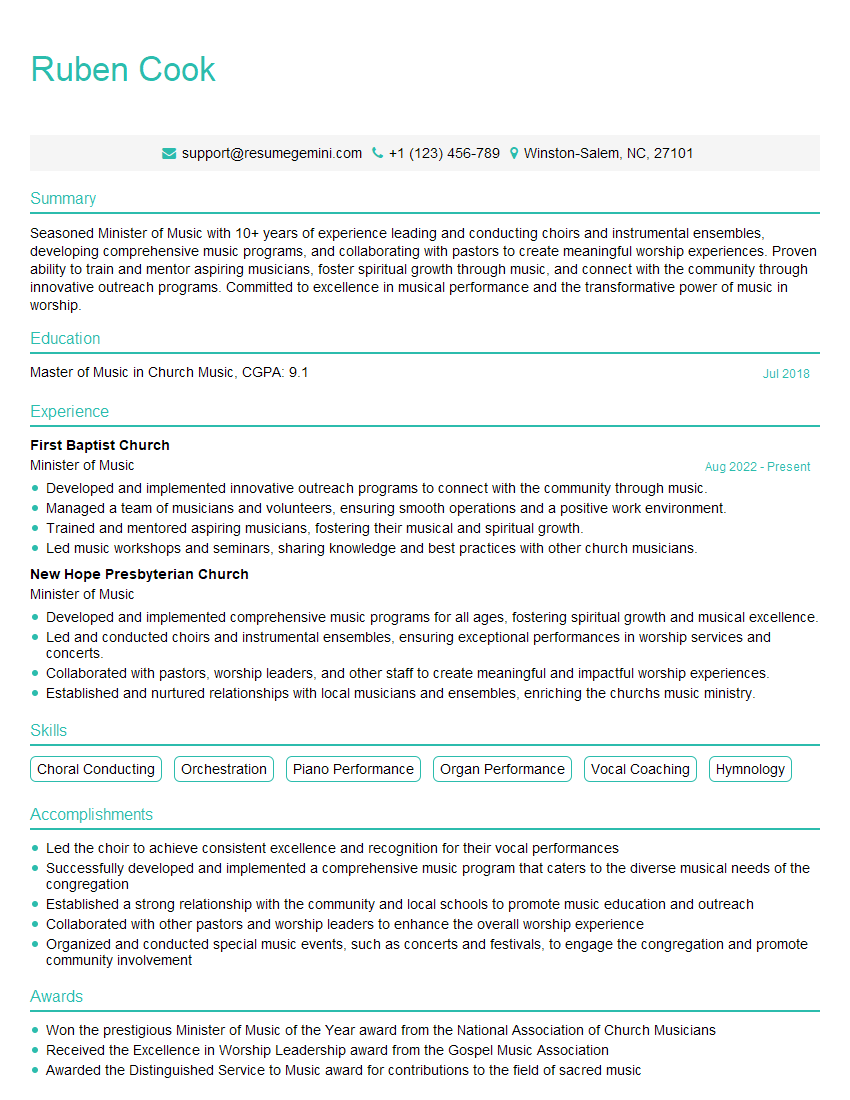
Minister of Music Resume Sample
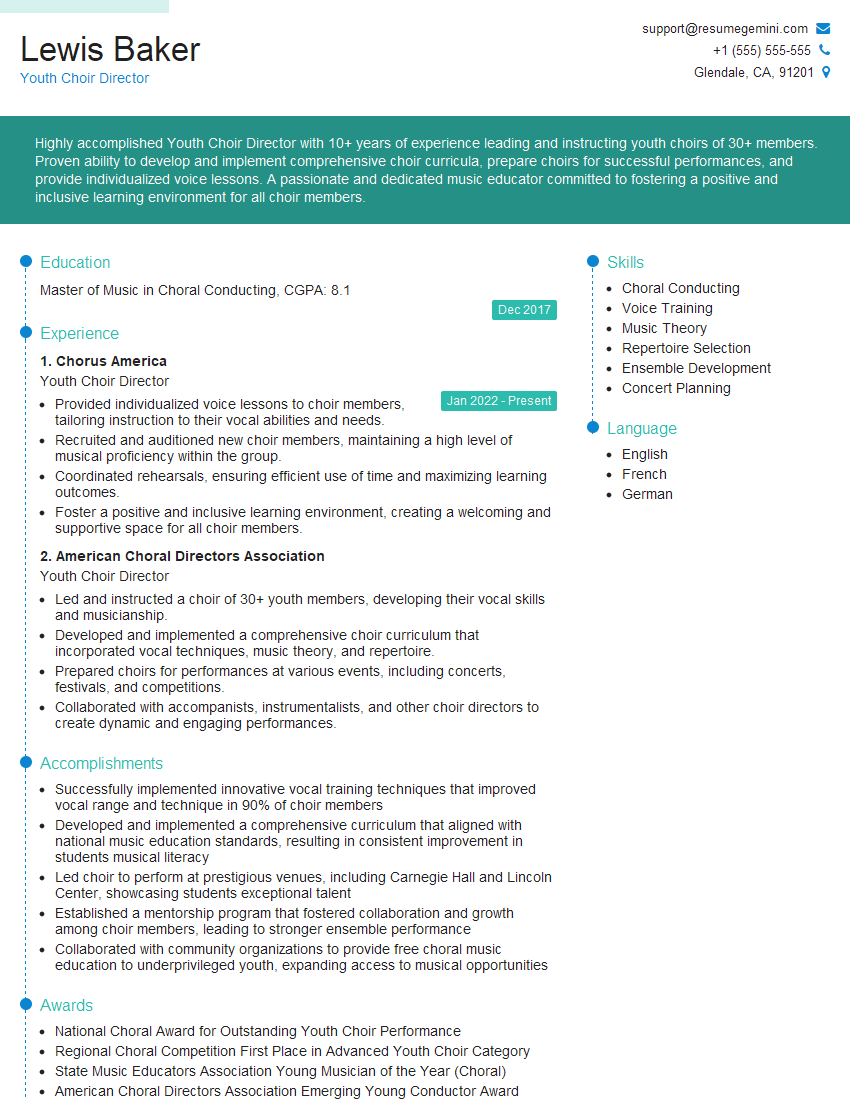
Youth Choir Director Resume Sample
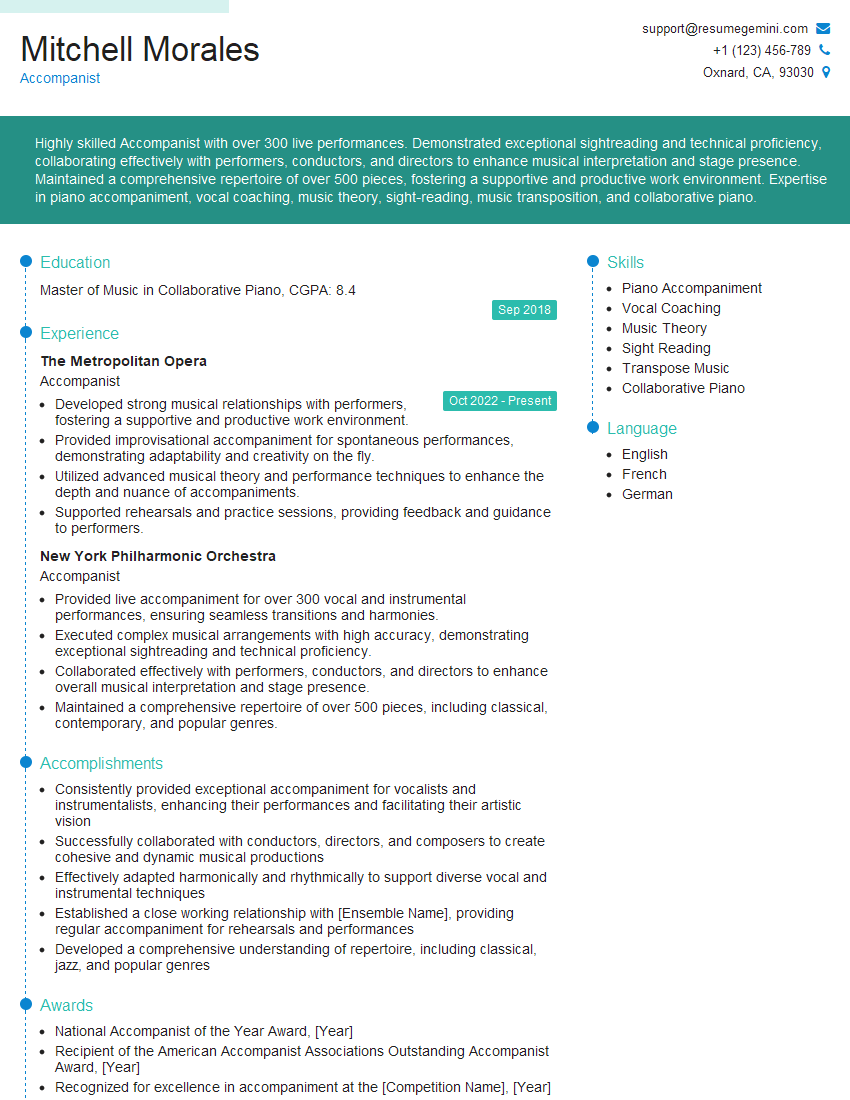
Accompanist Resume Sample
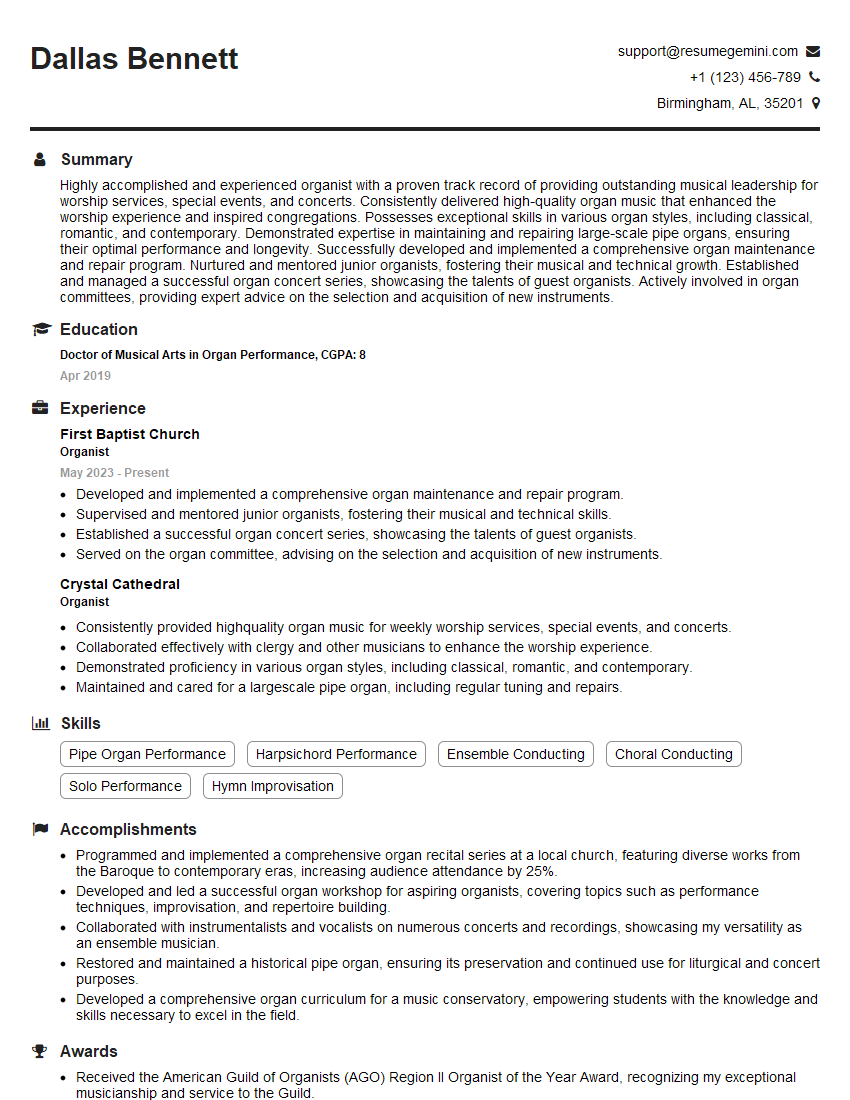
Organist Resume Sample
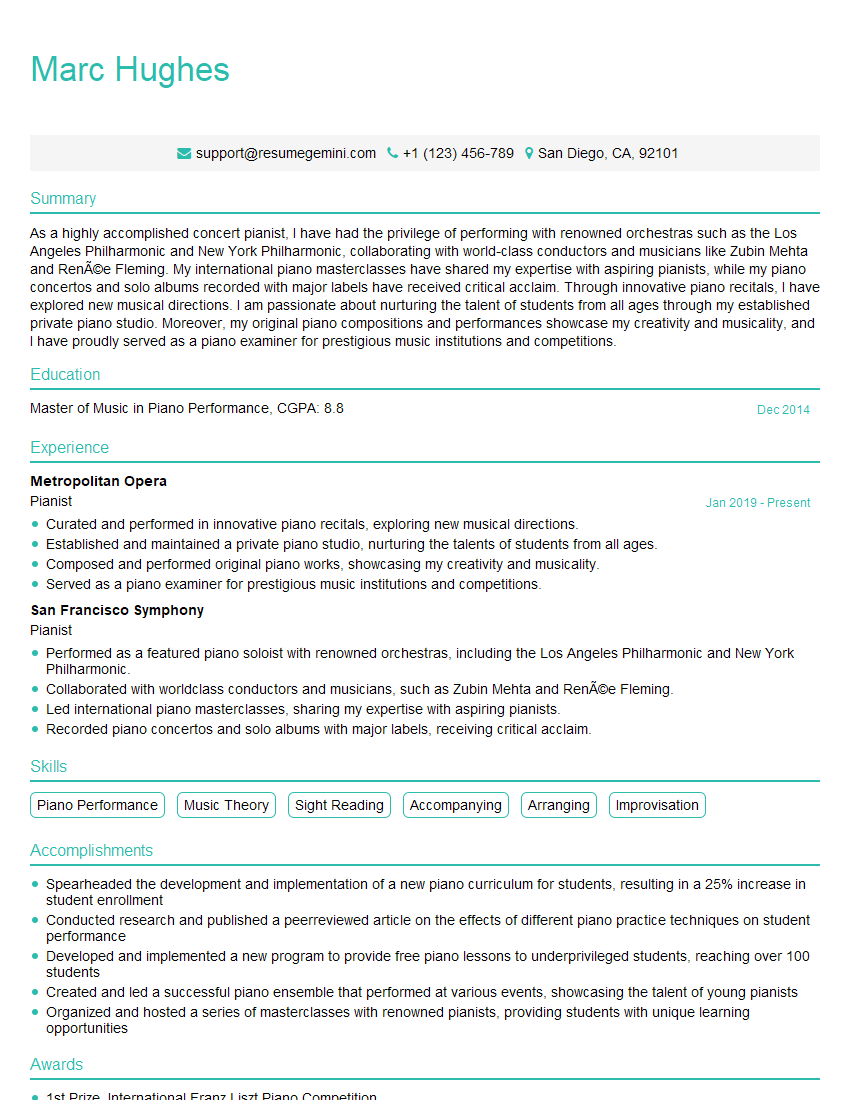
Pianist Resume Sample
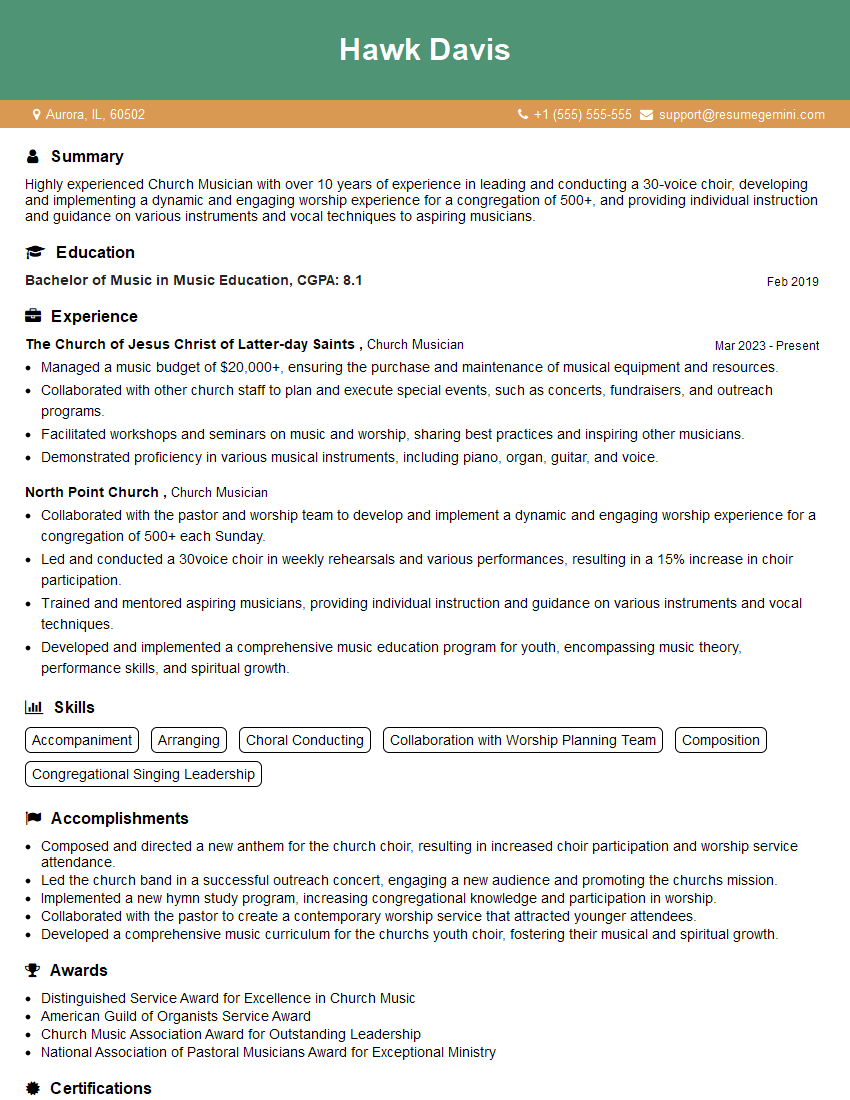
Church Musician Resume Sample
Explore more articles
Users Rating of Our Blogs
Share Your Experience
We value your feedback! Please rate our content and share your thoughts (optional).
What Readers Say About Our Blog
Very informative content, great job.
good