The thought of an interview can be nerve-wracking, but the right preparation can make all the difference. Explore this comprehensive guide to Construction Documents Review interview questions and gain the confidence you need to showcase your abilities and secure the role.
Questions Asked in Construction Documents Review Interview
Q 1. Explain the process of reviewing construction documents for completeness and accuracy.
Reviewing construction documents for completeness and accuracy is a crucial step ensuring a successful project. It’s like assembling a complex puzzle – every piece needs to be present and in the right place. My process involves a systematic approach, starting with a thorough checklist.
- Checklist Review: I begin by using a pre-defined checklist tailored to the project type (residential, commercial, industrial etc.), covering all disciplines (architectural, structural, MEP, etc.). This ensures nothing is overlooked.
- Document Cross-Referencing: I meticulously compare information across different drawings and specifications. For example, I verify that door schedules match the architectural drawings and that material specifications are consistent throughout the documents.
- Calculations & Dimensions: I perform spot checks on calculations (e.g., area calculations, quantity take-offs) and verify dimensions for consistency and feasibility. Discrepancies are flagged immediately.
- Notation and Markups: I use digital markup tools to highlight discrepancies, omissions, or ambiguities directly on the drawings. Clear and concise notes accompany each markup.
- Summary Report: Finally, I generate a comprehensive report summarizing all identified issues, prioritized by severity, along with recommendations for resolution. This serves as a roadmap for the design team to address the identified issues.
For example, I once identified a missing detail on a foundation plan, potentially leading to significant cost overruns during construction. My review prevented this costly error.
Q 2. How do you identify and resolve conflicts between drawings and specifications?
Conflicts between drawings and specifications are common but need immediate resolution to prevent construction delays and errors. This is where my experience in conflict resolution becomes vital. Think of it like arbitrating a disagreement – you need to understand both sides before reaching a solution.
- Identify the Conflict: I carefully identify the conflicting information, noting the specific drawing number, specification section, and the nature of the discrepancy (e.g., conflicting material specifications, dimension conflicts).
- Prioritize Based on Impact: I prioritize conflicts based on their potential impact on the project’s cost, schedule, or safety. For example, a conflict on a structural element needs immediate attention compared to a minor finish discrepancy.
- Consult Relevant Documents: I consult other related documents like addenda, design development drawings or other related submittals to see if there’s clarifying information.
- Contact the Design Team: I communicate the identified conflict to the design team, providing clear documentation of the issue. We then discuss the best resolution, ensuring it’s documented and agreed upon in writing.
- Formal Resolution: The resolution is formally documented through a revised drawing, specification, or addendum. This updated documentation becomes the controlling document.
In one project, a conflict between the architectural and structural drawings regarding a beam size was identified. This was promptly brought to the attention of the engineers and architects. A collaborative effort resulted in a revised structural drawing ensuring structural integrity and preventing potential collapse.
Q 3. Describe your experience with reviewing shop drawings and submittals.
Shop drawings and submittals are the contractor’s interpretation of the design documents. Reviewing these is like quality control for the construction process. I’ve extensively reviewed shop drawings for various trades, including structural steel, MEP systems, and architectural components.
- Compliance with Specifications: I verify that shop drawings comply with the approved design documents, specifications, and relevant building codes. This ensures that the proposed construction aligns with the design intent.
- Accuracy and Completeness: I check for completeness, ensuring all necessary details and dimensions are included. I also review the drawings for accuracy, making sure they are free of errors and inconsistencies.
- Coordination: A key aspect of my review is checking for coordination between different trades and disciplines. This prevents clashes and ensures smooth construction. For instance, I’ll review the coordination between mechanical ductwork and structural elements to ensure sufficient clearance.
- Constructability Review: I assess constructability, determining if the proposed fabrication and installation methods are feasible and efficient.
- Submittal Review Process: I’m experienced in using various submittal tracking software and processes to efficiently manage the review workflow.
I once identified a clash between a proposed HVAC system and a structural column during a shop drawing review. The prompt identification and resolution prevented costly rework on-site.
Q 4. What are the key elements you check for in architectural drawings?
Architectural drawings are the blueprint for the building’s aesthetics and functionality. My review focuses on several key elements:
- Space Planning & Functionality: I ensure that the layout is functional, accessible, and meets the client’s needs. For example, I check for adequate circulation space, appropriate room sizes, and compliance with accessibility codes.
- Dimensions & Scalings: I verify the accuracy of all dimensions and scales, ensuring consistency between different drawings and views.
- Details & Sections: I examine detailed drawings and sections to ensure that all elements are properly detailed and coordinated. This includes window details, door schedules, wall sections, and other crucial components.
- Material Specifications: I verify that the material specifications are clearly defined and consistent with the overall design intent.
- Compliance with Codes: I check for compliance with building codes and regulations concerning egress, fire safety, and accessibility.
In one project, I noticed a discrepancy in the location of a crucial fire exit on the architectural plans which was immediately rectified. This prevented potential violations of the fire code.
Q 5. How do you review structural drawings for compliance with building codes?
Structural drawings form the backbone of a building’s integrity. My review process for structural drawings focuses on safety and code compliance, employing both technical expertise and a systematic approach.
- Load Calculations: I review the structural calculations to verify that the design can withstand all anticipated loads (dead loads, live loads, wind loads, seismic loads).
- Member Sizes & Connections: I scrutinize the sizing of structural members (beams, columns, foundations) and the details of their connections to ensure they meet the required strength and stability.
- Code Compliance: I verify compliance with all relevant building codes and standards, including those related to seismic design, wind loads, and material specifications.
- Foundation Design: I pay close attention to the foundation design, ensuring adequate bearing capacity and proper drainage.
- Construction Details: I check the construction details to ensure that the structural elements can be built efficiently and accurately.
For instance, in one project, I noticed a calculation error in the design of a beam which could have jeopardized its load-bearing capacity. My timely intervention prevented a potential structural failure.
Q 6. What is your experience with reviewing MEP (Mechanical, Electrical, Plumbing) drawings?
My experience with MEP (Mechanical, Electrical, Plumbing) drawings is extensive. A thorough review of these drawings ensures the building’s systems are efficient, safe, and compliant.
- Coordination: I review the coordination of MEP systems with architectural and structural elements, identifying and resolving potential clashes or interferences.
- Equipment Specifications: I verify that the specifications for equipment (HVAC units, pumps, electrical panels) meet the project requirements and are consistent with industry standards.
- Piping & Ductwork Routing: I examine the routing of pipes, ducts, and conduits to ensure they are appropriately sized, supported, and routed to avoid conflicts with other systems and structural elements.
- Electrical System Design: I review electrical plans for compliance with electrical codes, verifying the adequacy of power distribution, grounding, and lighting.
- Plumbing System Design: I examine plumbing plans for proper sizing, drainage, and venting in compliance with plumbing codes.
In a recent project, I detected an error in the sizing of a main electrical panel, which could have resulted in insufficient power for the building. My review led to the correction of the panel size, ensuring the building’s electrical needs were met.
Q 7. How do you identify potential constructability issues during document review?
Identifying constructability issues during document review is vital for avoiding costly delays and rework on-site. It requires a deep understanding of construction practices and a keen eye for detail. My approach involves:
- Experience-Based Assessment: I leverage my construction experience to anticipate potential problems. This includes understanding the limitations of construction equipment, the sequencing of work, and the practical challenges of building in the real world.
- Detailed Review of Drawings: I carefully analyze the drawings for details that might indicate constructability challenges. This includes tight clearances, difficult access, and complex coordination between trades.
- Code & Standard Compliance: I ensure all elements of the design comply with relevant codes and standards. Non-compliance often leads to constructability problems.
- Mock-up and Simulation: For complex systems, I may use virtual modeling or even physical mock-ups to identify and resolve issues before construction begins.
- Collaboration with Contractors: Early engagement with contractors and subcontractors is crucial to obtain their insights into potential constructability issues.
For example, I once noticed a detail in a set of drawings that would make the installation of a particular piece of equipment nearly impossible due to access constraints. Flagging this allowed for a design change that simplified the construction process and saved significant time and money.
Q 8. Describe your experience using BIM software for construction document review.
My experience with BIM software in construction document review is extensive. I’ve used various platforms like Revit, ArchiCAD, and Navisworks to efficiently review models and drawings. This goes beyond simply viewing the models; I utilize the software’s clash detection capabilities to identify conflicts between disciplines – for example, detecting where a mechanical ductwork design clashes with a structural column. This proactive approach saves significant time and cost later in the project. I also leverage the software’s quantification tools to verify quantities of materials, ensuring the accuracy of cost estimates. For instance, I can quickly verify the total square footage of a flooring type across multiple levels to ensure it matches the project’s budget and material orders. Finally, I utilize the ability to generate detailed reports and create marked-up drawings directly within the BIM environment, making the review process streamlined and the communication of issues crystal clear.
Q 9. How do you manage and track revisions to construction documents?
Managing and tracking revisions is critical for maintaining document control. We typically use a version control system integrated within our BIM software or a dedicated document management system. Each revision is clearly marked with a revision number and date, along with a description of the changes made. Think of it like a meticulous history of the project’s design evolution. This system allows us to easily access any previous version, facilitating comparison and understanding the rationale behind changes. For example, if a structural engineer changes a column’s dimension, the previous version allows us to quickly understand why. We also use a centralized log for recording all revisions and distributing those changes to relevant stakeholders, ensuring everyone works with the most up-to-date information. This approach minimizes confusion and errors caused by outdated documents.
Q 10. How do you ensure that construction documents are compliant with relevant regulations and standards?
Compliance is paramount. My review process involves a meticulous check against all relevant codes, standards, and regulations, such as building codes (IBC, etc.), accessibility standards (ADA), and fire codes (NFPA). This isn’t a cursory glance; it involves a deep dive into each section of the documents, ensuring they meet all legal and safety requirements. For instance, I’ll verify that egress routes meet fire code specifications, ensuring adequate width and accessibility features are incorporated. I also cross-reference the project’s specifications with the design documents to ensure consistency. Any discrepancies are flagged immediately for clarification and resolution. Think of it as a rigorous quality control process, preventing potential costly and dangerous issues down the line.
Q 11. Explain your process for coordinating with different disciplines during document review.
Coordination between different disciplines is achieved through regular meetings, collaborative platforms, and BIM model coordination sessions. We hold dedicated meetings with representatives from architecture, structural, MEP (mechanical, electrical, plumbing), and other relevant disciplines. Each team presents their designs and we actively identify and resolve potential conflicts before they escalate. Think of it as an orchestra—each section has its part, and a conductor ensures they play harmoniously. The BIM model acts as a central platform for reviewing the integrated designs, providing a comprehensive overview and facilitating timely conflict resolution. We also utilize markups and comments directly on the model and drawings, leaving a clear audit trail of our discussions and decisions.
Q 12. How do you handle discrepancies or errors found during document review?
Discrepancies or errors are addressed systematically. First, I carefully document the issue, including its location, description, and the potential impact. Then, I communicate the issue clearly to the responsible discipline, providing sufficient context and evidence from the drawings or models. For example, if a wall shown on the architectural plans is missing in the structural model, I’ll clearly highlight this discrepancy in a marked-up drawing and BIM model and notify both architects and structural engineers. Finally, I track the resolution of the issue, ensuring it’s rectified and documented. This includes verifying corrections and ensuring the updated documents are circulated among all relevant parties. Transparency and clear communication are key to efficient conflict resolution.
Q 13. Describe your experience with using document control software.
My experience with document control software is extensive. I’ve worked with various platforms designed for construction document management, such as Procore, Autodesk BIM 360, and PlanGrid. These systems provide a central repository for all project documents, allowing for easy access, version control, and efficient workflow management. They streamline the distribution and approval process for revisions, reducing the risk of using outdated documents. The software often includes features like automated notifications, providing real-time updates to project stakeholders. This ensures everyone is working from the most current information, minimizing confusion and delays. The software also allows for detailed reporting and tracking, providing valuable insights into the document review process.
Q 14. How do you prioritize tasks when reviewing large volumes of construction documents?
Prioritizing tasks when reviewing large volumes of documents requires a strategic approach. I typically begin by understanding the project schedule and critical deadlines. Tasks related to urgent items or those impacting critical project milestones are prioritized. For instance, I would prioritize the review of documents related to the foundation before reviewing those related to the interior finishes. I also break down the review process into manageable chunks, focusing on specific areas or disciplines at a time. This prevents feeling overwhelmed and ensures a systematic and thorough review. Utilizing checklists and employing a risk-based approach, focusing on areas with higher potential for errors or non-compliance, further enhances efficiency. Finally, effective communication with the project team ensures a shared understanding of priorities and helps manage expectations.
Q 15. How do you communicate findings and recommendations to project stakeholders?
Communicating findings and recommendations effectively is crucial for successful project outcomes. My approach involves a multi-faceted strategy tailored to the specific stakeholders and the nature of the findings. I begin with a clear and concise summary report highlighting critical issues, categorized by severity and impact on the project schedule and budget. This report uses plain language, avoiding technical jargon unless absolutely necessary, and includes visual aids like annotated drawings or spreadsheets to illustrate complex issues.
For technical stakeholders like architects and engineers, I provide detailed reports with specific references to document numbers and sections. I use collaborative tools for real-time feedback and discussion. I’ll often schedule a meeting to walk them through the findings, allowing for interactive problem-solving. For less technical stakeholders such as clients or project managers, I focus on the overall impact of the identified issues and present clear, actionable recommendations. I might use a presentation format that summarizes key findings and proposed solutions, emphasizing cost and schedule implications. Follow-up communication is key; I ensure everyone understands the agreed-upon actions and I actively monitor progress to ensure resolution.
For instance, in a recent project, I discovered a significant clash between MEP (Mechanical, Electrical, and Plumbing) and structural elements. My report for the engineers included precise coordinates and images highlighting the conflict. For the client, I focused on potential schedule delays and cost overruns if the conflict wasn’t addressed immediately, presenting alternative solutions with their respective cost implications.
Career Expert Tips:
- Ace those interviews! Prepare effectively by reviewing the Top 50 Most Common Interview Questions on ResumeGemini.
- Navigate your job search with confidence! Explore a wide range of Career Tips on ResumeGemini. Learn about common challenges and recommendations to overcome them.
- Craft the perfect resume! Master the Art of Resume Writing with ResumeGemini’s guide. Showcase your unique qualifications and achievements effectively.
- Don’t miss out on holiday savings! Build your dream resume with ResumeGemini’s ATS optimized templates.
Q 16. How familiar are you with different construction document formats (PDF, DWG, etc.)?
I’m proficient in working with various construction document formats. This includes the widely used PDF format for plans and specifications, which I use extensively for review and markup. I’m also experienced in using DWG (AutoCAD) files, which allows me to directly interact with the design model, performing checks such as clash detection and quantity take-offs using dedicated software. I’m also familiar with other formats such as IFC (Industry Foundation Classes) for Building Information Modeling (BIM) data, RVT (Revit) files, and various image formats like TIFF and JPEG. My expertise extends to navigating nested folders and large document sets efficiently, using tools to manage and search these files effectively.
For example, using DWG files allows me to identify conflicts between architectural and structural elements more readily than if I only used PDFs. While PDFs are excellent for overall review and distribution, direct model interaction within DWG or RVT files offers far greater precision and speed for certain tasks.
Q 17. What are some common errors you frequently encounter during construction document review?
During construction document reviews, I frequently encounter several common errors. These include:
- Dimensional inconsistencies: Discrepancies between dimensions shown on plans, sections, and details.
- Missing or incomplete information: Omissions in specifications, details, or schedules, leaving crucial information unclear.
- Conflicts between drawings: Discrepancies between different drawings or between drawings and specifications.
- Code violations: Designs that do not comply with building codes and regulations.
- Unrealistic or impractical details: Design elements that are difficult or impossible to construct.
- Errors in quantities: Inaccuracies in material quantities or estimations, leading to potential cost overruns.
- Ambiguous details: Design elements or specifications that can be interpreted in multiple ways, leading to confusion during construction.
For example, a missing detail regarding a crucial connection between structural members could lead to a costly rework during construction. Similarly, ambiguous descriptions in specifications could cause multiple interpretations, increasing the likelihood of mistakes on site. Proactive identification of these errors is key in minimizing potential problems later in the project lifecycle.
Q 18. How do you ensure the accuracy of quantities taken from construction documents?
Ensuring accurate quantities is critical for cost estimation and project budgeting. My process involves a multi-step approach combining manual and digital techniques. First, I carefully review the drawings and specifications to fully understand the scope of work. Then I use a combination of planimetric measurements from drawings and specialized take-off software to quantify materials. This software significantly reduces errors and streamlines the process. For complex geometries, I will utilize 3D modeling software for greater accuracy. I always perform cross-checks, comparing my quantities to those provided by the designer, and I reconcile any discrepancies. I also consider potential waste factors and include them in my final quantities. Finally, I document my entire process, including calculations and assumptions, to ensure transparency and traceability.
For instance, in a recent project, discrepancies were found between the initial quantity take-off provided by the designer and my own independent verification. This led to discussions and adjustments which prevented potential overspending on materials during construction.
Q 19. What is your experience with value engineering related to construction documents?
Value engineering is a crucial aspect of my construction document review process. My experience includes identifying areas where designs can be optimized without sacrificing quality or functionality, leading to cost savings and improved efficiency. This often involves analyzing material selections, construction methods, and overall design strategies. I collaborate with the design team to explore alternative solutions that maintain or enhance performance while reducing costs. I’ll present options in a clear and concise manner, providing a comprehensive cost-benefit analysis for each proposed change. I also consider the long-term implications of any changes, such as maintenance costs and sustainability factors.
For example, in one project, I suggested substituting a costly material with a more economical alternative that met the required performance standards. This led to significant savings without compromising the overall quality of the structure. The documentation of this value engineering exercise was pivotal in supporting the change request approval process.
Q 20. Describe your process for verifying the completeness of construction documents.
Verifying the completeness of construction documents requires a systematic approach. I begin by using a comprehensive checklist tailored to the specific project type, building codes, and industry standards. This checklist ensures I systematically review all necessary drawings, specifications, schedules, and other relevant documents. I also cross-reference the documents to ensure that information provided in one document is consistent with others. I pay particular attention to details such as dimensions, materials, finishes, and construction methods. I visually inspect each sheet, searching for missing information or discrepancies. If I find inconsistencies, I immediately flag them, and request clarifications from the design team.
Think of it like assembling a complex puzzle: each piece needs to be in place and properly connected. A missing piece, or a piece that doesn’t quite fit, can cause significant issues down the line. My methodical approach is designed to eliminate such issues early on.
Q 21. How do you handle conflicting information between different sets of construction documents?
Conflicting information between different sets of construction documents is a common challenge. My approach involves first identifying the conflicting information using a systematic comparison of the relevant documents. I document these conflicts with clear references to the specific documents and locations of the discrepancies. I then work with the design team to resolve these conflicts, utilizing my understanding of construction practices and building codes to propose solutions. This may involve reviewing the design intent, clarifying ambiguities, or proposing revisions to resolve the inconsistencies. The priority is to determine the most accurate and constructible solution, while maintaining alignment with project goals. I document the resolution of the conflicts, ensuring everyone involved is aware of the agreed-upon revisions.
For example, if architectural plans show a different wall thickness than structural plans, I would analyze the situation, potentially consulting with both the architect and structural engineer to find the correct dimension. The resolution process might involve adjusting one drawing to match the other, or even creating a new drawing clarifying the discrepancy.
Q 22. How do you track and manage RFIs (Requests for Information)?
Tracking and managing RFIs (Requests for Information) is crucial for efficient construction project communication. I utilize a multi-pronged approach combining technology and established processes. Firstly, I employ a dedicated RFI log, either within a construction management software or a meticulously maintained spreadsheet. This log includes a unique RFI number, the date submitted, the issuer (contractor, subcontractor, etc.), the recipient, the subject, the status (open, pending, closed), and the response deadline. This provides a centralized, easily searchable repository.
Secondly, I ensure that all RFIs are assigned to the appropriate individuals for response and follow up meticulously on their timely resolution. Regularly reviewing the RFI log helps identify bottlenecks or potential delays. I use email notifications to keep all relevant parties informed about updates and progress. Finally, I ensure that all responses are thoroughly reviewed for accuracy and completeness before closing the RFI. This ensures that all questions are addressed fully and that there is clear documentation of the process.
For instance, on a recent high-rise project, utilizing a cloud-based platform, we managed over 150 RFIs without a single unresolved issue past its deadline. This system allowed for real-time updates, ensuring transparency across the entire team.
Q 23. Describe your experience with using a construction document management system.
I have extensive experience using various construction document management systems (CDMS), including Procore, Bluebeam Revu, and BIM 360. My experience spans from small residential projects to large-scale commercial developments. A CDMS significantly improves efficiency by centralizing all project documents, allowing for easy version control, and facilitating collaboration. For example, in Bluebeam, the markup tools allow for precise and detailed annotations, facilitating clear communication of issues and revisions. The ability to track changes and revisions, integrated with the RFI system, ensures complete transparency and reduces the risk of errors. In Procore, project dashboards provide a holistic view of the project’s progress, enabling proactive identification and mitigation of potential issues.
The choice of CDMS depends on the project’s complexity and the team’s familiarity with specific platforms. However, regardless of the platform, proficient use of these systems streamlines workflow, minimizing delays and enhancing communication.
Q 24. How do you ensure the timely completion of construction document reviews?
Ensuring timely completion of construction document reviews involves a structured and proactive approach. This begins with a clear understanding of the project schedule and the associated review deadlines. I always develop a detailed review checklist tailored to the specific project requirements, encompassing aspects such as code compliance, constructability, and design coordination. This checklist ensures a thorough and systematic review process.
Prioritization is key. I focus on critical path items and high-risk areas first, addressing potential conflicts early on. Regular meetings with the design and construction teams are essential to discuss any emerging issues and ensure that the reviews are aligned with the project schedule. By utilizing the project management software’s scheduling and task management tools, I can closely monitor progress and proactively address any potential delays. Open communication is fundamental; if I anticipate delays, I communicate this proactively to the project management team, presenting potential solutions for mitigation.
Q 25. How do you contribute to a collaborative team environment during document review?
Contributing to a collaborative team environment during document review is paramount. I achieve this through consistent communication and proactive engagement. This includes clearly articulating findings and suggestions, using constructive feedback and fostering open discussions. I actively participate in team meetings, offering insights and perspectives gained during the review process. I believe in a collaborative approach, not simply highlighting discrepancies but also proposing solutions. This collaborative approach is more constructive and facilitates a more effective resolution process.
Furthermore, I leverage the collaborative features of the CDMS to facilitate real-time discussions and feedback. For instance, using tools like Bluebeam’s Studio Sessions, we can conduct concurrent reviews, addressing questions and concerns in real-time, minimizing misunderstandings and accelerating the review process. This improves efficiency and reinforces team cohesion.
Q 26. How do you stay up-to-date with changes in building codes and construction standards?
Staying abreast of changes in building codes and construction standards is critical. I utilize a multi-faceted approach to ensure ongoing professional development. This involves subscribing to industry publications like Engineering News-Record (ENR) and attending relevant conferences and workshops. I actively monitor the websites of organizations such as the International Code Council (ICC) and local building departments for updates and changes in building codes and regulations.
I also maintain a network of contacts within the industry, exchanging information and best practices. Continuous learning is a commitment; I dedicate time each week to reviewing updates and new information, staying informed about advancements in technology and construction methodologies that may impact code compliance and best practices. Staying updated is not merely about compliance; it enhances project quality, reduces risks, and ensures that we’re delivering innovative and compliant designs.
Q 27. Describe a situation where you had to resolve a significant issue during document review.
During the review of documents for a large-scale hospital project, we discovered a significant conflict between the structural and MEP (Mechanical, Electrical, and Plumbing) designs. The MEP design encroached on the structural columns, compromising structural integrity. This was not immediately apparent in the individual drawings but only became clear during a thorough cross-referencing and 3D modeling review.
To resolve this, I initiated a meeting with the structural and MEP engineers, presenting the conflict clearly using visual aids generated from the BIM model. We collaboratively explored several solutions, including re-routing the MEP systems, modifying the structural column locations slightly, and optimizing space utilization. Ultimately, we agreed on a solution that minimized design changes while maintaining structural integrity and meeting code requirements. This involved detailed coordination and several rounds of iterative design revisions documented meticulously within the CDMS. The successful resolution avoided significant cost overruns and schedule delays. This situation highlighted the importance of rigorous document review and the value of collaborative problem-solving.
Q 28. How would you approach reviewing documents for a fast-track project?
Fast-track projects require a highly efficient and agile approach to document review. The key is to streamline the process without compromising quality. This starts with a clear definition of roles and responsibilities, ensuring that the review team is adequately staffed and equipped. I would prioritize a phased review approach, focusing on the critical aspects of the design first. This ensures that critical issues are identified early and addressed promptly, preventing major delays further down the line.
Concurrent reviews, using tools that allow real-time collaboration, are essential. We would employ techniques like parallel reviews, dividing the review workload among multiple reviewers specialized in different areas. Frequent communication and regular status meetings ensure everyone stays aligned with the accelerated schedule. While maintaining accuracy is crucial, we may need to adopt a more flexible approach to issue resolution, prioritizing solutions that mitigate the most critical risks while allowing for minor discrepancies to be addressed later if time permits. In essence, a more focused and iterative review process adapted to the fast-paced nature of the project is key.
Key Topics to Learn for Construction Documents Review Interview
- Understanding Drawings: Mastering the interpretation of architectural, structural, MEP (Mechanical, Electrical, Plumbing), and civil drawings. This includes understanding scales, symbols, notations, and details.
- Specifications & Standards: Familiarizing yourself with different types of specifications (e.g., CSI MasterFormat) and relevant building codes and industry standards. Practice applying these to real-world scenarios.
- Quantities & Takeoffs: Develop proficiency in accurately estimating quantities of materials and labor from construction documents. Explore different methods and software used for takeoffs.
- Conflict Detection & Resolution: Learn to identify potential conflicts or discrepancies within the construction documents, and develop strategies for resolving these issues before construction begins.
- Building Codes & Regulations: Understand the application of relevant building codes and regulations to ensure compliance and safety during the construction process. Explore local and national codes.
- Contract Documents & Legal Aspects: Develop an understanding of common contract types and clauses relevant to construction projects. Know how documents impact the review process.
- Collaboration & Communication: Practice effective communication and collaboration techniques for discussing and resolving issues with architects, engineers, and other stakeholders.
- Software Proficiency: Highlight your skills in relevant software used for construction document review (e.g., Bluebeam, AutoCAD, Revit). Be prepared to discuss your experience with these tools.
- Problem-Solving & Critical Thinking: Demonstrate your ability to analyze complex information, identify potential problems, and develop effective solutions.
Next Steps
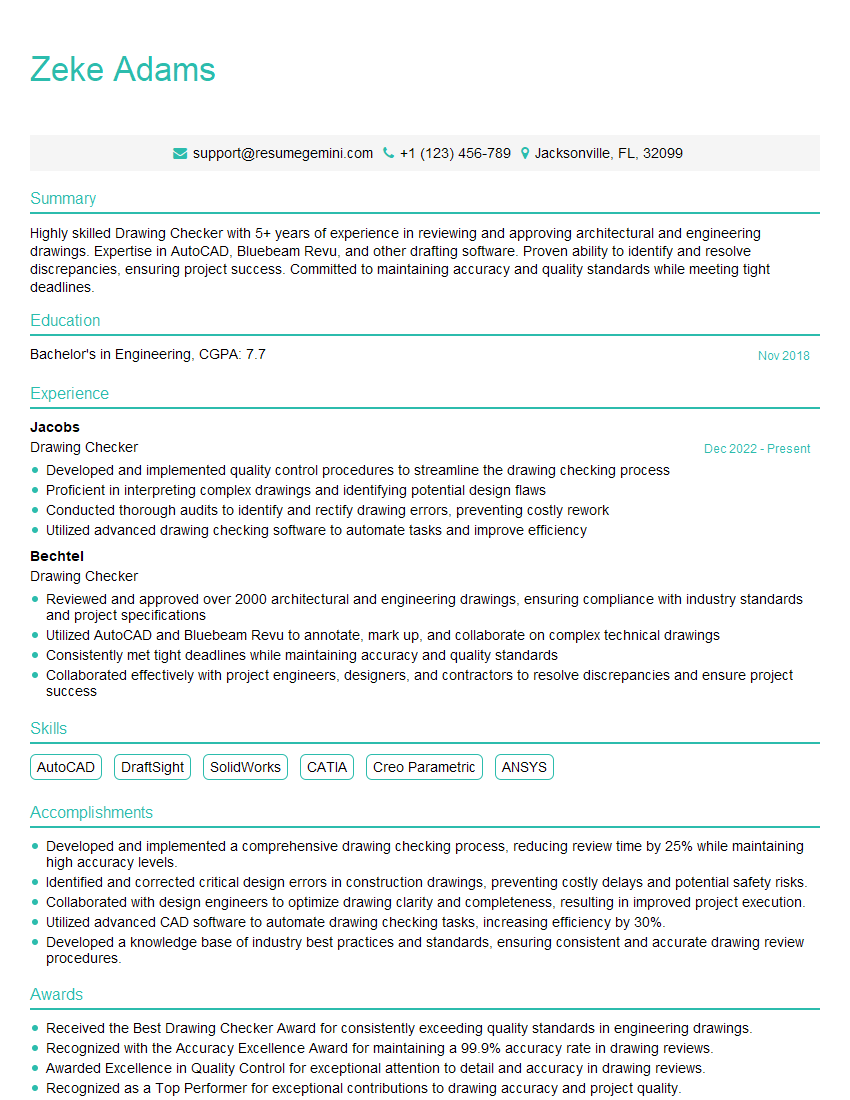
Mastering Construction Documents Review is crucial for career advancement in the construction industry, opening doors to specialized roles and increased earning potential. A strong resume is your key to unlocking these opportunities. An ATS-friendly resume, optimized for applicant tracking systems, significantly increases your chances of getting your application noticed. To create a compelling and effective resume tailored to your Construction Documents Review skills and experience, we highly recommend using ResumeGemini. ResumeGemini provides tools and resources to build a professional resume, and examples of resumes specifically tailored for Construction Documents Review are available to guide you.
Explore more articles
Users Rating of Our Blogs
Share Your Experience
We value your feedback! Please rate our content and share your thoughts (optional).
What Readers Say About Our Blog
Very informative content, great job.
good