Interviews are more than just a Q&A session—they’re a chance to prove your worth. This blog dives into essential Content Aggregation and Curation interview questions and expert tips to help you align your answers with what hiring managers are looking for. Start preparing to shine!
Questions Asked in Content Aggregation and Curation Interview
Q 1. Explain the difference between content aggregation and content curation.
Content aggregation and curation are closely related but distinct processes. Think of it like this: aggregation is gathering, while curation is refining and presenting.
Content aggregation is the process of collecting content from various sources and presenting it in a centralized location. It’s like building a massive library – you gather books from everywhere, but they might not be organized or selected for a specific audience. Examples include RSS feeds pulling together blog posts or news aggregators like Google News.
Content curation, on the other hand, involves selecting, organizing, and presenting information from multiple sources in a meaningful and relevant way. It’s like being a librarian who meticulously selects the best books, categorizes them, and recommends them to readers based on their interests. A curated newsletter highlighting only the most relevant articles on a specific topic is a good example.
The key difference lies in the level of selection and presentation. Aggregation simply gathers; curation selects, organizes, and adds value.
Q 2. Describe your process for identifying high-quality content sources.
Identifying high-quality content sources is crucial. My process involves a multi-pronged approach:
- Reputation and Authority: I start by looking at established sources with a proven track record, like well-known publications, respected academic institutions, and government agencies. Their authority lends credibility to the information they produce.
- Audience Engagement: I analyze the engagement levels of various sources – comments, shares, likes, and overall website traffic. High engagement often indicates valuable, relevant content that resonates with a significant audience.
- Fact-Checking and Verification: I cross-reference information from multiple sources to ensure accuracy. This includes checking for inconsistencies or conflicting reports. I also look for transparent sourcing and methodology.
- Expertise and Specialization: I prioritize sources known for their expertise in specific niches. For example, if I’m curating content on climate change, I’d heavily weigh publications from leading climate scientists and reputable research institutions.
- Search Engine Optimization (SEO): While not the primary factor, I analyze the SEO performance of websites. High-ranking websites often suggest quality content that search engines deem authoritative.
I regularly update my list of sources, constantly evaluating their performance and reliability.
Q 3. How do you ensure the accuracy and relevance of aggregated content?
Ensuring accuracy and relevance is paramount. I employ several strategies:
- Fact-Checking and Verification: As mentioned earlier, cross-referencing information from multiple trustworthy sources is critical. I look for corroborating evidence and avoid relying on single sources, especially for sensitive or controversial topics.
- Contextualization: I don’t simply present information; I provide context. This includes highlighting the source’s potential biases, limitations, or perspectives. I also connect seemingly disparate pieces of information to show a bigger picture.
- Timeliness: I prioritize recent and up-to-date information. Outdated content can be misleading, so I maintain a rigorous schedule for updating my aggregated content.
- Relevance Filtering: I use algorithms and keywords to filter out irrelevant or duplicate content. This ensures that only the most pertinent information reaches the audience.
- Human Oversight: Technology is a powerful tool, but human judgment remains indispensable. I personally review a significant portion of the aggregated content to ensure quality, accuracy, and relevance.
Q 4. What strategies do you use to organize and categorize large amounts of content?
Organizing and categorizing large amounts of content requires a structured approach. I utilize a combination of techniques:
- Taxonomy and Ontology: I use hierarchical systems to categorize content based on topics, themes, and keywords. This enables efficient searching and retrieval.
- Metadata tagging: Each piece of content is tagged with relevant metadata, including keywords, date, author, source, and subject matter. This metadata allows for efficient filtering and searching.
- Database Management: I use a database system to store and manage the aggregated content, allowing for efficient querying and retrieval based on various criteria.
- Content clustering: Algorithms can group similar content together based on semantic similarity, making it easier to identify related articles and themes.
- Visualizations: I often use visual tools such as mind maps or concept maps to represent the relationships between different pieces of content.
The choice of specific tools and techniques depends on the scale and complexity of the content, and the specific requirements of the audience.
Q 5. How do you evaluate the credibility and authority of content sources?
Evaluating the credibility and authority of content sources requires a critical eye. I consider several factors:
- Author Expertise: I examine the author’s credentials, experience, and reputation within their field. Are they recognized experts? Do they have a history of publishing accurate and reliable information?
- Source Reputation: I assess the reputation of the publication or website. Is it known for its accuracy and journalistic integrity? Does it have a clear editorial policy? Does it engage in fact-checking?
- Peer Review: For academic or scientific content, I look for evidence of peer review, as this signifies a rigorous vetting process.
- Transparency and Disclosure: I check for transparency in methodology and funding. Are potential conflicts of interest disclosed? Is the sourcing clearly stated?
- Fact-Checking Websites: I cross-reference information with reputable fact-checking organizations to validate claims and identify potential misinformation.
Building a robust network of trusted sources takes time and consistent evaluation. It’s an ongoing process of verification and refinement.
Q 6. Explain your approach to content repurposing and syndication.
Content repurposing and syndication are valuable strategies for extending the reach and impact of aggregated content.
Repurposing involves transforming existing content into new formats. For example, a blog post can be turned into an infographic, a short video, or a series of tweets. This increases its accessibility and caters to different audience preferences.
Syndication involves distributing content to other platforms and websites. This can involve embedding articles, sharing excerpts, or publishing the content in its entirety on other sites (with appropriate permissions). Syndication significantly expands the reach of the content, exposing it to a larger audience.
My approach considers both audience and platform. I strategically repurpose and syndicate content to maximize its impact, always respecting copyright and obtaining necessary permissions.
Q 7. How do you measure the success of your content aggregation and curation efforts?
Measuring the success of content aggregation and curation involves both qualitative and quantitative metrics.
- Website Analytics: I track website traffic, engagement metrics (time spent on site, bounce rate, pages per visit), and user demographics to gauge the effectiveness of the aggregated content.
- Social Media Engagement: I monitor shares, likes, comments, and retweets on social media platforms to measure audience response and content virality.
- Email Metrics: If utilizing newsletters or email marketing, I monitor open rates, click-through rates, and unsubscribes to understand audience interest and engagement.
- User Feedback: I actively solicit user feedback through surveys, comments, and social media interaction to gain insights into their experience and satisfaction.
- Conversion Rates: If the goal is to drive conversions (e.g., subscriptions, sales), I track conversion rates to measure the success of the content in achieving specific objectives.
By combining these metrics, I gain a comprehensive understanding of the effectiveness of my content aggregation and curation efforts. This allows me to continuously optimize my strategies and improve the quality and relevance of my content.
Q 8. What tools and technologies are you familiar with for content aggregation and curation?
Content aggregation and curation relies heavily on various tools and technologies. My experience encompasses a wide range, from simple RSS readers to sophisticated content management systems (CMS) and specialized aggregation platforms.
- RSS Feed Readers and Aggregators: Tools like Feedly and Inoreader allow me to monitor numerous sources simultaneously, ensuring I don’t miss relevant updates. This is particularly useful for tracking news and blog posts in a specific niche.
- Social Media Monitoring Tools: Platforms like Brandwatch and Mention help track brand mentions, identify trending topics, and analyze social sentiment, crucial for understanding public perception and identifying relevant content.
- Content Management Systems (CMS): I’m proficient with platforms like WordPress, Drupal, and Contentful. These are vital for organizing, managing, and publishing aggregated content, often with features for scheduling and automation.
- Data Scraping Tools: While respecting ethical and legal guidelines, I utilize tools like Octoparse and Import.io to extract data from websites, enabling efficient aggregation of structured information (e.g., product details, research findings).
- API Integration: I have experience integrating with various APIs (Application Programming Interfaces) to automate data fetching from different sources, streamlining the content aggregation process. For example, using a news API to pull in relevant articles.
- Database Management Systems (DBMS): I’m comfortable using databases like MySQL or PostgreSQL for storing and managing large volumes of aggregated content, allowing for efficient search and retrieval.
The choice of tools depends heavily on the scale and nature of the project. For a small blog, a simple RSS reader might suffice, while a large-scale news aggregator would necessitate a robust CMS and potentially custom API integrations.
Q 9. Describe your experience with content rights management and licensing.
Content rights management and licensing are paramount. Ignoring these aspects can lead to legal issues and reputational damage. My experience involves a thorough understanding of copyright laws, Creative Commons licenses, and different types of licensing agreements.
Before using any content, I meticulously check its license. For example, content under a Creative Commons Attribution-ShareAlike (CC BY-SA) license requires attribution to the original creator and the same license for any derivative works. I carefully document the source and licensing details of each piece of content. For content without a clearly stated license, I contact the copyright holder to secure permission for usage. This thorough approach ensures legal compliance and builds trust with content creators.
For commercial projects, I have experience negotiating licenses with content providers, ensuring that the usage rights align with project requirements and budgetary constraints. This includes understanding usage fees, territorial restrictions, and exclusivity clauses.
Q 10. How do you handle conflicting information or biased sources?
Handling conflicting information and biased sources is a core aspect of responsible curation. My approach is multi-faceted:
- Triangulation: I verify information from multiple independent and reputable sources. If several reliable sources corroborate a piece of information, it strengthens its credibility. Discrepancies, however, warrant further investigation.
- Source Evaluation: I assess the credibility of each source, considering factors like authorship, publication date, methodology, potential biases, and any conflicts of interest. This involves fact-checking information against reputable organizations or established databases.
- Contextualization: I present information within its proper context. If there are different viewpoints or interpretations, I highlight them, allowing the audience to make informed judgments.
- Transparency: I always cite my sources, clearly indicating where information originated. This enhances transparency and accountability.
- Nuance and Qualification: I avoid presenting information as absolute truth when there is uncertainty. Instead, I use qualifying language such as “likely,” “suggests,” or “according to…”
For instance, if I find conflicting reports about a scientific study, I would investigate the methodology of each study, look for peer reviews, and potentially consult with experts in the field before presenting any conclusions to the audience.
Q 11. How do you adapt your content aggregation and curation strategy to different target audiences?
Adapting my content aggregation and curation strategy to different target audiences is critical. The same content won’t resonate with everyone.
I tailor my approach by considering several factors:
- Demographics: Age, gender, location, education level, and socioeconomic status significantly influence content preferences and consumption habits.
- Interests and Needs: I identify the specific interests and information needs of the target audience. A strategy for tech enthusiasts will differ significantly from one for senior citizens.
- Platform: The choice of platform (e.g., social media, blog, newsletter) dictates the format and style of content.
- Content Style and Tone: I adapt the language, tone, and style of the content to suit the target audience. A formal, academic tone might be suitable for researchers, while a more casual, conversational tone might be better for social media.
- Content Format: I vary the format of content (e.g., text, images, videos, infographics) to cater to different preferences and learning styles.
For instance, when curating content for children, I prioritize safety, simplicity, and engagement, focusing on age-appropriate visuals and language. Conversely, a curated feed for financial professionals would necessitate more in-depth analysis and complex information.
Q 12. Describe your experience with content scheduling and automation tools.
Content scheduling and automation are crucial for efficiency and consistency. I’m proficient in using various tools and techniques:
- CMS Scheduling Features: Most CMS platforms have built-in scheduling features that allow me to pre-schedule content for publication at specific times and dates.
- Social Media Scheduling Tools: Platforms like Hootsuite and Buffer enable scheduling posts across different social media channels, optimizing reach and engagement.
- Zapier and IFTTT: These automation tools allow me to connect different apps and services, automating tasks such as automatically publishing aggregated content to multiple platforms or sending email newsletters based on new content.
- Custom Scripting (Python, JavaScript): For more complex automation tasks, I can leverage scripting languages to create custom solutions. This might involve automated data extraction, content processing, and publishing.
By automating repetitive tasks, I can focus on higher-level curation activities such as content selection, quality control, and audience engagement. For example, I can set up automated workflows to pull in relevant news articles daily, process them, and automatically publish them to my website at a pre-defined time.
Q 13. How do you ensure content accessibility and inclusivity?
Content accessibility and inclusivity are not just good practice; they are essential for reaching a wider audience. My approach considers:
- Alt Text for Images: Providing descriptive alt text for images ensures that visually impaired users can understand the content of the image through screen readers.
- Captions and Transcripts for Videos: Including captions and providing transcripts for videos makes the content accessible to deaf and hard-of-hearing individuals.
- Structured HTML: Using proper semantic HTML tags ensures that assistive technologies can properly interpret the content structure and hierarchy.
- Color Contrast: I ensure sufficient color contrast between text and background to improve readability for users with visual impairments.
- Plain Language: I use clear and concise language, avoiding jargon and technical terms whenever possible.
- Multilingual Support: When appropriate, I translate or provide multilingual versions of content to cater to diverse audiences.
I regularly test my content using accessibility checkers and screen readers to ensure its compliance with accessibility guidelines like WCAG (Web Content Accessibility Guidelines).
Q 14. How do you stay up-to-date on industry trends and best practices?
Staying updated on industry trends and best practices is crucial in the rapidly evolving field of content aggregation and curation. My strategies include:
- Industry Publications and Blogs: I regularly read industry publications, blogs, and newsletters (both print and online) that focus on content marketing, digital publishing, and information science. This helps me stay abreast of new tools, techniques, and best practices.
- Conferences and Webinars: Attending industry conferences and webinars allows me to network with peers and learn from experts in the field.
- Online Courses and Workshops: I actively participate in online courses and workshops to enhance my skills and knowledge of new technologies.
- Following Key Influencers: I follow key influencers and thought leaders on social media and other platforms to stay informed about emerging trends and innovations.
- Experimentation and Testing: I continually experiment with new tools and techniques, testing their effectiveness in real-world scenarios.
This multi-pronged approach ensures I remain at the forefront of the field, adapting my methods and strategies accordingly.
Q 15. Explain your experience with content analytics and reporting.
Content analytics and reporting are crucial for understanding the performance of aggregated and curated content. My experience involves using various tools to track key metrics and draw actionable insights. This includes using platforms like Google Analytics, which allows me to monitor website traffic, user engagement (time on page, bounce rate), and content popularity. I also leverage social media analytics to understand the reach and engagement of curated content shared on different platforms. For example, I might track the number of shares, likes, and comments on posts featuring aggregated content. Beyond these platforms, I often build custom dashboards and reports using tools like Tableau or Power BI to visualize data and identify trends. This enables me to understand which content sources are performing best, which topics resonate most with the audience, and which areas need improvement. Ultimately, this data-driven approach helps optimize content strategy and ensure that the aggregation and curation process delivers maximum value.
For instance, I once identified a significant drop in engagement with content from a particular source using Google Analytics. Further investigation revealed a change in their content style that no longer aligned with our target audience. This informed a strategic decision to adjust our aggregation from that source, resulting in a significant improvement in overall engagement.
Career Expert Tips:
- Ace those interviews! Prepare effectively by reviewing the Top 50 Most Common Interview Questions on ResumeGemini.
- Navigate your job search with confidence! Explore a wide range of Career Tips on ResumeGemini. Learn about common challenges and recommendations to overcome them.
- Craft the perfect resume! Master the Art of Resume Writing with ResumeGemini’s guide. Showcase your unique qualifications and achievements effectively.
- Don’t miss out on holiday savings! Build your dream resume with ResumeGemini’s ATS optimized templates.
Q 16. Describe your process for creating engaging content summaries or excerpts.
Creating engaging content summaries or excerpts involves a careful balance of brevity and impact. My process starts with identifying the core message and key takeaways of the original content. I then craft a concise summary that captures the essence of the original piece, using clear and engaging language. This often involves using strong action verbs, impactful quotes, and a compelling introduction that hooks the reader. Visual elements such as images or short videos can further enhance engagement. I pay close attention to the target audience, tailoring the style and tone to their preferences and interests. The length of the excerpt is also crucial; it should be long enough to provide value but short enough to avoid overwhelming the reader. Think of it like crafting a compelling movie trailer – you need to capture the essence of the full story without giving everything away.
For example, when summarizing a lengthy research paper on climate change for a general audience, I would focus on the key findings and implications, avoiding technical jargon and using relatable examples to illustrate complex concepts. In contrast, summarizing a blog post for a niche technical audience would involve a more detailed approach, potentially focusing on specific technical aspects or methodologies.
Q 17. How do you handle copyright issues related to aggregated content?
Copyright is a paramount concern when aggregating content. My approach involves a multi-layered strategy. Firstly, I meticulously identify the copyright holder for each piece of content and seek permission whenever necessary. This often involves direct contact with the copyright holder or utilizing licensing agreements. Where appropriate, I utilize Creative Commons licensed content, ensuring compliance with the specific terms of use. For instance, if I want to use an image, I will ensure that it is either in the public domain, has a Creative Commons license allowing its use, or I have obtained direct permission. For text, I will carefully consider fair use principles, which allow for limited use of copyrighted material for commentary, criticism, news reporting, and other purposes. However, I always err on the side of caution and seek permission whenever possible to avoid any legal disputes. Proper attribution is always provided, clearly indicating the source of the aggregated content.
Maintaining a detailed log of permissions, licenses, and attributions is crucial for transparency and accountability. This record acts as a comprehensive reference and simplifies compliance management.
Q 18. How do you maintain the originality and value-add of curated content?
Maintaining originality and value-add is critical to differentiate curated content from simple aggregation. My approach focuses on providing a unique perspective, adding context, and enhancing the user experience. This can involve creating original analyses, comparisons, or summaries of multiple sources to provide a synthesized view. I also add value through insightful commentary, original graphics, or by organizing the content in a more user-friendly manner than the original sources. Think of it as being a curator in an art museum; you’re not simply placing objects in a room, you’re arranging them thoughtfully, providing context, and highlighting their significance.
For example, I might aggregate several news articles about a particular event and then create an original analysis summarizing the different perspectives and identifying key trends or controversies. This provides more than just a collection of articles; it gives the audience a nuanced understanding of the topic.
Q 19. Describe your experience with content tagging and metadata management.
Content tagging and metadata management are essential for effective content organization and retrieval. My experience involves using a variety of techniques, including keyword tagging, subject classification, and the implementation of structured metadata schemas such as Dublin Core. I carefully select keywords that accurately reflect the content’s subject matter, audience, and purpose. This allows for efficient searching and filtering. Consistent and accurate tagging ensures that content is easily discoverable by both users and search engines. This also ensures proper organization within a content management system (CMS).
For instance, a blog post about ‘reducing carbon footprint through sustainable travel’ might be tagged with keywords like ‘sustainability’, ‘travel’, ‘carbon footprint’, ‘eco-tourism’, and ‘environmental responsibility’. This allows users to easily find relevant content through search functionality.
Q 20. How do you prioritize content based on relevance and audience engagement?
Prioritizing content involves a blend of data-driven analysis and editorial judgment. I use content analytics to identify high-performing content based on metrics like engagement rate, click-through rate, and time spent on page. However, I also consider factors like relevance to the target audience’s interests, current trends, and editorial goals. A multi-faceted approach is necessary. While data provides valuable insights, human judgment is equally important to ensure that the content aligns with the overall objectives. For example, a trending topic might be highly engaging but not relevant to the core editorial focus; in such a case, I’d prioritize content that aligns with long-term strategic goals.
A well-defined content calendar aids in scheduling and prioritizing content. This ensures a steady flow of relevant and engaging material.
Q 21. What is your approach to creating a consistent brand voice across aggregated content?
Maintaining a consistent brand voice across aggregated content requires a thoughtful approach to editing and curation. While the original sources may have different writing styles, my goal is to create a cohesive and consistent tone throughout the aggregated content. This involves establishing clear style guidelines that dictate aspects such as language, tone, and voice. I ensure that all aggregated content is edited to adhere to these guidelines. This might involve rewriting sections to maintain consistency or adding introductory and concluding remarks that bridge the different sources. Consistency helps to build trust and brand recognition. Think of it as orchestrating a symphony; individual instruments have their unique sounds, but a skilled conductor brings them together to create a harmonious whole.
Regular reviews of brand voice and style are crucial to maintain consistency over time. I use style guides and editorial checklists to ensure that the voice remains consistent across all platforms.
Q 22. How do you handle negative or controversial content?
Handling negative or controversial content requires a nuanced approach that balances freedom of expression with the need to maintain a safe and productive environment. My strategy involves a multi-step process. First, I clearly define what constitutes unacceptable content, outlining policies against hate speech, misinformation, harassment, and illegal activities. This is crucial for transparency and consistency. Second, I implement robust moderation tools and processes, combining automated flagging systems with human review. Automated systems can catch obvious violations, but human oversight is essential for contextual understanding and nuanced judgment. For example, satire might be flagged incorrectly by an algorithm, requiring human intervention. Third, I employ a clear escalation path for handling complaints and appeals, providing users with a fair and transparent process. Finally, I engage in proactive community management, fostering a culture of respect and encouraging users to report inappropriate content. This proactive approach helps prevent issues before they escalate.
For example, if a piece of content expresses a controversial opinion, I’d assess if it violates my platform’s policies. If not, it might remain visible, but I’d ensure there’s space for counter-arguments and constructive dialogue within the comments section, always actively moderating to prevent toxic exchanges.
Q 23. Describe your experience with content moderation and community management.
My experience in content moderation and community management spans several years, encompassing various platforms and content types. I’ve honed my skills in developing and implementing content moderation policies, training moderators, and managing community feedback. I’ve used a range of tools, from basic content filtering systems to sophisticated AI-powered moderation platforms. My focus is always on building a positive and engaged community. I’ve found that effective community management isn’t just about removing negative content; it’s about actively fostering positive interactions, encouraging constructive dialogue, and responding promptly to user concerns. One project involved managing a large online forum with diverse users; successfully navigating sensitive discussions and disagreements was paramount. I employed strategies such as creating dedicated spaces for different viewpoints and clearly outlining community guidelines to prevent misunderstandings and conflicts.
I also have experience with proactive community building, including creating engaging content, running contests, and facilitating discussions to increase user participation and loyalty. This approach builds trust and makes users more likely to report problems.
Q 24. How do you use social listening to inform your content aggregation and curation strategies?
Social listening plays a critical role in informing my content aggregation and curation strategies. It allows me to understand current trends, identify emerging topics, gauge public sentiment, and discover content gaps. I use various tools to monitor social media conversations and online forums, tracking keywords related to my target audience and industry. This data informs my content selection process, helping me prioritize topics that resonate with my audience and are relevant to their needs. For example, if I notice a significant increase in online discussions about a specific technological advancement, I can prioritize content that explains or analyzes that advancement, ensuring my aggregated content remains timely and relevant.
Furthermore, social listening allows for real-time feedback on my curated content. By monitoring user reactions and comments, I can quickly adapt my strategy, addressing any negative feedback or incorporating suggestions for improvement. This iterative process ensures my content remains engaging and effective.
Q 25. Explain your process for identifying and addressing content gaps.
Identifying and addressing content gaps is a key aspect of effective content aggregation and curation. My process begins with a thorough analysis of my target audience’s needs and interests. This involves studying their demographics, online behavior, and engagement patterns. I then compare the available content to the identified needs, pinpointing areas where there’s a lack of information or a significant demand for specific types of content. For instance, if my analysis shows a high level of interest in sustainable living practices but a scarcity of accessible resources, I actively seek out and curate relevant articles, videos, and infographics.
Once gaps are identified, I develop a plan to fill them. This might involve commissioning original content, partnering with other creators, or re-purposing existing content to fit the need. Regular monitoring and analysis of user feedback and engagement metrics are crucial to evaluate the effectiveness of my efforts and make further adjustments.
Q 26. How do you measure the ROI of your content aggregation and curation efforts?
Measuring the ROI of content aggregation and curation requires a multi-faceted approach. I track key performance indicators (KPIs) that directly reflect the value my efforts bring. These include metrics like website traffic, engagement (time spent on site, shares, comments), lead generation, and conversion rates. For example, I might track the number of leads generated through links embedded in curated content or the increase in website traffic attributable to a specific curated content piece. Qualitative data is also important, such as customer feedback and brand sentiment analysis gathered from surveys or social media monitoring.
Attributing specific ROI to content curation can be challenging, so I use a combination of quantitative and qualitative measures, correlation analysis, and A/B testing whenever possible. It is important to consider the long-term effects such as brand awareness and customer loyalty that are harder to quantify but still contribute significantly to the overall ROI.
Q 27. How do you collaborate effectively with content creators and stakeholders?
Effective collaboration with content creators and stakeholders is essential for success in content aggregation and curation. My approach emphasizes clear communication, mutual respect, and transparency. I start by establishing clear guidelines and expectations regarding content quality, style, and attribution. I maintain open lines of communication, regularly providing feedback and actively seeking input from creators. For example, I might hold regular meetings to discuss content strategy and feedback from the audience. When collaborating with external stakeholders, I use project management tools to track progress, deadlines, and deliverables.
Building strong relationships is crucial. I value the contributions of my content creators and celebrate their successes. This approach leads to a more productive and collaborative environment, contributing to better quality content and stronger partnerships.
Q 28. How do you manage and resolve conflicts related to content ownership or attribution?
Managing conflicts related to content ownership or attribution is a critical aspect of content aggregation and curation. My approach prioritizes clear communication and proactive measures to prevent disputes. I start with a thorough review of content licenses and usage rights before incorporating any material. I use clear attribution practices, citing sources correctly and obtaining necessary permissions whenever required. I maintain a detailed record of all sources and permissions granted. When disputes arise, I follow a structured conflict resolution process, starting with direct communication with the parties involved, aiming for a mutually agreeable solution. If this fails, I may seek legal counsel.
Transparency is key. If a dispute cannot be resolved amicably, I will be transparent with my audience about the situation and how it is being handled. This ensures trust and builds credibility with both my audience and content creators. Prevention, through meticulous documentation and clear communication upfront, is always preferred to cure.
Key Topics to Learn for Content Aggregation and Curation Interview
- Understanding Content Strategy: Defining target audience, content goals, and KPIs for successful aggregation and curation efforts. Practical application: Developing a content strategy for a specific niche or industry.
- Source Identification and Evaluation: Identifying reliable and reputable sources, assessing content quality and relevance, and understanding copyright and licensing implications. Practical application: Building a robust network of trusted content sources for a specific industry blog.
- Content Organization and Categorization: Developing effective taxonomy and metadata strategies for efficient content organization and retrieval. Practical application: Designing a user-friendly content navigation system for a large content repository.
- Content Enhancement and Repurposing: Adapting and modifying aggregated content for optimal engagement; creating new content from existing sources while respecting intellectual property. Practical application: Transforming a research paper into a series of engaging social media posts.
- Content Delivery and Promotion: Utilizing various channels to disseminate curated content effectively to the target audience. Practical application: Creating a comprehensive content marketing plan for a new product launch.
- Data Analysis and Reporting: Tracking key metrics to measure the effectiveness of content aggregation and curation strategies. Practical application: Analyzing website traffic and social media engagement to improve future content strategies.
- Technological Tools and Platforms: Familiarity with relevant software and platforms used for content aggregation, curation, and management (RSS feeds, social listening tools, content management systems). Practical application: Explain your experience with specific tools and their advantages/disadvantages.
Next Steps
Mastering content aggregation and curation is crucial for career advancement in today’s digital landscape. These skills are highly sought-after across diverse industries, opening doors to exciting roles and opportunities for professional growth. To maximize your job prospects, invest time in crafting an ATS-friendly resume that effectively showcases your abilities. ResumeGemini is a trusted resource that can help you build a professional and impactful resume tailored to your specific experience. Examples of resumes tailored to Content Aggregation and Curation are available to guide your creation process, ensuring your application stands out from the competition. Take the next step towards your dream career – build a compelling resume today!

Knowledge Manager Resume Sample
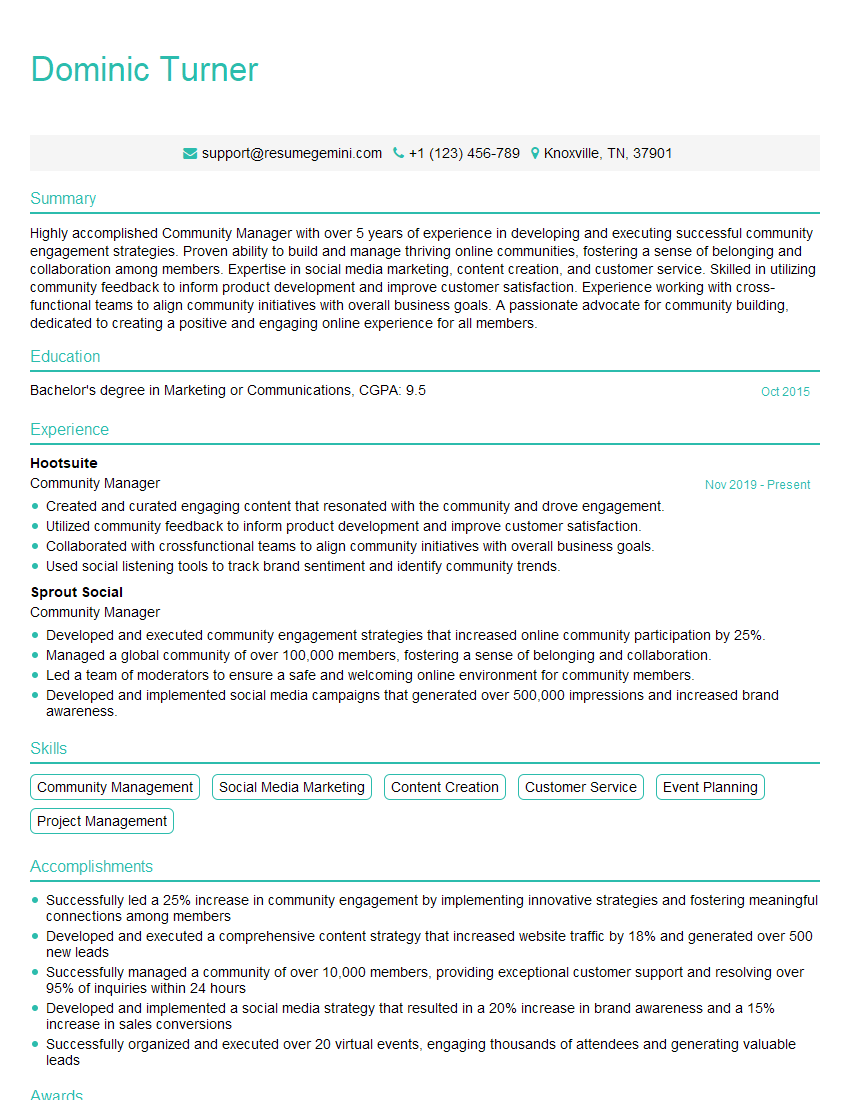
Community Manager Resume Sample
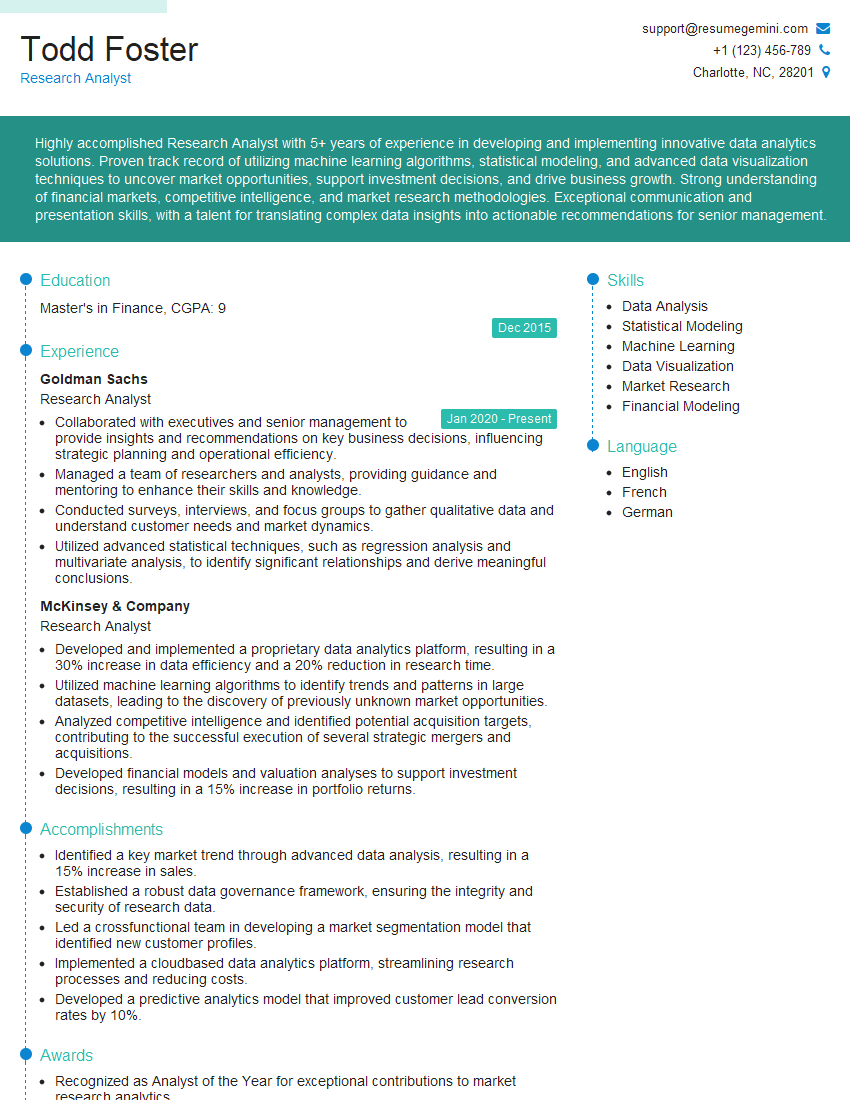
Research Analyst Resume Sample

Social Media Manager Resume Sample
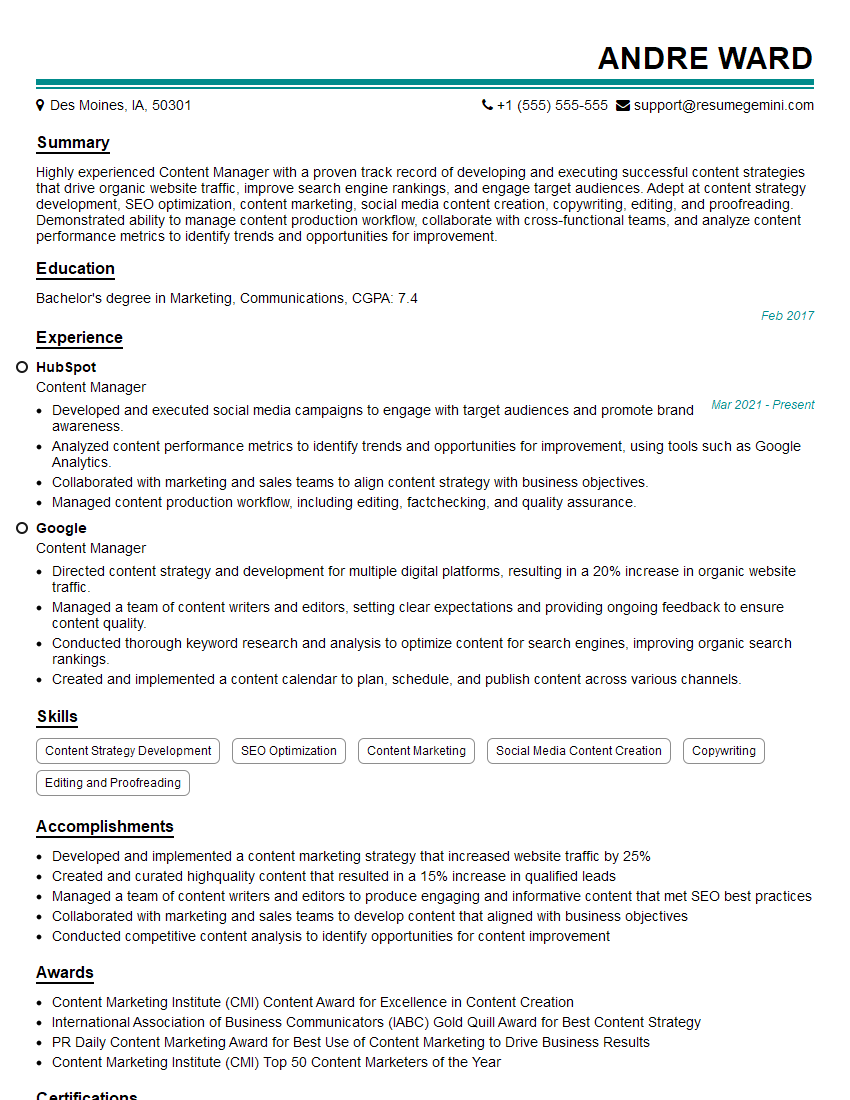
Content Manager Resume Sample

Information Architect Resume Sample
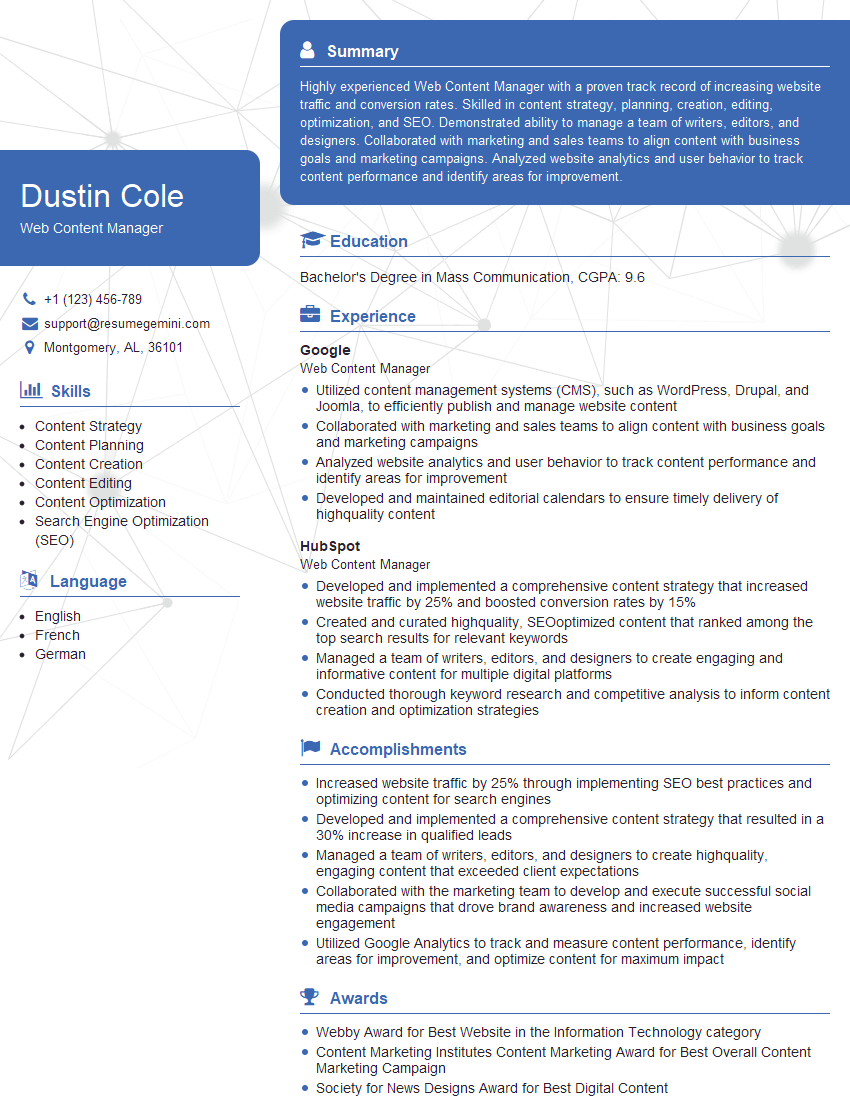
Web Content Manager Resume Sample
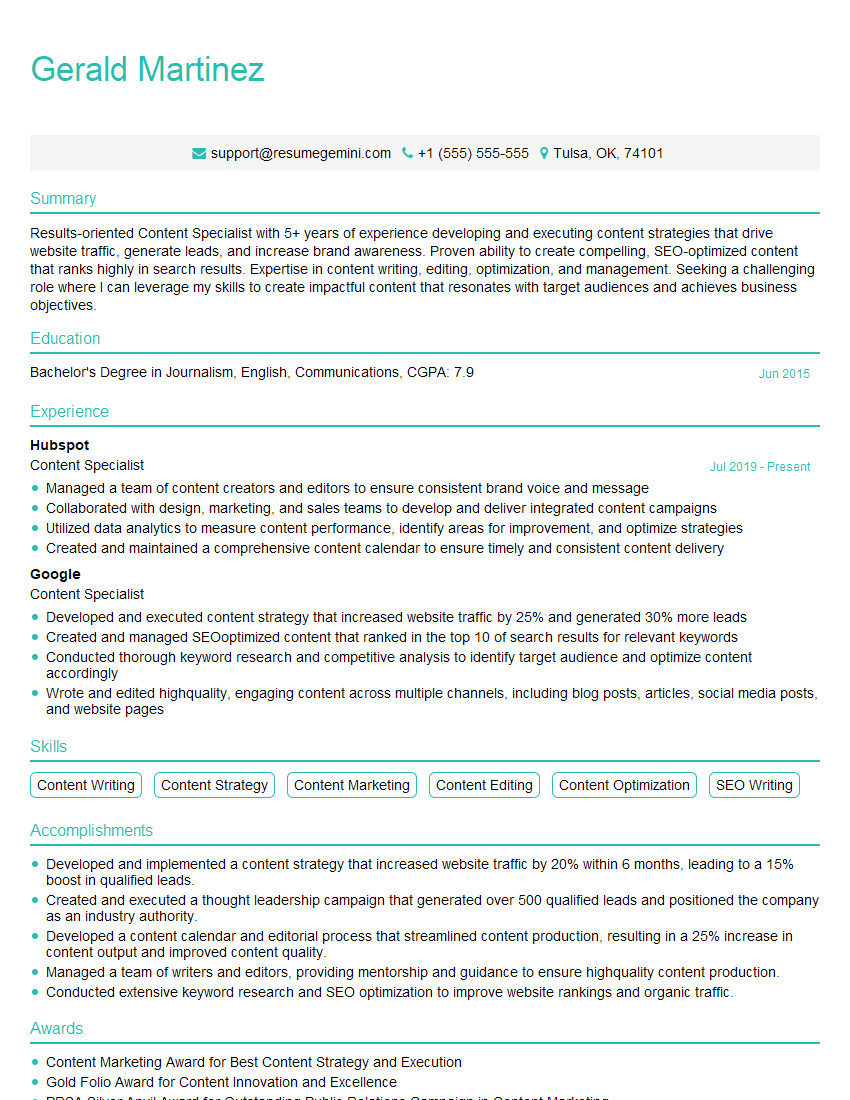
Content Specialist Resume Sample

Content Strategist Resume Sample
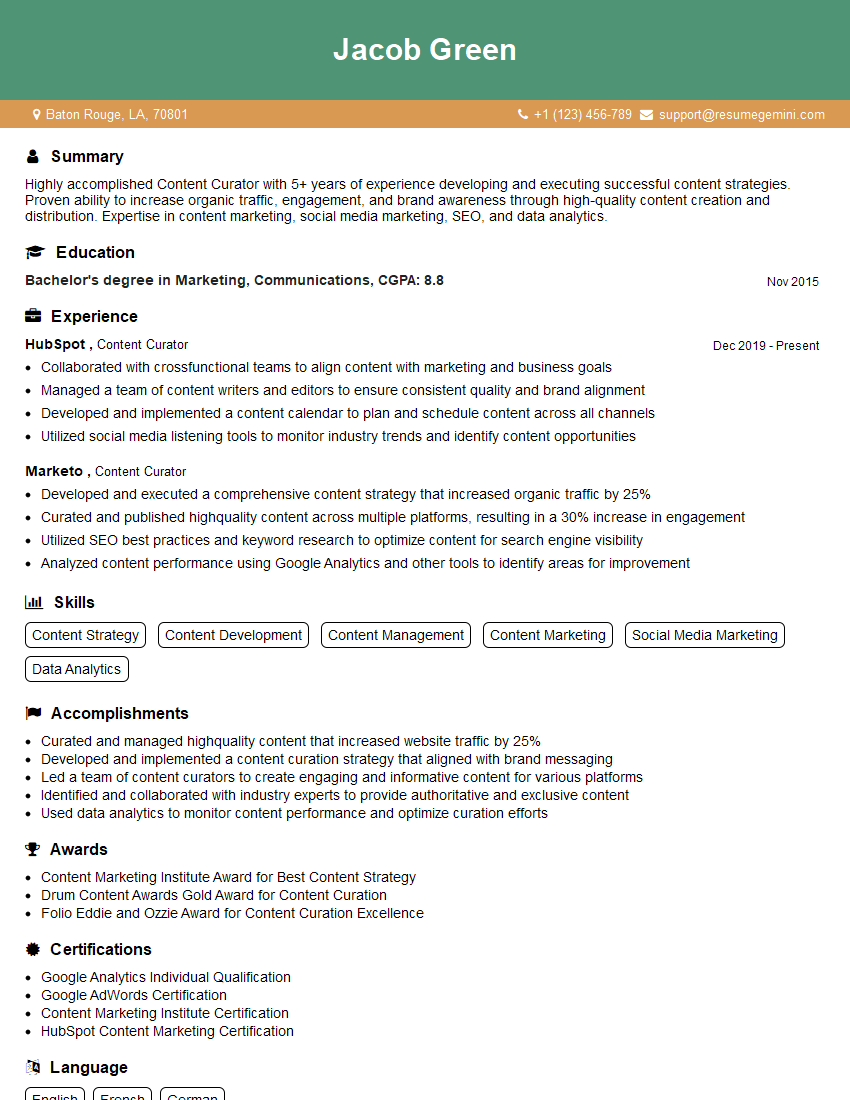
Content Curator Resume Sample
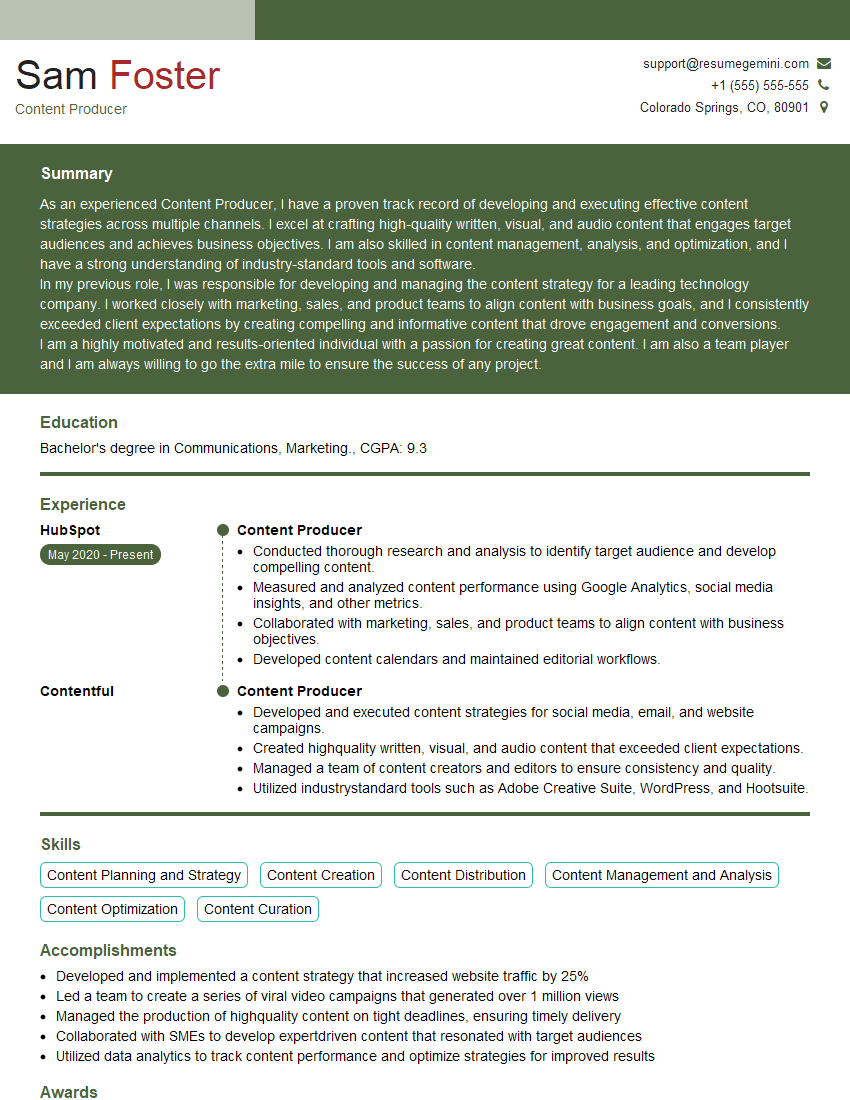
Content Producer Resume Sample
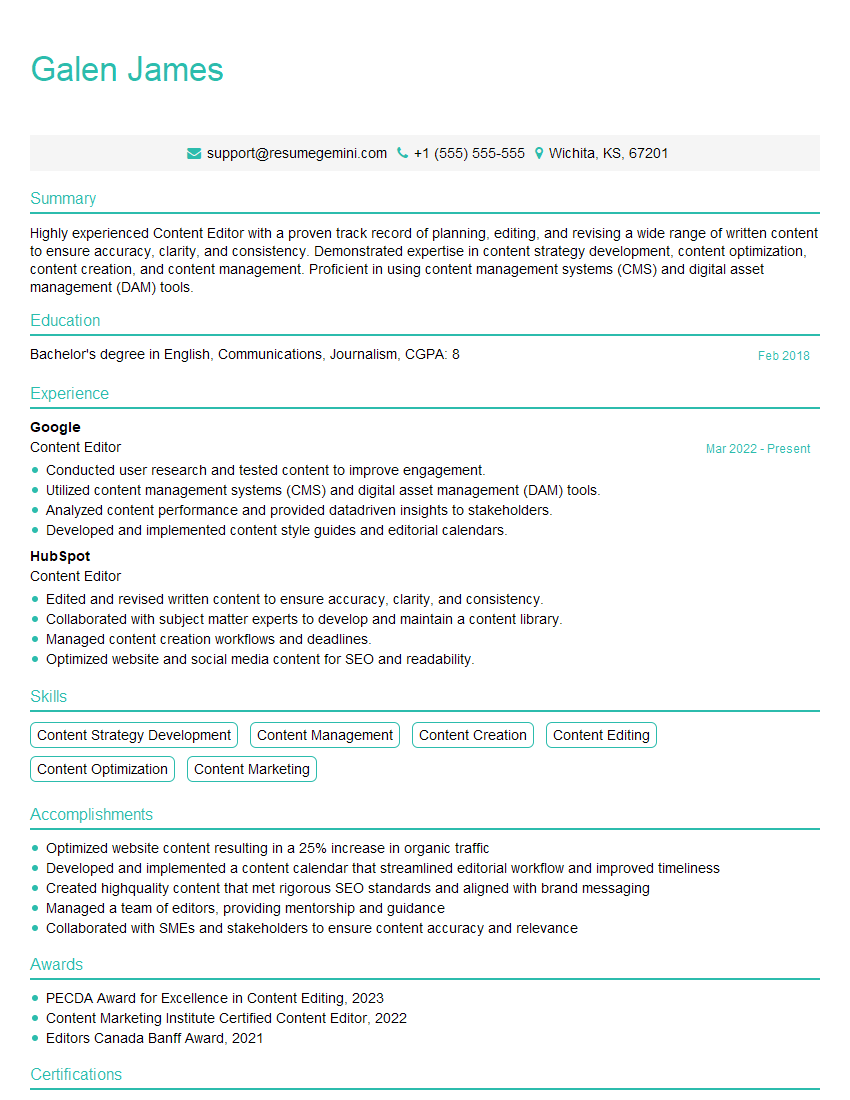
Content Editor Resume Sample
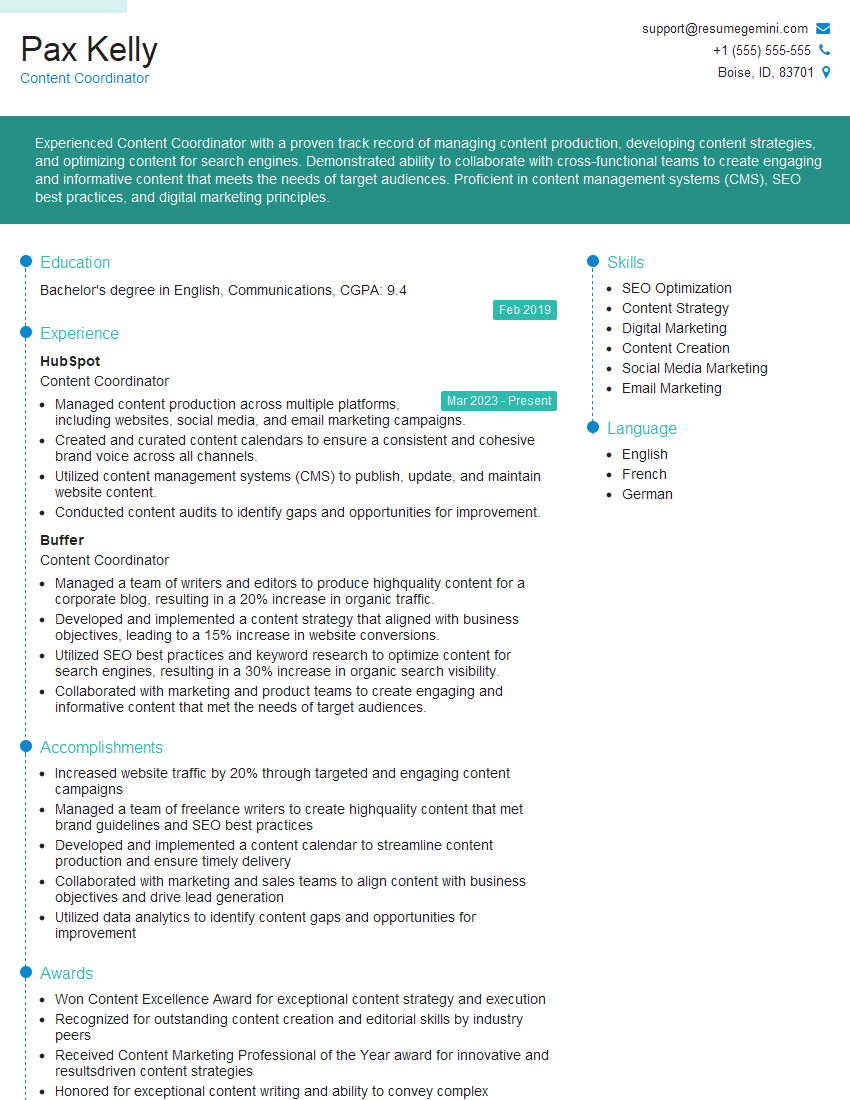
Content Coordinator Resume Sample
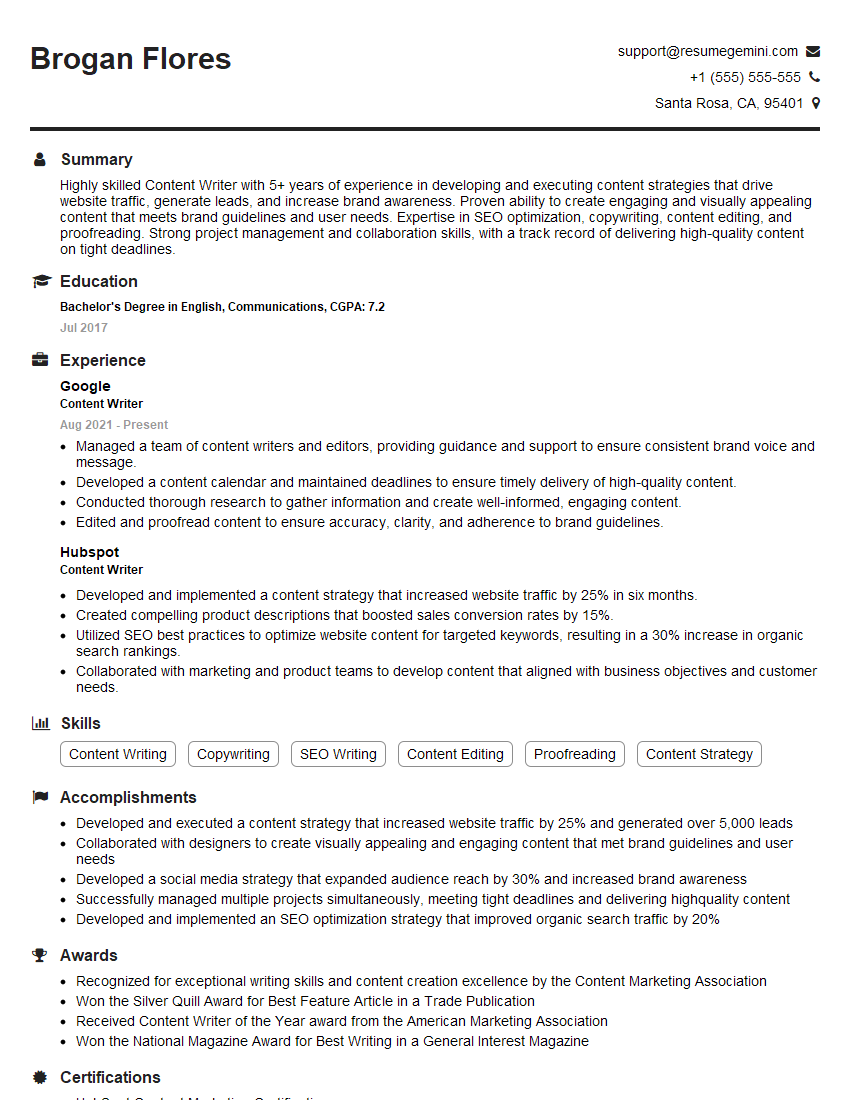
Content Writer Resume Sample
Explore more articles
Users Rating of Our Blogs
Share Your Experience
We value your feedback! Please rate our content and share your thoughts (optional).
What Readers Say About Our Blog
Very informative content, great job.
good