Are you ready to stand out in your next interview? Understanding and preparing for Copywriting for Sports Commentary interview questions is a game-changer. In this blog, we’ve compiled key questions and expert advice to help you showcase your skills with confidence and precision. Let’s get started on your journey to acing the interview.
Questions Asked in Copywriting for Sports Commentary Interview
Q 1. Describe your experience in crafting concise and engaging sports commentary.
Crafting concise and engaging sports commentary requires a delicate balance of factual accuracy, vivid description, and exciting narrative. It’s about painting a picture with words, bringing the action to life for the listener or reader even if they aren’t physically present. My approach centers on understanding the core elements of the game and translating those into captivating prose. I focus on key moments, pivotal plays, and the emotional arc of the contest. Rather than simply stating ‘the team scored,’ I might write something like, ‘A stunning breakaway by Johnson, a perfectly weighted pass to Smith, and a rocket of a shot into the back of the net – the crowd erupts!’ This provides a richer, more immersive experience.
Years of experience covering various sports have honed my ability to distill complex events into easily digestible narratives. I’ve learned to prioritize impactful details, choosing words that evoke the intensity and drama of the game. Conciseness is crucial, especially in live broadcasts where time is limited. I constantly refine my writing to eliminate unnecessary words while retaining the essence of the action.
Q 2. How do you adapt your writing style to different sports and audiences?
Adapting my style depends on the sport’s inherent rhythm and the audience’s familiarity. For example, covering a NASCAR race necessitates a different style than covering a chess match. NASCAR demands a rapid-fire, almost breathless style to mirror the speed and excitement. I use shorter sentences, focusing on immediate action and position changes. ‘Logano takes the lead! Elliott closes the gap! A bump and grind in turn three!’ Chess, however, requires a more analytical and strategic approach, focusing on the unfolding plan and positional advantages. I might describe strategic maneuvers using more considered language and explaining the implications of each move, ‘Carlsen sacrifices a pawn, a bold gambit that opens up the Kingside, potentially creating an attack on the Black King.’
Audience considerations are equally important. For a younger audience, I’ll adopt a more energetic and informal tone, potentially incorporating slang or playful commentary. For a more mature or seasoned audience, I’ll maintain a professional, yet still engaging, tone, focusing on analysis and strategic insights. The key is to understand your audience and tailor your language and tone to resonate with them.
Q 3. Explain your process for writing live sports commentary.
My process for live sports commentary is highly dynamic and relies on preparation, adaptability, and quick thinking. It begins with thorough pre-game research. I study team lineups, player statistics, recent performances, and any significant news or storylines. This research forms the foundation of my commentary. During the game, I actively observe the action, noting key moments, momentum shifts, and important stats. I create concise mental notes or use a shorthand system to capture essential information, enabling me to weave these into my commentary without losing the flow of the game.
I aim for a blend of factual reporting and engaging narrative. I might start with an observation, ‘The crowd is electric tonight!’ then integrate relevant information, ‘And no wonder, given the home team’s recent winning streak.’ This approach ensures my commentary is informative, dynamic, and exciting.
I constantly monitor the game’s flow, adjusting my commentary to reflect the unfolding events. If the game slows down, I might offer analysis or background information; if it’s fast-paced, I focus on the immediate action.
Q 4. How do you incorporate real-time updates and statistics into your writing?
Incorporating real-time updates and statistics seamlessly is critical. I leverage various sources, including live scoreboards, official game statistics, and often a dedicated stats assistant. I strive for natural integration; I wouldn’t abruptly interrupt the flow of the game with a long statistical recitation. Instead, I might say, ‘Smith’s now just two points away from tying the all-time scoring record, a feat that would be unprecedented in this league’s history!’ This way, the statistics enhance the narrative rather than disrupting it. The use of brief, impactful statistical mentions—like ‘leading scorer’ or ‘career-high’–adds weight and credibility to my commentary without being overwhelming.
To avoid sounding robotic, I contextualize the statistics, explaining their significance in relation to the current game or the player’s career. This provides deeper insight and makes the stats engaging for a wider audience. Accurate and up-to-the-minute information is essential for maintaining credibility and providing a superior viewing or listening experience.
Q 5. How do you manage deadlines under pressure while maintaining accuracy?
Managing deadlines under pressure requires a combination of efficient workflow, meticulous planning, and clear communication. Before a game, I prepare a basic outline or talking points, ensuring I know the key storylines and potential talking points. This allows me to react quickly to unfolding events without losing focus. During live commentary, I prioritize speed and accuracy. Concise sentences, a strong grasp of the game, and quick mental processing are key. My shorthand system allows me to efficiently record key data points and integrate them smoothly into my writing.
I also maintain constant communication with the broadcast team, alerting them to any potential delays or unexpected situations. Experience is crucial; over time, you develop an intuitive sense of pacing and can anticipate potential changes in the game’s momentum, allowing for smoother transitions between different aspects of the commentary. The ability to write quickly, accurately, and under pressure is honed through practice and experience. The key is calm and decisive action under stress.
Q 6. Describe your experience in collaborating with other members of a broadcast team.
Collaboration is essential in broadcast commentary. I work closely with analysts, play-by-play commentators, and production crews to create a cohesive and engaging broadcast. Open communication and a shared understanding of the game’s narrative are paramount. Before the broadcast, we typically discuss the key storylines, potential talking points, and overall direction of the commentary. This ensures a unified and consistent message. During the broadcast, we rely on constant communication, often through nonverbal cues and pre-arranged signals to keep the flow of the commentary smooth and engaging.
I value the diverse perspectives and expertise of my teammates. Analysts provide in-depth insights into the game’s strategic elements, while play-by-play commentators focus on the action’s immediate flow. Working together creates a richer and more insightful experience for the audience. Successful collaboration is built upon mutual respect, clear communication, and a shared commitment to producing a top-quality broadcast.
Q 7. How familiar are you with AP style guidelines for sports writing?
I am very familiar with AP style guidelines for sports writing. AP style is the foundation of clear, concise, and accurate reporting, crucial in sports commentary. My understanding encompasses all aspects, from capitalization and punctuation to the proper use of numbers, abbreviations, and sports-specific terminology. Consistency is key, and I strive to maintain adherence to AP style in all my writing to ensure readability and clarity for the audience. I understand that consistent style ensures credibility and makes the commentary more professional. Knowing the nuances of AP style is paramount to my work, ensuring a high degree of professionalism.
Q 8. What strategies do you use to ensure clarity and accuracy in sports commentary?
Clarity and accuracy are paramount in sports commentary. My strategy involves meticulous preparation, a deep understanding of the sport, and a commitment to concise, precise language. Before any game, I thoroughly research the teams, players’ statistics, recent performances, and any significant news or injuries. This allows me to anticipate likely scenarios and react smoothly to unfolding events. During the broadcast, I use clear, simple language avoiding jargon unless absolutely necessary and always defining any technical terms I do use. I also double-check facts, using multiple reliable sources whenever possible, especially for statistics and records. Imagine trying to describe a complex play – I’d break it down into easily digestible chunks, highlighting key actions and their impact on the game. Accuracy is built on thorough preparation and constant fact-checking.
- Pre-game Research: Studying team rosters, player profiles, and historical data.
- Concise Language: Avoiding ambiguity and using precise terminology.
- Fact-Checking: Verifying statistics and information from multiple sources.
Q 9. How do you handle unexpected events or controversial moments during a game?
Unexpected events, like a controversial call or a sudden injury, require quick thinking and adaptability. My approach involves remaining calm, acknowledging the situation clearly and accurately, and avoiding speculation until further information is available. For example, if a controversial penalty is called, I would first describe the play objectively, then state the referee’s call, and finally, briefly address any immediate reaction from the players or coaches without offering personal opinion. If an injury occurs, I provide concise, factual information regarding the player’s condition, drawing from official reports or on-field observations while being sensitive to the situation. The key is to convey the facts efficiently, maintain a neutral tone, and refrain from making premature judgements or drawing hasty conclusions. This helps maintain the integrity of the commentary while keeping the audience informed.
- Remain Calm and Objective: Avoid emotional reactions and stick to the facts.
- Acknowledge the Situation: Clearly describe what happened without speculation.
- Wait for Confirmation: Avoid making judgments until official information is available.
Q 10. What software or tools do you use for sports writing and editing?
My toolkit includes a combination of software to enhance efficiency and accuracy. I rely on a robust word processor like Microsoft Word or Google Docs for initial drafting and editing, leveraging their grammar and spell-check functionalities. I often use spreadsheet software, like Excel or Google Sheets, to organize player statistics and team data for quick reference during the broadcast. Additionally, I use a professional-grade audio editing software (e.g., Adobe Audition, Audacity) for reviewing and potentially adjusting any recorded commentary, ensuring sound quality and removing any unwanted noise. For collaborating with my broadcast partners, I make use of communication platforms like Slack or dedicated team messaging systems.
- Word Processor: Microsoft Word, Google Docs (for drafting and editing).
- Spreadsheet Software: Excel, Google Sheets (for organizing data).
- Audio Editing Software: Adobe Audition, Audacity (for audio quality control).
- Communication Platforms: Slack, team messaging systems (for collaboration).
Q 11. Provide an example of a compelling sentence you’ve written for sports commentary.
One compelling sentence I recall writing was: "With a flick of the wrist and a roar from the crowd, Johnson unleashed a thunderbolt of a shot that soared past the outstretched fingertips of the goalkeeper, finding the back of the net with unstoppable precision." This sentence attempts to encapsulate the excitement, skill, and impact of a goal, using evocative language and imagery to immerse the listener in the moment. The selection of words – ‘flick of the wrist’, ‘thunderbolt’, ‘unstoppable precision’ – all contribute to a powerful and memorable image.
Q 12. How do you balance factual accuracy with storytelling in your commentary?
Balancing factual accuracy with storytelling is a crucial skill. I achieve this by weaving factual details into a narrative framework. Instead of simply stating statistics, I contextualize them within the flow of the game. For instance, instead of saying ‘Player X scored 20 points’, I might say ‘Player X, who’d been relatively quiet in the first half, exploded in the third quarter, racking up 20 crucial points that turned the tide of the game.’ This approach engages the listener while ensuring the information remains accurate. The key is to use the facts to build a compelling story, not to let the facts overshadow the narrative.
- Contextualize Statistics: Integrate numbers within the larger game narrative.
- Focus on Narrative: Build a story around the factual information.
- Engaging Language: Employ descriptive words to create vivid imagery.
Q 13. How do you maintain objectivity while conveying excitement in your writing?
Maintaining objectivity while conveying excitement involves careful word choice and tone. While I aim to enthuse the listener with the drama of the game, I avoid using biased or emotionally charged language. For example, instead of saying ‘That was a terrible call by the referee!’, I might say ‘The referee’s decision to call a foul there proved controversial, sparking immediate debate.’ This approach allows me to convey the tension and excitement of the moment without imposing my personal opinion. The excitement comes from the factual description of the game itself, and the skill lies in highlighting the dramatic elements objectively.
- Neutral Language: Use unbiased and descriptive words.
- Focus on Events: Describe the action without passing judgment.
- Highlight Drama: Emphasize the tension and excitement objectively.
Q 14. Explain your understanding of the different formats of sports commentary (e.g., play-by-play, color commentary).
Sports commentary encompasses various formats, each serving a unique purpose. Play-by-play commentary provides a blow-by-blow account of the game’s action, focusing on what’s happening in real-time. Think of the announcer calling every pitch, every pass, every shot. It requires speed, precision, and an ability to describe the action concisely. Color commentary provides context, analysis, and insight, offering a deeper understanding of the game’s strategy, players’ performances, and significant events. The color commentator may discuss player history, tactical decisions, or the game’s implications. A good analogy is that play-by-play is the ‘what’ and color commentary is the ‘why’. There are also variations such as studio analysis which provides a broader perspective, often pre- and post-game, and might involve discussions amongst multiple commentators, reviewing highlights and offering opinions.
- Play-by-Play: Real-time description of the game’s action.
- Color Commentary: Analysis, context, and insights.
- Studio Analysis: Broader perspectives, often pre/post-game.
Q 15. How would you describe your writing voice in the context of sports commentary?
My writing voice in sports commentary is energetic, informative, and engaging, yet remains objective. I strive for a balance between the excitement of the moment and providing insightful analysis. Think of it as a knowledgeable friend sharing their passion for the game, not a detached narrator. I avoid overly technical jargon unless absolutely necessary, and I always prioritize clarity and conciseness. For example, instead of saying, “The point guard executed a deft crossover dribble, initiating a fast break culminating in a successful layup,” I might say, “Wow! What a move by the point guard! He blew past his defender and finished with a smooth layup.” The goal is to paint a vivid picture for the listener while still conveying essential details.
Career Expert Tips:
- Ace those interviews! Prepare effectively by reviewing the Top 50 Most Common Interview Questions on ResumeGemini.
- Navigate your job search with confidence! Explore a wide range of Career Tips on ResumeGemini. Learn about common challenges and recommendations to overcome them.
- Craft the perfect resume! Master the Art of Resume Writing with ResumeGemini’s guide. Showcase your unique qualifications and achievements effectively.
- Don’t miss out on holiday savings! Build your dream resume with ResumeGemini’s ATS optimized templates.
Q 16. How do you ensure your commentary appeals to both casual and hardcore fans?
Appealing to both casual and hardcore fans requires a layered approach. I incorporate elements that resonate with casual viewers, such as clear explanations of key plays and engaging storytelling, while simultaneously providing deeper insights and statistical analysis that satisfy hardcore fans. This means using simple, everyday language when explaining complex strategies, but also slipping in stats or historical comparisons to enrich the experience for more seasoned fans. For example, I might say, “That was a spectacular three-pointer from Johnson—his fifth of the night! He’s really on fire tonight,” which appeals to everyone, and then follow it with, “This marks his highest three-point total this season, surpassing his previous record against the Lakers.” This adds depth without alienating casual viewers.
Q 17. How do you incorporate audience engagement into your sports writing?
Audience engagement is key. I achieve this through several strategies. First, I use inclusive language, addressing the listeners directly – phrases like, “Can you believe this?” or “This is incredible!” draw them into the excitement. Second, I anticipate questions and answer them proactively; for example, if a player is struggling, I might say, “Many fans are wondering why Smith isn’t scoring tonight… Let’s look at the defensive pressure he’s facing.” Finally, I encourage interaction through social media mentions or by referencing trending topics related to the game. For instance, I might say, “And don’t forget to use #GameNight to share your thoughts on Twitter!”
Q 18. How would you structure your commentary for different phases of a game?
Commentary structure varies across game phases. The pre-game focuses on setting the stage: introducing players, discussing key storylines, and offering predictions. During the game, the focus shifts to play-by-play descriptions, analysis of tactics, and highlighting significant moments. Post-game commentary involves summarizing the game, analyzing key factors contributing to the outcome, and reflecting on notable performances. For instance, during a crucial timeout, I might offer strategic analysis, explaining the team’s possible approach based on their current situation. After the final buzzer, my commentary will focus on the game’s overall narrative, recognizing the winning team’s accomplishments and discussing the losing team’s challenges.
Q 19. Describe your experience with on-air or live commentary writing.
My experience with on-air commentary includes working on various sports, from basketball and football to even niche sports like esports. The pressure of live commentary is immense, requiring quick thinking, adaptability, and the ability to seamlessly weave together facts, analysis, and excitement. One memorable experience involved covering a sudden, unexpected game-changing event. My preparation allowed me to smoothly transition my commentary to explain the impact of the change, keeping the audience informed and engaged. This emphasized the importance of being prepared for any eventuality, having backup commentary points readily available.
Q 20. How do you handle criticism of your work?
Criticism, when constructive, is invaluable. I treat it as an opportunity for growth. I carefully analyze any feedback, considering whether it points to areas for improvement in my style, accuracy, or insights. I also evaluate the source of the criticism to discern whether it’s objective or based on personal bias. Ignoring critical feedback can be detrimental to professional growth; engaging with it thoughtfully leads to refinement and enhances performance. For example, feedback that highlights a tendency to be overly enthusiastic might push me to find a better balance between exciting descriptions and providing clear and concise information.
Q 21. What are some common mistakes to avoid in sports commentary writing?
Common mistakes in sports commentary writing include:
- Overly technical language: Jargon alienates casual viewers.
- Lack of objectivity: Show bias, particularly favoring a particular team or player.
- Poor pacing: Rushing through exciting moments or rambling during less significant plays.
- Inaccurate information: Mistakes in facts or statistics damage credibility.
- Ignoring the narrative: Failing to tell a captivating story through the game.
Q 22. How do you stay up-to-date on the latest sports news and developments?
Staying current in the dynamic world of sports requires a multi-pronged approach. It’s not just about reading headlines; it’s about deep immersion.
- Dedicated News Sources: I subscribe to several reputable sports news outlets, both print and digital, ensuring I receive breaking news, in-depth analysis, and expert opinions across various sports.
- Social Media Monitoring: Social media platforms are invaluable for real-time updates, athlete insights, and fan reactions. I actively monitor relevant accounts and hashtags to stay ahead of the curve.
- Sports Websites and Apps: I utilize dedicated sports websites and apps that offer live scores, stats, and news feeds, often tailored to specific leagues or teams. This allows me to track performances and emerging storylines.
- Podcast Consumption: Sports podcasts provide insightful commentary and interviews with athletes, coaches, and analysts, offering a deeper understanding beyond the surface-level news.
- Direct Engagement: Whenever possible, I attend press conferences and networking events to engage directly with athletes, coaches, and other professionals in the field.
This combination of diverse sources ensures that my commentary is well-informed, accurate, and up-to-date, allowing me to offer context and analysis that goes beyond the immediate event.
Q 23. Describe your experience using different styles of sports commentary based on different platforms.
Adapting my commentary style to different platforms is crucial for effective communication. Each platform demands a unique tone and delivery.
- Radio: Radio commentary requires a conversational, descriptive style. I focus on painting a vivid picture for the listener, using evocative language and precise descriptions of player actions. Pacing and timing are key, ensuring a clear, engaging narrative.
- Television: TV commentary demands a more concise and visually-driven approach. I work in close collaboration with the on-screen graphics team, ensuring my words complement the visuals. The tone is often more energetic and enthusiastic, adapting to the visual excitement.
- Digital Platforms (Blogs, Social Media): Digital platforms allow for a more informal and analytical style. I can incorporate data, insights, and humorous observations while maintaining a conversational tone that resonates with online audiences. This often requires more concise sentences and a focus on keywords.
- Live Events: Live event commentary requires spontaneous thinking and quick adaptation to unexpected events. While preparation is critical, the ability to improvise and stay calm under pressure is paramount.
Each platform has unique demands. The key is to understand the audience and the platform’s capabilities, adjusting my style accordingly to maximize impact.
Q 24. How do you ensure your commentary is accessible to a broad audience?
Ensuring broad accessibility in sports commentary involves mindful language choices and narrative strategies.
- Avoiding Jargon: I avoid overly technical terms and sports-specific jargon. When necessary, I explain complex concepts in simple, clear language accessible to a casual viewer or listener.
- Inclusive Language: I use gender-neutral language and avoid stereotypes when referring to athletes and teams. My language is respectful and avoids potentially offensive terms.
- Clear and Concise Sentences: I prioritize clarity over complexity, ensuring sentences are easy to understand and follow. I avoid convoluted structures or long, rambling descriptions.
- Storytelling Approach: I often frame the game or event as a story, focusing on the human elements and the drama unfolding. This helps connect with a broader audience, regardless of their prior knowledge.
- Variety in Delivery: In live commentary, I vary my tone, pacing, and emphasis to maintain audience interest and avoid monotony. This can include moments of humor, excitement, and thoughtful reflection, as appropriate.
The goal is to create a universally engaging narrative that captivates even those who are unfamiliar with the specific nuances of the sport.
Q 25. How familiar are you with different sports analytics and data sources?
I am very familiar with various sports analytics and data sources. This is a vital component of modern sports commentary, providing context, insights, and predictive analysis.
- Traditional Stats: I am proficient in interpreting and utilizing traditional statistics such as batting averages, ERA, points per game, etc., to provide context and analysis.
- Advanced Metrics: I understand and employ advanced metrics like WAR (Wins Above Replacement), OPS (On-base plus slugging), and expected goals (xG) to provide a deeper level of analysis and prediction.
- Data Sources: I utilize a range of data sources, including official league websites, specialized sports analytics platforms (like ESPN, etc.), and publicly available databases.
- Data Visualization: I am familiar with different data visualization tools and techniques to effectively present data in a clear and understandable format to enhance the commentary.
Integrating data into my commentary allows me to move beyond simple play-by-play descriptions, enriching the viewer/listener experience with insightful analysis and predictions.
Q 26. Give an example of how you have overcome a writing challenge in sports commentary.
One challenging situation I faced involved covering a game significantly delayed by inclement weather. The initial plan of focusing on the game’s momentum became irrelevant.
My solution involved adapting my approach. Instead of solely focusing on the game itself, I shifted to:
- Background Stories: I highlighted the history of the teams, focusing on memorable moments and rivalries. This kept the audience engaged despite the lack of live action.
- Player Profiles: I shared intriguing stories about key players, revealing their personalities and backstories. This created a human connection with the audience.
- Weather Analysis: I incorporated insights from weather reports, explaining the impact on the game and the players. This provided relevant context to the delay.
- Audience Interaction: Where possible, I encouraged audience participation through social media, prompting discussions and keeping them engaged.
By creatively adapting to the situation, I maintained audience interest and delivered a comprehensive commentary, even in the absence of consistent on-field action. The key was adaptability and focusing on elements beyond the immediate game.
Q 27. How do you incorporate sponsorship mentions seamlessly into your sports commentary?
Incorporating sponsorships seamlessly into sports commentary requires a subtle and natural approach. Forced mentions feel unnatural and detract from the viewing/listening experience.
- Contextual Integration: I integrate sponsor mentions within the natural flow of the commentary, relating them to relevant game events or moments. For example, mentioning a sponsor’s product during a discussion about player performance or equipment.
- Avoid Disruptive Mentions: I avoid interrupting crucial moments of the game with sponsor mentions. The focus should always remain on the sporting event.
- Natural Language: I use conversational language when mentioning sponsors, making the integration feel less like a commercial and more like an organic part of the narrative.
- Variety in Mentions: I vary the types of mentions to avoid repetition, using a combination of explicit mentions, visual cues (where applicable), and implicit connections.
- Pre-planning: Careful pre-planning is essential. I work with the sponsors to understand their message and identify appropriate moments for integration during the commentary.
The goal is to find a balance between acknowledging sponsors and delivering engaging commentary. A well-integrated sponsorship mention adds value without disrupting the flow of the narrative or alienating the audience.
Key Topics to Learn for Copywriting for Sports Commentary Interview
- Understanding the Audience: Analyze different sports audiences and tailor your writing style accordingly (e.g., casual vs. formal, technical jargon vs. plain language).
- Real-time Adaptation: Practice writing concise, impactful copy under pressure, simulating the fast-paced nature of live sports commentary.
- Storytelling Techniques: Learn how to craft compelling narratives within the constraints of a live broadcast, highlighting key moments and player performances.
- Vocabulary and Tone: Develop a rich vocabulary appropriate for the sport and maintain a consistent, engaging tone throughout the broadcast.
- Conciseness and Clarity: Master the art of conveying complex information quickly and clearly, avoiding ambiguity and unnecessary details.
- Collaboration and Teamwork: Understand the dynamics of working with commentators, producers, and other team members in a broadcast environment.
- SEO and Keyword Optimization (for written pieces): If the role involves writing pre or post-game analyses, learn to incorporate relevant keywords to enhance online visibility.
- Style Guides and Brand Voice: Familiarize yourself with common style guides and adapt your writing to maintain a consistent brand voice.
- Ethical Considerations: Understand the importance of factual accuracy, avoiding bias, and maintaining professional conduct.
Next Steps
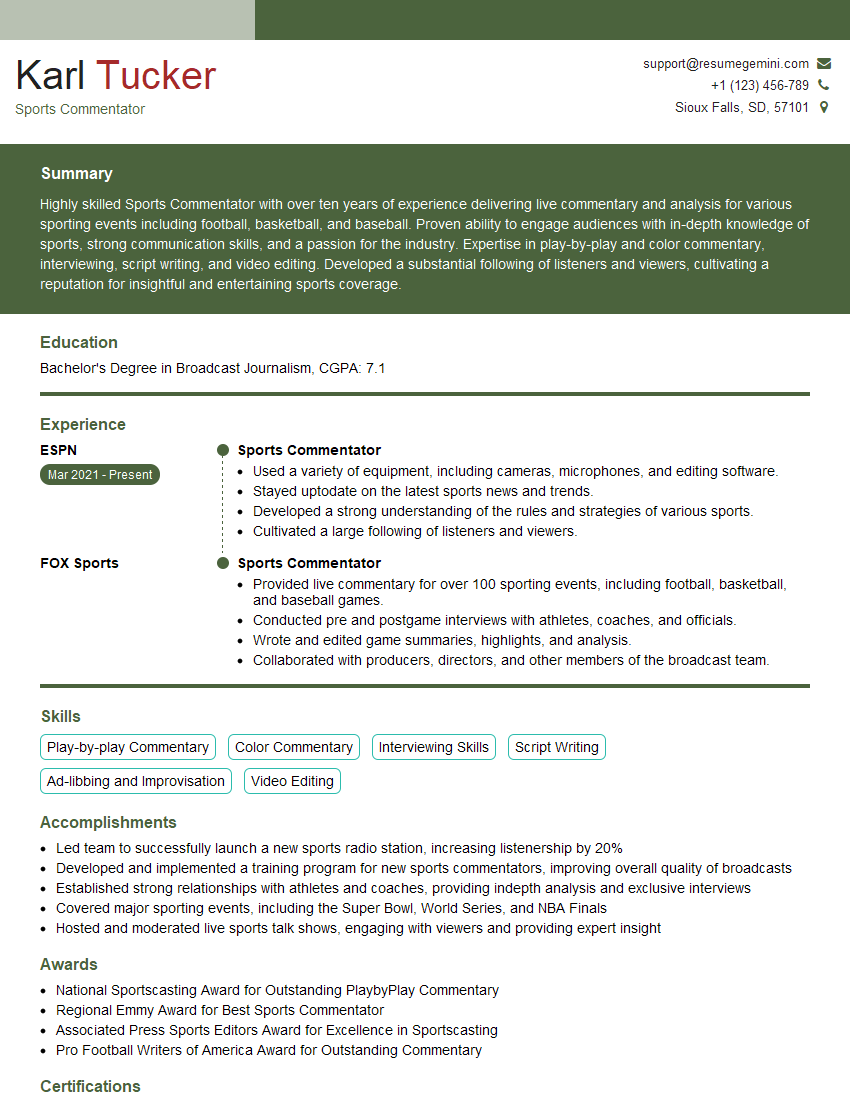
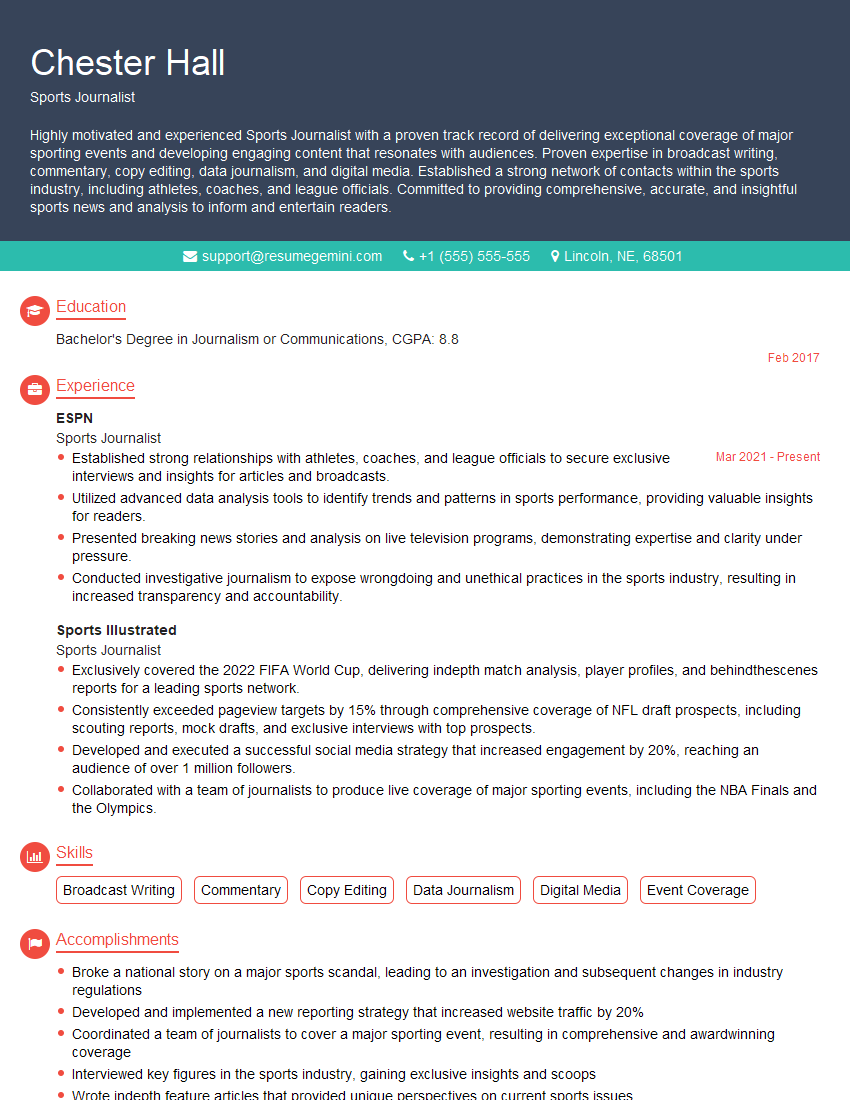
Mastering copywriting for sports commentary opens doors to exciting careers in broadcasting, digital media, and sports journalism. A strong resume is your key to unlocking these opportunities. An ATS-friendly resume significantly improves your chances of getting noticed by recruiters. To build a compelling and effective resume that showcases your skills and experience, we highly recommend using ResumeGemini. ResumeGemini provides a user-friendly platform and offers examples of resumes tailored specifically to Copywriting for Sports Commentary, ensuring your application stands out from the competition.
Explore more articles
Users Rating of Our Blogs
Share Your Experience
We value your feedback! Please rate our content and share your thoughts (optional).