Are you ready to stand out in your next interview? Understanding and preparing for Costume Design for Ice Shows interview questions is a game-changer. In this blog, we’ve compiled key questions and expert advice to help you showcase your skills with confidence and precision. Let’s get started on your journey to acing the interview.
Questions Asked in Costume Design for Ice Shows Interview
Q 1. Describe your experience designing costumes specifically for ice skating.
My experience in ice show costume design spans over 15 years, encompassing a wide range of productions, from small-scale local competitions to major international tours. I’ve collaborated with renowned choreographers, skaters, and production teams, creating costumes for both soloists and large ensembles. My work has involved designing costumes for diverse themes, styles, and technical requirements, ranging from elegant classical pieces to dynamic modern interpretations. I’ve consistently focused on creating costumes that enhance the performance, complementing the choreography and the skaters’ individual styles while ensuring maximum comfort and safety on the ice.
For example, for a recent production of Swan Lake, I designed costumes that used intricate beadwork and lightweight fabrics to capture the ethereal grace of the swans, while ensuring the costumes allowed for the complex choreography demanding spins, jumps and lifts. For a contemporary piece, I utilized bold colors and innovative textiles that reflected the energetic movement and strong visual narrative of the choreography. Each project requires a unique approach, and I am adept at adapting my skills and knowledge to meet the specific demands of the production.
Q 2. What fabrics are best suited for ice show costumes, and why?
Fabric selection for ice show costumes is crucial, as it directly impacts both the aesthetic appeal and the skater’s performance. The ideal fabrics are lightweight, yet durable, allowing for freedom of movement while withstanding the rigorous demands of skating. Factors to consider include drape, stretch, warmth, and resistance to snagging or tearing.
- Stretch Velvets: Offer a luxurious look with excellent drape and stretch, ideal for elegant costumes.
- Lycra/Spandex blends: Provide comfortable stretch and excellent body-hugging fit, often used as a base layer or for accent pieces.
- Lightweight silks and chiffons: Create flowing, ethereal effects, perfect for delicate choreography, but require careful construction and handling.
- Technical Fabrics: Moisture-wicking fabrics like nylon or polyester blends help regulate body temperature and prevent overheating.
- Mesh Fabrics: Used for ventilation and creating visual interest through layering or textural contrast.
Avoid heavy fabrics like wool or thick cotton, as they can restrict movement and increase the risk of falls. The choice of fabric also depends heavily on the overall theme and design concept of the costume.
Q 3. How do you incorporate movement and fluidity into your ice show costume designs?
Incorporating movement and fluidity into ice show costume designs is paramount. The costumes should not only look stunning but also enhance the grace and athleticism of the skaters. I achieve this through several key design elements:
- Strategic Drape and Cut: Using flowing fabrics, strategic cuts, and layered designs creates a sense of movement even when the skater is stationary. A-line skirts, asymmetrical hems, and strategically placed gathers all contribute to this effect.
- Paneling and Seams: Careful placement of panels and seams can accentuate the body’s natural movement, allowing the fabric to move with the skater’s body rather than against it.
- Lightweight Construction: Minimizing the weight of the costume through fabric selection and construction techniques allows for greater freedom and range of motion.
- Layered Fabrics: Combining different fabrics with varying weights and textures creates visual interest and enhances the flow of movement. A sheer overlay over a more substantial base layer, for instance, adds dimension and visual interest.
- Careful Consideration of Choreography: Working closely with choreographers is essential to understand the specific movements and poses that the skaters will be executing, to ensure the costume enhances rather than hinders the performance.
Q 4. Explain your process for creating a costume design from initial concept to final product.
My design process is iterative and collaborative, involving several distinct phases:
- Initial Concept and Research: This stage involves understanding the theme, music, and choreography of the ice show. Mood boards, sketches, and fabric swatches are used to develop initial concepts.
- Sketching and Design Development: Detailed sketches and technical drawings are created, exploring different design options and experimenting with fabric choices and embellishments.
- Fabric Sourcing and Selection: Once a design is finalized, I source the appropriate fabrics, considering factors like color, texture, drape, and practicality for ice skating.
- Pattern Making and Sample Creation: Accurate patterns are drafted and muslin samples are created to ensure a proper fit and assess the drape and movement of the fabric.
- Construction and Fitting: The costumes are constructed, with multiple fittings to ensure a comfortable and flattering fit on the skaters. Adjustments are made as needed based on feedback from the skaters and choreographer.
- Finishing Touches and Embellishments: This involves adding final details like beading, embroidery, or other embellishments to enhance the visual appeal of the costumes.
- Final Fittings and Approval: Final fittings are conducted with the skaters to make any necessary adjustments before the costumes are ready for the show.
Q 5. How do you ensure the costumes are both aesthetically pleasing and functionally appropriate for skating?
Balancing aesthetics and functionality is crucial. A visually stunning costume that restricts movement or poses a safety risk is ultimately unsuccessful. I achieve this balance by:
- Prioritizing Movement: Choosing lightweight, flexible fabrics and using construction techniques that allow for a full range of motion. This often involves using strategically placed seams and darts to allow for flexibility.
- Safety Considerations: Avoiding embellishments that could pose a safety hazard on the ice (e.g., loose hanging elements). I also ensure costumes are secure and won’t easily come undone during intense movements.
- Fit and Comfort: Careful attention is paid to the fit of each costume, ensuring it is comfortable and allows for optimal performance. This involves taking precise measurements and multiple fittings.
- Durable Construction: Using high-quality materials and construction techniques to ensure the costumes can withstand the rigors of rehearsals and performances. Reinforcing seams and using appropriate interfacings are vital.
- Collaboration: Close collaboration with the skaters and choreographers is essential to gather feedback and ensure the costumes meet both aesthetic and functional requirements.
Q 6. How do you manage the challenges of working with multiple performers and varied body types?
Managing multiple performers and varied body types requires a systematic approach. I begin by taking precise body measurements for each skater. This data informs the pattern making process, allowing for adjustments to ensure a comfortable and flattering fit for everyone. I might create a base pattern and then create variations for different body types. For example, I may adjust the waistline, sleeve length, or skirt length to accommodate the individual needs of each skater. I also incorporate various design elements that can easily be adapted to different body types, such as adjustable straps, belts, or ties.
Furthermore, I often create a ‘sample’ costume – a prototype – which helps to assess the fit and functionality of the design before proceeding with the full production. This allows me to make any necessary adjustments to the patterns before mass production. Communication with the skaters is key throughout this process to ensure comfort and satisfaction. This collaboration ensures everyone feels confident and comfortable in their costumes, enhancing their performance.
Q 7. Describe your experience with pattern making and garment construction for ice show costumes.
My pattern-making skills are fundamental to my design process. I’m proficient in drafting patterns from scratch, adapting existing patterns, and utilizing computer-aided design (CAD) software to create precise patterns. For ice show costumes, I often modify standard patterns to incorporate unique design features or accommodate the skater’s movements. For example, I might adjust the seams of a bodice to allow for greater flexibility during spins, or add panels to a skirt to create a more dynamic flow.
Garment construction for ice show costumes requires meticulous attention to detail. I employ a variety of construction techniques, including hand-sewing for intricate details, machine sewing for efficiency, and specialized finishing techniques to ensure durability and longevity. The construction methods are crucial for ensuring that the costumes not only look stunning but also withstand the stress and strain of skating and are comfortable for the performers. Strong seams, carefully chosen interfacings, and secure stitching are vital for ensuring that the costumes can withstand the rigors of rehearsals and performances.
Q 8. What are some common challenges in creating costumes for ice shows and how have you overcome them?
Creating costumes for ice shows presents unique challenges. The most significant is the need for extreme durability. Costumes must withstand the rigorous demands of skating, including falls, spins, and jumps, often on rough ice. Another challenge is the need for flexibility and freedom of movement. The fabric and construction must not restrict the skater’s performance. Finally, the costumes need to be visually stunning under the bright lights and on camera, often requiring intricate embellishments that can be easily damaged.
To overcome these, I prioritize using high-quality, durable fabrics like stretch velvet, Lycra blends, and reinforced stitching. I incorporate strategic reinforcement in high-stress areas, like seams at the knees and shoulders. I also utilize innovative techniques like appliqué instead of heavy embroidery to minimize weight and bulk, thereby enhancing the skaters’ movement. For example, in one show, we used laser-cut, bonded fabric overlays for intricate details instead of traditional beading, making the costumes both visually striking and highly resistant to wear and tear. And to safeguard against unexpected damage, I always create backups or quick repair kits for key costumes.
Q 9. How do you balance artistic vision with practical considerations like cost, time constraints, and durability?
Balancing artistic vision with practical considerations is crucial. It’s a constant negotiation. I begin with mood boards and detailed sketches to define the artistic direction, but immediately factor in budget constraints and available production time. For example, I might initially envision elaborate hand-beaded costumes, but if the budget is limited, I explore alternative embellishments like high-quality printed fabrics or strategically placed sequins to achieve a similar visual effect at a lower cost. Durability is addressed through material selection and construction methods. I always choose fabrics and techniques proven to withstand the demands of performance. A tight timeline necessitates efficient production planning and potentially simpler designs or the use of pre-made components whenever possible without compromising the overall aesthetic.
For instance, in one project, the director envisioned a majestic, flowing gown for the lead skater. However, the performance required quick changes and significant movement. To resolve this, we designed a costume using lightweight, stretchy fabrics that retained shape despite movement, and we minimized embellishments to allow the skirt to flow freely, while incorporating quick-release components for swift costume changes between scenes.
Q 10. Explain your knowledge of different embellishment techniques used in ice show costumes.
Embellishment is key to the visual impact of ice show costumes. I use a wide range of techniques, including:
- Beading: This classic technique involves hand-sewing beads, sequins, and crystals onto the fabric. It’s labor-intensive but yields stunning results.
- Appliqué: Fabric shapes or motifs are cut and sewn onto the base fabric. It’s versatile and allows for intricate designs. Laser cutting allows for precise and consistent appliqués.
- Embroidery: Various embroidery stitches, from simple running stitch to intricate beading embroidery, add texture and detail.
- Sequin Work: Sequins can be applied by hand sewing or machine-stitching. They add sparkle and shimmer.
- Crystal embellishment: Using Swarovski crystals or similar high-quality crystals, glued or sewn to the fabric for extra shimmer and visual effect.
- Printing: Advanced fabric printing techniques offer detailed designs directly printed onto the fabric itself, saving time and cost for certain designs.
The choice of technique depends on the design, budget, and time constraints. For example, a show with a limited budget might use printed fabrics as a cost-effective way to achieve complex patterns. A more lavish production might utilize extensive hand-beading and crystal embellishment.
Q 11. How do you handle costume alterations and repairs during a show’s run?
During a show’s run, costume alterations and repairs are inevitable. I address this with a comprehensive strategy. A dedicated costume crew, trained in quick repairs, accompanies the show. This crew has access to a well-stocked repair kit containing needles, threads (matching various costume colors), sequins, beads, crystals, and fabric scraps. A detailed inventory of each costume, including fabric swatches and embellishment samples, is kept so replacements can be easily sourced and implemented. Prior to the show’s opening, I conduct rigorous rehearsals, identifying potential weak points and making any necessary preemptive repairs. Small rips or loose embellishments are dealt with quickly during intermissions or pre-show checks. For more significant damage, backup costumes are always on standby. I also employ quick-drying adhesives and bonding techniques for faster repairs during hectic backstage moments.
Q 12. Describe your experience collaborating with choreographers and directors on costume design.
Collaboration with choreographers and directors is vital. I begin by reviewing the show’s script, music, and choreography. This helps me understand the artistic vision, movement sequences, and overall mood. I attend rehearsals to observe the skaters’ movements and interactions, ensuring that the costumes don’t impede their performance. Regular meetings with the director and choreographer allow us to discuss design concepts, fabric choices, and practical considerations. I provide sketches, renderings, and fabric swatches for feedback, facilitating clear communication and creative synergy. Open communication is crucial; I actively solicit their input at every stage of the design process, even during the final fittings, making any necessary adjustments in close collaboration. For example, a choreographer’s suggestion to incorporate a flowing cape led to the design of a uniquely structured garment that perfectly complemented a particular dance sequence.
Q 13. How do you source fabrics and materials for your ice show costume designs?
Sourcing fabrics and materials requires a nuanced approach. I work with a network of suppliers, including fabric wholesalers, specialty stores, and online retailers. The selection depends on the show’s theme, budget, and desired aesthetic. High-quality, performance-oriented fabrics are paramount. I prioritize materials that are durable, comfortable, and resistant to wear and tear. For example, I often use stretch velvet for its richness and drape, Lycra blends for their flexibility, and durable mesh fabrics for lightness and breathability. I also source embellishments like beads, sequins, and crystals from reputable suppliers, ensuring consistency in quality and color. I often experiment with innovative materials like sustainable alternatives to traditional fabrics, ensuring that both artistic vision and responsible sourcing are part of the process.
For one show inspired by underwater themes, I sourced shimmering, iridescent fabrics that resembled scales and incorporated reflective materials to enhance the visual impact under stage lighting, working closely with my suppliers to find fabrics that met both the aesthetic and performance criteria.
Q 14. How familiar are you with various theatrical costume construction techniques?
My expertise encompasses a wide range of theatrical costume construction techniques. I’m proficient in various sewing techniques including hand-sewing, machine sewing (straight stitch, zig-zag stitch, serger, etc.), pattern making, draping, and alterations. I’m skilled in working with diverse fabrics and understand the properties of different materials, ensuring that construction techniques are tailored to each fabric type. I utilize various construction methods including flat pattern cutting, draping for three-dimensional shaping, and applying various finishes to enhance durability and aesthetics. I also possess in-depth knowledge of specific construction methods for different garment types, including dresses, pants, jackets, and specialized skating costumes. For instance, I’m skilled in creating structured garments that provide support and freedom of movement while maintaining their shape and drape. I also understand the importance of proper fitting and have extensive experience in making alterations to ensure a perfect fit for each skater.
Q 15. What software programs do you use for costume design and pattern making?
My workflow relies heavily on a combination of digital and physical tools. For initial design concepts and sketching, I use Adobe Photoshop and Illustrator. These programs allow me to create detailed costume illustrations, experiment with different fabrics and colors, and even create basic mockups. For pattern making, I utilize industry-standard software like CLO 3D, which provides a 3D modeling environment. This allows me to create accurate patterns, digitally drape fabric onto the 3D model of a skater, and make adjustments before cutting any real fabric. This significantly reduces waste and ensures a perfect fit. I also use simpler programs like Adobe Acrobat for creating technical design packs for my team, ensuring clear communication about fabric choices, construction details, and embellishments. Finally, I always have my trusty physical pattern-making tools – rulers, measuring tapes, and French curves – for adjustments and fine-tuning.
Career Expert Tips:
- Ace those interviews! Prepare effectively by reviewing the Top 50 Most Common Interview Questions on ResumeGemini.
- Navigate your job search with confidence! Explore a wide range of Career Tips on ResumeGemini. Learn about common challenges and recommendations to overcome them.
- Craft the perfect resume! Master the Art of Resume Writing with ResumeGemini’s guide. Showcase your unique qualifications and achievements effectively.
- Don’t miss out on holiday savings! Build your dream resume with ResumeGemini’s ATS optimized templates.
Q 16. How do you handle feedback and criticism on your costume designs?
Feedback is crucial in costume design, and I embrace it as an opportunity for improvement. I actively seek feedback from various stakeholders throughout the design process – the director, choreographers, skaters themselves, and even the sewing team. I encourage open and honest communication, making sure everyone feels comfortable expressing their opinions. Constructive criticism is particularly valuable; I listen carefully to the specific concerns, analyze the points raised, and then either modify the design to address them or clearly explain my creative choices. For example, a skater might feel a particular neckline is uncomfortable; this is valuable feedback that I can immediately use to improve the design. Ultimately, the goal is to create costumes that are both aesthetically pleasing and functional for the performers.
Q 17. Describe your experience managing a costume budget.
Managing a costume budget requires meticulous planning and efficient resource allocation. My approach starts with a detailed breakdown of the project’s needs – identifying the number of costumes, fabrics, embellishments, and labor required. Then, I research various fabric and trim options, comparing prices and quality to ensure we get the best value for our money. I prioritize sourcing materials that are both aesthetically appropriate and cost-effective. For example, for a large ensemble, I might choose a less expensive but durable base fabric and add eye-catching details using strategically placed embellishments. Negotiating with vendors and finding creative ways to reuse or repurpose elements can also help save on costs. Throughout the process, I maintain a spreadsheet to track all expenses, providing regular updates to the production team.
Q 18. How would you approach designing costumes for a specific theme or era?
Designing costumes for a specific theme or era requires thorough research. I begin by immersing myself in the chosen theme or period, studying relevant historical documents, visual materials (paintings, photographs, films), and fashion trends. For instance, designing costumes for a show themed around the Roaring Twenties requires studying flapper dresses, Art Deco patterns, and the color palettes of the era. This research informs my fabric selection, silhouette choices, embellishment style, and overall aesthetic. I then translate my research into design sketches, exploring different options and considering how the costumes will move on the ice and interact with the lighting and choreography. The goal is not just to replicate historical styles but to interpret them in a way that is visually compelling and relevant to the modern audience.
Q 19. What is your experience with creating quick-change costumes?
Quick-change costumes are a specialty of mine and a critical part of many ice show productions. The design process for these costumes involves several key considerations. First, I need to analyze the choreography carefully to determine the exact time frame for each change and the skater’s movements during the transition. Second, I meticulously plan the construction to ensure seamless and rapid changes. This often involves using magnetic closures, strategically placed zippers, and easily detachable pieces. Velcro and elastic are frequently used but chosen carefully to avoid wear and tear that can impact rapid changes. I also incorporate multiple layers which are pre-positioned for a faster change. This is where 3D pattern making software really shines, allowing me to simulate the quick change process virtually before creating a physical prototype. The goal is to minimize the time needed for changes without compromising safety or the aesthetic impact of the costume.
Q 20. How do you maintain the quality and appearance of costumes throughout a show’s run?
Maintaining costume quality throughout a show’s run involves a proactive approach. First, we select durable, high-quality fabrics that can withstand repeated wear and cleaning. Second, I create detailed care instructions for each costume, outlining appropriate cleaning methods and storage techniques. Throughout the run, our dedicated costume crew conducts regular inspections, identifying and repairing minor damages promptly. We employ a system of backup costumes to allow for repairs and replacements without disrupting performances. For delicate embellishments, we may utilize protective coverings. This meticulous attention to detail ensures the costumes look their best throughout the entire production run. We even have a dedicated seamstress attend every performance, ready for emergency repairs.
Q 21. What is your understanding of safety regulations for ice show costumes?
Safety is paramount in ice show costume design. I am well-versed in industry safety regulations, ensuring all costumes adhere to strict guidelines. This includes using flame-retardant fabrics to minimize fire risks. All embellishments must be securely attached to prevent them from detaching and causing injury. Skater safety is a top priority. Long trailing fabrics or loose pieces are avoided to prevent trips or falls. We ensure costumes do not restrict movement or impede the skater’s balance. Fittings are critical, allowing the skater to comfortably move on the ice during rehearsals, identifying any potential hazards before the actual performance. We also consider the visibility of the costumes to ensure skaters are seen clearly, especially under stage lighting.
Q 22. How do you incorporate lighting and special effects into your costume designs?
Incorporating lighting and special effects into ice show costume design is crucial for creating a visually stunning performance. It’s not just about the fabric; it’s about how the costume interacts with the light. We consider the stage lighting design from the very beginning.
For example, a costume designed for a dramatic solo might incorporate strategically placed reflective sequins or embroidery. These will catch the spotlight and create a shimmering effect during key moments in the routine. Alternatively, we might use fabrics with varying levels of light absorption to create depth and contrast. A dark velvet might absorb the light, while a sheer organza will be translucent, adding to the visual storytelling.
Special effects also come into play. Think LED lights embedded into costumes for a futuristic look, or fiber optics that can create a flowing, ethereal effect as a skater spins. We even work with pyrotechnics teams to ensure costumes are safely integrated with any flame effects, using flame-retardant materials and construction techniques.
- Reflective materials: Sequins, glitter, metallic fabrics.
- Light-absorbing materials: Velvet, matte fabrics.
- LED and fiber optics: Integrated lighting for special effects.
- Flame-retardant fabrics: For safety in pyrotechnic displays.
Q 23. Describe your experience with working with different costume shops and vendors.
My experience working with costume shops and vendors is extensive and varied. I’ve collaborated with small, specialized boutiques known for their exquisite hand-beading, as well as large-scale manufacturers capable of mass-producing costumes for ensemble numbers. Each collaboration requires a different approach.
With smaller shops, the process is often more collaborative and hands-on. We work closely to develop custom fabrics and embellishments. We might even be involved in pattern creation and fitting. With larger vendors, I provide detailed technical sketches and specifications to ensure the final product meets our exacting standards. Effective communication and clear communication of expectations are vital in both scenarios. For example, I’ve worked with a small workshop specializing in creating elaborate feathered headdresses, and they have been instrumental in delivering showstopping headpieces. On the other hand, a larger manufacturer was crucial for producing hundreds of identical costumes for the chorus line in a recent production, ensuring consistency in look and feel across the entire group.
I’ve developed strong relationships with vendors who understand the unique demands of ice show costumes, including the need for durability, flexibility and ease of movement on the ice.
Q 24. How familiar are you with the use of different fabrics for warmth and movement on ice?
Understanding the properties of different fabrics is fundamental to creating functional and aesthetically pleasing ice show costumes. The skater’s comfort and performance are paramount. We need fabrics that offer warmth without restricting movement, and withstand the demands of rigorous routines.
Warmth: We often layer fabrics. A base layer of thermal material close to the skin provides insulation. This might be a lightweight fleece or a thin synthetic fabric. Then, outer layers can be more visually appealing; perhaps velvet, brocade or even luxurious furs (with careful consideration of ethical sourcing).
Movement: Fabrics with good drape and flexibility are key. Stretchy materials like lycra or spandex provide freedom of movement, and are frequently used as a base layer or incorporated into panels of more structured fabrics. However, even flexible materials need to be durable enough to handle the wear and tear of spins, jumps, and slides on the ice. We avoid stiff, heavy fabrics that could impede the skater’s performance or be prone to tearing.
Durability: Reinforcements are often strategically placed in areas that will experience a lot of stress, such as seams around the shoulders, knees, and underarms. We might use double stitching or add interfacing to prevent wear and tear. The choice of fabric also affects durability; some synthetic fabrics are more resistant to abrasion than natural fibers.
Q 25. What is your process for creating technical costume sketches and specifications?
Creating technical sketches and specifications is a crucial step in the costume design process. These documents serve as blueprints for the costume makers, ensuring accuracy and consistency.
My process begins with initial design sketches, exploring different silhouettes, colours and themes. These are then refined into detailed technical sketches. These sketches show the garment’s construction, including seams, darts, and other details. Each piece is precisely measured and annotated with clear specifications, including fabric type, quantity, and embellishments. We even specify stitch types and thread colours for the utmost precision.
In addition to sketches, we create comprehensive specifications sheets. These list all the materials needed, including their quantity and any specific suppliers. We detail embellishments, such as beading, embroidery, or appliqué. This information is used by the costume makers to source materials and guide them in the construction process. A detailed technical package ensures everyone is on the same page, reducing errors and saving time and resources. Think of it as the recipe for the perfect costume, ensuring everyone follows the same steps and has the right ingredients.
Q 26. How do you ensure the costumes are durable enough to withstand the rigors of performance?
Durability is paramount in ice show costumes. The fabric and construction must withstand the intense physical demands of skating – the friction of the ice, the repetitive movements, and the potential for falls. Several strategies ensure costumes are up to the task:
- Reinforced seams: Double stitching and French seams are employed in high-stress areas.
- Durable fabrics: Synthetic blends and high-quality natural fibers are prioritized. We carefully select fabrics known for their strength and resistance to wear and tear.
- Protective layers: Reinforcement fabrics or interfacing may be used to add extra support to areas prone to stress.
- Careful construction: Precision sewing techniques are vital to minimize the risk of seams ripping or parts of the costume falling apart during performances.
- Regular maintenance: After each performance, costumes are inspected and any minor repairs are carried out immediately to prevent further damage. This is like regular car maintenance – keeping things in good shape prevents bigger problems later.
Sometimes, we might even create multiple versions of key costumes, ensuring a backup is always readily available in case of damage during a show.
Q 27. Describe your experience with fitting and adjusting costumes on performers.
Fitting and adjusting costumes on performers is a collaborative and iterative process. It’s crucial to ensure the costumes fit perfectly, allowing for both comfort and freedom of movement. This is where we go from a theoretical design to a wearable piece of art.
We schedule multiple fittings, especially during the early stages of costume creation. We typically start with a ‘muslin’ fitting, using a less expensive fabric to check the pattern and fit. After the muslin fitting we make the necessary alterations to the pattern, before moving on to the final fabric fitting with the actual costume materials. This involves detailed adjustments: shortening seams, altering darts, and ensuring ease of movement for spins, jumps, and other key skating maneuvers.
We also consider the performers’ personal preferences and comfort levels. This is a dialogue; the performers can share their feedback, and adjustments are made to enhance both the look and the feel of the costume. The goal isn’t just a perfect fit, but a costume that allows the skater to feel confident and comfortable, enhancing their performance. Communication and a willingness to make adjustments are vital to success.
Q 28. How do you manage time effectively when working on multiple costume projects simultaneously?
Managing multiple costume projects simultaneously requires meticulous planning and organization. It’s like a well-orchestrated production in itself.
I use project management tools to track deadlines, materials, and the progress of each costume. This allows me to prioritize tasks effectively and keep all projects on schedule. I create detailed timelines, breaking down each project into smaller, manageable tasks with clearly defined milestones. This allows me to stay organized and easily see how everything progresses, like a conductor guiding an orchestra.
Effective communication is vital. I maintain open lines of communication with the costume makers, performers, and other stakeholders, ensuring everyone is informed about project status and potential challenges. Delegation is also important. I entrust tasks to skilled team members when possible, maximizing productivity and efficiency. By combining detailed planning, open communication, and effective delegation, I’m able to seamlessly manage several costume projects concurrently, delivering stunning results on time and within budget.
Key Topics to Learn for Costume Design for Ice Shows Interview
- Fabric Selection and Functionality: Understanding the properties of fabrics suitable for ice show costumes – durability, drape, stretch, and resistance to tearing under demanding performance conditions. Consider the practical implications of fabric choice on movement and performance.
- Movement and Performance Considerations: Designing costumes that allow for freedom of movement, spins, jumps, and other acrobatic elements crucial in ice skating. Analyze how costume design can enhance or hinder athletic performance.
- Theatrical Design Principles: Applying principles of color theory, composition, and character development to create visually stunning and thematically appropriate costumes. Explore how costumes contribute to the overall narrative and visual impact of the show.
- Construction Techniques and Craftsmanship: Demonstrating proficiency in various sewing techniques, embellishment methods (beading, embroidery, appliqué), and pattern making tailored to the unique challenges of ice show costume construction. This includes understanding how to reinforce seams for durability.
- Budgeting and Sourcing: Understanding the cost considerations involved in costume creation, including fabric costs, embellishment materials, and labor. Explore various sourcing options for materials and potential cost-saving strategies.
- Collaboration and Communication: Highlighting experience collaborating with choreographers, skaters, directors, and other members of the production team. Showcase your ability to effectively communicate design concepts and respond to feedback.
- Safety and Practicality: Demonstrating awareness of safety regulations and the need for durable and practical costumes that are comfortable and safe for the performers. Discuss considerations such as preventing snags, ensuring proper fit, and avoiding potential hazards.
Next Steps
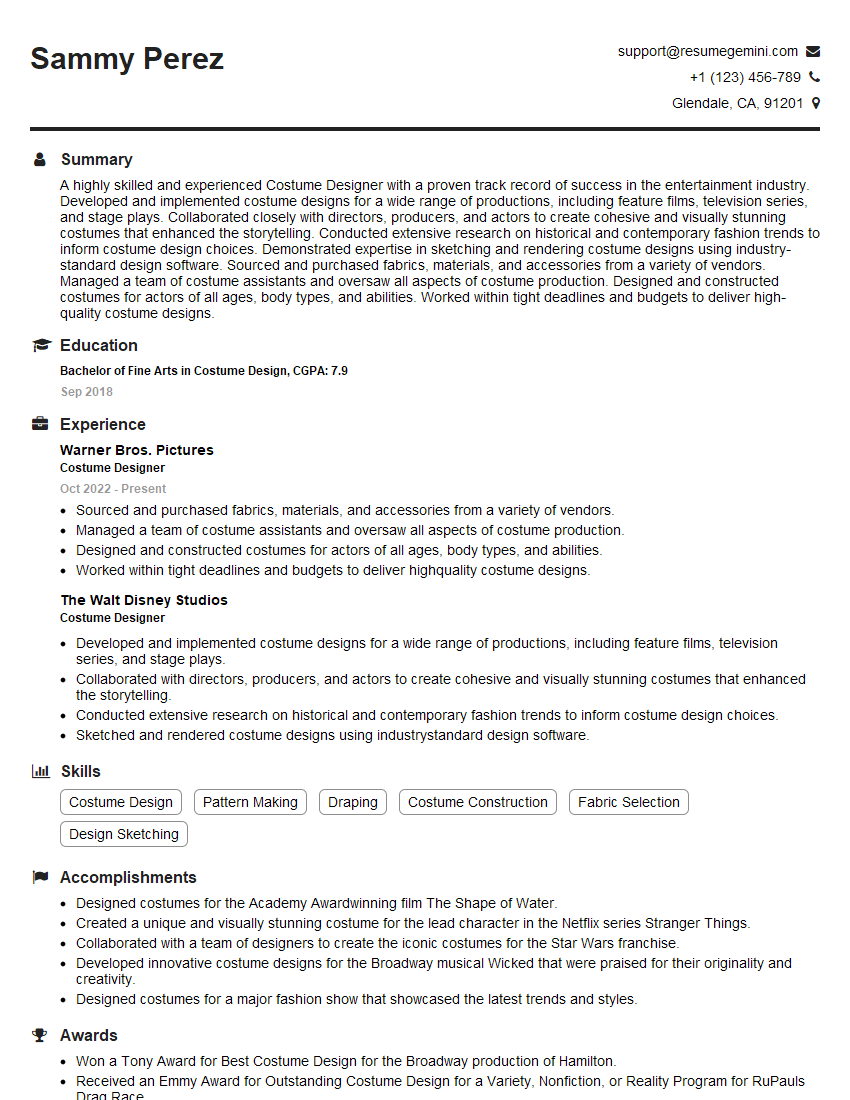
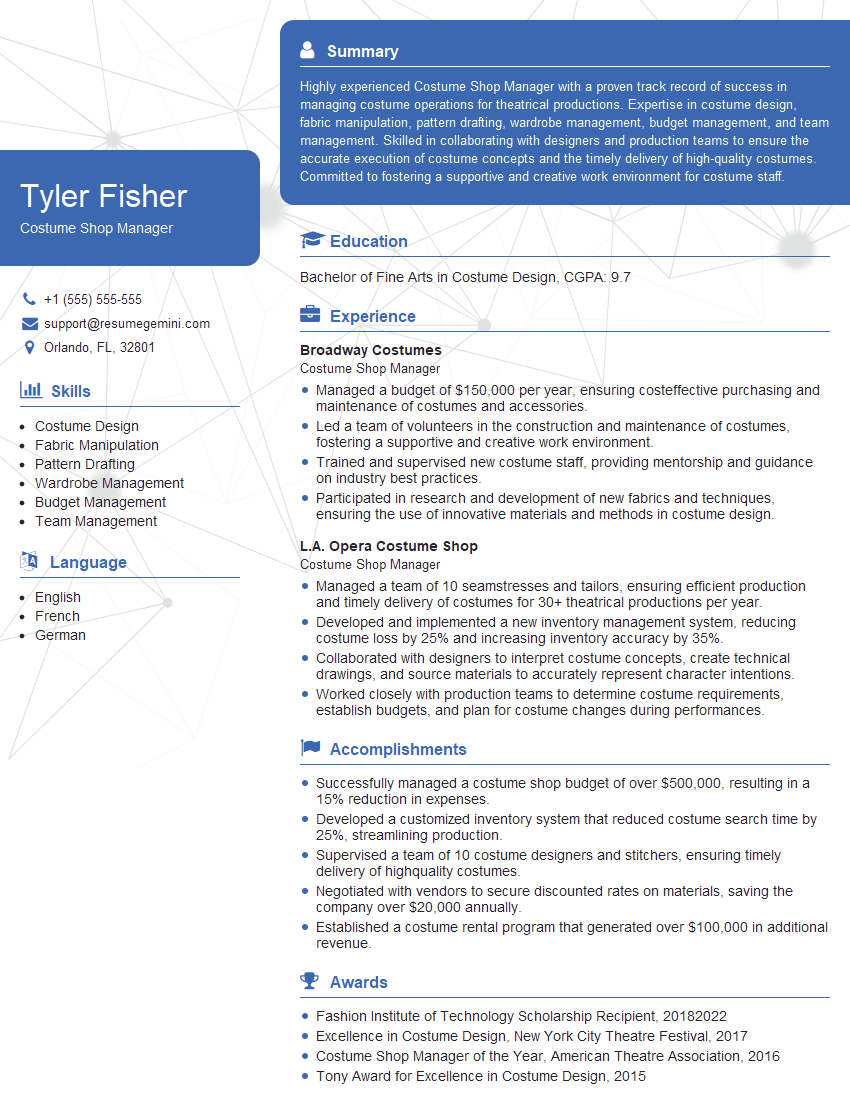
Mastering Costume Design for Ice Shows opens doors to a dynamic and creative career path within the entertainment industry. It’s a specialized skillset highly valued by production companies and allows you to contribute to breathtaking theatrical experiences. To significantly boost your job prospects, crafting an ATS-friendly resume is crucial. This ensures your application gets noticed by recruiters and hiring managers. We highly recommend leveraging ResumeGemini to build a professional and impactful resume that highlights your unique skills and experience. ResumeGemini provides examples of resumes tailored to Costume Design for Ice Shows to help you get started. Invest time in creating a resume that truly showcases your talent and passion – it’s your first impression!
Explore more articles
Users Rating of Our Blogs
Share Your Experience
We value your feedback! Please rate our content and share your thoughts (optional).
What Readers Say About Our Blog
Very informative content, great job.
good