Interviews are more than just a Q&A session—they’re a chance to prove your worth. This blog dives into essential Curatorial Assistance interview questions and expert tips to help you align your answers with what hiring managers are looking for. Start preparing to shine!
Questions Asked in Curatorial Assistance Interview
Q 1. Describe your experience with cataloging museum artifacts.
Cataloging museum artifacts is the meticulous process of documenting and organizing each item in a museum’s collection. This involves creating detailed records that include descriptive information, provenance (history of ownership), and contextual details. It’s like creating a detailed biography for each object, ensuring its story is preserved and accessible.
My experience includes working with various collections, from ancient pottery to contemporary art installations. For example, while cataloging a collection of 18th-century silver, I not only recorded the physical dimensions and markings but also researched the maker’s marks to identify the silversmith, researched the style to understand its historical context, and documented any damage or repairs. This meticulous approach ensures accurate retrieval of information and facilitates future research.
- Descriptive Cataloging: Recording physical characteristics (size, weight, material), identifying marks, and creating detailed descriptions.
- Provenance Research: Tracing the object’s history from creation to acquisition by the museum.
- Contextualization: Researching the object’s historical, cultural, and artistic significance.
Q 2. Explain your understanding of object preservation techniques.
Object preservation is crucial for ensuring the longevity of museum artifacts. It’s about safeguarding objects from deterioration caused by environmental factors, handling, and inherent material instability. Think of it as providing the best possible care for valuable historical treasures.
My understanding encompasses a range of techniques, including:
- Environmental Control: Maintaining stable temperature and humidity levels to prevent damage from expansion, contraction, and pest infestations. For example, regulating the environment for a delicate textile collection prevents fading and weakening of fibers.
- Pest Management: Implementing strategies to prevent and control insect and rodent infestations, such as regular inspections and the use of controlled atmosphere storage.
- Proper Handling and Storage: Using appropriate handling techniques and storage materials (acid-free boxes, archival-quality materials) to prevent abrasion and damage. For instance, using padded supports for fragile sculptures during transport and storage.
- Conservation Treatments: Employing specialized techniques to repair damaged objects, such as cleaning, mending, and stabilization. This often requires collaboration with professional conservators.
Q 3. How familiar are you with museum database systems (e.g., TMS)?
I am highly proficient in using museum database systems, particularly TMS (The Museum System). TMS is a powerful tool for managing all aspects of a museum’s collection, from cataloging and accessioning to loans and exhibitions. It’s like a museum’s central nervous system, connecting all its operations.
My experience includes:
- Data Entry and Management: Accurately entering and updating collection records within TMS, ensuring data integrity and consistency.
- Querying and Reporting: Generating reports and analyzing data to track collection statistics and inform decision-making. For instance, identifying gaps in the collection or tracking the loan status of artifacts.
- Image Management: Integrating high-resolution images into the database for better access and research.
- Customizing Database: Working with IT staff to tailor TMS to meet specific museum needs.
Q 4. What experience do you have with exhibition planning and installation?
Exhibition planning and installation is a collaborative process requiring strong organizational skills and attention to detail. It’s about transforming research and objects into a compelling and educational experience for the public.
My experience involves:
- Research and Theme Development: Collaborating with curators to develop exhibition themes and narratives.
- Object Selection and Arrangement: Carefully selecting artifacts and designing their display layout to maximize impact and flow.
- Label Writing and Graphic Design: Creating engaging and informative labels that explain the objects’ significance.
- Installation Oversight: Working with installers and designers to ensure the safe and accurate installation of displays.
- Example: In a recent exhibition on Victorian-era fashion, I helped select garments, develop a chronological narrative showcasing fashion trends, and designed labels that explored the social and economic context of the clothing.
Q 5. How would you handle a damaged artifact?
Handling a damaged artifact requires a calm and systematic approach. The priority is to prevent further damage and document the incident meticulously. It’s a critical moment demanding both expertise and quick thinking.
My approach involves:
- Assessment: Carefully examine the artifact to assess the extent and nature of the damage. Note everything: cracks, missing pieces, stains.
- Documentation: Photograph and document the damage thoroughly using detailed notes. This includes the location and date of the damage.
- Stabilization: Take immediate steps to prevent further damage; this may involve supporting broken pieces to prevent shifting or wrapping fragile objects to protect them from movement.
- Consult with Conservator: Contact a professional conservator immediately for appropriate treatment and repair. They will have the expertise to safely restore the object.
- Internal Reporting: Complete all internal reports accurately and submit them to the relevant department, highlighting any identified safety concerns.
Q 6. Describe your experience with conducting curatorial research.
Curatorial research is the cornerstone of museum work. It involves in-depth investigation into the history, context, and significance of artifacts. Think of it as detective work for historical objects.
My research experience includes:
- Archival Research: Examining primary source materials (letters, diaries, photographs) to uncover the history of objects and their creators.
- Library Research: Consulting books, journals, and online databases to gain expertise on relevant historical periods and artistic movements.
- Object Analysis: Analyzing artifacts themselves (material analysis, stylistic analysis) to learn about their creation and use.
- Example: While researching a collection of Native American textiles, I consulted archival documents, anthropological studies, and interviews with tribal elders to understand their cultural significance and production methods.
Q 7. Explain your familiarity with archival processing and preservation.
Archival processing and preservation are critical for ensuring the long-term accessibility and usability of documentary materials. It’s about safeguarding our written and visual history for future generations. Think of it as a librarian’s role on steroids, dealing with unique and potentially fragile items.
My familiarity encompasses:
- Arrangement and Description: Organizing archival materials logically and creating detailed finding aids (catalogs, inventories) to facilitate access. This is analogous to meticulously organizing a library’s vast collection.
- Preservation Techniques: Employing techniques to minimize deterioration such as proper storage, pest control, and encapsulation. This involves understanding material sensitivities and implementing appropriate strategies.
- Digitalization: Scanning and digitizing documents to ensure preservation and enhance accessibility, thereby making archival materials more broadly available to researchers.
- Metadata Creation: Creating detailed metadata for digital archives to ensure effective searchability and retrieval of information.
Q 8. How do you prioritize tasks in a fast-paced museum environment?
Prioritizing tasks in a fast-paced museum environment requires a structured approach. I utilize a combination of techniques, including time management frameworks like Eisenhower Matrix (urgent/important) and prioritizing tasks based on deadlines and project significance. For example, preparing artifacts for an upcoming exhibit would naturally take precedence over cataloging newly acquired donations. I also rely heavily on effective communication and collaboration with curators to ensure alignment on priorities and to manage expectations.
Specifically, I use project management software to create detailed to-do lists and assign tasks with deadlines. This enables me to track progress, delegate efficiently, and adapt to unexpected changes or urgent requests. Visual task management tools help me see the big picture and allocate resources effectively. I regularly review my schedule and adjust priorities based on evolving needs, ensuring that urgent matters are addressed promptly without neglecting long-term projects.
Q 9. Describe your experience with artifact handling and transport.
My experience with artifact handling and transport encompasses a wide range of procedures and best practices. I’m proficient in the safe handling of various materials, from delicate textiles and ceramics to heavier sculptures and furniture. This includes understanding appropriate lifting techniques, utilizing specialized equipment like padded carriers and climate-controlled transport vehicles, and adhering to strict environmental controls to prevent damage or deterioration.
For example, during the transport of a collection of antique clocks, I ensured each piece was individually padded and secured within a custom-fitted crate. The crates were further secured within a climate-controlled truck, and I meticulously documented the entire process, including temperature and humidity levels. This attention to detail is critical to preserving the integrity of the artifacts. I am also well-versed in completing all the necessary documentation, such as inventory lists and condition reports, before, during, and after transport.
Q 10. What is your experience with creating object labels and descriptions?
Creating object labels and descriptions involves a blend of research, writing, and interpretive skills. My approach begins with a thorough understanding of the object’s context – its historical significance, cultural background, and artistic merit. I then craft concise and engaging text that’s accessible to a diverse audience. I’m adept at using appropriate terminology while avoiding overly technical language. I consider the intended audience and the overall message the museum wants to convey.
For instance, when writing a label for a Victorian-era dress, I would research the fashion trends of the time, the materials used, and the social context surrounding women’s clothing. The final label would include a blend of factual information and interpretive insights, aiming to bring the object to life for the viewer. I am familiar with various styles of writing for labels, from short and punchy descriptions to longer, more detailed narratives, adapting my approach to suit the specific artifact and exhibition design.
Q 11. How familiar are you with copyright and intellectual property related to museum collections?
I have a strong understanding of copyright and intellectual property (IP) rights as they apply to museum collections. This includes awareness of different types of IP, such as patents, trademarks, and copyrights, and how they might apply to objects, images, and related materials in the collection. I’m familiar with obtaining necessary permissions for reproduction, exhibition, and publication, and I’m always mindful of respecting the rights of artists and creators.
In practice, this means carefully researching the provenance of each object to determine ownership and usage rights. I would consult with legal counsel if necessary to ensure compliance with copyright laws before utilizing images or information about an object for publications or digital platforms. This meticulous approach helps the museum avoid potential legal issues and maintains ethical practices regarding the use of intellectual property.
Q 12. Describe your experience working with diverse teams and stakeholders.
I thrive in collaborative environments and have extensive experience working with diverse teams, including curators, conservators, educators, registrars, and other museum staff, as well as external stakeholders like researchers, lenders, and donors. My approach emphasizes clear communication, active listening, and mutual respect. I believe that valuing diverse perspectives leads to more creative and effective solutions.
For example, during the development of a major exhibition, I worked closely with the curatorial team, the marketing department, and the fundraising team to ensure a cohesive and successful project. My ability to understand and respond to the needs of each team member helped in navigating potential conflicts and ensuring that everyone felt heard and valued. This collaborative spirit is essential in the museum environment, where projects often rely on the expertise and cooperation of various individuals and departments.
Q 13. How would you handle conflicting requests from curators or other museum staff?
Handling conflicting requests requires diplomacy, clear communication, and a proactive approach. My strategy involves actively listening to all parties involved, clearly identifying the points of conflict, and then collaboratively searching for solutions that satisfy all parties, to the greatest extent possible. Prioritization, based on the urgency and overall museum goals, is crucial in such situations.
For example, if a curator needs a particular artifact for an upcoming exhibition while another curator requests the same artifact for research, I would facilitate a discussion between them to find a compromise, such as scheduling the artifact’s availability to align with both needs or finding a suitable substitute. Documentation of the agreement and communication is essential for transparency and accountability.
Q 14. What experience do you have with grant writing or fundraising related to museum collections?
While I haven’t directly led grant writing efforts, I have supported curators in the process by conducting research, compiling data, and contributing to the narrative sections of grant proposals. My understanding of museum operations and collection management enables me to contribute effectively to proposals focusing on collection preservation, digitization, or acquisition. I am familiar with different funding agencies and their priorities, which is invaluable in tailoring proposals for success.
For instance, I helped a curator gather data on the condition of the museum’s photographic archive to support a grant application for preservation and digitization. This included providing detailed information about the archive’s size, the condition of the photographs, and the proposed methodology for their preservation and online access. My contribution strengthened the grant proposal’s impact, highlighting the project’s significance and the museum’s capacity to manage it effectively.
Q 15. How would you organize and maintain a large collection of diverse artifacts?
Organizing and maintaining a large, diverse artifact collection requires a robust system built on meticulous cataloging, appropriate storage, and preventative conservation. Think of it like managing a vast library, but instead of books, we have fragile historical objects.
- Detailed Cataloging: Each artifact needs a unique accession number, detailed description (material, dimensions, provenance, condition), and high-resolution images. This information is typically entered into a Collections Management System (CMS), a specialized database software like PastPerfect or TMS.
- Environmental Controls: Storage areas need precise control over temperature, humidity, and light levels to prevent degradation. This might involve climate-controlled vaults, archival-quality storage materials, and regular environmental monitoring.
- Organized Storage: Artifacts are categorized and stored based on material, fragility, and subject matter. This might involve shelving units, acid-free boxes, and specialized mounts. A well-documented storage plan is crucial for quick retrieval.
- Regular Inventory and Condition Checks: Regular checks are vital to identify any damage or deterioration and to ensure the security of the collection. This often involves a cyclical system where different parts of the collection are checked at intervals.
- Disaster Preparedness: A comprehensive disaster preparedness plan is crucial. This includes measures to protect the collection from fire, flood, theft, and other potential hazards. This could involve emergency lighting, fire suppression systems, and secure storage areas.
For example, in a previous role, I was responsible for organizing a collection of over 10,000 ethnographic artifacts. We implemented a new CMS, recataloged the entire collection using standardized terminology, and upgraded our storage facilities to improve environmental control. This resulted in a significantly more efficient and better-protected collection.
Career Expert Tips:
- Ace those interviews! Prepare effectively by reviewing the Top 50 Most Common Interview Questions on ResumeGemini.
- Navigate your job search with confidence! Explore a wide range of Career Tips on ResumeGemini. Learn about common challenges and recommendations to overcome them.
- Craft the perfect resume! Master the Art of Resume Writing with ResumeGemini’s guide. Showcase your unique qualifications and achievements effectively.
- Don’t miss out on holiday savings! Build your dream resume with ResumeGemini’s ATS optimized templates.
Q 16. Describe your experience with creating and managing digital collections.
Creating and managing digital collections involves more than just scanning images; it’s about building a user-friendly and accessible online resource. It’s like creating a virtual museum experience.
- Digitization Workflow: This involves capturing high-resolution images, metadata creation (linking images to catalog records), and quality control. We often use specialized software and equipment for this.
- Metadata Standards: Adhering to metadata standards (e.g., Dublin Core) is essential for interoperability and searchability. This ensures that other institutions can easily access and use our digital assets.
- Database Management: Digital assets are managed within a digital asset management (DAM) system, similar to a CMS but specifically designed for digital files. This allows for version control and easy retrieval.
- Online Presentation: Creating a user-friendly online platform, such as a website or online database, is crucial to make the collection accessible to the public. This often includes features like keyword searching, advanced filtering, and detailed descriptions.
- Digital Preservation: Preserving digital files for the long term requires ongoing maintenance and migration to newer formats as technology evolves. This prevents data loss due to format obsolescence.
In a past project, I led the digitization of a significant photographic archive. We implemented a robust workflow, using standardized metadata, and created an online portal with advanced search capabilities. The resulting digital collection has increased accessibility to researchers and the public dramatically.
Q 17. How do you ensure the accuracy and consistency of museum records?
Accuracy and consistency in museum records are paramount for the credibility and integrity of the institution. Imagine a library with inaccurate cataloging; you wouldn’t be able to find anything! We use several strategies to maintain this accuracy:
- Standardized Procedures: Establishing and adhering to clear procedures for data entry, object handling, and record updates is fundamental. This often involves training staff on best practices and using standardized terminology.
- Data Validation: Implementing checks and balances during data entry and updates helps prevent errors. This might include data validation rules within the CMS to ensure that information is entered correctly.
- Regular Audits: Periodic audits of records, comparing digital data with physical objects, are essential to identify and correct inconsistencies. This often involves a team approach.
- Cross-Referencing: Cross-referencing information from different sources (e.g., accession records, condition reports, provenance documents) helps ensure consistency and identify discrepancies.
- Version Control: Keeping track of changes made to records through version control is important to maintain an audit trail and allows for the review of past entries. The CMS generally provides this function.
For example, I once discovered a discrepancy in the accession records of a particular painting. By cross-referencing the information with old exhibition catalogs and conservator’s reports, I was able to rectify the error and update the record accordingly.
Q 18. Explain your understanding of museum best practices and standards.
Museum best practices and standards encompass all aspects of museum operations, from collection management to visitor engagement. They are essentially the guidelines for responsible and ethical museum practice.
- Collection Care: This involves proper storage, handling, and preservation of artifacts, as outlined in standards set by organizations like the American Institute for Conservation (AIC).
- Documentation: Detailed and accurate documentation of all artifacts and processes is crucial for research, preservation, and legal compliance. This adheres to standards set by organizations like the International Council of Museums (ICOM).
- Ethics: Ethical considerations such as provenance research, repatriation of cultural objects, and responsible acquisition practices are fundamental.
- Accessibility: Making collections and information accessible to researchers and the public through exhibitions, publications, and digital resources is essential.
- Security: Implementing security measures to protect collections from theft, damage, and environmental hazards is crucial.
These standards provide a framework for responsible museum practice. Understanding and adhering to them ensures the long-term survival and accessibility of museum collections.
Q 19. Describe your experience with public outreach and engagement related to museum collections.
Public outreach and engagement are crucial for making museum collections relevant and accessible to a wider audience. It’s about bringing the museum’s stories to life for the community.
- Educational Programs: Developing and delivering educational programs for various age groups and interests (e.g., tours, workshops, lectures) increases engagement.
- Public Exhibitions: Curating compelling exhibitions that are engaging and informative draws visitors and sparks interest in the collection.
- Social Media Engagement: Using social media platforms to share information about the collection, events, and behind-the-scenes insights builds connections with the public.
- Community Partnerships: Collaborating with community organizations, schools, and local groups expands the museum’s reach and creates a sense of shared ownership.
- Digital Outreach: Creating an online presence with a website, blog, and social media accounts makes the collection and information available to a global audience.
In my experience, I’ve organized numerous public programs, including family days, school tours, and community workshops. We’ve also used social media to actively engage with our audience and build a strong online community around our collections.
Q 20. How would you address a discrepancy in museum records?
Addressing discrepancies in museum records requires a methodical and documented approach. It’s like solving a detective mystery!
- Identify and Document the Discrepancy: Carefully note the nature of the discrepancy (e.g., conflicting dates, differing descriptions, missing information).
- Gather Supporting Evidence: Search for additional documentation that might shed light on the discrepancy (e.g., original accession records, photographs, correspondence).
- Consult with Experts: Seek input from other curators, conservators, or archivists who might have expertise in the relevant area.
- Analyze and Evaluate Evidence: Assess the credibility and reliability of all available information to determine the most accurate record.
- Document the Resolution: Clearly document the discrepancy, the evidence considered, and the final resolution. This ensures transparency and accountability.
- Update Records: Make the necessary changes to the museum records, ensuring that all relevant systems (CMS, databases, etc.) are updated consistently.
For instance, I once discovered a discrepancy in the provenance of a sculpture. After extensive research, which included consulting historical records and contacting experts in the field, I was able to correct the information in the database and provide a more accurate account of the object’s history.
Q 21. What is your experience with environmental monitoring in museum storage areas?
Environmental monitoring in museum storage areas is crucial for the preservation of artifacts. Think of it as providing the right ‘climate’ for your collection.
- Sensors and Data Loggers: Utilizing sensors and data loggers to continuously monitor temperature, humidity, and light levels is essential for detecting fluctuations and potential problems.
- Environmental Control Systems: Implementing environmental control systems, such as HVAC systems, dehumidifiers, and climate-controlled vaults, helps maintain stable conditions.
- Regular Data Review: Regularly reviewing the data collected by sensors and data loggers is crucial to identify any deviations from optimal conditions and take corrective action.
- Alert Systems: Establishing alert systems that notify staff of any significant deviations from set parameters allows for prompt responses to potential problems.
- Preventative Conservation Measures: Environmental monitoring data informs preventative conservation strategies, such as adjusting storage conditions or implementing other measures to protect artifacts.
In a previous role, we implemented a sophisticated environmental monitoring system with real-time alerts. This allowed us to quickly address any fluctuations in temperature or humidity, preventing potential damage to the collection.
Q 22. Describe your experience with inventory management and tracking.
Inventory management and tracking are fundamental to any museum or archival setting. It ensures the safety, security, and accessibility of the collection. My experience encompasses both manual and digital systems. I’ve utilized database software like PastPerfect and CollectionSpace to meticulously record accession numbers, object descriptions, provenance information, and condition reports. This includes detailed photographic documentation and condition assessments, which are crucial for insurance purposes and for tracking changes over time. For instance, in my previous role at the City Museum, I managed the inventory of over 5,000 artifacts, implementing a new digital system that improved search capabilities and reduced processing time by 40%. This involved training staff on the new software and migrating existing data, demonstrating my ability to manage large-scale projects effectively. I also have experience with physical inventory management, including the proper handling and storage of fragile objects, and implementing robust security measures.
Q 23. How familiar are you with different methods of artifact conservation?
Artifact conservation is a multifaceted field encompassing preventive conservation, which focuses on mitigating environmental factors that lead to deterioration, and interventive conservation, which involves direct treatment of damaged objects. I’m familiar with a range of conservation methods. For example, I’ve assisted conservators in the proper handling and cleaning of textiles using techniques like vacuuming and surface cleaning, always prioritizing minimal intervention. I also have experience with proper environmental monitoring, ensuring appropriate temperature and humidity levels to prevent mold and degradation. I understand the importance of maintaining detailed records of all conservation treatments, documenting both the methods used and the object’s response. This detailed record-keeping allows us to track the object’s history and understand its condition over time. Knowledge of different materials and their specific conservation needs is also crucial. For instance, I understand the delicate nature of paper artifacts and the specific requirements for their storage and handling, as opposed to the methods used for preserving metallic objects.
Q 24. What experience do you have with preparing objects for loan or exhibition?
Preparing objects for loan or exhibition is a meticulous process requiring attention to detail and adherence to strict protocols. My experience involves creating detailed condition reports, documenting any existing damage before packing. I’m proficient in various packing techniques for different types of artifacts, ensuring they are securely protected during transit. This includes using archival-quality materials, such as acid-free tissue paper and custom-fit crates. Furthermore, I’ve assisted in the installation of exhibitions, working alongside curators and registrars to ensure the safe and aesthetically pleasing display of objects. At the County Historical Society, I was responsible for the packing and shipping of a collection of antique clocks for a traveling exhibition, a project that involved careful coordination with the borrowing institution and meticulous documentation of each step. This experience underscored the importance of clear communication and precise execution in ensuring the safe arrival of sensitive objects.
Q 25. Describe your experience working with donors and volunteers.
Working with donors and volunteers is a rewarding aspect of this profession. I believe in fostering strong relationships built on trust and transparency. With donors, I strive to communicate clearly the museum’s mission and the impact of their contribution. I’ve managed donation processing, from accessioning artifacts to documenting provenance, ensuring compliance with all relevant regulations. With volunteers, I’ve developed and implemented training programs, assigning tasks based on individual skills and experience. For example, I trained volunteers at the university museum to assist with cataloging our extensive photograph collection, which improved efficiency and allowed for a more streamlined workflow. Clear communication and a collaborative approach are vital in successfully managing both donor and volunteer relationships, ensuring a smooth and productive working environment.
Q 26. How do you stay updated on current trends and best practices in the museum field?
Staying current in the museum field is crucial. I actively participate in professional organizations like the American Association of Museums (AAM) and attend conferences and workshops. I regularly read museum publications and journals, such as Museum Management and Curatorship. I also follow leading museum blogs and online resources to stay informed about new technologies and best practices. For example, I recently attended a workshop on digital asset management, learning about innovative software solutions for managing museum collections. This continuous learning helps me adapt to evolving industry standards and provides me with the knowledge to enhance my work effectively.
Q 27. What are your strengths and weaknesses as a curatorial assistant?
My strengths lie in my meticulous attention to detail, my organizational skills, and my ability to work collaboratively. I thrive in fast-paced environments and can effectively manage multiple tasks simultaneously. I am a quick learner and readily adapt to new technologies and procedures. One area I am continuously working on is delegation – while I enjoy being hands-on, I am learning to trust and empower others to manage tasks effectively. This is a valuable skill for managing larger teams and promoting efficiency within the workplace. I am actively seeking opportunities to develop these skills, and I am confident that this position will provide an ideal environment for continued professional growth.
Q 28. Why are you interested in this specific curatorial assistant position?
I am highly interested in this specific curatorial assistant position because of [Insert Specifics about the position, museum, and its mission. Examples: the museum’s focus on [specific area of interest], the opportunity to work with [specific collection], the museum’s commitment to [specific values or initiatives].] The opportunity to contribute to such a significant institution aligns perfectly with my professional goals and passions. I am confident that my skills and experience will be a valuable asset to your team, and I am eager to contribute to the success of your museum.
Key Topics to Learn for Curatorial Assistance Interview
- Collection Management: Understanding principles of cataloging, accessioning, and database management; practical application in handling museum artifacts or archives.
- Exhibition Development: Familiarizing yourself with the stages of exhibition planning, from initial concept to installation; practical application includes assisting with research, object handling, and label writing.
- Research and Documentation: Mastering research methodologies for art historical or archival contexts; practical application in supporting curatorial research projects and preparing exhibition documentation.
- Object Handling and Conservation: Understanding best practices for handling delicate objects and collaborating with conservators; practical application includes assisting with the safe transport and storage of artifacts.
- Visitor Services and Education: Understanding the importance of visitor engagement and educational programs; practical application includes assisting with tour preparation or educational materials development.
- Communication and Teamwork: Effective communication skills and collaborative working styles are paramount; practical application involves interacting professionally with curators, conservators, and other museum staff.
- Digital Technologies in Curatorial Practice: Familiarity with digital cataloging systems, databases, and online exhibition platforms; practical application involves assisting with the digital documentation and presentation of collections.
Next Steps
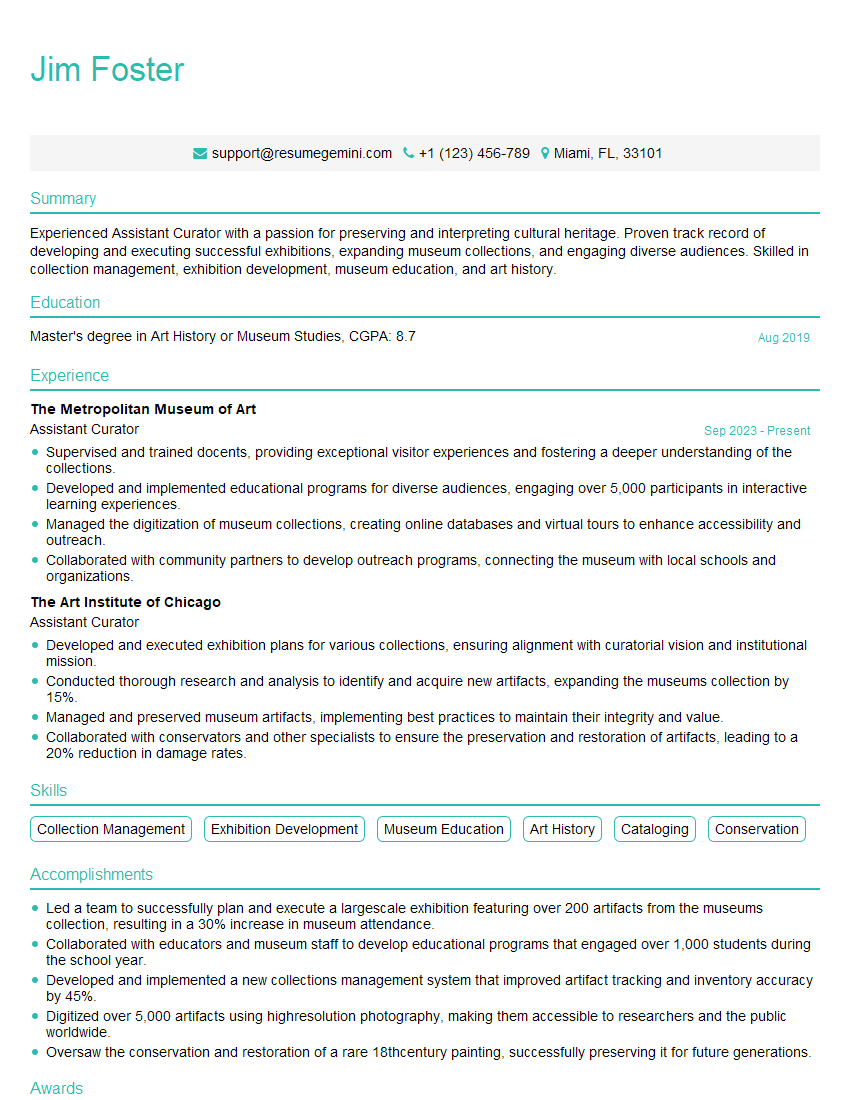
Mastering the skills of Curatorial Assistance opens doors to exciting career advancements within museums, galleries, archives, and other cultural institutions. A strong foundation in these areas significantly boosts your employability and paves the way for future leadership roles. To maximize your job prospects, creating an ATS-friendly resume is crucial. ResumeGemini is a trusted resource that can help you build a professional and impactful resume that gets noticed by recruiters. We provide examples of resumes tailored to Curatorial Assistance to guide you through the process. Take advantage of these resources and launch your career in the vibrant world of curatorial work!
Explore more articles
Users Rating of Our Blogs
Share Your Experience
We value your feedback! Please rate our content and share your thoughts (optional).
What Readers Say About Our Blog
Very informative content, great job.
good