The thought of an interview can be nerve-wracking, but the right preparation can make all the difference. Explore this comprehensive guide to Curtain and Drapery Fabrication interview questions and gain the confidence you need to showcase your abilities and secure the role.
Questions Asked in Curtain and Drapery Fabrication Interview
Q 1. Describe your experience with various fabric types used in curtain and drapery fabrication.
My experience encompasses a wide range of fabrics, each with unique properties influencing drape, light control, and durability. I’m proficient with natural fibers like linen, cotton, and silk, understanding their tendency to wrinkle and their luxurious feel. These are often used for formal draperies, where their texture adds elegance. I also have extensive experience with synthetic fabrics such as polyester, rayon, and blends. Polyester is incredibly versatile – it’s durable, wrinkle-resistant, and comes in a vast array of colors and patterns, making it ideal for everyday curtains. Rayon offers a beautiful drape, similar to silk but more affordable and easier to maintain. Blends often combine the best qualities of different fibers, providing strength, softness, and drape control. Finally, I work frequently with heavier-weight fabrics like velvet and damask for more opulent looks, and sheer fabrics like voile and organza for delicate, light-filtering applications.
For instance, a client recently requested blackout curtains for a bedroom. We selected a heavy-weight polyester blend with a blackout lining to ensure complete darkness. Conversely, for a living room with ample natural light, a sheer linen with a subtle pattern was perfect to add texture while maintaining brightness.
Q 2. Explain the process of measuring for curtains and draperies.
Accurate measurements are crucial for perfect-fitting curtains and draperies. The process begins with determining the desired width and length of the finished treatment. For width, measure the window’s width and add extra fabric for fullness – typically 1.5 to 2.5 times the window width for a gathered look. The exact amount depends on the desired fullness and fabric weight. For length, measure from the top of the rod or track to where you want the curtains to fall, considering the heading style and hem allowance. We always double-check measurements to avoid costly mistakes. This involves measuring both the inside and outside window frames depending on the clients preference, taking into account any window molding or trim that could affect the final hanging position. We also discuss with the clients about the desired fall for curtains, floor length, puddle, etc.
For example, if a window is 48 inches wide, we might calculate a fabric width of 72 to 96 inches (48 x 1.5 to 2). Similarly, if the desired length is 84 inches from the rod to the floor, we’d add several inches for the hem, heading, and any extra length needed for the desired fullness.
Q 3. How do you calculate fabric yardage for a given window treatment?
Calculating fabric yardage is a critical skill. We start with the total width of fabric needed as calculated in the measuring process. Then, we divide this width by the fabric’s width (usually 54 inches) to determine the number of panels needed. The final calculation involves adding extra fabric for pattern matching, hems, and any waste during cutting. The fabric’s repeat (the distance before the pattern repeats itself) is key when dealing with patterned fabrics, as it determines how much extra fabric might be needed to ensure the pattern lines up correctly across multiple panels. This calculation also requires considering fabric shrinkage, especially with natural fabrics, adding an additional percentage to account for this.
Example: A window requiring 72 inches of fabric width, using 54-inch wide fabric, needs 72/54 = 1.33 panels (round up to 2 panels). If the desired length is 96 inches, plus 6 inches for hem and heading, we need 102 inches of fabric per panel. For two panels, we would require a total of approximately 204 inches or 5.67 yards (204/36). Plus additional yardage for pattern matching and shrinkage.
Q 4. What are the different types of curtain and drapery headings?
Many heading styles are available, each affecting the look and functionality of the curtains.
- Pinch Pleats: Elegant and formal, creating evenly spaced vertical folds.
- Box Pleats: Similar to pinch pleats but with larger, more structured folds.
- Grommets: Metal rings inserted into the fabric, allowing the curtains to slide easily along a rod; very contemporary.
- Rod Pocket: A simple heading where the rod is inserted directly into a pocket sewn into the top of the curtain.
- Tab Top: Fabric loops attached to the top of the curtain that hang over the rod, creating a casual, relaxed look.
- Ripple Fold: Creates a soft, wave-like drape using a specialized heading tape.
Q 5. Describe your experience with different lining fabrics and their purposes.
Lining fabrics significantly enhance the drape, durability, and functionality of curtains and draperies. Common lining choices include:
- Cotton: Affordable and breathable, but not very effective at blocking light.
- Polyester: Durable and wrinkle-resistant, provides some light-blocking capabilities.
- Blackout Lining: Specifically designed to block light and reduce noise, great for bedrooms.
- Silk: Luxurious, adds sheen and drape, but often expensive and requires delicate care.
Q 6. How do you handle challenging fabric patterns or designs during fabrication?
Handling complex patterns requires careful planning and precision. Before cutting, I meticulously lay out the fabric to ensure that the pattern matches seamlessly across all panels. This may involve manipulating the pattern layout to minimize waste. Large-scale or directional patterns require even more attention to detail. Sometimes, it’s necessary to create a detailed diagram or mockup to visualize the pattern placement and to avoid any unexpected mismatches. For extremely intricate designs, I might even create a sample panel first to test the pattern alignment and ensure everything works perfectly before cutting the entire order. This meticulous process guarantees that the finished product is visually appealing and showcases the beauty of the fabric’s design.
Q 7. Explain the process of installing a standard curtain rod and hanging curtains.
Installing a curtain rod is a relatively straightforward process. First, we measure and mark the wall where the rod brackets will be placed, ensuring they are level and at the appropriate height. Then, we securely attach the brackets to the wall using appropriate screws for the wall type (drywall, plaster etc.). Once the brackets are in place, we carefully slide the curtain rod into the brackets. Finally, we hang the curtains on the rod, ensuring that they hang evenly and the folds fall naturally. We always double-check that the rod is securely fastened and the curtains hang perfectly straight. For heavier curtains, extra support might be necessary, such as using additional brackets or a stronger rod. In challenging situations, like uneven walls or complex window designs, additional steps might be needed to achieve a perfect result.
Q 8. What are common issues encountered during curtain and drapery installation, and how do you resolve them?
Common installation issues with curtains and draperies often stem from inaccurate measurements, improper track installation, or unsuitable hardware. For instance, a common problem is uneven hanging, where one side of the curtain is lower than the other. This usually results from incorrectly positioned brackets or a poorly leveled track. Another issue is difficulty in opening and closing the curtains smoothly, possibly due to friction from the fabric against the wall or a track that isn’t properly aligned.
- Uneven Hanging: I resolve this by carefully re-measuring and adjusting the bracket positions, ensuring the track is perfectly level using a level tool. Sometimes, slight adjustments to the curtain pleats themselves might be needed.
- Friction Issues: To address friction, I check for any obstructions between the fabric and the wall or within the track system. Applying a lubricating spray to the track runners can significantly reduce friction. In cases where the fabric is too heavy for the hardware, upgrading to a sturdier track and stronger carriers is necessary.
- Incorrect Length: If the curtains are too short or long, which is often due to initial measurement errors, I’ll either take them down and re-hem them (for shortening) or add a fabric extension (for lengthening), maintaining the original style and pleat consistency.
Thorough pre-installation planning, including accurate measurements and selecting the right hardware for the fabric weight and window style, significantly reduces these problems.
Q 9. Describe your experience with different types of curtain tracks and hardware.
My experience encompasses a wide range of curtain tracks and hardware, from simple single-track systems to more complex systems with multiple tracks, motorized operation, and various header styles. I’ve worked extensively with:
- Standard single and double track systems: These are suitable for basic curtain installations, providing flexibility in opening and closing options. I’m proficient in installing them using various bracket types to accommodate different window frames and ceiling heights.
- Curved tracks: These are great for bay windows and other non-standard window shapes. Installation requires precision and attention to detail to ensure the curve is smooth and the curtains move easily.
- Motorized tracks: These offer convenient remote control of curtains. My expertise extends to various brands and their specific installation procedures, including wiring and integration with home automation systems.
- Various header styles: I am familiar with grommet, pinch pleat, goblet, and wave styles, understanding which hardware is most appropriate for each style to ensure a professional and aesthetically pleasing finish.
- Different materials: I have hands-on experience with aluminum, steel, and plastic tracks and am aware of the strengths and weaknesses of each material. For example, aluminum tracks are lightweight yet durable, making them ideal for lighter curtains, while steel tracks are suitable for heavy, luxurious fabrics.
I always prioritize selecting the correct hardware to ensure a smooth, safe, and long-lasting installation that complements the chosen fabric and the overall design aesthetic.
Q 10. How do you ensure precise and accurate cutting of fabrics?
Precise fabric cutting is paramount in ensuring the perfect fit and professional finish. My method involves a multi-step process that minimizes errors:
- Accurate Measurement: I always double-check my measurements, using a measuring tape and adding seam allowances meticulously. I often use a large cutting table to ensure the fabric is laid out flat and unwrinkled, preventing distortion.
- Pattern Marking: I clearly mark the cutting lines on the fabric using tailor’s chalk or a water-soluble pen. For complex designs, I use templates or pattern pieces to achieve consistent shapes and sizes.
- Sharp Cutting Tools: I utilize rotary cutters with sharp blades for clean cuts. Dull blades can cause frayed edges and inaccuracies. A self-healing cutting mat protects the table surface and keeps the blade sharp.
- Checking and Double-Checking: Before making any cuts, I check the pattern placement and measurements one more time. After cutting, I carefully inspect the edges to ensure they are straight and free of any imperfections.
Experience has taught me that patience and precision are key to accurate fabric cutting, which directly impacts the final appearance and drape of the curtains.
Q 11. What are your skills in using industrial sewing machines?
I’m highly proficient in operating various industrial sewing machines, including straight stitch, zigzag stitch, and overlock machines. My skills encompass more than just basic operation; I understand the nuances of machine maintenance, thread tension adjustments, and stitch length selection depending on fabric type and project requirements.
For example, I know that using a heavier-duty needle and appropriate thread is crucial when sewing thicker fabrics like velvet or heavy brocade. Adjusting the stitch length ensures a strong, even seam that can withstand the stress of daily use. Similarly, I can adjust the tension of the machine to prevent puckering or stretching of delicate materials like silk or linen.
Beyond basic operation, I can troubleshoot common machine problems like skipped stitches, broken needles, and thread jams. I am confident in maintaining and repairing my machines, extending their lifespan and minimizing downtime.
Q 12. Describe your experience with different stitching techniques for curtains and draperies.
My experience with stitching techniques for curtains and draperies is extensive, encompassing various styles and applications. I’m proficient in a wide array of techniques, each selected based on the fabric type, design, and desired finish.
- French seams: These are ideal for fine fabrics where a clean, neat finish is essential. They create an almost invisible seam.
- Flat felled seams: These are durable and suitable for heavier fabrics. The seam is enclosed to prevent fraying and offer a robust finish.
- Overlocking/serging: This technique prevents fabric raveling and creates a decorative edge, commonly used on heavier or more structured fabrics.
- Blind hemming: This creates a virtually invisible hem, crucial for a professional and clean finish, especially on sheer or delicate fabrics.
Selecting the appropriate stitching technique is crucial for achieving both aesthetic and functional excellence. For example, a French seam would be inappropriate for a heavy velvet curtain, while a flat felled seam wouldn’t suit a sheer linen. The choice is a matter of matching the technique to the material and the desired outcome.
Q 13. How do you handle alterations or repairs to existing curtains and draperies?
Handling alterations or repairs to existing curtains and draperies often involves a careful assessment of the damage, fabric type, and the original construction. My approach involves:
- Careful Inspection: I start by thoroughly examining the curtains to identify the extent of the damage, determining if repair is feasible or if replacement is necessary.
- Fabric Matching: If repair is possible, I try to source matching fabric, or in cases of unavailable fabric, find a suitable substitute that closely resembles the original. This ensures a consistent and seamless repair.
- Repair Techniques: Depending on the damage, I employ various techniques such as patching, re-sewing seams, replacing damaged lining, or re-hemming. I’m skilled in both hand-sewing and machine sewing for repairs.
- Seam Repair: For seam repairs, I carefully unravel and re-sew the seams, matching the original stitch type and length.
A recent project involved repairing a set of antique silk curtains with several small tears. By carefully matching the fabric and using delicate hand-stitching, I was able to invisibly repair the tears, preserving the historical value and aesthetic of the curtains.
Q 14. What are your skills in pattern making for custom draperies?
Pattern making for custom draperies is a crucial skill requiring a blend of design sense and technical expertise. My process begins with detailed measurements of the window and client preferences. This includes considering the window’s shape, height, width, and any architectural features.
- Measurements and Design: I begin by taking accurate measurements of the window and discussing the client’s desired style – including the header style (pinch pleat, grommet, etc.), fullness, and the type of lining required.
- Drafting the Pattern: Based on the measurements and style, I draft a pattern, often using digital tools or manually sketching on graph paper. The pattern accounts for seam allowances, pleats, and the desired fullness. The pattern needs to ensure the finished curtains fit perfectly and hang beautifully.
- Testing and Refinement: I typically create a muslin mock-up (using inexpensive fabric) to test the pattern and ensure a proper fit before cutting into the final fabric. This step helps identify and fix any errors early on, saving both time and material.
- Adjustments for Complex Shapes: For non-standard shapes like bay windows or arched windows, the pattern-making process becomes more complex, requiring intricate calculations and adjustments to ensure the drapes hang gracefully and fit seamlessly.
Precision in pattern-making directly translates to the final appearance and functionality of the custom draperies. A well-made pattern is the foundation for a successful project. I pride myself in creating patterns that are not only precise but also aesthetically pleasing, producing curtains that exceed client expectations.
Q 15. How do you maintain quality control throughout the fabrication process?
Maintaining quality control in curtain and drapery fabrication is paramount. It’s a multi-step process that begins even before the fabric is cut. We start with meticulous order verification, ensuring all measurements, fabric choices, and design details perfectly match the client’s specifications. This involves double-checking the order form and any accompanying sketches or diagrams.
- Fabric Inspection: Before cutting, we thoroughly inspect the fabric roll for flaws like inconsistencies in weave, color variations, or damage. This prevents costly mistakes later on.
- Precise Cutting: We use laser-guided cutting systems whenever possible for superior accuracy. For manual cutting, experienced pattern makers use sharp shears and precise measuring tools to minimize waste and ensure consistent cuts.
- Consistent Sewing: Our team undergoes regular training on proper sewing machine operation and maintenance. We maintain a standardized stitch length and tension for each project, depending on the fabric type. This ensures a uniform finish across the entire piece.
- Regular Quality Checks: Throughout the process – after cutting, during construction, and before final finishing – quality control checks are performed at various stages to identify and correct any errors early on. These checks may involve visual inspections and measuring specific aspects to confirm they are to specification.
- Final Inspection: A final inspection is conducted before packaging, ensuring the finished product meets the highest standards. This includes checking for even pleats, proper hanging, and the absence of any stitching imperfections or loose threads.
Think of it like baking a cake – each step, from measuring ingredients to the final frosting, is crucial for a perfect result. We apply the same level of precision and attention to detail to every curtain and drapery we create.
Career Expert Tips:
- Ace those interviews! Prepare effectively by reviewing the Top 50 Most Common Interview Questions on ResumeGemini.
- Navigate your job search with confidence! Explore a wide range of Career Tips on ResumeGemini. Learn about common challenges and recommendations to overcome them.
- Craft the perfect resume! Master the Art of Resume Writing with ResumeGemini’s guide. Showcase your unique qualifications and achievements effectively.
- Don’t miss out on holiday savings! Build your dream resume with ResumeGemini’s ATS optimized templates.
Q 16. How do you prioritize tasks and manage your time effectively during a busy period?
Managing time during busy periods requires a systematic approach. I use a combination of techniques to prioritize tasks and maximize efficiency.
- Prioritization Matrix: I use a prioritization matrix (like the Eisenhower Matrix) to categorize tasks based on urgency and importance. This helps me focus on the most critical projects first.
- Detailed Scheduling: I create detailed schedules, breaking down large projects into smaller, manageable tasks. This makes the overall workload seem less daunting and allows for better tracking of progress.
- Time Blocking: I allocate specific time blocks for different tasks to maintain focus and avoid task-switching. This significantly improves efficiency and reduces interruptions.
- Effective Communication: Open communication with clients and team members is essential. Regular updates prevent misunderstandings and ensure everyone is on the same page. This minimizes delays and prevents rework.
- Delegate When Possible: I delegate tasks where appropriate to utilize team members’ skills effectively. This frees up my time to focus on more complex or demanding aspects of the projects.
For example, during peak season, I might allocate the morning for high-priority custom orders requiring complex pleating techniques, leaving the afternoon for simpler projects or administrative tasks. This structured approach helps me navigate even the most demanding periods successfully.
Q 17. What safety precautions do you take when working with sewing machines and fabrics?
Safety is paramount in our workshop. We strictly adhere to safety guidelines when using sewing machines and handling fabrics.
- Machine Maintenance: Regular maintenance of sewing machines is crucial. This includes checking for loose parts, proper lubrication, and ensuring the machine is securely fastened to the work surface. We also always unplug machines before cleaning or making adjustments.
- Proper Posture and Ergonomics: We prioritize proper posture and ergonomics to avoid repetitive strain injuries. This includes using ergonomic chairs and adjusting machine heights to suit individual needs.
- Sharp Object Handling: We use safety guards on cutting tools and always handle sharp objects with care. Scissors are kept pointed downwards when not in use, and blades are properly stored.
- Fabric Handling: When working with large or heavy fabrics, we utilize proper lifting techniques to avoid strains or injuries. We also ensure the work area is free of tripping hazards.
- Eye Protection: Safety glasses are worn to protect against flying debris when cutting or using machinery. For heavier fabrics or when using specific tools, face shields might also be used.
We conduct regular safety training for all staff members, reinforcing best practices and emphasizing the importance of a safe work environment. This culture of safety is woven into everything we do.
Q 18. Describe your experience working with different types of pleats.
I have extensive experience working with various pleat types, each lending a unique aesthetic to curtains and draperies. The choice of pleat depends on the fabric, the desired fullness, and the overall style of the window treatment.
- Pinch Pleats: These are classic, elegant pleats created by evenly spaced folds, often three or more, that are stitched together at the top. They offer a tailored look suitable for formal settings.
- Box Pleats: These are very similar to pinch pleats but provide a crisper, more structured look, created by evenly spaced box-like folds. They usually require more fabric than pinch pleats to achieve the same fullness.
- Goblet Pleats: These create a more dramatic and luxurious effect with their deep, rounded folds. They require more fabric and are suitable for heavier fabrics.
- French Pleats: These offer a softer, more romantic look than pinch or box pleats. The folds are less structured and more flowing. Suitable for lighter fabrics.
- Inverted Pleats: These folds create a dramatic outward-facing effect, offering a unique and contemporary style, often used with modern interiors.
I can adapt my techniques to accommodate variations within these styles, adjusting the size and spacing of pleats to achieve the specific look desired by the client. For instance, I’ve created custom patterns for exceptionally large windows, requiring precise calculations to maintain a consistent pleat size across the entire width.
Q 19. What are the different methods of attaching linings to curtains?
There are several methods for attaching linings to curtains, each offering different advantages. The best method depends on the fabric type, desired finish, and budget.
- Hand-Stitching: This is ideal for delicate fabrics or intricate designs. It allows for precise placement of the lining and minimizes the risk of damaging the face fabric. However, it is more time-consuming.
- Machine Stitching: A faster method suitable for most fabrics. It can be done along the edges of the curtains (top, sides, and bottom) or with a blind stitch for a less visible seam.
- Tape Method: Using fusible interfacing or lining tape, the lining can be quickly adhered to the back of the curtain, especially for lightweight fabrics. This method minimizes bulk and creates a cleaner look on the face.
- Overlapping Method: The lining can overlap the main fabric by a few inches on the sides and bottom. This creates a slight overlap for a cleaner finish and keeps the lining neatly tucked in.
Sometimes, a combination of methods is used, for instance, hand-stitching delicate hems while using a machine to stitch the main lining to the curtain fabric. The goal is always to achieve a professional, even finish that enhances the look and drape of the finished curtains.
Q 20. How do you handle customer requests or concerns regarding their orders?
Handling customer requests and concerns is crucial for building trust and ensuring client satisfaction. My approach is proactive and focuses on clear communication and prompt resolution.
- Active Listening: I always listen carefully to the client’s concerns, ensuring I fully understand the issue before offering a solution. This includes asking clarifying questions to avoid misunderstandings.
- Empathetic Response: I acknowledge and validate the client’s feelings. This shows that I value their experience and helps create a positive dialogue.
- Prompt Action: I address concerns promptly and efficiently. If it’s a simple fix, I address it immediately. If it’s a more complex issue, I provide a timeline for resolution and keep the client updated on progress.
- Collaborative Problem-Solving: If a solution isn’t immediately apparent, I work collaboratively with the client to find an acceptable resolution. This might involve making adjustments to the design, fabric, or construction.
- Documentation: I maintain clear documentation of all communication and actions taken. This is essential for accountability and prevents misunderstandings in the future.
For example, if a client expresses concern about the color of the finished curtains differing slightly from the sample, I’d offer to re-dye the piece, if feasible, or discuss potential alterations to compensate for the difference. My aim is to find a solution that meets the client’s expectations and leaves them feeling valued.
Q 21. Explain your understanding of different types of interlinings and their applications.
Interlinings are crucial in curtain and drapery fabrication, providing body, drape, and insulation to the finished product. Different types offer unique properties.
- Fusible Interlining: This is a lightweight, heat-activated interlining that bonds directly to the fabric. It’s often used to add body and structure to lightweight fabrics, without adding excessive bulk. It’s great for sheers or linens.
- Cotton Interlining: A natural fiber interlining providing moderate body and drape. It’s breathable and suitable for a wide range of fabrics, particularly those used in more formal settings.
- Silk Interlining: Adds luxurious drape and weight to the curtain. It’s usually more expensive but provides a softer hand and a higher-end look. Ideal for formal curtains or those made from delicate fabrics.
- Polyester Interlining: A synthetic option that is durable, washable, and offers good crease resistance. It can provide good body without excessive stiffness and is useful for heavier fabrics and lining to keep the shape.
- Blends: Many interlinings are blends of various fibers, combining the properties of different materials. For example, a blend of cotton and polyester could offer the drape of cotton with the durability of polyester.
The choice of interlining depends heavily on the final look and function desired for the curtains. A heavy fabric like velvet might not need an interlining, while a lightweight sheer will benefit significantly from a fusible interlining to give it structure and body.
Q 22. What is your experience with working with heavy or delicate fabrics?
Working with diverse fabrics, from the most delicate silks to heavy velvets, requires a nuanced approach. My experience encompasses handling a wide range of weights and textures. For delicate fabrics like silk or chiffon, I use specialized needles, like microtex sharps, and adjust my sewing machine tension accordingly to prevent puckering or breakage. I also employ techniques like using tissue paper under the fabric to protect it during cutting and sewing. For heavier fabrics like velvet or brocade, I use heavier-duty needles and a more robust stitch to ensure strength and durability. I also take care to pre-press these heavier fabrics to avoid wrinkles during construction. I’ve worked on projects ranging from intricate silk window treatments requiring the utmost precision to substantial velvet drapes demanding substantial support and structure. This varied experience enables me to adapt my techniques to any fabric, prioritizing its unique characteristics to achieve the best results.
Q 23. Describe your experience using various tools and equipment in a drapery workroom.
My experience with drapery workroom equipment is extensive. I’m proficient in operating industrial sewing machines, including single-needle and double-needle models, for various stitch types. I’m skilled in using sergers for clean and professional finishes, especially on delicate fabrics. I’m also adept at operating industrial cutting tables, ensuring precise cuts using rotary cutters and pattern weights. Measuring tools like tape measures and rulers are essential, and I understand the importance of accuracy. Ironing and pressing equipment, including steam irons and industrial-sized pressing boards, are critical for achieving crisp, professional folds and pleats. I’m familiar with various types of shears, from pinking shears to heavy-duty shears, appropriate for different fabrics and applications. Finally, I can expertly handle other tools including grommet setting tools, needle threaders and seam rippers.
Q 24. How do you troubleshoot common sewing machine malfunctions?
Troubleshooting sewing machine malfunctions requires a systematic approach. First, I’d check the bobbin for correct winding and placement. A common issue is improper bobbin tension. I’d then inspect the needle for damage or incorrect type for the fabric. Next, I would examine the thread path, ensuring no tangles or knots. If the machine is skipping stitches, I would check the tension settings on both the upper and lower threads. Finally, I would check for any obstructions, like lint or debris, in the machine’s mechanisms. For example, if my machine is creating inconsistent stitches, I’ll systematically check the bobbin case, ensuring smooth movement and proper tension. If the problem persists after these checks, I consult the machine’s manual or seek professional assistance.
Q 25. Describe your understanding of different drapery styles and their design elements.
My understanding of drapery styles is comprehensive. I’m familiar with various styles, including classic pinch pleats, tailored pleats, grommet top treatments, and more contemporary styles like inverted pleats or ripplefold. Each style has unique design elements. For example, pinch pleats involve precise folding and stitching to create a gathered look; tailored pleats create a sharp, clean line; and grommet tops provide a more modern, minimalist aesthetic. Understanding the appropriate heading, lining, and interlining for each style is crucial to achieving the desired drape and fullness. I consider the client’s preferences and the room’s architectural features when recommending a style. A large window might be best suited for a dramatic, full-length panel with ample pleats, while a smaller window may benefit from a more streamlined approach, like a simple grommet top treatment.
Q 26. How do you ensure that the finished product meets the client’s expectations?
Ensuring client satisfaction is paramount. Throughout the process, I maintain open communication, confirming measurements, fabric choices, and style preferences. I provide regular updates and address any questions or concerns promptly. Before the final installation, I conduct a thorough quality check, paying close attention to details like stitch quality, pleat uniformity, and overall finish. If there are any discrepancies between the finished product and the client’s expectations, I address them immediately, possibly through minor adjustments or, if necessary, a complete re-do of the affected sections. Client feedback is invaluable, and I actively solicit and incorporate it into future projects. For instance, if a client expresses a slight preference for a fuller drape, I will adjust the pleat arrangement in subsequent projects to incorporate this feedback.
Q 27. What are your skills in working independently and as part of a team?
I’m equally comfortable working independently and as part of a team. When working independently, I’m self-motivated and manage my time efficiently, prioritizing tasks and meeting deadlines. I’m adept at problem-solving and finding creative solutions to unexpected challenges. In a team environment, I’m a collaborative team player, readily sharing knowledge and expertise. I’m comfortable contributing to discussions and assisting colleagues. I understand the value of teamwork and actively participate in creating a supportive and productive work environment. For example, I’ve successfully managed solo projects involving complex window treatments and simultaneously collaborated with others on large-scale projects, taking on roles such as team lead, seamstress, or quality controller.
Q 28. How do you maintain a clean and organized workspace?
Maintaining a clean and organized workspace is crucial for efficiency and safety. I follow a daily cleaning routine, clearing clutter and disposing of fabric scraps regularly. I keep my tools and equipment neatly arranged and readily accessible. I ensure the sewing machines are cleaned and oiled appropriately, and the work surfaces are wiped down to prevent fabric residue buildup. I organize my fabric storage using a system that allows for easy retrieval. A clean workspace minimizes the risk of accidents, ensures efficiency in tasks, and presents a professional image. This organizational approach extends beyond the immediate work area; I also maintain an organized digital system for design specifications, client information, and project timelines.
Key Topics to Learn for Curtain and Drapery Fabrication Interview
- Fabric Selection and Properties: Understanding different fabric types (e.g., linen, velvet, silk), their drape, weight, and suitability for various applications. Knowing how to assess fabric quality and identify potential issues.
- Measurement and Pattern Making: Mastering accurate window and drapery measurements, creating precise patterns, and accounting for fullness and pleating styles. Practical application involves understanding different drafting methods and adjusting patterns for complex window shapes.
- Sewing Techniques and Finishes: Proficiency in various sewing techniques specific to curtain and drapery fabrication, including seams, hems, headings, and casings. Understanding professional finishing techniques for a high-quality look and durability.
- Hardware and Installation: Familiarity with different types of curtain rods, tracks, rings, and other hardware. Knowledge of proper installation techniques and troubleshooting common issues.
- Safety Procedures and Workplace Practices: Understanding and adhering to safety regulations in a sewing and fabrication environment, including the proper use of machinery and handling of fabrics.
- Project Management and Cost Estimation: Ability to manage projects efficiently, meet deadlines, and accurately estimate material costs and labor hours. This includes understanding client needs and communicating effectively.
- Troubleshooting and Problem-Solving: Identifying and resolving common issues during the fabrication process, such as pattern adjustments, fabric defects, or hardware malfunctions. Demonstrating a methodical approach to problem-solving.
Next Steps
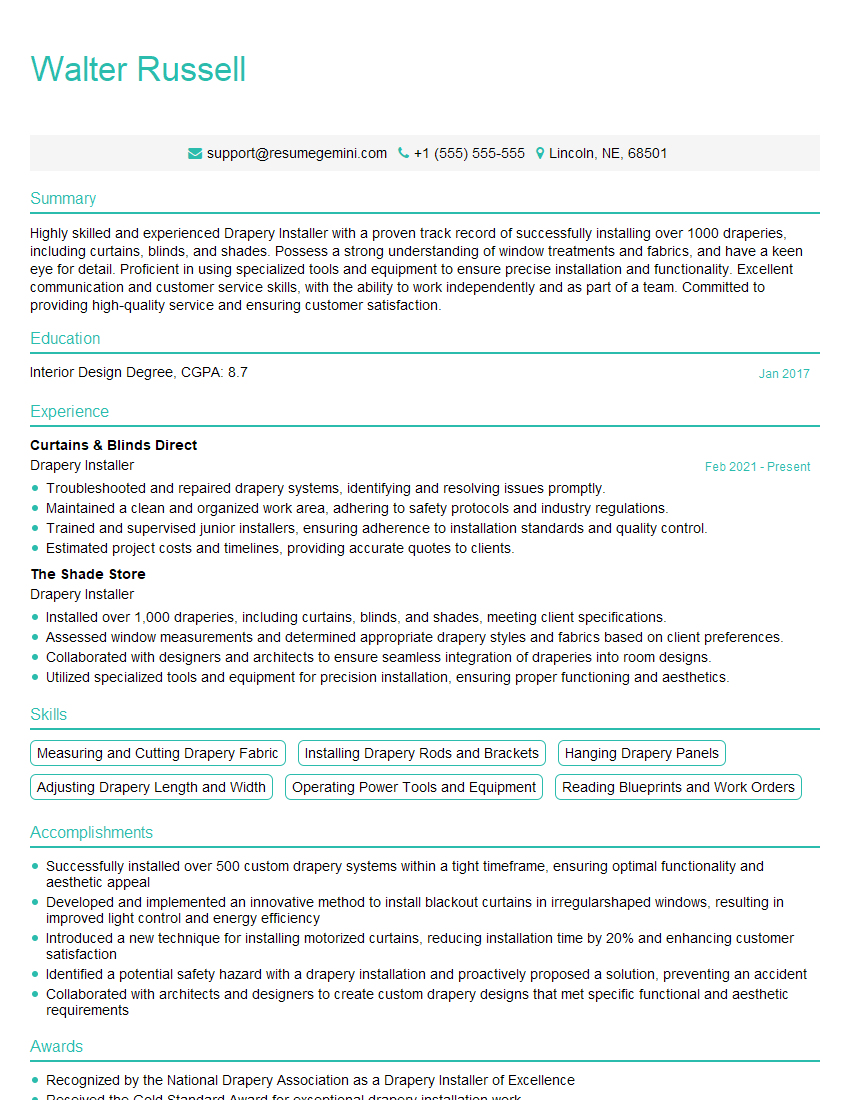
Mastering curtain and drapery fabrication opens doors to exciting career opportunities in design, manufacturing, and installation. A strong understanding of these techniques is highly valued by employers, leading to increased job prospects and career advancement. To maximize your chances of landing your dream job, it’s crucial to create a professional and ATS-friendly resume that showcases your skills and experience effectively. ResumeGemini is a trusted resource that can help you build a compelling resume that stands out. ResumeGemini provides examples of resumes tailored to the Curtain and Drapery Fabrication field, helping you craft a document that highlights your unique qualifications. Invest time in creating a strong resume – it’s your first impression on potential employers.
Explore more articles
Users Rating of Our Blogs
Share Your Experience
We value your feedback! Please rate our content and share your thoughts (optional).
What Readers Say About Our Blog
good