The right preparation can turn an interview into an opportunity to showcase your expertise. This guide to Custom Countertop Fabrication interview questions is your ultimate resource, providing key insights and tips to help you ace your responses and stand out as a top candidate.
Questions Asked in Custom Countertop Fabrication Interview
Q 1. Describe your experience with different countertop materials (granite, quartz, marble, etc.).
My experience spans a wide range of countertop materials, each with its own unique characteristics and challenges. Granite, for instance, is known for its durability and stunning natural variations. However, it requires careful handling due to its hardness and potential for cracking. Quartz, a manufactured stone, offers consistent color and pattern, high durability, and lower maintenance compared to granite. Marble, on the other hand, is prized for its elegance and veining but is softer and more susceptible to etching from acidic substances. I’ve also worked extensively with other materials like concrete, which allows for highly customized designs, and laminate, a cost-effective option for various applications.
Understanding the properties of each material is crucial for successful fabrication. For example, I adjust my cutting techniques and tooling based on the material’s hardness and grain structure. A diamond blade suitable for granite might be too aggressive for marble. Similarly, the sealing process varies significantly depending on the material’s porosity. I’ve learned through experience to select the right materials and techniques to meet the specific needs and aesthetic preferences of each client.
Q 2. Explain the process of templating countertops for a typical kitchen installation.
Templating is a critical step that ensures a perfect fit. It’s like taking a detailed blueprint of the countertop space. I begin by carefully measuring all dimensions, including cabinet heights, overhangs, and any unique features like sinks or cooktops. I then use a combination of traditional measuring tools and digital tools, like laser measuring devices, for utmost accuracy. This data is then transferred to a computer-aided design (CAD) program to create a precise template.
Next, I use a thin, flexible material, often paper or plastic, to create a physical template that exactly mirrors the countertop’s shape. This template is carefully checked against the actual countertop space before finalizing it. Think of it as a tailor making a precise pattern before cutting fabric. Any inaccuracies at this stage can lead to significant problems later in the fabrication process. This detailed templating process minimizes on-site adjustments and ensures a flawless installation.
Q 3. How do you ensure accurate measurements and cuts to minimize waste?
Minimizing waste requires meticulous planning and execution. Accurate measurements, as discussed in the previous answer, form the foundation. Beyond that, I use specialized software to optimize material utilization during the cutting process. This software analyses the template and arranges the pieces to minimize waste on the slabs. Think of it like solving a complex jigsaw puzzle to get the most out of the available materials.
Furthermore, I regularly calibrate my cutting equipment to ensure precision. Experienced operators like myself learn to anticipate potential issues and plan the cuts carefully. For example, when working with large slabs, I strategically plan the layout considering the natural variations and any imperfections present in the stone to minimize waste and maximize usable areas.
Q 4. What safety precautions do you take when operating fabrication equipment (e.g., CNC router, bridge saw)?
Safety is paramount in our industry. When using heavy machinery like a CNC router or bridge saw, I always adhere to strict safety protocols. This includes wearing appropriate personal protective equipment (PPE) such as safety glasses, hearing protection, dust masks, and gloves. Machines are regularly inspected and maintained to prevent malfunctions. Proper machine guards are in place and operational at all times.
Before starting any operation, I ensure the work area is clear and free from obstructions. I follow the manufacturer’s instructions for operating each machine, and I never operate equipment when fatigued or under the influence of any substance. Regular safety training is also essential to keep our skills and safety knowledge updated.
Q 5. Describe your experience with different edge profiles and their application.
Edge profiles add the finishing touch to a countertop, impacting both aesthetics and functionality. There’s a wide variety, each suited to different tastes and countertop materials. Simple profiles like eased edges, where the edge is slightly rounded, are common and suitable for most materials. More elaborate profiles, such as ogee, bevel, or bullnose, can add a decorative touch. I’ve worked with hundreds of edge profiles over the years and have become proficient in producing them with precision.
The choice of edge profile often depends on the material and overall design style. A sharp, straight edge might look striking on a modern quartz countertop, while a softer, rounded edge would complement the natural beauty of a marble countertop. I always discuss the options with clients, guiding them to choose profiles that enhance their kitchen’s aesthetic and practicality.
Q 6. How do you handle complex countertop designs with multiple curves or angles?
Complex designs requiring curves and angles demand a high level of skill and precision. The templating process becomes even more critical to capture every detail accurately. I utilize CAD software to model these complex shapes digitally, allowing me to create precise cutting patterns. The use of CNC routers is invaluable for intricate cuts, ensuring consistent accuracy throughout the process. CNC routers are computer-controlled cutting machines that create highly precise cuts, even on curved surfaces, which is extremely difficult to achieve manually.
For very complex designs, I might employ hand-finishing techniques, using specialized tools to refine the curves and angles to perfection. It’s a combination of high-tech machinery and time-honored craftsmanship that allows me to produce stunning, bespoke countertops. For example, I once fabricated a countertop with a sweeping curve and integrated sink; using CAD and CNC machining, I ensured the flawless fit and overall look.
Q 7. Explain the process of seaming countertops to create a seamless appearance.
Seaming is essential for creating long countertops from multiple slabs. The goal is to make the seam virtually invisible. Before seaming, I carefully select slabs with similar color and veining patterns to ensure consistency. The edges of the slabs are meticulously prepared using precision tools for a perfectly aligned joint. A special epoxy resin, carefully matched to the countertop’s color, is then used to bond the two pieces.
The resin is applied skillfully and precisely, avoiding excess material that can create a noticeable ridge. Once the resin cures, it’s carefully polished and buffed to match the surrounding surface. The end result, when done properly, is a seamless appearance, making the joint nearly undetectable. This is a delicate process requiring patience and attention to detail; a poorly executed seam will always be a visual eyesore.
Q 8. How do you polish and finish countertops to achieve a high-quality finish?
Achieving a high-quality finish on countertops involves a multi-step polishing process that refines the surface to a smooth, lustrous state. This process typically begins with coarser grits of abrasive, gradually moving to finer grits to eliminate scratches and imperfections.
The process usually starts with diamond grinding pads, progressing through various grits (e.g., 50, 100, 200, 400, 800). Each grit removes the scratches left by the previous one. Following the grinding, polishing compounds are applied with specialized polishing pads. These compounds, often containing progressively finer abrasives like cerium oxide, create a mirror-like shine. The final step frequently involves applying a sealant or enhancer to protect the surface and enhance its color and depth.
For example, with granite, the polishing process might reveal the stone’s natural veining and create a deep, rich luster. In quartz, achieving a consistent, high-gloss finish relies heavily on the precision of the polishing compounds and the skill of the technician to avoid inconsistencies.
Q 9. What experience do you have with installing undermount sinks and other integrated features?
I have extensive experience installing undermount sinks and other integrated features, such as integrated sinks, drainboards, and cooktops. This involves precise measurements and cuts to ensure a seamless fit within the countertop. Accurate templating is crucial to prevent costly mistakes. For undermount sinks, I use specialized templates and jigs to ensure the cutout is precisely sized and shaped for the sink. I’m proficient in using various cutting tools, including CNC routers, for intricate designs and precise cuts. I also take care to ensure the support structure around the sink is strong enough to prevent sagging.
For instance, I once worked on a project with an intricate, curved undermount sink. Achieving a perfect fit required multiple template revisions and careful adjustments throughout the cutting process. Precise cutting and consistent measurements were vital for the successful installation.
Q 10. Describe your troubleshooting experience when encountering issues during fabrication or installation.
Troubleshooting is a critical part of this profession. I’ve encountered various issues, from material defects to measurement errors during fabrication and installation. My approach involves a systematic process: First, I carefully assess the problem to identify its root cause. This might involve examining the material, reviewing the plans, or checking the tools and equipment. Then I create a plan to resolve the issue. This could range from repairing a minor chip to re-cutting a section of the countertop.
For example, I once encountered a situation where the adhesive wasn’t adhering properly to a section of the countertop during installation. After careful inspection, I discovered a small film of oil on the stone surface. Thorough cleaning solved the problem. Another time, I discovered a crack in a slab during fabrication. Careful repair and reinforcing the surrounding area ensured the quality wasn’t compromised.
Q 11. How do you handle customer requests or changes during a project?
Handling customer requests and changes requires clear communication and careful planning. I always emphasize open communication throughout the process. Once a request or change is made, I immediately evaluate its impact on the project schedule, budget, and design integrity. If the change is feasible, I adjust accordingly and keep the customer informed of the potential implications. I document all changes meticulously.
For example, a customer might decide to change the edge profile after the initial template is created. I’d discuss the feasibility, potential cost implications, and timeline adjustments with the customer. Then, after approval, I’d adjust the design and fabrication plans accordingly, making sure all parties are on the same page. Transparency and clear communication ensure a positive customer experience.
Q 12. Explain your understanding of different countertop installation methods (e.g., adhesive, mechanical fasteners).
Different countertop installation methods offer varying levels of stability and aesthetic appeal. Adhesive methods use epoxy or other specialized adhesives to bond the countertop to the cabinetry. This is common for most countertop materials and is typically strong and reliable when executed correctly. Mechanical fastening involves using screws or clips to secure the countertop to the cabinet frames. This is often used for heavier or larger countertops to provide additional support.
The choice of method depends on factors such as the countertop material, the cabinet type, and the desired aesthetic outcome. For example, undermount sinks often require adhesive installation to ensure a clean, integrated look. On the other hand, some heavier stone countertops might benefit from a combination of adhesive and mechanical fasteners for added security. Proper preparation of the surfaces, applying the adhesive correctly, and ensuring sufficient clamping pressure are crucial for success regardless of the method.
Q 13. How do you maintain a clean and organized workspace?
Maintaining a clean and organized workspace is essential for efficiency and safety. I follow a daily cleaning routine to remove dust, debris, and excess materials. Tools and equipment are stored in designated locations. Materials are organized according to their type and usage, and I regularly dispose of waste materials safely and responsibly. This prevents accidents and optimizes the workflow.
For example, I have a designated area for each type of tool, ensuring that I can quickly locate what I need. I also have a system for storing different sizes and types of materials, keeping them clean and dry to avoid material degradation.
Q 14. What software or CAD programs are you proficient in?
I’m proficient in several software and CAD programs commonly used in countertop fabrication. These include AutoCAD for creating detailed drawings and designs, SketchUp for 3D modeling and visualization, and specialized countertop design software for generating precise templates and cut lists. My expertise in these programs allows me to create accurate designs, generate efficient cut lists, and minimize material waste.
For instance, I often use AutoCAD to create precise templates for undermount sinks, ensuring a perfect fit with the countertop. SketchUp helps customers visualize the final product and choose the best option for their space.
Q 15. Describe your experience with different types of countertop adhesives and sealants.
Choosing the right adhesive and sealant is crucial for a successful countertop installation. My experience spans a wide range of products, each with its own strengths and weaknesses. For example, I frequently use epoxy adhesives for their superior strength and water resistance, particularly when working with natural stone like granite or marble. These are ideal for situations requiring a strong bond that can withstand significant stress. However, epoxy requires careful mixing and a relatively short working time. For less demanding applications, or when working with engineered stone like quartz, I might opt for a polyurethane adhesive, which offers excellent adhesion and is easier to work with, boasting a longer open time.
Sealants are equally important. I always use a high-quality silicone sealant, specifically designed for kitchen and bath applications, to seal the countertop to the backsplash and other adjoining surfaces. This prevents water infiltration, which is a major cause of damage and mold growth. The choice of sealant color also matters – I ensure a perfect match to minimize visibility.
In addition, I’m familiar with other specialized adhesives and sealants, such as those specifically formulated for certain materials like glass or metal. The selection always depends on the specific materials involved and the project’s requirements. A wrong choice could lead to significant problems down the line.
Career Expert Tips:
- Ace those interviews! Prepare effectively by reviewing the Top 50 Most Common Interview Questions on ResumeGemini.
- Navigate your job search with confidence! Explore a wide range of Career Tips on ResumeGemini. Learn about common challenges and recommendations to overcome them.
- Craft the perfect resume! Master the Art of Resume Writing with ResumeGemini’s guide. Showcase your unique qualifications and achievements effectively.
- Don’t miss out on holiday savings! Build your dream resume with ResumeGemini’s ATS optimized templates.
Q 16. How do you ensure the structural integrity of a countertop installation?
Structural integrity is paramount. I begin by ensuring a perfectly level and stable substrate. Any unevenness can compromise the countertop’s stability and lead to cracking or other problems. This often involves careful preparation of the cabinets, adding shims where necessary to achieve perfect levelness. I then use appropriate support structures, such as bracing or blocking, to ensure the countertop is adequately supported across its entire length and width, especially important with overhangs.
The choice of adhesive also plays a crucial role. Using a high-strength adhesive like epoxy, as discussed previously, is vital. For larger or more complex countertops, I might use a combination of adhesive and mechanical fasteners for added security. The installation process itself must be meticulous, following the manufacturer’s instructions carefully to prevent stress points or gaps. Finally, after installation, I perform a visual inspection and even a slight stress test to ensure everything is secure and stable.
Q 17. What is your experience with repairing damaged countertops?
Repairing damaged countertops requires a keen eye for detail and a thorough understanding of the material. Minor chips or scratches on many materials can often be repaired using specialized fillers and polishing compounds. The process involves carefully cleaning the damaged area, applying the filler to match the color and texture, and then meticulously sanding and polishing to achieve a seamless finish. For deeper chips or cracks, more extensive repair might be needed, possibly involving epoxy resin and pigment to replicate the original material.
For more significant damage, like a large crack or severe burn mark, the extent of repair is crucial to determine. Sometimes, a complete section replacement is the only feasible option. This requires precision cutting, accurate matching of the replacement piece, and meticulous re-installation to ensure the repair is virtually invisible.
My experience encompasses repairs for various materials, from granite and marble to quartz and laminate, each needing a slightly different approach and specific tools. The key is to properly assess the damage and use the most appropriate repair technique to ensure both aesthetics and functionality are restored.
Q 18. How do you manage your time and prioritize tasks effectively on multiple projects?
Managing multiple projects effectively requires a structured approach. I use project management software to track tasks, deadlines, and resource allocation for each project. This allows me to prioritize tasks based on urgency and dependencies, ensuring that critical milestones are met. I also maintain clear communication with clients, keeping them informed of progress and addressing any concerns promptly.
My team and I utilize a Kanban-style workflow. This system visually tracks the progress of various tasks across different projects, allowing for a clear overview and identification of potential bottlenecks. Regular team meetings are vital for collaboration and problem-solving. We also emphasize clear communication and delegation, ensuring everyone understands their roles and responsibilities. This allows me to focus on the higher-level aspects of each project while ensuring all tasks are completed efficiently and on schedule.
Q 19. Describe your experience working with different types of sink materials and their installation.
I’ve worked with a wide variety of sink materials, including stainless steel, porcelain, cast iron, and composite sinks. Each material has its own unique installation requirements. Stainless steel sinks, for instance, are relatively straightforward to install, often using clips or adhesive to secure them in place. Porcelain sinks usually require a more careful approach, ensuring a strong and watertight seal to prevent leaks.
Cast iron sinks, due to their weight, need sturdy support and precise fitting. Composite sinks often require specialized adhesives compatible with the sink material and the countertop. Regardless of the material, I always take the utmost care to ensure a precise fit and a flawless finish. This often involves template creation, careful cutting and precise sealing to create a professional and leak-free installation. I also inspect the sink thoroughly for any defects or cracks before proceeding with the installation.
Q 20. What are the common challenges you encounter in countertop fabrication, and how do you address them?
Common challenges include dealing with difficult material cuts, particularly intricate curves or complex shapes requiring specialized tools and precision. Matching existing countertops during repairs can be tricky, especially with natural stone where color variations are inherent. I often utilize digital templates and advanced cutting technology to minimize errors and ensure accurate results. Color matching in repair work might require multiple attempts and careful selection of fillers and pigments.
Another challenge is managing client expectations. Understanding the limitations of materials, design considerations, and communicating these clearly to clients can prevent misunderstandings and delays. Finally, adhering to strict deadlines while maintaining high-quality workmanship requires effective project management and efficient resource allocation. I address these by using project management software, keeping open communication with clients, and delegating tasks effectively to my team.
Q 21. Describe your experience with quality control processes in countertop fabrication.
Quality control is an integral part of my process. It starts with material selection – I only use high-quality materials from reputable suppliers. I then meticulously inspect materials for defects before fabrication. During fabrication, I closely monitor each step of the process, ensuring accuracy and precision in cutting, shaping, and finishing. Regular checks are done to ensure that the material is properly handled to avoid damage.
After fabrication, a thorough inspection is conducted before installation. This involves checking for any imperfections, ensuring proper sealing, and verifying the fit and alignment of the countertop. Finally, a post-installation inspection is carried out to confirm that the countertop is installed correctly and meets the client’s expectations. This multi-stage quality control process ensures high-quality workmanship and minimizes errors. If any problems are detected, immediate corrective actions are implemented to fix them before proceeding to the next stage.
Q 22. How do you calculate material costs and provide accurate project estimates?
Accurately estimating material costs for custom countertop fabrication is crucial for project success. It involves a multi-step process combining precise measurements, material pricing, and waste factor calculations. First, we meticulously measure the countertop area, accounting for all curves, angles, and cutouts. This often involves using digital measuring tools for greater precision. Then, we determine the required material quantity, adding a percentage for waste, which varies depending on the material (e.g., granite may have a higher waste factor than quartz due to potential cracking during cutting).
Next, we obtain current pricing from our suppliers for the chosen material, considering factors such as slab size, color, and veining patterns. Premium materials naturally command higher prices. Finally, we compile all costs, including material, potential waste, and any additional fees, such as for edge profiling or special finishing, to arrive at a comprehensive and accurate estimate. This is presented transparently to the client with a detailed breakdown.
Example: Let’s say a client wants a 10ft x 3ft quartz countertop. After accounting for cutouts for the sink and cooktop, the net usable area is 25 square feet. With a 10% waste factor, we need to order 27.5 square feet of material. If the quartz costs $75 per square foot, the material cost alone is approximately $2062.50. Adding costs for fabrication and installation gives us the final project estimate.
Q 23. Explain your experience with working with clients and understanding their needs.
Client communication is paramount in countertop fabrication. I begin by scheduling a thorough consultation to understand their vision, lifestyle, and budgetary constraints. We discuss their preferred materials, styles, and functionality needs. Active listening is key – I ask clarifying questions and visually confirm their choices using sketches and samples. This helps me grasp their aesthetic preferences, functional requirements (e.g., need for a specific sink cutout), and any potential challenges.
I believe in maintaining open communication throughout the entire process. Regular updates, both on progress and potential issues (if any arise), keep clients informed and build trust. Transparency in cost management and scheduling is also crucial. Addressing client concerns promptly and efficiently is essential for building strong relationships. One client once was unsure about the best edge profile for their quartz countertops; we spent time reviewing different options and I created 3D renderings to illustrate the final look, leading to a much happier client.
Q 24. How familiar are you with building codes and regulations related to countertop installations?
I’m very familiar with building codes and regulations concerning countertop installations. This includes understanding requirements for material safety (e.g., lead content in certain materials), proper installation techniques to ensure structural integrity and prevent damage, and adherence to accessibility guidelines (where applicable). I regularly consult local building codes and stay updated on changes through professional development and interactions with building inspectors. This ensures our work complies with all standards and guarantees client safety and satisfaction.
For example, I’m aware of regulations regarding the use of adhesives and sealants, ensuring they’re appropriate for the material and application. I also ensure proper ventilation during installation processes that might involve fumes. Familiarity with these aspects minimizes potential complications and protects both the client and our business from legal issues.
Q 25. What is your understanding of the different types of backsplashes and their installation?
Backsplashes are an important design element and protective layer for kitchen walls. There’s a wide variety of materials to choose from, each with unique properties and installation requirements.
- Tile: Ceramic, porcelain, glass, and stone tiles offer versatility in color, pattern, and texture. Installation requires careful planning, precise cutting, and application of appropriate adhesive and grout.
- Glass: Tempered glass backsplashes are sleek and easy to clean. They’re usually installed with silicone adhesive, requiring precise measurements for a seamless look.
- Stone: Materials like granite, marble, or quartzite can provide a luxurious and durable backsplash, often requiring professional installation due to the material’s weight and potential for cracking.
- Metal: Stainless steel or copper backsplashes offer a modern aesthetic and are relatively easy to install.
- Laminate: Budget-friendly, easily installed but less durable than other materials.
Proper installation involves surface preparation, careful measurements, secure attachment, and appropriate sealing to prevent water damage. I always advise clients on the best material choice based on their needs, budget, and style preferences, and always ensure the correct installation techniques are followed for longevity.
Q 26. Describe your experience with handling and transporting heavy countertop materials.
Handling and transporting heavy countertop materials requires specialized equipment and safety procedures. We utilize vacuum lifters, forklift trucks, and specialized slings to lift and move slabs safely and efficiently. Our team is trained in proper lifting techniques and the safe operation of this equipment. We prioritize safety by using protective gear such as gloves, safety glasses, and steel-toed boots. Our trucks are equipped with appropriate securing mechanisms to prevent shifting or damage during transportation. We also plan delivery routes to minimize risks and ensure efficient delivery to the installation site.
A crucial part of safe handling is the meticulous planning before the material even arrives at the site. We meticulously survey the installation space and access routes to ensure that heavy materials can be moved and placed safely. This includes assessing potential obstacles and ensuring that our equipment can navigate the area without difficulty or risk of damage to the property.
Q 27. How do you stay updated on the latest trends and technologies in the countertop industry?
Staying updated in the countertop industry requires a multi-pronged approach. I regularly attend industry trade shows and conferences, such as Surfaces or KBIS, to learn about new materials, technologies, and installation methods. I subscribe to industry publications and online resources, keeping me abreast of current trends and advancements. I also actively participate in online forums and networking groups to connect with other professionals and exchange insights.
Furthermore, I’m committed to continuous learning and invest in training programs on new fabrication techniques and safety procedures. Keeping up with these advancements ensures we offer our clients the latest options, superior quality, and the most efficient installation processes.
Q 28. Describe a time you had to solve a complex problem during a countertop installation.
During one project, we encountered a significant challenge. The client had chosen a large, uniquely veined slab of marble for their kitchen island. During fabrication, a significant crack appeared unexpectedly in a critical area, rendering the slab unusable. This was close to the installation deadline, creating immense pressure.
Instead of panicking, we immediately contacted the supplier and collaboratively explored solutions. We reviewed the supplier’s stock for a similar slab, but none matched the unique veining the client loved. We then decided to carefully analyze the existing crack and explore the possibility of repairing and reinforcing it. This involved consulting with a specialist in marble repair, using specialized epoxy and reinforcement techniques. After a rigorous repair process, the client approved the corrected slab and the installation proceeded as scheduled.
This experience highlighted the importance of meticulous material selection and the need for swift, collaborative problem-solving. Our commitment to client satisfaction led us to explore alternative solutions while maintaining professionalism and communication, resulting in a positive outcome despite the initial setback.
Key Topics to Learn for Custom Countertop Fabrication Interview
- Material Selection & Properties: Understanding the characteristics of various countertop materials (granite, quartz, marble, laminate, etc.), their strengths, weaknesses, and suitability for different applications. This includes knowledge of sourcing, pricing, and maintenance.
- Templating & Measurement Techniques: Mastering precise measurement and templating methods to ensure accurate countertop fabrication. This involves using various tools and understanding tolerance levels for a perfect fit.
- Fabrication Processes: Familiarity with different fabrication techniques, including cutting, shaping, polishing, edging, and finishing. This includes understanding the machinery used and safety protocols.
- Installation & Finishing: Knowledge of proper installation techniques to ensure a seamless and professional finish. This includes understanding different installation methods and addressing potential issues.
- Design & Customer Interaction: Understanding customer needs, translating designs into technical specifications, and effectively communicating with clients throughout the process. This also includes problem-solving and handling potential design conflicts.
- Health & Safety Regulations: Understanding and adhering to relevant health and safety regulations concerning material handling, machinery operation, and workplace safety.
- Troubleshooting & Problem-Solving: Ability to identify and resolve common issues during fabrication and installation. This includes understanding potential material defects and how to mitigate them.
- Estimating & Project Management: Developing accurate cost estimates, managing project timelines, and coordinating resources effectively.
Next Steps
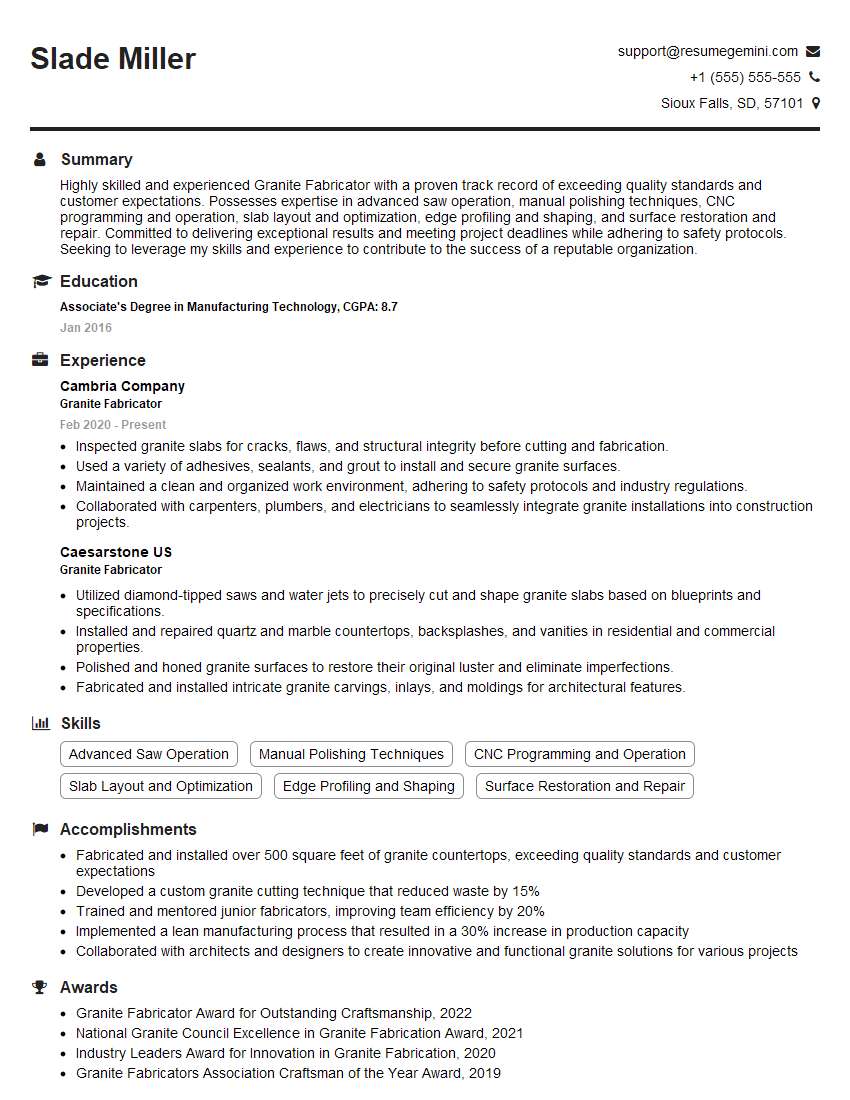
Mastering Custom Countertop Fabrication opens doors to rewarding careers with excellent growth potential. This specialized skillset is highly sought after, leading to competitive salaries and opportunities for advancement within the industry. To maximize your job prospects, focus on creating an ATS-friendly resume that highlights your relevant skills and experience. ResumeGemini is a trusted resource to help you build a professional and impactful resume that stands out. Examples of resumes tailored to Custom Countertop Fabrication are available to further guide your preparation.
Explore more articles
Users Rating of Our Blogs
Share Your Experience
We value your feedback! Please rate our content and share your thoughts (optional).
What Readers Say About Our Blog
Very informative content, great job.
good