The right preparation can turn an interview into an opportunity to showcase your expertise. This guide to Custom Embroidery interview questions is your ultimate resource, providing key insights and tips to help you ace your responses and stand out as a top candidate.
Questions Asked in Custom Embroidery Interview
Q 1. Explain the difference between appliqué and embroidery.
Appliqué and embroidery are both decorative sewing techniques, but they differ significantly in their method. Appliqué involves sewing a fabric shape onto a base fabric, creating a raised design. Think of it like adding fabric ‘stickers.’ Embroidery, on the other hand, uses stitches to create the design directly onto the base fabric. It’s like drawing with thread.
For example, imagine creating a flower. With appliqué, you’d cut out fabric petals and sew them onto a background. With embroidery, you’d use stitches to create the petals directly on the fabric, resulting in a flatter, more intricate design. Appliqué often provides a bolder, more three-dimensional look, while embroidery allows for more detailed and nuanced designs.
Q 2. Describe your experience with various embroidery stitches (e.g., satin, fill, chain).
My experience encompasses a wide range of embroidery stitches. Satin stitch, for example, creates a smooth, glossy surface, ideal for filling in solid areas of a design like leaves or lettering. I’ve used it extensively for creating logos and monograms, where a clean, polished finish is crucial. Fill stitches, which offer various patterns and textures (like a dense, uniform fill or a more open, textured fill), are essential for filling larger areas, adding depth, and creating different visual effects. I’ve found that choosing the right fill stitch significantly impacts the overall aesthetic and durability of the embroidered piece, especially on densely packed designs. Finally, chain stitch offers a more decorative, outlining style. I often combine it with satin stitch for highlighting and adding texture to a design, making it ideal for detailed floral work or creating a border around a monogram.
I’ve honed my skills with these stitches through years of practical application and experimentation with different fabrics and threads. Mastering these stitch types is about more than just the mechanical act of sewing; it’s about understanding how the stitch choice affects the final look and feel of the embroidered piece.
Q 3. How do you determine the correct thread tension for different fabrics?
Determining the correct thread tension is crucial for achieving high-quality embroidery, and it varies greatly depending on the fabric. Loosely woven fabrics like linen require a looser tension to prevent puckering or pulling. Tightly woven fabrics such as cotton twill or denim need a tighter tension to ensure clean stitches and prevent the thread from sinking too deeply into the fabric. I typically start by testing the tension on a scrap piece of the same fabric. I adjust the tension dial on my machine, observing the stitches and the fabric’s reaction. I look for even stitch formation, neither too loose nor too tight.
The type of thread also plays a role. Thicker threads will typically require a looser tension than thinner threads. Experience and a keen eye are essential; I’ve learned to ‘feel’ the right tension over time. If the stitches are too tight and the fabric puckers, I loosen the tension. If the stitches are loose and uneven, I tighten it. It’s an iterative process—a bit like fine-tuning a musical instrument.
Q 4. What are some common causes of thread breakage during embroidery?
Thread breakage during embroidery can be frustrating, but often stems from a few common causes. One frequent culprit is improper tension—too tight a tension creates friction and stress on the thread, leading to breakage. Another common cause is using damaged or old thread. Thread can become weakened over time, especially if it has been exposed to moisture or extreme temperatures. Using the wrong type of needle for the thread is another potential problem. A needle that’s too small can damage the thread, while a needle that’s too large can cause the thread to slip and break.
Finally, knots or tangles in the thread itself can cause breakage. Regularly inspecting the thread before use and ensuring the thread path is clear within the machine are essential preventative measures. Addressing these causes often solves the thread breakage issue, leading to smoother embroidery sessions.
Q 5. How do you troubleshoot a skipped stitch problem on an embroidery machine?
Skipped stitches are a common problem, and troubleshooting them involves a systematic approach. First, I check the needle. A bent or dull needle is a frequent cause. I replace it with a new one, ensuring it’s the correct size and type for the fabric and thread being used. Next, I inspect the thread for any knots or damage. Tangles or weak areas in the thread can cause the machine to skip stitches. I also check the bobbin, making sure it’s properly wound and seated correctly in the bobbin case, as bobbin issues are a common source of skipped stitches.
If the problem persists, I examine the tension. I may need to adjust the top and bobbin tension to ensure a balanced stitch formation. Finally, I inspect the fabric; excessive thickness or stiffness can cause skipped stitches. If this is the issue, there is a possibility that a stabilizer is needed to improve stitch penetration.
Q 6. Explain your experience with different types of embroidery machines (e.g., single-head, multi-head).
My experience with embroidery machines includes both single-head and multi-head machines. Single-head machines are excellent for smaller projects and those requiring intricate detail and customization. They offer great control and precision, perfect for personalized gifts or small-batch production. For example, I’ve used single-head machines for intricate custom monograms or small detailed patches. Multi-head machines, on the other hand, are workhorses for high-volume production. They significantly increase efficiency, capable of embroidering multiple pieces simultaneously. I’ve utilized multi-head machines for larger orders, such as corporate apparel or uniform embroidery.
Each type of machine has its strengths. The choice depends entirely on the project’s scale and complexity. Understanding the capabilities and limitations of both is essential for efficient and high-quality production.
Q 7. How do you digitize embroidery designs?
Digitizing embroidery designs involves converting artwork into a stitch format that embroidery machines can understand. This is usually done using specialized software. The process involves tracing the artwork, choosing the appropriate stitch types, selecting the correct thread colors and defining the sequence in which these stitches are applied to create the final design. Careful consideration is given to factors such as stitch density, underlay, and jump stitches to ensure both the visual appearance and the durability of the finished embroidery. For instance, a logo might require a dense satin stitch for solid areas and a chain stitch for outlines, carefully planned to avoid thread breakage and ensure a smooth, even result.
The skill lies in balancing aesthetic quality with machine capabilities. A poorly digitized design can lead to thread breaks, puckering, or a generally unsatisfactory result. Good digitizing software aids in this process by providing tools for stitch manipulation, color management, and overall design optimization.
Q 8. What software programs are you proficient in for embroidery design and creation?
My proficiency in embroidery design software is extensive. I’m highly skilled in using industry-standard programs like Wilcom EmbroideryStudio and Embird. These programs allow me to create designs from scratch, digitize existing artwork, and manipulate various design elements to achieve the desired look. I’m comfortable with all aspects of these programs, from initial design creation and editing to the crucial step of generating stitch files that are compatible with my embroidery machines. For example, in Wilcom, I frequently utilize the advanced features for creating complex fills and lettering effects, ensuring optimal stitch density and preventing thread breakage. In Embird, I often leverage its powerful editing tools for seamlessly merging different design elements.
Q 9. Describe your experience with hooping different fabrics.
Hooping different fabrics requires a keen understanding of fabric types and their behavior under tension. My experience encompasses a wide range of materials, from delicate silks and knits to heavy denims and towels. The key is to select the right hoop size and stabilizer type to prevent puckering or fabric damage. For instance, when hooping a delicate silk scarf, I would use a smaller hoop and a lightweight, tear-away stabilizer to minimize stress on the fabric. Conversely, working with a thick denim jacket would require a larger hoop and a more robust, cutaway stabilizer to provide enough support during stitching. I always pre-check my tension and take extra care to ensure the fabric is smooth and taut within the hoop to ensure even stitches and precise placement.
Q 10. How do you ensure the accurate placement of designs on garments?
Accurate design placement is paramount. I use a combination of techniques to ensure precision. First, I meticulously mark the garment with tailor’s chalk or a water-soluble pen, creating a guide based on the design dimensions and the garment’s layout. Then, I carefully position the hooped fabric onto the machine, aligning the markings with the machine’s needle position. For complex designs or larger garments, I may use a template or specialized placement tools. I double-check my placement before starting the stitching process to prevent costly mistakes. For example, when embroidering a logo on a shirt, I’ll meticulously measure and mark the center point to guarantee the logo is perfectly aligned. If a garment has a complicated shape, I may use a temporary adhesive to hold the fabric in place within the hoop before stitching. This ensures accuracy across different fabric types and design sizes.
Q 11. What is your experience with different types of embroidery threads?
My experience spans a wide array of embroidery threads, each with its unique properties. I’m familiar with the differences between polyester, rayon, metallic, and cotton threads. Polyester threads are known for their durability and vibrant colors, while rayon threads provide a lustrous sheen. Metallic threads add a touch of elegance but require special attention to avoid breakage. Cotton threads offer a natural look and feel. The selection of thread depends entirely on the project; for instance, I would use a durable polyester thread for a high-wear item like a work uniform, while a delicate rayon thread would be perfect for a bridal gown. I also understand the importance of thread weight and its influence on the overall look and feel of the embroidery. A thicker thread results in a bolder design, while a finer thread yields more delicate details.
Q 12. How do you manage color changes during embroidery?
Managing color changes during embroidery involves careful planning and execution. I typically use the color sequence generated by my design software, which automatically arranges the thread changes to minimize thread trims and maximize efficiency. The machine itself prompts me for each color change, and I meticulously thread the new color, ensuring it’s correctly tensioned. With complex designs involving many color changes, I might use a thread organizer or tray to keep everything neat and easily accessible. This systematic approach ensures efficient color transitions and the production of high-quality, professional embroidery. Careful attention is paid to thread trimming to prevent loose ends that could snag or damage the fabric.
Q 13. Explain your experience with different stabilization methods for various fabrics.
Stabilization is crucial for achieving high-quality results. The method I choose depends heavily on the fabric type and the design complexity. For lightweight fabrics like knits, I often use a tear-away stabilizer, which is removed after embroidery. Heavier fabrics such as denim might require a cutaway stabilizer, allowing for more support during stitching, and leaving a slight backing. For delicate fabrics such as lace, a water-soluble stabilizer is sometimes the best option, completely disappearing after rinsing. In some cases, I use a combination of stabilizers to achieve the best possible results, offering added stability and preventing puckering. For instance, I might use a lightweight tear-away stabilizer in conjunction with a water-soluble stabilizer for delicate materials, combining the benefits of both.
Q 14. How do you maintain and clean embroidery machines?
Regular maintenance is critical for extending the life of embroidery machines. After each use, I clean the bobbin area, removing any lint or thread buildup. The needle is also checked for damage and replaced as needed. I lubricate the moving parts according to the manufacturer’s recommendations. Periodically, a more thorough cleaning is undertaken, including removing accumulated dust and debris from the machine’s internal components. Regular maintenance like this prevents mechanical issues, ensures stitch quality, and maintains the value of my machines. A simple analogy would be regular car maintenance; neglecting it will lead to expensive repairs down the road.
Q 15. How do you identify and address fabric damage during the embroidery process?
Identifying and addressing fabric damage before, during, and after the embroidery process is crucial for delivering high-quality results. I start by carefully inspecting the fabric before even beginning the digitization process. This initial inspection helps identify any pre-existing weaknesses like thin spots, loose threads, or areas with significant wear. For instance, a delicate silk might require a stabilizer to prevent damage from the needle punctures.
During the embroidery process, I closely monitor the machine’s behavior and the fabric’s reaction. Unusual noises, skipped stitches, or fabric puckering are all red flags. If the machine struggles, I immediately stop and investigate. This might involve adjusting the tension, changing needles, or switching to a more appropriate stabilizer.
After embroidery, I perform a final inspection to look for any broken threads, needle holes that are too large, or any damage caused by the hooping process. For example, if I notice excessive fabric stretching near the edges, it indicates I need to adjust my hooping technique or use a gentler hooping method next time. Minor damage can often be repaired with a little hand-stitching, but extensive damage may require the project to be remade.
Career Expert Tips:
- Ace those interviews! Prepare effectively by reviewing the Top 50 Most Common Interview Questions on ResumeGemini.
- Navigate your job search with confidence! Explore a wide range of Career Tips on ResumeGemini. Learn about common challenges and recommendations to overcome them.
- Craft the perfect resume! Master the Art of Resume Writing with ResumeGemini’s guide. Showcase your unique qualifications and achievements effectively.
- Don’t miss out on holiday savings! Build your dream resume with ResumeGemini’s ATS optimized templates.
Q 16. Describe your experience with different embroidery techniques (e.g., free motion, shadow work).
My embroidery experience spans a wide range of techniques. Free-motion embroidery, also known as free-style embroidery, allows for spontaneous designs without a pattern. This is perfect for creating unique, organic shapes and textures. I often use this technique in custom designs where clients want a personalized, less structured feel, such as incorporating free-flowing floral elements on a garment.
Shadow work is another fascinating technique I utilize. It involves layering different colors of thread to create a sense of depth and dimension. For instance, a layered design of a bird might use darker shades in the innermost layer to create shadows and gradually build to lighter shades on the outer layer to create highlights. The resulting effect is incredibly realistic and adds visual impact to the embroidered piece.
Beyond these, I’m proficient in numerous other techniques including appliqué, satin stitching, fill stitches, and more. My goal is always to employ the most appropriate techniques to achieve the client’s vision and the highest possible quality.
Q 17. How do you handle customer requests or design modifications?
Handling customer requests and design modifications is a core part of my process. I begin by actively listening to the client’s needs and reviewing any initial designs or sketches they provide. Open communication is key. I always ask clarifying questions to fully understand their vision. For example, if a client wants a logo embroidered, I’ll confirm the exact size, colors, and placement on the garment.
If modifications are needed, I use design software to make the changes. I then present these revised designs to the client for approval, often with multiple options. I clearly explain any potential implications of these modifications, such as the impact on price or timeline. I see every design adjustment as a collaborative process to ensure the final product perfectly matches the client’s expectations. I even keep a record of design revisions to make future adjustments easier and more efficient.
Q 18. Describe your understanding of color matching in embroidery.
Color matching in embroidery is a critical skill requiring a keen eye for detail and a thorough understanding of thread properties. Simply matching Pantone colors isn’t always sufficient, as the embroidery thread’s texture and weave can influence the final appearance. I meticulously compare threads from different manufacturers, paying close attention to their shade under various lighting conditions. I often request color swatches from the client to ensure accurate color matching.
Moreover, I consider the fabric’s color and texture, as this can alter the way the embroidery thread appears on the final piece. A darker fabric might subtly change the perceived shade of the thread. For example, a bright red thread might appear slightly muted when embroidered on a dark navy fabric. I always conduct test runs on fabric scraps that match the client’s fabric to mitigate color discrepancies.
Q 19. Explain your process for quality control in custom embroidery.
Quality control is integral to my embroidery process, and it’s a multi-stage system. It starts with a meticulous inspection of the fabric before beginning the embroidery process. Following this, I check the digitization process to ensure the design is properly scaled and the stitches are optimized for the fabric type. During the embroidery itself, I meticulously monitor the machine for any signs of issues, such as broken threads, skipped stitches, or tension problems.
After the embroidery is completed, a thorough final inspection is essential. I carefully examine the finished piece, checking for any imperfections like crooked stitching, uneven color distribution, or loose threads. I might even use a magnifying glass to identify very small imperfections. Any defects are addressed immediately, whether through minor repairs or, in severe cases, re-embroidery. This careful process ensures every piece delivered is of exceptional quality.
Q 20. How do you manage deadlines and prioritize tasks in a fast-paced environment?
Managing deadlines and prioritizing tasks is essential in a fast-paced custom embroidery business. I use a project management system to track all orders, including deadlines, client details, and any special instructions. This system allows me to visualize my workload and identify potential bottlenecks. I prioritize tasks based on urgency and deadline, focusing on the most time-sensitive projects first.
Effective time management involves breaking down larger projects into smaller, manageable tasks. I allocate specific time slots for each task to ensure efficient progress. If a task seems overly time-consuming, I re-evaluate the process to identify areas for improvement or potentially delegate certain elements, ensuring timely and efficient task completion.
Q 21. Describe your experience with working with different types of clients.
My experience encompasses working with a wide variety of clients, from individual customers ordering personalized gifts to large corporations needing branded apparel. I tailor my communication and approach to each client’s specific needs. For individual clients, I foster a personal connection, listening carefully to their requests and offering personalized design suggestions. For larger corporations, I focus on efficiency and adhere strictly to their branding guidelines. I’ve worked with small boutiques who needed 10 custom embroidered towels and with large corporations ordering thousands of embroidered company logos on uniforms.
Regardless of the client’s size, my approach remains consistent: clear communication, attention to detail, and a commitment to delivering high-quality results. My ability to adapt my communication and approach according to individual client requirements ensures everyone feels heard and valued, leading to successful collaborations.
Q 22. How familiar are you with safety regulations and procedures related to embroidery machines?
Safety is paramount in any embroidery operation. My familiarity with safety regulations and procedures is extensive, encompassing everything from machine-specific safety protocols to broader workplace safety guidelines. I’m well-versed in the proper use of safety equipment like eye protection, dust masks (especially crucial when working with certain thread types), and hearing protection (high-speed machines can be surprisingly loud). I understand the importance of regular machine maintenance to prevent malfunctions and injuries, and I always ensure the workspace is clean and organized to minimize trip hazards.
For instance, before operating any embroidery machine, I always check for loose parts, ensure proper grounding, and inspect the needle and bobbin for any damage. I’m also trained in emergency procedures, including what to do in the event of a needle breakage or a power surge. Regular safety training and adherence to established protocols are integral parts of my work ethic.
Q 23. Explain your problem-solving skills when dealing with embroidery machine malfunctions.
Troubleshooting embroidery machine malfunctions requires a systematic approach. My problem-solving strategy involves a combination of observation, analysis, and testing. I begin by carefully assessing the nature of the malfunction. Is the machine making unusual noises? Are the stitches inconsistent or skipping? Is the machine completely unresponsive? Then, I refer to the machine’s manual and diagnostic codes (if applicable). Often, simple issues like thread jams or bobbin problems are easily solved by following standard procedures.
For example, if the stitches are skipping, I’ll check the tension settings, the needle for bends, and ensure the thread is properly threaded. If the machine is making unusual noises, I may check for loose parts or potential damage within the machine itself. However, if the problem persists despite basic troubleshooting, I might need to seek help from a qualified technician. I document every step of the troubleshooting process, including the issue, actions taken, and results. This comprehensive record is invaluable for future reference and prevents repeated occurrences.
Q 24. Describe your experience with pricing and quoting embroidery projects.
Pricing embroidery projects requires a multifaceted approach. I consider various factors, including the design complexity, the number of stitches, the type of fabric, the size of the design, and the urgency of the project. I use a combination of time-based and material-based costing to determine a fair price. Time-based costing involves estimating the time it will take to complete the project and multiplying it by my hourly rate. Material-based costing involves calculating the cost of materials such as thread, backing, and stabilizer.
For example, a small, simple monogram on a cotton tote bag will cost less than a large, intricate logo embroidered on a thick, textured jacket. I often provide clients with a detailed breakdown of the costs involved to ensure transparency. I also factor in a profit margin to reflect my expertise and the overhead costs associated with running my business. I’m comfortable providing both fixed-price quotes and time and materials quotes, based on the client’s needs and the complexity of the project.
Q 25. How familiar are you with different types of embroidery designs (e.g., logos, monograms, artwork)?
I’m highly familiar with a wide range of embroidery designs. My experience spans logos (vector-based artwork is essential for clean, crisp results), monograms (both traditional and more modern styles), and intricate artwork, ranging from photographic reproductions to original designs. I understand the nuances of different design formats, including DST, PES, and EXP, and can work with various digitizing software to manipulate and prepare designs for embroidery. My ability extends to understanding the limitations of each design and adjusting them to meet the needs of the project. For instance, highly detailed artwork might require special techniques like underlay or dense stitching for optimal results.
I can also advise clients on the suitability of different designs for different fabrics and applications. For example, a highly detailed design might not be suitable for a delicate fabric.
Q 26. What are the advantages and disadvantages of using different backing materials?
The choice of backing material significantly impacts the quality of the embroidery. Different backing materials offer various advantages and disadvantages. Tear-away stabilizers are easy to remove, leaving a clean finish, but can sometimes tear the fabric if not handled carefully. Cut-away stabilizers provide greater support for complex designs and are suitable for fabrics that are difficult to stabilize, but require cutting away the excess stabilizer, potentially leaving a less clean edge. Wash-away stabilizers dissolve during washing, leaving a very clean finish, but require careful management of water temperature and wash cycles.
For example, tear-away stabilizer is ideal for simple logos on t-shirts, while cut-away stabilizer would be preferred for intricate designs on denim jackets, and wash-away is best for delicate fabrics or when the cleanest possible finish is required. Selecting the appropriate backing is crucial for achieving the desired result and ensuring the integrity of the final product.
Q 27. How do you manage inventory and supplies in an embroidery setting?
Efficient inventory management is crucial for smooth embroidery operations. I use a combination of physical and digital inventory tracking. I maintain a detailed spreadsheet or database listing all my supplies – threads (categorized by color and type), needles (by size and type), stabilizers (various types and quantities), hoops (different sizes), and other consumables. I regularly conduct physical inventory checks to reconcile the digital records and identify any discrepancies. This allows me to accurately forecast future needs, manage stock levels, and prevent stockouts of essential materials.
I also use a first-in, first-out (FIFO) system to minimize waste and ensure that older materials are used first. Regular stock rotation prevents spoilage of materials with limited shelf life. Having a well-organized inventory system not only ensures smooth operations but also saves time and money.
Q 28. Explain your experience with troubleshooting bobbin issues.
Bobbin issues are a common occurrence in embroidery. My experience with bobbin troubleshooting involves a methodical approach. I start by checking for simple problems like improper bobbin winding, incorrect bobbin placement, or thread tension issues. I ensure the bobbin case is clean and free from lint and debris, which can cause jams. I also verify that the bobbin thread is correctly threaded through the bobbin case and that the thread tension is properly adjusted.
If the problem persists, I inspect the bobbin and the bobbin case for any damage or defects. Sometimes, a slightly bent hook or a faulty bobbin case requires replacement. I also examine the needle for bends or damage as a poorly performing needle can contribute to bobbin issues. By systematically checking these aspects, I can usually pinpoint the cause of the bobbin problem and resolve it quickly and efficiently. I consider myself highly proficient in handling bobbin related problems.
Key Topics to Learn for Your Custom Embroidery Interview
- Design & Digitization: Understanding design software, vector graphics, stitch types (e.g., fill, satin, outline), and the digitization process for optimal embroidery results. Consider the trade-offs between stitch density, speed, and thread usage.
- Machine Operation & Maintenance: Familiarity with various embroidery machine types (single-head, multi-head), their functionalities, troubleshooting common mechanical issues (e.g., thread breakage, tension problems), and routine maintenance procedures.
- Fabric & Thread Selection: Knowledge of different fabrics suitable for embroidery (e.g., cotton, polyester, denim), their properties, and appropriate thread selection based on fabric type and design complexity. Understand the impact of thread weight and color on the final product.
- Production & Workflow: Understanding efficient production processes, including hooping techniques, managing multiple projects simultaneously, meeting deadlines, and prioritizing tasks effectively. Explore the use of production management software or techniques.
- Quality Control & Finishing: Implementing quality checks throughout the process, identifying and addressing imperfections (e.g., skipped stitches, puckering), and performing finishing techniques such as trimming and pressing to ensure a professional final product.
- Customer Communication & Collaboration: Effective communication with clients, understanding their design briefs, managing expectations, and providing timely updates on project progress. Consider how you would handle revisions or design changes.
- Safety Procedures & Best Practices: Adherence to safety protocols related to machinery operation, handling needles and threads, and maintaining a clean and organized workspace.
Next Steps
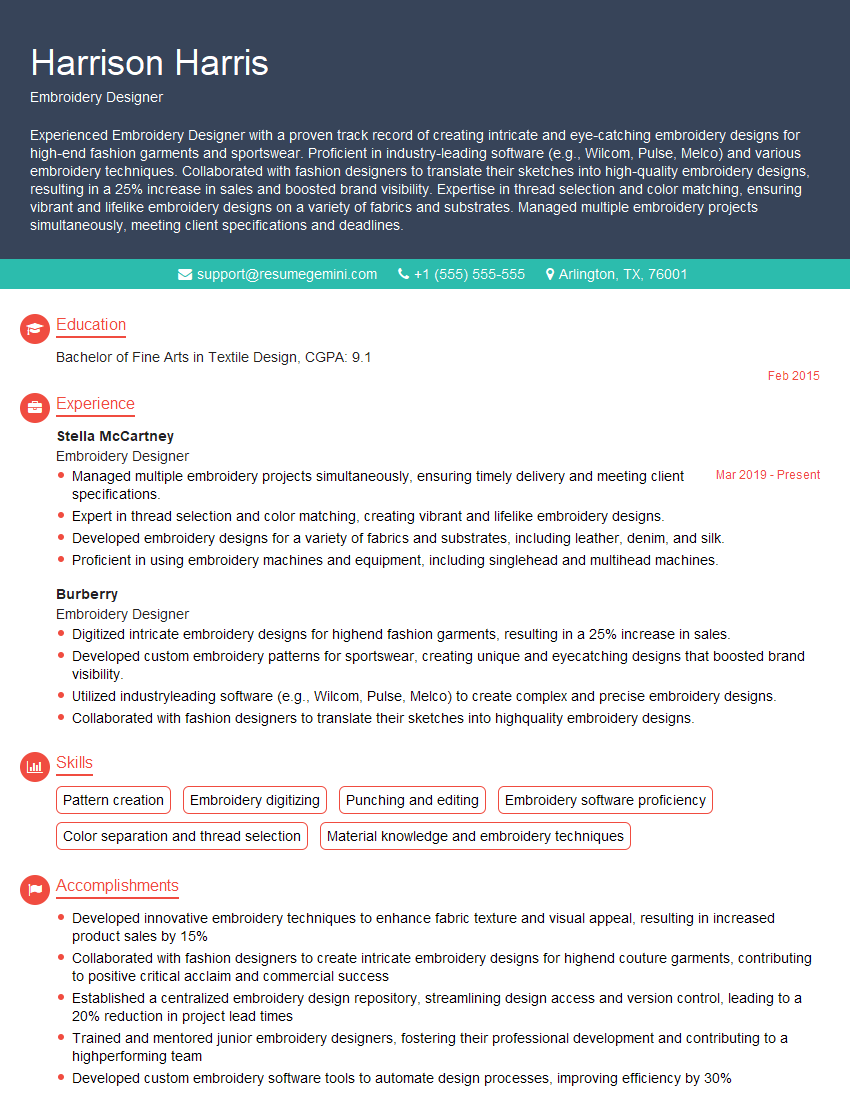
Mastering custom embroidery opens doors to exciting career opportunities, offering a blend of creativity and technical skill. To maximize your chances, create an ATS-friendly resume that highlights your relevant skills and experience. ResumeGemini is a trusted resource to help you build a professional and impactful resume that catches the eye of recruiters. Examples of resumes tailored to the custom embroidery field are available to help you get started.


Explore more articles
Users Rating of Our Blogs
Share Your Experience
We value your feedback! Please rate our content and share your thoughts (optional).
What Readers Say About Our Blog
Very informative content, great job.
good