Interviews are more than just a Q&A session—they’re a chance to prove your worth. This blog dives into essential Custom Shoemaking interview questions and expert tips to help you align your answers with what hiring managers are looking for. Start preparing to shine!
Questions Asked in Custom Shoemaking Interview
Q 1. Describe your experience with various leather types and their suitability for different shoe styles.
Selecting the right leather is crucial for a shoe’s longevity, comfort, and aesthetic appeal. Different leathers possess unique characteristics in terms of durability, suppleness, texture, and appearance. My experience encompasses a wide range, from the robust full-grain hides ideal for durable work boots to the delicate calfskin perfect for elegant dress shoes.
- Full-grain leather: The strongest and most durable, with a natural, pebbled texture. Excellent for boots, brogues, and other sturdy styles.
- Top-grain leather: A smoother, more uniform surface than full-grain, but still quite durable. Suitable for a broad range of styles, including loafers and oxfords.
- Corrected-grain leather: A more processed leather with a consistent, smooth surface. Often used in more affordable shoes but can be less durable.
- Suede: A soft, napped leather, offering a luxurious feel. Best for casual shoes or boots, requiring careful maintenance.
- Patent leather: A glossy, lacquered leather, adding a sleek, high-shine finish. Popular for formal shoes and evening wear. However, less breathable and requires more specialized care.
For example, I recently crafted a pair of bespoke riding boots using premium full-grain leather for its exceptional strength and water resistance, while a recent client’s bespoke oxfords were made from supple calfskin for its elegant appearance and comfortable feel. The choice of leather always depends on the intended use and aesthetic preferences of the client.
Q 2. Explain the process of creating a shoe last from a foot tracing.
Creating a shoe last, the three-dimensional model of a foot, is a crucial step in custom shoemaking that ensures a precise fit. The process starts with a detailed foot tracing, capturing the contours and measurements of the client’s foot.
- Taking the tracing: The client’s foot is traced onto a large sheet of paper, marking key points like the heel, ball, and toes.
- Creating the model: Using this tracing as a base, a three-dimensional model is constructed, typically using a combination of plaster, wood, or specialized foam materials. This step involves shaping and refining the model to mimic the foot’s unique form.
- Refinement and adjustment: The model is often refined based on trial fittings of the client’s foot, ensuring proper support, comfort, and the desired fit across different areas of the foot.
- Finalizing the last: Once the fit is perfected, the last is carefully finished, smoothed, and prepared for the shoemaking process. This might include adding heel supports and other features.
Think of it like sculpting. We’re not just making a copy, we’re crafting a unique form tailored to the client’s individual anatomy.
Q 3. How do you ensure a precise fit during the shoemaking process?
Achieving a precise fit is paramount in custom shoemaking. It involves a combination of meticulous measurements, careful last making, and precise pattern cutting.
- Detailed Measurements: We start with comprehensive foot measurements, considering not only length and width but also the arch height, instep, and heel shape. This is crucial for proper last construction.
- Last Fitting: Multiple fittings are conducted throughout the process. This allows for adjustments to the last and patterns, ensuring comfort and eliminating pressure points.
- Pattern Making & Adjustments: Patterns are created based on the last shape and are meticulously adjusted after each fitting to fine-tune the fit further.
- Trial fitting with uppers: Before final assembly, the uppers (the visible part of the shoe) are fitted on the last, and adjustments are made to ensure a snug and comfortable fit before lasting (attaching the upper to the last).
For example, a client might have a higher instep than usual. Through careful measurement and fitting, I would adjust the pattern to accommodate this, preventing discomfort and ensuring a perfect fit. This iterative process ensures the final product matches the customer’s expectations and needs.
Q 4. What are the common challenges in pattern making for custom shoes?
Pattern making for custom shoes is a complex process, and several challenges can arise. One major challenge lies in translating the three-dimensional form of the last into accurate two-dimensional patterns.
- Irregular foot shapes: Feet are rarely perfectly symmetrical, and unusual shapes require careful consideration during pattern creation to avoid distortions or ill-fitting areas in the finished shoe.
- Complex designs: Intricate designs or decorative elements can complicate pattern making, demanding precision and attention to detail to ensure they fit seamlessly into the shoe’s structure.
- Material stretch and shrinkage: Different leathers stretch and shrink differently during the shoemaking process. Accurately accounting for this behavior during pattern creation is crucial to avoid fit issues in the finished shoe.
- Symmetry and balance: Ensuring that both shoes are identical and balanced, maintaining consistent shaping throughout the process.
For instance, designing a shoe with a unique asymmetrical detail requires additional care to ensure that the pattern reflects this design without distorting the overall fit. Overcoming these challenges relies heavily on experience, technical skill, and a deep understanding of leather properties.
Q 5. Describe your experience with different stitching techniques and their applications.
Stitching is an essential aspect of shoemaking, impacting both the shoe’s durability and its aesthetic appeal. My experience covers various techniques, each with its own strengths and applications.
- Hand-stitching: A traditional method offering exceptional durability and precision. Commonly used for Goodyear welting, visible stitching adds a bespoke touch.
- Machine stitching: Used for faster production and specific components. While less personalized, machine stitching offers consistency and efficiency.
- Blind stitching: A technique where the stitching is hidden, creating a clean, seamless appearance, ideal for delicate areas or when a less visible stitch is preferred.
- Saddle stitching: A strong, decorative stitch used for specific details or for certain kinds of shoes that use multiple pieces of leather. A very popular stitch for higher-end shoes.
For example, I utilize hand-stitching for the Goodyear welt construction of my high-end shoes, as it provides unparalleled strength and a beautiful aesthetic detail. Conversely, for interior seams where appearance is less critical, machine stitching may be more efficient. Selecting the optimal stitching technique is always determined by the specific needs of the project.
Q 6. How do you handle customer requests for unconventional designs or materials?
Handling unconventional designs and materials is a rewarding part of custom shoemaking. It’s an opportunity to push creative boundaries and translate the client’s vision into reality.
The process involves careful consideration of various factors:
- Material feasibility: Assessing the suitability of the chosen material for shoe construction. Some materials may be too delicate, too inflexible, or otherwise unsuitable for certain applications.
- Design feasibility: Evaluating the structural integrity and practicality of the design. Highly complex designs may require additional planning and construction techniques.
- Construction adaptations: Adapting standard construction techniques to accommodate the unique properties of the materials or design elements. This may involve developing new patterns or modifying existing ones.
- Collaboration: Maintaining open communication with the client, providing input and advice while respecting their creative vision.
For example, a client recently requested shoes made with reclaimed wood and leather. While challenging, it sparked a creative journey of exploration. Through meticulous planning and adapting traditional shoemaking techniques, I successfully produced a unique and highly satisfying pair of shoes.
Q 7. Explain the process of constructing a Goodyear welted shoe.
The Goodyear welt construction is a sophisticated method known for its durability and repairability. It’s a hallmark of high-quality, bespoke footwear. The process is intricate but can be broken down into key steps:
- Lasting: The upper is carefully attached to the last.
- Welt stitching: A welt (a strip of leather) is stitched to both the upper and the insole. This forms a channel, creating a strong connection between the upper and sole.
- Sole attaching: The outsole is attached to the welt, typically using a stitching machine.
- Edge finishing: The edges of the welt and outsole are finished to create a neat, clean appearance.
- Heel attaching: A heel is attached to the outsole, ensuring structural stability and comfort.
The Goodyear welt construction creates a durable, repairable shoe. The welt acts as a buffer, protecting the stitching from wear, and the construction allows for resoling and other repairs, extending the shoe’s lifespan significantly. It’s a testament to the craft and represents a superior level of quality and longevity.
Q 8. How do you measure and assess a customer’s foot for custom shoemaking?
Accurately measuring a customer’s foot for custom shoemaking is paramount. It’s not just about length; we need a comprehensive understanding of the foot’s shape, width, arch height, and any other unique characteristics. We begin with a detailed tracing of both feet, using a specialized measuring device that accounts for weight distribution. This isn’t a one-size-fits-all approach; I also assess the foot’s shape while the customer is standing, observing the weight bearing points and any potential pressure areas. We then take several key measurements including:
- Length: From the heel to the longest toe.
- Width: At the widest part of the forefoot.
- Ball girth: Circumference across the ball of the foot.
- Heel girth: Circumference around the heel.
- Instep height: The height of the arch.
These measurements are meticulously recorded, and I often take photos for future reference. This detailed process ensures that the lasts (the wooden or plastic forms used to build the shoes) accurately represent the customer’s unique foot structure, leading to a comfortable and well-fitting shoe. For instance, a customer with a high arch will require a last with more pronounced arch support, whereas someone with flat feet will need a different construction altogether. Each foot is unique and requires individual assessment; I often find that even a pair of feet will have slight asymmetries that demand attention.
Q 9. What are the key differences between bespoke and ready-to-wear shoes?
Bespoke and ready-to-wear shoes represent distinct ends of the spectrum in shoemaking. Ready-to-wear shoes are mass-produced, using standard sizes and lasts. Think of your average shoe from a department store – they fit a general range of foot shapes but rarely perfectly. Bespoke shoes, on the other hand, are entirely customized from start to finish. Each pair is made specifically to a customer’s individual foot measurements, and often their personal preferences regarding style and materials are also incorporated.
- Bespoke: Involves multiple fittings, detailed measurements, and complete customization of every aspect, from last construction to leather selection and stitch patterns. It’s a collaborative process focused on achieving a perfect fit and reflecting the customer’s personal style.
- Ready-to-wear: Offers convenience and affordability but sacrifices the perfect fit and level of personalization offered by bespoke shoes.
The key difference lies in the level of personalization and fit. A bespoke shoe fits like a second skin, offering unparalleled comfort and support, whereas a ready-to-wear shoe may require compromises in fit and comfort. The price difference significantly reflects the time, skill, and personalized attention required for bespoke creation.
Q 10. How do you maintain the quality and consistency of your work?
Maintaining quality and consistency in custom shoemaking relies heavily on meticulous attention to detail at every stage. This begins with the selection of high-quality materials – premium leathers, carefully sourced threads, and durable sole materials. I use precise hand tools and techniques passed down through generations of shoemakers, ensuring consistent craftsmanship. My workspace is meticulously organized to maintain efficiency and reduce the risk of error. Regular maintenance of my tools and machinery is crucial. Beyond the physical process, I also keep a detailed record of each project. This includes client measurements, chosen materials, and specific construction notes. This documentation ensures consistency and allows me to refine my techniques and processes over time. Finally, continuous learning and skill development are critical. I stay updated on new techniques, materials, and industry best practices, ensuring my skills remain sharp and my creations consistently reflect the highest standards.
Q 11. Describe your experience with different sole materials and their properties.
My experience with different sole materials has shaped my understanding of their unique properties. Leather soles, for example, are highly durable and offer excellent comfort. They conform to the foot over time, providing a natural, supple feel. However, they are less water-resistant than other options. Leather soles require careful maintenance and are typically best suited for dry conditions.
Rubber soles offer superior water resistance and durability. They are ideal for everyday wear and provide exceptional grip and protection against wear and tear. However, they are not as flexible as leather and may not provide the same level of comfort for extended periods. Different types of rubber also offer varying degrees of flexibility and cushioning. For instance, a high-quality rubber compound provides better cushioning and shock absorption compared to a cheaper alternative.
Other materials like cork, wood, or even composite materials offer different benefits and challenges. Each has its own characteristics in terms of flexibility, durability, water resistance, and overall feel. The choice of sole material significantly impacts the overall performance, durability, and comfort of the finished shoe; therefore, material selection is guided by the intended use and the client’s preferences.
Q 12. What are the common issues that can arise during the lasting process?
The lasting process—attaching the upper to the last—is a critical and potentially problematic stage. Common issues include wrinkles in the upper leather, particularly around the toe box and vamp. These wrinkles can be caused by inadequate stretching or shaping of the leather during the preparation stages. Another common issue is uneven tension on the upper, resulting in a distorted or asymmetrical shape. This can stem from improper application of adhesive or insufficient skill in stretching and aligning the leather onto the last. Additionally, poor-quality lasts or damage to the lasts during the lasting process can affect the final form and fit of the shoe. In some cases, the leather might be too stiff or the last not properly prepared causing a poor fit which then causes issues in the stretching process. Addressing these issues involves careful attention to detail at each step, thorough leather preparation, and the skill to apply proper tension and alignment.
Q 13. How do you troubleshoot problems related to fit or structural issues?
Troubleshooting fit or structural issues requires a methodical approach. If a shoe is too tight in the toe box, for instance, it could be addressed by carefully stretching the leather in that specific area using specialized tools and techniques, or even by re-shaping the last. If the shoe is too loose, potential adjustments include adding padding or shims at specific pressure points within the shoe. Structural problems, such as uneven balance, often result from errors in the lasting process. These issues might necessitate partial or even complete re-lasting, ensuring that the upper is properly shaped and aligned to the last. Careful inspection and diagnosis are crucial. Analyzing pressure points through visual assessment and client feedback helps to determine the necessary adjustments or repairs.
Q 14. Explain the importance of proper finishing techniques in custom shoemaking.
Proper finishing techniques are the final touch that elevates a custom shoe from good to exceptional. It involves multiple stages, starting with edge finishing, where the raw edges of the leather are carefully trimmed, smoothed, and painted to prevent fraying and enhance the overall appearance. Next is the polishing and shining of the leather, which not only enhances the shine but also provides protection from scuffs and water damage. Finally, the sole is finished and attached perfectly, often involving careful stitching and adding a heel tap for added protection. These seemingly minor details significantly impact the shoe’s durability, water resistance, and overall aesthetic appeal. A well-finished shoe is not just comfortable and functional; it’s a testament to the craftsmanship and dedication involved in its creation. A sloppy finish can dramatically detract from even the most meticulously crafted shoe.
Q 15. What is your experience with different types of shoe heels and their construction?
Shoe heels are a crucial element of footwear design, impacting both aesthetics and functionality. My experience encompasses a wide range of heel types, from the classic stiletto to the sturdy block heel, and even more bespoke designs. The construction varies significantly depending on the heel’s style and intended use.
- Stiletto Heels: These are characterized by their slender, tapered shape. Construction often involves a metal shank for strength and durability, layered with leather or other covering materials meticulously shaped and glued in place. The delicate nature requires precision and expertise.
- Block Heels: These provide greater stability and comfort compared to stilettos. They’re typically constructed from solid wood, plastic, or even stacked leather, making them robust and less prone to breakage. The shaping is simpler but requires careful attention to evenness and alignment.
- Cone Heels: A hybrid between stiletto and block, offering a balance between elegance and practicality. Construction often mirrors that of stiletto heels but with a wider base for added stability.
- Wedge Heels: These encompass the entire sole’s underside. The construction can be quite complex, often requiring multiple layers of materials shaped and meticulously joined to create a seamless and comfortable underfoot experience.
Beyond the basic types, I’ve worked with custom heel designs incorporating unique materials like sculpted wood, carved bone, or even recycled materials. Each construction method requires a different approach, emphasizing meticulous craftsmanship and a deep understanding of materials.
Career Expert Tips:
- Ace those interviews! Prepare effectively by reviewing the Top 50 Most Common Interview Questions on ResumeGemini.
- Navigate your job search with confidence! Explore a wide range of Career Tips on ResumeGemini. Learn about common challenges and recommendations to overcome them.
- Craft the perfect resume! Master the Art of Resume Writing with ResumeGemini’s guide. Showcase your unique qualifications and achievements effectively.
- Don’t miss out on holiday savings! Build your dream resume with ResumeGemini’s ATS optimized templates.
Q 16. How do you manage your time and prioritize tasks in a busy shoemaking environment?
Time management is paramount in a custom shoemaking environment. My approach relies on a structured system combining meticulous planning with flexible adaptation.
- Detailed Project Planning: Each commission starts with a detailed breakdown of the process, outlining individual steps, estimated timeframes, and necessary materials. This provides a roadmap to guide my work.
- Prioritization Matrix: I use a prioritization matrix to rank tasks based on urgency and importance. Urgent and important tasks, like meeting tight deadlines for a wedding shoe order, are tackled first.
- Batching Similar Tasks: I group similar tasks together to optimize workflow. For example, I’ll complete all the stitching for multiple projects before moving on to sole attaching. This minimizes the setup time and boosts overall efficiency.
- Timeboxing: Allocating specific time blocks to particular tasks helps me stay focused and prevents scope creep. This approach prevents me from getting bogged down in one area, ensuring I meet all deadlines.
- Regular Evaluation and Adjustment: I regularly review my progress and adapt my schedule as needed. Unexpected delays or changes in client requirements necessitate flexibility and quick problem-solving.
Think of it like conducting a symphony – each instrument (task) needs to play its part at the right time for a harmonious outcome (finished shoe). Constant monitoring and adjustments ensure the final piece is perfect.
Q 17. Describe your experience with using specialized shoemaking tools and equipment.
My expertise encompasses a vast array of specialized shoemaking tools and equipment, ranging from hand tools to power machinery. Proficiency in these tools is crucial for producing high-quality footwear.
- Hand Tools: I’m adept at using various hand tools, including awls, stitching groovers, hammers, lasts (forms for shaping the shoes), and various knives for cutting leather and other materials. Precision and dexterity are key to using these tools effectively.
- Power Tools: I have extensive experience using machinery such as sewing machines (both industrial and specialized), skiving machines (for thinning leather), and edge finishing machines. These tools significantly improve efficiency and allow for greater precision.
- Specialized Molds and Lasts: I possess a wide collection of lasts to accommodate diverse foot shapes and sizes. The ability to select the appropriate last is crucial for creating comfortable and well-fitting shoes.
Working with these tools requires both technical skill and a deep understanding of material properties. For instance, understanding the appropriate pressure and speed for various sewing machines prevents damage to delicate materials. Each tool contributes to the overall craftsmanship, and a proficient shoemaker knows how to wield them all with precision and finesse.
Q 18. How do you stay updated with the latest trends and advancements in shoemaking?
Staying current in the dynamic world of shoemaking is crucial. My strategy incorporates multiple avenues to ensure I’m at the forefront of industry developments.
- Industry Publications and Trade Shows: I regularly read specialized shoemaking magazines and attend relevant trade shows to keep abreast of the latest materials, techniques, and design trends. These events often feature demonstrations and workshops, providing invaluable hands-on learning.
- Online Communities and Forums: I actively participate in online shoemaking communities and forums, engaging in discussions with other professionals and sharing knowledge. This collaborative learning environment allows me to learn from others’ experiences.
- Workshops and Masterclasses: I continually seek out opportunities to enhance my skills through workshops and masterclasses led by renowned shoemakers. This direct learning from experts broadens my skillset and exposes me to innovative approaches.
- Experimentation and Research: I actively experiment with new materials and techniques in my own practice, constantly pushing the boundaries of my craft. This allows me to assess the efficacy of new methods firsthand and incorporate them into my work.
Continual learning is integral to my craft; it’s not merely about keeping up but about actively shaping the future of custom shoemaking.
Q 19. Explain the process of repairing damaged shoes.
Shoe repair requires a keen eye for detail and a methodical approach. The repair process varies greatly depending on the extent and type of damage.
- Assessment of Damage: The first step is a thorough inspection to determine the type and severity of the damage. This includes examining the sole, upper, heel, and stitching for wear, tears, or structural issues.
- Material Selection: Appropriate materials must be selected to match the original shoe’s composition as closely as possible. This ensures a seamless repair that maintains the integrity of the shoe.
- Repair Techniques: Different repair methods are employed depending on the specific damage. This could include stitching, patching, re-soling, heel replacement, or even reshaping. Specialized glues and adhesives are crucial for strong and lasting repairs.
- Finishing Touches: Once the repair is complete, finishing touches such as polishing, conditioning, or applying protective coatings ensure a durable and aesthetically pleasing result.
Repairing a damaged shoe often involves creative problem-solving, combining technical skill with artistic flair. For example, repairing a torn leather upper might involve carefully stitching in a patch of matching leather, ensuring the repair is both functional and nearly invisible.
Q 20. How do you handle customer feedback and address concerns about the finished product?
Customer feedback is invaluable in refining my craft and ensuring client satisfaction. I actively solicit and address all feedback, both positive and negative.
- Open Communication: I maintain open communication with clients throughout the entire process, from initial consultation to final delivery. This ensures transparency and addresses potential concerns proactively.
- Feedback Mechanisms: I utilize various feedback channels, such as in-person meetings, email correspondence, and post-delivery surveys, to gather feedback on the finished product.
- Addressing Concerns: Any concerns or issues are addressed promptly and professionally. Depending on the nature of the issue, this might involve making adjustments to the shoe, offering a partial refund, or providing a replacement.
- Continuous Improvement: I carefully analyze all feedback to identify areas for improvement in my design process, craftsmanship, or customer service. This feedback loop is critical for my continued growth as a shoemaker.
Positive feedback is rewarding, confirming that my work meets client expectations. However, constructive criticism is equally important, highlighting areas for refinement and demonstrating a commitment to continuous improvement.
Q 21. What are the key considerations for designing shoes for different foot types and sizes?
Designing shoes for different foot types and sizes requires a deep understanding of human anatomy and biomechanics. Key considerations include:
- Foot Shape and Width: Different individuals have varying foot shapes (e.g., narrow, medium, wide) and widths. Custom shoemaking accounts for this by using appropriately sized lasts and employing construction techniques that cater to specific needs.
- Arch Height: The height of the foot’s arch significantly impacts comfort. Shoe designs must consider this to provide adequate support and prevent discomfort or injury.
- Foot Length and Proportions: Accurate measurements are crucial for creating shoes that fit properly. This involves precise measurements of foot length, width, and arch height to ensure a comfortable fit.
- Material Selection: The choice of materials significantly impacts comfort and durability. Materials such as leather and suede provide flexibility and breathability, while others offer more support or waterproofing properties, tailored to the needs of different foot types and expected use.
- Construction Techniques: Construction methods should be tailored to the needs of different foot types. For example, shoes designed for high arches require additional support, while those for flat feet might need more cushioning in the insole.
Creating a comfortable and functional shoe requires a meticulous approach and a deep understanding of how different foot structures interact with the shoe’s design. It’s like building a custom house – it’s not just about the aesthetics, but also about ensuring the structure is functional and supportive for the intended occupant.
Q 22. Describe your experience with working with different types of shoe closures (e.g., laces, buckles, straps).
My experience with shoe closures is extensive, encompassing a wide range of techniques and materials. I’ve worked with everything from classic leather laces – where understanding the appropriate thickness and stiffness for different shoe styles is crucial – to intricate buckle systems, including those requiring precise hand-tooling for custom-fitted straps. I’m also proficient with a variety of strap styles, from simple single straps to more complex multi-strap designs that demand attention to both functionality and aesthetic appeal. For example, I recently crafted a bespoke pair of riding boots with a unique, adjustable buckle closure system that allowed for a truly personalized fit. The client’s feedback was extremely positive, highlighting both the comfort and the elegant design.
Beyond the traditional methods, I’ve explored more innovative closures like magnetic clasps and hidden zippers, integrating them seamlessly into the overall design for a clean, modern aesthetic. Each closure type requires a different approach – from the precise placement of eyelets for laces to the meticulous stitching required for strong and durable straps. The choice of closure is always guided by the overall design and the client’s preferences, ensuring both function and form are perfectly balanced.
Q 23. How do you ensure the durability and longevity of your custom-made shoes?
Ensuring the durability and longevity of my custom-made shoes is paramount. It starts with the selection of high-quality materials – I source only the finest leathers, sourced from reputable tanneries known for their durability and longevity. I carefully consider the thickness and grain of the leather, choosing appropriate types for different parts of the shoe depending on the anticipated stress points. For example, I might use a tougher, more durable leather for the sole and heel areas compared to the upper.
Beyond materials, meticulous construction techniques are essential. I employ traditional Goodyear welting – a method known for its exceptional durability and repairability – whenever appropriate. This involves stitching the upper, insole, and outsole together, creating a strong and flexible construction that can withstand years of wear. I also pay close attention to details like reinforcing stress points with extra stitching and using high-quality adhesives. Regular quality checks throughout the construction process ensure that every stitch and every component is perfectly aligned and secured.
Finally, I advise clients on proper shoe care, providing guidance on cleaning, conditioning, and storage. This ensures that the shoes remain in top condition for many years.
Q 24. Describe your approach to quality control throughout the entire shoemaking process.
My quality control process is rigorous and multi-faceted, extending throughout the entire shoemaking process. It starts with the initial consultation, where I meticulously assess the client’s requirements and preferences. This ensures that the design is not only aesthetically pleasing but also functional and suitable for the intended purpose. I then create detailed sketches and patterns, ensuring precise measurements and proportions.
During the construction phase, I conduct regular quality checks at each stage. I inspect the cut leather for any imperfections, carefully examine stitching for consistency and strength, and regularly check the fit and alignment of the components. Any flaws are addressed immediately, ensuring that the highest standards are maintained throughout. Once the shoes are completed, a final inspection is carried out, including a rigorous assessment of comfort, durability, and overall aesthetic appeal. Only after passing this final inspection are the shoes deemed ready for delivery.
Furthermore, I regularly review my processes and seek feedback from clients to continuously improve my quality control procedures. This ongoing commitment to excellence is vital in maintaining the reputation of my bespoke shoemaking service.
Q 25. What is your experience with working in a team environment?
While much of my work is solitary and requires focused craftsmanship, I have significant experience working collaboratively in team environments. In my previous role at a high-end shoe manufacturing company, I was part of a team comprising pattern makers, leather cutters, stitchers, and finishers. This experience honed my ability to effectively communicate design specifications, collaborate on complex projects, and contribute to a shared goal of producing high-quality footwear. I learned the importance of clear communication, teamwork, and mutual respect among colleagues.
I value teamwork because it allows for the efficient division of labor, bringing diverse skills and perspectives together to achieve the best possible results. The collaborative nature of bespoke shoemaking is often essential, particularly when dealing with intricate designs or bespoke requests requiring specialized skills. I’m comfortable leading a team, delegating tasks, and providing constructive feedback. I’m confident that I can effectively integrate into any team environment, contributing my skills and expertise while fostering a positive and productive atmosphere.
Q 26. What software or design tools are you familiar with?
I’m proficient in several software and design tools crucial for modern shoemaking. My expertise includes CAD (Computer-Aided Design) software, specifically programs like Rhino 3D and Autodesk Fusion 360 for 3D modeling and pattern making. These programs allow me to create accurate and detailed patterns, ensuring a precise fit and flawless construction. I also utilize digital imaging software, like Adobe Photoshop and Illustrator, to refine designs, create detailed visual representations for clients, and manage digital archives of my work.
Beyond digital tools, I’m adept at using traditional methods like creating hand-drawn patterns and utilizing specialized shoemaking software for grading and pattern manipulation. My skills extend beyond digital proficiency to include a deep understanding of traditional techniques, enabling me to effectively integrate both approaches for optimal results.
Q 27. Explain your understanding of the costs involved in producing custom shoes.
Understanding the costs involved in producing custom shoes is critical. The costs are multifaceted and depend on several factors, primarily the materials used, the complexity of the design, and the time investment required. High-quality leathers can significantly impact the overall cost, as can intricate detailing, such as hand-tooled designs or bespoke embellishments.
Labor costs are another significant component. The time involved in crafting a bespoke pair of shoes – from initial design consultation and pattern making through to the final finishing touches – can be substantial. Highly skilled craftsmanship commands a premium. Additional costs can include the sourcing of specific materials, specialized tools and equipment, and any external services like custom tooling or finishing techniques.
Therefore, accurate cost estimation requires a detailed breakdown of each element of the process. I typically provide clients with transparent and detailed quotes, explaining each cost component, ensuring transparency and mutual understanding. This approach builds trust and ensures that both the client and I are aligned on expectations.
Q 28. How would you handle a situation where a customer requests an unreasonable modification or alteration?
Handling unreasonable requests requires a delicate balance of professionalism and firmness. My approach focuses on open communication and a collaborative problem-solving strategy. I would begin by actively listening to the client, seeking to understand their underlying needs and motivations. I might ask clarifying questions to ensure that I fully comprehend their request and to identify any potential misunderstandings.
If the request is truly unreasonable – for example, a modification that compromises the structural integrity of the shoe or significantly deviates from established craftsmanship principles – I would explain the potential consequences in a calm and professional manner, offering alternative solutions that address the client’s underlying needs while maintaining the quality and integrity of the shoe. This might involve suggesting a compromise, exploring alternative design options, or providing technical reasoning to support my recommendations.
In cases where a compromise cannot be reached, I would clearly and respectfully explain the limitations and politely decline the request, while maintaining a professional and understanding demeanor. Maintaining a client-centric approach is key, even when dealing with difficult situations. The goal is to find a mutually satisfactory resolution that upholds the high standards of my craftsmanship and preserves the professional relationship.
Key Topics to Learn for Your Custom Shoemaking Interview
- Last Construction: Understanding different last types (e.g., Goodyear welt, Blake stitch, cemented construction), their advantages, disadvantages, and suitability for various shoe styles. Practical application: Explain how you would choose the appropriate last for a specific customer request, considering factors like comfort and durability.
- Pattern Making & Grading: Mastering the creation and adjustment of shoe patterns to accommodate different foot shapes and sizes. Practical application: Describe your process for adapting a pattern to create a perfect fit for a challenging foot.
- Material Selection: Knowledge of various leathers, soles, and other materials used in shoemaking, including their properties, care, and appropriate uses. Practical application: Justify your choice of materials for a specific shoe design, considering factors like cost, aesthetics, and durability.
- Shoemaking Techniques: Proficiency in various hand and machine stitching techniques, lasting, finishing, and other crucial processes. Practical application: Detail your experience with specific techniques, highlighting any specialized skills or problem-solving approaches.
- Measurement & Fitting: Accurately measuring feet and understanding different foot types and common fitting challenges. Practical application: Explain how you would address a client’s unique foot issues to ensure a comfortable and properly fitting shoe.
- Design & Aesthetics: Understanding shoe design principles, trends, and the ability to translate client vision into a functional and aesthetically pleasing design. Practical application: Describe your design process and how you incorporate client feedback.
- Business Acumen: Understanding pricing strategies, client communication, and managing a bespoke shoemaking business (if applicable). Practical application: Discuss how you would handle a difficult client or a complex order.
Next Steps
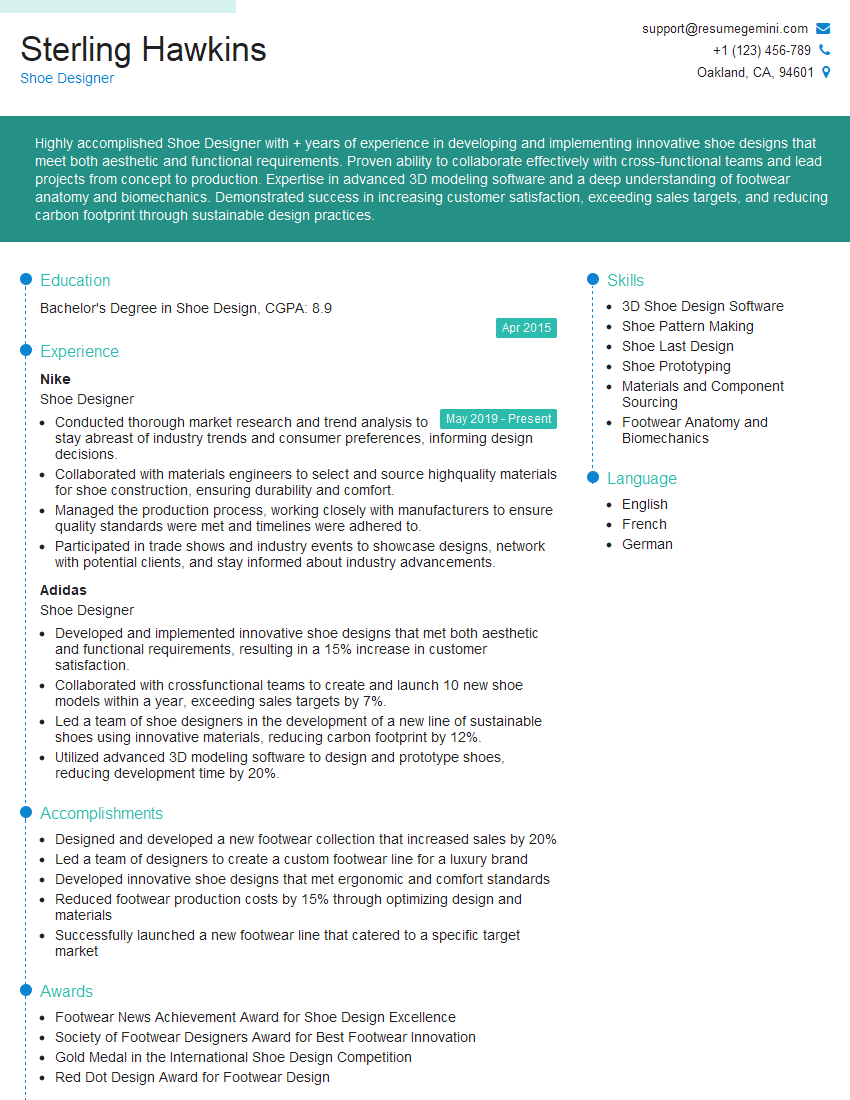
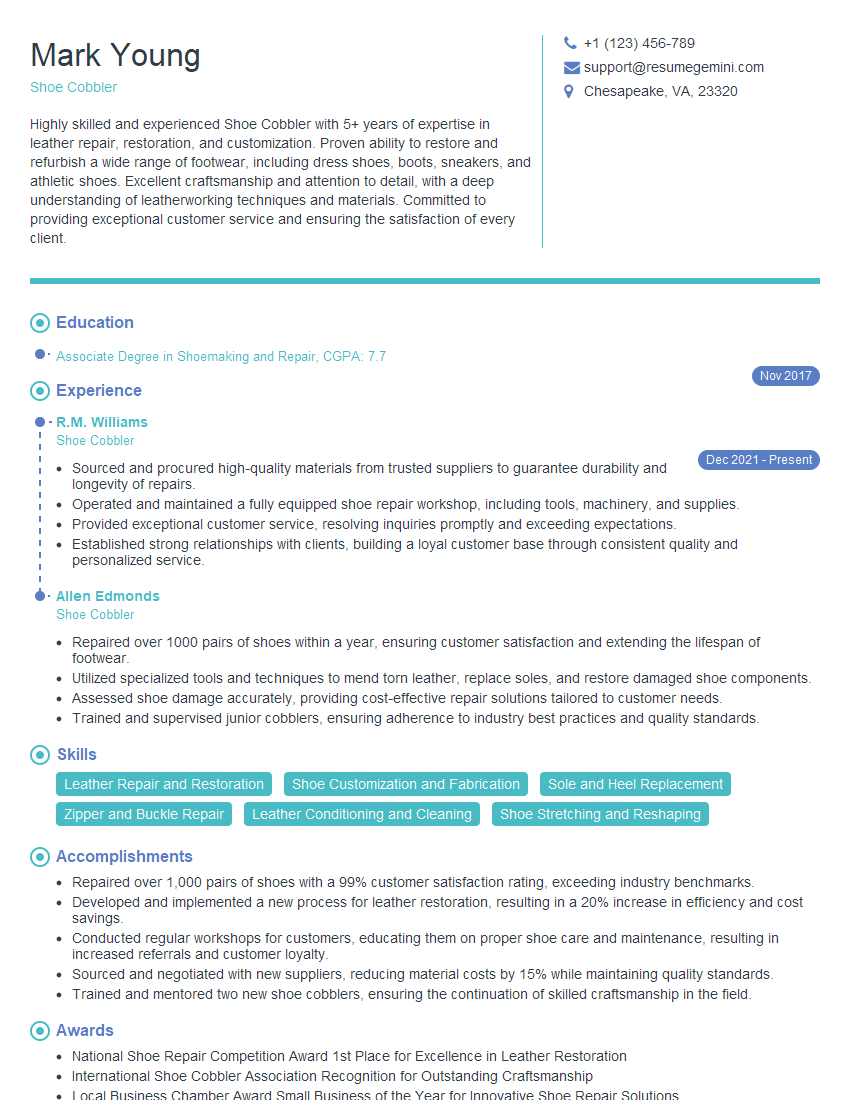
Mastering custom shoemaking opens doors to a fulfilling and rewarding career, offering opportunities for creative expression, technical expertise, and entrepreneurial ventures. To maximize your job prospects, crafting an ATS-friendly resume is crucial. This ensures your qualifications are effectively highlighted to potential employers. ResumeGemini is a trusted resource that can help you build a compelling and effective resume. They offer examples of resumes tailored specifically to the custom shoemaking industry, allowing you to showcase your skills and experience in the best possible light.


Explore more articles
Users Rating of Our Blogs
Share Your Experience
We value your feedback! Please rate our content and share your thoughts (optional).
What Readers Say About Our Blog
Very informative content, great job.
good