Every successful interview starts with knowing what to expect. In this blog, we’ll take you through the top Customer Experience Analysis interview questions, breaking them down with expert tips to help you deliver impactful answers. Step into your next interview fully prepared and ready to succeed.
Questions Asked in Customer Experience Analysis Interview
Q 1. Define Customer Experience (CX) and its key components.
Customer Experience (CX) encompasses the entirety of a customer’s interaction with a company, product, or brand. It’s not just about a single transaction but the cumulative effect of all touchpoints across the customer journey. A positive CX leads to loyalty, advocacy, and ultimately, business success.
- Touchpoints: All points of contact – website, app, social media, customer service, in-store experience, etc.
- Emotions: The feelings a customer experiences at each touchpoint (e.g., frustration, satisfaction, delight).
- Memories: The lasting impressions and overall perception formed after each interaction.
- Loyalty: The likelihood of a customer returning for future interactions.
- Advocacy: Whether a customer actively recommends the company to others.
Think of it like this: you might have a great product (UX), but if the customer service is terrible, your overall CX suffers.
Q 2. Explain the difference between UX and CX.
While both UX and CX focus on the customer, they address different aspects. User Experience (UX) focuses on the usability and satisfaction of a specific product or service, usually a digital product like a website or app. It deals with the interaction design, information architecture, and visual appeal. Customer Experience (CX) is broader, encompassing all interactions a customer has with a brand across multiple channels, from initial awareness to post-purchase support.
Example: A company might have excellent UX on its website (easy navigation, attractive design – the UX part), but poor CX due to slow delivery times and unhelpful customer service (the CX part). UX is a subset of CX.
Q 3. Describe the customer journey mapping process.
Customer journey mapping is a visual representation of the customer’s interaction with your business, from initial awareness to post-purchase engagement. It’s a crucial tool for understanding customer needs and identifying pain points. The process typically involves these steps:
- Identify your key customer segments: Define the different types of customers you serve.
- Determine the stages of the customer journey: Map out the steps a customer takes from awareness to loyalty (e.g., awareness, consideration, purchase, retention).
- Gather data: Use surveys, interviews, analytics, and feedback to understand customer behavior and pain points at each stage.
- Create a visual map: Use tools like Miro or Mural to visually represent the journey, highlighting touchpoints and emotions at each stage.
- Analyze the map: Identify opportunities for improvement, such as streamlining processes or improving communication.
- Develop solutions: Based on your analysis, implement strategies to enhance the customer experience.
A well-crafted journey map allows you to identify areas for improvement, enhance customer satisfaction and boost loyalty.
Q 4. What are three key metrics you would use to measure CX?
Three key metrics for measuring CX are:
- Customer Satisfaction (CSAT): Measures how satisfied customers are with a specific interaction or product. Often measured through post-interaction surveys with rating scales (e.g., 1-5 stars).
- Net Promoter Score (NPS): Measures customer loyalty and willingness to recommend a company. Based on a single question: “On a scale of 0-10, how likely are you to recommend [company] to a friend or colleague?”
- Customer Effort Score (CES): Measures how much effort customers have to expend to interact with a company. Lower scores indicate a better experience. Typical questions include: “How easy was it to…?”
These metrics, when used together, provide a holistic view of the customer experience, allowing businesses to identify areas for improvement.
Q 5. How do you identify and prioritize customer pain points?
Identifying and prioritizing customer pain points requires a multi-faceted approach:
- Analyze customer feedback: Examine surveys, reviews, social media comments, and support tickets to identify recurring negative comments or complaints.
- Conduct customer interviews: In-depth interviews can provide valuable qualitative data about customer frustrations and needs.
- Monitor website and app analytics: Track website bounce rates, task completion rates, and error rates to identify areas of friction in the digital experience.
- Use customer journey mapping: As discussed earlier, this helps visualize pain points across the entire customer journey.
Prioritization should be based on the impact and frequency of the pain point. Focus first on issues impacting the largest number of customers or those causing significant frustration.
Q 6. What tools and techniques do you use for CX analysis?
Several tools and techniques are used for CX analysis:
- Survey platforms: SurveyMonkey, Qualtrics, Typeform – for collecting quantitative and qualitative feedback.
- Social listening tools: Brandwatch, Talkwalker – for monitoring social media conversations and identifying customer sentiment.
- Web analytics platforms: Google Analytics, Adobe Analytics – for analyzing website and app usage patterns.
- CRM systems: Salesforce, HubSpot – for storing and analyzing customer interaction data.
- Customer journey mapping software: Miro, Mural – for collaborative customer journey mapping.
- Text analytics software: For analyzing unstructured data like surveys and reviews to uncover themes and sentiment.
The choice of tools depends on the specific needs and resources of the organization.
Q 7. How do you translate customer feedback into actionable insights?
Translating customer feedback into actionable insights requires a structured approach:
- Organize and categorize feedback: Group similar comments and complaints together to identify recurring themes.
- Analyze sentiment: Determine the overall positive or negative sentiment expressed in the feedback.
- Identify root causes: Dig deeper to understand the underlying reasons for customer dissatisfaction.
- Prioritize issues: Focus on addressing the most impactful and frequent pain points.
- Develop solutions: Based on the analysis, create concrete plans to address the identified issues.
- Implement and test solutions: Make the necessary changes, monitor their impact, and iterate as needed.
- Communicate updates: Let customers know about implemented changes and improvements.
This systematic approach ensures that customer feedback is not just collected but also utilized effectively to improve the customer experience.
Q 8. Describe your experience with qualitative and quantitative data analysis in CX.
Customer experience (CX) analysis thrives on both qualitative and quantitative data. Quantitative data provides the ‘what’ – measurable metrics like website traffic, conversion rates, and survey scores. Qualitative data reveals the ‘why’ – the underlying reasons behind those numbers, through customer interviews, feedback comments, and social media sentiment analysis.
Example: Let’s say a company sees a drop in online sales (quantitative). Qualitative data, such as customer interviews, might reveal the website’s navigation is confusing or that product descriptions are unclear. This combination allows for a complete understanding of the problem, leading to effective solutions.
In my experience, I’ve used quantitative methods like statistical analysis of survey data to identify key areas of improvement, and qualitative methods like thematic analysis of customer interviews to uncover nuanced customer needs and pain points. I’m proficient in using tools like SPSS and NVivo for these analyses.
Q 9. How do you measure the ROI of CX initiatives?
Measuring the ROI of CX initiatives requires a clear understanding of your initial investment and the subsequent impact on key business metrics. It’s not just about customer satisfaction; it’s about how improved CX translates to financial gains.
Steps to measure ROI:
- Define Key Performance Indicators (KPIs): Identify metrics directly linked to CX improvements, such as customer retention rate, average order value, customer lifetime value (CLTV), and Net Promoter Score (NPS).
- Establish Baseline Metrics: Measure these KPIs before implementing any CX initiatives to establish a benchmark.
- Track Changes: Monitor these KPIs after implementing your initiatives. Look for statistically significant improvements.
- Calculate ROI: Compare the increase in revenue or cost savings (benefits) against the cost of the CX initiatives (investment). ROI = (Benefits – Investment) / Investment.
Example: If a company invests $10,000 in a customer service training program, and this leads to a 5% increase in customer retention, resulting in an additional $50,000 in revenue, the ROI would be (($50,000 – $10,000) / $10,000) = 400%. This demonstrates a significant return on the investment.
Q 10. How would you handle conflicting customer feedback?
Conflicting customer feedback is common, and handling it effectively requires a systematic approach. It’s rarely a case of one feedback piece being ‘right’ and another ‘wrong’; instead, different perspectives highlight different aspects of the customer experience.
My approach:
- Identify Patterns: Look for recurring themes within the conflicting feedback. Are there multiple perspectives on a single issue? Are there different segments of customers expressing different needs?
- Qualitative Data Triangulation: If possible, cross-reference the feedback with other qualitative data points, such as observation data or user testing to gain a broader perspective.
- Quantitative Data Correlation: Analyze quantitative data to see if any trends support or contradict the conflicting feedback.
- Prioritize based on Impact: Determine which feedback points affect the largest number of customers or impact key business metrics the most.
- Develop Solutions that Address Multiple Perspectives: Focus on solutions that aim to satisfy the needs of as many customer segments as possible.
Example: Some customers complain a product is too complex, while others find it too simple. This suggests different user segments with varying levels of technical expertise. The solution might involve creating multiple versions of the product or providing detailed tutorials for different skill levels.
Q 11. Explain your experience with A/B testing in a CX context.
A/B testing is crucial in optimizing the CX. It involves creating two versions of a webpage, email, or other CX element (A and B) and presenting them to different segments of customers to see which version performs better.
In a CX context, A/B testing can be applied to:
- Website design: Comparing different layouts, button placements, and call-to-action designs.
- Email marketing: Testing different subject lines, email content, and call-to-action buttons.
- Onboarding flows: Testing different onboarding processes to optimize user engagement and retention.
My experience involves: Defining clear hypotheses, selecting appropriate metrics (e.g., click-through rate, conversion rate), ensuring sufficient sample size, and analyzing results using statistical significance tests. I have utilized various A/B testing platforms such as Optimizely and Google Optimize.
Example: Testing two different versions of a checkout page. Version A uses a simplified design, while Version B includes more detailed product information. By tracking the conversion rates of each version, we can determine which design leads to higher sales.
Q 12. How do you ensure your CX analysis is data-driven and objective?
Ensuring data-driven and objective CX analysis relies on a structured approach. Subjectivity can creep in, but rigorous methods help mitigate this.
My strategies:
- Clearly defined KPIs: Using specific, measurable, achievable, relevant, and time-bound (SMART) KPIs ensures objectivity. Avoid vague terms and rely on concrete numbers.
- Large and representative samples: Using sufficiently large samples and ensuring they represent the target customer population minimizes the influence of outliers.
- Statistical analysis: Using statistical methods helps identify significant trends and correlations, minimizing the influence of bias.
- Blind testing: Whenever possible, conducting blind tests eliminates bias from the researchers’ expectations.
- Transparency and auditability: Documenting the entire analysis process, including data collection methods, analysis techniques, and findings, ensures transparency and allows for auditing.
Example: Instead of relying on gut feeling about website usability, I’d use eye-tracking data and heatmaps (quantitative) combined with user interview feedback (qualitative) to provide objective insights into where users struggle on the website.
Q 13. What is your experience with Net Promoter Score (NPS)?
The Net Promoter Score (NPS) is a widely used metric that measures customer loyalty and satisfaction. It’s based on a single question: “On a scale of 0 to 10, how likely are you to recommend [company/product/service] to a friend or colleague?”
My experience with NPS includes:
- Survey design and implementation: Creating and distributing NPS surveys using various channels (email, in-app, etc.).
- Data analysis and segmentation: Analyzing NPS scores to identify trends, segmenting customers into promoters, passives, and detractors, and correlating NPS with other business metrics.
- Actionable insights: Using NPS data to identify areas for improvement and prioritize CX initiatives.
- Benchmarking and tracking: Tracking NPS over time to measure progress and compare performance against industry benchmarks.
Example: A low NPS score might indicate a problem with the product, customer service, or overall experience. By segmenting the detractors, we can identify their specific pain points and address them with targeted initiatives.
Q 14. How do you present your CX findings to stakeholders?
Presenting CX findings to stakeholders requires clear, concise communication that focuses on actionable insights. The presentation should be tailored to the audience’s level of understanding and their specific interests.
My approach involves:
- Storytelling: Framing the findings within a narrative that highlights key issues and the impact on business objectives.
- Data visualization: Using charts, graphs, and other visuals to communicate complex data effectively.
- Prioritized recommendations: Focusing on actionable recommendations, prioritizing those with the highest impact and feasibility.
- Interactive elements: Using interactive elements (if appropriate) to encourage engagement and discussion.
- Q&A session: Allowing time for questions and providing clear, concise answers.
Example: Instead of simply presenting a table of NPS scores, I would visually represent the score trends over time, highlight key segments, and link those trends to specific business outcomes (e.g., increased revenue, reduced churn). Then, I’d propose concrete solutions based on the findings.
Q 15. Describe your experience using customer feedback platforms.
My experience with customer feedback platforms spans a variety of tools, from simple survey platforms like SurveyMonkey and Typeform to more sophisticated solutions like Qualtrics and Medallia. I’ve used these platforms to design, deploy, and analyze feedback across various channels – email, in-app surveys, website pop-ups, and post-interaction feedback forms. My expertise extends beyond simply using the interface; I understand the importance of crafting effective survey questions, managing response rates, and interpreting the data to gain actionable insights. For example, in a previous role, we used Qualtrics to track customer satisfaction post-product launch. By analyzing the open-ended responses, we identified a recurring issue with the user interface, which allowed our development team to prioritize a critical bug fix, significantly improving customer satisfaction scores.
I also have experience integrating feedback platforms with CRM systems, allowing for a holistic view of the customer journey. This integration allows us to connect survey responses with customer profiles, helping to segment customers based on feedback and tailor our communication and service accordingly.
Career Expert Tips:
- Ace those interviews! Prepare effectively by reviewing the Top 50 Most Common Interview Questions on ResumeGemini.
- Navigate your job search with confidence! Explore a wide range of Career Tips on ResumeGemini. Learn about common challenges and recommendations to overcome them.
- Craft the perfect resume! Master the Art of Resume Writing with ResumeGemini’s guide. Showcase your unique qualifications and achievements effectively.
- Don’t miss out on holiday savings! Build your dream resume with ResumeGemini’s ATS optimized templates.
Q 16. What is your experience with customer segmentation?
Customer segmentation is crucial for delivering personalized experiences. My approach involves using a combination of quantitative and qualitative data to segment customers into meaningful groups. I typically utilize demographic data (age, location, income), behavioral data (purchase history, website activity, customer service interactions), and psychographic data (values, lifestyle, attitudes) gleaned from surveys and CRM systems. For instance, I once segmented customers based on their Net Promoter Score (NPS) responses, identifying ‘promoters,’ ‘passives,’ and ‘detractors.’ This allowed us to tailor communication and support strategies to each group; promoters received exclusive offers, passives received targeted engagement, and detractors received proactive intervention to address their concerns.
Furthermore, I utilize clustering techniques (like k-means clustering) to identify naturally occurring segments within the data. This approach is particularly useful when dealing with large datasets where pre-defined segmentations may not be sufficient.
Q 17. How do you identify and track key performance indicators (KPIs) for CX?
Identifying and tracking KPIs for CX requires a strategic approach. The KPIs should directly reflect business goals and should be measurable, actionable, and relevant. Some common KPIs include Customer Satisfaction (CSAT), Net Promoter Score (NPS), Customer Effort Score (CES), and resolution time for customer service issues. For example, we might track CSAT scores after each customer service interaction to assess the effectiveness of our support agents. Similarly, NPS can provide a long-term view of customer loyalty.
I also look beyond these standard metrics and focus on more nuanced KPIs, like customer lifetime value (CLTV) and customer churn rate, to gain a holistic understanding of customer health. I believe in setting targets for each KPI and regularly monitoring progress against those targets. This allows us to identify areas for improvement and to measure the impact of our CX initiatives. Regular reporting and dashboards are crucial for maintaining visibility of these KPIs across the organization.
Q 18. Describe your experience with different customer feedback collection methods.
I have extensive experience using diverse customer feedback collection methods. This includes:
- Surveys: I utilize various survey types (e.g., CSAT, NPS, CES surveys) designed to capture specific aspects of the customer experience. I carefully craft questions to be clear, concise, and unbiased, ensuring accurate and reliable data collection.
- Social Media Monitoring: Analyzing social media platforms to identify customer sentiment and uncover emerging issues or trends is critical. This provides valuable qualitative insights not always captured through traditional methods.
- Customer Interviews: Conducting in-depth interviews allows for richer, more detailed understanding of customer experiences, particularly when exploring the ‘why’ behind feedback.
- Focus Groups: Facilitating group discussions provides a collaborative space for gathering diverse perspectives and uncovering shared experiences.
- Usability Testing: Observing customers interacting with a product or service directly allows for real-time identification of usability issues and pain points.
- Customer Service Interactions: Analyzing call recordings, chat transcripts, and email exchanges provides valuable insights into customer pain points and service efficiency.
The choice of method depends on the specific objectives and resources available. Often, a mixed-methods approach is most effective in providing a comprehensive understanding of the customer experience.
Q 19. How do you stay current with the latest trends in CX?
Staying current with CX trends is an ongoing process. I regularly attend industry conferences, webinars, and workshops. I actively follow thought leaders and influencers on social media and subscribe to relevant industry publications and newsletters. I also participate in online communities and forums dedicated to CX, engaging in discussions and sharing best practices with other professionals.
I actively research and experiment with new technologies and methodologies. This includes exploring AI-powered tools for sentiment analysis and predictive modeling, which can significantly enhance the efficiency and accuracy of CX analysis. Keeping abreast of evolving customer expectations and technological advancements is vital to ensuring relevance and effectiveness in my work.
Q 20. What are some common challenges in CX analysis?
Several challenges commonly arise in CX analysis:
- Data Silos: Data from different sources (e.g., CRM, marketing automation, customer service) may be fragmented, hindering a holistic view of the customer journey.
- Incomplete or Inaccurate Data: Missing data or inconsistencies in data collection can compromise the reliability of the analysis.
- Bias in Data Collection: Poorly designed surveys or biased sampling can lead to skewed results.
- Interpreting Qualitative Data: Analyzing open-ended feedback requires careful consideration and may be time-consuming.
- Difficulty in Attributing Causation: Correlation does not equal causation; it can be difficult to definitively determine the root causes of customer satisfaction issues.
- Lack of Integration with Business Processes: CX insights may not be effectively integrated into business decision-making processes, leading to missed opportunities for improvement.
Addressing these challenges requires careful planning, robust data governance, and a collaborative approach involving multiple stakeholders.
Q 21. How do you ensure data privacy and security in your analysis?
Data privacy and security are paramount in CX analysis. I adhere to strict data governance principles and comply with relevant regulations (e.g., GDPR, CCPA). This includes:
- Anonymizing Data: Removing personally identifiable information (PII) whenever possible to protect customer privacy.
- Data Encryption: Utilizing encryption techniques to secure data during storage and transmission.
- Access Control: Restricting access to sensitive data to authorized personnel only.
- Data Minimization: Collecting only the necessary data to avoid unnecessary risks.
- Regular Security Audits: Conducting regular security assessments to identify and address vulnerabilities.
- Transparency and Consent: Being transparent with customers about data collection practices and obtaining their consent.
I use platforms and tools that prioritize data security and have robust compliance measures in place. Protecting customer data is not just a compliance requirement; it is a fundamental aspect of building trust and maintaining ethical standards.
Q 22. Describe your experience with using analytics dashboards for CX monitoring.
Analytics dashboards are crucial for real-time CX monitoring. My experience spans various platforms, including Tableau, Power BI, and custom-built solutions. I’m proficient in configuring dashboards to visualize key metrics like customer satisfaction (CSAT), Net Promoter Score (NPS), customer effort score (CES), website bounce rates, call resolution times, and social media sentiment. I use these dashboards not just to track performance but also to identify trends and pinpoint areas needing immediate attention. For example, a sudden dip in CSAT scores from a specific customer segment might indicate a problem with a recent product update or a change in customer support processes. I then use this data to proactively address the issues and prevent further negative impact. Furthermore, I’m skilled at building interactive dashboards that allow stakeholders at different levels to access relevant data, fostering better collaboration and data-driven decision-making.
In one project, we used a custom dashboard to track customer journey maps, visualizing their interactions across various touchpoints. This helped identify bottlenecks in the onboarding process, leading to a streamlined experience and a significant improvement in customer retention.
Q 23. How do you prioritize different CX improvement projects?
Prioritizing CX improvement projects requires a strategic approach that balances urgency and impact. I typically use a framework that considers several key factors:
- Impact: How significantly will the project improve the customer experience and business outcomes? This is assessed through quantitative data (e.g., projected increase in CSAT, reduction in churn) and qualitative insights (e.g., customer feedback on pain points).
- Urgency: How quickly does the issue need to be addressed? Issues impacting a large number of customers or posing a significant brand reputation risk need immediate attention.
- Feasibility: How realistic is it to implement the project given available resources, timelines, and technical capabilities? This involves evaluating the complexity, cost, and potential risks.
- Alignment with business objectives: How well does the project align with overall business goals? Projects should directly contribute to key performance indicators (KPIs).
Using a prioritization matrix (e.g., a weighted scoring system) helps rank projects objectively, ensuring that resources are allocated to initiatives with the highest potential return on investment. For instance, a project with high impact and urgency might be prioritized over a project with low urgency despite a high potential impact.
Q 24. How do you balance customer needs with business objectives?
Balancing customer needs with business objectives is essential for sustainable CX improvement. It’s not a zero-sum game; it’s about finding synergies. I approach this through a process of continuous feedback and iterative improvement.
- Customer-centric research: Deeply understanding customer needs and pain points through surveys, interviews, focus groups, and analyzing feedback from various channels (e.g., social media, reviews).
- Business analysis: Understanding business goals, constraints, and opportunities. This involves collaborating with sales, marketing, product, and engineering teams.
- Value mapping: Identifying areas where addressing customer needs directly aligns with business objectives. For example, improving customer onboarding can reduce churn and increase lifetime value.
- Prioritization and trade-offs: Not every customer request can be immediately implemented. Prioritization is key. Trade-offs might be necessary, but they should be documented and justified based on data and impact analysis.
For example, a company might want to launch a new feature quickly, but customer feedback reveals usability issues that could lead to negative experiences. Balancing these requires a well-informed decision based on the potential benefits and risks of delaying or modifying the launch. This process requires excellent communication and collaboration among all teams involved.
Q 25. What is your experience with using Voice of Customer (VoC) data?
Voice of Customer (VoC) data is invaluable for understanding customer sentiment and identifying areas for improvement. My experience encompasses various VoC data collection methods, including surveys (CSAT, NPS, CES), social media monitoring, online reviews, customer support interactions (emails, calls, chat transcripts), and feedback forms. I’m proficient in using qualitative and quantitative analysis techniques to extract meaningful insights from this data.
For qualitative analysis, I use techniques such as thematic analysis to identify recurring themes and sentiments. For quantitative analysis, I leverage statistical methods to measure sentiment scores, identify correlations between different factors, and track trends over time. I use tools like sentiment analysis software to automate the process of identifying positive, negative, and neutral sentiments in large volumes of text data. In one project, analyzing VoC data from customer support calls revealed a recurring problem with a specific product feature, allowing us to prioritize its improvement and resolve customer frustrations.
Q 26. How do you measure customer satisfaction?
Measuring customer satisfaction involves using a variety of metrics and methodologies. The most common are:
- Customer Satisfaction (CSAT): Measures how satisfied customers are with a specific interaction or product. Typically measured using a simple rating scale after a specific event.
- Net Promoter Score (NPS): Measures customer loyalty and willingness to recommend a product or service. Uses a single question: “On a scale of 0-10, how likely are you to recommend us to a friend or colleague?”
- Customer Effort Score (CES): Measures the ease with which customers can accomplish their goals. Typically involves rating the ease of interaction or completing a specific task.
- Customer Churn Rate: The percentage of customers who stop using a product or service over a specific period. Indicates overall customer satisfaction and loyalty.
Beyond these, we can use qualitative data from customer reviews, social media, and support interactions to gain a deeper understanding of customer satisfaction. It is crucial to use multiple metrics to gain a holistic view, as a single metric might not fully capture the complete picture of customer satisfaction.
Q 27. Describe your approach to improving the overall customer experience.
My approach to improving the overall customer experience is iterative and data-driven. It involves these key steps:
- Understanding the Customer Journey: Mapping out the entire customer journey, from initial awareness to post-purchase engagement, identifying potential pain points and areas for improvement.
- Data Collection and Analysis: Gathering data from various sources (VoC, website analytics, CRM data) to understand customer behavior, preferences, and satisfaction levels.
- Identifying Key Areas for Improvement: Using data analysis to pinpoint specific areas where the customer experience can be enhanced. This might involve reducing friction points in the purchase process, improving customer service responsiveness, or personalizing the customer experience.
- Implementation and Testing: Implementing changes and testing their effectiveness through A/B testing or other methodologies. Continuous monitoring and iteration are crucial.
- Continuous Monitoring and Improvement: Regularly monitoring key CX metrics and making adjustments to continuously improve the customer experience. This requires a feedback loop where customer feedback is actively sought and used to inform future improvements.
My approach is based on empathy and a strong belief in using data to inform decisions. Improving the customer experience is not just about fixing problems but also about creating delightful interactions that exceed customer expectations.
Key Topics to Learn for Customer Experience Analysis Interview
- Customer Journey Mapping: Understand the principles of mapping customer interactions across various touchpoints. Learn how to identify pain points and opportunities for improvement.
- Qualitative Data Analysis: Master techniques for analyzing customer feedback from surveys, interviews, and focus groups. Practice identifying recurring themes and insights.
- Quantitative Data Analysis: Become proficient in using metrics like CSAT, NPS, and CES to measure customer satisfaction and identify trends. Understand how to interpret and present data effectively.
- Statistical Analysis & Data Visualization: Develop skills in using statistical tools to analyze customer data and present findings clearly through charts and graphs. Practice explaining complex data in a simple, accessible manner.
- Voice of the Customer (VoC) Programs: Learn how to design and implement effective VoC programs to capture customer feedback across various channels.
- Customer Segmentation & Personas: Understand how to segment customers based on their behaviors, needs, and demographics to tailor experiences effectively. Practice developing detailed customer personas.
- A/B Testing and Experimentation: Learn how to design and conduct A/B tests to measure the impact of changes on the customer experience. Understand how to analyze results and draw meaningful conclusions.
- Reporting & Communication: Practice presenting your findings clearly and concisely to stakeholders, both verbally and in writing. Develop the ability to communicate complex information in a way that is easily understood.
- Problem-Solving & Analytical Thinking: Develop your ability to identify problems within the customer experience, propose solutions, and evaluate their effectiveness. Practice using data to support your recommendations.
Next Steps
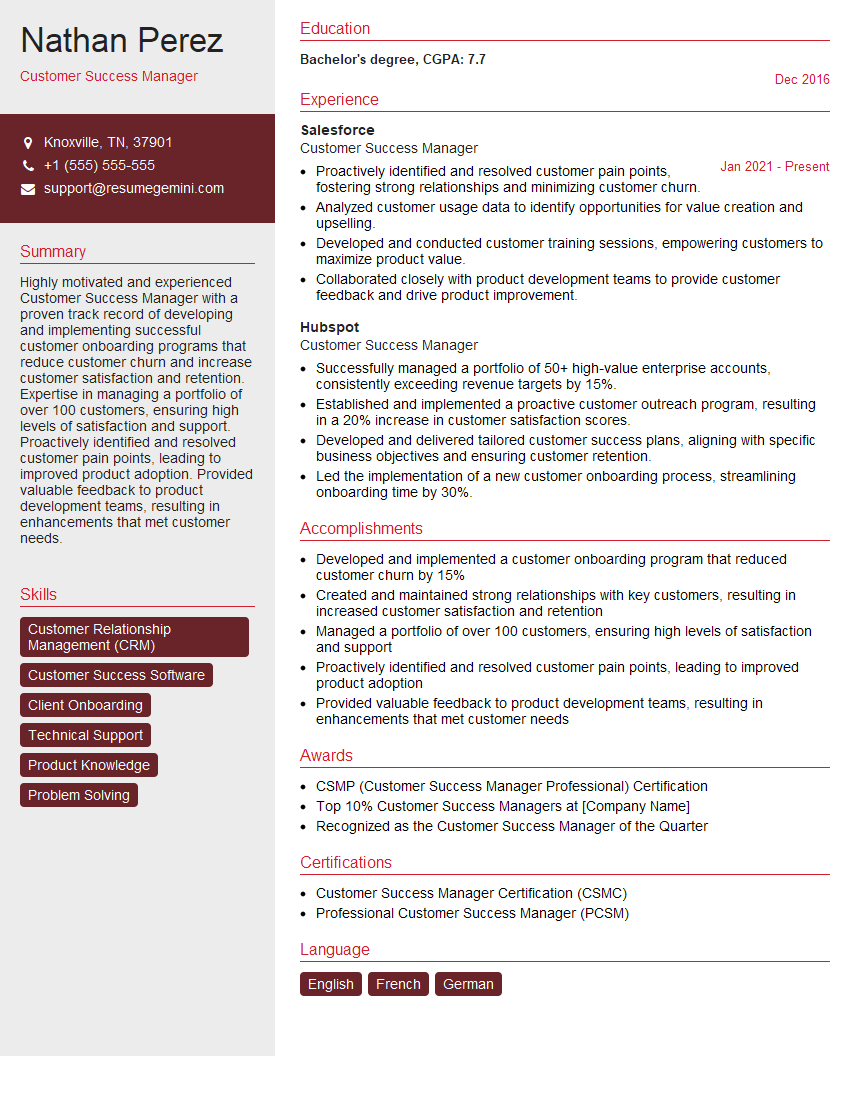
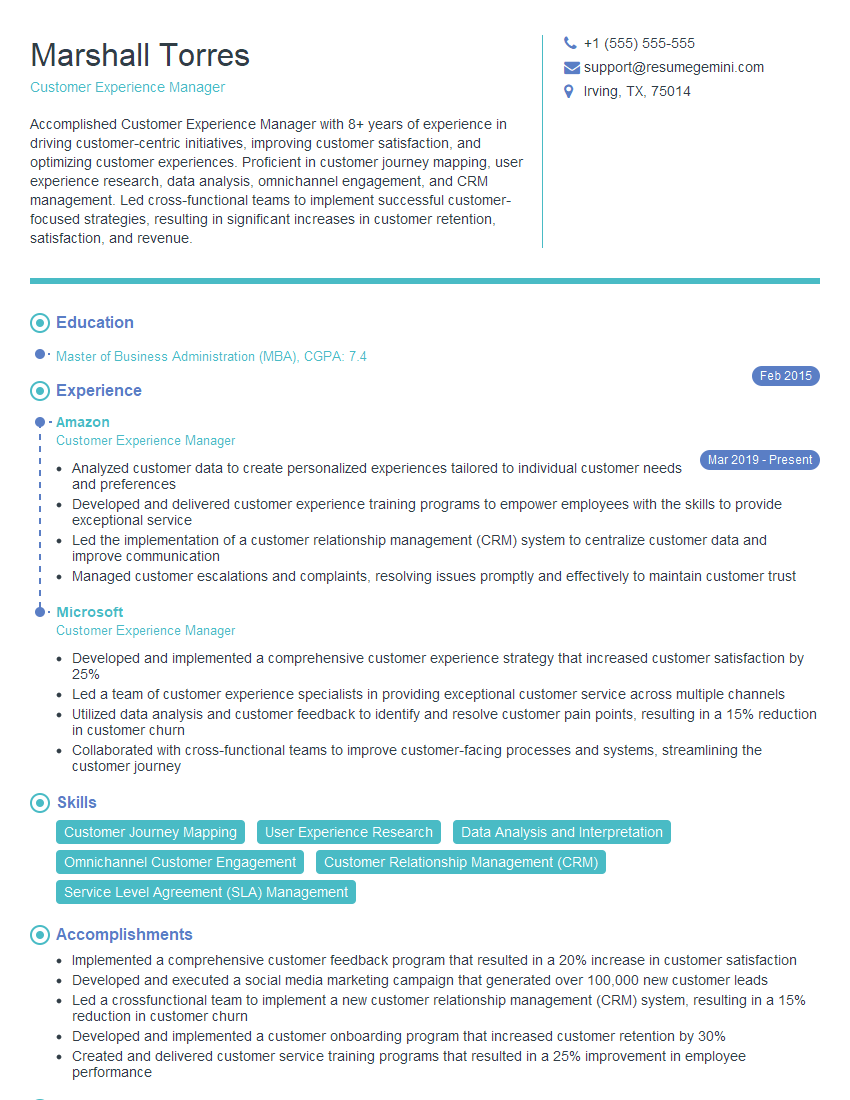
Mastering Customer Experience Analysis is crucial for career advancement in today’s customer-centric market. Demonstrating a strong understanding of these principles will significantly enhance your job prospects. To increase your chances of landing your dream role, crafting an ATS-friendly resume is paramount. ResumeGemini is a trusted resource for building professional resumes that help you stand out. We provide examples of resumes tailored to Customer Experience Analysis to give you a head start. Take advantage of these resources to create a compelling resume that showcases your skills and experience effectively.
Explore more articles
Users Rating of Our Blogs
Share Your Experience
We value your feedback! Please rate our content and share your thoughts (optional).
What Readers Say About Our Blog
good