The thought of an interview can be nerve-wracking, but the right preparation can make all the difference. Explore this comprehensive guide to Customer Support and Training interview questions and gain the confidence you need to showcase your abilities and secure the role.
Questions Asked in Customer Support and Training Interview
Q 1. Describe your experience handling escalated customer issues.
Handling escalated customer issues requires a calm, empathetic, and systematic approach. My experience involves thoroughly understanding the root cause of the customer’s frustration, actively listening to their concerns, and working collaboratively to find a resolution. This often involves going above and beyond standard procedures to ensure customer satisfaction.
For example, I once dealt with a customer whose order was significantly delayed due to an unforeseen logistical issue. While I couldn’t magically fix the delay, I proactively communicated with them every step of the way, providing updates, offering alternative solutions (like a partial refund or expedited shipping for the remaining portion), and ultimately exceeding their expectations with my commitment to transparency and problem-solving. This resulted in a positive outcome, converting a potentially negative experience into a positive one. I also documented the issue thoroughly, helping prevent similar occurrences in the future.
My approach centers on:
- Active Listening: Truly understanding the customer’s perspective and validating their feelings.
- Empathy: Putting myself in their shoes and showing genuine concern for their situation.
- Problem-Solving: Exploring all possible solutions, even those outside the usual protocol.
- Clear Communication: Keeping the customer informed every step of the way.
- Documentation: Recording the issue, resolution, and lessons learned for future reference.
Q 2. Explain your approach to developing a training program.
Developing a training program involves a structured approach that considers the learner’s needs, the desired outcomes, and the overall learning environment. I begin by conducting a thorough needs analysis, identifying skill gaps and determining the knowledge and skills required for successful job performance. This often involves surveys, interviews, and performance reviews.
Once the needs are identified, I design a curriculum that incorporates various learning methods, such as interactive modules, role-playing, case studies, and hands-on practice. The program is modular to allow for flexibility and adaptability based on individual learning styles and paces. For example, I’ve designed training programs using blended learning techniques, incorporating e-learning modules for self-paced learning and in-person workshops for collaborative activities and hands-on practice. I also ensure the program aligns with the company’s overall goals and objectives.
My approach includes:
- Needs Analysis: Identifying skill gaps and learning needs.
- Curriculum Design: Creating a structured and engaging learning experience.
- Content Development: Creating clear, concise, and relevant learning materials.
- Delivery Method Selection: Choosing appropriate methods (e-learning, in-person, blended learning).
- Evaluation and Feedback: Measuring program effectiveness and gathering feedback for improvement.
Q 3. How do you measure the effectiveness of a training program?
Measuring the effectiveness of a training program requires a multifaceted approach that goes beyond simply asking participants if they enjoyed it. I utilize a range of methods to assess both the knowledge gained (cognitive) and the skills developed (behavioral).
Key metrics I use include:
- Pre- and Post-Training Assessments: Comparing knowledge levels before and after the training to measure knowledge gain.
- Performance Improvement: Tracking key performance indicators (KPIs) such as customer satisfaction scores, call handling time, and error rates, to see if there’s an actual improvement in performance on the job.
- On-the-Job Observation: Directly observing trainees in their work environment to assess practical skill application.
- Trainee Feedback Surveys: Gathering feedback on the program’s content, delivery, and usefulness.
- Return on Investment (ROI): Calculating the cost of the training versus the benefits it provides (e.g., increased productivity, reduced errors).
For instance, if a training program aimed to reduce call handling time, I would compare average call handling time before and after the training. A significant decrease would indicate the program’s effectiveness.
Q 4. What metrics do you use to assess customer satisfaction?
Assessing customer satisfaction requires a holistic approach using various metrics to capture different aspects of the customer experience. I typically use a combination of quantitative and qualitative data.
Quantitative metrics include:
- Customer Satisfaction (CSAT) Scores: Surveys measuring overall satisfaction.
- Net Promoter Score (NPS): Gauging customer loyalty and willingness to recommend.
- Customer Effort Score (CES): Measuring the ease of interacting with the company.
- Ticket Resolution Time: Measuring the speed of issue resolution.
- First Contact Resolution (FCR): Measuring the percentage of issues resolved on the first contact.
Qualitative metrics include:
- Customer Feedback from Surveys and Reviews: Open-ended questions to understand customer experiences in detail.
- Social Media Monitoring: Tracking customer sentiment on social media platforms.
- Call Recordings: Analyzing calls to identify areas for improvement in agent performance.
By analyzing these metrics, I can identify trends, pinpoint areas for improvement, and measure the overall success of customer support initiatives.
Q 5. How do you prioritize competing customer support requests?
Prioritizing competing customer support requests requires a well-defined system to ensure that the most urgent and critical issues are addressed first. I typically use a combination of factors to determine priority.
My prioritization framework considers:
- Urgency: How quickly the issue needs to be resolved (e.g., system outage vs. minor account question).
- Impact: How many customers are affected or the potential severity of the issue (e.g., widespread service disruption vs. a single customer issue).
- Customer Importance: Prioritizing high-value or VIP customers.
- Service Level Agreements (SLAs): Meeting agreed-upon response and resolution times for different issue types.
For example, a system outage affecting all users would take precedence over individual account inquiries. I often use a ticketing system with a clear prioritization scheme (e.g., using labels like ‘Urgent,’ ‘High,’ ‘Medium,’ ‘Low’) and regularly review and re-prioritize tickets to ensure efficiency.
Q 6. Describe your experience with CRM software.
I have extensive experience using various CRM (Customer Relationship Management) software platforms, including Salesforce, Zendesk, and HubSpot. My experience extends beyond basic data entry and retrieval; I’m proficient in utilizing these systems to track customer interactions, manage cases, analyze customer data, and improve overall customer service efficiency. I understand the importance of data accuracy and consistency within the CRM and regularly conduct data audits to ensure data integrity.
For example, in a previous role, I used Salesforce to build customized reports and dashboards to track key metrics such as customer churn rate, average resolution time, and customer satisfaction scores. This data-driven approach enabled me to identify areas for improvement and optimize our support processes. I’m also skilled in using CRM features like automation to streamline workflows and improve efficiency. For instance, I’ve set up automated email responses for frequently asked questions, freeing up agents to handle more complex issues.
Q 7. How do you handle difficult or angry customers?
Handling difficult or angry customers requires patience, empathy, and strong communication skills. My approach focuses on de-escalating the situation and finding a mutually acceptable solution. I begin by actively listening to the customer’s concerns without interrupting, validating their feelings, and demonstrating empathy.
My steps to handling difficult customers include:
- Active Listening: Let the customer fully express their concerns without interruption.
- Empathy: Show understanding and acknowledge their frustration.
- Calm and Respectful Tone: Maintain a professional and respectful demeanor, even under pressure.
- Apologize Sincerely: If appropriate, apologize for the inconvenience, regardless of who is at fault.
- Take Ownership: Take responsibility for finding a solution, even if it’s not directly your fault.
- Offer Solutions: Present clear and concise options for resolving the issue.
- Follow Up: After resolving the issue, follow up with the customer to ensure they are satisfied.
I understand that sometimes, despite best efforts, some situations cannot be fully resolved. In such cases, I ensure the customer understands the steps I’ve taken and escalate appropriately when necessary. Documentation of these interactions is crucial for learning and improvement.
Q 8. What is your experience with creating training materials (e.g., presentations, manuals)?
Creating effective training materials is crucial for knowledge transfer and consistent service delivery. My experience encompasses developing a wide range of materials, from concise presentations using tools like PowerPoint and Google Slides to comprehensive manuals utilizing platforms such as Adobe InDesign and Articulate Storyline. I tailor the format and content to the specific audience and learning objective. For example, for a technical rollout, I’d opt for a step-by-step manual with screenshots and diagrams, whereas for a new product launch, a dynamic presentation with engaging visuals might be more suitable. I always ensure materials are accessible, using clear language and incorporating visual aids to enhance understanding. I’ve also developed interactive e-learning modules that offer quizzes and assessments to reinforce learning and track progress.
For instance, when training new customer service representatives on our CRM system, I created a modular training manual, complemented by short, engaging videos demonstrating key functionalities. This blended approach allowed trainees to learn at their own pace while ensuring they mastered essential tasks before moving on to more complex ones.
Q 9. How do you adapt your training style to different learning styles?
Understanding and adapting to diverse learning styles is paramount for effective training. I employ a multifaceted approach, catering to visual, auditory, and kinesthetic learners. Visual learners benefit from presentations with clear visuals, charts, and infographics; auditory learners respond well to discussions, lectures, and audio-based materials; and kinesthetic learners learn best through hands-on activities and simulations.
For example, when teaching a new software, I’d combine a PowerPoint presentation illustrating the software’s functions with a hands-on exercise where trainees interact directly with the software. I’d also incorporate group discussions to encourage peer learning and address individual questions. Regular quizzes and assessments help me monitor understanding and adjust my approach accordingly, ensuring everyone feels comfortable and confident.
Q 10. Describe a time you had to troubleshoot a complex technical issue.
During a major system outage, I was tasked with troubleshooting a complex network connectivity issue. Our customer support team experienced widespread service disruptions due to an unexplained server malfunction. My initial approach was to systematically gather information: I reviewed system logs, analyzed network traffic patterns, and consulted with the IT team.
The issue turned out to be a misconfiguration in our firewall settings, inadvertently blocking crucial communication channels. Working collaboratively with the IT team, we identified the error, implemented a temporary workaround to restore service, and then carefully adjusted the firewall rules to prevent future occurrences. The entire process involved meticulous analysis, collaborative problem-solving, and effective communication to keep stakeholders informed of the progress. This incident highlighted the value of proactive monitoring, detailed documentation, and effective teamwork in resolving complex technical challenges.
Q 11. What is your experience with ticketing systems?
I possess extensive experience with various ticketing systems, including Zendesk, ServiceNow, and Jira Service Desk. My proficiency spans ticket creation, assignment, prioritization, escalation, and resolution. I’m adept at utilizing these systems to manage workflows, track performance metrics (such as resolution time and customer satisfaction), and generate reports. Beyond basic functionality, I understand how to configure and customize these systems to optimize efficiency and streamline processes. I’m comfortable training teams on the best practices for using ticketing systems to ensure clear communication and effective issue resolution.
For instance, in a previous role, I implemented a new tagging system within our Zendesk instance to categorize and track customer inquiries more effectively. This improved our ability to identify recurring issues and develop proactive solutions.
Q 12. How do you identify and address knowledge gaps in your team?
Identifying and addressing knowledge gaps within a team is essential for maintaining high performance levels. My approach involves a combination of observation, performance reviews, and feedback analysis. I regularly observe team members interacting with customers, analyzing their performance to identify areas needing improvement. I also conduct regular performance reviews, using feedback sessions to understand individual strengths and weaknesses. Analyzing customer feedback and support tickets can also highlight areas where training might be lacking.
Once knowledge gaps are identified, I develop targeted training programs or resources to address these deficiencies. This might involve one-on-one coaching, group training sessions, or the creation of new knowledge base articles. I emphasize continuous learning and encourage team members to actively seek out opportunities for professional development.
Q 13. Describe your experience with remote training methods.
My experience with remote training methods is extensive, leveraging various technologies for effective knowledge transfer. I’m proficient in conducting virtual training sessions using platforms like Zoom, Google Meet, and Microsoft Teams. I utilize interactive tools such as screen sharing, online whiteboards, and collaborative documents to engage participants. I also create and deliver asynchronous training materials, such as e-learning modules and pre-recorded videos, allowing trainees to learn at their own pace.
For example, when training a geographically dispersed team on a new customer service protocol, I delivered a series of short, engaging video modules supplemented by interactive online quizzes. This ensured consistency in training delivery while allowing trainees flexibility in their learning schedule. I also utilized a dedicated online forum for Q&A, fostering collaboration and knowledge sharing among the trainees.
Q 14. How do you ensure customer data privacy and security?
Protecting customer data privacy and security is paramount. My approach aligns with industry best practices and relevant regulations, such as GDPR and CCPA. This includes adhering to strict data handling protocols, encrypting sensitive information both in transit and at rest, and implementing robust access control measures to limit data access to authorized personnel only. Regular security audits and vulnerability assessments are crucial to identify and mitigate potential risks.
Furthermore, I ensure that all team members receive comprehensive training on data privacy and security policies, emphasizing the importance of responsible data handling. We regularly conduct phishing simulations and security awareness training to enhance our collective vigilance. I’m committed to maintaining a culture of security awareness and compliance.
Q 15. How do you build rapport with customers?
Building rapport with customers is crucial for effective customer support. It’s about creating a connection based on trust and understanding, making them feel heard and valued. I achieve this through active listening, empathy, and personalized communication.
- Active Listening: I pay close attention not just to what the customer says, but also to their tone and body language (if interacting in person or via video). This shows I’m truly engaged and invested in resolving their issue.
- Empathy: I try to understand the customer’s perspective, even if I don’t necessarily agree with it. Acknowledging their frustration or disappointment goes a long way. For example, saying something like, “I understand this is frustrating, and I’ll do everything I can to help you,” can significantly improve the interaction.
- Personalized Communication: I avoid using generic scripts and instead tailor my responses to the individual customer. Using their name and addressing their specific concerns demonstrates respect and care. I also adjust my communication style to match the customer’s, being formal or informal as appropriate.
For example, I once helped a customer who was extremely upset about a delayed shipment. Instead of focusing solely on the logistics, I acknowledged their frustration with the delay and offered a sincere apology. I then proactively offered a solution, such as expedited shipping or a discount on their next purchase. This helped de-escalate the situation and transform a negative experience into a positive one.
Career Expert Tips:
- Ace those interviews! Prepare effectively by reviewing the Top 50 Most Common Interview Questions on ResumeGemini.
- Navigate your job search with confidence! Explore a wide range of Career Tips on ResumeGemini. Learn about common challenges and recommendations to overcome them.
- Craft the perfect resume! Master the Art of Resume Writing with ResumeGemini’s guide. Showcase your unique qualifications and achievements effectively.
- Don’t miss out on holiday savings! Build your dream resume with ResumeGemini’s ATS optimized templates.
Q 16. What is your experience with performance support tools?
My experience with performance support tools is extensive. I’ve worked with a variety of tools, from simple knowledge bases and FAQs to sophisticated learning management systems (LMS) and integrated help systems embedded directly within applications. I’m proficient in identifying the right tool for the job, implementing it effectively, and training users on its features.
For example, I’ve successfully implemented a knowledge base system using a tool like Zendesk Guide which reduced call volume by 20% by providing readily accessible answers to frequently asked questions. This freed up my team to focus on more complex issues requiring personalized attention. I also have experience with tools that integrate directly into software applications, providing context-sensitive help and reducing the learning curve for new users. This can include features like tooltips, interactive walkthroughs, and embedded videos.
My expertise extends beyond simply using these tools to designing and deploying them strategically. I consider factors like user needs, content organization, search functionality, and accessibility to create a truly effective performance support solution.
Q 17. How familiar are you with different learning theories?
My understanding of learning theories informs my approach to training design and delivery. I’m familiar with several key theories, including:
- Andragogy (Adult Learning Theory): This theory emphasizes the importance of self-concept, prior experience, readiness to learn, and orientation to learning in adult learners. I use this by focusing on practical application, allowing for self-paced learning, and encouraging learner participation.
- Cognitive Load Theory: This theory focuses on managing the amount of information presented to learners to avoid cognitive overload. I apply this by breaking down complex topics into smaller, manageable chunks and using visuals and multimedia to enhance understanding.
- Constructivism: This theory highlights the importance of active learning and knowledge construction. I incorporate this through hands-on activities, group discussions, and real-world case studies to encourage learners to build their own understanding.
- Experiential Learning: This emphasizes learning through doing and reflection. I use this approach extensively through role-playing exercises, simulations, and on-the-job training.
By understanding these theories, I can design training that is effective, engaging, and relevant to the learners’ needs and learning styles. For instance, for a technical training session, I would utilize a blended learning approach combining self-paced modules with instructor-led sessions and hands-on lab work, reflecting the principles of andragogy and cognitive load theory.
Q 18. How do you handle conflicting priorities in customer support and training?
Handling conflicting priorities in customer support and training requires a strategic approach. I utilize several techniques to ensure that both areas receive adequate attention.
- Prioritization Matrix: I use a prioritization matrix (such as Eisenhower Matrix) to categorize tasks based on urgency and importance. This helps me focus on the most critical tasks first while still allocating resources to less urgent but important items.
- Effective Time Management: I employ time management techniques, such as time blocking and the Pomodoro Technique, to dedicate specific time slots to each area, preventing one from consistently overshadowing the other.
- Communication and Collaboration: Open and honest communication with my team and stakeholders is vital. I regularly update everyone on progress, challenges, and potential conflicts. This allows for collaborative problem-solving and ensures everyone is working towards shared goals.
- Delegation: Where appropriate, I delegate tasks to team members to distribute the workload more evenly and to leverage individual expertise.
For instance, if there’s a major customer issue requiring immediate attention that overlaps with a scheduled training session, I will prioritize the customer issue, perhaps rescheduling the training or adjusting its format to accommodate the situation. I would then clearly communicate the change to the trainees.
Q 19. How do you stay up-to-date on the latest customer support and training best practices?
Staying current with best practices in customer support and training requires continuous learning. I utilize several methods:
- Professional Organizations: I actively participate in professional organizations like the Association for Talent Development (ATD) and attend conferences and webinars to network and learn from industry leaders.
- Industry Publications and Blogs: I regularly read industry publications and blogs to stay abreast of the latest trends, technologies, and best practices. This helps me understand emerging challenges and find effective solutions.
- Online Courses and Certifications: I pursue relevant online courses and certifications to enhance my skill set and deepen my understanding of specific areas.
- Networking: I actively engage in networking with peers and experts in the field. Sharing knowledge and experiences with others helps me identify blind spots and adopt best practices.
For instance, I recently completed a certification in customer service management, which broadened my understanding of effective team leadership and the latest strategies in customer relationship management (CRM). This knowledge directly translates into improved performance within my teams.
Q 20. Describe your experience with coaching and mentoring team members.
I have extensive experience coaching and mentoring team members. My approach is focused on fostering growth and development through constructive feedback, supportive guidance, and creating opportunities for learning.
- Regular Check-ins: I conduct regular one-on-one meetings with my team members to discuss their progress, challenges, and career goals. This allows me to provide personalized support and address any concerns promptly.
- Constructive Feedback: I provide constructive feedback based on observations, performance data, and self-assessments. My feedback focuses on both strengths and areas for improvement, always framing it in a supportive and encouraging manner.
- Mentorship and Guidance: I offer mentorship and guidance by sharing my own experiences and expertise. I help my team members develop their skills, identify their career paths, and achieve their professional goals.
- Delegation and Empowerment: I delegate tasks and responsibilities to empower my team members to develop their skills and take ownership of their work.
For example, I worked with a junior team member who was struggling with handling difficult customer interactions. Through regular coaching and role-playing sessions, I helped her develop effective communication and conflict resolution skills. This resulted in a significant improvement in her performance and boosted her confidence.
Q 21. What is your approach to creating and delivering engaging training content?
Creating and delivering engaging training content requires a multi-faceted approach. I prioritize clear learning objectives, interactive activities, and a variety of delivery methods.
- Clear Learning Objectives: I begin by defining clear and measurable learning objectives. This ensures that the training is focused and effective, directly addressing the needs of the learners.
- Interactive Activities: I incorporate interactive activities, such as group discussions, quizzes, role-playing exercises, and simulations, to keep learners engaged and promote active learning. This moves away from passive listening and promotes knowledge retention.
- Variety of Delivery Methods: I utilize a variety of delivery methods, such as online modules, instructor-led sessions, blended learning, and on-the-job training, to cater to different learning styles and preferences.
- Storytelling and Real-World Examples: I use storytelling and real-world examples to make the content relatable and memorable. This helps learners connect the concepts to their own experiences.
- Gamification: I sometimes incorporate gamification elements, such as points, badges, and leaderboards, to make the learning experience more fun and motivating.
For instance, when creating a training module on a new software application, I would incorporate interactive tutorials, short video clips demonstrating features, and a hands-on exercise allowing learners to practice using the software within a simulated environment. This blended learning approach maximizes learner engagement and knowledge retention.
Q 22. How do you deal with resistance to training within a team?
Resistance to training is common, stemming from various factors like fear of change, lack of perceived value, or time constraints. Addressing this requires a multi-pronged approach.
- Understand the Root Cause: First, I conduct informal interviews or surveys to understand *why* the team is resistant. Are they overwhelmed? Do they feel the training is irrelevant? Do they lack confidence in their ability to learn new skills?
- Make it Relevant: Training must directly address employees’ needs and show a clear link between the training and their daily tasks. I showcase how the new skills will improve efficiency, reduce workload, or lead to better performance reviews – tangible benefits are key.
- Tailor the Approach: Different learning styles exist. I offer various training formats – video tutorials, hands-on workshops, mentoring, or even gamified learning – to cater to diverse preferences. This increases engagement and makes learning more enjoyable.
- Create a Supportive Environment: Encouraging collaboration and peer-to-peer learning reduces feelings of isolation. I foster a safe space where questions are welcomed and mistakes are viewed as learning opportunities. Regular check-ins and feedback sessions also provide continuous support.
- Incentivize Participation: Recognizing and rewarding successful completion of the training program motivates employees and reinforces the importance of the training. This could involve gift cards, extra time off, or even public acknowledgement.
For example, in a previous role, a team resisted adopting a new CRM system. After interviews, I discovered their resistance stemmed from a fear of the technology and a lack of confidence in their ability to master it. I addressed this by providing one-on-one coaching, creating short, focused training modules, and offering ongoing support. The result? Team adoption increased significantly, and productivity improved.
Q 23. What experience do you have with developing training evaluations?
Developing effective training evaluations is crucial for assessing program success. My approach is multi-faceted and involves both formative and summative evaluations.
- Formative Evaluation (during training): I use methods like quizzes, short assignments, and informal feedback sessions to identify knowledge gaps and adjust the training content in real-time. This ensures the training is engaging and effective throughout the process.
- Summative Evaluation (after training): Summative evaluations measure the overall effectiveness of the training program. This often includes knowledge tests (pre and post-training), performance-based assessments (simulations or on-the-job observation), and surveys to gauge participant satisfaction and perceived improvement in skills.
I always aim for a balanced approach, using both quantitative (e.g., test scores, completion rates) and qualitative (e.g., open-ended feedback, interviews) data to provide a holistic understanding of the training’s impact. For example, in a recent project, I incorporated a 360-degree feedback mechanism to evaluate the impact of a leadership training program. This included feedback from peers, supervisors, and subordinates, providing a comprehensive view of the effectiveness of the training.
Q 24. How do you ensure that training aligns with business goals?
Aligning training with business goals is paramount. This starts with a thorough understanding of the organization’s strategic objectives and how training can contribute to achieving them.
- Needs Analysis: I begin with a comprehensive training needs analysis – identifying skill gaps, performance deficiencies, and the specific knowledge or skills required to meet the business goals. This process often involves interviews, surveys, and performance data analysis.
- SMART Goals: Training objectives should be aligned with SMART goals (Specific, Measurable, Achievable, Relevant, Time-bound). This ensures that the training program is focused, measurable, and directly contributes to business objectives. For example, instead of a vague goal like ‘improve customer satisfaction’, a SMART goal would be ‘increase customer satisfaction scores by 15% within six months of training completion’.
- KPIs and Metrics: I establish key performance indicators (KPIs) to track the success of the training. These metrics should directly reflect the business goals. For instance, if the goal is improved sales conversion rates, then KPIs could include the number of successful sales calls or the average deal size.
- Continuous Improvement: I regularly review the training program’s effectiveness against the established KPIs and make necessary adjustments to ensure alignment with evolving business needs.
In a past project, a company aimed to increase sales revenue. Our training focused on improving sales techniques and product knowledge. We tracked sales figures before and after the training to demonstrate its direct impact on the company’s bottom line, proving the alignment between the training and the overall business goal.
Q 25. Describe your experience with different types of training delivery methods (e.g., instructor-led, e-learning).
I have extensive experience with various training delivery methods, each with its strengths and weaknesses. The optimal approach depends on the training content, audience, and budget.
- Instructor-Led Training (ILT): This method is highly effective for interactive sessions, complex topics requiring immediate clarification, and building rapport with participants. It allows for immediate feedback and personalized attention.
- E-Learning: E-learning (online courses, modules, videos) is cost-effective, scalable, and allows for self-paced learning. It’s particularly well-suited for large audiences or geographically dispersed teams and offers flexibility in scheduling.
- Blended Learning: This combines the best of ILT and e-learning, offering a more engaging and comprehensive learning experience. For example, a foundational course delivered via e-learning could be followed by an ILT workshop for hands-on practice and discussion.
- On-the-Job Training (OJT): OJT involves direct experience and observation. It’s great for developing practical skills but requires careful supervision and mentorship.
I’ve successfully implemented all of these methods, often adapting them to suit specific situations. For instance, for a technical training program, I leveraged e-learning for the theoretical aspects and supplemented it with instructor-led sessions for hands-on lab work. This blended approach maximized learning outcomes and kept the training engaging.
Q 26. How do you use technology to improve customer support and training efficiency?
Technology plays a crucial role in improving both customer support and training efficiency. I leverage several technologies to streamline processes and enhance performance.
- CRM Systems (e.g., Salesforce, Zendesk): These systems centralize customer data, track interactions, and facilitate efficient case management. They also provide valuable insights into customer behavior and common issues that can be addressed in training.
- Knowledge Base Software: Knowledge base platforms provide easy access to self-service resources for customers and agents alike, reducing reliance on live support and empowering customers to resolve issues independently. They also serve as repositories of training materials.
- Learning Management Systems (LMS): LMS platforms like Moodle or Canvas manage, track, and deliver training programs, making the process more organized and efficient. They allow for automated scheduling, progress monitoring, and assessment tracking.
- Collaboration Tools (e.g., Slack, Microsoft Teams): These facilitate effective communication within support teams, enabling quick information sharing and problem-solving. They also serve as valuable tools for team-based training and mentoring.
- AI-powered Chatbots: Chatbots can handle routine customer inquiries, freeing up human agents to address more complex issues. The data gathered by chatbots provides insights for training and process improvements.
In a previous role, we implemented a comprehensive knowledge base and an LMS, resulting in a 20% reduction in average resolution time for customer inquiries and a 15% increase in employee training completion rates.
Q 27. What is your experience with developing training needs analyses?
Developing a training needs analysis is the cornerstone of any effective training program. It’s a systematic process that identifies skill gaps and determines what training is needed to address them.
- Gather Data: I utilize various methods to gather data, including:
- Surveys: To assess employee knowledge, skills, and training preferences.
- Interviews: To gain deeper insights into individual needs and challenges.
- Performance Data: Analyzing metrics like error rates, customer satisfaction scores, or sales figures to identify areas for improvement.
- Focus Groups: To collect feedback from groups of employees representing different roles or departments.
- Observation: Observing employees in their work environment to identify performance issues.
- Analyze Data: After data collection, I analyze it to identify trends and patterns, highlighting areas where training is most needed. This analysis should consider the organization’s strategic goals and how training can contribute to their achievement.
- Prioritize Needs: Based on the analysis, I prioritize training needs, considering factors like urgency, impact, and resources available.
- Develop Recommendations: Finally, I develop specific recommendations for training programs, including content, delivery methods, and evaluation plans. The recommendations are tailored to address the identified needs and align with the overall business objectives.
A recent needs analysis I conducted for a call center revealed a significant gap in product knowledge among new hires. This led to the development of a comprehensive onboarding program that significantly improved their performance and customer satisfaction scores.
Q 28. How would you handle a situation where a customer is consistently dissatisfied despite your best efforts?
Persistent customer dissatisfaction, despite best efforts, requires a thorough investigation and a proactive approach.
- Empathy and Active Listening: I begin by actively listening to the customer’s concerns, showing empathy and acknowledging their frustration. This builds trust and allows me to understand the underlying issue.
- Thorough Investigation: I investigate the situation meticulously, reviewing past interactions, support tickets, and any available data to identify patterns or systemic problems. This might involve speaking with colleagues who have also interacted with the customer.
- Escalation and Collaboration: If the issue cannot be resolved at my level, I escalate it to a supervisor or relevant department. Collaboration is key; involving other team members might provide fresh perspectives and solutions.
- Offer Alternative Solutions: I explore alternative solutions to address the customer’s needs, even if it means exceeding standard procedures. This demonstrates commitment to customer satisfaction.
- Feedback and Process Improvement: The experience should serve as an opportunity for process improvement. I document the situation thoroughly, including the resolution and any identified gaps in processes or training. This feedback is valuable for improving customer support strategies and preventing similar issues from recurring.
- Follow-up: After the issue is resolved, I follow up with the customer to ensure they are satisfied and that the solution has addressed their concerns. This shows a commitment to ongoing support.
In one instance, a customer remained dissatisfied despite multiple attempts to resolve a technical issue. Through investigation, we discovered a bug in our software that wasn’t initially apparent. Escalating the issue to the development team led to a fix, and proactively reaching out to the customer showed our commitment to resolving their issue, restoring their trust.
Key Topics to Learn for Your Customer Support and Training Interview
- Understanding Customer Needs: Learn to actively listen, identify underlying issues, and empathize with customer frustrations. Practical application: Role-playing different customer scenarios and practicing active listening techniques.
- Troubleshooting and Problem-Solving: Develop a systematic approach to resolving technical issues and guiding users through complex processes. Practical application: Practice diagnosing common problems and outlining step-by-step solutions.
- Communication Skills (Written & Verbal): Master clear, concise, and professional communication in both written and verbal formats. Practical application: Practice explaining technical information in a way that is easily understood by non-technical users.
- Training Methodology and Delivery: Familiarize yourself with various training methods (e.g., online modules, in-person workshops, presentations) and how to adapt your approach to different learning styles. Practical application: Research different training methodologies and consider how you’d adapt them to a specific audience.
- Technical Proficiency (Relevant Software/Systems): Depending on the specific role, demonstrate familiarity with relevant software, CRM systems, or ticketing systems. Practical application: Research the specific technologies used by the company you’re interviewing with.
- Performance Metrics and Reporting: Understand key performance indicators (KPIs) in customer support and training and how to track and analyze them. Practical application: Research common metrics like customer satisfaction scores (CSAT), resolution time, and training completion rates.
- Teamwork and Collaboration: Highlight your ability to work effectively within a team and collaborate with colleagues to achieve shared goals. Practical application: Prepare examples demonstrating your teamwork skills in previous roles.
Next Steps
Mastering Customer Support and Training is a valuable skillset that opens doors to diverse career opportunities, offering growth potential and increasing earning capacity. A well-crafted resume is crucial for showcasing your skills and experience effectively to potential employers. An ATS-friendly resume increases your chances of getting past Applicant Tracking Systems and landing interviews. To build a compelling and effective resume that highlights your abilities, we encourage you to utilize ResumeGemini, a trusted resource for crafting professional resumes. Examples of resumes tailored to Customer Support and Training roles are available for your review.
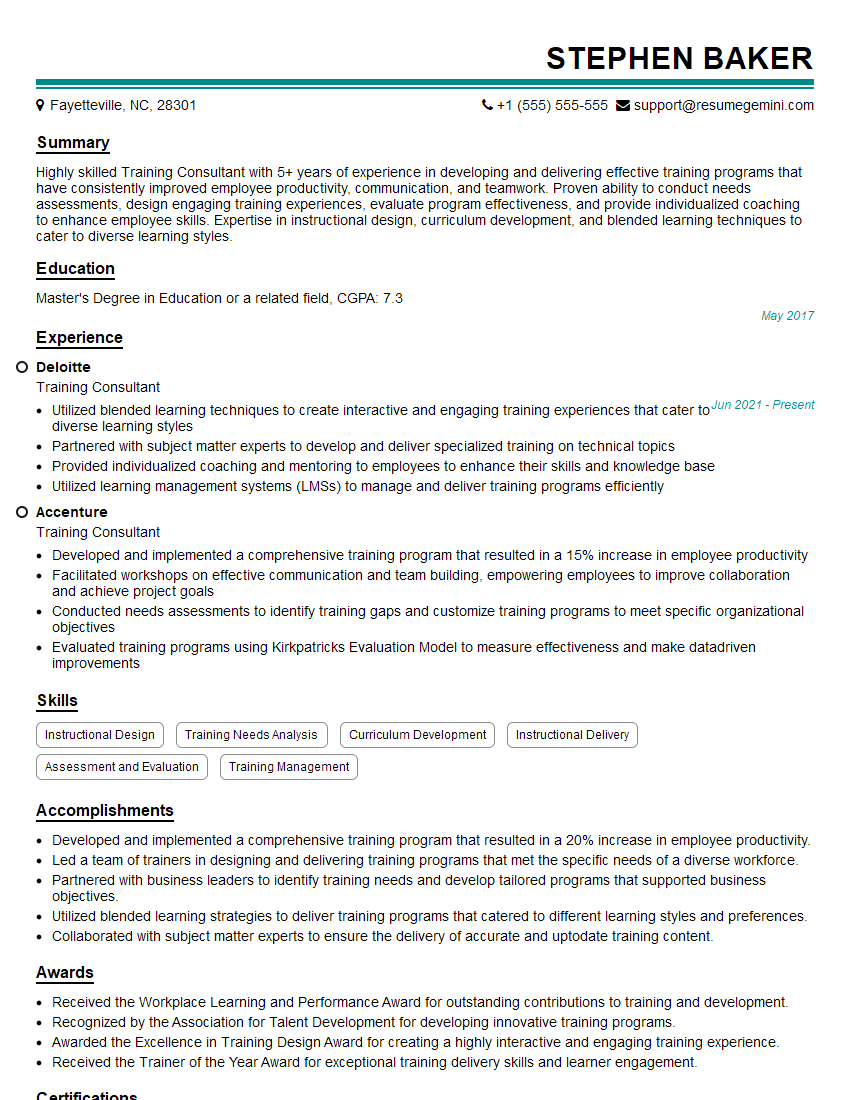
Training Consultant Resume Sample
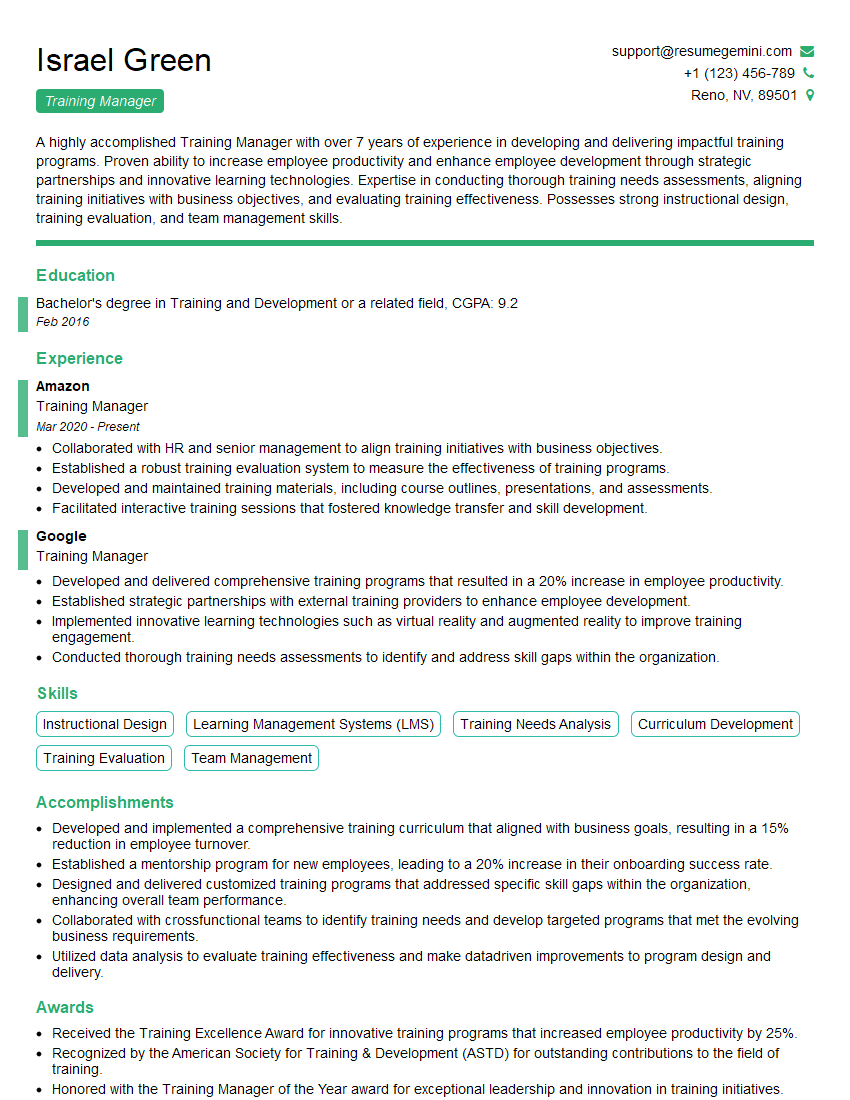
Training Manager Resume Sample
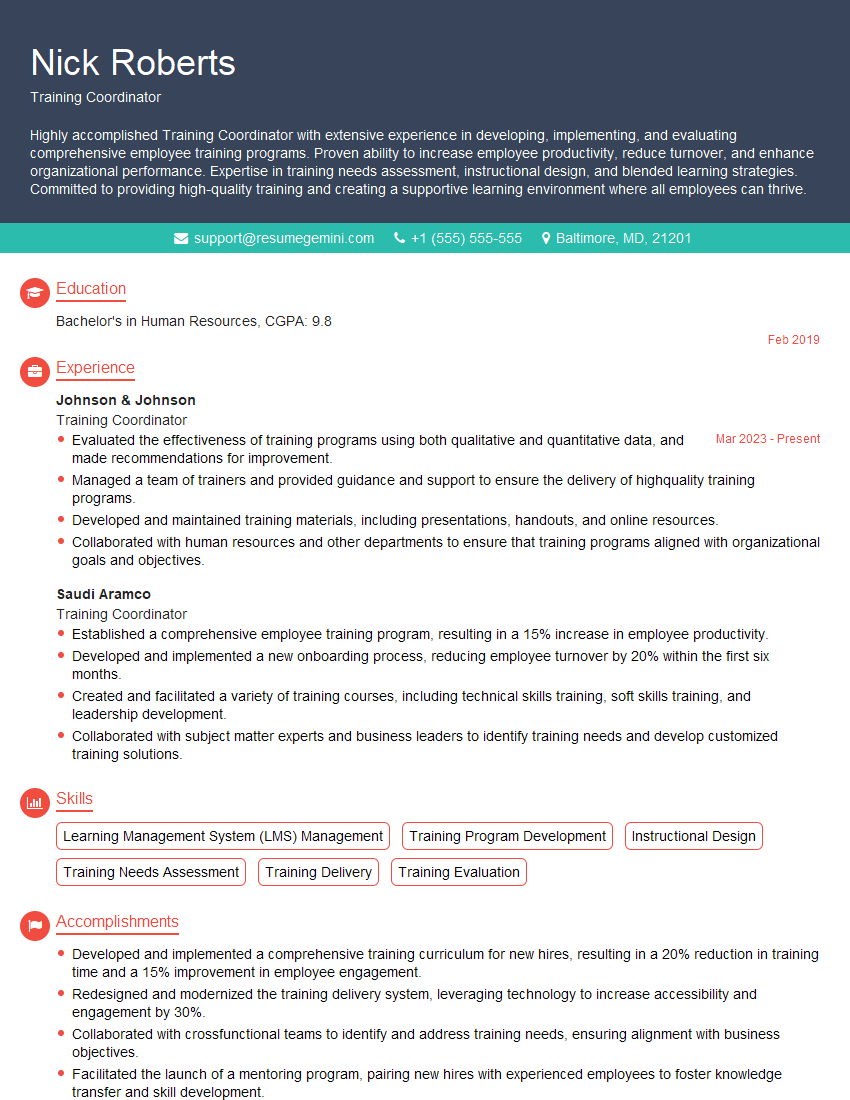
Training Coordinator Resume Sample
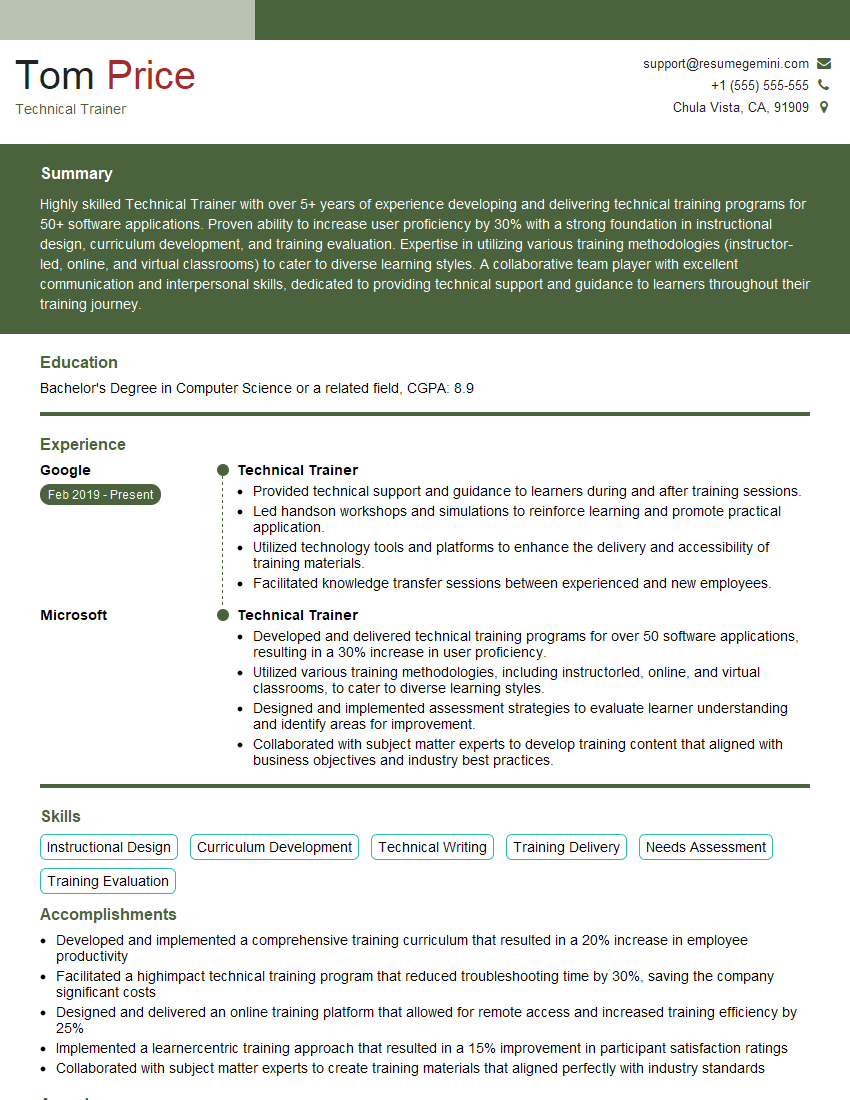
Technical Trainer Resume Sample

Training Specialist Resume Sample
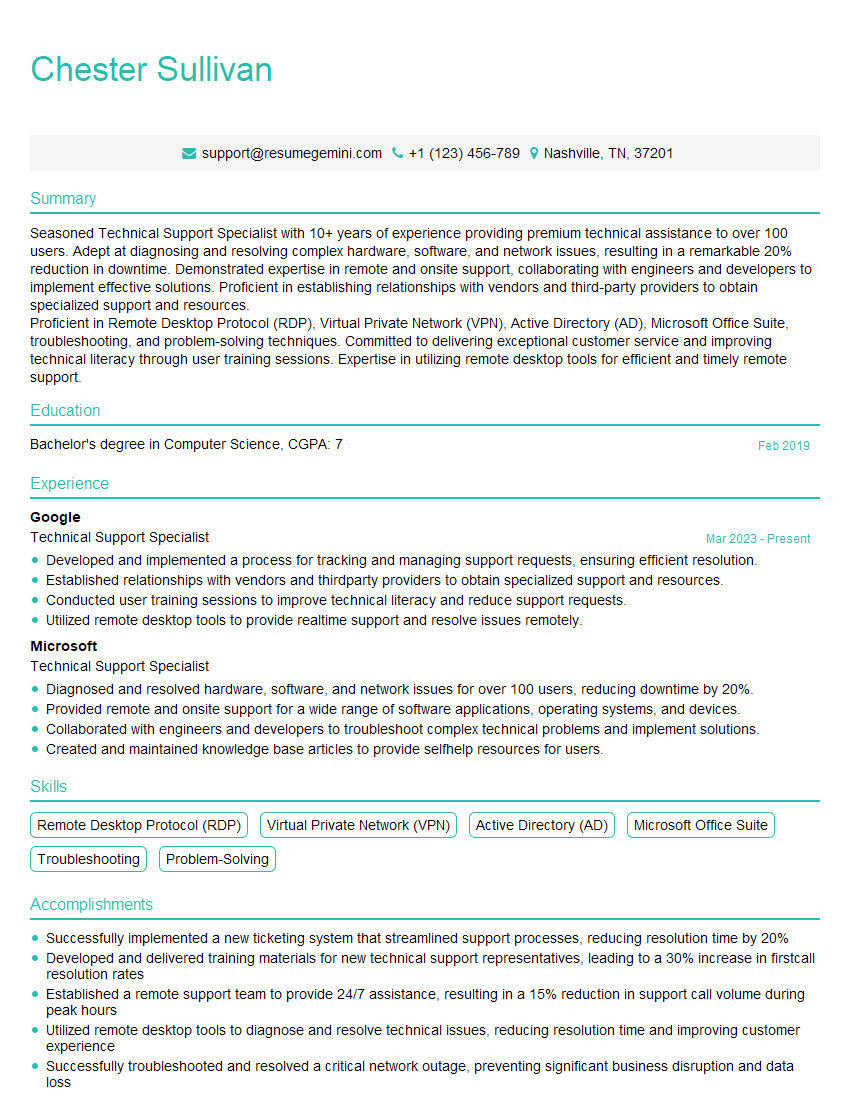
Technical Support Specialist Resume Sample

Customer Support Analyst Resume Sample
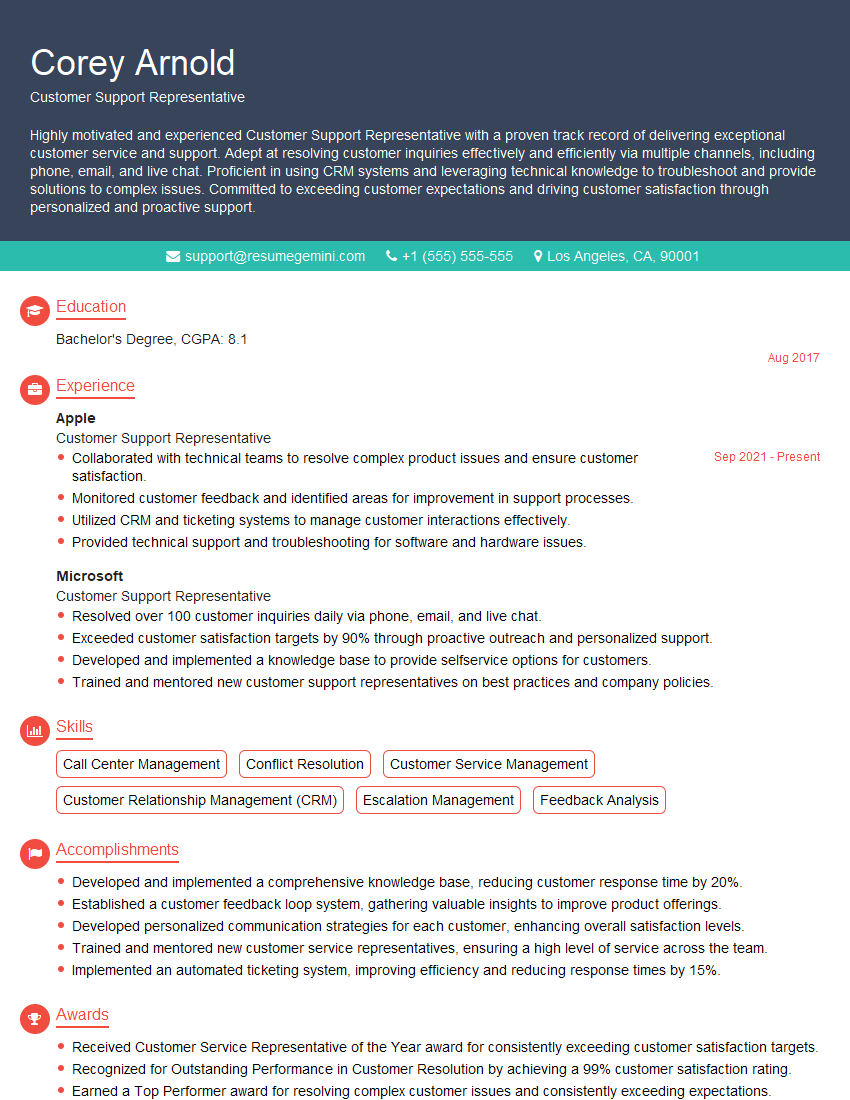
Customer Support Representative Resume Sample
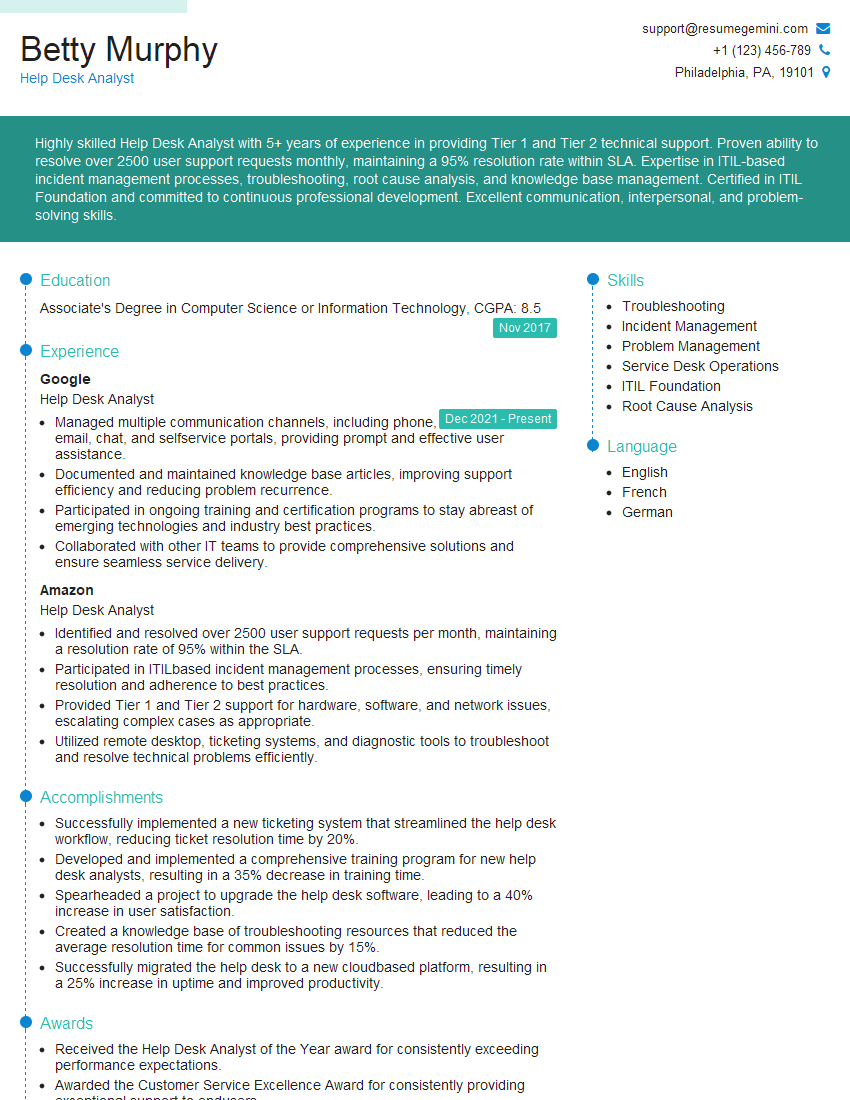
Help Desk Analyst Resume Sample
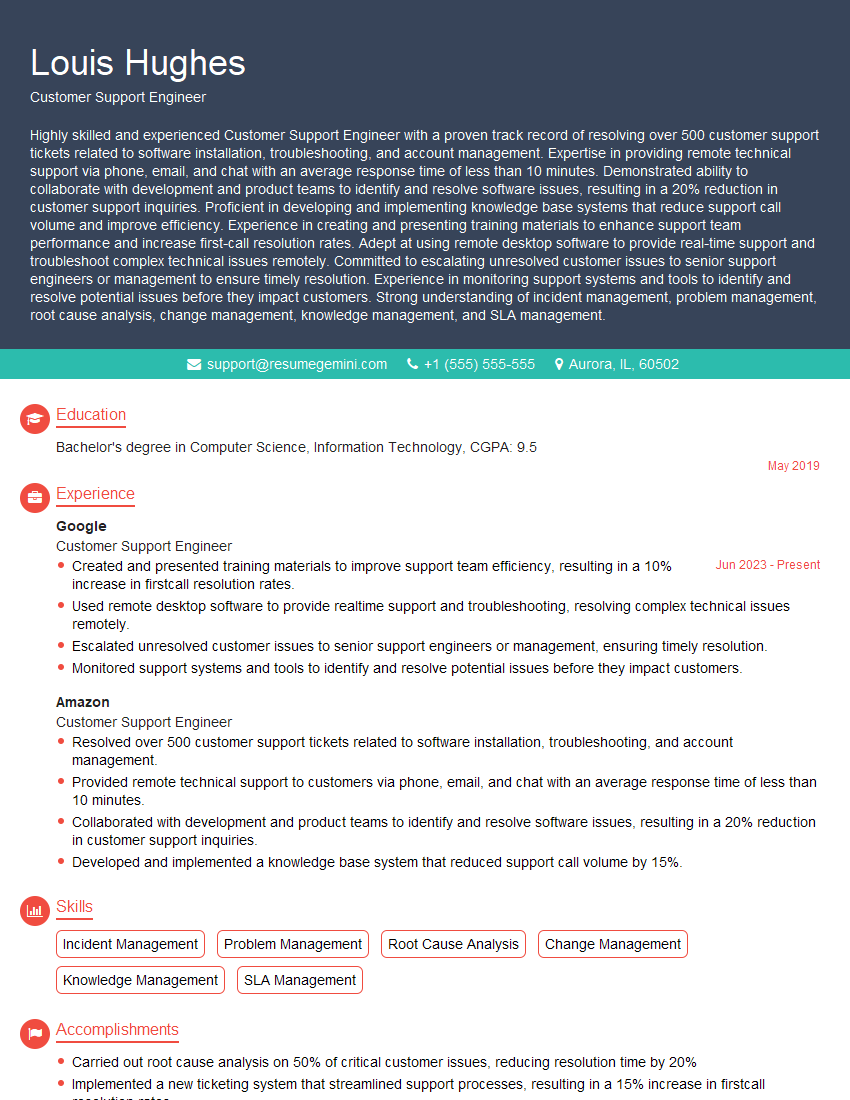
Customer Support Engineer Resume Sample
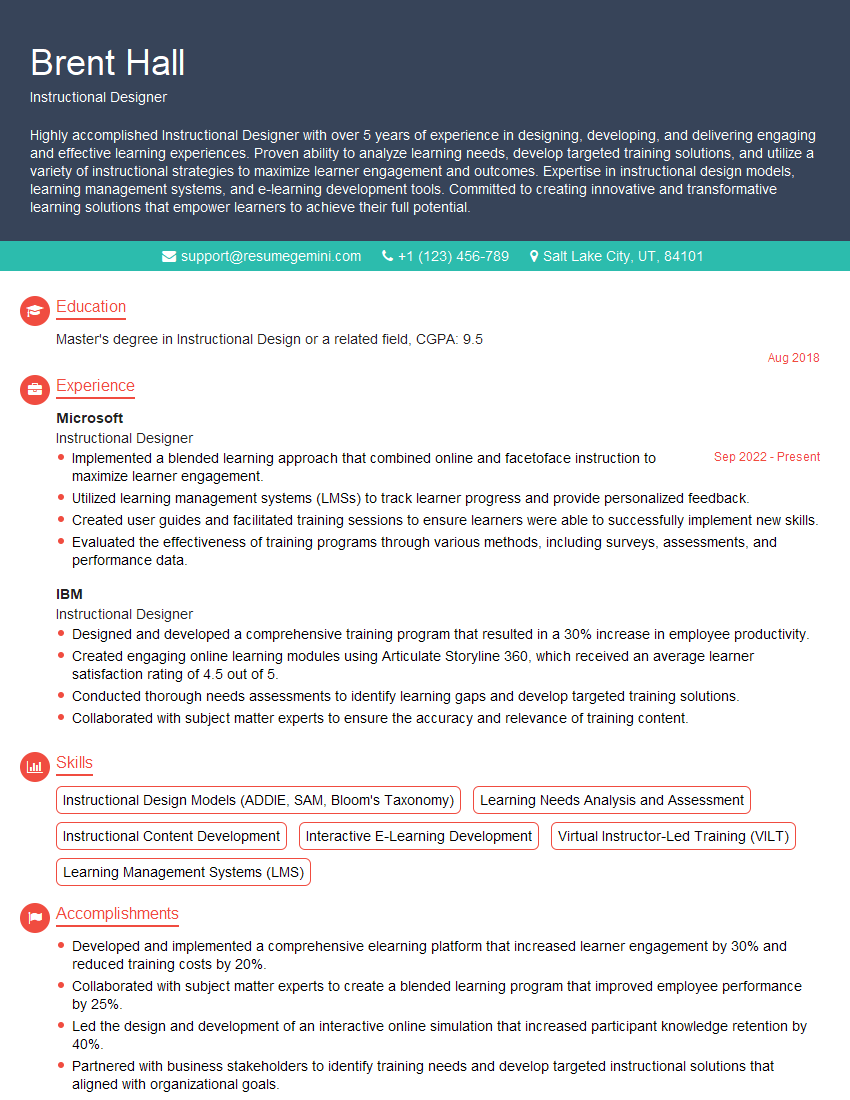
Instructional Designer Resume Sample

Technical Writer Resume Sample
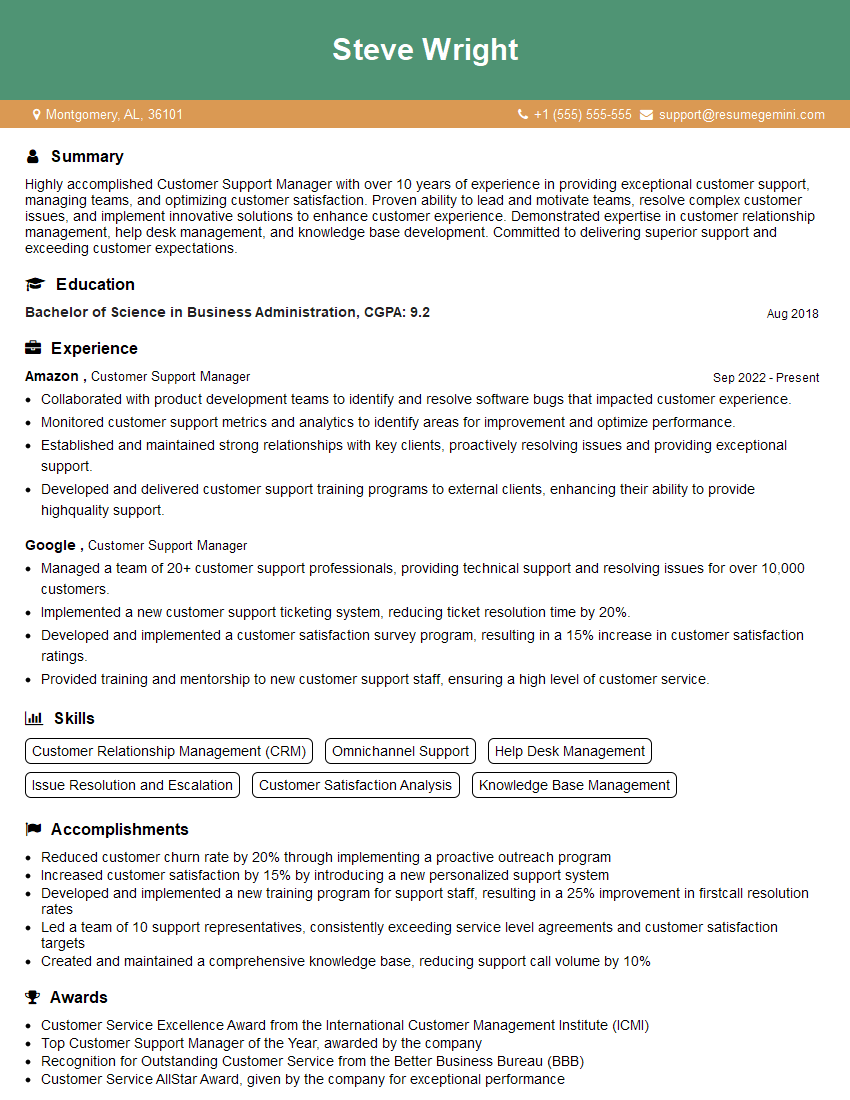
Customer Support Manager Resume Sample
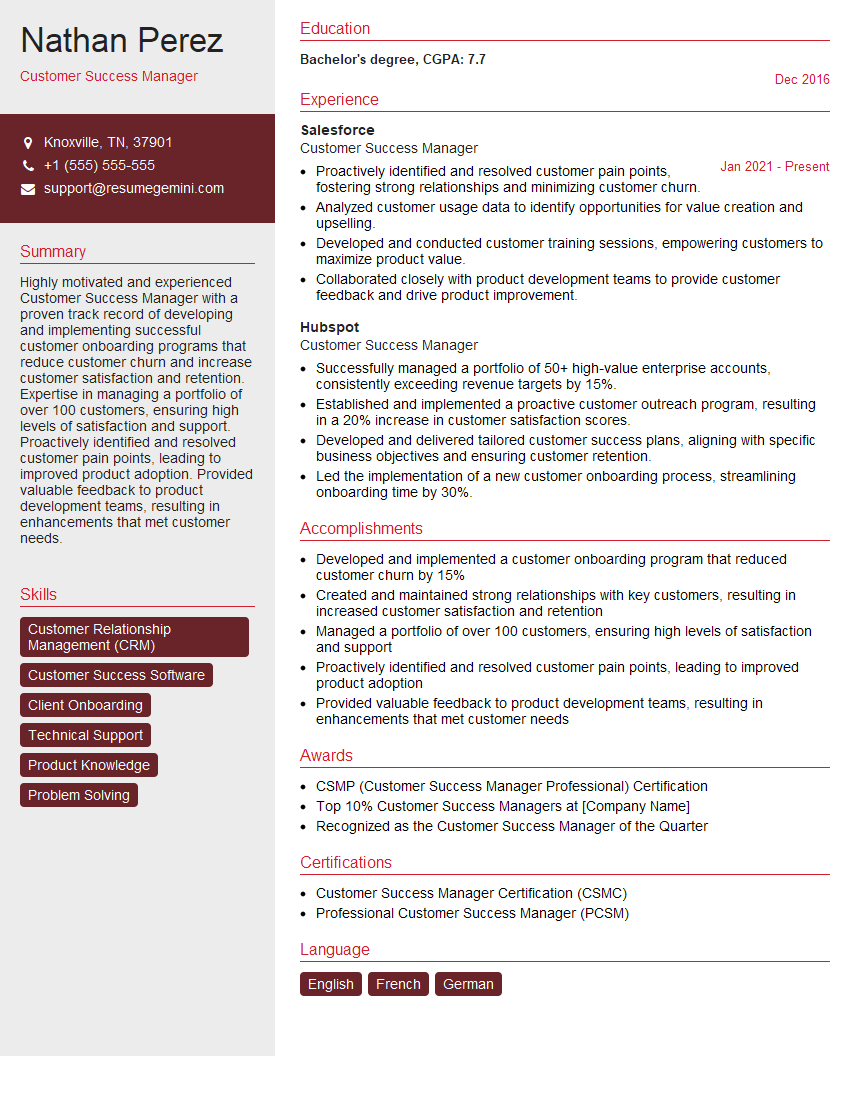
Customer Success Manager Resume Sample
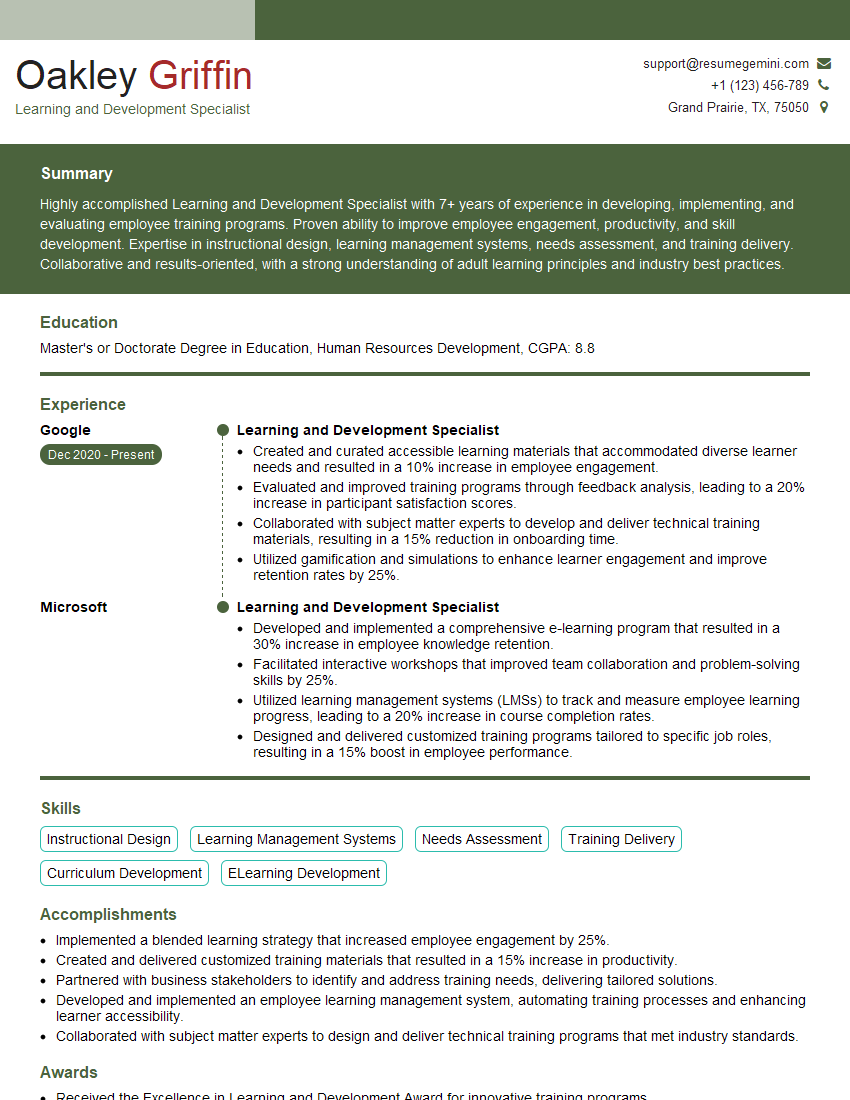
Learning and Development Specialist Resume Sample
- Training Consultant
- Training Manager
- Training Coordinator
- Technical Trainer
- Training Specialist
- Technical Support Specialist
- Customer Support Analyst
- Customer Support Representative
- Help Desk Analyst
- Customer Support Engineer
- Instructional Designer
- Technical Writer
- Customer Support Manager
- Customer Success Manager
- Learning and Development Specialist
Explore more articles
Users Rating of Our Blogs
Share Your Experience
We value your feedback! Please rate our content and share your thoughts (optional).
What Readers Say About Our Blog
Very informative content, great job.
good