The thought of an interview can be nerve-wracking, but the right preparation can make all the difference. Explore this comprehensive guide to Customs Brokering interview questions and gain the confidence you need to showcase your abilities and secure the role.
Questions Asked in Customs Brokering Interview
Q 1. Explain the difference between entry summary and entry.
In customs brokerage, an entry and an entry summary are closely related but distinct documents. Think of it like this: the entry summary is a preliminary notification, while the entry is the complete and formal declaration.
An entry summary is a shorter document submitted to Customs electronically, providing basic information about the shipment – like the importer, exporter, carrier, and a general description of the goods. It’s essentially a heads-up to Customs, allowing them to begin pre-processing the shipment. This speeds up the entire process.
The entry, on the other hand, is the comprehensive and legally binding declaration. It includes all the detailed information required by Customs, including the HS code classification, value, quantity, origin, and any applicable licenses or permits. The entry is only filed after the entry summary is processed and accepted. The entry is what officially releases the goods.
For example, imagine ordering a shipment of electronics. The entry summary might be submitted a day or two before the goods arrive at the port, giving customs time to prepare. The complete entry, with all the detailed commercial invoice and other documents, would then be filed upon arrival.
Q 2. Describe the process of classifying goods under the Harmonized System (HS) Code.
Classifying goods under the Harmonized System (HS) Code is crucial for determining the correct duties and regulations. It’s a multi-step process requiring careful examination of the product’s characteristics and the HS nomenclature.
- Understand the Product: First, thoroughly understand the physical and chemical properties, the intended use, and the manufacturing process of the goods. What is it made of? How is it used?
- Consult the HS Code Nomenclature: Use the official HS Nomenclature published by the World Customs Organization (WCO). It’s a hierarchical system, starting with broad categories and becoming more specific. You’ll need to navigate through different chapters, headings, subheadings, and tariff codes until you find the exact match.
- Legal Interpretation: Customs often provides detailed legal interpretations and rulings. Carefully reviewing these interpretations is crucial, particularly for borderline cases. These interpretations can help clarify ambiguity in the HS nomenclature.
- Binding Rulings: For complex classifications or high-value goods, consider seeking a binding ruling from your country’s customs authority. A binding ruling offers certainty and protects against future disputes. It formally declares the correct HS classification.
Example: Classifying a laptop computer involves finding the appropriate chapter (Chapter 84 – Nuclear reactors, boilers, machinery, and mechanical appliances), heading (Heading 8471 – Automatic data processing machines and units thereof), and subheadings (potentially 8471.30 – Laptops) based on its characteristics. Incorrect classification could lead to incorrect duties or delays.
Q 3. What are the key elements of a commercial invoice?
A commercial invoice is the primary document used in international trade to describe the goods being shipped. It’s essential for customs clearance and accurate duty assessment. Key elements include:
- Seller and Buyer Information: Full addresses, contact information.
- Invoice Date and Number: Unique identification.
- Description of Goods: Detailed description of each item, including quantity, unit of measurement, and specifications.
- HS Code: Correct Harmonized System classification code for each item.
- Unit Price and Total Value: Clearly stated in the currency of the transaction.
- Terms of Sale (Incoterms): Specifies the responsibilities of the buyer and seller concerning shipping and delivery (e.g., FOB, CIF, DDP).
- Payment Terms: How and when payment will be made.
- Shipping Information: Details about the shipment’s mode of transport, port of loading and discharge.
Inaccurate or incomplete commercial invoices can lead to delays and penalties. It’s critical that the invoice accurately reflects the goods and transaction details. A missing HS code, for instance, could cause significant delays.
Q 4. What are the different types of customs duties?
Customs duties are taxes imposed on imported goods. Several types exist, and their application depends on the country and specific goods.
- Ad Valorem Duties: A percentage of the value of the goods. For example, a 5% ad valorem duty on a $100 item would be $5.
- Specific Duties: A fixed amount per unit of quantity (e.g., $1 per kilogram).
- Compound Duties: A combination of ad valorem and specific duties.
- Anti-dumping Duties: Imposed to counteract unfairly low pricing of imported goods.
- Countervailing Duties: Offset subsidies provided by the exporting country.
These duties help protect domestic industries and generate revenue for the government. The specific rates vary widely between countries and depend on trade agreements.
Q 5. How do you determine the value of goods for customs purposes?
Determining the value of goods for customs purposes is crucial for calculating duties and taxes. Customs generally uses the transaction value as the primary basis. This is the price actually paid or payable for the goods, but it needs to meet specific criteria:
- Genuine Transaction: The price should represent a bona fide transaction between independent buyer and seller.
- Free of Conditions: The price shouldn’t include any hidden charges or conditions that aren’t explicitly stated.
- Arm’s Length: The buyer and seller should act independently and not be related in a way that affects the price.
If the transaction value can’t be used due to any discrepancies, alternative valuation methods exist, often involving adjustments to the transaction price to account for various factors.
Example: If a company imports goods at a price significantly lower than the market value, customs authorities might suspect undervaluation and apply alternative methods to determine a more accurate valuation.
Q 6. Explain the concept of ‘rules of origin’ and their importance.
Rules of origin determine where a product originates from. They’re crucial for determining applicable tariffs, trade preferences (e.g., free trade agreements), and compliance with trade regulations. They dictate the percentage of value added that needs to be produced in a certain country or region to be eligible for preferential treatment.
For example, under a free trade agreement between Country A and Country B, goods originating in Country A may enter Country B duty-free. But rules of origin specify that a significant portion of the manufacturing, processing or production must occur within Country A for preferential access to be granted.
The importance lies in their impact on trade costs, market access, and compliance. Incorrect rules of origin claims can lead to substantial penalties and trade disputes.
Determining rules of origin involves examining the manufacturing process, materials used, and the value added at each stage of production. Specific criteria vary greatly between agreements.
Q 7. What are the penalties for customs violations?
Penalties for customs violations can be severe and vary depending on the nature and severity of the violation, the jurisdiction, and the history of the involved parties.
- Financial Penalties: Fines ranging from a percentage of the dutiable value to substantial amounts.
- Seizure of Goods: The goods may be seized by customs, often resulting in forfeiture.
- Criminal Prosecution: In cases of serious violations like smuggling or fraud, criminal charges can lead to imprisonment.
- Trade Restrictions: Future import/export privileges might be suspended or revoked.
- Civil Liability: Legal action may be taken against importers for causing damages.
It’s vital to maintain accurate records, follow all regulations, and seek professional guidance when needed to avoid costly and time-consuming consequences.
Q 8. What are free trade agreements (FTAs) and how do they impact customs processes?
Free Trade Agreements (FTAs) are treaties between two or more countries that reduce or eliminate tariffs and other trade barriers on goods and services traded between them. Think of them as special deals that make international trade easier and cheaper. These agreements significantly impact customs processes by streamlining procedures and reducing paperwork.
- Reduced or Eliminated Tariffs: FTAs often eliminate or significantly reduce the tariffs (taxes) levied on goods imported from participating countries. This simplifies customs valuation and reduces the overall cost of imports.
- Simplified Documentation: FTAs often require less documentation than general imports, reducing the administrative burden on businesses. This is because the agreements often outline specific rules of origin, which determine whether a product qualifies for preferential treatment.
- Rules of Origin: A crucial element of FTAs is the rules of origin, which determine where a product was made. Meeting these rules is essential to benefit from the reduced tariffs. Customs authorities verify these rules to ensure that only eligible goods receive preferential treatment.
- Customs Procedures: Many FTAs lead to the development of specialized customs procedures, such as expedited customs clearance or simplified documentation processes, to expedite the movement of goods.
For example, a company importing furniture from a country with which its home country has an FTA would pay considerably less in import duties than if it were importing from a country without such an agreement. This could make the business significantly more competitive.
Q 9. How do you handle a customs audit?
A customs audit is a thorough examination of a company’s import and export records by customs authorities. It’s essentially a detailed review to ensure compliance with all relevant laws and regulations. Handling a customs audit requires meticulous preparation and cooperation.
- Gather Documentation: The first step is to assemble all relevant documentation, including invoices, packing lists, certificates of origin, import permits, and any other records related to the imports and exports being reviewed.
- Identify and Address Discrepancies: Review your own records for any potential discrepancies or inconsistencies before the audit begins. Identifying and correcting these ahead of time significantly lessens the impact of the audit.
- Cooperate Fully: Be fully cooperative with the auditors. Provide requested documents promptly and answer their questions thoroughly and honestly. Obstruction will only prolong the process and could lead to penalties.
- Maintain Accurate Records: Throughout the audit, maintain a detailed record of all communications and findings. This documentation will be crucial if disputes arise.
- Seek Professional Advice: If you’re unsure about any aspect of the audit, or if you believe that an auditor’s assessment is inaccurate, consult with a qualified customs broker or attorney. They can help ensure your rights are protected and that you are adhering to all procedures correctly.
Think of it like a financial audit – thorough preparation and transparent cooperation are key to a successful outcome. Proactive record-keeping throughout the year significantly minimizes the stress and potential penalties associated with an audit.
Q 10. What are the different types of customs bonds?
Customs bonds are financial guarantees that ensure compliance with customs regulations. They act as a form of insurance, protecting the government from losses due to non-compliance. Several types exist:
- Single-Entry Bond: Covers a single importation. This is commonly used for infrequent importers.
- Continuous Bond: Covers multiple importations over a specific period, offering convenience for regular importers. It’s often more cost-effective in the long run.
- Import Bond: Guarantees payment of duties and taxes on imported goods.
- Carnet Bond: A specialized bond that permits temporary importation of goods without paying duties. This is utilized for things like trade shows or temporary exhibitions.
- Transportation in Bond: Allows goods to move under customs control, for example from a port to a warehouse without paying duties until released into the country.
The specific type of bond needed will depend on the individual’s import/export activities and circumstances. Selecting the appropriate bond is crucial for ensuring a smooth customs clearance process.
Q 11. Explain the process of filing a customs protest.
Filing a customs protest is a formal process used to challenge a customs decision. This is usually done when an importer disagrees with a customs assessment of duties, taxes, or other fees. It’s a formal appeal, and strict timelines must be followed.
- Review the Customs Decision: Carefully review the customs assessment to fully understand the reasons for the decision.
- Prepare the Protest: The protest must include a detailed explanation of the reasons for the disagreement and provide supporting evidence. This may include documentation such as invoices, contracts, or expert opinions.
- File the Protest: The protest must be filed with the appropriate customs authority within the specified time frame (this varies by country and situation). Failure to meet the deadline can void the protest.
- Negotiation and Response: Customs will review the protest. If they determine the assessment was incorrect, they may reverse their decision. However, in many cases, additional evidence may be requested.
- Appeal (If Necessary): If the initial protest is unsuccessful, it might be possible to appeal the decision to a higher authority or through court action.
Think of it like appealing a traffic ticket, but with significantly more legal complexity and financial implications. It’s crucial to have a thorough understanding of customs law and regulations or seek professional legal counsel before filing a protest.
Q 12. How do you ensure compliance with customs regulations?
Ensuring compliance with customs regulations is paramount to avoid penalties and maintain a smooth flow of goods. This involves a multi-faceted approach:
- Stay Updated: Customs regulations change frequently. It’s essential to stay current on all applicable laws and regulations in the countries of import and export.
- Maintain Accurate Records: Thoroughly maintain detailed and accurate records of all import and export transactions. This includes invoices, packing lists, certificates of origin, and other supporting documents. This documentation is vital for audits and potential disputes.
- Proper Classification: Accurately classify your goods using the Harmonized System (HS) coding system. Misclassification can lead to significant penalties.
- Utilize Customs Brokers: A customs broker has expertise in navigating customs regulations and can significantly reduce the risk of non-compliance.
- Internal Controls: Implement robust internal controls and procedures to ensure that all import and export transactions comply with all relevant regulations.
- Training: Provide thorough training to your employees on customs regulations and procedures.
Regular review and updates to these processes are crucial. Think of compliance as an ongoing process, not a one-time task, to guarantee a consistently smooth flow of goods across borders.
Q 13. What are Incoterms and how do they affect customs documentation?
Incoterms® rules (International Commercial Terms) are standardized trade terms that define the responsibilities of buyers and sellers in international transactions. They specify who is responsible for costs, risks, and obligations related to the transportation of goods. These terms directly affect customs documentation because they determine which party is responsible for various aspects of the customs process.
- Responsibility for Export Customs Clearance: Incoterms dictate who is responsible for completing export customs clearance procedures in the seller’s country. For example, under DDP (Delivery Duty Paid), the seller handles all customs formalities at export and import.
- Responsibility for Import Customs Clearance: Similar to export, Incoterms determine which party handles import customs clearance in the buyer’s country. Under EXW (Ex Works), the buyer is responsible for all import customs processes.
- Documentation Requirements: The chosen Incoterm determines which documents are needed and who is responsible for providing them. For example, a commercial invoice might be the seller’s responsibility in one scenario and the buyer’s in another.
- Cost Allocation: Incoterms determine which party bears the costs associated with transportation, insurance, and customs duties. This impacts how these costs are reflected in customs declarations.
Choosing the right Incoterm is crucial for avoiding disputes and ensuring clarity regarding responsibilities. Incoterms are integral to accurate and complete customs documentation.
Q 14. Describe your experience with customs software and systems.
Throughout my career, I’ve extensively used various customs software and systems, both proprietary and government-provided. My experience includes:
- ACS (Automated Commercial System): I’m proficient in using ACS for electronic filing of import and export entries, managing bonds, and tracking shipments. I’m familiar with its various modules and reporting capabilities.
- Tradenet: I have experience with Tradenet, another electronic filing system commonly used for customs transactions.
- Import/Export Management Systems (IMS): I have worked with several enterprise-level IMS software, which integrate with customs systems to automate processes, track shipments, and manage documentation. This includes experience with data integration and API usage.
- Customs Brokerage Software: I’ve utilized various brokerage software packages specifically designed to streamline customs processes, managing client data, generating documentation, and tracking the status of shipments.
My understanding of these systems extends beyond simple data entry. I understand the underlying data structures and the ability to troubleshoot and resolve system-related issues. My experience ensures efficient and accurate customs processing, minimizing delays and errors.
Q 15. How do you manage complex supply chains?
Managing complex supply chains in customs brokerage requires a holistic approach. It’s like orchestrating a symphony – each instrument (supplier, manufacturer, carrier, customs authority) needs to play its part in perfect harmony to achieve the final goal: timely and compliant delivery of goods.
- Visibility: I utilize advanced tracking systems and collaborate closely with all stakeholders to maintain complete visibility into the shipment’s journey, from origin to destination. This allows us to proactively identify and address potential delays or disruptions.
- Risk Management: Proactive risk assessment is key. I identify potential issues, such as port congestion, regulatory changes, or geopolitical instability, and develop contingency plans to mitigate them. For example, if a particular port is experiencing delays, I might explore alternative routes or modes of transport.
- Process Optimization: Streamlining processes is crucial for efficiency. We employ automation wherever possible, using tools like the Automated Broker Interface (ABI), to reduce manual data entry and improve accuracy. We also regularly review our processes to identify areas for improvement.
- Communication: Constant and clear communication with all parties is paramount. This includes regular updates, proactive alerts, and prompt responses to queries. This ensures everyone is on the same page and minimizes misunderstandings.
For instance, during a recent project involving the shipment of sensitive medical equipment, we encountered an unexpected regulatory change mid-transit. By leveraging our established relationships with authorities and swiftly adjusting our strategy, we ensured the shipment reached its destination on time and within compliance.
Career Expert Tips:
- Ace those interviews! Prepare effectively by reviewing the Top 50 Most Common Interview Questions on ResumeGemini.
- Navigate your job search with confidence! Explore a wide range of Career Tips on ResumeGemini. Learn about common challenges and recommendations to overcome them.
- Craft the perfect resume! Master the Art of Resume Writing with ResumeGemini’s guide. Showcase your unique qualifications and achievements effectively.
- Don’t miss out on holiday savings! Build your dream resume with ResumeGemini’s ATS optimized templates.
Q 16. What is your experience with different modes of transportation (sea, air, land)?
My experience encompasses all major modes of transportation – sea, air, and land. Each presents unique challenges and considerations regarding customs procedures, documentation, and regulatory compliance.
- Sea Freight: I’m proficient in handling Bill of Lading (B/L) documentation, Incoterms, and the nuances of ocean carrier contracts. I understand the complexities of port operations, including potential delays caused by congestion or unforeseen circumstances. I have experience managing large volumes of containerized cargo.
- Air Freight: Air freight requires faster turnaround times and specialized handling. I’m experienced with Air Waybills (AWB), managing sensitive cargo, and navigating the intricacies of air cargo security regulations. I’ve successfully managed numerous time-sensitive shipments of high-value goods.
- Land Freight: I have experience with trucking, rail, and other land-based transport. This includes ensuring compliance with various trucking regulations, managing cross-border transportation, and coordinating with various trucking companies and border crossing agents. I’m familiar with the documentation requirements and potential challenges related to in-transit cargo.
My experience allows me to select the optimal mode of transport based on factors such as cost, speed, and the nature of the goods being shipped. I can effectively manage multimodal shipments, seamlessly integrating different modes of transport to create the most efficient and cost-effective solution.
Q 17. How do you prioritize tasks in a high-pressure environment?
Prioritization in a high-pressure environment like customs brokerage is critical. I use a combination of techniques to effectively manage tasks and deadlines. Think of it like a triage system in a hospital – you need to attend to the most urgent cases first.
- Urgency/Importance Matrix: I categorize tasks based on their urgency and importance. This helps me focus on the most critical tasks first, ensuring timely completion of time-sensitive items.
- Time Blocking: I allocate specific time slots for focused work on critical tasks, minimizing distractions. This ensures efficient use of time and helps avoid feeling overwhelmed.
- Delegation: When appropriate, I delegate tasks to team members with the necessary skills. This ensures efficient workload distribution and allows me to focus on high-level strategic decision-making.
- Communication: Maintaining open communication with clients and team members is vital. I keep everyone informed about progress, potential roadblocks, and revised timelines as needed.
For instance, during a peak shipping season, I might prioritize shipments with imminent deadlines, ensuring their timely clearance while effectively managing other tasks.
Q 18. Describe your experience with international trade regulations.
My experience with international trade regulations is extensive. I possess a comprehensive understanding of various regulations, including tariff schedules, rules of origin, import/export licensing requirements, and trade sanctions. It’s like knowing the intricate rules of a complex game – if you don’t know them, you can’t win.
- Harmonized System (HS) Codes: I’m highly proficient in classifying goods using HS codes, ensuring accurate tariff determination and compliance.
- Country-Specific Regulations: I have a deep understanding of regulations specific to various countries, including the U.S., Canada, the EU, and several Asian markets. This includes knowing the specific paperwork, licenses, and certificates needed for different types of goods.
- Free Trade Agreements (FTAs): I’m knowledgeable about various FTAs and how to leverage them to reduce import duties and simplify customs procedures.
- Sanctions and Embargoes: I’m fully aware of current sanctions and embargoes and always ensure compliance with them. This is crucial to avoid legal and financial penalties.
I continuously update my knowledge to stay abreast of changes in regulations. I regularly attend industry seminars, and subscribe to updates from regulatory agencies. This ensures that our clients benefit from the most up-to-date and accurate information, leading to smooth transactions and minimized risks.
Q 19. How do you handle challenging or ambiguous situations in customs brokerage?
Handling challenging or ambiguous situations requires a methodical approach. I typically follow a structured problem-solving process:
- Identify the Problem: Clearly define the issue, gathering all relevant information and documentation.
- Analyze the Situation: Investigate the root cause of the problem, considering all potential factors, including regulatory requirements, logistical constraints, and potential errors.
- Develop Solutions: Explore different solutions, weighing their pros and cons. This might involve contacting customs authorities, consulting legal experts, or negotiating with carriers.
- Implement Solution: Execute the chosen solution, monitoring its effectiveness.
- Evaluate Results: Assess the outcome and document the process, lessons learned, and any improvements for future situations.
For example, I once encountered a shipment where the documentation was incomplete, causing a delay in customs clearance. By systematically investigating the issue, I identified the missing paperwork, worked with the shipper to obtain it, and ultimately secured timely release of the shipment while maintaining compliance.
Q 20. What is your understanding of anti-dumping and countervailing duties?
Anti-dumping and countervailing duties are trade remedies imposed by importing countries to protect their domestic industries from unfair competition.
- Anti-dumping duties are levied when imported goods are sold at a price lower than their normal value in the exporting country (dumping). This is seen as an unfair trade practice that can harm domestic producers.
- Countervailing duties are imposed when imported goods benefit from government subsidies in the exporting country. These subsidies can give exporters an unfair advantage, and countervailing duties are designed to neutralize that advantage.
Understanding these duties is critical for customs brokerage. We must be aware of any investigations or imposed duties that might affect our clients’ shipments. This requires a strong understanding of trade laws and a diligent monitoring of relevant government announcements. Failing to account for these duties can lead to significant financial losses for our clients.
Q 21. Explain your experience with the Automated Broker Interface (ABI).
The Automated Broker Interface (ABI) is a critical tool in modern customs brokerage. It’s an electronic system that allows brokers to submit and receive information from U.S. Customs and Border Protection (CBP). Think of it as a secure digital portal for all customs-related transactions.
- Entry Filing: I routinely use ABI to electronically file import and export entries, significantly reducing processing time and paperwork.
- Data Transmission: ABI enables secure and efficient transmission of all necessary documents, including commercial invoices, packing lists, and certificates of origin.
- Tracking: I utilize ABI to track the status of entries, ensuring timely clearance and managing potential delays.
- Reporting: ABI provides access to various reports and data, helping us monitor performance and identify areas for improvement.
My proficiency in ABI allows me to handle high volumes of shipments efficiently and accurately, ensuring regulatory compliance and minimizing delays. I’m comfortable navigating the system and addressing any issues or queries that may arise during the submission process. It’s become an indispensable part of my daily workflow.
Q 22. How do you stay updated on changes in customs regulations and procedures?
Staying current with customs regulations is paramount in this field. It’s not a one-time task but a continuous process. I employ a multi-pronged approach:
Subscription to Regulatory Updates: I subscribe to official government publications and newsletters from agencies like Customs and Border Protection (CBP) in the US, or equivalent agencies in other countries where I’m operating. This ensures I receive direct updates on rule changes, new procedures, and interpretations.
Industry-Specific Publications and Journals: I regularly read trade journals and online resources that focus on customs brokerage and international trade. These often provide expert analysis and insights into the practical implications of regulatory changes.
Professional Development: I actively participate in webinars, seminars, and conferences hosted by customs organizations and professional bodies. This allows for networking and learning directly from experts and other brokers.
Collaboration with Colleagues: I maintain a strong network of colleagues and mentors within the industry. We share insights and discuss challenges, which often surfaces information about recent changes or interpretations.
Software and Technology: Many customs compliance software platforms provide automated updates and alerts on regulatory changes. Using these tools keeps me proactively informed.
For example, recently, the EU updated its rules on the import of certain textiles. Through my subscriptions and professional networks, I was quickly aware of the changes and adjusted our processes accordingly to ensure compliance for our clients.
Q 23. What is your experience with different types of customs documentation?
My experience encompasses a wide range of customs documentation, crucial for efficient and compliant international trade. I’m proficient in handling various forms, including:
Commercial Invoices: These detail the goods being shipped, their value, and other relevant information. I understand the nuances of creating compliant invoices that meet both the exporter’s and importer’s requirements, as well as the destination country’s regulations.
Packing Lists: These provide a detailed description of the contents of each package in a shipment, crucial for customs officers to verify the declared goods. Accuracy here is vital to prevent delays and penalties.
Bills of Lading (B/L): These documents serve as a contract of carriage between the shipper and the carrier, and are an essential part of the import/export process. Different types exist, like ocean bills of lading, air waybills, etc., each with specific requirements.
Certificates of Origin (COO): These certify the country of origin of the goods, impacting tariffs and trade agreements (like USMCA). I have expertise in determining the correct COO and ensuring accurate documentation.
Import/Export Licenses and Permits: Certain goods require specific licenses or permits for import or export, and I’m experienced in acquiring the necessary documentation for our clients.
Entry Summaries (e.g., CBP Form 7501 in the US): These are the formal entry documents submitted to customs authorities to declare imported goods. Accuracy and completeness are critical here to ensure smooth clearance.
I’ve handled thousands of shipments across different industries, ensuring all necessary documentation is properly completed and submitted to meet strict deadlines and avoid delays or penalties. For example, I recently helped a client navigate the complex documentation requirements for importing specialized medical equipment, ensuring compliance with all regulations.
Q 24. How do you identify and mitigate customs risks?
Identifying and mitigating customs risks is a proactive and essential part of my role. My approach involves:
Risk Assessment: I carefully analyze each shipment to identify potential risks, considering factors such as the goods’ classification, origin, destination, and value. High-value goods or those subject to sanctions or quotas are assessed more thoroughly.
Due Diligence on Clients: I conduct due diligence on new clients to assess their compliance history and reputation, minimizing the risk of associating with non-compliant businesses.
Accurate Classification: Properly classifying goods under the Harmonized System (HS) code is crucial. Misclassification can lead to significant financial penalties. I have the expertise to ensure accurate classification based on the product’s characteristics and intended use.
Documentation Review: Thorough review of all submitted documents is crucial to identify any inconsistencies or omissions before submission to customs.
Proactive Communication with Customs: Maintaining open communication with customs authorities allows for early identification and resolution of potential issues. This can include pre-filing consultations to address any concerns before the shipment arrives.
Contingency Planning: I develop contingency plans to address potential delays or issues. This might involve having alternative solutions ready or anticipating potential challenges with particular goods or destinations.
For instance, I recently identified a potential risk of misclassification for a client’s shipment of electronics. By conducting thorough research and consulting with experts, I ensured correct classification, avoiding significant financial penalties.
Q 25. Describe your experience with NAFTA/USMCA compliance.
I have extensive experience with NAFTA/USMCA compliance. My understanding extends beyond simply knowing the rules; I understand the practical implications for businesses. This includes:
Rules of Origin: Determining whether goods qualify for preferential tariff treatment under USMCA requires a deep understanding of the rules of origin. This often involves verifying the origin of components and materials used in manufacturing.
Proof of Origin: I am skilled in preparing and verifying the required documentation, such as certificates of origin, to demonstrate that goods meet the USMCA rules of origin requirements.
Value Verification: Accurately determining the value of goods is essential for proper tariff calculation. I am familiar with the valuation methodologies under USMCA.
Tariff Classification: Understanding the HS codes under USMCA and ensuring correct classification to benefit from preferential treatment.
Markings and Labeling Requirements: Compliance with any specific markings and labeling requirements for goods under USMCA.
I’ve helped numerous clients navigate the complexities of USMCA, ensuring they receive the benefits of the agreement while maintaining full compliance. One successful example involved a client producing automotive parts in Mexico. By ensuring accurate documentation and compliance, we secured significant tariff reductions for them.
Q 26. How do you build and maintain relationships with customs officials?
Building and maintaining strong relationships with customs officials is crucial for effective customs brokerage. This is achieved through:
Professionalism and Respect: Always treating customs officials with respect and professionalism, adhering to all protocols and procedures.
Clear and Accurate Communication: Providing clear, concise, and accurate information in all communications. This minimizes misunderstandings and delays.
Prompt Response to Inquiries: Responding promptly and thoroughly to any inquiries from customs officials.
Proactive Communication: Proactively communicating with customs authorities about potential issues or concerns before they escalate.
Maintaining a Strong Compliance Record: A consistent record of compliance builds trust and credibility with customs officials.
Networking and Professional Development: Attending industry events and engaging in professional development to build relationships with customs officials and other brokers.
Building rapport is not about favors, but about establishing a reputation for professionalism and accuracy. By demonstrating expertise and reliability, I’ve cultivated long-term relationships with officials, leading to smoother customs clearances for my clients.
Q 27. How do you handle discrepancies between documentation and actual goods?
Discrepancies between documentation and actual goods are a serious issue that requires immediate attention. My approach involves:
Immediate Investigation: Upon discovering a discrepancy, a thorough investigation is launched to determine the cause. This involves reviewing all available documentation, comparing it to the actual goods, and involving all relevant parties.
Detailed Documentation: Meticulously documenting all findings, including photos, descriptions, and explanations of the discrepancy.
Communication with All Parties: Open communication with the client, carrier, and customs authorities is crucial. Transparency is vital to ensure a smooth resolution.
Corrective Actions: Taking appropriate corrective actions to rectify the discrepancy, which may involve amending documentation, rectifying errors in the shipment, or applying for corrections with customs authorities.
Follow-Up: Following up with customs authorities to ensure the issue is resolved and to monitor for any potential consequences.
For instance, I once discovered a discrepancy in the quantity of goods declared versus the actual quantity upon physical inspection. Through a methodical investigation and clear communication with all parties, we successfully amended the documentation and cleared the shipment with minimal disruption.
Key Topics to Learn for Your Customs Brokering Interview
- International Trade Regulations: Understand the intricacies of import and export regulations, including tariff classifications, rules of origin, and trade agreements (e.g., NAFTA/USMCA, WTO agreements).
- Customs Documentation: Master the preparation and accurate completion of all necessary customs documentation, including commercial invoices, packing lists, certificates of origin, and entry summaries. Be prepared to discuss practical scenarios involving missing or incorrect documentation.
- Customs Procedures: Familiarize yourself with the entire customs clearance process, from entry filing to examination and release of goods. Understand the different types of entries (e.g., formal, informal) and their implications.
- Classification and Valuation: Develop a strong understanding of the Harmonized System (HS) code classification and its impact on duties and taxes. Practice different valuation methods used to determine the dutiable value of goods.
- Compliance and Risk Management: Discuss strategies for ensuring compliance with customs regulations and mitigating potential risks, including penalties and audits. Be ready to explain how you would handle a potential customs audit.
- Technology and Systems: Demonstrate familiarity with relevant customs brokerage software and electronic filing systems. Discuss your experience with data entry, data analysis, and reporting.
- Logistics and Supply Chain Management: Explain your understanding of the broader supply chain and how customs brokerage fits into the overall process. Discuss your ability to work effectively with other stakeholders, such as importers, exporters, and freight forwarders.
- Problem-Solving and Critical Thinking: Be prepared to discuss how you would approach and solve complex problems related to customs clearance, such as delays, discrepancies, and disputes.
Next Steps
Mastering Customs Brokering opens doors to a rewarding career with significant growth potential in a dynamic global industry. To maximize your job prospects, it’s crucial to present yourself effectively. An ATS-friendly resume is key to getting your application noticed by recruiters and hiring managers. We highly recommend using ResumeGemini to craft a compelling and professional resume that highlights your skills and experience. ResumeGemini provides examples of resumes tailored specifically to the Customs Brokering field to help guide you in creating a standout application.
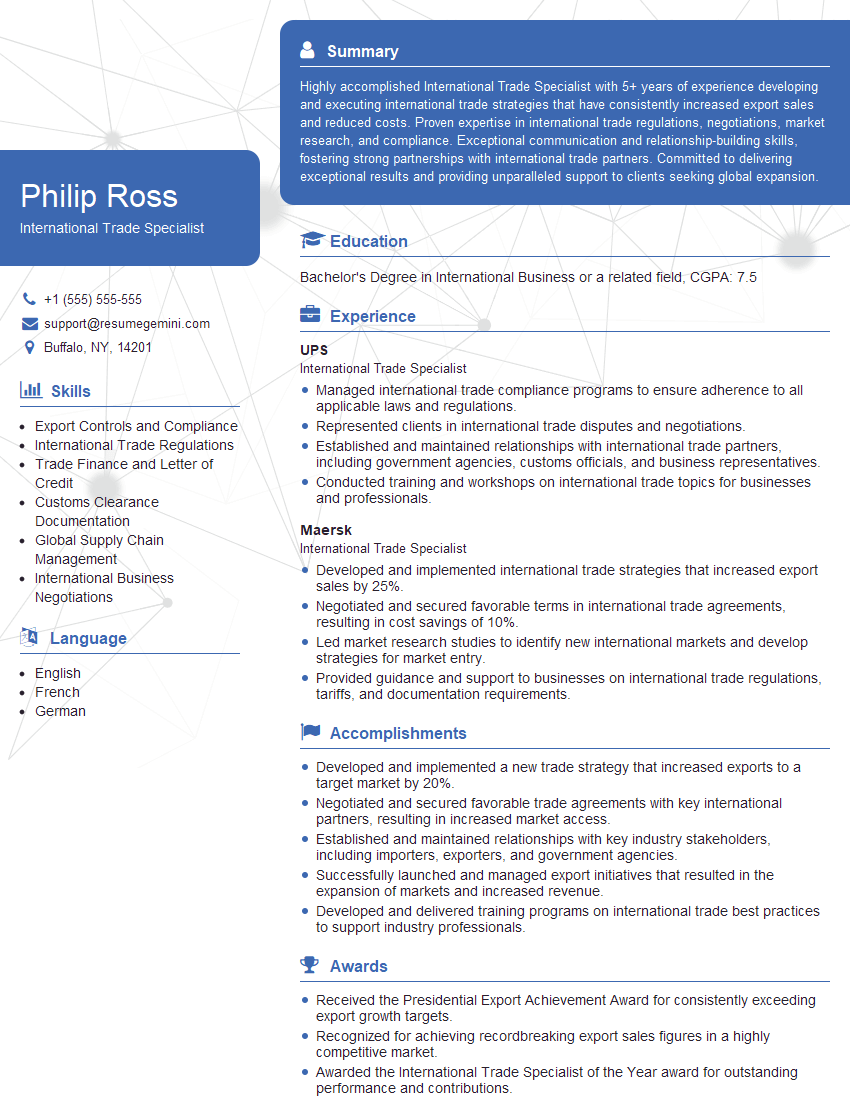
International Trade Specialist Resume Sample

Supply Chain Manager Resume Sample
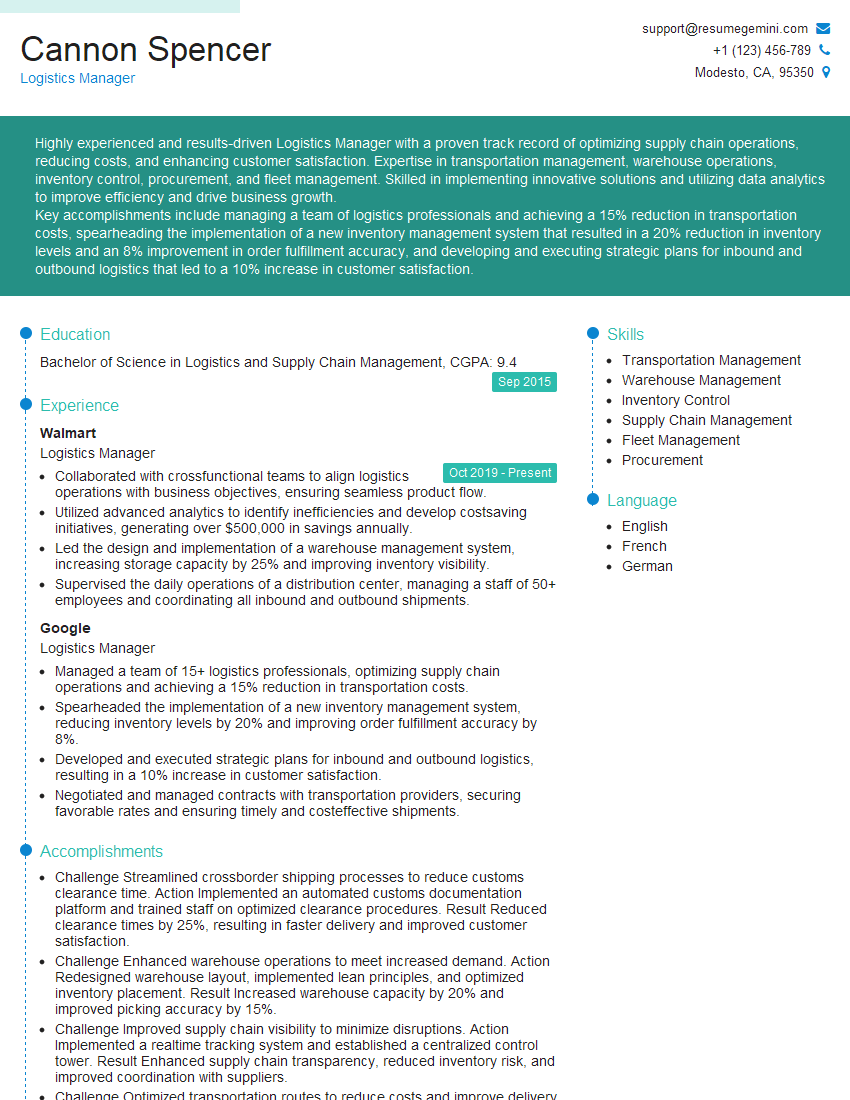
Logistics Manager Resume Sample
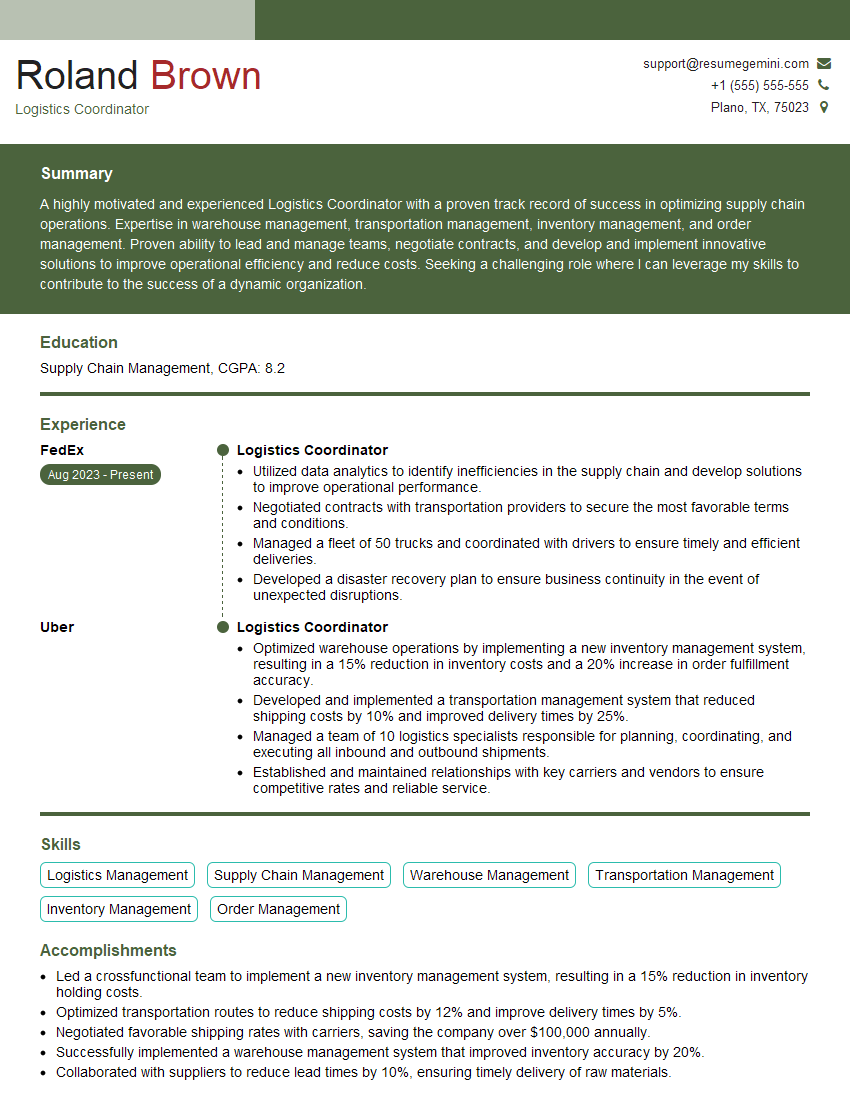
Logistics Coordinator Resume Sample
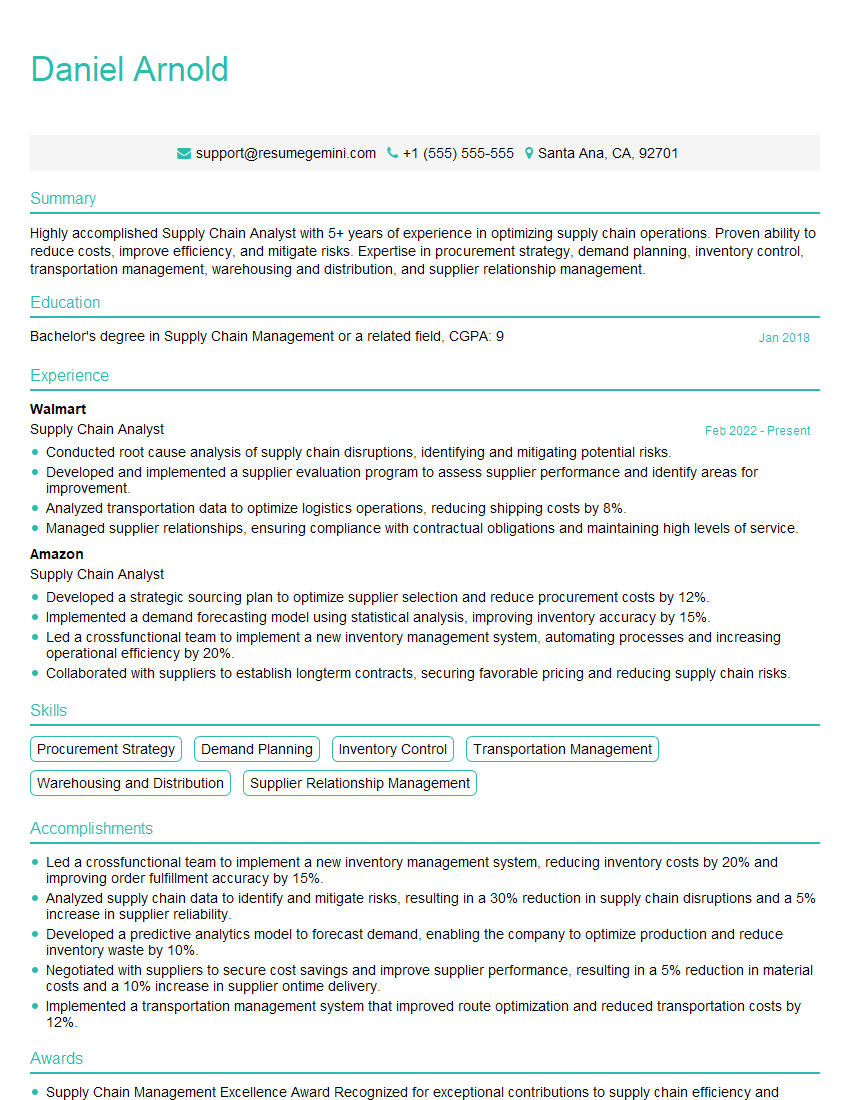
Supply Chain Analyst Resume Sample
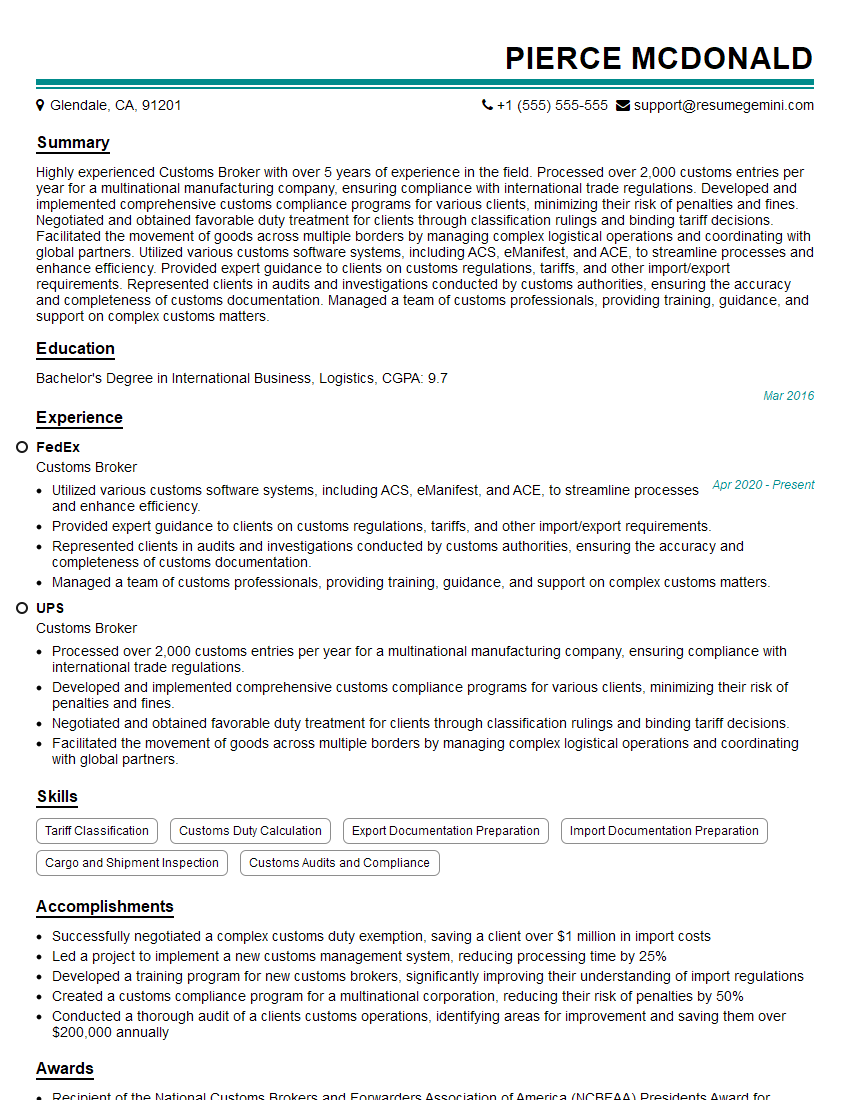
Customs Broker Resume Sample
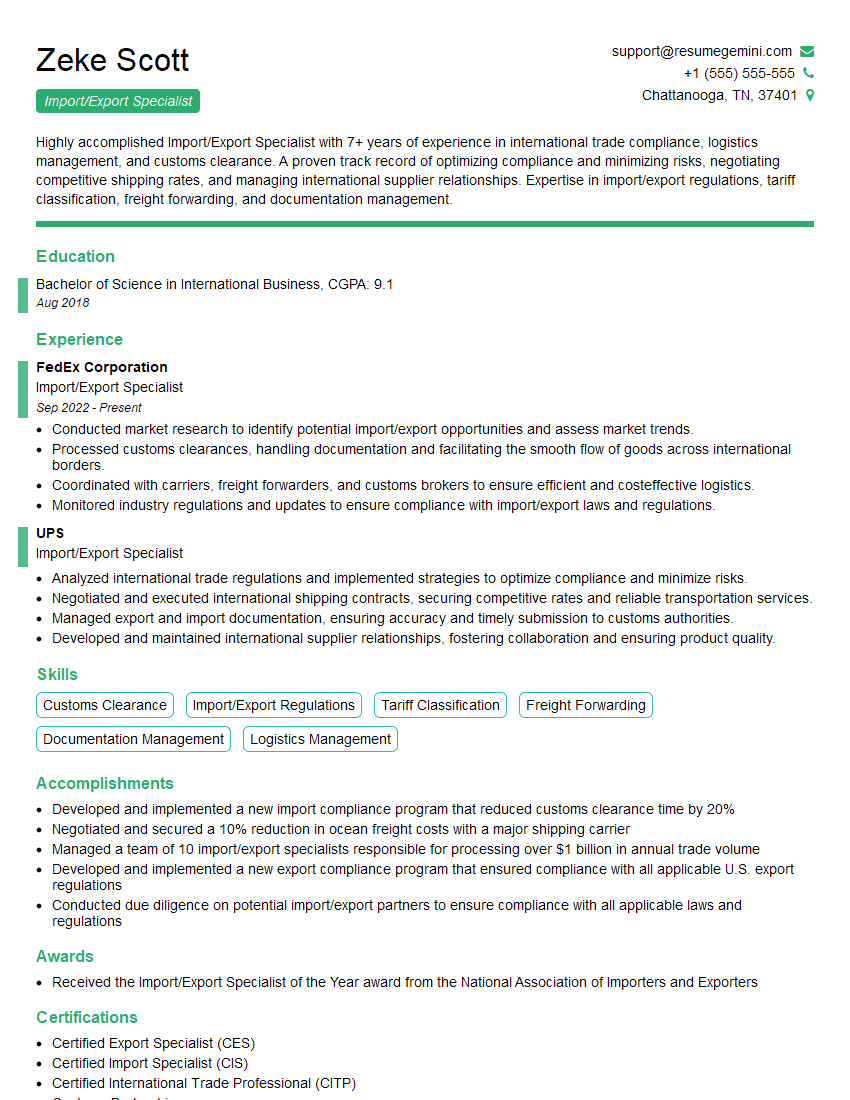
Import/Export Specialist Resume Sample
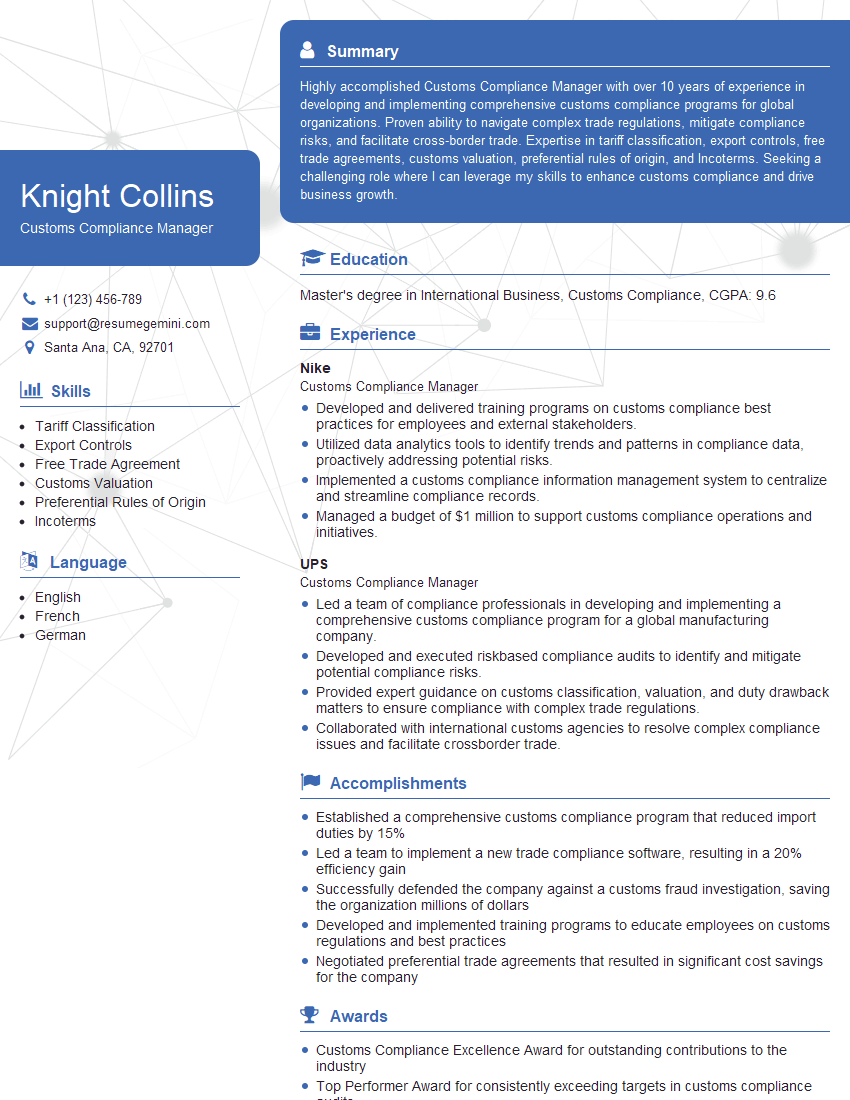
Customs Compliance Manager Resume Sample
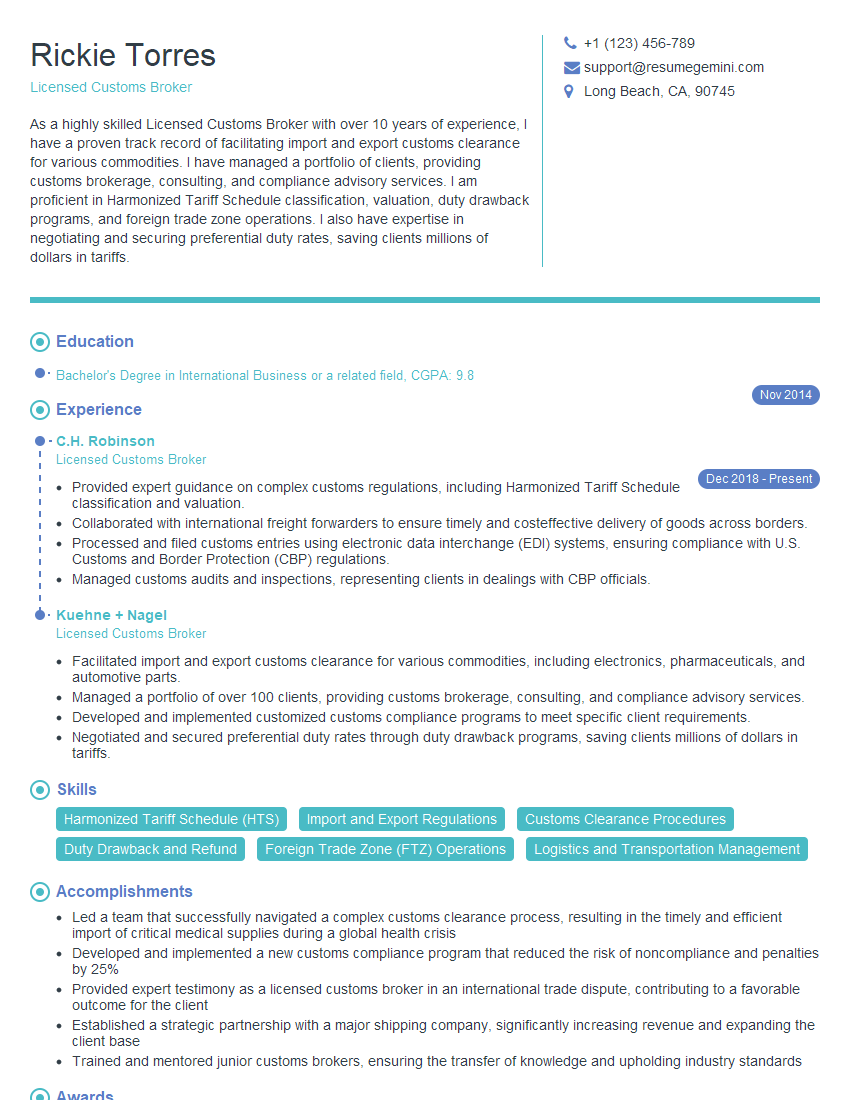
Licensed Customs Broker Resume Sample
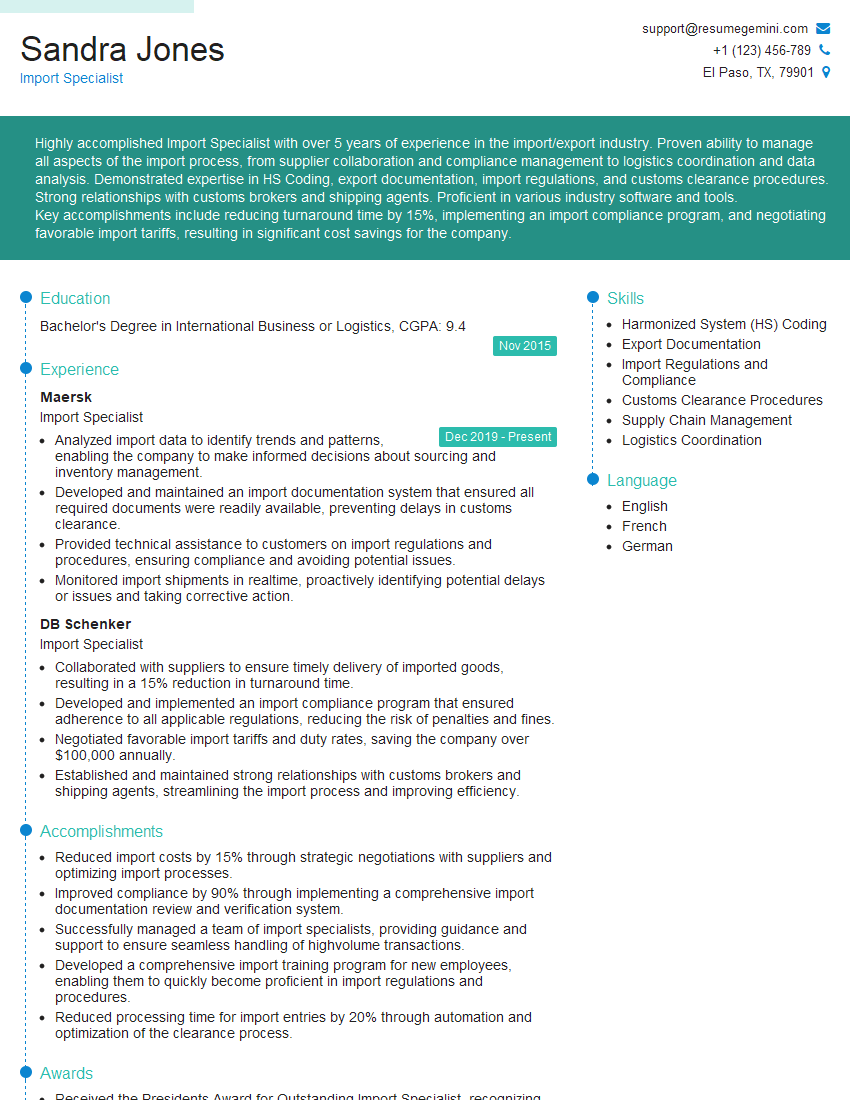
Import Specialist Resume Sample
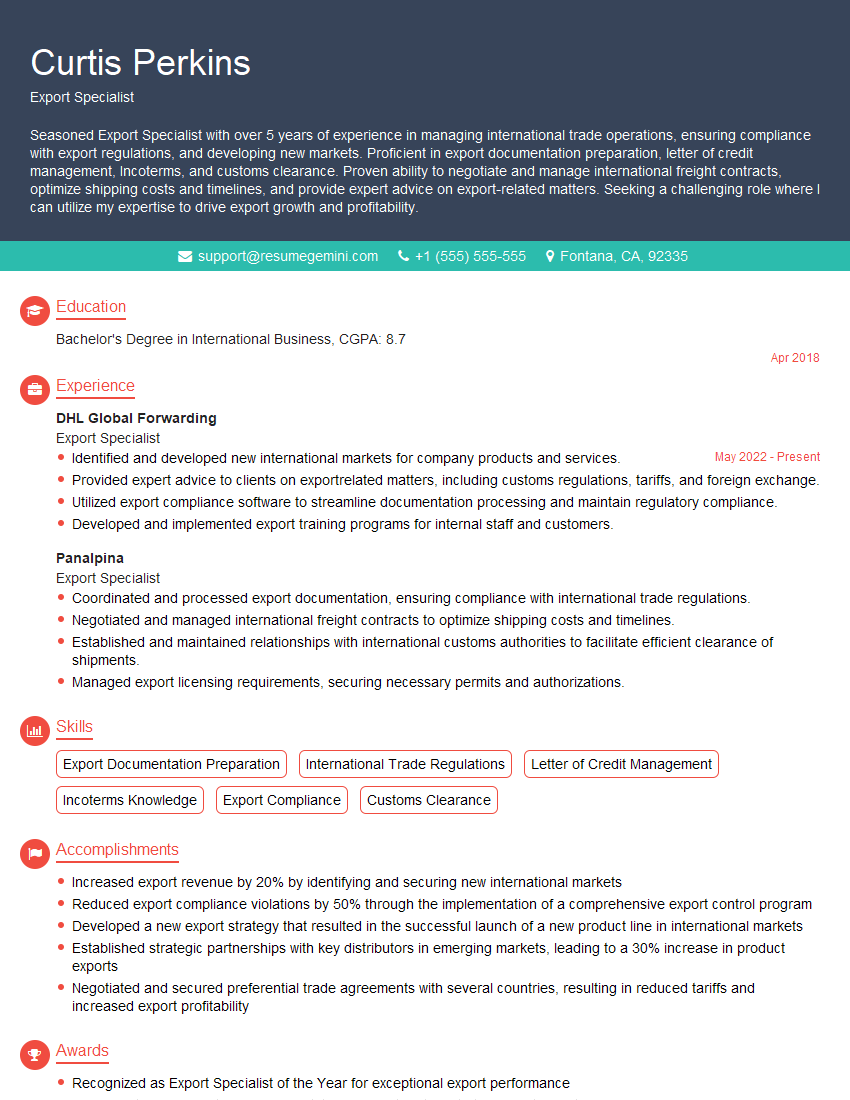
Export Specialist Resume Sample
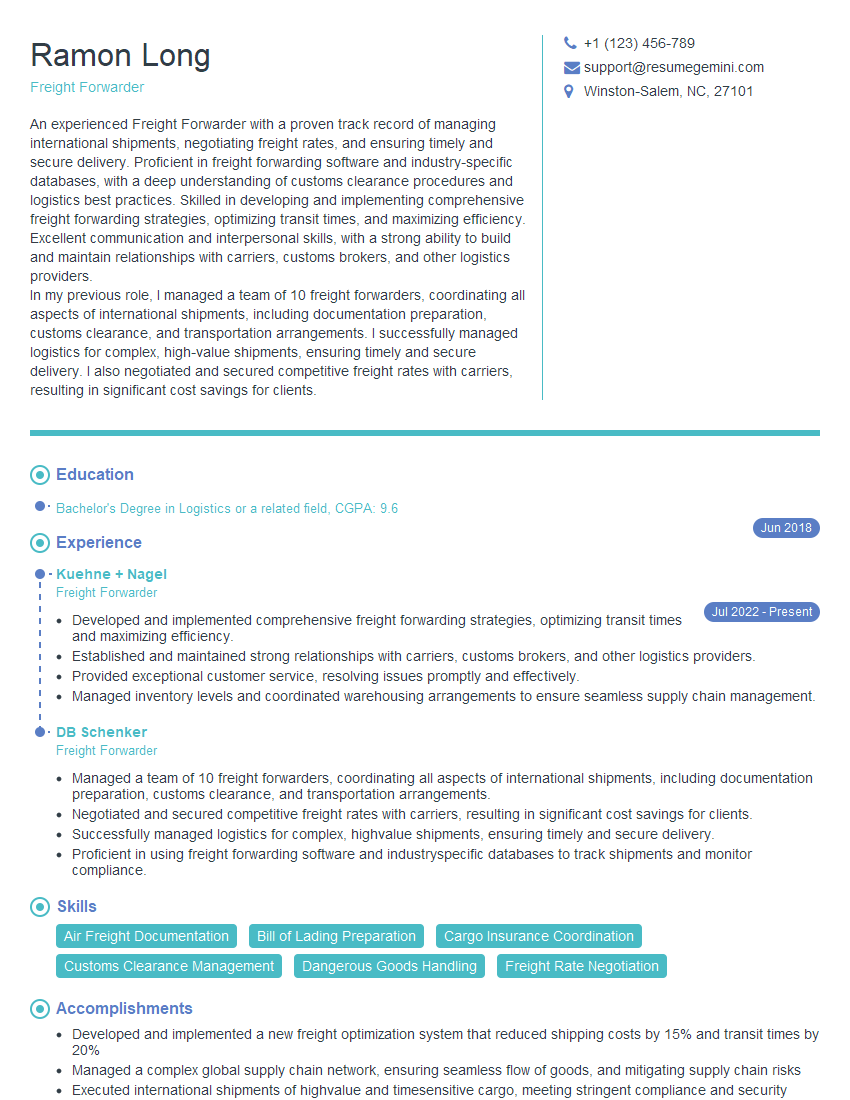
Freight Forwarder Resume Sample
Explore more articles
Users Rating of Our Blogs
Share Your Experience
We value your feedback! Please rate our content and share your thoughts (optional).
What Readers Say About Our Blog
Very informative content, great job.
good