Interviews are opportunities to demonstrate your expertise, and this guide is here to help you shine. Explore the essential Cyber Security Incident Response Planning interview questions that employers frequently ask, paired with strategies for crafting responses that set you apart from the competition.
Questions Asked in Cyber Security Incident Response Planning Interview
Q 1. Explain the NIST Cybersecurity Framework in the context of incident response.
The NIST Cybersecurity Framework (CSF) provides a voluntary framework for organizations to improve their cybersecurity posture. In the context of incident response, it acts as a guide for developing and implementing a comprehensive plan. It’s not a prescriptive standard, but a flexible set of guidelines that can be tailored to any organization’s size and complexity. The CSF’s five core functions – Identify, Protect, Detect, Respond, and Recover – directly map to the stages of incident response. For example, the ‘Identify’ function involves asset inventory and risk assessment, crucial for preparing for incidents. The ‘Protect’ function focuses on preventative measures like security controls, aligning with the preparation phase of incident response. The ‘Detect’ function is all about identifying incidents as they occur, directly linking to the identification phase. ‘Respond’ mirrors the containment, eradication, and recovery phases, detailing how to handle an incident. Finally, ‘Recover’ covers restoring systems and learning from the event, aligning with post-incident activity. By using the CSF, organizations can build a resilient incident response program aligned with their specific needs and risk profile. Imagine a hospital – their incident response needs will be far more stringent than a small retail store. The CSF allows both to adopt its principles, though their implementation will differ significantly.
Q 2. Describe the phases of incident response: Preparation, Identification, Containment, Eradication, Recovery, and Post-Incident Activity.
Incident response unfolds in a series of phases, each crucial for mitigating the impact of a security breach. Let’s break them down:
- Preparation: This is the proactive phase. It involves creating an incident response plan (IRP), defining roles and responsibilities, establishing communication protocols, identifying critical assets, and conducting regular training and drills. Think of it as building a fire escape plan – you hope you never need it, but if you do, you want to know exactly what to do.
- Identification: This is when you detect an incident. This might be through security alerts, unusual system activity, user reports, or external notifications. Early identification is crucial for minimizing damage.
- Containment: Once an incident is identified, the priority is to contain its spread. This could involve isolating infected systems from the network, disabling accounts, or blocking malicious traffic. Imagine quarantining a sick person to prevent a virus outbreak.
- Eradication: This involves removing the threat completely. This could involve deleting malware, patching vulnerabilities, or reinstalling systems. It’s the equivalent of curing the illness.
- Recovery: This phase focuses on restoring systems and data to their operational state. This includes restoring backups, reconfiguring systems, and testing functionality. It’s like rebuilding after a natural disaster.
- Post-Incident Activity: This final phase is about analyzing the incident, identifying lessons learned, improving security controls, and updating the IRP to prevent similar incidents in the future. This is the process of evaluating what went right, what went wrong, and how to prevent it from happening again.
Q 3. What is the difference between malware analysis and incident response?
While both malware analysis and incident response deal with malicious software, their focus and scope are different. Malware analysis is a deep dive into the technical aspects of the malware itself. Analysts dissect the code, understand its functionality, and determine its origins and purpose. It’s like performing an autopsy on the virus. Incident response, on the other hand, is a broader process that focuses on handling the entire security incident, from detection to recovery. It utilizes malware analysis findings but also addresses broader impacts like business continuity, legal considerations, and communication. Imagine a house fire: malware analysis is like determining what caused the fire (faulty wiring, arson, etc.), while incident response is the entire process of dealing with the fire, from calling the fire department to restoring the house.
Q 4. How do you prioritize incidents based on criticality and impact?
Prioritizing incidents requires a structured approach. We use a framework that considers both criticality (the severity of the vulnerability) and impact (the potential damage caused). A commonly used method is to assign severity levels (e.g., high, medium, low) based on a matrix combining these factors. For example:
- High Criticality, High Impact: A ransomware attack encrypting critical data – immediate action is required.
- High Criticality, Low Impact: A vulnerability discovered in a non-critical system – needs patching, but not immediate attention.
- Low Criticality, High Impact: A denial-of-service attack on a website – may impact revenue but the underlying system might be unaffected.
- Low Criticality, Low Impact: A phishing email sent to a few employees – requires immediate user education, but likely minimal direct impact.
This matrix helps prioritize the response based on potential damage and the urgency required. We use a scoring system – each factor gets a number, and the total score dictates the order of response. This allows for objectively prioritizing multiple incidents simultaneously.
Q 5. What are the key steps in conducting a digital forensic investigation as part of incident response?
Digital forensic investigations are crucial during incident response to gather evidence, establish facts, and support legal action. The key steps include:
- Preparation: Securing the crime scene (the affected systems), documenting the initial state, and developing a plan for the investigation.
- Collection: Gathering data from affected systems and storage devices. This requires specialized tools and techniques to prevent data alteration. This includes creating forensic images of hard drives and memory.
- Analysis: Examining the collected data to identify the cause and extent of the breach. This includes malware analysis, network traffic analysis, log analysis, and timeline reconstruction.
- Reporting: Documenting the findings in a clear and concise report, including timelines, methods of attack, and impact assessment. This report is essential for management, legal teams, and potentially law enforcement.
- Presentation: Presenting findings to stakeholders, explaining technical details in a non-technical way, and supporting decisions.
Throughout this process, maintaining the chain of custody is paramount. This means documenting every step of the process to ensure the integrity of the evidence.
Q 6. How do you handle ransomware attacks?
Ransomware attacks require a swift and decisive response. The immediate priority is containment: isolating the affected systems to prevent further spread. Then, we focus on eradication – but we do *not* pay the ransom. Paying only encourages further attacks and doesn’t guarantee decryption. We then work on recovery, relying on backups, and if they aren’t available, we explore data recovery techniques and possibly negotiation with the victim.
- Containment: Isolate infected systems from the network. Disconnect from the internet and any shared storage.
- Eradication: Attempt to remove the ransomware using anti-malware tools or other remediation techniques. If possible, restore from clean backups.
- Recovery: Restore systems and data from backups. This might require reinstalling operating systems and applications. Data recovery specialists might be needed if no backups are available.
- Post-Incident: Thoroughly investigate the attack vector, harden systems to prevent future incidents, and update the incident response plan.
It’s crucial to engage law enforcement, especially if the attack has broader legal implications. They often have resources and expertise to assist in investigations.
Q 7. What are your preferred methods for containing a malware outbreak?
Containing a malware outbreak involves a multi-layered approach. The methods employed depend heavily on the type of malware and its spread mechanism. However, some common techniques include:
- Network Segmentation: Isolating infected systems from the rest of the network. This prevents lateral movement of the malware.
- Firewall Rules: Blocking traffic to and from known malicious IP addresses and domains.
- Disconnecting Infected Systems: Unplugging infected machines from the network to prevent further spread.
- Endpoint Detection and Response (EDR): Utilizing EDR tools to identify and quarantine infected processes. This helps isolate the threat and limit damage.
- Intrusion Prevention Systems (IPS): Actively blocking malicious traffic based on signatures or anomalies.
It’s crucial to act quickly and decisively. The longer the malware remains active, the greater the potential damage. The chosen methods should consider the context and aim to minimize the impact on legitimate operations while neutralizing the threat.
Q 8. How do you maintain chain of custody during a digital forensic investigation?
Maintaining chain of custody in a digital forensic investigation is crucial for ensuring the admissibility of evidence in court or during any legal proceedings. It’s like a meticulously documented trail, proving that the evidence hasn’t been tampered with from the moment it was collected until it’s presented.
This is achieved through rigorous documentation at every stage. We utilize tools like hash verification to ensure data integrity. Imagine a digital fingerprint – each file has a unique hash. We record this hash at the time of acquisition. Any change to the file will alter its hash, immediately alerting us to potential tampering.
- Secure Acquisition: We document the exact time, date, location, and method used to collect data. For example, if we seize a hard drive, we note the serial number, any damage, and the specific forensic imaging tool employed.
- Evidence Tracking: A detailed log meticulously tracks every individual who accesses the evidence, the date and time of access, and the reason for access. This is often managed through a digital evidence management system.
- Hashing and Validation: As mentioned, we utilize cryptographic hashing algorithms (like SHA-256) to generate unique fingerprints of the evidence. These hashes are recorded, and re-verified at each stage to confirm data integrity.
- Storage and Transportation: Secure storage and transportation are paramount. Evidence is stored in tamper-evident bags or containers, and transportation is documented, often with signed chain-of-custody forms.
Failure to maintain a robust chain of custody can lead to the dismissal of evidence and negatively impact any legal action.
Q 9. Explain the importance of incident response documentation.
Incident response documentation is the backbone of any effective response. It’s the story of what happened, what we did, and what we learned. Without it, we are flying blind. Think of it as a detailed after-action report that guides future responses and helps prevent similar incidents.
- Legal Compliance: Many regulations (like GDPR, HIPAA, PCI DSS) mandate thorough incident documentation for accountability and compliance. It helps demonstrate due diligence.
- Incident Reconstruction: Detailed documentation enables investigators to reconstruct the timeline of events accurately, providing a roadmap to understanding the attack.
- Root Cause Analysis: The information gathered allows for a comprehensive root cause analysis, which is essential for implementing effective preventative measures.
- Lessons Learned: Documentation helps organizations identify areas for improvement in security procedures and policies. What worked well? What didn’t?
- Improved Response Times: A well-documented playbook based on past incidents accelerates response times in future situations. It provides a clear, step-by-step guide for handling similar incidents.
Imagine trying to solve a complex puzzle without any instructions. That’s what responding to an incident without proper documentation is like. Thorough documentation acts as the instruction manual for a smooth and effective response.
Q 10. Describe your experience with SIEM tools and their role in incident response.
SIEM (Security Information and Event Management) tools are indispensable in incident response. They aggregate security logs from various sources – firewalls, servers, endpoints, etc. – providing a centralized view of security events across the entire organization. Think of it as a central nervous system for security.
In incident response, SIEMs help us:
- Identify Threats: SIEMs can identify suspicious activity by correlating events and detecting anomalies that might indicate an intrusion or attack. For example, it can alert on unusual login attempts from unexpected geographic locations.
- Contain Threats: By analyzing logs, we can identify the scope of the breach and isolate affected systems to prevent further damage.
- Analyze the Attack: SIEMs enable deep investigation into the attack’s tactics, techniques, and procedures (TTPs), providing invaluable insights into the attacker’s methods.
- Accelerate Response: The automated alerts and correlation capabilities significantly reduce the time it takes to identify and respond to incidents.
For instance, in a recent incident, our SIEM alerted us to a large volume of data exfiltration attempts from a specific server. This allowed us to quickly isolate the server, investigate the breach, and mitigate the damage before significant data loss occurred.
Q 11. What are the legal and regulatory considerations in incident response?
Legal and regulatory considerations are paramount in incident response. Failing to adhere to these can result in significant legal repercussions, financial penalties, and reputational damage. These considerations vary by jurisdiction and industry.
- Data Privacy Regulations: Regulations like GDPR, CCPA, and HIPAA mandate specific procedures for handling personal data breaches, including notification requirements and data protection measures.
- Cybersecurity Frameworks: Frameworks like NIST Cybersecurity Framework and ISO 27001 provide guidelines for incident response, which often influence legal expectations.
- Notification Requirements: Many jurisdictions mandate notifying affected individuals and regulatory bodies within a specific timeframe after a breach. Failure to do so can result in penalties.
- Evidence Preservation: Legal considerations dictate how evidence is collected, handled, and stored, emphasizing the chain of custody discussed earlier.
- Legal Counsel: It’s crucial to engage legal counsel early in the response process to ensure all actions align with applicable laws and regulations.
Imagine a scenario where a company fails to report a data breach as required by law. This could lead to substantial fines and severe damage to their reputation. Understanding and adhering to legal frameworks are essential.
Q 12. How do you communicate incident status to stakeholders?
Communicating incident status to stakeholders is as critical as the technical response itself. Clear, timely, and accurate communication builds trust and keeps everyone informed.
My approach involves:
- Establishing Communication Channels: Early on, we identify key stakeholders (executive leadership, legal, public relations, affected users) and establish clear communication channels (email, phone calls, dedicated communication portals).
- Regular Updates: We provide regular updates, focusing on the incident’s severity, impact, containment efforts, and next steps. These updates are tailored to the specific audience’s needs and understanding.
- Transparency: While protecting sensitive information, we strive for transparency in our communications, avoiding speculation and providing factual information.
- Escalation Procedures: We have a defined escalation path to ensure critical updates are communicated to the appropriate levels of management in a timely manner.
- Post-Incident Report: A comprehensive post-incident report is prepared and distributed to stakeholders summarizing the event, response actions, and lessons learned.
Imagine a fire in a building – panicked residents need regular updates on the situation and evacuation plans. Similarly, stakeholders need regular updates during an incident for reassurance and to coordinate their actions.
Q 13. How do you identify the root cause of a security incident?
Identifying the root cause of a security incident is a crucial step in preventing future occurrences. It’s like performing a digital autopsy to understand exactly what went wrong. We use a structured approach:
- Timeline Reconstruction: We meticulously reconstruct the timeline of events using logs, system data, and witness statements.
- Evidence Analysis: We analyze the collected evidence (malware samples, network traffic, system logs) to identify attack vectors and vulnerabilities exploited.
- Vulnerability Assessment: We assess the systems and applications involved to determine if known vulnerabilities were exploited.
- Threat Intelligence: We leverage threat intelligence feeds to see if the incident aligns with known attack campaigns or malware families.
- Root Cause Analysis Techniques: We might use techniques like the 5 Whys or fishbone diagrams to systematically identify the underlying causes. For example, if the issue was unauthorized access, the 5 Whys might uncover weak passwords as the root cause.
Consider a data breach. Simply patching a vulnerability might not be sufficient. Identifying the root cause could reveal a lack of security awareness training among employees who fell for phishing attempts, leading to a more comprehensive solution.
Q 14. Explain the concept of ‘lessons learned’ and its importance in incident response.
The ‘lessons learned’ phase is crucial for continuous improvement. It’s where we analyze the incident response and extract valuable insights to prevent similar incidents in the future. This is like a post-game analysis for our security team.
We conduct a thorough review, focusing on:
- What Went Well: Identifying successful strategies and effective tools used during the response.
- What Could Be Improved: Highlighting weaknesses in our incident response plan, detection capabilities, and security controls.
- Actionable Recommendations: Formulating specific recommendations for improvements based on the findings, such as updating security policies, enhancing training programs, or implementing new security technologies.
- Documentation: All lessons learned are documented and incorporated into our incident response playbook and security awareness training materials.
For example, if a phishing attack succeeded due to insufficient security awareness training, we’d update the training materials and schedule refresher courses. This ensures we learn from mistakes and build a more resilient security posture.
Q 15. Describe your experience with vulnerability management tools and processes.
Vulnerability management is the cornerstone of a robust cybersecurity posture. It involves identifying, assessing, and mitigating security weaknesses in systems and applications. My experience encompasses using a range of tools, from commercial solutions like QualysGuard and Tenable.sc to open-source options such as OpenVAS. The process typically begins with vulnerability scanning, which automatically identifies potential weaknesses. Tools like Nessus or OpenVAS use various techniques like port scanning and protocol analysis to uncover vulnerabilities. The results are then prioritized based on factors such as severity, exploitability, and potential impact on the business. This prioritization helps focus remediation efforts on the most critical vulnerabilities first. For example, a critical vulnerability in a web server needs immediate attention, while a low-severity vulnerability in an internal application might be addressed later.
Following the identification phase, we conduct vulnerability assessments, which involve deeper investigation of identified vulnerabilities to determine their true risk. This could involve manual analysis of code, penetration testing, or other specialized security assessments. Once vulnerabilities are confirmed, remediation strategies are developed and implemented. This could involve patching software, configuring security settings, or implementing compensating controls. Finally, regular vulnerability scanning and assessment are crucial to ensure ongoing protection. I also have experience using vulnerability management systems that integrate with configuration management tools, automating much of the remediation process.
Career Expert Tips:
- Ace those interviews! Prepare effectively by reviewing the Top 50 Most Common Interview Questions on ResumeGemini.
- Navigate your job search with confidence! Explore a wide range of Career Tips on ResumeGemini. Learn about common challenges and recommendations to overcome them.
- Craft the perfect resume! Master the Art of Resume Writing with ResumeGemini’s guide. Showcase your unique qualifications and achievements effectively.
- Don’t miss out on holiday savings! Build your dream resume with ResumeGemini’s ATS optimized templates.
Q 16. How do you perform threat hunting and proactively identify potential incidents?
Threat hunting is a proactive approach to cybersecurity that goes beyond simply reacting to alerts. It involves actively searching for threats that might have evaded traditional security defenses. I employ a variety of techniques, including analyzing security logs, using threat intelligence feeds to identify known malicious actors and techniques, and employing specialized security tools such as SIEM (Security Information and Event Management) systems and EDR (Endpoint Detection and Response) solutions.
For example, I might use a SIEM system to correlate security events across different sources to identify suspicious patterns of activity. A suspicious login from an unusual location might trigger further investigation. EDR tools can also be used to monitor endpoint activity for signs of compromise, such as unusual process execution or attempts to access sensitive data. I also utilize threat intelligence feeds to stay informed about the latest threats and vulnerabilities and proactively look for indicators of compromise (IOCs) within our systems. For instance, knowing a specific malware family is targeting a particular type of server allows us to specifically look for its signature or behaviors on those servers.
Proactive identification combines these techniques with regular security assessments and penetration testing to identify weaknesses before attackers can exploit them. Imagine it like a detective – rather than simply responding to a crime, a detective actively searches for clues to prevent future crimes. This proactive approach significantly reduces our response time and minimizes potential damage.
Q 17. What is your experience with incident response playbooks and runbooks?
Incident response playbooks and runbooks are critical for effective incident handling. They provide step-by-step instructions for responding to different types of security incidents. My experience includes developing and maintaining playbooks for various scenarios, such as data breaches, ransomware attacks, and denial-of-service attacks. These documents outline the roles and responsibilities of different team members, the procedures for containing and eradicating threats, and the steps for recovery and post-incident activities.
A well-structured playbook includes detailed procedures for each phase of incident response: preparation, identification, containment, eradication, recovery, and post-incident activity. For example, a ransomware playbook might detail steps for isolating affected systems, identifying the type of ransomware, attempting decryption (if possible), restoring data from backups, and implementing preventative measures to avoid future attacks. Runbooks, often more detailed than playbooks, can focus on specific technical tasks within an incident response process. For instance, a runbook might detail the steps for isolating a compromised server or restoring data from a backup server.
I strongly advocate for regularly reviewing and updating these documents to ensure they reflect the latest threats and technologies. Regular tabletop exercises, simulating various incident scenarios, are also essential to validate the effectiveness of our playbooks and train team members.
Q 18. What are your strategies for incident response automation?
Automation is essential for efficient and effective incident response. My strategies focus on automating repetitive tasks and streamlining the overall process. This involves using various tools and techniques, such as SOAR (Security Orchestration, Automation, and Response) platforms and scripting languages like Python.
For instance, SOAR platforms can automate tasks like threat intelligence lookups, vulnerability scanning, and malware analysis. We can configure these platforms to automatically trigger actions based on specific security events or alerts. For example, if a SIEM system detects a suspicious login attempt, the SOAR platform could automatically quarantine the affected user account and initiate a vulnerability scan of the system. Using scripting languages, I can automate routine tasks like collecting forensic evidence or restoring systems from backups. This speeds up response time significantly.
Automation also reduces human error and improves consistency. While automation is invaluable, human oversight remains critical, especially for complex incidents requiring nuanced decision-making and judgment. A balance between automation and human expertise ensures effectiveness and safety.
Q 19. How do you collaborate with other teams (e.g., IT, legal) during an incident?
Collaboration is vital during an incident. Effective communication and coordination among different teams are crucial for a successful response. I prioritize clear and concise communication channels, utilizing tools like Slack or Microsoft Teams for quick updates and decision-making.
Collaboration with the IT team involves coordinating technical actions, such as isolating affected systems, restoring data from backups, and patching vulnerabilities. The legal team provides guidance on legal and regulatory requirements, ensuring compliance and minimizing legal risks. For example, in a data breach, the legal team will help with notification requirements, regulatory compliance (like GDPR or CCPA), and managing communication with affected individuals.
I also foster strong working relationships with other teams through regular communication and joint training exercises. This preparedness helps ensure a smooth and coordinated response during an actual incident. Regularly scheduled meetings and cross-training opportunities ensure everyone is up-to-date with each other’s roles and responsibilities. A well-defined communication plan helps direct everyone’s efforts towards a common goal, minimizing confusion and maximizing effectiveness.
Q 20. Explain the difference between reactive and proactive incident response.
Reactive incident response focuses on addressing security incidents *after* they occur. It involves identifying, containing, eradicating, and recovering from an attack that has already taken place. Think of this as damage control—putting out fires after they’ve started. Proactive incident response, on the other hand, focuses on preventing incidents *before* they occur. This involves activities such as vulnerability management, security awareness training, penetration testing, and threat hunting. This is like preventing fires from ever starting in the first place.
For example, reacting to a ransomware attack is reactive incident response. The focus would be on containing the attack, restoring data, and investigating how the attack occurred. In contrast, proactively identifying and mitigating vulnerabilities in your systems before an attacker can exploit them is proactive. Regular vulnerability scans and patching are proactive measures. Both approaches are necessary for a robust cybersecurity posture. While reactive response is essential, a strong proactive strategy significantly reduces the likelihood and impact of incidents.
Q 21. How do you ensure the confidentiality, integrity, and availability of data during an incident?
The CIA triad—Confidentiality, Integrity, and Availability—forms the foundation of data security, and maintaining these during an incident is paramount.
Confidentiality involves protecting data from unauthorized access. During an incident, this means containing the breach to prevent further unauthorized data access. This could involve isolating affected systems, implementing access controls, and encrypting sensitive data. For instance, in a data breach, immediately isolating the compromised server prevents further data exfiltration.
Integrity refers to ensuring data accuracy and completeness. Maintaining data integrity during an incident means verifying that data hasn’t been altered or corrupted. This involves using forensic techniques to gather evidence and analyze the impact of the attack. Hashing critical files before and after the incident can verify data integrity.
Availability means ensuring that systems and data are accessible to authorized users when needed. During an incident, maintaining availability often involves restoring systems and data from backups or implementing business continuity plans. For example, rapidly restoring services from a backup server ensures that critical business operations are minimally disrupted.
Achieving these goals during an incident requires a well-defined incident response plan, strong technical skills, and a collaborative approach among different teams. Regular security awareness training for staff also plays a crucial role in protecting these principles.
Q 22. How do you handle incidents involving insider threats?
Insider threats are arguably the most challenging security incidents to handle, as they involve individuals with legitimate access to systems and data. My approach is multi-layered and begins with a strong security awareness program. This educates employees on security policies, acceptable use, and the potential consequences of malicious or negligent actions.
Beyond training, robust access control measures are crucial. This includes the principle of least privilege, where users only have access to the resources absolutely necessary for their jobs. Multi-factor authentication (MFA) significantly enhances security by adding an extra layer of verification. Regular access reviews identify and revoke unnecessary privileges.
Incident response for an insider threat starts with thorough investigation. We use digital forensics to analyze logs, systems, and data to understand the extent of the breach. If malicious intent is confirmed, legal counsel is immediately involved. Depending on the severity and nature of the breach, law enforcement might also be notified. Communication is key; we keep relevant stakeholders informed throughout the process.
For example, in a previous role, we uncovered an insider who was exfiltrating data to a competitor. Our investigation, aided by forensic analysis and network monitoring, identified the compromised systems and the data exfiltration pathway. This led to the immediate termination of the employee, legal action, and a thorough review of our access control policies and security awareness training program.
Q 23. Describe your experience with incident response frameworks such as ISO 27001 or other relevant standards.
I have extensive experience with various incident response frameworks, most notably ISO 27001. This standard provides a structured approach to information security management, including incident response. My experience involves implementing and auditing controls aligned with ISO 27001, specifically Annex A, which details security controls relevant to incident management. This includes developing incident response plans, establishing communication protocols, defining roles and responsibilities, and outlining procedures for containment, eradication, recovery, and post-incident activity.
Beyond ISO 27001, I’m familiar with NIST Cybersecurity Framework (CSF) and various industry best practices. The CSF provides a flexible, adaptable approach, aligning with different organizational risk tolerance levels. I’ve leveraged both frameworks in developing and improving incident response capabilities, focusing on proactive risk management alongside reactive incident handling. The key is adapting a framework to the specific needs and context of the organization.
For instance, in a recent project, we used the NIST CSF to assess the maturity of an organization’s incident response capabilities. This involved a gap analysis, identifying areas for improvement and prioritizing remediation efforts based on risk assessment. This structured approach ensures a consistent and effective incident response process.
Q 24. What metrics do you use to measure the effectiveness of incident response procedures?
Measuring the effectiveness of incident response procedures requires a multi-faceted approach. Key metrics include:
- Mean Time to Detect (MTTD): How long it takes to identify an incident.
- Mean Time to Respond (MTTR): How long it takes to contain and resolve an incident.
- Mean Time to Recovery (MTTR): How long it takes to restore systems and data to normal operation.
- Incident Frequency: The number of incidents occurring over a given period.
- Incident Severity: The impact of incidents on business operations and data.
- Cost of Incidents: The financial impact of incidents, including remediation, recovery, and reputational damage.
By tracking these metrics over time, we can identify trends, evaluate the effectiveness of incident response plans, and pinpoint areas for improvement. Regular reviews and adjustments to the response plan are vital. For example, a consistently high MTTD might indicate a need for improved security monitoring and threat detection tools.
Q 25. How do you handle denial-of-service (DoS) attacks?
Handling Denial-of-Service (DoS) attacks requires a layered approach, combining proactive mitigation techniques with reactive response strategies. Proactive measures include:
- Network Filtering: Implementing firewalls and intrusion detection/prevention systems (IDS/IPS) to filter malicious traffic.
- Content Delivery Networks (CDNs): Distributing traffic across multiple servers to reduce the impact of attacks.
- Rate Limiting: Limiting the number of requests from a single IP address or network.
When a DoS attack occurs, the response involves:
- Identifying the Attack: Monitoring network traffic for unusual activity and identifying the source of the attack.
- Containing the Attack: Implementing mitigation techniques such as rate limiting and traffic redirection.
- Mitigating the Attack: Working with the internet service provider (ISP) to block malicious traffic or using DDoS mitigation services.
- Analyzing the Attack: Determining the type and source of the attack to prevent future occurrences.
For example, during a volumetric DoS attack, we quickly implemented rate limiting on our web servers and engaged our CDN provider to mitigate the attack’s impact. Simultaneously, we contacted our ISP for assistance in filtering malicious traffic at the network level.
Q 26. What are your experience with cloud-based incident response?
Cloud-based incident response presents unique challenges and opportunities. The shared responsibility model is key – the cloud provider is responsible for the underlying infrastructure, while the customer is responsible for the security of their data and applications. My experience involves leveraging cloud-native security tools and services, such as:
- Cloud Access Security Brokers (CASBs): To monitor and control access to cloud applications.
- Security Information and Event Management (SIEM) solutions in the cloud: To collect and analyze security logs from cloud resources.
- Cloud-based forensics tools: For investigation and analysis of incidents in cloud environments.
A crucial aspect of cloud-based incident response is establishing clear communication and collaboration channels with the cloud provider. This ensures efficient incident investigation and remediation. For example, I’ve worked on incidents involving compromised virtual machines in AWS. Collaboration with the AWS security team was essential in isolating the compromised resources and restoring services quickly and securely.
Q 27. Describe a challenging incident response scenario you’ve faced and how you handled it.
One of the most challenging incidents involved a sophisticated ransomware attack targeting our organization’s critical financial systems. The attack was highly targeted, using a zero-day exploit that bypassed our existing security controls. Our initial response focused on containment: isolating the affected systems to prevent further spread. We immediately activated our incident response plan, engaging our incident response team, legal counsel, and external forensic experts.
The challenge lay in the complexity of the ransomware and the lack of readily available decryption tools. We pursued a multi-pronged approach: collaborating with law enforcement, engaging specialized ransomware recovery services, and meticulously reconstructing data from backups. The recovery process was lengthy and involved significant data restoration. Post-incident activity included a thorough vulnerability assessment, system hardening, and enhancement of our security awareness training program, including education on phishing and social engineering techniques.
While the financial and reputational impact was significant, the experience underscored the importance of comprehensive backup strategies, robust incident response planning, and collaboration across teams and external experts. It also highlighted the need for continuous monitoring and adaptation of our security posture to counter evolving threats.
Key Topics to Learn for Cyber Security Incident Response Planning Interview
- Incident Response Lifecycle: Understand the phases (Preparation, Identification, Containment, Eradication, Recovery, Lessons Learned) and their practical application in real-world scenarios. Consider the importance of each phase and how they interconnect.
- Vulnerability Management & Risk Assessment: Discuss proactive measures to minimize vulnerabilities and the process of assessing and prioritizing risks. Be prepared to discuss specific methodologies and frameworks used in these processes.
- Incident Handling Tools & Technologies: Familiarize yourself with various SIEM systems, security information and event management (SIEM) tools, and other technologies used in incident response. Highlight your experience with specific tools and their functionalities.
- Forensics & Evidence Collection: Explain the process of collecting, preserving, and analyzing digital evidence during an incident. Discuss chain of custody and legal considerations.
- Communication & Collaboration: Describe how effective communication and collaboration are crucial during an incident response. This includes internal and external stakeholders, legal teams, and potentially law enforcement.
- Incident Response Planning & Documentation: Discuss the importance of creating and maintaining comprehensive incident response plans, including playbooks, runbooks, and post-incident reports. Highlight your experience with creating and using such documentation.
- Disaster Recovery & Business Continuity: Understand how incident response integrates with broader disaster recovery and business continuity planning. Discuss the recovery time objectives (RTO) and recovery point objectives (RPO).
- Threat Intelligence & Analysis: Demonstrate your understanding of threat intelligence gathering, analysis, and its application to incident response planning and prevention.
- Ethical Hacking & Penetration Testing: Explain how ethical hacking and penetration testing inform and improve incident response capabilities. Discuss how these activities help identify vulnerabilities before they are exploited by malicious actors.
Next Steps
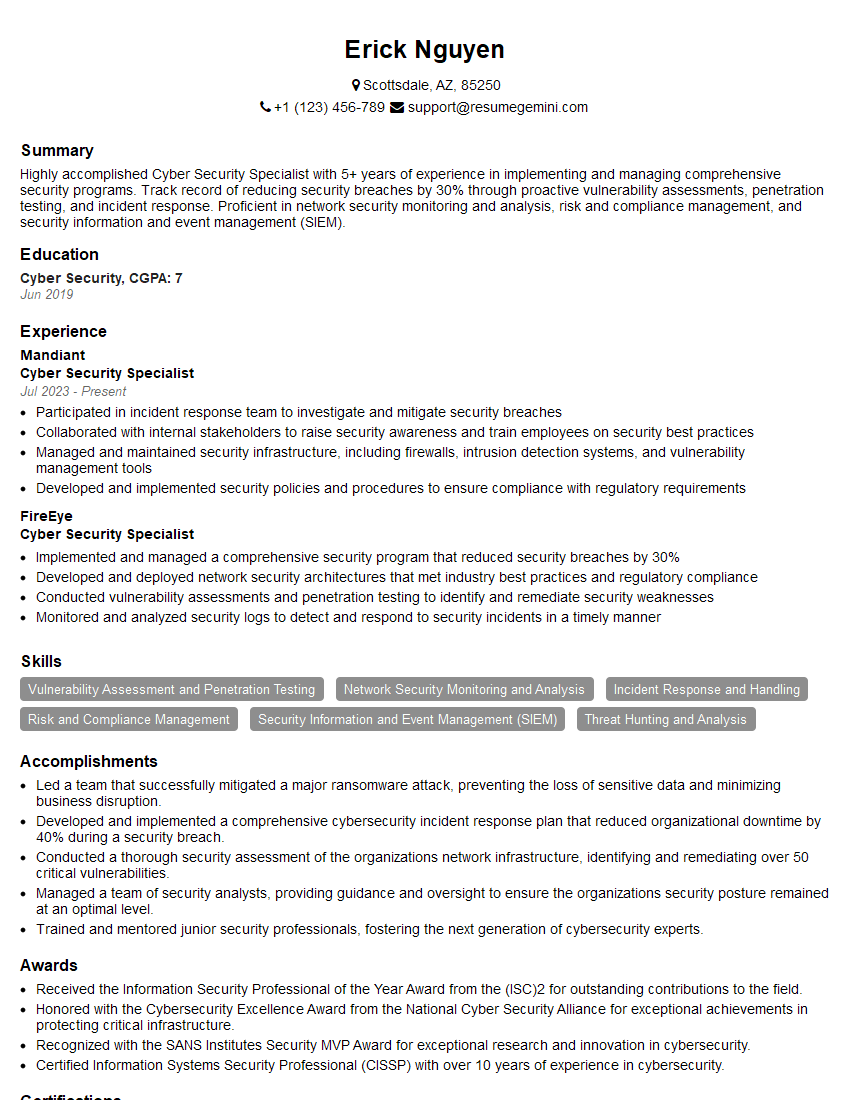
Mastering Cyber Security Incident Response Planning is crucial for advancing your career in this rapidly evolving field. Demonstrating a strong understanding of these concepts will significantly enhance your interview performance and job prospects. To further strengthen your candidacy, create an ATS-friendly resume that showcases your skills and experience effectively. ResumeGemini is a trusted resource to help you build a professional and impactful resume. They provide examples of resumes tailored to Cyber Security Incident Response Planning, giving you a head start in crafting a compelling application that highlights your unique qualifications.

Explore more articles
Users Rating of Our Blogs
Share Your Experience
We value your feedback! Please rate our content and share your thoughts (optional).
What Readers Say About Our Blog
good