The right preparation can turn an interview into an opportunity to showcase your expertise. This guide to Dance Sociology interview questions is your ultimate resource, providing key insights and tips to help you ace your responses and stand out as a top candidate.
Questions Asked in Dance Sociology Interview
Q 1. Define Dance Sociology and differentiate it from other related fields like Dance Anthropology or Dance History.
Dance sociology is the study of dance as a social phenomenon. It examines how dance is created, performed, experienced, and understood within its social context. Unlike dance history, which focuses on the chronological development of dance styles and techniques, dance sociology explores the social structures, power dynamics, and cultural meanings embedded within dance practices. It differs from dance anthropology, which often uses a comparative, cross-cultural approach to understand dance in its broadest societal context, emphasizing ethnographic fieldwork and the study of dance in non-Western cultures. Dance sociology, while incorporating elements of anthropology and history, tends to focus more intently on specific social contexts within a given society, utilizing sociological theories and methods.
For example, dance sociology might examine how gender roles are represented in contemporary ballet, analyzing the choreography, costumes, and audience reception to explore underlying societal expectations. Dance history, on the other hand, would chronicle the evolution of ballet technique over centuries, while dance anthropology might compare ballet’s conventions to those of traditional dances in other cultures.
Q 2. Explain the theoretical frameworks you’re most familiar with in Dance Sociology.
My research is heavily influenced by several theoretical frameworks. Symbolic interactionism, for instance, helps me understand how dancers create meaning through shared symbols and interactions during rehearsals and performances. I examine how nonverbal communication, costumes, and stage settings contribute to the meaning-making process. Functionalism allows me to analyze dance’s role in society, such as its contribution to social cohesion, identity formation, or even social protest. Conflict theory provides a lens through which I can explore power dynamics, inequalities, and struggles for control within dance communities and the broader social structures that influence them – for instance, who gets to define ‘good’ dance and why. Finally, feminist theory helps me to understand how gender, sexuality, and power relations shape dance practices and how they reinforce or challenge traditional gender roles.
Q 3. Describe your experience with qualitative research methods in the context of dance.
My experience with qualitative research methods in dance is extensive. I primarily employ ethnographic methods, including participant observation, where I immerse myself in dance communities— spending time at rehearsals, performances, and social gatherings to gain an insider’s perspective. I conduct in-depth interviews with dancers, choreographers, and audience members to explore their experiences and perspectives on dance. I also utilize narrative analysis to understand the stories people tell about their experiences with dance, revealing deeper meanings and interpretations. Focus groups are another valuable tool, enabling me to collect data from small groups of individuals, fostering discussion and revealing shared perspectives and social dynamics.
For example, in a study on hip-hop dance crews, I used participant observation to understand the group’s internal hierarchies and dynamics, followed by interviews to explore individual dancers’ motivations and experiences.
Q 4. What are some key ethical considerations when conducting research on dance communities?
Ethical considerations are paramount in dance research. Informed consent is crucial; participants need to fully understand the research’s purpose, their rights, and how the data will be used before participating. Confidentiality and anonymity must be ensured to protect participants from potential harm. Building trust is key; rapport with dance communities is essential to gain their cooperation and ensure data integrity. Researchers should be mindful of potential power imbalances, ensuring they don’t exploit vulnerable populations. They should also avoid causing disruption or harm to existing community structures or traditions. Furthermore, researchers should actively consider the potential for misrepresentation or misinterpretation of cultural practices.
Q 5. Discuss the sociological impact of specific dance forms (e.g., ballet, hip-hop).
Ballet, with its historical association with elite social classes, continues to reinforce social hierarchies through its access and training costs, perpetuating inequalities. However, it also serves as a powerful vehicle for individual expression and aesthetic appreciation, creating a sense of community among its practitioners. Hip-hop, in contrast, emerged from marginalized communities as a form of social commentary and self-expression. It’s now a global phenomenon, influencing fashion, music, and popular culture, but it also faces issues of commercialization and appropriation, highlighting complex negotiations of power and cultural ownership.
Q 6. Analyze the role of power dynamics in dance practices and performances.
Power dynamics are inherent in dance practices and performances. These dynamics manifest in various ways: choreographers hold power over dancers, determining movement, aesthetics, and narrative; established dance forms can marginalize innovative or non-conformist styles; audiences exert power through their reception and interpretation of performances; and even within a dance troupe, hierarchies of skill, experience, and seniority can shape interactions and opportunities.
For example, the selection process for professional ballet companies, often highly competitive and subjective, reveals power dynamics based on aesthetic preferences, physical attributes, and social connections.
Q 7. How does globalization influence the evolution of dance styles and traditions?
Globalization profoundly impacts dance styles and traditions. The increased connectivity through technology and travel facilitates the exchange and fusion of diverse dance forms, leading to hybrid styles and cross-cultural collaborations. However, this exchange also carries risks of cultural appropriation, where dominant cultures borrow elements from less powerful ones without proper acknowledgment or understanding. Furthermore, globalization can lead to the homogenization of dance styles, threatening the survival of unique local traditions. The spread of popular dance styles via media, like Bollywood dances gaining popularity worldwide, highlights this duality – cultural exchange alongside potential dilution of original forms.
Q 8. Explain the concept of ‘dance as social practice.’
Dance as social practice views dance not merely as artistic expression but as a deeply embedded social activity. It examines how dance shapes and is shaped by social structures, power dynamics, and cultural contexts. It’s about understanding the choreography of everyday life as it intersects with movement and ritual.
For instance, consider a traditional folk dance: it’s not just about steps; it’s about community building, preserving cultural heritage, and communicating values and beliefs across generations. The dance itself reflects and reinforces social structures – who participates, the roles they play, and the power dynamics inherent within the performance.
Analyzing dance as social practice requires examining who creates, performs, and consumes the dance, the spaces where it occurs, the meanings attributed to it, and its broader social impact. This approach goes beyond aesthetics and explores the sociological functions of dance within a society.
Q 9. Describe your proficiency in data analysis techniques relevant to dance research.
My expertise in data analysis for dance research spans a range of qualitative and quantitative methods. I’m proficient in using software like NVivo for qualitative data analysis, allowing me to systematically analyze interview transcripts, ethnographic observations, and textual data to identify recurring themes and patterns in dance practices and perceptions. For quantitative analysis, I utilize statistical software such as R and SPSS to analyze survey data, audience counts, and performance metrics, allowing me to identify correlations and make inferences about trends in dance participation and preferences.
For example, I’ve used network analysis techniques to map the relationships between dancers and choreographers within a specific dance company, revealing power structures and collaborations. I’ve also applied statistical modelling to examine the relationship between socioeconomic factors and access to dance education and opportunities.
My analytical skills extend to the visualization of data. I create insightful charts and graphs that effectively communicate complex findings to both academic audiences and the wider public.
Q 10. How do you interpret the relationship between dance and social class?
The relationship between dance and social class is complex and multifaceted. Access to dance training and performance opportunities is often stratified by class. Elite dance forms, like ballet, historically required significant financial investment in training and costumes, making them largely inaccessible to lower socioeconomic groups. Conversely, some dance styles emerged from working-class communities and reflect their cultural experiences and aesthetic preferences.
Consider the contrasting examples of ballet and hip-hop. Ballet, often associated with wealth and elite status, requires years of rigorous and expensive training. In contrast, hip-hop dance evolved from the streets, reflecting the experiences and creativity of marginalized communities. However, even hip-hop dance has undergone processes of commercialization and gentrification, impacting its accessibility and original cultural meanings.
My research explores how class impacts participation, styles, and the perceived value of different dance forms, analyzing how class influences both the production and consumption of dance.
Q 11. How does dance contribute to social identity and group formation?
Dance significantly contributes to social identity and group formation. Shared dance practices create a sense of belonging, fostering group cohesion and collective identity. This is evident in many contexts, from school dance teams to professional dance companies to religious or cultural groups that utilize dance in rituals and ceremonies.
Think about the shared experience of learning a complex choreography; the collaborative effort required builds strong bonds and shared identity. Furthermore, dance styles often become markers of group affiliation, signifying membership in specific social groups or subcultures. For example, certain styles of street dance can signal affiliation with particular crews or communities, reinforcing group boundaries and promoting a sense of shared identity.
The performative aspect of dance also reinforces social identity, as performances can act as a powerful way to present and assert group identity to both insiders and outsiders.
Q 12. Discuss the role of gender and sexuality in the context of dance.
Gender and sexuality are deeply intertwined with dance, influencing both the creation and interpretation of dance forms. Historically, many dance traditions have prescribed specific gender roles and expectations, often reinforcing societal norms and stereotypes. For example, traditional ballet often features highly stylized gender roles, with women embodying grace and passivity, while men portray strength and power.
However, contemporary dance increasingly challenges these norms, creating spaces for exploring diverse gender expressions and sexual identities. Choreographers are experimenting with gender-bending performances and blurring traditional gender roles in dance. Moreover, LGBTQ+ dancers and choreographers are creating innovative works that explore issues of gender and sexuality in powerful and compelling ways.
Studying the intersection of dance, gender, and sexuality requires analyzing the representation of gender and sexuality in dance, the social meanings attached to different dance styles, and the lived experiences of dancers who challenge or subvert traditional norms.
Q 13. How has technology changed the way dance is created, performed, and consumed?
Technology has profoundly impacted the creation, performance, and consumption of dance. Digital technologies have opened up new avenues for dance creation, with motion capture, 3D animation, and virtual reality offering innovative tools for choreographers. This allows for the creation of complex and visually stunning pieces that may not be feasible using traditional methods.
Performance has also been transformed. Live streaming and online platforms have expanded the reach of dance performances, making them accessible to wider audiences across geographical boundaries. Virtual dance communities have emerged, fostering collaboration and knowledge exchange among dancers globally.
Dance consumption has also changed. Audiences can now experience dance performances in various formats, from live broadcasts and recorded videos to interactive virtual experiences. This shift creates both opportunities and challenges for dancers and choreographers in terms of monetization and audience engagement.
Q 14. Analyze the use of dance in social movements or political protests.
Dance has played, and continues to play, a vital role in social movements and political protests. It serves as a powerful medium for expressing dissent, solidarity, and collective action. Dance can mobilize large groups, create shared experiences, and communicate complex political messages in a visually compelling way.
Consider, for example, the use of dance in the Civil Rights Movement in the United States, where dance became a powerful form of protest and resistance. In more recent times, dance has been used in protests against police brutality and social injustice, conveying emotions and messages that words alone might not capture.
The analysis of dance in social movements requires examining its role in shaping collective identity, mobilizing participants, conveying political messages, and generating social change. Studying the choreography, the spaces where it occurs, and the social meanings attributed to it allows us to understand dance’s capacity to function as a powerful force for social and political action.
Q 15. Describe your experience with ethnographic fieldwork.
My ethnographic fieldwork experience spans over a decade, focusing primarily on the sociocultural aspects of contemporary dance practices. I’ve conducted immersive studies in various settings, from professional dance companies and studios to community dance groups and informal dance gatherings. This involved participant observation, where I actively participated in rehearsals, performances, and social events, alongside extensive interviewing with dancers, choreographers, and audience members. For instance, in one project, I spent six months embedded within a hip-hop dance crew, observing rehearsals, competitions, and social interactions to understand the dynamics of the group and the role of dance in their lives. This immersive approach allowed me to gain rich, nuanced insights into the lived experiences of dancers and the cultural contexts shaping their practices. Data collection also included video and audio recordings of performances and informal conversations, photographs documenting the setting and events, and detailed field notes capturing my observations and reflections. The analysis involved careful coding of the data, identifying recurring themes, and constructing narratives that reveal the complex social processes at play.
Career Expert Tips:
- Ace those interviews! Prepare effectively by reviewing the Top 50 Most Common Interview Questions on ResumeGemini.
- Navigate your job search with confidence! Explore a wide range of Career Tips on ResumeGemini. Learn about common challenges and recommendations to overcome them.
- Craft the perfect resume! Master the Art of Resume Writing with ResumeGemini’s guide. Showcase your unique qualifications and achievements effectively.
- Don’t miss out on holiday savings! Build your dream resume with ResumeGemini’s ATS optimized templates.
Q 16. Explain your understanding of Pierre Bourdieu’s concept of ‘habitus’ in relation to dance.
Pierre Bourdieu’s concept of ‘habitus’ is crucial to understanding dance. Habitus refers to the deeply ingrained habits, dispositions, and tastes that shape an individual’s actions, perceptions, and preferences. In the context of dance, habitus embodies the embodied knowledge, skills, and aesthetic sensibilities acquired through years of training and immersion within a specific dance community. For example, a ballet dancer’s habitus encompasses not only the technical skills but also a specific posture, aesthetic ideals, and social etiquette that are learned and internalized through rigorous training and social interaction within the ballet world. This habitus then influences their choices, performances, and social interactions within the wider dance field. It determines the kinds of dances they are inclined to perform, the ways they move, the aesthetic values they prioritize, and how they interact with other dancers and audiences. This concept helps us understand how social class, cultural background, and training influence dance practice and performance styles, highlighting the connection between individual actions and broader social structures. Analyzing a dancer’s habitus means examining the ways their body, movement, and aesthetics reflect and reinforce particular social positions and power dynamics.
Q 17. How do you approach the analysis of dance performance?
My approach to analyzing dance performance is multi-faceted and draws on both qualitative and quantitative methods. I start by observing the performance holistically, considering the choreography, the dancers’ movement qualities, the use of space, the costumes, the music, and the overall staging. Then I analyze individual movement sequences, identifying patterns, variations, and stylistic features. I also examine the interaction between the dancers, the relationship between the performance and the audience, and the sociocultural context of the work. My analysis moves beyond merely describing the movements; instead it explores the underlying meanings and messages conveyed through the dance. This might involve analyzing the use of symbolism, metaphors, and narratives embedded in the choreography. I may also consider the performance in relation to broader social and political issues. For example, a particular style of movement might carry connotations related to gender, ethnicity, or social class. Often, I employ video recording and digital tools to assist with this process. The data might be analyzed using frameworks such as semiotics, performance studies, and critical discourse analysis, depending on the research questions and the specific nature of the dance performance. This combination of detailed observation and theoretical frameworks allows for a rich and insightful analysis of the performance’s aesthetic, social, and political dimensions.
Q 18. Discuss the limitations and challenges of researching dance.
Researching dance presents several unique challenges. One significant limitation is the ephemeral nature of dance itself; a performance is a fleeting event, making it difficult to capture and analyze every detail. Recording and preserving the performance through video and other means helps, but it can’t fully capture the nuances of a live performance. Another challenge is gaining access to dance communities and gaining the trust of dancers. Building rapport and establishing ethical research relationships is crucial, particularly when working with marginalized or vulnerable dance groups. Furthermore, the subjective nature of aesthetic judgments can pose analytical difficulties. Different individuals perceive and interpret dance in various ways based on their background, experience, and aesthetic sensibilities. This necessitates careful consideration of the researcher’s own biases and perspectives and seeking diverse viewpoints during the research process. Another challenge is the sheer volume of data that can be generated during research, ranging from video recordings to interviews and field notes. Managing and analyzing this data effectively is crucial and requires appropriate methodologies and software tools.
Q 19. What are the key debates currently shaping Dance Sociology?
Current key debates in Dance Sociology include the intersection of dance with issues of identity, power, and social justice. For example, there’s much discussion about the representation of marginalized groups in dance, the role of dance in challenging social norms, and the importance of inclusive and equitable practices in dance education and professional settings. Another significant area of debate involves the commodification of dance, exploring the relationship between dance, the market, and the pressures of globalization. How does the commercialization of dance affect artistic integrity, access, and the creative freedom of dancers and choreographers? There’s also ongoing discussion on methodologies, with scholars exploring new approaches to analyzing dance performances and the experiences of dancers. Researchers are increasingly engaging with digital technologies to enhance data collection and analysis, sparking debates about the ethical implications and limitations of these new tools. Finally, the relationship between dance, technology, and virtuality is generating much research and stimulating discussions on the future of dance performance and audience engagement.
Q 20. Describe your experience with using software for data analysis in dance research (e.g., NVivo, SPSS).
I have extensive experience using qualitative data analysis software, primarily NVivo. I’ve employed NVivo to manage and analyze interview transcripts, field notes, and textual data derived from written materials. NVivo's features, such as coding, memoing, and the creation of visual representations of the data, have proved invaluable in identifying patterns, themes, and relationships within large datasets. For instance, in a study on the experiences of female dancers in the contemporary dance world, I used NVivo to code transcripts of interviews for recurring themes related to gender inequality, body image, and career challenges. This enabled me to identify recurring patterns and generate detailed reports visualizing the frequency and relationships between different themes. I have also used SPSS for quantitative analysis of survey data, for example in analyzing audience demographics or dancer training practices in relation to chosen dance styles. The combination of qualitative and quantitative data analysis techniques allows for a more comprehensive understanding of dance practices within their sociocultural context.
Q 21. Explain your familiarity with different sampling techniques in qualitative research.
My familiarity with sampling techniques in qualitative research is extensive. I understand the strengths and limitations of various approaches and select the most appropriate method depending on the research question and the population being studied. For instance, purposeful sampling is frequently used in dance research to select participants who possess specific knowledge, skills, or experiences relevant to the study. This might involve selecting dancers with specific training backgrounds or individuals who have been involved in particular dance communities. Snowball sampling can be useful in accessing hard-to-reach populations, such as dancers in underground dance scenes. This technique involves starting with one or two initial participants and then asking them to recommend others who might be willing to participate. Theoretical sampling is useful in grounded theory studies, where the researcher collects data iteratively, refining their theoretical understanding as the research progresses. The choice of sampling technique is a critical decision as it impacts the generalizability and validity of the research findings. Careful consideration must be given to the research question and the specific context of the study to ensure that the sample adequately represents the population of interest and the chosen sampling technique aligns with the overall research objectives and methodology.
Q 22. How do you ensure the validity and reliability of your research findings in dance studies?
Ensuring validity and reliability in dance studies requires a rigorous approach, mirroring methods in other social sciences but adapted to the unique nature of dance as both art form and social practice. Validity refers to whether our research accurately measures what it intends to measure, while reliability indicates the consistency of our measurements.
Triangulation: I employ multiple data sources – interviews with dancers and choreographers, observations of rehearsals and performances, analysis of archival materials (videos, programs, reviews), and potentially quantitative data like audience surveys – to corroborate findings. If all sources point to the same conclusion, confidence in the validity increases. For example, in studying the impact of a specific dance technique on dancer’s body image, I would combine interviews exploring dancers’ self-perceptions with observational data on their physical expressions during class and performances.
Inter-rater reliability: When using observational methods, multiple researchers independently code the data. The degree of agreement between their codes indicates the reliability of the observation instrument. For example, if studying the use of specific movement vocabularies within a dance style, multiple researchers would independently observe and code videos of performances. High inter-rater reliability would suggest that our observation categories are clearly defined and objectively applied.
Reflexivity: I acknowledge my own positionality and biases as a researcher. This means critically examining how my background, beliefs, and values might influence the research process and interpretation of findings. I document this reflexivity in my research reports to enhance transparency and allow readers to assess potential limitations.
Member checking: I share my interpretations and findings with participants to ensure that they resonate with their experiences and perspectives. This iterative process allows for corrections and refinements, improving the validity of the research.
Q 23. Describe your experience presenting your research at conferences or publishing in academic journals.
Presenting research and publishing in academic journals is a crucial part of my work. I’ve presented at numerous conferences, both national and international, on topics ranging from the socio-political implications of contemporary dance to the historical representation of gender in ballet. This includes both paper presentations and poster sessions. My publications encompass peer-reviewed journal articles in Dance Research Journal and other relevant academic outlets, as well as book chapters in edited collections. The process generally involves submitting a paper or abstract, undergoing peer review, and then potentially revising and resubmitting the work before publication. For example, one of my articles explored the impact of globalization on traditional dance forms in a specific region, leveraging ethnographic fieldwork and archival research. The feedback I received during the peer-review process helped me strengthen the theoretical framework and refine the analysis.
Q 24. How do you plan your research projects, from conceptualization to dissemination?
My research projects follow a systematic process.
Conceptualization: This stage involves identifying a research question, reviewing existing literature, and refining the research design. The research question often emerges from observing a specific dance practice or noticing a gap in existing scholarship. For example, a research question might be: ‘How has the representation of LGBTQ+ dancers in mainstream media evolved over the past 20 years?’
Methodology: I select appropriate methods (e.g., ethnography, interviews, archival research, content analysis) based on the research question and available resources. This involves developing interview protocols, observation schedules, or coding schemes, ensuring ethical considerations are prioritized.
Data collection and analysis: I gather data systematically, adhering to ethical guidelines. Data analysis is then tailored to the chosen methods (e.g., thematic analysis for qualitative data, statistical analysis for quantitative data).
Dissemination: Findings are presented at conferences, published in journals, or shared with the communities involved. This may involve producing academic publications, creating public-facing reports, or organizing workshops or community events.
Q 25. Explain your understanding of the intersectionality of dance with other social categories.
Dance, as a social practice, is deeply intertwined with various social categories like gender, race, class, sexuality, and ability. Intersectionality recognizes that these categories are not independent but interact to shape individuals’ experiences and opportunities. For instance, a Black female dancer might experience different forms of marginalization compared to a white male dancer, due to the intersection of race and gender within the dance world. This might involve facing racial bias in casting, experiencing limitations in role opportunities based on stereotypical gender expectations, or navigating a lack of representation in historical narratives of dance.
Understanding intersectionality in dance involves examining how these social categories influence access to dance education, training opportunities, performance spaces, and the overall representation of dancers and dance styles. My research explores how power dynamics, shaped by intersecting social categories, manifest in choreography, performance, and audience reception. For example, I might research how the representation of disability in dance has evolved, considering its intersection with factors such as class and race, to illustrate the complexities of these interactions.
Q 26. Discuss your experience working with diverse dance communities.
Working with diverse dance communities has been a central part of my research. This includes collaborating with dancers and choreographers from various cultural backgrounds, exploring diverse dance forms like traditional folk dances, contemporary styles, and experimental performance art. My approach emphasizes building trust, respecting cultural protocols, and ensuring that the research process empowers the communities involved. For example, in a study focusing on a specific immigrant community’s dance traditions, I prioritized working closely with community leaders to gain informed consent, ensure accurate representation, and avoid cultural appropriation.
This collaborative approach involves ensuring community members have a voice in shaping the research questions, methodology, and dissemination of findings. It’s essential to recognize the expertise and knowledge that resides within these communities and avoid imposing external frameworks.
Q 27. How would you approach a research project on a previously unstudied dance form?
Approaching a previously unstudied dance form requires a multifaceted strategy.
Ethnographic fieldwork: This would involve immersing myself in the community that practices the dance, observing rehearsals and performances, and conducting interviews with dancers, teachers, and other key figures. This immersive approach allows for a deep understanding of the dance’s cultural context and meaning.
Oral histories: Collecting oral histories from experienced dancers and community elders can provide valuable insights into the dance’s history, evolution, and significance. These narratives offer personal perspectives and help to reconstruct the dance’s trajectory.
Movement analysis: Detailed observation and documentation of the dance’s movements and techniques is crucial, possibly using video recording and notation systems to capture its complexities.
Comparative analysis: Once a comprehensive understanding of the dance form is established, comparison with other related dance styles can help identify its unique features and place it within a broader historical and geographical context.
Crucially, ethical considerations are paramount. Informed consent from participants is essential, and respect for cultural protocols and intellectual property must be maintained throughout the research process.
Q 28. Describe your familiarity with relevant archival materials related to the history of dance.
My familiarity with archival materials related to the history of dance encompasses a wide range of sources. This includes:
Dance notation systems: I’m proficient in reading and interpreting various dance notation systems, such as Labanotation, Benesh notation, and Eshkol-Wachmann movement notation. These systems allow me to analyze historical choreographic works, reconstructing movements and exploring choreographic styles across time.
Photographs and film footage: Analyzing historical photographs and film offers visual evidence of dance practices, costumes, performance styles, and stage design. This visual data provides valuable context and complements written accounts.
Playbills, programs, and reviews: These materials provide information about performance contexts, performers, and audience reception. Analyzing these items helps to understand how dance was presented and received in its historical setting.
Letters, diaries, and memoirs: Personal accounts from dancers and choreographers offer intimate perspectives on dance practices, motivations, and the social world of dance. These materials provide valuable human narratives and help to understand the historical context surrounding dance.
Accessing and utilizing these archives requires careful consideration of preservation techniques and ethical guidelines for handling fragile materials. I’m adept at using both physical archives and digital resources to trace dance history across different periods and locations. For example, I might research the use of specific music in ballet through accessing digitized scores and recordings while simultaneously studying the related performance documentation found in physical archives.
Key Topics to Learn for Dance Sociology Interview
- The Sociology of Dance Performance: Explore the social contexts shaping dance performances, including audience reception, performer identity, and the role of power dynamics.
- Dance and Social Change: Analyze how dance has been used as a tool for social activism, protest, and community building. Consider examples and case studies.
- Dance, Identity, and Social Class: Examine how dance styles and participation reflect and reinforce social class structures and cultural capital.
- The Body in Dance: Discuss the sociological significance of the body as a site of performance, expression, and social control within dance practices.
- Globalization and Dance: Analyze the impact of globalization on dance forms, styles, and their dissemination across cultures. Consider the implications of cultural appropriation and hybridity.
- Research Methods in Dance Sociology: Understand qualitative and quantitative research methodologies applicable to dance studies, including ethnography, interviews, and content analysis.
- Theoretical Frameworks: Familiarize yourself with key sociological theories (e.g., Symbolic Interactionism, Feminist Theory, Post-structuralism) and their application to the study of dance.
- Critical Analysis of Dance: Develop skills in critically analyzing dance performances and choreography, considering their social, political, and cultural contexts.
- Dance Education and Policy: Understand the role of dance education in shaping social attitudes and behaviors and the impact of dance-related policies.
Next Steps
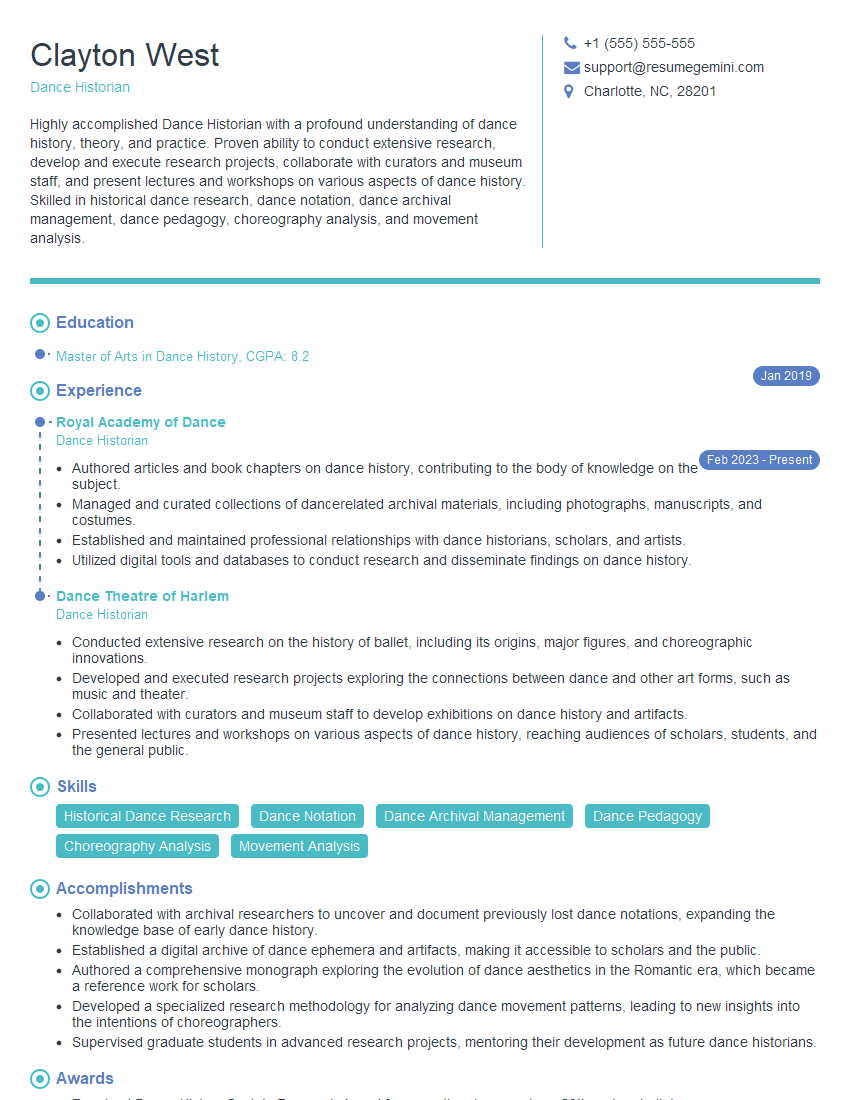
Mastering Dance Sociology opens doors to diverse and rewarding careers in academia, arts administration, cultural studies, and community engagement. A strong understanding of these concepts will significantly enhance your interview performance and demonstrate your expertise. To maximize your job prospects, creating an ATS-friendly resume is crucial. ResumeGemini is a trusted resource to help you build a professional and impactful resume that highlights your skills and experience effectively. Examples of resumes tailored to Dance Sociology are available to guide you through the process.
Explore more articles
Users Rating of Our Blogs
Share Your Experience
We value your feedback! Please rate our content and share your thoughts (optional).
What Readers Say About Our Blog
Very informative content, great job.
good