Every successful interview starts with knowing what to expect. In this blog, we’ll take you through the top Demonstrating Judo Techniques for Students interview questions, breaking them down with expert tips to help you deliver impactful answers. Step into your next interview fully prepared and ready to succeed.
Questions Asked in Demonstrating Judo Techniques for Students Interview
Q 1. Explain the proper execution of a basic Judo throw, such as Ippon Seoi Nage.
Ippon Seoi Nage, or one-hand shoulder throw, is a fundamental Judo technique focusing on controlling your opponent’s balance and using your own leverage. It’s executed in stages:
- Kuzushi (Break Balance): Begin by slightly pulling your opponent forward while stepping to your right, causing them to shift their weight. Think of it as gently ‘leading’ them off balance.
- Tsukuri (Fitting): As your opponent’s balance breaks, quickly grip their gi (jacket) with your left hand on their right lapel and your right hand on their left shoulder. Your grip should be firm but not overly tight. Your right arm should be close to their neck, acting like a brace.
- Kake (Throwing): With your right arm acting as a lever, lift your opponent’s weight as you swiftly step in with your left foot, pivoting on your right foot. Simultaneously, rotate your body and lift, driving your opponent upwards and over your shoulder. Your hips should lead this rotation. Your left leg will drive under their supporting leg, essentially sweeping it out.
- Okuri (Follow-through): Continue the rotation of your body and extend your arms until your opponent is completely airborne and lands safely on their back. Maintain good balance during this final step.
Imagine it like lifting a heavy bucket; you don’t just lift it straight up, but you use your legs and body rotation for leverage. This is the same principle applied to Ippon Seoi Nage.
Q 2. Describe three different ways to execute a Kuzushi (break balance).
Kuzushi, or breaking balance, is crucial in Judo. Here are three ways to achieve it:
- Pulling Kuzushi: This involves gently pulling your opponent off balance while maintaining a close grip. It’s effective when your opponent is relatively static or predictable. Think of pulling a slightly leaning tree gently in a certain direction.
- Pushing Kuzushi: This technique uses a push, typically against your opponent’s chest or shoulder, to disrupt their balance. This is particularly useful when you need to create space or when your opponent is leaning slightly backward. Imagine pushing someone gently to break their equilibrium.
- Footwork Kuzushi: This uses clever footwork to disrupt your opponent’s base. You can achieve this by shifting your weight quickly, stepping in, or using a controlled stepping motion to force their feet to move, throwing off their stance. Think about how easily someone falls if their feet move unexpectedly.
The key with Kuzushi is subtlety and timing; it’s about creating an imbalance, not forcing a fall.
Q 3. How would you adapt your teaching style for beginners versus advanced students?
My teaching approach varies significantly based on student experience. With beginners, I focus on fundamental movements and basic techniques, ensuring they understand the principles before moving on to more advanced concepts. This often involves breaking down techniques into smaller, manageable steps, with lots of repetition and positive reinforcement. We start with basic grips, posture, and falls (ukemi) before even attempting throws. I use lots of physical demonstrations and allow plenty of time for questions.
For advanced students, the focus shifts to refining technique, developing speed and power, and understanding more complex combinations and counter-techniques. The instruction becomes more nuanced, involving detailed discussions of strategy, footwork, and timing. We drill techniques at higher speeds and introduce randori (free sparring) to apply skills in a dynamic setting. The focus is not just on mastering techniques but on adapting them to unpredictable situations.
Q 4. What safety precautions are essential when demonstrating Judo throws?
Safety is paramount when demonstrating Judo throws. Here’s a breakdown of essential precautions:
- Warm-up: Always begin with a thorough warm-up to prepare the body for strenuous activity. This reduces the risk of injury.
- Spotting: When demonstrating a throw on a student, use a spotter to assist in controlling the fall and mitigating any unexpected movements. The spotter needs to be experienced and positioned appropriately.
- Controlled Execution: Demonstrations should always be controlled and performed at a lower intensity than in actual practice. The emphasis is on the technique, not the power.
- Soft Landing: Ensure the receiving student is practicing safe falling techniques (ukemi) to minimize the impact of the throw.
- Appropriate Matting: Judo should always be practiced on a safe, well-cushioned mat to absorb impact and protect against injury.
- Breakfalls: Students need to be thoroughly trained in breakfalls before attempting any throws. These are essential for safety.
A safe training environment is absolutely crucial in Judo, and a culture of safety should be instilled from the very beginning.
Q 5. How do you correct a common mistake in performing Uchi Mata?
A common mistake in Uchi Mata (inner thigh throw) is leaning too far forward during the execution. This results in loss of balance and an ineffective throw. The correction involves emphasizing the importance of maintaining a strong, upright posture throughout the technique.
I address this by guiding students to focus on their posture, ensuring their upper body remains upright and their weight is centered. I encourage them to utilize a small hip turn rather than a forward lunge while driving with the legs. Often, I will have them perform slow-motion repetitions, paying close attention to posture. Adding a step to the side to initiate the move before the hip turn can help prevent the lunge. Practice with a resistance partner can also be valuable, allowing them to feel the force needed to keep the posture upright and prevent the leaning forward. Visualization can also be helpful- they should imagine a wall behind them they cannot lean against.
Q 6. Describe your experience in teaching different Judo techniques.
Throughout my career, I’ve had the privilege of teaching a wide range of Judo techniques to students of all levels and ages. From beginners learning basic breakfalls to advanced practitioners refining complex throws and grappling techniques, I’ve adapted my teaching style to meet their individual needs and goals. I have experience teaching various throwing techniques, such as seoi nage variations, o-goshi, uchi-mata, and various grappling techniques such as Kuzure Kesa Gatame and Osoto Gari.
I particularly enjoy working with beginners, helping them build a strong foundation in the fundamentals and instilling a love for the art of Judo. But the challenge and satisfaction of pushing advanced students to refine their technique and develop strategic thinking is equally rewarding. I’ve also worked with special needs students, adjusting the techniques and approach as needed to ensure their safety and success.
Q 7. How do you assess a student’s understanding of a particular technique?
Assessing a student’s understanding involves a multi-faceted approach:
- Practical Application: I observe students performing the technique during randori and drills. This is the most direct way to see if they understand the application of the technique in a dynamic environment. Are they able to apply the technique effectively against a resisting opponent?
- Verbal Explanation: I ask them to explain the technique step-by-step. This reveals their understanding of the principles and sequences involved.
- Troubleshooting: I present them with scenarios or potential problems and observe how they react and solve these. This demonstrates their problem-solving skills and their understanding of the technique beyond rote memorization.
- Questioning: I ask probing questions to ensure their understanding of the nuances and subtleties of the technique, exploring their understanding of the principles, force application, and timing involved.
A combination of observation, questioning, and practical application provides a holistic assessment of a student’s mastery of a Judo technique.
Q 8. What are the key elements of a successful Judo demonstration?
A successful Judo demonstration hinges on three key elements: clarity, efficiency, and safety. Clarity ensures the technique is easily understood by the observer, showcasing the proper execution of each step. Efficiency demonstrates the technique’s effectiveness with minimal wasted movement, highlighting its power and precision. Safety is paramount; the demonstration must prioritize the well-being of both the demonstrator and the uke (the person receiving the technique), showcasing proper control and awareness throughout.
- Clarity: This involves a clear explanation of the technique’s purpose, its application, and the specific body mechanics involved. Breaking down the technique into individual steps, emphasizing key points, and using clear verbal cues enhances clarity.
- Efficiency: Demonstrating a technique smoothly and powerfully, without unnecessary hesitation or jerky movements, shows its true effectiveness. The demonstration should appear fluid and natural, highlighting the practitioner’s mastery.
- Safety: This involves controlling the force, ensuring proper breaks, and mitigating any potential risk of injury. Using a partner with appropriate experience and skill level is crucial for a safe demonstration. The demonstrator must be aware of their own body positioning and control throughout the technique’s execution.
For example, demonstrating an ippon-seoi-nage (one-arm shoulder throw) should clearly show the grip, kuzushi (breaking the balance), and the execution of the throw, with a controlled and safe landing for the uke.
Q 9. How would you explain the concept of Kime (focus of power) to a student?
Kime, or focused power, is the explosive culmination of all your effort in a Judo technique. It’s not just brute strength; it’s the precise application of force at the critical moment, maximizing impact and effectiveness. Imagine throwing a punch: you don’t just push your arm forward; you coordinate your entire body, focusing your energy into that final impact.
To explain kime to a student, I use analogies. I might compare it to a perfectly-timed karate chop breaking a board, where the concentration of force at the precise moment creates the break. Or, I’d say it’s like the feeling you get when you throw a ball with all your might—the perfect timing and focused energy create maximum power.
In Judo practice, kime is achieved through proper breathing, full body extension at the moment of execution, and a clear understanding of the technique’s mechanics. It’s not about being the strongest, but being the most efficient in using your body’s potential.
Q 10. How do you manage a student who struggles with a specific Judo technique?
When a student struggles with a specific technique, I employ a multi-faceted approach. I begin by observing their execution closely to identify the exact point of difficulty. This could range from incorrect grip, poor footwork, or an insufficient understanding of the principles behind the technique.
- Breakdown and Repetition: I break down the technique into smaller, more manageable segments, focusing on individual parts until they are mastered. We then practice these segments repeatedly until they become automatic.
- Visual and Kinesthetic Learning: I use multiple methods of instruction, including demonstrations, video analysis, and physical adjustments, to cater to different learning styles. Sometimes, showing them the technique from their perspective (by performing the technique *with* them) is helpful.
- Personalized Feedback and Corrections: I provide specific and constructive feedback, focusing on the student’s strengths and weaknesses. Hands-on adjustments and corrections help them understand the correct body mechanics and movement.
- Progression and Modification: I may adjust the difficulty of the technique, using modifications or variations to build their confidence and address specific areas of challenge. This could involve practicing against a lighter or more cooperative partner.
It’s vital to be patient and encouraging throughout the process. Celebrating small successes builds their confidence and motivates them to continue learning.
Q 11. What is your approach to maintaining discipline and order during a Judo class?
Maintaining discipline and order in a Judo class is crucial for a safe and productive learning environment. My approach combines clear expectations, positive reinforcement, and consistent structure.
- Clear Instructions and Expectations: I establish clear rules and expectations at the beginning of each class, emphasizing respect for others, proper etiquette, and safe practice. These rules are consistently reinforced throughout the class.
- Positive Reinforcement: I actively praise and reward positive behavior and effort, fostering a supportive learning environment. Acknowledging good technique and improvements boosts morale and encourages continued effort.
- Consistent Structure: A structured class format with a clear progression of activities maintains order and allows students to anticipate the flow of the session. This ensures efficient use of time and prevents chaos.
- Address Disruptive Behavior Promptly and Fairly: If any issues arise, I address them promptly and fairly, addressing the behavior without undermining the student’s self-esteem. Often, a brief and private conversation is more effective than public reprimands.
Ultimately, creating a respectful and engaging atmosphere is key to maintaining discipline. Students are more likely to follow rules and guidelines when they feel valued and respected.
Q 12. Explain the importance of proper warm-up exercises before practicing Judo.
Proper warm-up exercises are absolutely essential before practicing Judo. They prepare the body physically and mentally for the strenuous demands of the sport, reducing the risk of injury and enhancing performance. A good warm-up should include:
- Cardiovascular warm-up: Light cardio, such as jogging or jumping jacks, increases heart rate and blood flow, preparing the muscles for activity.
- Dynamic stretching: Moving stretches, such as arm circles, leg swings, and torso twists, improve range of motion and flexibility without overstretching cold muscles.
- Joint mobility exercises: Gentle rotations and movements of joints prepare them for the stress of Judo techniques. This might include ankle circles, knee bends, and shoulder rotations.
- Specific Judo movements: Practicing basic Judo movements like falls (ukemi) at a slower pace helps prepare the body for the more intense movements to come.
A thorough warm-up increases muscle temperature, improves blood flow to the muscles, and enhances neuromuscular coordination, thus decreasing the likelihood of strains, sprains, and other injuries. Moreover, it helps prepare the mind for focused training by improving concentration and alertness.
Q 13. Describe your experience in creating and implementing a Judo curriculum.
My Judo curriculum is structured to provide a progressive and comprehensive learning experience. It begins with fundamental techniques, including falls (ukemi), basic grips, and movement, before gradually introducing more complex throws, grappling, and pinning techniques. The curriculum is divided into levels (beginner, intermediate, advanced) and belts (kyu and dan grades), each level building upon the previous one.
I incorporate various teaching methods, including demonstrations, partner drills, individual practice, and randori (free practice), promoting both technical skill and application. Regular assessments monitor student progress, allowing for adjustments to the curriculum as needed. I constantly update my curriculum, incorporating new techniques, strategies, and teaching methodologies to enhance the students’ overall learning experience and ensure it aligns with the latest Judo standards.
My focus is on creating a well-rounded Judo practitioner, encompassing not only technical skills but also physical fitness, mental discipline, and ethical conduct. The curriculum emphasizes the importance of respect, discipline, and sportsmanship.
Q 14. How do you assess student progress in Judo?
Assessing student progress in Judo involves a holistic approach, considering both technical skills and overall development. My assessment methods include:
- Technical Skill Assessment: I regularly observe students during practice, evaluating their technique execution, understanding of principles, and efficiency of movement. I provide feedback and make corrections to refine their skills. This includes assessing their ability to perform different techniques correctly, safely, and effectively.
- Randori Observation: Observing students during randori sessions allows me to assess their ability to apply learned techniques under pressure, their strategic thinking, and overall performance in a dynamic setting. I look for their ability to adapt and react effectively, maintaining control and composure.
- Grading System: I use a standardized grading system that aligns with the Judo curriculum to objectively evaluate their progress and award belts. This provides students with concrete targets and measurable benchmarks.
- Physical Fitness: I also monitor their physical condition, assessing their strength, flexibility, and stamina, as these aspects contribute significantly to their overall Judo performance.
- Attitude and Conduct: I evaluate their attitude towards training, their respect for fellow students and instructors, and their adherence to Judo etiquette. A strong moral character is a cornerstone of the Judo tradition.
By combining these assessment methods, I gain a comprehensive understanding of each student’s progress, enabling me to tailor my instruction to their individual needs and further improve their Judo practice.
Q 15. What resources do you use to enhance your Judo teaching skills?
Continuously enhancing my Judo teaching skills requires a multifaceted approach. I leverage several key resources. Firstly, I actively participate in professional development workshops and seminars led by renowned Judo instructors and experts. These sessions often cover the latest teaching methodologies, updated technique refinements, and best practices for injury prevention. Secondly, I regularly review and study Judo literature, including instructional books, DVDs, and online resources. This allows me to stay abreast of evolving techniques and pedagogical approaches. Thirdly, I actively engage with the Judo community, attending competitions and training sessions to observe other instructors and high-level practitioners. This observational learning helps me refine my own teaching methods and stay connected to the broader Judo world. Finally, I actively solicit feedback from my students – both positive and constructive criticism – to understand their learning experiences and adjust my teaching accordingly.
Career Expert Tips:
- Ace those interviews! Prepare effectively by reviewing the Top 50 Most Common Interview Questions on ResumeGemini.
- Navigate your job search with confidence! Explore a wide range of Career Tips on ResumeGemini. Learn about common challenges and recommendations to overcome them.
- Craft the perfect resume! Master the Art of Resume Writing with ResumeGemini’s guide. Showcase your unique qualifications and achievements effectively.
- Don’t miss out on holiday savings! Build your dream resume with ResumeGemini’s ATS optimized templates.
Q 16. How would you handle a conflict between two students during a Judo class?
Handling conflicts between students requires a calm and authoritative approach, prioritizing safety and respect. My first step would be to immediately and safely separate the students, ensuring no further physical altercation occurs. Once the situation is under control, I’d move both students to a private area for a discussion. I’d listen to each student’s perspective individually, encouraging them to explain their point of view without interruption. It’s crucial to remain neutral and avoid assigning blame prematurely. The goal is to understand the root cause of the conflict, whether it’s a misunderstanding, a difference in training styles, or a personality clash. Once I have a clearer understanding, I’d facilitate a dialogue between the students, encouraging them to empathize with each other’s perspectives and find a resolution. If the conflict is persistent, I may involve a senior instructor or parent, depending on the students’ ages and the severity of the issue. Ultimately, the aim is to foster a respectful and supportive learning environment where disagreements are resolved constructively.
Q 17. Explain how you would adapt a Judo technique for a student with a physical limitation.
Adapting Judo techniques for students with physical limitations is crucial for inclusivity and safety. The key is to modify the technique rather than abandoning it. For example, a student with a knee injury might struggle with certain throws requiring deep knee bends. In this case, we could modify the technique by emphasizing a different grip, using less leg drive, or focusing on upper body leverage to achieve the same result with reduced stress on the injured joint. A student with limited mobility in one arm could be taught modifications focusing on using their stronger side more effectively. This might involve adjusting grips, emphasizing body positioning, or using different leverage points. The goal is to maintain the core principles of the technique while making it accessible and safe for the individual student. Careful observation and individualized instruction are essential to ensure the modification remains effective and injury-free. It’s important to consult with the student and, where appropriate, their physician or physical therapist to identify safe and appropriate modifications.
Q 18. What are some common injuries in Judo, and how can they be prevented?
Common Judo injuries include sprains, strains, and contusions, often occurring in the ankles, knees, shoulders, and wrists. These are frequently the result of falls, throws, and joint locks. Preventing such injuries requires a multi-pronged approach. Proper warm-up exercises prepare the body for the physical demands of Judo, increasing flexibility and blood flow to muscles and joints. Correct technique execution is paramount. Students must be thoroughly taught the proper form and execution of techniques to minimize the risk of injury. Breakfalls (ukemi) are essential to mitigate the impact of falls. Students should consistently practice safe breaking techniques to minimize impact force and protect themselves during throws. Finally, proper protective gear, such as a judogi (Judo uniform) in good condition and appropriate mouth guards, can reduce the severity of injuries. Encouraging a culture of safety within the dojo, where students are encouraged to train within their limits and communicate any discomfort is equally vital.
Q 19. How do you deal with a student who is afraid of falling?
Fear of falling is a common obstacle for new Judo students. Addressing this fear requires patience, understanding, and a graduated approach. I begin by emphasizing the importance of breakfalls (ukemi) and their role in mitigating injuries. We start with basic breakfall practice on mats, gradually increasing the height and complexity of the falls. I provide clear instructions, demonstrations, and hands-on assistance, helping students build confidence in their ability to control their body during a fall. Positive reinforcement and encouragement are vital; I praise even small improvements to build self-assurance. I often incorporate games or playful activities into the practice to reduce anxiety and foster a fun learning environment. Finally, I pair new students with experienced partners who can provide support and guidance during throws and falls, building trust and reducing the fear of the unknown.
Q 20. How do you maintain your own Judo skills and knowledge?
Maintaining my Judo skills and knowledge is an ongoing commitment. Regular participation in Judo training and practice sessions is crucial for keeping my technique sharp and body conditioned. I frequently attend advanced Judo seminars and workshops to learn from renowned instructors and refine my techniques. I also regularly practice randori (free practice) with experienced partners, allowing me to apply and refine my techniques in a dynamic environment. Staying updated with recent developments in Judo techniques and pedagogy through reading Judo literature and journals is also a priority. Furthermore, I attend Judo competitions as a participant or spectator, observing the skills and strategies of high-level practitioners. This process is a continuous cycle of learning and refinement, ensuring that my teaching reflects current best practices and my own high level of skill.
Q 21. Describe your understanding of Judo’s history and philosophy.
Judo’s history is deeply rooted in Japan’s rich martial arts tradition. It was founded by Professor Jigoro Kano in the late 19th century, drawing upon elements of Jujutsu to create a system emphasizing effective self-defense, physical and mental development, and the cultivation of character. Judo’s philosophy, encapsulated in the principles of seiryoku zenyo (maximum efficiency, minimum effort) and jita kyoei (mutual welfare and benefit), extends far beyond the physical aspects of the martial art. Seiryoku zenyo highlights the importance of using efficient movements and leveraging an opponent’s weight and momentum to gain an advantage. Jita kyoei emphasizes mutual benefit and respect both on and off the mat, promoting cooperation and harmonious relationships. Understanding this historical context and philosophical foundation is essential for effective teaching, allowing me to convey the true essence of Judo to my students and fostering a respectful and enriching learning experience.
Q 22. How do you use positive reinforcement to encourage student participation?
Positive reinforcement is crucial in Judo, as it fosters a supportive learning environment and motivates students. Instead of focusing solely on errors, I prioritize acknowledging and celebrating even small improvements. This builds confidence and encourages continued effort.
- Verbal praise: I frequently use phrases like “Great work on your grip!” or “I noticed you improved your balance.” Specific praise is more effective than general compliments.
- Non-verbal cues: A smile, a nod, or a thumbs-up can be powerful motivators, especially for younger students. Positive body language conveys encouragement.
- Progress tracking: I use a simple chart or log to visually represent each student’s progress in mastering specific techniques. Seeing their improvement charted is highly motivating.
- Reward system (carefully implemented): While not the primary focus, small rewards like extra time for free practice or a small prize for consistent attendance can add an element of fun.
For example, if a student struggles with a particular throw but manages to improve their stance and grip, I’ll highlight that progress. This helps them focus on gradual improvement rather than becoming discouraged by immediate perfection.
Q 23. What are some different types of Judo randori (practice sparring) methods?
Randori, or practice sparring, is essential for applying Judo techniques under pressure. Different methods cater to various skill levels and training goals.
- Shiai Randori (Competition Randori): This is a fully competitive format, similar to a match, where students aim to score points and win. It’s suited for advanced students.
- Go-Kyo (Free Randori): Students practice techniques without specific limitations, focusing on applying learned skills under resistance. This enhances problem-solving skills and adaptability.
- Kata Randori: Randori with a specific focus on a particular technique or combination of techniques. This is very useful for beginners and intermediate students to drill techniques repeatedly.
- Yakusoku Randori (Pre-arranged Randori): This involves predetermined sequences of attacks and defenses. It’s helpful for practicing specific counter-techniques and transitions.
- Randori with specific focus (e.g., Kuzushi Randori): Randori that focuses on practicing a specific element of Judo, such as Kuzushi (breaking balance) for better understanding of body mechanics before engaging fully.
I vary the type of randori depending on the students’ skill and goals, starting with structured methods and gradually transitioning to more free-flowing sparring as they develop their abilities. Safety is always paramount, and I ensure appropriate supervision during all randori sessions.
Q 24. How do you evaluate a student’s readiness to progress to the next belt rank?
Assessing a student’s readiness for belt promotion involves a holistic evaluation that goes beyond just technique.
- Technical proficiency: The student should demonstrate a solid understanding and execution of techniques appropriate for their current rank, including throws, grappling, and pins.
- Understanding of Judo principles: They should show an understanding of the underlying principles of Judo, such as Kuzushi (breaking balance), Tsukuri (connecting), and Kake (throwing).
- Randori performance: Their ability to apply techniques effectively during randori, demonstrating both offensive and defensive capabilities, is crucial.
- Physical fitness and conditioning: Judo requires strength, endurance, and flexibility. A student should show a reasonable level of physical fitness.
- Attitude and sportsmanship: Respect for themselves, their training partners, and their instructors are essential qualities. Good sportsmanship and perseverance are equally important.
I often use a grading rubric to ensure consistent evaluation. This rubric clearly outlines the criteria for each rank, making the process transparent and fair. Student feedback is also included to provide further guidance.
Q 25. How do you ensure that your Judo classes are inclusive and accessible to all students?
Inclusivity and accessibility are central to my teaching philosophy. I strive to create a welcoming environment where all students feel safe, respected, and valued, regardless of their background, abilities, or physical limitations.
- Adaptive techniques: I modify techniques as needed to accommodate students with physical limitations or injuries. The focus is on safe participation and progression.
- Differentiated instruction: I adapt my teaching methods and materials to cater to diverse learning styles and needs, offering individualized support as required.
- Positive and supportive atmosphere: I foster a culture of mutual respect and encouragement, where students feel comfortable asking questions and supporting each other.
- Partnerships with relevant organizations: Collaborating with organizations that support individuals with disabilities ensures I am aware of and utilizing best practices for inclusivity.
- Clear communication and support: Open communication with students and parents allows for any concerns or needs to be addressed promptly and effectively.
For example, a student with a knee injury might focus on upper body techniques or modified throws, ensuring they still actively participate and progress without risking further injury.
Q 26. Describe your experience using different teaching aids or visual aids for Judo.
Visual aids are invaluable in Judo instruction. They help students visualize techniques, understand body mechanics, and improve retention.
- Videos: Demonstrations and analyses of techniques from various angles are extremely helpful for enhancing understanding.
- Illustrations and diagrams: Simple diagrams showing the steps involved in a technique can break down complex movements into easily digestible parts.
- Interactive whiteboard: I use a whiteboard to draw diagrams and illustrate key points during explanations, making the instruction more engaging.
- Physical models (e.g., dummies): While not always practical, using models helps demonstrate proper positioning and leverage.
- Computer simulations: Sophisticated simulations can help visualize complex movements and forces involved in Judo techniques.
For instance, when teaching a particular throw, I’ll first show a video demonstrating the technique, then break it down step-by-step using diagrams on the whiteboard before practicing it physically.
Q 27. How do you tailor your demonstrations to fit different age groups and skill levels?
Adapting demonstrations to different age groups and skill levels requires flexibility and understanding of developmental stages.
- Age-appropriate language and explanations: Simpler language and demonstrations are used for younger children, gradually increasing complexity as they mature.
- Shorter sessions and frequent breaks: Younger students have shorter attention spans, requiring more frequent breaks and shorter practice sessions.
- Simplified techniques: For beginners, techniques might be broken down into smaller, more manageable components, focusing on fundamental movements before introducing the full technique.
- Increased complexity and speed: For more advanced students, the focus shifts to speed, precision, and application in randori.
- Emphasis on different learning aspects: The teaching methods and learning objectives would be different for beginners focusing on fundamentals, intermediate students practicing combinations, and advanced students working on strategy and advanced techniques.
For example, when teaching a hip throw (hip throw) to beginners, I may focus on just the grip and initial movement, leaving out more advanced details like using the opponent’s momentum until later. For advanced students, this would be reviewed as a part of a more elaborate combination.
Q 28. What are your methods for evaluating the effectiveness of your teaching?
Evaluating teaching effectiveness is an ongoing process requiring a multi-faceted approach.
- Student feedback: Regular feedback from students, either through formal surveys or informal conversations, provides valuable insights into their learning experience.
- Observation and assessment: Observing students during practice and grading their performance allows me to identify areas where improvement is needed.
- Tracking progress: Monitoring student progress over time, through techniques learned, skills improvement in randori, and belt promotions, gives a clear indication of overall effectiveness.
- Peer observation: Regular peer observation sessions with other instructors offer valuable feedback and opportunities for professional development.
- Self-reflection: Regular self-reflection on my teaching methods, techniques, and approach helps me identify areas for improvement.
For instance, if student feedback consistently indicates difficulty with a particular technique, I’ll revisit my teaching method for that technique, perhaps using different visual aids or breaking it down in a new way.
Key Topics to Learn for Demonstrating Judo Techniques for Students Interview
- Safe and Effective Technique Demonstration: Mastering the correct execution of basic Judo techniques, emphasizing safety for both the demonstrator and the student. This includes proper grips, body mechanics, and breakfalls.
- Pedagogical Approach: Understanding how to break down complex techniques into smaller, easily digestible steps for students of varying skill levels and experience. Consider different learning styles and adapt your approach accordingly.
- Verbal Communication and Instruction: Developing clear, concise, and engaging verbal instructions. Practice explaining techniques using precise terminology and avoiding jargon.
- Visual Demonstration and Cueing: Utilizing effective visual cues and demonstrations to enhance understanding. This includes appropriate body language and the use of visual aids if necessary.
- Student Feedback and Correction: Learning how to effectively provide constructive feedback and correct common errors in a positive and supportive manner. This includes identifying areas for improvement and offering solutions.
- Adapting to Different Student Needs: Understanding how to modify techniques and instruction to accommodate students with varying levels of physical ability, experience, and learning styles.
- Classroom Management and Discipline: Demonstrating an understanding of how to maintain a safe and productive learning environment. This includes managing student behavior and addressing any potential safety concerns.
- Risk Assessment and Safety Protocols: Identifying and mitigating potential risks associated with Judo training, and implementing appropriate safety protocols to prevent injuries.
- Understanding Judo Philosophy and Ethics: Demonstrating a grasp of the underlying principles of Judo, including respect, self-discipline, and mutual benefit.
Next Steps
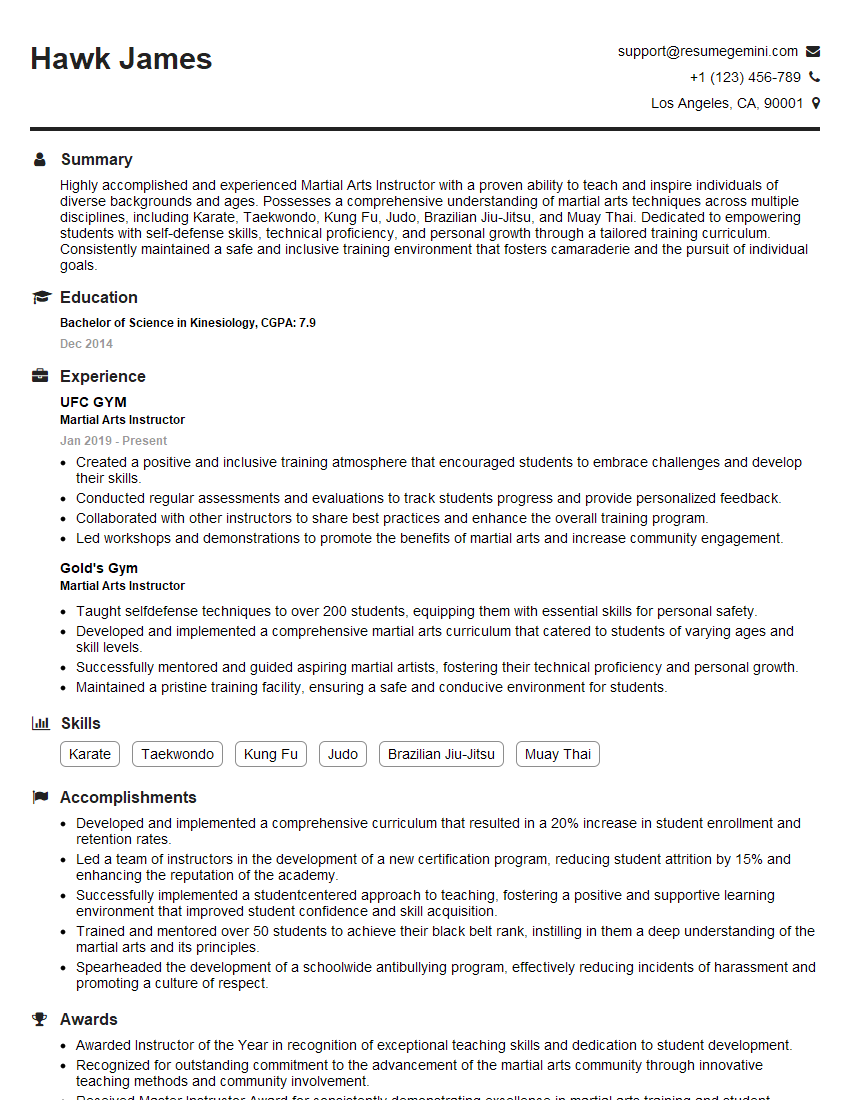
Mastering the art of demonstrating Judo techniques effectively is crucial for career advancement in this field. It showcases your expertise, teaching ability, and commitment to safety. To maximize your job prospects, focus on creating a strong, ATS-friendly resume that highlights your relevant skills and experience. ResumeGemini is a trusted resource to help you build a professional and impactful resume. Examples of resumes tailored to demonstrating Judo techniques for students are available to guide your creation. Invest time in crafting a compelling resume; it’s your first impression on potential employers.

Explore more articles
Users Rating of Our Blogs
Share Your Experience
We value your feedback! Please rate our content and share your thoughts (optional).
What Readers Say About Our Blog
Very informative content, great job.
good