Are you ready to stand out in your next interview? Understanding and preparing for Derrick Installation interview questions is a game-changer. In this blog, we’ve compiled key questions and expert advice to help you showcase your skills with confidence and precision. Let’s get started on your journey to acing the interview.
Questions Asked in Derrick Installation Interview
Q 1. Describe your experience with different types of derricks.
My experience encompasses a wide range of derricks, from the simpler gin poles and A-frames commonly used in smaller construction projects to the more complex mast derricks and guy derricks employed in heavy lifting operations like those seen in oil and gas platforms or large-scale industrial projects. I’ve worked extensively with both fixed and mobile derricks, understanding the unique challenges and advantages of each type. For instance, I’ve overseen the installation of a guy derrick supporting the construction of a 100-meter high wind turbine, requiring precise calculations and meticulous safety procedures, very different from working with a simple gin pole during a smaller roofing project. Each type demands a specific approach to assembly, operation, and maintenance, and my experience ensures I adapt my techniques to the specific circumstances and requirements of the project.
Q 2. Explain the process of derrick assembly step-by-step.
Derrick assembly is a meticulous process requiring careful planning and execution. Here’s a step-by-step breakdown:
- Site Preparation: This includes leveling the ground, ensuring sufficient space for the derrick’s footprint, and identifying any potential hazards or obstructions.
- Foundation Preparation: A stable base is crucial. This might involve pouring concrete footings or using pre-fabricated bases, depending on the size and type of derrick.
- Base Assembly: The derrick’s base components are assembled according to the manufacturer’s specifications, ensuring all bolts are properly tightened and secured.
- Mast Erection: This is often the most challenging part. It involves carefully raising the mast into a vertical position, using cranes or specialized rigging equipment. Precise alignment is crucial at this stage.
- Guy Wire Installation: For guy derricks, the guy wires are carefully attached to the mast at specified points and anchored to the ground, providing stability and preventing sway.
- Sheave and Block Installation: The sheaves (pulleys) and blocks are installed on the mast, ensuring smooth and efficient operation of the hoisting system.
- Hoisting System Setup: The hoisting system (winch, cables, etc.) is connected and tested, ensuring its proper functioning.
- Final Inspection: A thorough inspection of the entire assembly is conducted to verify stability, alignment, and the absence of any potential hazards.
Throughout this process, safety is paramount. Regular checks are performed to ensure all components are secure and no deviations from the plan occur.
Q 3. What safety procedures do you follow during derrick installation?
Safety is my top priority. My safety procedures involve:
- Pre-task Planning: Thorough risk assessment identifying potential hazards, developing mitigation strategies, and selecting appropriate PPE.
- Lockout/Tagout Procedures: Proper lockout/tagout procedures are followed when working with any moving machinery or electrical components.
- Regular Inspections: Regular inspections of all equipment and components before, during, and after assembly to ensure everything is in safe working order.
- Emergency Response Plan: A clearly defined emergency response plan is in place and communicated to all personnel, including evacuation routes and emergency contact information.
- Competent Personnel: Only trained and certified personnel are involved in the assembly and operation of the derrick.
- Safe Lifting Practices: Adhering to safe lifting practices to avoid overloading the derrick, using appropriate lifting slings and ensuring correct load distribution.
- Weather Monitoring: Close monitoring of weather conditions to ensure the safety of personnel and equipment. Work ceases in unsafe weather conditions.
I also ensure that all workers follow the safety procedures, including the use of appropriate personal protective equipment (PPE), such as hard hats, safety harnesses, and safety shoes.
Q 4. How do you ensure the stability and alignment of a derrick during erection?
Ensuring stability and alignment is crucial for safe and efficient derrick operation. This is achieved through:
- Precise Leveling: The base is meticulously leveled using surveying equipment to provide a stable foundation.
- Plumb Bobs and Laser Levels: These instruments are used to ensure the mast is perfectly vertical during erection.
- Guy Wire Tensioning: For guy derricks, precise tensioning of the guy wires is critical for maintaining stability and preventing sway, usually done using calibrated tensioning devices.
- Load Testing: After assembly, a load test is conducted to verify the derrick’s stability and load-bearing capacity under actual working conditions.
- Regular Monitoring: Throughout operation, the derrick’s alignment and stability are continuously monitored to detect and address any potential issues.
For example, in one project involving a large mast derrick, we utilized laser leveling technology to ensure the mast remained perfectly vertical, even during high wind conditions, minimizing any risk of instability.
Q 5. What are the common challenges encountered during derrick installation?
Common challenges include:
- Ground Conditions: Unstable or uneven ground can make foundation preparation difficult and affect stability.
- Weather Conditions: High winds, rain, or extreme temperatures can delay or impede the assembly process and pose safety risks.
- Access Restrictions: Limited access to the site can make equipment transportation and maneuverability challenging.
- Component Damage: Damaged or defective components can significantly delay the project and necessitate replacements.
- Unexpected Obstructions: Discovering unexpected underground obstructions during foundation preparation can require adjustments to the plan.
Effective planning, risk assessment, and a proactive approach are vital in mitigating these challenges.
Q 6. Describe your experience with troubleshooting derrick malfunctions.
My experience in troubleshooting involves systematic diagnosis to identify the root cause of a malfunction. This typically involves:
- Visual Inspection: A thorough visual inspection of all components to identify any visible damage or wear.
- Functional Testing: Testing each component individually to pinpoint the faulty part.
- Mechanical Checks: Checking for loose bolts, worn bearings, or other mechanical issues.
- Electrical Checks: If the malfunction involves electrical components, carrying out checks to identify short circuits, faulty wiring, or other electrical problems.
- Hydraulic Checks (if applicable): Checking hydraulic systems for leaks, low fluid levels, or other hydraulic issues.
For example, I once encountered a derrick with a faulty winch. Through systematic testing, I identified a broken internal gear. The repair involved replacing the gear, which restored the winch to full functionality, preventing costly delays.
Q 7. What are the key components of a derrick system?
The key components of a derrick system vary depending on the type, but generally include:
- Mast: The central vertical support structure.
- Base: The foundation upon which the derrick is built.
- Guy Wires (for guy derricks): Used for stability and support.
- Sheaves/Pulleys: Used to redirect the hoisting cables.
- Blocks: Used to increase mechanical advantage in hoisting.
- Hoisting System: Consists of a winch, cables, and other components for lifting loads.
- Swivel: Allows the load to be rotated.
- Control System: For operating the hoisting system and controlling load movement.
Understanding the function of each component is crucial for safe and effective derrick installation and operation.
Q 8. How do you inspect a derrick for damage or defects?
Inspecting a derrick for damage or defects is crucial for ensuring safe operation. It’s a multi-stage process that begins with a visual inspection, moving to more detailed checks as needed.
- Visual Inspection: This involves a thorough examination of the entire structure, looking for obvious signs of damage like cracks, bends, corrosion, or missing components. Pay close attention to welds, connections, and critical load-bearing points. I always use checklists to ensure thoroughness.
- Component Checks: This step involves detailed checks on individual components like the mast, boom, and guy wires. We’d check for proper tension in the guy wires, examine the sheaves and blocks for wear and tear, and look for any signs of fatigue or deformation in the metalwork.
- Load Testing (if necessary): In cases where significant damage is suspected or the derrick hasn’t been inspected recently, load testing under the supervision of a qualified engineer is necessary. This validates the derrick’s capacity and structural integrity.
- Documentation: All findings, including photos and detailed descriptions, are meticulously documented. This documentation helps track the derrick’s condition over time and forms part of a comprehensive maintenance plan.
For example, during an inspection of a used derrick, I once discovered a hairline crack in a weld near a crucial connection point. This was only identified through close visual inspection and careful probing with a magnet. Early detection prevented a potential catastrophic failure.
Q 9. What are the different types of derrick foundations?
Derrick foundations are critical for stability and safe operation. The choice of foundation depends heavily on the soil conditions, the derrick’s size and load capacity, and the duration of the operation. Common types include:
- Fixed (or Permanent) Foundations: These are typically concrete structures built in the ground, offering maximum stability. They are suited for long-term projects. Think of a large, heavily reinforced concrete pad designed specifically for the derrick.
- Driven Pile Foundations: These use steel piles driven deep into the ground to transfer the load to a more stable soil layer. This is a good solution for soft or unstable ground conditions where a concrete pad might not be suitable.
- Mat Foundations: These are large, reinforced concrete slabs designed to distribute the derrick’s load over a wide area. This is ideal for heavy derricks on relatively stable ground.
- Temporary Foundations: For shorter-term projects, temporary foundations like steel bases or cribbing may be used. Cribbing, for instance, involves carefully stacking timber to create a stable base.
Selecting the appropriate foundation is vital. A poorly designed foundation can lead to derrick instability and potential accidents, hence a thorough geotechnical assessment is always performed before selection.
Q 10. Explain the role of load calculations in derrick installation.
Load calculations are paramount in derrick installation and operation; they’re the cornerstone of safe practice. They determine the maximum weight the derrick can lift under various conditions. Incorrect calculations can result in catastrophic equipment failure or injury.
The process considers several factors:
- Derrick Design and Specifications: The manufacturer’s specifications provide the derrick’s rated capacity under ideal conditions. This is often displayed on a data plate.
- Boom Angle and Radius: The boom’s angle and distance from the mast significantly affect lifting capacity. The further the load, the less the derrick can lift.
- Wind Speed and Direction: High winds can significantly reduce the derrick’s effective capacity. Wind speed is a crucial factor in load calculations.
- Load Distribution: The way the load is attached and distributed also affects its center of gravity, which impacts the derrick’s stability.
We use specialized software and established engineering principles to perform these calculations. The results guide us in choosing the appropriate derrick, setting safe lifting limits, and ensuring safe operation throughout the project. A margin of safety is always incorporated to account for uncertainties.
Q 11. What are your experience with different types of lifting equipment used in derrick installation?
My experience encompasses a wide range of lifting equipment, each suited to specific tasks during derrick installation:
- Mobile Cranes: These are extensively used to erect the derrick mast and install major components. Their mobility and lifting capacity make them ideal for this phase.
- Hydraulic Jacks: These are used for precise adjustments to derrick components during assembly and leveling. The controlled lifting power is essential for careful positioning.
- Winches and Hoists: These are crucial for lifting and placing smaller parts of the derrick, and for tensioning guy wires.
- Forklifts: These are useful for transporting and positioning smaller components and materials near the installation site.
I’ve worked extensively with various manufacturers’ equipment, gaining expertise in their operation, maintenance, and safety protocols. Knowing the capabilities and limitations of different equipment is essential for choosing the right tools for the job and ensuring a smooth, safe installation.
Q 12. How do you handle unexpected problems during installation?
Unexpected problems during derrick installation are not uncommon. My approach emphasizes a systematic problem-solving process:
- Assessment: Immediately assess the situation to understand the nature and severity of the problem. Safety is always the top priority. Stop work if necessary.
- Risk Evaluation: Evaluate potential risks associated with the problem and implement appropriate safety measures.
- Problem Identification: Determine the root cause of the problem. This might involve reviewing the installation plan, checking equipment functionality, or seeking expert advice.
- Solution Development: Develop and implement a solution, always prioritizing safety. This might involve adjusting the installation plan, using alternative equipment, or contacting specialized engineers for guidance.
- Documentation: Thoroughly document the problem, its resolution, and any lessons learned. This helps to improve future projects and prevent similar incidents.
For instance, I once encountered unexpected hard ground during foundation construction. We quickly assessed the situation, revised the foundation plan, and used specialized equipment to deal with the harder-than-expected ground conditions. The revised approach ensured the derrick was safely installed without delays.
Q 13. Describe your experience with working at heights during derrick installation.
Working at heights during derrick installation is inherent and demands meticulous adherence to safety protocols. My experience emphasizes a layered approach to safety:
- Fall Protection: Harness systems, lifelines, and safety nets are always used. The use of these systems is non-negotiable.
- Scaffolding and Platforms: Stable and properly constructed scaffolding and platforms are used to access different levels of the derrick. Regular inspections are essential.
- Training and Competency: All personnel involved in working at heights are thoroughly trained and competent in using the required safety equipment. Regular refresher training is implemented.
- Risk Assessments: A detailed risk assessment is conducted before any work at heights begins to identify and mitigate potential hazards.
I’ve always ensured that all personnel understand the importance of safety and are equipped to handle any unforeseen circumstances. A proactive approach to safety, combined with regular inspections and training, is critical in preventing accidents during work at heights.
Q 14. How do you ensure compliance with safety regulations?
Ensuring compliance with safety regulations is paramount. My approach involves:
- Thorough Knowledge of Regulations: I maintain up-to-date knowledge of all relevant occupational safety and health (OSH) regulations, including those relating to derrick installation, lifting operations, and working at heights.
- Pre-Installation Planning: Before starting any project, I conduct thorough risk assessments and develop a detailed safety plan that outlines all necessary precautions and procedures. This plan is reviewed and approved by relevant authorities as needed.
- Permit-to-Work Systems: We utilize permit-to-work systems for all critical tasks, ensuring that all risks are identified and controlled before work commences.
- Regular Inspections and Audits: Regular inspections and audits are conducted to ensure continued compliance with safety regulations. Findings are documented and corrective actions are implemented as needed.
- Training and Documentation: All personnel receive comprehensive safety training and the necessary documentation, including certificates and training records, is meticulously maintained.
Compliance is not just a matter of following rules; it’s a commitment to ensuring the safety of everyone involved. I believe a proactive and systematic approach to safety is essential to prevent accidents and protect people.
Q 15. What are the legal and regulatory requirements for derrick installation in your region?
Derrick installation, particularly in the oil and gas industry, is heavily regulated. In my region, compliance necessitates adherence to several key legal and regulatory frameworks. These include, but aren’t limited to, OSHA (Occupational Safety and Health Administration) regulations pertaining to crane and rigging operations, environmental protection agency (EPA) guidelines regarding potential soil and water contamination, and local ordinances governing permits and construction in specific areas. Specific requirements vary depending on the size and type of derrick, the location of the installation (onshore vs. offshore), and the nature of the project. For example, pre-installation inspections are mandatory, and detailed risk assessments are needed to address potential hazards like falling objects and structural failure. Failure to comply can lead to significant fines, project delays, and even legal action. We always maintain meticulous records of all permits, inspections, and safety measures taken, ensuring full transparency and compliance.
For instance, on a recent project involving a large land-based derrick, we had to obtain permits from both the state and local authorities, demonstrating compliance with their respective regulations concerning weight restrictions on roads and potential environmental impacts. Detailed plans of the installation process, including emergency response procedures, were submitted and approved before commencing work.
Career Expert Tips:
- Ace those interviews! Prepare effectively by reviewing the Top 50 Most Common Interview Questions on ResumeGemini.
- Navigate your job search with confidence! Explore a wide range of Career Tips on ResumeGemini. Learn about common challenges and recommendations to overcome them.
- Craft the perfect resume! Master the Art of Resume Writing with ResumeGemini’s guide. Showcase your unique qualifications and achievements effectively.
- Don’t miss out on holiday savings! Build your dream resume with ResumeGemini’s ATS optimized templates.
Q 16. What software or tools are you familiar with for derrick planning and design?
Derrick planning and design involves sophisticated software and tools. I’m proficient in using industry-standard software such as SAP2000 for structural analysis, ensuring the derrick can withstand anticipated loads. This allows us to optimize the design for strength and efficiency. Alongside SAP2000, I also utilize AutoCAD for creating detailed 2D and 3D models of the derrick and its surrounding environment. These models are critical for visualizing the installation process and identifying any potential spatial conflicts. For project management, we frequently use specialized software to track progress, manage resources, and maintain accurate records of materials and personnel. Furthermore, I’m familiar with various simulation software that allows us to model and analyze the dynamic behavior of the derrick under various load conditions and environmental factors. These tools are integral to mitigating risks and ensuring a safe and efficient installation process.
Q 17. How do you communicate effectively with your team during derrick installation?
Effective communication is paramount during derrick installation. Our team uses a combination of methods to ensure seamless coordination and safety. Pre-installation briefings are mandatory, where we go through the entire plan, highlighting critical steps, potential risks, and emergency procedures. During the installation, we utilize two-way radios for real-time communication between the crew on the ground and those working at height. A clear and concise communication protocol, established beforehand, helps prevent misunderstandings. We also employ visual signals where necessary, especially in noisy environments. Regular progress meetings and post-installation debriefs allow us to review the process, identify areas for improvement, and document lessons learned. We even utilize checklists to track crucial steps and ensure no vital tasks are overlooked.
For example, during a particularly challenging offshore installation, clear radio communication prevented a near-miss involving a crane boom and a nearby platform. The immediate warning allowed the crane operator to correct course, preventing a potentially disastrous accident.
Q 18. Describe your experience with derrick dismantling and decommissioning.
Derrick dismantling and decommissioning requires the same level of precision and safety as installation. It’s a systematic process that begins with a thorough risk assessment, focusing on the safe removal of components, minimizing the risk of damage or injury. Each component is carefully inspected, and any necessary repairs are carried out before removal. The dismantling process follows a predetermined sequence, ensuring the structural integrity of the derrick is maintained throughout. We use specialized equipment, such as heavy-lift cranes and rigging gear, to handle the large and heavy components. All activities are documented, and safety checks are performed at every stage. Once dismantling is complete, the site is thoroughly inspected to ensure no debris or hazardous materials remain. Disposal of materials is handled according to environmental regulations, ensuring environmental responsibility.
On a recent offshore platform decommissioning project, our team meticulously followed a detailed dismantling plan, resulting in a completely safe and efficient removal of the derrick without any incidents or environmental damage.
Q 19. What is your experience with different types of derrick winches?
My experience encompasses various types of derrick winches, each with its own strengths and applications. I’m familiar with mechanical winches, which are robust and reliable, ideal for heavy-duty lifting. I also have extensive experience with hydraulic winches, offering precise control and speed adjustments, particularly useful for delicate operations. Electric winches, while less common in some applications, offer efficient operation and precise speed control. Understanding the capabilities and limitations of each type is crucial for selecting the appropriate winch for a specific project and ensuring safety. Factors considered include the load capacity, lifting speed, braking systems, and overall reliability. Selection is also influenced by environmental conditions and power availability on-site.
Q 20. How do you maintain and service derrick equipment?
Derrick equipment maintenance is crucial for safety and operational efficiency. Our maintenance program follows a rigorous schedule, with regular inspections and preventative maintenance tasks performed according to the manufacturer’s guidelines. This includes lubrication of moving parts, inspection of cables and sheaves for wear and tear, and regular testing of braking systems. Any defects are addressed promptly to prevent potential failures. Detailed records of all maintenance activities are meticulously kept to track the equipment’s condition and history. This ensures that all equipment meets safety standards and performs optimally. Beyond routine maintenance, we conduct thorough inspections after significant use or exposure to harsh environmental conditions. This proactive approach helps ensure the long-term reliability and safety of the derrick equipment.
Q 21. What are your experience with pre-installation site surveys?
Pre-installation site surveys are critical for successful derrick installation. These surveys involve a comprehensive assessment of the site, considering various factors. This includes evaluating ground conditions, ensuring sufficient load-bearing capacity, assessing accessibility for heavy equipment, identifying potential obstacles, and verifying the availability of utilities. Topographical surveys are conducted to create accurate site maps, and we often use drone technology to get a better overall view. The survey also takes into account environmental considerations, assessing potential risks to the surrounding ecosystem and identifying measures to mitigate any negative impacts. A thorough understanding of the site conditions is crucial for planning the installation process, estimating the required resources, and ensuring a safe and efficient operation. It is a critical step to prevent delays and ensure cost-effectiveness.
For instance, on a recent project, a pre-installation survey revealed unstable ground conditions, necessitating the use of specialized ground reinforcement techniques. This proactive identification prevented delays and potential safety hazards that would have otherwise resulted from unforeseen ground issues during installation.
Q 22. Describe a situation where you had to solve a complex problem during derrick installation.
During a recent derrick installation on an offshore platform, we encountered a significant challenge: unforeseen soil conditions. The initial geotechnical survey underestimated the presence of a soft, clay layer beneath the planned foundation. This meant the originally designed foundation would be inadequate to support the derrick’s load, risking instability and potential collapse.
To solve this, I collaborated with the geotechnical engineers and the rigging crew. We first conducted additional soil testing to precisely determine the soil’s bearing capacity. Based on this data, we redesigned the foundation, opting for a larger, more robust pile foundation system instead of the originally planned spread footing. This involved adjusting the project timeline, ordering additional materials, and modifying the installation plan. We carefully coordinated all these changes, ensuring safety remained the top priority. The modified foundation successfully supported the derrick, proving the importance of adaptive problem-solving in derrick installation projects. The project concluded without incident, highlighting the effectiveness of our collaborative approach and contingency planning.
Q 23. What are your experience with different types of derrick masts?
My experience encompasses various derrick mast types, including:
- Standard Derrick Masts: These are the most common type, typically constructed of steel and featuring a simple, triangular or square configuration. I’m proficient in their erection, maintenance, and dismantling.
- Subsea Derrick Masts: These are specially designed for subsea operations, often requiring greater resistance to corrosion and pressure. I’ve been involved in projects using these masts, focusing on their unique installation requirements, which necessitate more stringent safety protocols and specialized equipment.
- Heavy-Duty Derrick Masts: These are built to withstand incredibly high loads and are frequently utilized for large-scale projects such as lifting heavy equipment or building large structures. My expertise lies in the careful planning and execution of installations using these masts, which include rigorous load calculations and meticulous risk assessments.
- Lattice Boom Derrick Masts: These offer a lightweight yet robust solution. I’ve worked with these structures, understanding their assembly procedures and the specific precautions required during operations.
This diverse experience allows me to select and manage the appropriate mast for each project based on its specific needs and constraints.
Q 24. How do you manage a project timeline for derrick installation?
Managing a derrick installation project timeline requires a meticulous, phased approach. I use a combination of critical path method (CPM) and Gantt charts to visualize tasks, dependencies, and deadlines. This involves:
- Detailed Planning: Breaking the project into manageable tasks, each with a defined duration and dependencies.
- Resource Allocation: Identifying and securing necessary equipment, personnel, and materials.
- Risk Assessment: Identifying potential delays and developing mitigation strategies.
- Regular Monitoring: Tracking progress against the schedule and addressing any deviations promptly.
- Communication: Maintaining open communication with all stakeholders to ensure everyone is informed and on track.
For instance, in a recent project, we used a Gantt chart to monitor the progress of each phase, from site preparation and foundation construction to derrick assembly and load testing. Regular meetings ensured transparent communication and allowed us to proactively address any potential bottlenecks.
Q 25. Describe your experience working with different types of derrick foundations.
My experience includes working with various derrick foundations, including:
- Spread Footings: These are suitable for stable soil conditions. I understand the importance of proper soil analysis to ensure adequate bearing capacity.
- Pile Foundations: These are necessary for less stable soil conditions, such as soft clay or loose sand. My experience includes specifying pile types (e.g., driven piles, bored piles), determining the number of piles needed, and overseeing their installation to ensure proper load transfer.
- Mat Foundations: These large concrete slabs provide a highly stable base for extremely heavy derricks. I’ve been involved in the planning and execution of complex mat foundation projects, ensuring precise leveling and alignment for optimal derrick stability.
The selection of the appropriate foundation type is crucial for the overall stability and safety of the derrick. Incorrect foundation design can lead to instability and potential catastrophic failure.
Q 26. What are your experience with different types of derrick guy wires?
My experience covers several types of derrick guy wires, including:
- Steel Wire Ropes: The most common type, offering high tensile strength and durability. I am proficient in inspecting these wires for wear and tear, ensuring they meet safety standards.
- High-Strength Synthetic Fibers: These offer a lighter weight alternative to steel, reducing the overall weight and stress on the derrick structure. I have worked with these materials, understanding their specific properties and limitations.
Regardless of the type, regular inspection and maintenance of guy wires are crucial. I follow strict protocols for inspecting wires for fraying, corrosion, and other signs of degradation. Proper tensioning is also critical for optimal derrick stability and safety.
Q 27. Explain your understanding of load distribution and its impact on derrick stability.
Understanding load distribution is paramount for derrick stability. Uneven load distribution can lead to significant stress concentrations on certain structural elements, potentially causing failure. Think of it like a seesaw; if the weight isn’t balanced, one side will tip over.
The load on a derrick is influenced by several factors, including the weight of the suspended load, the position of the load relative to the derrick, and environmental factors like wind. Proper load calculations, taking into account all these factors, are crucial. We use specialized software and engineering principles to determine the center of gravity and ensure the derrick’s structure can safely support the projected load. To mitigate risks, we often employ load-monitoring systems and employ multiple points of support to distribute the stress evenly across the derrick’s structure, ensuring structural integrity and preventing catastrophic failures.
Key Topics to Learn for Derrick Installation Interview
- Derrick Assembly and Disassembly: Understanding the step-by-step procedures, safety protocols, and tools involved in both assembling and disassembling derricks of various types and sizes.
- Derrick Components and Functionality: In-depth knowledge of each component (e.g., mast, substructure, crown block, sheaves, etc.) and their roles in the overall operation. Be prepared to discuss troubleshooting common malfunctions.
- Rigging and Lifting Techniques: Mastering safe rigging practices, load calculations, and understanding the limitations of derrick systems in different environments and applications.
- Safety Procedures and Regulations: Demonstrate a thorough understanding of relevant safety regulations, risk assessment, and preventative measures to ensure safe operation.
- Maintenance and Inspection: Familiarize yourself with routine maintenance procedures, inspection checklists, and identifying potential issues before they become major problems.
- Hydraulic and Pneumatic Systems: Understanding the hydraulic and pneumatic systems that power the derrick, including troubleshooting and maintenance.
- Problem-Solving and Troubleshooting: Be prepared to discuss scenarios where you encountered problems during derrick installation and how you successfully resolved them. Highlight your analytical and problem-solving skills.
- Different Derrick Types and Applications: Showcase your knowledge of various derrick types (e.g., gin pole, A-frame, etc.) and their suitable applications in different industries (e.g., oil and gas, construction).
Next Steps
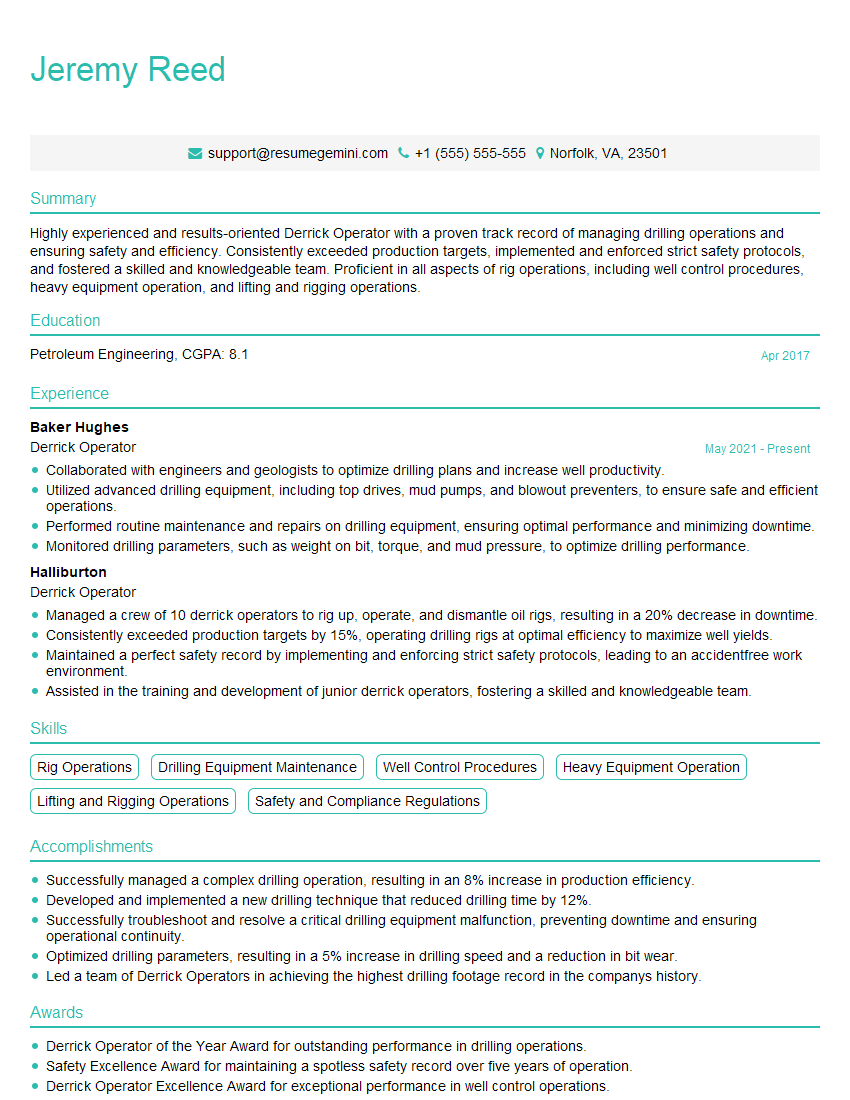
Mastering Derrick Installation opens doors to exciting career opportunities in demanding and rewarding industries. To maximize your chances of securing your dream role, creating a strong, ATS-friendly resume is crucial. ResumeGemini is a trusted resource that can help you craft a professional and impactful resume that highlights your skills and experience effectively. Examples of resumes tailored to Derrick Installation are provided to guide you in building yours. Invest time in crafting a compelling resume – it’s your first impression on potential employers.
Explore more articles
Users Rating of Our Blogs
Share Your Experience
We value your feedback! Please rate our content and share your thoughts (optional).
What Readers Say About Our Blog
Very informative content, great job.
good