Interviews are opportunities to demonstrate your expertise, and this guide is here to help you shine. Explore the essential Device Physics interview questions that employers frequently ask, paired with strategies for crafting responses that set you apart from the competition.
Questions Asked in Device Physics Interview
Q 1. Explain the depletion region in a p-n junction diode.
The depletion region in a p-n junction diode is a crucial area formed at the interface between p-type and n-type semiconductor materials. Imagine it like a border zone between two different countries. In this zone, the free charge carriers – electrons in the n-type and holes in the p-type – diffuse across the junction due to their concentration gradients. Electrons from the n-side move into the p-side, and holes from the p-side move into the n-side.
This diffusion leaves behind immobile, charged ions: negatively charged acceptor ions on the p-side and positively charged donor ions on the n-side. This creates an electric field across the junction, opposing further diffusion. Eventually, an equilibrium is reached where the electric field prevents further charge carrier movement, resulting in a region devoid of free charge carriers – the depletion region. This region acts as an insulator, preventing current flow unless a sufficient external voltage is applied. The width of the depletion region is influenced by factors like doping concentration and applied bias voltage.
Think of it like this: the diffusion of charge carriers is like two crowds pushing towards each other. The immobile ions are like walls formed by the crowds’ movement, creating a space in between them – that’s the depletion region. The electric field is like a force pushing back against the crowds, preventing them from completely merging.
Q 2. Describe the different types of MOSFETs and their operating principles.
MOSFETs (Metal-Oxide-Semiconductor Field-Effect Transistors) are fundamental building blocks of modern electronics. They come in two main types: n-channel and p-channel, distinguished by the type of majority carriers they use (electrons for n-channel and holes for p-channel). Within these types, we have enhancement-mode and depletion-mode MOSFETs.
- n-channel Enhancement-Mode MOSFET (nMOS): Normally OFF. A positive voltage (gate voltage) applied to the gate terminal creates a conductive channel between the source and drain, allowing current to flow. Think of it like opening a gate to allow water to flow.
- p-channel Enhancement-Mode MOSFET (pMOS): Normally OFF. A negative voltage applied to the gate terminal creates a conductive channel between the source and drain, allowing current to flow.
- n-channel Depletion-Mode MOSFET: Normally ON. A negative voltage applied to the gate pin is required to deplete the channel and turn the transistor OFF. It’s like having a gate that is always open unless you actively close it.
- p-channel Depletion-Mode MOSFET: Normally ON. A positive voltage applied to the gate is needed to turn the transistor OFF.
The operating principle revolves around the electric field induced by the gate voltage controlling the conductivity of the channel. The gate is insulated from the channel by a thin oxide layer, allowing for high input impedance. The current flow is controlled by the gate voltage, making MOSFETs excellent for switching and amplification applications. Their low power consumption makes them ideal for integrated circuits.
Q 3. What are the key performance parameters of a transistor?
Key performance parameters of a transistor dictate its suitability for specific applications. These include:
- Current Gain (β or hFE): For bipolar junction transistors (BJTs), it represents the ratio of collector current to base current (IC/IB). A higher gain indicates better amplification.
- Transconductance (gm): For FETs, it shows how much the output current changes for a change in gate voltage. A higher transconductance signifies better control over current flow.
- Input Impedance (Zin): Indicates how much current the transistor draws from the input signal. High input impedance is desirable to avoid loading effects.
- Output Impedance (Zout): Shows the transistor’s resistance to changes in load. Low output impedance ensures that the output voltage remains relatively stable under varying loads.
- Cut-off Frequency (fT): Represents the frequency at which the transistor’s gain drops by 3dB. It’s crucial for high-frequency applications.
- Power Dissipation (PD): The amount of heat generated by the transistor when operating. This limits the transistor’s maximum power handling capability.
These parameters are crucial for choosing the right transistor for a given circuit design and ensuring optimal performance. For instance, a high-frequency amplifier requires a transistor with a high cut-off frequency, while a low-power application necessitates a transistor with low power dissipation.
Q 4. Explain the concept of carrier mobility and its impact on device performance.
Carrier mobility (μ) is a measure of how easily charge carriers (electrons or holes) can move through a semiconductor material under the influence of an electric field. Think of it as the ‘speed’ of the charge carriers. It’s expressed in units of cm²/Vs. Higher mobility translates to faster carrier movement, which directly impacts device performance.
Factors influencing carrier mobility include temperature, doping concentration, and the presence of defects or impurities in the crystal lattice. Higher temperatures generally reduce mobility due to increased lattice vibrations, which scatter charge carriers. Increased doping can also reduce mobility due to increased scattering from ionized impurities. Defects act as obstacles, slowing down carrier movement.
The impact on device performance is significant. Higher mobility leads to faster switching speeds in transistors, higher current carrying capacity, and improved efficiency. This is crucial in high-speed applications like microprocessors and high-frequency circuits. For example, silicon-on-insulator (SOI) technology aims to enhance mobility by reducing scattering from substrate impurities, thus increasing the speed and power efficiency of transistors.
Q 5. Describe the different types of semiconductor materials and their applications.
Semiconductor materials are the foundation of modern electronics, exhibiting electrical conductivity between conductors and insulators. Several types exist, each with unique properties and applications:
- Elemental Semiconductors: Silicon (Si) and Germanium (Ge) are the most common examples. Silicon is dominant due to its abundance, ease of processing, and superior properties at room temperature. Germanium finds niche applications in high-frequency circuits.
- Compound Semiconductors: These are formed from combinations of elements from groups III and V (e.g., GaAs, InP) or II and VI (e.g., CdS, CdSe). They offer wider bandgaps and higher electron mobilities compared to silicon, making them suitable for high-speed and optoelectronic applications, such as LEDs, lasers, and high-frequency transistors.
- Amorphous Semiconductors: These lack a crystalline structure, making them useful in thin-film applications like solar cells and certain types of transistors. Their lower mobility compared to crystalline materials limits their use in high-performance devices.
The choice of semiconductor material is dictated by the specific application requirements. For example, silicon is ideal for integrated circuits due to its mature fabrication processes and cost-effectiveness, while compound semiconductors are preferred for high-speed optoelectronic devices due to their superior properties.
Q 6. Explain the working principle of a solar cell.
A solar cell is a semiconductor device that converts sunlight into electricity through the photovoltaic effect. When sunlight strikes a solar cell, photons (light particles) excite electrons in the semiconductor material, typically silicon. The solar cell is structured as a p-n junction diode.
The p-n junction creates an electric field that forces the excited electrons to move to the n-type side, creating a current. This current can be harnessed to power electrical devices. A crucial element is the anti-reflection coating on the top surface, which maximizes the light absorption by the semiconductor. The generated current is proportional to the intensity of sunlight.
Essentially, sunlight provides the energy to push electrons across the p-n junction, creating an electrical current. The higher the intensity of the light, the greater the number of excited electrons and, consequently, the higher the output current. Different materials and cell designs optimize the efficiency of this conversion process, impacting overall solar panel performance.
Q 7. What are the different types of semiconductor defects and their impact on device performance?
Semiconductor defects, deviations from the perfect crystal lattice, significantly impact device performance. These defects can be:
- Point Defects: These are localized imperfections involving one or a few atoms. Examples include vacancies (missing atoms), interstitials (extra atoms in the lattice), and substitutional impurities (different atoms replacing host atoms). These can act as scattering centers for charge carriers, reducing mobility and affecting conductivity.
- Line Defects (Dislocations): These are one-dimensional imperfections, like extra half-planes of atoms inserted into the crystal structure. They disrupt the regular arrangement of atoms, affecting carrier mobility and creating regions with different electrical properties.
- Planar Defects: These are two-dimensional defects such as grain boundaries (interfaces between differently oriented crystallites) and stacking faults (incorrect stacking of atomic planes). They can impede carrier transport and act as recombination centers, reducing the lifetime of charge carriers.
- Volume Defects: These are three-dimensional imperfections, such as precipitates (clusters of impurity atoms) and voids (empty spaces). They can severely alter the local electronic properties and significantly affect device performance.
The impact on device performance depends on the type and concentration of defects. For example, high concentrations of point defects can significantly reduce carrier mobility and increase resistance. Dislocations can act as paths for current leakage, while grain boundaries can hinder carrier transport in polycrystalline materials. Careful control of defect density during material growth and processing is crucial for achieving high-performance semiconductor devices.
Q 8. Describe the process of diffusion and its role in device fabrication.
Diffusion is the net movement of particles from a region of higher concentration to a region of lower concentration. Think of it like dropping a sugar cube into a cup of water – the sugar molecules spread out until they are evenly distributed. In semiconductor device fabrication, diffusion is crucial for precisely controlling the distribution of dopant atoms within a semiconductor substrate. This process is used to create regions with different electrical properties, essential for forming transistors, diodes, and other components.
The process typically involves exposing the semiconductor wafer to a gaseous or liquid source of dopant atoms at a high temperature. This high temperature provides the energy needed for the dopant atoms to overcome the energy barriers and migrate into the silicon lattice. The duration and temperature of the diffusion process determine the depth and concentration profile of the dopants. For example, a longer diffusion time will lead to a deeper penetration of dopants.
One common example is the formation of a p-n junction. By diffusing phosphorus (n-type dopant) into one side of a silicon wafer and boron (p-type dopant) into the other, we create a region where the concentration of electrons and holes changes sharply, forming the essential building block for many electronic devices.
Q 9. Explain the concept of doping and its effects on semiconductor properties.
Doping is the intentional introduction of impurities into a semiconductor material to alter its electrical properties. Pure silicon, for example, is an intrinsic semiconductor with limited electrical conductivity. By adding small amounts of impurities, we can dramatically increase its conductivity and control whether it acts as an n-type (electron-rich) or p-type (hole-rich) semiconductor.
N-type doping involves introducing impurities with extra valence electrons (like phosphorus or arsenic). These extra electrons become free to move within the silicon crystal, increasing its conductivity and making it electron-rich. Conversely, p-type doping involves impurities with fewer valence electrons (like boron or gallium). These impurities create ‘holes’ – the absence of electrons – which act as positive charge carriers, increasing conductivity and making it hole-rich.
The effects on semiconductor properties are significant: doping changes the conductivity, resistivity, and carrier concentration. This allows us to precisely engineer the electrical behavior of semiconductor devices. For example, varying the doping concentration allows us to create regions with different resistance, enabling the creation of transistors that can amplify signals or act as switches.
Q 10. What are the different types of semiconductor fabrication techniques?
Semiconductor fabrication involves a complex sequence of steps to create integrated circuits (ICs). Several techniques are employed, each tailored for specific requirements:
- Photolithography: This is the foundation of many fabrication methods. It involves using light to transfer patterns onto a photosensitive layer (photoresist) on the silicon wafer. The exposed areas are then selectively etched away, creating the desired patterns.
- Ion Implantation: A highly precise technique that uses accelerated ions (dopants) to embed impurities into the semiconductor. This offers precise control over dopant depth and concentration, but can introduce crystal lattice damage that needs annealing (high-temperature heat treatment) to repair.
- Chemical Vapor Deposition (CVD): This method grows thin films of materials onto the wafer surface at high temperatures. It’s used to deposit insulating layers (like silicon dioxide) and conducting layers (like polysilicon or metals).
- Physical Vapor Deposition (PVD): Similar to CVD, but materials are deposited in a vacuum using physical processes like sputtering or evaporation. Often used to deposit metal contacts.
- Etching: Used to remove unwanted material, either selectively (wet etching) or anisotropically (dry etching using plasmas). Different etching methods are used depending on the material to be removed and the desired precision.
The choice of technique depends on factors like the desired feature size, material properties, and manufacturing costs. Many modern fabrication processes combine multiple techniques in a sophisticated sequence.
Q 11. Explain the concept of band bending in a semiconductor.
Band bending refers to the distortion of the energy bands near the surface of a semiconductor when it comes into contact with another material, or when an external electric field is applied. Imagine the energy bands as a landscape; band bending is like tilting or curving this landscape.
In a metal-semiconductor junction, for instance, the work function difference between the metal and semiconductor causes electrons to flow from one to the other, creating a depletion region where charge carriers are depleted. This charge imbalance generates an electric field that bends the energy bands. The amount of bending depends on the doping concentration and the difference in work functions.
Similarly, in a p-n junction, the diffusion of electrons and holes across the junction creates a depletion region. The resulting electric field bends the bands, creating a potential barrier that prevents further diffusion. This potential barrier is crucial for the diode’s rectifying behavior – allowing current to flow easily in one direction but restricting it in the other.
Understanding band bending is vital for designing and analyzing various semiconductor devices like diodes, transistors, and solar cells. The shape and magnitude of band bending directly affect their electrical characteristics and performance.
Q 12. Describe the different types of semiconductor lasers and their applications.
Semiconductor lasers are devices that emit coherent light through stimulated emission. Several types exist, each with specific applications:
- Edge-emitting lasers: These are the most common type, emitting light from the edge of a semiconductor crystal. They are used widely in optical fiber communication, laser pointers, barcode scanners, and laser printers.
- Vertical-cavity surface-emitting lasers (VCSELs): These emit light perpendicular to the wafer surface. They offer advantages like low cost, high speed modulation, and easy array fabrication, making them suitable for optical interconnects, optical sensing, and laser displays.
- Quantum cascade lasers (QCLs): These exploit intersubband transitions in quantum wells to generate light at mid-infrared and far-infrared wavelengths. They are used in spectroscopy, gas sensing, and medical applications.
- Quantum dot lasers: These utilize quantum dots as active regions. Their advantages include reduced linewidth broadening and potential for enhanced temperature stability and efficiency.
The choice of laser type depends heavily on the application’s requirements concerning wavelength, power output, modulation speed, beam quality, and cost.
Q 13. What are the different types of semiconductor detectors and their applications?
Semiconductor detectors are devices that convert light or other radiation into an electrical signal. Various types exist:
- Photodiodes: These convert light into current. They’re widely used in optical communication, light detection in imaging systems, and optical sensors.
- Phototransistors: These are similar to photodiodes but offer current amplification. Useful in applications requiring high sensitivity.
- Avalanche photodiodes (APDs): These provide internal gain, enhancing sensitivity. They are used in applications requiring low-light detection, such as long-haul fiber optic communication.
- Charge-coupled devices (CCDs): These are arrays of photosensitive elements used to create digital images. They’re used in astronomy, medical imaging, and digital cameras.
- Complementary metal-oxide-semiconductor (CMOS) image sensors: These offer lower power consumption and are integrated directly onto chips. Found in most modern cell phone cameras and many other imaging applications.
The choice of detector depends on the type of radiation being detected, the required sensitivity, speed, and dynamic range.
Q 14. Explain the working principle of a light-emitting diode (LED).
A light-emitting diode (LED) is a semiconductor device that emits light when an electric current passes through it. The process relies on the radiative recombination of electrons and holes in a p-n junction. When a forward bias is applied, electrons from the n-type region and holes from the p-type region are injected into the depletion region.
In this region, electrons and holes recombine. When an electron drops from a higher energy level (conduction band) to a lower energy level (valence band), it releases energy in the form of a photon (light). The energy (and therefore the wavelength) of this photon is determined by the band gap of the semiconductor material. Different materials have different band gaps, leading to LEDs emitting light across the visible and infrared spectrums.
The efficiency of an LED depends on factors like the quality of the semiconductor material, the design of the p-n junction, and the packaging. Modern LEDs are very efficient and are used in various applications, from displays and lighting to signaling and optical communication.
Q 15. Describe the different types of thin film deposition techniques.
Thin film deposition is a crucial process in microelectronics and nanotechnology, involving the creation of thin layers of material onto a substrate. Several techniques exist, each with its own advantages and disadvantages depending on the desired material properties and application.
- Physical Vapor Deposition (PVD): This encompasses techniques like evaporation and sputtering. In evaporation, material is heated until it vaporizes and then condenses onto the substrate. Sputtering uses a plasma to bombard a target material, ejecting atoms that then deposit on the substrate. PVD is generally excellent for creating high-quality films with good adhesion, but it can be less efficient for large-scale production.
- Chemical Vapor Deposition (CVD): In CVD, gaseous precursors react chemically on the heated substrate’s surface, decomposing and leaving behind the desired thin film. Different variations exist, such as Atmospheric Pressure CVD (APCVD), Low-Pressure CVD (LPCVD), and Plasma-Enhanced CVD (PECVD). CVD allows for greater control over film composition and often enables the deposition of complex materials, but it can be more complex to control and may produce byproducts.
- Solution-based deposition techniques: These include spin coating, dip coating, and spray pyrolysis. These methods use liquid solutions containing the desired material, which is then deposited onto the substrate and dried or annealed to form the film. Solution-based techniques are relatively simple and cost-effective for large-area depositions, but they typically result in less control over film uniformity and thickness.
For example, sputtering is frequently used for depositing metallic films in semiconductor fabrication, while PECVD is commonly employed to deposit dielectric layers like silicon dioxide (SiO2).
Career Expert Tips:
- Ace those interviews! Prepare effectively by reviewing the Top 50 Most Common Interview Questions on ResumeGemini.
- Navigate your job search with confidence! Explore a wide range of Career Tips on ResumeGemini. Learn about common challenges and recommendations to overcome them.
- Craft the perfect resume! Master the Art of Resume Writing with ResumeGemini’s guide. Showcase your unique qualifications and achievements effectively.
- Don’t miss out on holiday savings! Build your dream resume with ResumeGemini’s ATS optimized templates.
Q 16. Explain the concept of Fermi level and its significance in semiconductor physics.
The Fermi level is a crucial concept in semiconductor physics representing the energy level at which the probability of finding an electron is exactly one-half at absolute zero temperature. Think of it as the ‘sea level’ for electrons in a material. Its significance lies in its ability to predict the material’s electrical properties.
In an intrinsic semiconductor (pure, without dopants), the Fermi level lies exactly in the middle of the band gap (the energy range between the valence band, where electrons are bound to atoms, and the conduction band, where electrons are free to move and conduct electricity). Doping a semiconductor with impurities (n-type or p-type) shifts the Fermi level towards the conduction band (n-type) or valence band (p-type). This is because n-type doping introduces extra electrons, increasing the probability of finding electrons near the conduction band, and conversely, p-type doping introduces ‘holes’ (electron vacancies), pushing the Fermi level closer to the valence band.
The difference in Fermi levels between two materials in contact drives the flow of electrons (or holes) across the junction, forming a p-n junction, which is the foundation of many semiconductor devices such as diodes and transistors. The alignment of Fermi levels at equilibrium is critical for understanding device behavior.
Q 17. What are the different types of carrier transport mechanisms in semiconductors?
Carrier transport mechanisms in semiconductors describe how electrons (or holes) move through the material. The primary mechanisms are:
- Drift: This is carrier motion under the influence of an external electric field. The higher the field, the faster the carriers drift. This is analogous to a ball rolling down a hill.
- Diffusion: This is carrier motion driven by a concentration gradient. Carriers move from regions of high concentration to regions of low concentration, much like how perfume spreads out in a room.
- Scattering: This refers to the random collisions of carriers with lattice imperfections (phonons, impurities), which interrupt their motion and reduces their mobility. Think of it as bumps in the road slowing down the ball.
These mechanisms don’t operate in isolation. For example, in a p-n junction, drift and diffusion work together to produce the rectifying behavior of a diode. Understanding the relative importance of each mechanism is crucial for optimizing device performance, considering that scattering effects lead to energy losses as heat.
Q 18. Explain the concept of quantum confinement and its application in nanotechnology.
Quantum confinement occurs when the movement of electrons or holes is restricted to a very small spatial region, typically at the nanoscale. This restriction causes the energy levels of the carriers to become quantized, meaning only certain discrete energy levels are allowed. This contrasts with bulk materials, where energy levels are continuous.
The size of the nanostructure determines the energy level spacing. Smaller structures have larger energy level spacing, resulting in a significant blue shift in the optical properties (increased bandgap). This phenomenon is heavily exploited in nanotechnology.
Applications: Quantum dots, for instance, are semiconductor nanocrystals that exhibit quantum confinement. Their size-tunable optical properties lead to applications in displays, lasers, and biomedical imaging. Quantum wells, which are thin layers of semiconductor sandwiched between other materials, are utilized in high-electron mobility transistors (HEMTs) and lasers.
Q 19. Describe the different types of nanoscale devices and their applications.
Nanoscale devices are devices whose dimensions are on the order of nanometers. Their unique properties arise from quantum effects and high surface-to-volume ratios.
- Quantum dots: As mentioned before, these are used in displays, lasers, and biomedical imaging due to their size-tunable optical and electronic properties.
- Carbon nanotubes: Their exceptional mechanical strength, electrical conductivity, and thermal conductivity make them suitable for applications in composites, sensors, and electronics.
- Graphene: A single layer of graphite, graphene’s high electron mobility, strength, and flexibility are attractive for transistors, sensors, and flexible electronics.
- Nanowires: These one-dimensional nanostructures can act as building blocks for nanoelectronics, sensors, and energy applications.
- Nano-electromechanical systems (NEMS): These combine mechanical and electrical components at the nanoscale, finding applications in sensors, actuators, and data storage.
The applications are vast and continuously expanding as scientists and engineers explore new possibilities offered by these unique materials and structures.
Q 20. Explain the concept of capacitance in semiconductor devices.
Capacitance in semiconductor devices refers to the ability of a structure to store electrical charge. It’s fundamentally determined by the geometry and dielectric properties of the structure. In essence, it’s the ratio of the charge stored to the applied voltage.
In a parallel-plate capacitor, the capacitance (C) is given by the equation:
C = εA/dwhere ε is the permittivity of the dielectric material between the plates, A is the area of the plates, and d is the distance between them.
In semiconductor devices, capacitance plays a critical role. For example, the gate capacitance of a MOSFET (metal-oxide-semiconductor field-effect transistor) dictates the amount of charge that needs to be added to the gate to control the current flowing between the source and drain. Junction capacitance in diodes and transistors influences the device’s switching speed and frequency response. Understanding and modeling capacitance is critical in designing high-performance semiconductor circuits.
Q 21. Describe the different types of semiconductor memories and their applications.
Semiconductor memories are integrated circuits used for storing digital information. Several types exist, each with its own characteristics and applications.
- Random Access Memory (RAM): This is volatile memory; data is lost when power is removed. Dynamic RAM (DRAM) stores data as charge on capacitors, while Static RAM (SRAM) uses flip-flops to retain data. DRAM is more dense and cheaper, while SRAM is faster.
- Read-Only Memory (ROM): This is non-volatile memory; data is retained even when power is off. Different types include Programmable ROM (PROM), Erasable PROM (EPROM), and Electrically Erasable PROM (EEPROM). ROM is used to store firmware, boot instructions, and other permanent data.
- Flash memory: This is a non-volatile memory type that offers a balance between speed, density, and cost. It’s commonly used in solid-state drives (SSDs), USB drives, and memory cards. Flash memory allows for in-place erasing of blocks of data, making it more efficient than EEPROM in many applications.
The choice of memory type depends on the application’s requirements for speed, capacity, cost, and volatility. For example, DRAM is used as the main memory in computers due to its high speed, while flash memory is commonly used in portable devices due to its non-volatility.
Q 22. Explain the concept of breakdown voltage in semiconductor devices.
Breakdown voltage in a semiconductor device refers to the critical voltage at which the device’s insulating properties fail, leading to a sudden and significant increase in current. Imagine a dam holding back water; the water pressure represents the voltage. At a certain pressure (breakdown voltage), the dam (insulator) breaks, releasing a large volume of water (current).
This breakdown is typically caused by a phenomenon called avalanche breakdown or Zener breakdown. In avalanche breakdown, high electric fields accelerate charge carriers to energies sufficient to ionize lattice atoms, creating more charge carriers in a self-sustaining process. It’s like a chain reaction, where one ionized atom creates more, leading to a rapid increase in current. Zener breakdown, on the other hand, occurs due to quantum mechanical tunneling of electrons through the energy band gap at high electric fields.
Understanding breakdown voltage is crucial for designing reliable semiconductor devices. Exceeding this voltage can permanently damage the device. For example, in a diode, exceeding the reverse breakdown voltage will destroy it. Manufacturers specify this crucial parameter in datasheets to ensure safe operation.
Q 23. What are the different types of noise in semiconductor devices?
Semiconductor devices are susceptible to various types of noise, which are unwanted fluctuations in the electrical signal. These noises can significantly degrade the performance of the device and limit its capabilities. The major types include:
- Thermal Noise (Johnson-Nyquist Noise): This is inherent to all resistive components and arises from the random thermal motion of electrons. It’s present even in the absence of any external signal and increases with temperature. Think of it as the background hum in a room – always present, regardless of other sounds.
- Shot Noise: This noise is caused by the discrete nature of charge carriers (electrons and holes). Imagine counting drops of water from a tap – the count is not perfectly uniform, resulting in fluctuations. Similarly, the current flow isn’t perfectly smooth, creating noise.
- Flicker Noise (1/f Noise): This type of noise has a power spectral density that is inversely proportional to frequency (1/f). Its origin is complex and often related to imperfections in the device’s material or structure. It’s typically dominant at low frequencies.
- Burst Noise (Popcorn Noise): This is characterized by sudden, abrupt changes in current, often caused by trapping and detrapping of charge carriers at defects within the device. Think of it like sporadic pops and crackles in a speaker.
Minimizing noise is critical for designing high-performance devices. Techniques like careful material selection, optimized device geometry, and noise filtering are employed to mitigate its effects.
Q 24. Describe the different techniques for characterizing semiconductor devices.
Characterizing semiconductor devices involves a range of techniques to determine their electrical and physical properties. These techniques are essential for ensuring the device meets performance specifications and for understanding its limitations. Common techniques include:
- Current-Voltage (I-V) Measurements: This fundamental technique measures the current flowing through the device as a function of applied voltage. It provides information about the device’s operating characteristics, such as forward and reverse bias behavior, breakdown voltage, and leakage current.
- Capacitance-Voltage (C-V) Measurements: This technique measures the capacitance of the device as a function of applied voltage, providing insights into doping profiles and interface states.
- Current-Temperature (I-T) Measurements: This method examines the current’s temperature dependence, offering information about activation energies and device reliability.
- High-Frequency Measurements (S-parameters): Used for high-speed devices, S-parameter measurements provide information on the device’s behavior at different frequencies, such as gain and impedance.
- Noise Measurements: These measurements quantify different types of noise present in the device, crucial for understanding performance limitations in applications such as amplifiers and sensors.
- Optical Characterization Techniques: Techniques like ellipsometry, photoluminescence, and Raman spectroscopy provide information on the material properties, such as bandgap, defects, and strain.
The choice of characterization techniques depends on the specific device and the desired information.
Q 25. Explain the concept of device reliability and its importance.
Device reliability refers to the probability that a semiconductor device will function correctly without failure for a specified time under specified operating conditions. Think of it as the trustworthiness of a device to perform its intended function consistently. It’s paramount for ensuring the long-term success of electronic systems.
High reliability translates to reduced costs associated with repairs, replacements, and system downtime. In applications like automobiles, aerospace, and medical devices, where failure can have significant consequences, reliability is of utmost importance. Techniques like accelerated life testing, where devices are subjected to higher stress than normal operating conditions, are used to predict reliability and ensure that the devices meet stringent standards.
Q 26. Describe the different types of failure mechanisms in semiconductor devices.
Several failure mechanisms can lead to the malfunction or failure of semiconductor devices. These mechanisms can be broadly categorized as:
- Electromigration: This refers to the gradual movement of metal atoms within the device due to the high current densities, leading to open circuits or shorts.
- Hot Carrier Effects: High electric fields can accelerate charge carriers to energies high enough to damage the device’s structure.
- Dielectric Breakdown: The insulating layers within the device can fail due to high electric fields or defects.
- Time-Dependent Dielectric Breakdown (TDDB): This is a gradual degradation of the dielectric layer over time, eventually leading to breakdown.
- Bias-Temperature Instability (BTI): This is a long-term degradation related to the trapping and detrapping of charge carriers at interface states.
- Mechanical Stress: Physical stress or shocks can cause damage to the device’s structure.
Understanding these mechanisms is crucial in designing devices with enhanced reliability. Manufacturing processes and device design strategies are optimized to mitigate these failure modes.
Q 27. How do you model the behavior of a semiconductor device?
Modeling the behavior of a semiconductor device involves using mathematical equations and simulations to predict its performance under various conditions. This is crucial for optimizing device design and predicting its behavior before actual fabrication. Several techniques are used, depending on the complexity of the device:
- Drift-Diffusion Models: These models are based on solving the drift-diffusion equations for charge carriers, considering factors like electric fields, doping profiles, and carrier mobility.
- Hydrodynamic Models: These provide a more detailed description of charge carrier transport, incorporating energy and momentum balance equations.
- Monte Carlo Simulations: These simulate the trajectories of individual charge carriers, providing a statistical view of their transport behavior.
- SPICE (Simulation Program with Integrated Circuit Emphasis): This is a widely used circuit simulator capable of modeling the behavior of complex integrated circuits, using simplified models for individual devices.
These models are essential in optimizing the device’s performance, predicting its behavior under various conditions, and accelerating the design process.
Q 28. What are the challenges in scaling down semiconductor devices?
Scaling down semiconductor devices, making them smaller and more powerful, faces several significant challenges:
- Short Channel Effects: As devices shrink, the control over the channel’s charge carriers diminishes, leading to performance degradation.
- Increased Leakage Currents: Smaller devices exhibit higher leakage currents, leading to increased power consumption and reduced performance.
- Quantum Mechanical Effects: At nanoscale dimensions, quantum mechanical effects, such as tunneling, become prominent, affecting device behavior.
- Lithographic Limitations: Fabricating ever-smaller features requires increasingly sophisticated and expensive lithographic techniques.
- Heat Dissipation: Increased power density in smaller devices makes heat dissipation a major challenge, potentially leading to device failure.
- Material Limitations: Current materials may not be suitable for extreme scaling, necessitating the exploration of novel materials and device architectures.
Overcoming these challenges requires innovations in materials science, device design, and manufacturing techniques. Research in areas such as new materials, novel architectures (e.g., FinFETs, GAAFETs), and advanced lithography is crucial for continuing the trend of miniaturization.
Key Topics to Learn for Device Physics Interview
- Semiconductor Physics Fundamentals: Understanding energy bands, doping, carrier transport (drift and diffusion), and the basics of p-n junctions is crucial. Consider exploring different semiconductor materials and their properties.
- Device Fabrication and Characterization: Familiarize yourself with common fabrication techniques like lithography, etching, and deposition. Understand how to interpret I-V curves, capacitance-voltage (C-V) measurements, and other characterization data.
- MOSFET Operation and Modeling: Master the physics behind MOSFET operation, including threshold voltage, drain current characteristics, and different MOSFET types (NMOS, PMOS). Learn how to use simple models to predict device behavior.
- Diode Physics and Applications: Understand the principles of diode operation, including forward and reverse bias characteristics, and their applications in rectifiers, detectors, and other circuits.
- Advanced Topics (depending on the role): This could include topics like Heterojunction Bipolar Transistors (HBTs), high-frequency effects, device reliability, or specific device types relevant to the job description. Consider reviewing any relevant research papers or publications.
- Problem-solving and Analytical Skills: Practice applying theoretical concepts to solve practical problems related to device design, performance optimization, and troubleshooting. Focus on your ability to clearly explain your reasoning and problem-solving approach.
Next Steps
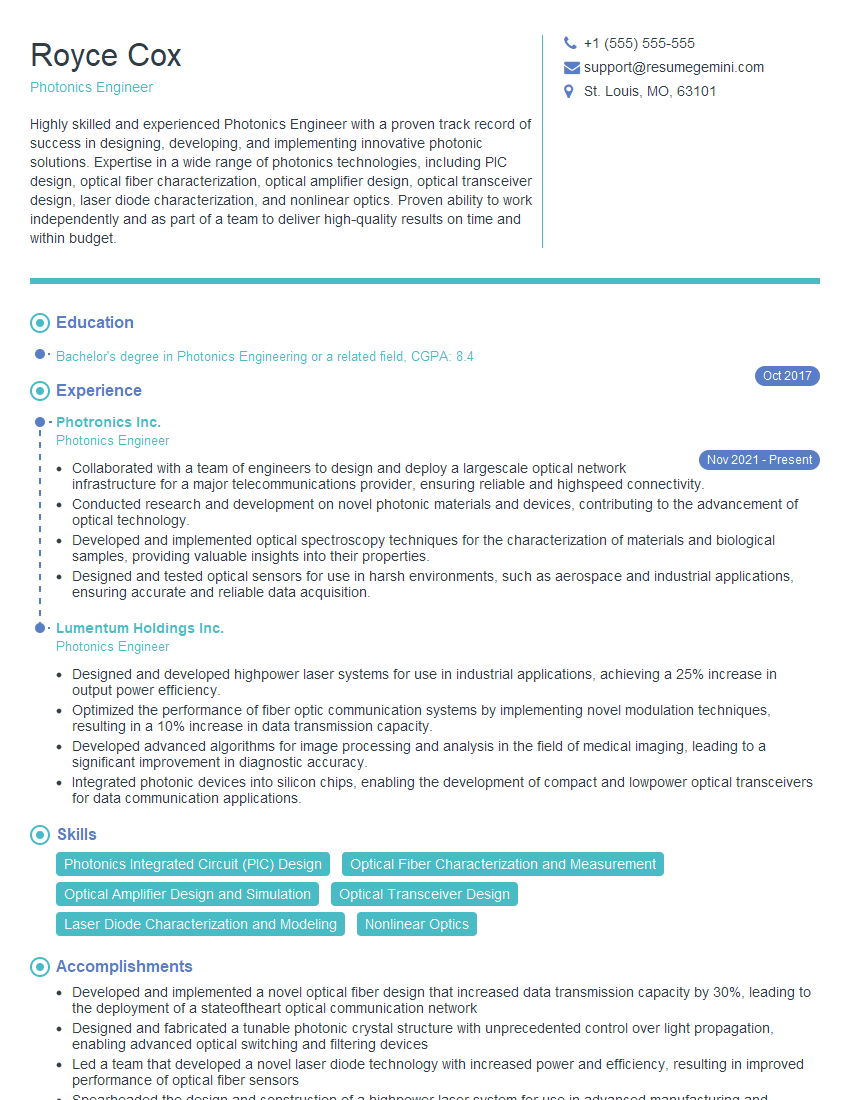
Mastering Device Physics opens doors to exciting careers in semiconductor research, development, and manufacturing. A strong understanding of these principles is highly sought after by leading companies in the industry, significantly enhancing your career prospects. To maximize your chances of landing your dream role, crafting a compelling and ATS-friendly resume is vital. ResumeGemini is a trusted resource to help you build a professional and impactful resume that highlights your skills and experience effectively. We provide examples of resumes tailored specifically to Device Physics roles to help you get started. Take the next step towards your successful career journey – build a winning resume with ResumeGemini today!

Explore more articles
Users Rating of Our Blogs
Share Your Experience
We value your feedback! Please rate our content and share your thoughts (optional).
What Readers Say About Our Blog
Very informative content, great job.
good