Unlock your full potential by mastering the most common Diamond Grading and Evaluation interview questions. This blog offers a deep dive into the critical topics, ensuring you’re not only prepared to answer but to excel. With these insights, you’ll approach your interview with clarity and confidence.
Questions Asked in Diamond Grading and Evaluation Interview
Q 1. Explain the 4Cs of diamond grading (Cut, Clarity, Color, Carat Weight).
The 4Cs – Cut, Clarity, Color, and Carat Weight – are the internationally recognized standards for grading diamonds. They represent the key characteristics that determine a diamond’s beauty, rarity, and ultimately, its value. Think of them as the four pillars supporting the assessment of a diamond.
- Cut: This refers to how well a diamond’s facets interact with light. An excellent cut maximizes brilliance, fire, and scintillation. It’s not just about the shape (round, princess, etc.), but the proportions, symmetry, and polish of the facets.
- Clarity: This describes the absence of inclusions (internal flaws) and blemishes (external flaws) in a diamond. A flawless diamond is extremely rare and valuable. Clarity grades range from Flawless (FL) to Included (I).
- Color: This assesses how colorless a diamond is. The less color, the higher the grade. The GIA grading scale uses letters from D (colorless) to Z (light yellow or brown). Diamonds with very faint color may appear colorless to the naked eye, but subtle differences are visible under magnification.
- Carat Weight: This refers to a diamond’s weight, and consequently, its size. One carat equals 200 milligrams. A larger carat weight, all other factors being equal, generally increases the price, reflecting rarity.
Understanding the 4Cs empowers buyers to make informed decisions, ensuring they get the best value for their investment. For example, a diamond with an excellent cut might appear significantly more brilliant than one with a lower cut grade, even if their other 3Cs are similar. A skilled gemologist expertly assesses each of the 4Cs to produce a comprehensive grading report.
Q 2. Describe the GIA grading scale for diamond color.
The GIA (Gemological Institute of America) color grading scale is the industry standard for assessing diamond color. It uses letters, ranging from D to Z, to represent the different color grades.
- D-F: Colorless. These are the rarest and most valuable grades. The difference between D and F is very subtle and only noticeable under expert examination.
- G-J: Near Colorless. Diamonds in this range appear colorless to the naked eye, but slight color can be seen under certain lighting conditions.
- K-M: Faint Color. A slight color is visible to the naked eye.
- N-Z: Light to Very Light Yellow or Brown. The color becomes increasingly noticeable.
While D-color diamonds are the most sought after, many consumers find that diamonds graded G-J offer excellent value, as the color difference is often imperceptible to the unaided eye. The choice depends on individual preference and budget. Remember that even slight color differences can significantly influence price.
Q 3. Explain the different clarity characteristics in diamonds (e.g., inclusions, blemishes).
Clarity characteristics in diamonds refer to internal inclusions and external blemishes that affect their transparency and overall appearance.
- Inclusions: These are internal flaws within the diamond’s structure, formed during its growth process. They can range from tiny crystals to feathers (internal cracks) to clouds (clusters of tiny crystals). The size, number, nature, and position of inclusions affect the clarity grade.
- Blemishes: These are external flaws on the surface of the diamond. They are usually caused by damage during the cutting and polishing process. Examples include nicks, pits, or scratches.
The GIA uses a standardized system to grade clarity, ranging from Flawless (FL), meaning no inclusions or blemishes are visible under 10x magnification, down to Included (I), where inclusions are readily visible. The location and nature of the inclusions/blemishes are also crucial; inclusions located near the center are often more impactful on appearance and value than those on the edge. Consider a diamond with a large inclusion near the center versus a diamond with several tiny inclusions at the edge—the latter might actually achieve a higher clarity grade.
Q 4. How do you assess diamond cut quality?
Assessing diamond cut quality involves evaluating several factors that impact how light interacts with the stone, determining its brilliance, fire, and scintillation. It’s not simply a matter of shape but of precise proportions, symmetry, and polish.
- Proportions: These refer to the relationships between the diamond’s depth, table size (the top facet), and girdle thickness. Optimal proportions maximize light return, resulting in greater brilliance.
- Symmetry: This refers to how well-aligned the facets are. Good symmetry ensures light travels efficiently through the diamond.
- Polish: This describes the smoothness and quality of the facets’ surfaces. Excellent polish creates a flawless appearance and maximizes brilliance.
GIA and other reputable labs use sophisticated instruments and experienced graders to assess these aspects. They provide a comprehensive cut grade that reflects the overall performance of the diamond’s cut. Remember, an excellent cut can significantly enhance a diamond’s beauty, making it sparkle more than a diamond with inferior cut characteristics, even if the other 3Cs are comparable.
Q 5. What are the different types of diamond cuts and their characteristics?
There’s a wide variety of diamond cuts, each with its own unique characteristics and aesthetic appeal. The most popular shapes include:
- Round Brilliant: This classic cut maximizes brilliance, fire, and scintillation due to its precisely calculated facets.
- Princess: A square or rectangular cut, known for its modern look and good brilliance.
- Emerald: A step-cut with long, rectangular facets, resulting in a distinctive hall-of-mirrors effect.
- Asscher: A square cut with stepped facets, resembling an antique cut with strong brilliance.
- Pear: A teardrop shape, combining the brilliance of a round brilliant with the elegance of a unique form.
- Marquise: An elongated oval shape, sometimes referred to as a navette, known for its vintage charm.
- Oval: A slightly elongated round shape, offering a balance of brilliance and elegance.
The choice of cut is largely a matter of personal preference. Each cut has its own strengths and weaknesses in terms of brilliance, fire, and scintillation. For example, emerald cuts generally showcase better clarity than round brilliant cuts due to their fewer facets, while round brilliants typically boast the most brilliance.
Q 6. Explain the fluorescence phenomenon in diamonds and its impact on grading.
Fluorescence is the phenomenon where a diamond emits visible light when exposed to ultraviolet (UV) light. This is caused by trace amounts of certain elements within the diamond’s crystal structure. The intensity of fluorescence can range from none to very strong.
Fluorescence is generally graded using a scale ranging from None to Strong. While it often appears as a bluish hue, other colours like yellow or green are also possible. Its impact on grading is usually minimal; the majority of diamond fluorescence does not significantly affect the diamond’s appearance. However, strong fluorescence can sometimes result in a slight hazy or milky appearance, which might be considered undesirable by some buyers. In such cases, it could slightly impact the diamond’s price. Many consumers, however, may not even notice the effect of fluorescence.
It’s important to remember that fluorescence is a naturally occurring phenomenon and doesn’t necessarily indicate lower quality. A diamond with strong fluorescence but otherwise excellent characteristics can still be a beautiful and valuable stone. Always consider the overall appearance of the diamond in combination with its fluorescence grade.
Q 7. Describe the different methods used to measure carat weight.
Carat weight is measured using highly precise electronic scales, calibrated to measure in milligrams. Since one carat equals 200 milligrams, the scale accurately determines the weight to several decimal places. This ensures consistency and accuracy in the diamond industry. The weighing process should always be done by a reputable gemological laboratory or jeweler using certified equipment to ensure precision and avoid any discrepancies.
Historically, carats were based on the weight of carob seeds, giving rise to the unit’s name. However, modern methods utilise sophisticated scales, far surpassing the accuracy of the ancient carob seed method, ensuring fair and accurate measurement.
Q 8. What are the common instruments used in diamond grading?
Diamond grading relies on a suite of specialized instruments to accurately assess the four Cs: Cut, Clarity, Color, and Carat Weight. These tools allow for precise measurements and observations, ensuring consistent and reliable grading results.
- Microscopes: High-powered microscopes, often incorporating darkfield illumination, are crucial for examining inclusions (internal flaws) and blemishes (external flaws) within the diamond. Different magnifications are used depending on the size and clarity of the diamond.
- Spectrometers: These instruments analyze the diamond’s light absorption and emission properties, helping identify the presence of trace elements that affect color. This is vital for detecting treatments or identifying the origin of fancy-colored diamonds.
- Diamond Scales: Precise scales, calibrated to measure to the hundredth of a carat, are essential for determining the diamond’s weight. Accuracy here is paramount, as carat weight directly impacts price.
- Master Stones: These are calibrated diamonds of known color grades, used for color comparison. Graders use these alongside the spectrometer to confirm color assignments.
- Proportions Measurement Tools: These tools, including specialized software and optical instruments, meticulously measure the diamond’s angles, girdle thickness, and pavilion depth to evaluate its cut quality. Accurate proportions contribute significantly to brilliance and fire.
For instance, a spectrometer can readily differentiate between a natural fancy pink diamond and one treated to enhance its pink hue, helping maintain the integrity of the grading process.
Q 9. How do you identify treated diamonds?
Identifying treated diamonds requires a thorough examination using a combination of techniques. The goal is to detect any evidence of alteration to the diamond’s natural properties, whether it’s to enhance color, clarity, or both.
- Visual Inspection: Experienced graders often spot subtle signs of treatments under magnification. For example, certain clarity enhancements might leave behind telltale marks or patterns.
- Spectroscopic Analysis: Spectrometers are crucial for revealing the presence of unusual elements or patterns associated with specific treatments. For example, irradiation treatments may leave unique spectroscopic signatures.
- Fluorescence Testing: Exposure to UV light can reveal fluorescence, which can be natural or induced through treatments. The intensity, color, and distribution of fluorescence are carefully assessed.
- Conductivity Testing: This test helps identify treatments involving coating or filling fissures, as these treatments typically alter the diamond’s electrical conductivity.
Let’s say a diamond shows unusually high levels of blue fluorescence under UV light coupled with spectral characteristics suggesting irradiation. This combination would strongly suggest that the diamond has undergone irradiation treatment to enhance its color or clarity.
Q 10. Explain the difference between natural and lab-grown diamonds.
Natural and lab-grown diamonds are chemically identical – both are composed of pure carbon. The key difference lies in their origin and formation process.
- Natural Diamonds: Formed billions of years ago deep within the Earth’s mantle under immense pressure and heat, natural diamonds are mined from the earth.
- Lab-Grown Diamonds: Created in controlled laboratory environments, lab-grown diamonds replicate the geological conditions responsible for natural diamond formation, using processes like High-Pressure/High-Temperature (HPHT) or Chemical Vapor Deposition (CVD).
While indistinguishable to the naked eye and often similar in physical properties, the difference in origin is significant. Lab-grown diamonds typically lack the geological history and scarcity associated with naturally mined diamonds, impacting their value perception in the market.
Q 11. How do you determine the value of a diamond based on its grading report?
A diamond’s value, as reflected in its grading report, is predominantly determined by the four Cs: Cut, Clarity, Color, and Carat Weight. The grading report provides objective assessments of each, providing a quantifiable basis for valuation.
- Cut: A well-cut diamond maximizes brilliance, fire, and scintillation, commanding a premium. The report details the proportions, symmetry, and polish.
- Clarity: Refers to the presence of inclusions and blemishes. Flawless diamonds are the rarest and most valuable. The report categorizes clarity based on the size, number, and nature of internal and external flaws.
- Color: The closer a diamond is to colorless, the higher its value. Reports use a grading scale (e.g., D-Z, where D is colorless) to categorize color grade.
- Carat Weight: Simply put, larger diamonds are generally more valuable, all else being equal.
However, other factors influence market price beyond the grading report, including shape, fluorescence, and current market trends. A skilled appraiser considers these factors to determine the overall value.
For example, two diamonds might have identical color and clarity grades, but one with an excellent cut will be significantly more valuable than one with a poor cut due to its superior brilliance.
Q 12. What are the ethical considerations in diamond grading and sourcing?
Ethical considerations in diamond grading and sourcing are paramount. They concern environmental and social impacts throughout the diamond’s journey from mine to market.
- Conflict-Free Diamonds: The Kimberley Process Certification Scheme aims to prevent the trade of conflict diamonds, often mined in war zones and used to finance armed conflict. Graders and distributors have a responsibility to adhere to these regulations and ensure diamonds are conflict-free.
- Environmental Impact: Diamond mining has environmental consequences, including habitat destruction and water pollution. Sustainable mining practices and responsible sourcing are essential.
- Labor Practices: Ensuring fair labor practices in diamond mining and production, including safe working conditions and fair wages, is a crucial ethical concern.
- Transparency and Traceability: A transparent supply chain, enabling the tracking of a diamond from its origin to the consumer, helps address concerns regarding conflict, labor practices, and environmental impacts. Grading reports can contribute to increased transparency through detailed information about the diamond’s origin.
Consumers increasingly demand ethical diamonds, making responsible sourcing and transparency key factors influencing diamond value and market acceptance.
Q 13. Explain the process of diamond grading from submission to certification.
The diamond grading process is rigorous and ensures accurate and consistent evaluation. It generally involves the following steps:
- Submission: The diamond is submitted to the grading laboratory, often accompanied by information about its origin and history.
- Initial Assessment: The diamond’s physical characteristics are initially assessed. This includes weight measurement, visual inspection, and preliminary identification of key features.
- Detailed Examination: The diamond undergoes meticulous examination using specialized instruments such as microscopes and spectrometers. Each of the four Cs is graded according to established standards.
- Data Recording and Analysis: All measurements, observations, and grading decisions are meticulously documented and analyzed to ensure consistency and accuracy.
- Certification Report Generation: A detailed report summarizing the diamond’s grading characteristics is generated. This includes images and plots that illustrate the diamond’s internal and external features and proportions.
- Final Review and Approval: Senior graders review the report to confirm the grading accuracy and consistency before issuing the final certification.
- Report Issuance: The certified grading report, along with the diamond (if applicable), is returned to the submitter.
Throughout the entire process, quality control measures ensure the objectivity and reliability of the grading results.
Q 14. How do you handle discrepancies in grading reports from different laboratories?
Discrepancies in grading reports from different laboratories can arise due to variations in grading standards, equipment, or grader interpretation. Handling such discrepancies requires a careful and objective approach.
- Review the Reports: Carefully compare the reports, noting any significant differences in grading parameters (cut, clarity, color, carat weight).
- Investigate Possible Causes: Consider potential reasons for the discrepancies. Are the differences minor variations within acceptable tolerances, or are they substantial deviations?
- Consult with Experts: If the discrepancies are significant, seeking the opinion of independent gemmological experts or experienced graders can provide valuable insight.
- Consider Additional Testing: In some cases, further testing might be warranted to resolve discrepancies. This could include additional spectroscopic analysis or re-examination by another independent laboratory.
- Document Findings: Maintain a detailed record of the investigation, including the original reports, expert opinions, and any additional testing results.
It’s crucial to remember that minor variations are possible. However, major discrepancies require careful investigation to ensure the accuracy and reliability of the grading information.
Q 15. Describe the different types of diamond grading reports.
Diamond grading reports are crucial documents that provide objective assessments of a diamond’s quality. Different labs issue reports with varying levels of detail, but they generally cover the same four Cs: Cut, Clarity, Color, and Carat Weight. The most common types include:
- Gemological Institute of America (GIA) Report: Widely considered the gold standard, GIA reports are highly detailed and reputable, providing comprehensive information about a diamond’s characteristics.
- American Gem Society (AGS) Report: AGS reports also offer detailed grading information, focusing on a more holistic assessment of the diamond’s overall beauty.
- European Gemological Laboratory (EGL) Report: EGL reports are generally less expensive than GIA or AGS reports but may have different grading standards, leading to potential inconsistencies in evaluation.
- International Gemological Institute (IGI) Report: IGI reports are another widely used option, offering a range of services from basic to more detailed reports.
The choice of report depends on budget and the level of detail required. For high-value diamonds, a GIA or AGS report is usually preferred for its reliability and market acceptance.
Career Expert Tips:
- Ace those interviews! Prepare effectively by reviewing the Top 50 Most Common Interview Questions on ResumeGemini.
- Navigate your job search with confidence! Explore a wide range of Career Tips on ResumeGemini. Learn about common challenges and recommendations to overcome them.
- Craft the perfect resume! Master the Art of Resume Writing with ResumeGemini’s guide. Showcase your unique qualifications and achievements effectively.
- Don’t miss out on holiday savings! Build your dream resume with ResumeGemini’s ATS optimized templates.
Q 16. How do you identify synthetic diamonds?
Identifying synthetic diamonds requires specialized knowledge and equipment. While they visually resemble natural diamonds, there are key differences that trained gemologists can detect. Common methods include:
- Gemological Instruments: Advanced instruments such as spectrometers, refractometers, and FTIR (Fourier-transform infrared spectroscopy) can reveal subtle differences in the chemical composition, crystal structure, and inclusion patterns between natural and synthetic diamonds.
- Fluorescence and Phosphorescence: Certain types of synthetic diamonds exhibit distinct fluorescence patterns under UV light, allowing for identification.
- Inclusion Analysis: Synthetic diamonds often possess characteristic growth structures and inclusions that differ from those found in natural diamonds. For example, the presence of metallic inclusions or specific growth patterns can be indicative of synthetic origin.
- Visual Examination (Experienced Gemologists): Experienced gemologists often have developed a keen eye, able to identify subtle differences in the brilliance or clarity characteristic of lab-grown versus mined diamonds.
It’s important to note that sophisticated synthetic diamonds are becoming increasingly difficult to distinguish from natural ones without proper testing. A professional gemological lab’s expertise is vital for accurate identification.
Q 17. What are the key differences between a diamond and a moissanite?
Diamonds and moissanites are both popular gemstones, but they have distinct properties:
| Property | Diamond | Moissanite |
|---|---|---|
| Chemical Composition | Pure carbon | Silicon carbide (SiC) |
| Hardness | 10 (Mohs scale) | 9.25 (Mohs scale) |
| Refractive Index | 2.417 | 2.65-2.69 |
| Dispersion (Fire) | Moderate | Strong (more fiery) |
| Brilliance | Exceptional | Excellent, often appearing slightly more brilliant |
| Price | Generally more expensive | Significantly less expensive |
In short, while moissanite offers exceptional brilliance and fire at a lower price, diamonds hold their value better due to their rarity and prestige. The choice depends on individual preference and priorities.
Q 18. Explain the concept of diamond symmetry and polish.
Diamond symmetry and polish are two critical aspects of cut grading that significantly impact a diamond’s brilliance and overall appearance.
- Symmetry: This refers to how well the diamond’s facets align with each other and its overall shape. A perfectly symmetrical diamond will have its facets evenly spaced and positioned, maximizing light return. Imperfect symmetry can cause light leakage, reducing brilliance.
- Polish: Polish refers to the smoothness and reflectivity of a diamond’s facets. A highly polished diamond will reflect light efficiently, creating a bright and lively appearance. Poor polish can result in a dull or hazy look due to surface imperfections.
Imagine a perfectly cut crystal: symmetry is how precisely the faces are aligned, while polish is the flawless smoothness of each face. Both contribute to the diamond’s ability to return light and sparkle.
Q 19. How do you assess the overall brilliance and fire of a diamond?
Assessing a diamond’s brilliance and fire requires a combination of visual examination and understanding of optical principles. Brilliance refers to the amount of white light reflected from the diamond’s surface, while fire refers to the flashes of colored light caused by the dispersion of white light into its spectral components.
- Visual Examination: In a well-lit environment, observe how much white light is reflected and scattered from the diamond’s facets. Look for a bright, lively appearance. Examine the flashes of color (fire) as you move the diamond. A well-cut diamond displays impressive brilliance and vivid fire.
- Cut Grade: A high cut grade (e.g., Excellent or Ideal) is strongly indicative of exceptional brilliance and fire, as these grades reflect optimized facet arrangements that maximize light return.
- Table Percentage and Depth Percentage: These proportions significantly influence brilliance. Ideally, the table and depth percentages should be within specific ranges.
Think of brilliance as the overall sparkle, and fire as the colorful rainbow flashes within the sparkle. Both are highly desirable qualities in a diamond.
Q 20. What are the common types of inclusions found in diamonds?
Diamonds often contain inclusions, which are internal flaws or imperfections. The types and severity of inclusions are factors in clarity grading. Common inclusion types include:
- Crystals: Small crystals of various minerals trapped within the diamond during its growth.
- Cleavages: Internal fractures or breaks that occur along the diamond’s natural cleavage planes.
- Feathers: Tiny cracks or fissures that resemble feathers.
- Clouds: Groups of tiny crystals or other inclusions clustered together.
- Twinning Wisps: Thin, wisp-like inclusions that occur where two crystal growth zones meet.
- Black Spots: Dark inclusions that can significantly impact a diamond’s clarity.
The presence and nature of inclusions influence a diamond’s clarity grade and overall value. While some inclusions are barely visible to the naked eye, others can be more prominent and affect the diamond’s appearance.
Q 21. How do you handle a diamond with a significant inclusion?
Handling a diamond with a significant inclusion requires careful consideration. The approach depends on the nature and location of the inclusion, and its impact on the overall appearance of the diamond.
- Transparency and Visibility: If the inclusion is internally positioned and doesn’t significantly affect the diamond’s appearance or brilliance, it may not reduce its value considerably.
- Location: Inclusions located on the table or crown (top) of the diamond are often more noticeable and can detract more from the diamond’s appearance than inclusions found on the pavilion (bottom).
- Clarity Grading: The inclusion’s impact on the clarity grade is a key factor. Lower clarity grades generally mean lower prices.
- Disclosure: Full transparency is essential when selling or buying a diamond with significant inclusions. The grading report should clearly document the inclusions.
- Price Negotiation: The presence of significant inclusions generally justifies negotiating a lower price compared to a similar diamond with fewer or less impactful inclusions.
Ultimately, a comprehensive assessment by a gemologist is crucial to determine the true value and market viability of a diamond with a significant inclusion.
Q 22. Describe the different types of diamond treatments (e.g., HPHT, irradiation).
Diamond treatments are processes used to enhance a diamond’s color or clarity. Several methods exist, each impacting the stone’s properties and value. Two common techniques are High-Pressure/High-Temperature (HPHT) treatment and irradiation.
- HPHT Treatment: This involves subjecting diamonds to intense heat and pressure. This can cause nitrogen impurities within the diamond to rearrange, potentially improving a diamond’s color from yellow or brown to clearer shades of white or colorless. The process is relatively stable, meaning the color improvement is generally permanent. However, a reputable gemological laboratory will often disclose HPHT treatment in their grading report.
- Irradiation: This treatment exposes diamonds to radiation, usually electrons or gamma rays. This alters the diamond’s color, often transforming brown diamonds into fancy colors like blue, green, or even pink. The color created via irradiation may not be as stable as that achieved through HPHT, and some irradiated diamonds may require additional treatment to stabilize the color. Disclosure of this treatment is also crucial for transparency.
Other treatments include laser drilling, which is used to remove or reduce the visibility of inclusions, and coating treatments which enhance a diamond’s appearance but can wear off.
Q 23. What is the impact of girdle thickness on diamond grading?
Girdle thickness, the widest part of the diamond’s circumference, significantly influences a diamond’s grading and value. The GIA (Gemological Institute of America), for instance, grades girdle thickness on a scale from Very Thin to Very Thick. A girdle that is too thin is prone to chipping or breakage, reducing its durability and value. Conversely, a girdle that’s too thick can reduce brilliance as it blocks light from entering the diamond. Ideally, a diamond should have a girdle thickness that balances strength and brilliance. A ‘medium’ girdle thickness is generally preferred.
The grader assesses the girdle’s thickness under magnification, taking note of its overall strength and its impact on the diamond’s appearance. A thin girdle might lead to a lower grade, even if other aspects of the diamond are exceptional, due to the inherent risk of damage. Similarly, an excessively thick girdle can negatively impact the light return, affecting brilliance, and thus the overall grade.
Q 24. Explain how you would determine if a diamond has been laser-drilled.
Determining if a diamond has been laser-drilled requires careful examination under magnification. Laser drilling is a treatment used to remove or improve the visibility of inclusions (internal flaws) within a diamond. It creates tiny channels within the diamond, allowing light to scatter differently around the inclusion, making it less noticeable to the naked eye.
I would use a gemological microscope to carefully examine the diamond for the presence of these tiny channels. They often appear as feather-like or needle-like features radiating from an inclusion. Inclusions treated by laser drilling will often have a slightly different appearance when compared to untreated inclusions. Additionally, advanced techniques such as spectroscopic analysis might be used to further confirm the presence of laser-induced damage within the crystal lattice.
Experienced graders can often identify laser drilling based on the characteristic patterns left behind, but advanced technology such as photoluminescence imaging can help in ambiguous cases. The presence of laser-drilled inclusions usually necessitates disclosure in the diamond grading report.
Q 25. How would you assess the potential value of a rough diamond?
Assessing the potential value of a rough diamond is a complex process that involves several factors. It’s a bit like evaluating a sculptor’s raw material before the masterpiece is revealed. First, I’d assess the diamond’s characteristics including its:
- Weight (Carat): Larger rough diamonds generally yield larger cut diamonds and are more valuable.
- Color: The color of the rough diamond hints at the possible color of the polished stone.
- Clarity: The number and type of inclusions present.
- Cuttability: This is crucial; a rough diamond with poor cuttability may yield a smaller polished diamond, lowering its value. This assessment frequently involves sophisticated software to simulate the potential yield.
I would use specialized software and perhaps consult with diamond cutters to estimate the potential yield and quality of the polished diamonds. Market analysis for similar rough diamonds is critical, considering current prices per carat for comparable grades and colors. The final value estimation involves calculating the projected value of the polished diamonds, factoring in potential cutting and polishing costs.
Q 26. What are the limitations of diamond grading reports?
Diamond grading reports, while highly valuable, have limitations. They provide a snapshot of the diamond’s characteristics at a particular point in time, but they don’t necessarily predict future performance or capture every aspect. Key limitations include:
- Subjectivity: While grading standards are established, some degree of subjectivity remains in assessing certain characteristics, such as fluorescence or polish.
- Limited Scope: Reports typically don’t assess treatment beyond basic disclosures. For example, some minor treatments or enhancements may not be detectable with standard gemological equipment.
- Focus on Physical Characteristics: Reports primarily focus on the 4Cs (Cut, Clarity, Color, Carat weight). They often don’t account for factors like consumer preferences, which can influence a diamond’s perceived value.
- No Guarantee of Value: A high grade does not guarantee high market value. Other factors like branding, demand, and market conditions influence price.
It’s important to remember that a grading report serves as a tool for understanding a diamond’s properties, but it’s not an absolute measure of its value.
Q 27. Describe a situation where you had to resolve a grading discrepancy.
In one instance, two different laboratories issued conflicting reports on a diamond’s clarity grade. One lab graded the diamond as VS1 (Very Slightly Included 1), while the other graded it as SI1 (Slightly Included 1). This discrepancy could have significant price implications.
To resolve this, I conducted a thorough re-examination of the diamond myself, using a variety of instruments including a gemological microscope and a digital image system. I meticulously documented the location and nature of every inclusion. The key was to compare the locations described in both reports with my observations under magnification. The discrepancy arose from slightly different interpretations of inclusion visibility under different lighting conditions. After careful analysis and comparison, I determined that the VS1 grading was more accurate, based on the overall clarity and size of the inclusions. A clear, detailed explanation, accompanied by photographic evidence, was then provided to both laboratories for review.
Q 28. What are your salary expectations for this position?
My salary expectations for this position are commensurate with my experience, skills, and the market value for a diamond grading expert with my qualifications. I’m confident that I can make a significant contribution to your team, and I’m open to discussing a competitive salary package that reflects that value. Let’s review the job description and my qualifications to arrive at a mutually agreeable figure.
Key Topics to Learn for Diamond Grading and Evaluation Interview
- The 4Cs: Understand the intricacies of Carat, Cut, Clarity, and Color grading, including the specific grading scales and their implications on diamond value.
- Diamond Fluorescence: Learn to identify and evaluate fluorescence, its impact on a diamond’s appearance, and how to communicate its presence to clients.
- Clarity Characteristics: Master the identification and grading of inclusions and blemishes, using standardized terminology and understanding their impact on a diamond’s value.
- Cut Grade Assessment: Develop a thorough understanding of how light performance is affected by cut proportions and polish, and how to accurately assess this based on observation and potentially using instruments.
- Color Grading: Become proficient in comparing diamonds against master stones or using instruments to determine subtle color differences and assigning accurate color grades.
- Diamond Grading Instruments: Familiarize yourself with the use of common diamond grading instruments like microscopes, spectroscopes, and other tools used for accurate evaluation.
- Grading Reports: Learn to interpret and understand the information provided in various diamond grading reports from different laboratories (e.g., GIA, AGS).
- Ethical Considerations: Understand ethical practices in the diamond industry, including conflict-free sourcing and responsible business practices.
- Practical Application: Be prepared to discuss how you would apply your knowledge to real-world scenarios, such as grading diamonds, assessing their value, and communicating that information to clients or colleagues.
- Problem-Solving: Practice identifying and resolving potential grading discrepancies or inconsistencies, demonstrating your critical thinking and problem-solving skills.
Next Steps
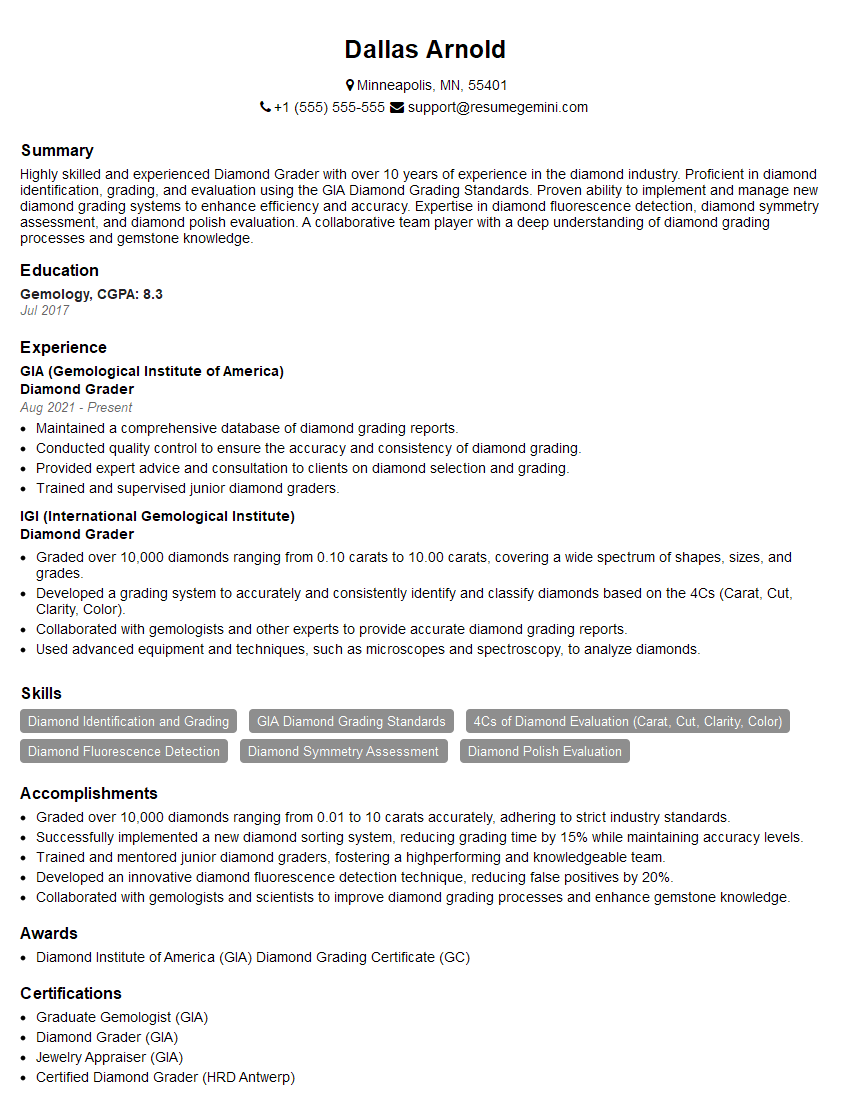
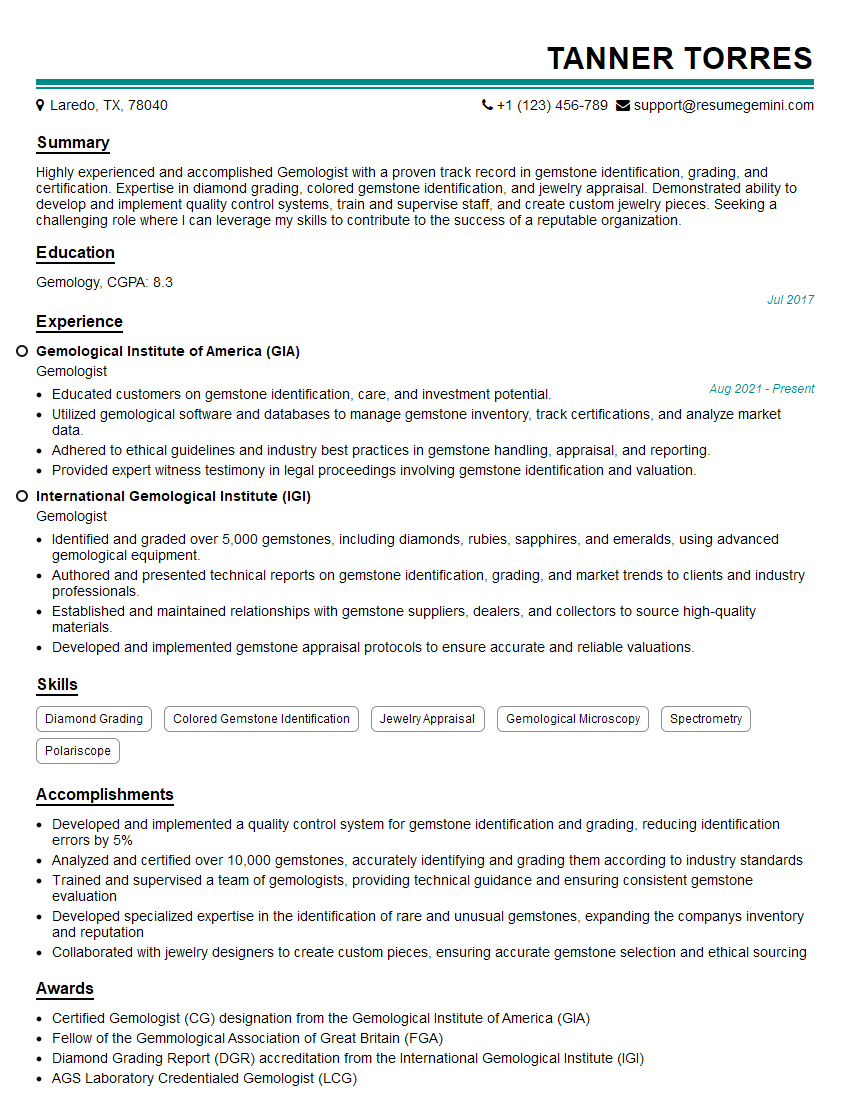
Mastering diamond grading and evaluation opens doors to exciting and rewarding careers in the gem and jewelry industry, offering opportunities for growth and specialization. A strong resume is crucial for showcasing your expertise and securing your dream role. To increase your chances of getting noticed by Applicant Tracking Systems (ATS) and recruiters, create an ATS-friendly resume that highlights your skills and experience effectively. ResumeGemini is a trusted resource that can help you build a professional, impactful resume tailored to the diamond grading industry. Examples of resumes specifically designed for Diamond Grading and Evaluation professionals are available to help you get started.
Explore more articles
Users Rating of Our Blogs
Share Your Experience
We value your feedback! Please rate our content and share your thoughts (optional).
What Readers Say About Our Blog
Very informative content, great job.
good