Unlock your full potential by mastering the most common Die Cutting Setup and Operation interview questions. This blog offers a deep dive into the critical topics, ensuring you’re not only prepared to answer but to excel. With these insights, you’ll approach your interview with clarity and confidence.
Questions Asked in Die Cutting Setup and Operation Interview
Q 1. Explain the difference between rotary and flatbed die cutting.
The main difference between rotary and flatbed die cutting lies in how the cutting force is applied. Think of it like this: rotary die cutting is like using a rolling pin to cut cookie dough – continuous and efficient for high volumes. Flatbed die cutting is more like using a cookie cutter – precise for intricate shapes, but slower for mass production.
Rotary Die Cutting: Uses a cylindrical die that rotates against a continuously fed substrate (material). This method is incredibly fast and ideal for large-scale production runs of simple shapes. Imagine cutting thousands of identical labels for a product. Rotary is perfect for that.
Flatbed Die Cutting: Employs a flat die that presses down onto the material, creating the cut. This offers superior accuracy and the ability to create complex shapes and intricate designs, making it ideal for projects needing precise cuts and details, like custom packaging or labels with delicate elements.
In essence, rotary is about speed and efficiency, while flatbed prioritizes precision and versatility. The choice depends entirely on the job requirements: volume, design complexity, and material type.
Q 2. Describe the process of setting up a die cutting machine for a new job.
Setting up a die-cutting machine for a new job is a meticulous process requiring precision and attention to detail. It’s akin to preparing a stage for a theatrical performance – everything must be in its place for a flawless outcome.
- Die Installation: Carefully mount the die onto the machine’s platen, ensuring it’s firmly secured and aligned correctly. Misalignment can lead to inaccurate cuts.
- Material Feeding: Adjust the material feed mechanism to accommodate the thickness and characteristics of the substrate. Too much tension can cause tearing; too little can lead to slippage and misregistration.
- Pressure Adjustment: Set the appropriate cutting pressure. This is critical to achieve clean cuts without damaging the material. A pressure test on scrap material is recommended before cutting the final product.
- Registration Marks: Precisely align the material with the registration marks on the die using the machine’s registration system. This ensures that the cut is consistently placed in the correct position.
- Test Run: Perform a test run with a small quantity of material to check for any issues, such as improper alignment, cutting defects, or material damage. This is crucial for catching problems early on.
- Fine Tuning: Based on the test run, make any necessary adjustments to the pressure, feed, and registration to optimize the cutting process.
Each step requires careful attention to detail. Rushing the setup can lead to costly errors and waste of materials.
Q 3. How do you ensure the accurate registration of a die cutting job?
Accurate registration is the cornerstone of a successful die-cutting job – it’s like ensuring all the pieces of a jigsaw puzzle fit perfectly. Achieving this relies on several key factors.
- Precise Die Design: The die itself must be designed with accurate registration marks. These marks act as guides during the cutting process.
- Accurate Material Feeding: Consistent material feeding is crucial to prevent slippage. This often involves using specialized material handling techniques and ensuring the machine’s feed system is properly calibrated.
- Proper Machine Alignment: Ensuring the machine’s components are perfectly aligned prevents misalignment of the cutting process.
- Registration System: Using the machine’s registration system (optical or mechanical) correctly is essential for aligning the material with the die. This requires careful attention to the system’s settings and accurate operation.
- Regular Maintenance: Consistent maintenance of the machine and die helps prevent wear and tear that could affect registration accuracy.
Regularly checking registration throughout the run is important to ensure consistent results. If inconsistencies are found, the process should be immediately stopped to investigate and correct the source of the error.
Q 4. What are the common causes of die cutting defects and how do you troubleshoot them?
Die-cutting defects can be frustrating, but systematic troubleshooting can usually pinpoint the cause. Think of it as detective work; we gather clues to solve the mystery.
- Incomplete Cuts: This often indicates insufficient cutting pressure, a dull die, or incorrect material type. Solution: Increase pressure, sharpen or replace the die, or use a more suitable material.
- Misregistration: Inaccurate cuts indicate problems with material feeding, die alignment, or machine registration. Solution: Check and adjust the feed system, ensure proper die alignment, and calibrate the registration system.
- Material Damage: Crushing, tearing, or creasing points to excessive pressure, improper material handling, or a faulty die. Solution: Reduce cutting pressure, handle the material more carefully, or repair/replace the die.
- Double-Striking: This often happens with misaligned dies or incorrect machine settings. Solution: Check alignment and adjust machine settings.
- Loose Blanks: This generally indicates inadequate pressure or a problem with the die’s cutting edge. Solution: Increase the pressure or have the die repaired.
A thorough inspection of the die, material, and machine settings is always the first step in troubleshooting. Keeping detailed records of each job helps identify recurring issues and refine processes for future runs.
Q 5. How do you maintain and clean a die cutting machine?
Maintaining and cleaning a die-cutting machine is crucial for longevity, accuracy, and safety. Regular maintenance is like giving your car a regular tune-up – preventing major problems down the line.
- Regular Cleaning: Remove debris, scrap material, and excess lubrication from the machine after each job. This prevents build-up that could affect performance and cause damage.
- Lubrication: Regularly lubricate moving parts according to the manufacturer’s recommendations. This ensures smooth operation and reduces wear.
- Die Maintenance: Regularly inspect dies for damage, wear, or debris. Sharpen or replace dies as needed. Proper die storage is crucial to prevent damage.
- Safety Checks: Conduct regular safety inspections to ensure all guards and safety features are in good working order.
- Scheduled Maintenance: Follow the manufacturer’s recommendations for scheduled maintenance, including more extensive cleaning, lubrication, and inspections.
Prevention is key. Regular maintenance can significantly extend the life of your die-cutting equipment and minimize downtime.
Q 6. What safety precautions do you follow when operating a die cutting machine?
Safety is paramount when operating a die-cutting machine. These machines can be dangerous if not handled properly; always treat them with respect.
- Personal Protective Equipment (PPE): Always wear appropriate PPE, including safety glasses, hearing protection, and gloves. These protect against potential hazards such as flying debris, loud noise, and contact with sharp edges.
- Machine Guards: Ensure all safety guards are in place and functioning correctly before operating the machine. These guards prevent accidental contact with moving parts.
- Lockout/Tagout Procedures: Follow proper lockout/tagout procedures before performing any maintenance or repairs. This prevents accidental activation of the machine.
- Training and Awareness: Only operate the machine after receiving proper training and understanding all safety procedures. Never operate a machine if you are unsure how to do so safely.
- Emergency Procedures: Be familiar with emergency procedures in case of an accident or malfunction. This includes knowing the location of emergency shut-off switches and first-aid equipment.
Safety is not just a set of rules; it’s a mindset. Prioritizing safety prevents accidents and ensures a healthy work environment.
Q 7. Explain the importance of proper die storage and handling.
Proper die storage and handling are essential for maintaining die quality and ensuring the longevity of your cutting tools. Think of it like storing fine silverware – proper care keeps it in top condition.
- Cleanliness: Clean dies thoroughly after each use to remove any debris or residue that could cause corrosion or damage. A clean die is a happy die.
- Storage Cases: Store dies in designated cases or containers that provide protection from damage, moisture, and dust. This helps maintain sharpness and accuracy.
- Organization: Organize dies systematically, using a labeling system that clearly identifies each die. This makes it easy to find the right die when needed.
- Handling: Handle dies carefully, avoiding dropping or hitting them. Use appropriate handling equipment like gloves and lifting devices when necessary.
- Regular Inspection: Regularly inspect dies for any signs of damage or wear. Sharpen or replace damaged dies as needed.
Proper die care is a cost-effective way to maximize the lifespan of your cutting tools and maintain the quality of your work. Neglecting this can lead to costly repairs or replacements.
Q 8. How do you interpret die cutting specifications and blueprints?
Interpreting die cutting specifications and blueprints requires a keen eye for detail and a solid understanding of the process. The blueprints will typically show the die’s dimensions, the placement of cut lines, perforations, and creases. Crucially, they indicate the material type and thickness. I start by verifying all dimensions against the provided specifications, checking for any discrepancies or potential issues early on. I look for notes regarding tolerances, which are critical for ensuring the final product meets quality standards. For example, a blueprint might specify a +/- 0.2mm tolerance on a critical cut line. This means the actual cut line can vary by up to 0.2mm in either direction and still be considered acceptable. Ignoring tolerances can lead to significant problems in assembly or functionality. I carefully examine the annotations, which typically detail the type of cut (e.g., full cut, kiss cut, perforation), the number of cuts, and specific requirements for particular elements. If there’s anything unclear, I always clarify with the design team before proceeding. This thorough review phase prevents costly errors down the line.
Q 9. How do you calculate the estimated production time for a die cutting job?
Estimating production time for a die cutting job involves several factors. The most significant are the material’s thickness and type, the complexity of the die (number of cuts, perforations, etc.), the quantity required, and the press’s speed and efficiency. I start by calculating the number of strokes required based on the die’s size and the sheet size. Then, I factor in the press speed, typically measured in strokes per minute (SPM). For instance, if a press runs at 100 SPM and requires 10 strokes per piece for a job with 10,000 pieces, the machine time would be (10,000 strokes / 100 SPM) = 100 minutes of run time. However, this doesn’t account for machine setup time (including die changes, material loading), which can vary based on the complexity of the setup and the material type. I’d add at least an hour for a standard setup and more for complex jobs. Quality checks and potential rework should also be factored in, adding 10-20% buffer time to the total. Therefore, a comprehensive calculation may include machine time, setup time, quality check time and a buffer time for unforeseen issues. I’ve developed a spreadsheet to standardize this process, allowing me to quickly generate accurate estimates.
Q 10. Describe your experience with different types of die cutting materials.
My experience encompasses a wide range of die cutting materials, from thin paper stocks and cardboards to thicker substrates like corrugated board, plastics (PVC, PET, etc.), and even foams. Each material requires a different approach to achieve optimal cutting results. For example, paper is relatively easy to cut and requires less force. However, achieving a clean cut without tearing, especially on thin paper, needs careful adjustment of cutting pressure and speed. Thicker materials like corrugated board demand higher cutting pressure and potentially slower speeds to prevent the blade from dulling quickly. Plastics, on the other hand, may necessitate specialized dies or adjustments to prevent cracking or warping. Understanding the material’s properties, including its thickness, tensile strength, and resilience, is paramount for setting up the press effectively and selecting the right die.
- Paper Stocks: Various weights and finishes (coated, uncoated).
- Cardboard: Different grades and thicknesses for packaging and display.
- Corrugated Board: Single-wall, double-wall, triple-wall – each requires specific settings.
- Plastics: PVC, PET, acrylic – each presents unique challenges regarding cutting force and tooling.
- Foams: EVA, PU foams, requiring sharp dies and specific pressures.
Q 11. What is your experience with different types of cutting dies (e.g., steel rule, magnetic, laser-cut)?
I have extensive experience working with various types of cutting dies: Steel rule dies are my most frequent choice due to their versatility and cost-effectiveness for high-volume production runs. They’re durable and easily customizable, allowing for intricate cuts and perforations. However, they require precise setup and regular maintenance to keep the cutting edges sharp. Magnetic dies offer a quick-change option and are ideal for short runs and prototyping. They are less expensive than steel rule dies, however their precision is somewhat lower, making them unsuitable for high-precision work. Laser-cut dies provide exceptional precision and clean cuts, particularly suitable for intricate designs and delicate materials, but they are generally more expensive and might not always be appropriate for high-volume applications due to their higher cost and often more delicate construction. The choice of die type depends heavily on the job’s specifics—volume, material, and complexity of the design.
Q 12. How do you ensure the quality of the finished die-cut product?
Ensuring the quality of the finished die-cut product requires a multi-stage approach, starting with rigorous inspection of the raw materials. Then, throughout the production process, I conduct regular quality checks. This involves visually inspecting the cut edges for burrs, clean cuts, registration accuracy (especially crucial for multi-layered products), and proper perforations. I use measuring instruments such as calipers and micrometers to verify dimensions against the specifications. Statistical process control (SPC) methods are employed to monitor critical parameters and identify potential problems early. Regular maintenance of the cutting dies and press is also crucial for maintaining consistent quality. A dedicated quality control officer reviews the finished product to provide further verification before releasing the batch. Any defects identified trigger an immediate investigation to pinpoint the root cause and prevent recurrence. This might involve adjusting machine settings, replacing worn dies, or even revising the setup procedure.
Q 13. What are the common problems associated with die stripping and how do you address them?
Die stripping, the process of separating the cut pieces from the waste material, can present several challenges. Common issues include sticking or tearing of the material, particularly with sticky materials or those with poor release properties. This may result from improper die design or material selection. In this case, adjustment of the die’s stripping mechanism or the use of release agents can prove effective. Another problem is inconsistent stripping, which may lead to damaged or incompletely stripped pieces. This frequently happens due to worn stripping elements, improper adjustment of the stripping pressure, or an accumulation of waste material on the die. Addressing this necessitates careful cleaning, adjustment of the stripping pressure, and maintenance of the die’s stripping mechanism. Another common issue is material wrapping around the die, causing jams. This points towards either an issue with the stripping mechanism, incorrect material feeding, or a die design that doesn’t effectively manage waste removal. A solution could involve optimizing the feed mechanism, reviewing the stripping design, or replacing the stripping pins. Solving stripping problems often involves a systematic approach, inspecting each component and element of the process to understand the root cause before implementing solutions.
Q 14. Explain your experience with different types of die cutting presses.
My experience encompasses various types of die cutting presses, ranging from smaller, manual platen presses ideal for short runs and prototyping to large, automated rotary presses suitable for high-volume production. Platen presses offer great versatility and are relatively easy to operate, making them perfect for smaller jobs or those requiring quick turnaround times. Rotary presses, on the other hand, are high-speed machines optimized for efficiency and high volumes, often equipped with automatic feeding and stacking systems. I’m also familiar with flatbed die cutters, which offer a balance between versatility and automation capabilities. The choice of press depends largely on factors like production volume, material thickness, and the complexity of the die cut. In addition to the mechanical aspect, I’m well-versed in the control systems of these presses, understanding how to optimize settings for different materials and dies to ensure consistent results, high-quality cuts, and maximum output with minimal downtime.
Q 15. How familiar are you with using pressure gauges and other measuring tools in die cutting?
Pressure gauges are fundamental in die cutting for ensuring consistent and effective cutting. They measure the tonnage (force) applied by the press to the cutting die, directly impacting the quality of the cut. I’m very familiar with using various pressure gauges, both analog and digital. Analog gauges provide a direct visual reading, while digital gauges offer precise numerical data and often allow for data logging. In my experience, accurately monitoring pressure is crucial; under-pressure can lead to incomplete cuts or weak creases, while over-pressure can damage the die, the material, or the press itself. For example, when working with thicker materials like corrugated cardboard, I’d carefully monitor the pressure to avoid crushing the material, while with delicate materials like thin paper, lower pressures are necessary to prevent tearing. I’m also proficient in using other measuring tools like micrometers and calipers to ensure precise die placement and material thickness checks, ensuring consistent results.
Career Expert Tips:
- Ace those interviews! Prepare effectively by reviewing the Top 50 Most Common Interview Questions on ResumeGemini.
- Navigate your job search with confidence! Explore a wide range of Career Tips on ResumeGemini. Learn about common challenges and recommendations to overcome them.
- Craft the perfect resume! Master the Art of Resume Writing with ResumeGemini’s guide. Showcase your unique qualifications and achievements effectively.
- Don’t miss out on holiday savings! Build your dream resume with ResumeGemini’s ATS optimized templates.
Q 16. Describe your experience with maintaining the sharpness and condition of cutting dies.
Maintaining the sharpness and condition of cutting dies is paramount for achieving clean, consistent cuts and maximizing die lifespan. My approach involves a multi-pronged strategy. Firstly, regular inspection is key. I visually inspect dies for signs of wear, damage, or burrs after each run. Secondly, I use appropriate sharpening techniques. This involves using specialized sharpening stones or services depending on the die type and material. For example, steel rule dies might require sharpening by a professional using specialized equipment, while simpler dies can sometimes be sharpened using finer grit stones. Thirdly, proper storage is crucial. Dies are stored in designated areas, away from moisture and potential damage. Finally, I use appropriate lubricants during the cutting process to help minimize wear and friction. Ignoring proper die maintenance can lead to poor cuts, material damage, and ultimately, increased costs from frequent die replacement.
Q 17. How do you handle material waste and optimize material usage in die cutting?
Minimizing material waste and optimizing material usage are crucial for both cost-effectiveness and environmental responsibility in die cutting. My strategies include careful nesting of designs to maximize the number of pieces cut from each sheet. This often involves using specialized software to optimize nesting patterns. Additionally, I meticulously track material usage to identify areas of potential improvement. For example, if a particular pattern consistently leads to excessive waste, I investigate alternative layouts. I also implement practices to reduce material spoilage, including carefully checking material quality before each run and performing test cuts to ensure the die and material are compatible. Proper material handling, including minimizing handling that can lead to damage, also significantly contributes to reducing waste. Finally, I’m actively seeking new, more efficient nesting techniques, including exploring the use of automated nesting software to fine-tune my processes.
Q 18. How do you work effectively under pressure and meet tight deadlines?
Working effectively under pressure and meeting tight deadlines requires a combination of planning, efficient execution, and proactive problem-solving. I prioritize tasks, identifying critical path activities to focus my energy on the most time-sensitive aspects of the project. I also ensure clear communication with my team and management. For instance, if I encounter an unexpected problem, such as a machine malfunction, I immediately communicate the issue and potential solutions, allowing for adjustments to the timeline. Furthermore, I strive to anticipate potential issues and develop contingency plans. I’ve developed a knack for efficiently using my time and resources, focusing on continuous improvement to prevent future setbacks. My ability to handle pressure comes from a combination of preparation, strong organization, and a positive can-do attitude.
Q 19. What is your experience with different types of adhesives used in die cutting?
My experience encompasses a wide range of adhesives used in die cutting, from water-based and hot-melt adhesives to pressure-sensitive adhesives. Water-based adhesives are common for their environmental friendliness, but require careful consideration of drying time. Hot-melt adhesives offer faster bonding, but require precise temperature control. Pressure-sensitive adhesives are widely used for self-adhesive labels and require careful selection based on the substrate and desired tack. I understand the properties and limitations of each adhesive type, including their adhesion strength, tack, open time, and environmental impact. In my work, selecting the appropriate adhesive is critical; incorrect adhesive selection can lead to poor adhesion, decreased production speed, or even damage to the final product. For example, using a weak adhesive on a heavy material would result in delamination, while using a strong adhesive on a delicate material could lead to product damage.
Q 20. Describe your experience with automated die cutting systems.
I possess significant experience with automated die-cutting systems, including both fully automated and semi-automated machines. My expertise covers the setup, operation, and troubleshooting of these systems. This includes programming the machine’s control system, understanding its safety protocols, and conducting routine maintenance. For instance, I’m proficient in setting up automated feeding systems, adjusting cutting parameters based on material type and thickness, and monitoring the machine’s performance for optimal efficiency. Automation increases production speed and consistency significantly compared to manual systems, but requires a strong understanding of the machine’s capabilities and limitations. I’m comfortable working with various control panels and interfaces common in automated die-cutting equipment, ensuring the machine runs efficiently and produces quality results.
Q 21. How do you identify and address machine malfunctions?
Identifying and addressing machine malfunctions quickly and effectively is crucial in maintaining production schedules. My approach involves systematic troubleshooting. I begin by observing the machine for any obvious issues, such as unusual noises or error messages. Next, I check the machine’s operational parameters, such as pressure, speed, and temperature, comparing them to the established norms. If the problem persists, I consult the machine’s manual and utilize diagnostic tools, such as pressure gauges and electronic sensors to pinpoint the problem’s root cause. I have experience with various troubleshooting techniques, ranging from simple adjustments to more complex repairs. For example, if the cutting die is not properly aligned, it may need adjustment or replacement. If there’s a problem with the electrical system, it may require the assistance of an electrician. Effective communication with maintenance personnel is crucial in resolving complex issues quickly and preventing prolonged downtime.
Q 22. Explain your experience with preventative maintenance procedures for die cutting machines.
Preventative maintenance is crucial for maximizing die-cutting machine uptime and minimizing costly breakdowns. My approach involves a multi-faceted strategy focusing on regular inspections, lubrication, and component replacement.
- Daily Checks: I begin each day by visually inspecting the machine for loose parts, wear and tear on blades, and any signs of malfunction. I check lubrication levels and ensure the safety guards are in place. This is akin to a car’s daily fluid check; a small amount of time invested can prevent major problems.
- Weekly Maintenance: This involves a more in-depth inspection, including cleaning the machine, checking the tension on belts and rollers, and lubricating moving parts according to the manufacturer’s specifications. Think of this like changing your car’s oil; it’s vital for longevity.
- Monthly Maintenance: Here, I focus on more complex tasks, such as checking and adjusting the die alignment, sharpening or replacing worn blades, and performing a thorough cleaning of critical areas. This is similar to a major car service – a more involved process to prevent bigger issues.
- Scheduled Overhauls: Larger preventative maintenance tasks, such as replacing worn bearings or performing a complete lubrication overhaul, are conducted according to the manufacturer’s recommended schedule or based on usage hours. This is like a complete engine rebuild in a car; done regularly to ensure top performance.
Proper documentation of all maintenance tasks is essential. I meticulously record all procedures, dates, and any findings in a dedicated logbook, ensuring traceability and compliance with safety standards. This allows for predictive maintenance, identifying trends and preventing future problems.
Q 23. What is your experience with quality control processes and documentation?
Quality control is paramount in die cutting. My experience encompasses the entire process, from raw material inspection to the final product. I utilize various methods, including visual inspection, dimensional checks using calipers and micrometers, and statistical process control (SPC) charts to track key metrics.
- Material Inspection: Before commencing any job, I meticulously check the substrate’s thickness, consistency, and suitability for the specific die cutting process. Defects like inconsistencies in material thickness can cause issues during cutting and need to be addressed early.
- In-Process Monitoring: Throughout the cutting process, I regularly monitor the machine’s performance and the quality of the cut pieces. Any deviation from the pre-set parameters triggers an investigation and corrective action.
- Final Inspection: Once the job is completed, a comprehensive inspection of the finished products is carried out. This involves examining for defects like miscuts, burrs, or inconsistencies in dimensions. We use calibrated instruments to ensure accuracy and maintain tolerances.
- Documentation: All quality control checks, including measurements, defect details, and corrective actions, are documented meticulously. This ensures complete traceability and facilitates continuous improvement.
SPC charts help identify trends and potential problems before they escalate. For example, if a sudden increase in miscuts is detected, we can trace it back to the machine settings, tooling, or material quality and rectify the problem promptly. We often use digital systems to enhance efficiency and accuracy.
Q 24. How do you manage and resolve conflicts or disagreements within a team?
Conflict resolution is a crucial skill in a team environment. My approach emphasizes open communication, active listening, and finding mutually agreeable solutions. I believe in fostering a collaborative atmosphere where everyone feels comfortable expressing their opinions and concerns.
When a conflict arises, my first step is to understand the root cause of the disagreement. I facilitate open dialogue between the involved parties, ensuring everyone has a chance to express their perspective. I then guide them towards a solution by focusing on shared goals and identifying common ground. If the conflict involves technical aspects of the process, my expertise helps to clarify misunderstandings and present factual data to support an objective resolution.
For example, if a disagreement arose about the optimal settings for a particular die-cutting job, I would gather data from previous runs, analyze the material properties, and present the factual findings to support the most effective approach. I firmly believe in collaboration and valuing diverse perspectives. A solution that is inclusive and addresses everyone’s concerns is most sustainable and produces the best outcomes.
Q 25. How do you adapt to new technologies and processes in the die cutting industry?
The die-cutting industry is constantly evolving, and adapting to new technologies and processes is crucial for staying competitive. I approach this through continuous learning and a proactive mindset.
- Industry Publications & Trade Shows: I actively read industry journals, attend trade shows, and participate in webinars to stay updated on the latest advancements in die-cutting technology. This keeps me informed about the potential benefits of new machinery and software.
- Online Courses & Training: I embrace opportunities for online training and workshops to enhance my skills in areas such as automated die-cutting systems, advanced software for die design, and process optimization techniques.
- Hands-on Experience: I actively seek opportunities to work with new equipment and software to gain practical experience. This experiential learning is invaluable in understanding the nuances of new technologies.
For instance, I recently completed a training course on a new automated die-cutting system which increased production efficiency by 15%. Continuous learning allows me to remain competitive and to contribute to optimizing processes in my role.
Q 26. Describe a time you had to solve a complex problem related to die cutting.
In a previous role, we faced a recurring issue with inconsistent cutting quality on a complex, multi-layer die. The problem manifested as inconsistent cuts and occasional tearing of the material. This impacted production efficiency and quality.
To solve this, I followed a structured approach:
- Problem Definition: Clearly defined the problem as inconsistent cutting quality across multiple layers, focusing on the source of the issue.
- Data Collection: Gathered data on machine settings, material properties, die condition, and operator inputs to identify patterns.
- Root Cause Analysis: Investigated potential causes, including die wear, improper machine settings, material variations, and operator error.
- Hypothesis Testing: Tested hypotheses using different machine settings, die adjustments, and material batches to isolate the main problem area.
- Solution Implementation: After confirming that the main problem was with the cutting die, we identified and replaced specific worn parts of the die set and adjusted blade pressure. We also implemented stricter material inspection procedures.
- Monitoring & Evaluation: Monitored the cutting quality after the implemented solutions, tracking key metrics to evaluate the effectiveness of our corrective measures.
This systematic approach allowed us to identify the worn cutting die as the primary cause and implement a successful solution. This experience highlighted the importance of meticulous investigation and data analysis in troubleshooting complex die-cutting problems.
Q 27. How do you prioritize multiple tasks when operating a die cutting machine?
Prioritizing tasks when operating a die-cutting machine involves a combination of urgency, importance, and workflow optimization. I use a system that incorporates both short-term and long-term planning.
- Urgency & Importance Matrix: I categorize tasks based on their urgency and importance using an Eisenhower Matrix. Urgent and important tasks (like addressing a machine malfunction) take immediate priority. Important but not urgent tasks (like preventative maintenance) are scheduled proactively.
- Job Scheduling: I carefully plan the sequence of jobs based on factors such as material type, die complexity, and production deadlines. This ensures an efficient workflow and minimizes downtime.
- Setup Optimization: I optimize the setup time for each job by pre-preparing materials, tools, and dies in advance. This reduces idle time between different production runs.
- Continuous Monitoring: I continuously monitor the machine’s performance and make adjustments as needed to maintain optimal efficiency and quality. This ensures that any unexpected issues can be handled promptly.
For instance, if I have an urgent rush order and a scheduled preventative maintenance task, I would prioritize the rush order first, ensuring I schedule the maintenance task for a less busy period while making sure the rush order doesn’t compromise the long-term health of the machine. Effective prioritization ensures that both urgent needs and long-term operational efficiency are balanced.
Key Topics to Learn for Die Cutting Setup and Operation Interview
- Die Selection and Preparation: Understanding different die types (steel rule, magnetic, rotary), their applications, and proper inspection for damage or wear. Practical application: Explaining the process of choosing the correct die for a specific material and thickness.
- Machine Setup and Adjustment: Familiarizing yourself with the various components of the die-cutting machine (e.g., pressure adjustment, stripping mechanism, feed system). Practical application: Describing how to accurately set up the machine based on die specifications and material properties.
- Material Handling and Feeding: Understanding proper material handling techniques to prevent damage and ensure efficient feeding into the die-cutting machine. Practical application: Explaining strategies for handling delicate or challenging materials.
- Quality Control and Troubleshooting: Identifying common defects (e.g., miscuts, wrinkles, improper stripping) and implementing corrective actions. Practical application: Describing your approach to troubleshooting a specific die-cutting issue.
- Safety Procedures and Regulations: Demonstrating knowledge of safety protocols and regulations related to die-cutting machinery and materials. Practical application: Outlining the steps you would take to ensure a safe working environment.
- Production Efficiency and Optimization: Understanding techniques for maximizing output and minimizing downtime. Practical application: Describing strategies for improving efficiency in a die-cutting operation.
- Maintenance and Preventative Maintenance: Understanding routine maintenance tasks and recognizing signs of potential machine malfunctions. Practical application: Explaining your approach to preventative maintenance and troubleshooting.
Next Steps
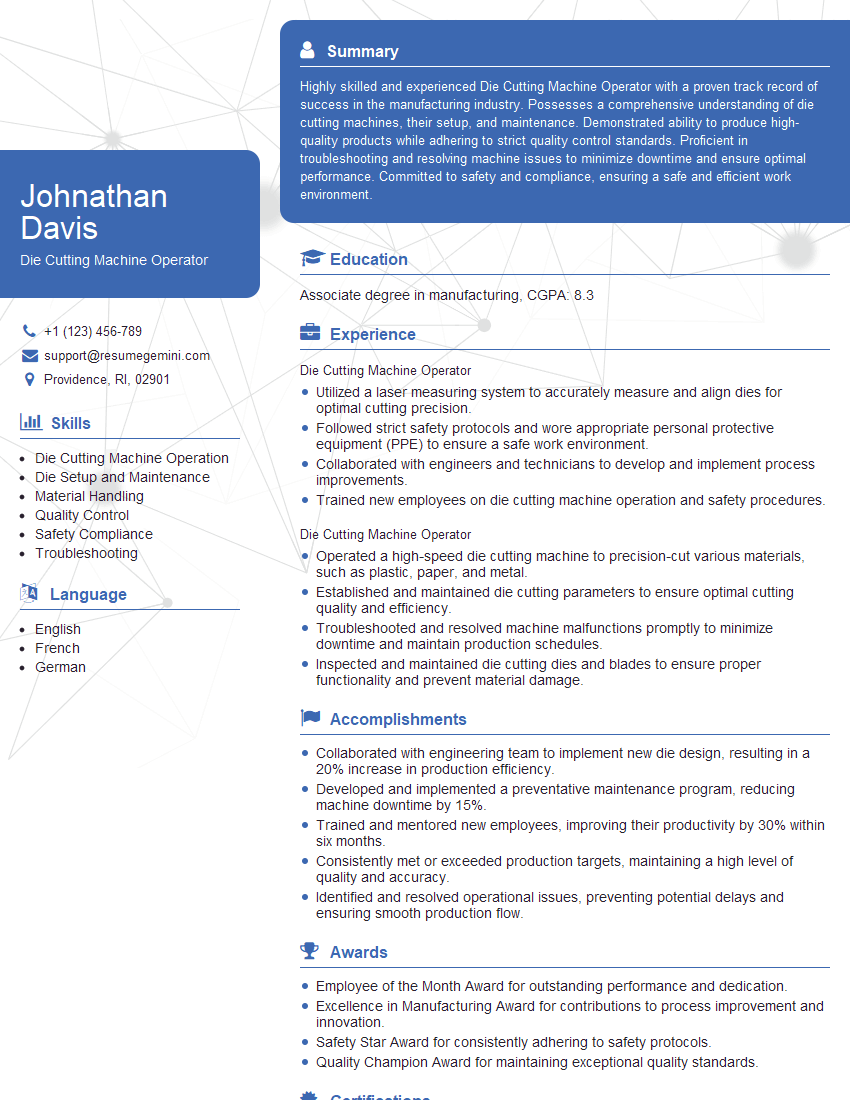
Mastering Die Cutting Setup and Operation opens doors to rewarding career opportunities with excellent growth potential. To stand out from the competition, a well-crafted resume is essential. An ATS-friendly resume significantly improves your chances of getting noticed by potential employers. We highly recommend using ResumeGemini to build a professional and effective resume that showcases your skills and experience. ResumeGemini provides examples of resumes tailored to Die Cutting Setup and Operation positions to help you create a compelling application.
Explore more articles
Users Rating of Our Blogs
Share Your Experience
We value your feedback! Please rate our content and share your thoughts (optional).
What Readers Say About Our Blog
Very informative content, great job.
good