Unlock your full potential by mastering the most common Digital Circuit Design interview questions. This blog offers a deep dive into the critical topics, ensuring you’re not only prepared to answer but to excel. With these insights, you’ll approach your interview with clarity and confidence.
Questions Asked in Digital Circuit Design Interview
Q 1. Explain the difference between combinational and sequential logic circuits.
The fundamental difference between combinational and sequential logic circuits lies in their dependence on time. Combinational circuits produce an output that depends only on the current input values. Think of a simple light switch: the light is on only when the switch is flipped on; its state is determined solely by the present input. Their behavior is instantaneous and doesn’t involve memory. Examples include adders, multiplexers, and decoders. Sequential circuits, however, have ‘memory’. Their output depends not just on the current inputs but also on the past sequence of inputs – they remember previous states. Think of a light switch with a timer: the light might stay on even after you release the switch, depending on the timer setting. Flip-flops, counters, and registers are examples of sequential circuits. This memory element is crucial for storing information and creating state machines.
In essence, combinational circuits are stateless, while sequential circuits are stateful.
Q 2. Describe the operation of a flip-flop and different types (e.g., SR, D, JK, T).
A flip-flop is a fundamental building block of sequential circuits, acting as a one-bit memory cell. It has two stable states, typically representing 0 and 1, and can switch between these states based on control signals. Different types of flip-flops offer different ways to control this switching behavior:
- SR (Set-Reset) Flip-Flop: This has two inputs, S (Set) and R (Reset). S=1 sets the output Q to 1, R=1 resets Q to 0. Both S and R being 1 is typically undefined.
- D (Data) Flip-Flop: The simplest flip-flop. It has a single data input D. On a clock pulse, the value at D is transferred to the output Q. This is very useful for simple data storage and transfer.
- JK Flip-Flop: Similar to the SR flip-flop but allows for toggling. J is the ‘set’ input and K is the ‘reset’ input. If both J and K are 1, the output toggles (changes from 0 to 1 or 1 to 0) with each clock pulse.
- T (Toggle) Flip-Flop: A special case of the JK flip-flop where J and K are tied together. It simply toggles its state with every clock pulse.
Flip-flops are essential for constructing registers, counters, and other sequential logic elements in digital systems, allowing data to be stored and manipulated.
Q 3. What are latches and how do they differ from flip-flops?
Latches and flip-flops are both fundamental memory elements but differ in their clocking mechanism. A latch is level-sensitive, meaning its output changes as long as the enable signal is active (high or low, depending on the design). A simple example is an SR latch, where the output reflects the S and R inputs as long as the enable is high. This continuous sensitivity can lead to unpredictable behavior if the inputs change while the enable is active. Flip-flops, on the other hand, are edge-triggered. They change state only on a specific edge (rising or falling) of a clock signal. This edge-triggered behavior makes them much more predictable and reliable in synchronous digital systems, preventing unintended changes due to input variations between clock pulses.
Think of a latch like a light switch that stays in the new state as long as you hold the button down. A flip-flop is more like a switch that changes state only when you momentarily push a button.
Q 4. Explain the concept of setup and hold time violations.
Setup time is the minimum time interval before the clock edge that data must be stable at the input of a flip-flop. Hold time is the minimum time interval after the clock edge that data must remain stable. Setup time violations occur when data changes too close to the clock edge, failing to meet the setup time requirement. This can cause unpredictable behavior and potentially lead to metastability. Hold time violations occur when data changes too soon after the clock edge, again leading to unpredictable behavior. Imagine a race: setup time ensures data arrives *before* the starting gun, while hold time ensures it doesn’t change immediately *after* the gun. Violations lead to an uncertain race outcome (the flip-flop’s output), and careful circuit design is needed to avoid them.
Q 5. How do you handle metastability in digital circuits?
Metastability is a critical issue in digital design. It occurs when a flip-flop’s output is indeterminate after a setup or hold time violation. The output might fluctuate unpredictably for an extended period before settling into a stable state – a potentially catastrophic event. There’s no guaranteed solution to eliminate metastability, but you can mitigate the risk. The key strategy is to use synchronous design, where all flip-flops are clocked by the same clock signal. This ensures data travels through the system in a predictable, synchronized manner. Another technique is using multiple flip-flops in series – this significantly reduces the probability of metastability propagating through the system. The likelihood of a flip-flop resolving from metastability decreases exponentially with each additional flip-flop in the synchronizer chain. Finally, using appropriate clock frequencies and signal paths that have sufficient delays is crucial for giving the system enough time to resolve uncertainty before propagating further. In professional settings, we often resort to robust simulation techniques to analyze and mitigate metastability risks.
Q 6. Describe different types of counters (e.g., synchronous, asynchronous).
Counters are sequential circuits that increment or decrement a numerical value with each clock pulse. Two main types exist:
- Asynchronous (Ripple) Counters: In these, each flip-flop is clocked by the output of the previous one. This creates a ripple effect, with changes propagating through the counter sequentially. They’re simple to implement but suffer from propagation delays, making them unsuitable for high-speed applications.
- Synchronous Counters: All flip-flops are clocked simultaneously by the same clock signal. This eliminates the ripple effect and allows for much higher operating frequencies. They are more complex but offer significantly better performance.
Specific counter types (like up counters, down counters, ring counters) further expand these categories, providing versatile options for various digital applications. The choice depends heavily on speed requirements and complexity constraints.
Q 7. Explain the function of a multiplexer and a demultiplexer.
Multiplexers (MUXs) act as data selectors. They choose one out of many input lines and forward it to the output based on a select signal. Think of a TV remote; you select the channel (select input), and the MUX chooses the corresponding video signal to display on the screen (output). Demultiplexers (DEMUXs) are the reverse: they take a single input and direct it to one of many output lines based on the select signal. Consider distributing data from a server to multiple clients. The DEMUX uses the client ID (select input) to send the data to the correct client (output).
Both are widely used in data routing and signal selection in digital systems. MUXs are critical in data routing and selection while DEMUXs are used to distribute signals.
Q 8. What are state machines and how are they used in digital design?
State machines are essentially abstract models representing systems that can exist in different states, transitioning between them based on input signals and internal logic. Think of a simple traffic light: it has three states (red, yellow, green) and transitions between them according to a predefined sequence. In digital design, state machines are ubiquitous because they provide a structured way to design sequential logic, enabling us to handle complex control flows and data processing efficiently.
They’re used to design controllers for various applications. Imagine designing the control unit of a microprocessor: a state machine would manage fetching instructions, decoding them, and executing them, moving sequentially through a series of defined steps.
Another example could be a simple vending machine. It might have states like ‘idle’, ‘waiting for payment’, ‘dispensing product’, and ‘returning change’. Input signals (coin insertion, button presses) trigger state transitions.
Q 9. Explain different state machine encoding techniques (e.g., one-hot, binary).
State machine encoding techniques determine how we represent the different states within the hardware. Two common approaches are:
- One-Hot Encoding: Each state is assigned a unique flip-flop. Only one flip-flop is active (set to ‘1’) at any given time, representing the current state. For example, if we have three states (A, B, C), we’d use three flip-flops, with only one high at a time. This method simplifies the logic, especially for large state machines, because transitions are easy to implement with simple gates. However, it requires more flip-flops compared to other methods.
- Binary Encoding: States are assigned binary codes (00, 01, 10, 11, etc.). This method is more compact, needing fewer flip-flops, but can lead to more complex combinational logic for state transitions. Let’s say we have four states; we could represent them as 00, 01, 10, 11, using only two flip-flops.
The choice between one-hot and binary encoding depends on factors such as the number of states, the complexity of the state transitions, and the available resources. One-hot encoding is generally preferred for larger state machines, while binary encoding is suitable for smaller ones.
Q 10. What are finite state machines (FSMs) and their applications?
Finite State Machines (FSMs) are a mathematical model of computation. They are characterized by a finite number of states and transitions between them, based on input symbols and associated actions. Essentially, they are a formalization of the state machine concept we discussed earlier.
FSMs are extensively applied in various areas of digital design, including:
- Control Unit Design: As mentioned before, FSMs are fundamental in designing the control units of processors and other digital systems.
- Protocol Implementation: Network protocols, like TCP/IP, are often modeled and implemented using FSMs to handle various communication states.
- Hardware Verification: FSMs are used in model checking to verify the correctness of digital designs by exhaustively exploring all possible states and transitions.
- Embedded Systems: FSMs form the backbone of many embedded systems, managing various aspects of operation, such as sensor readings, actuator control, and user interfaces.
Think of a simple elevator controller. An FSM would elegantly manage the states like ‘idle’, ‘moving up’, ‘moving down’, ‘door open’, etc., transitioning between them based on button presses and sensor inputs.
Q 11. Describe the process of designing a digital circuit using a HDL (e.g., Verilog, VHDL).
Designing a digital circuit using an HDL (Hardware Description Language) like Verilog or VHDL involves a structured process:
- Specification: Clearly define the functionality of the circuit. What are the inputs, outputs, and the desired behavior?
- Design: Write the HDL code describing the circuit’s behavior at a chosen abstraction level (behavioral, RTL, gate-level). This might involve defining modules, instantiating components, and specifying dataflow or behavioral descriptions.
- Simulation: Use a simulator (e.g., ModelSim, Icarus Verilog) to test the design’s functionality. This involves creating testbenches to provide inputs and verify that the outputs match the specifications.
- Synthesis: Use a synthesis tool to translate the HDL code into a netlist, a representation of the circuit using logic gates and other components suitable for the target technology (FPGA, ASIC).
- Implementation: The synthesized netlist is then mapped, placed, and routed onto the target device by place-and-route tools. This results in a physical implementation of the circuit ready for fabrication or programming.
- Verification: After implementation, further verification is crucial to confirm that the physical implementation matches the original design. This often includes timing analysis and post-layout simulation.
Example (Verilog snippet for a simple AND gate):
module and_gate (input a, input b, output out); assign out = a & b; endmoduleQ 12. Explain different levels of abstraction in digital design (e.g., behavioral, RTL, gate-level).
Different levels of abstraction in digital design allow designers to work at various levels of detail, improving efficiency and manageability of complex designs. The key levels are:
- Behavioral Level: The highest level of abstraction, focusing on the overall functionality without details of implementation. We describe the *what* the circuit does without specifying the *how*.
- Register-Transfer Level (RTL): The most commonly used level for digital design. We describe the data flow between registers and the operations performed on them. This level provides a good balance between abstraction and detail. We describe data movement between registers and the operations.
- Gate Level: The lowest level of abstraction. The design is specified in terms of individual logic gates (AND, OR, NOT, etc.). This level is closest to the actual hardware implementation. It specifies the exact arrangement of gates and connections.
Working at higher levels of abstraction simplifies the design process, while lower levels provide greater control over implementation details and optimization.
Q 13. What is timing analysis and why is it crucial in digital design?
Timing analysis is the process of determining the timing characteristics of a digital circuit, such as propagation delays, setup and hold times, and clock-to-output delays. It’s crucial because it ensures the circuit operates correctly at the desired speed and avoids timing violations. In essence, it validates if signals arrive at their destination within specified time windows.
Without proper timing analysis, a seemingly functional design might fail in practice due to timing issues. This could manifest as glitches, metastable states, or incorrect outputs. Timing analysis is therefore essential for both functional correctness and reliability of digital systems. Modern design tools incorporate sophisticated timing analysis algorithms to aid in this process. This often involves Static Timing Analysis (STA).
Q 14. Explain the concept of critical path and how it impacts performance.
The critical path is the longest path through a digital circuit, determining the maximum delay from input to output. It’s the limiting factor for the operating speed of the circuit. Any delay along the critical path directly impacts the overall circuit performance – limiting the maximum clock frequency.
Imagine a relay race: the critical path is the slowest runner. The overall race time is determined by that slowest runner, regardless of how fast the other runners are. Similarly, the critical path in a digital circuit dictates the maximum clock speed and overall performance. Optimization efforts often focus on reducing the delay of the critical path, either through algorithmic improvements or by selecting faster components. Identifying and optimizing the critical path is crucial for achieving high-performance designs.
Q 15. What are static and dynamic timing analysis?
Static and dynamic timing analysis are crucial techniques in digital circuit design used to verify the timing behavior of a circuit. They both aim to ensure that the circuit operates correctly within its specified timing constraints, but they differ in their approach.
Static Timing Analysis (STA) is a comprehensive analysis method that verifies timing constraints without actually simulating the circuit’s behavior. It analyzes the circuit’s netlist and timing information (like gate delays, clock speeds, and setup/hold times) to determine the worst-case delay paths. Think of it like a meticulous blueprint review – it checks for potential timing violations (like a signal arriving too late at a flip-flop) without actually running the circuit. STA tools calculate the maximum and minimum delays on each path and identify any critical paths that might violate setup or hold time constraints.
Dynamic Timing Analysis (DTA), on the other hand, is a simulation-based technique. It simulates the circuit’s operation under various input conditions and assesses the timing behavior based on the simulated waveforms. It’s like building the circuit and observing its timing behavior in real-time – it’s more computationally expensive than STA but can identify subtle timing issues that STA might miss. DTA is often used to supplement STA results and validate them in more complex scenarios.
In summary: STA is faster and more efficient for general timing verification, focusing on worst-case scenarios. DTA offers a more detailed, simulation-based approach to validate timing and identify subtle issues but at a greater computational cost.
Career Expert Tips:
- Ace those interviews! Prepare effectively by reviewing the Top 50 Most Common Interview Questions on ResumeGemini.
- Navigate your job search with confidence! Explore a wide range of Career Tips on ResumeGemini. Learn about common challenges and recommendations to overcome them.
- Craft the perfect resume! Master the Art of Resume Writing with ResumeGemini’s guide. Showcase your unique qualifications and achievements effectively.
- Don’t miss out on holiday savings! Build your dream resume with ResumeGemini’s ATS optimized templates.
Q 16. Describe different techniques for power optimization in digital circuits.
Power optimization is critical in modern digital circuits, especially in portable devices. Various techniques are employed to minimize power consumption, which can be broadly categorized into architectural-level, logic-level, and circuit-level optimizations.
- Architectural-level optimizations: These focus on the overall design structure. Examples include using lower-power clocking schemes (like clock gating), employing power-aware design methodologies (like low-power FSM design), and utilizing architectural techniques that reduce switching activity. For example, instead of having a large, constantly active block of logic, you might break it down into smaller modules that are only active when needed.
- Logic-level optimizations: These focus on reducing the number of logic gates and minimizing switching activity. Techniques include logic optimization (using fewer gates to perform the same function), using low-power logic styles (such as multi-threshold CMOS), and employing techniques like don’t care minimization to reduce complexity and switching.
- Circuit-level optimizations: These target individual components within the design. Methods include using low-power transistors, using voltage scaling (reducing the supply voltage, which reduces power but also might impact performance), and using techniques like clock gating to reduce power consumption in idle periods.
Consider a mobile phone. Low-power design is crucial to extend battery life. Techniques like clock gating (disabling clock signals to inactive blocks), reducing supply voltage for inactive components, and careful architectural design significantly contribute to maximizing battery life.
Q 17. Explain the concept of clock domain crossing (CDC) and its challenges.
Clock domain crossing (CDC) refers to situations where signals cross between different clock domains – parts of a system operating with different clock frequencies or phases. This is a significant challenge in digital design because mismatches in clock rates and phases can lead to metastability.
Metastability is a hazardous state where a flip-flop output is unpredictable; it can oscillate indefinitely or settle to an incorrect state. This uncertainty can propagate throughout the system, causing intermittent failures. Imagine a relay race where one runner (clock domain) uses a much faster pace than another; the handoff (signal crossing) might become unreliable, leading to an unpredictable race outcome.
The challenges of CDC include:
- Metastability: The primary challenge. The unpredictable output of the flip-flop crossing the clock domain can cause functional errors.
- Synchronization: Proper synchronization mechanisms must be implemented to mitigate metastability issues, typically using multi-stage flip-flops or asynchronous FIFOs.
- Verification: CDC verification requires careful testing and simulation to ensure that synchronization is properly handled across different clock domains.
Addressing these challenges often requires careful synchronization methods, such as using multi-stage synchronizers and FIFOs to ensure reliable signal transfers between clock domains.
Q 18. How do you handle asynchronous signals in a synchronous design?
Asynchronous signals, which aren’t synchronized to the system clock, must be carefully managed in a synchronous design to prevent unexpected behavior. The key is to introduce controlled synchronization techniques before integrating them into the synchronous system.
Common methods include:
- Asynchronous FIFO (First-In, First-Out): This is a crucial technique to handle asynchronous data streams. FIFOs buffer data from the asynchronous source and present it synchronously to the receiving clock domain. They are robust and efficiently manage data transmission between clock domains.
- Multi-stage synchronizers: These use multiple flip-flops in series to significantly reduce (though not entirely eliminate) the risk of metastability when an asynchronous signal transitions into a synchronous clock domain. Each flip-flop stage increases the probability of the signal settling to a stable state before it’s used in subsequent logic.
- Handshake protocols: Techniques like the four-phase handshake are employed to control the flow of asynchronous data and ensure reliable communication between the synchronous and asynchronous systems.
Imagine a simple scenario: a sensor providing data asynchronously to a microcontroller (a synchronous system). To prevent data corruption, a multi-stage synchronizer or an asynchronous FIFO would be used to safely transition the sensor data into the microcontroller’s clock domain.
Q 19. What are different types of memory elements (e.g., SRAM, DRAM, ROM)?
Memory elements are fundamental components in digital circuits responsible for storing data. Different types exist, each with its characteristics and applications.
- SRAM (Static Random-Access Memory): Uses flip-flops to store each bit, requiring continuous power to maintain data. It’s fast but less dense (fewer bits per unit area) and consumes more power than DRAM.
- DRAM (Dynamic Random-Access Memory): Stores bits as electric charges in capacitors, requiring periodic refresh to maintain data. It’s slower than SRAM but more dense and power-efficient. The charge in the capacitor fades over time, so it needs to be regularly recharged (refreshed). This leads to a slower access time but higher density.
- ROM (Read-Only Memory): Data is permanently stored during manufacturing. It’s non-volatile, meaning it retains data even when power is removed. ROMs are typically used for storing firmware or boot code.
- Flash memory: Non-volatile memory that allows for both reading and writing data but at a slower speed than SRAM or DRAM. Its non-volatility makes it suitable for storing persistent data like the operating system on a hard drive.
Each memory type has its advantages and disadvantages. SRAM is often used for caches due to its high speed; DRAM is used as main memory for its high density; and ROM is used for storing permanent instructions.
Q 20. Explain the difference between synchronous and asynchronous reset.
Synchronous and asynchronous resets are methods for initializing a sequential circuit (e.g., a flip-flop or a finite state machine).
Synchronous reset is controlled by the clock signal. The reset signal must be active during a clock edge for the circuit to be reset. This is generally preferred because it’s less susceptible to glitches and asynchronous noise, making it more reliable. This synchronicity with the clock ensures a clean and controlled reset.
Asynchronous reset is independent of the clock signal. The reset signal can change state at any time, regardless of the clock edge, and immediately resets the circuit. While simpler to implement, it can be more prone to glitches and false resets if the reset signal fluctuates near the clock edge.
In summary:
- Synchronous reset: Reset occurs only on a clock edge, more reliable, but requires more careful design to avoid metastability issues.
- Asynchronous reset: Reset can happen at any time, simpler to implement, but more susceptible to noise and glitches.
The choice depends on factors such as design complexity, timing constraints, and the risk of noise in the reset signal. Modern designs usually favor synchronous resets for enhanced reliability.
Q 21. What is a bus and how is it used in digital design?
A bus in digital design is a set of parallel wires used to transfer data between different components within a system. It’s a shared communication path, similar to a highway system. Different components can share the bus to communicate, but only one component can transmit data at any given time.
Buses are used to transmit various data types, including addresses, data, and control signals.
- Address bus: Used to specify the location (address) of the memory location or input/output device the CPU wishes to access.
- Data bus: Used for transferring actual data between components like the CPU, memory, and I/O devices. It’s bidirectional, meaning it can transmit data in both directions.
- Control bus: Transmits control signals that govern the operation of other components. These signals might indicate read/write operations, interrupts, or other control functions.
For example, in a computer system, the CPU uses the address bus to specify the location of data in memory. Then, it uses the control bus to signal a read operation and receives the data through the data bus.
Bus design considerations include width (number of parallel lines), speed, and communication protocols. The width of a bus determines how much data can be transferred at once. Wider buses allow for faster data transfer, but they also require more complex and power-hungry circuitry.
Q 22. Explain different bus arbitration techniques.
Bus arbitration is crucial in multi-master systems where multiple devices need to access a shared bus. Think of it like a highway with multiple cars trying to merge – you need a system to manage who gets access when. Several techniques ensure fair and efficient access.
- Daisy Chaining: The simplest method. Each device is connected sequentially. The first device with a request gets the bus; subsequent devices get a chance only if the preceding one doesn’t need it. This is simple but suffers from performance issues as a single failing device can block the whole bus. Imagine a traffic jam caused by one stalled car.
- Polling: A central arbiter polls each device in a round-robin fashion to check if it requires the bus. It grants access based on requests and prioritization. This can be more efficient than daisy chaining, but the polling overhead can impact performance, especially with a large number of devices. It’s like a traffic controller manually signaling each car to proceed.
- Centralised Arbitration: A dedicated arbiter manages access requests. This arbiter can employ various algorithms like priority-based arbitration (higher priority devices get access first), round-robin arbitration (devices take turns), or even sophisticated algorithms considering bandwidth needs. This is efficient but the arbiter is a single point of failure; its malfunction can cripple the whole system. This is like having a sophisticated traffic management system at a major intersection.
- Decentralised Arbitration: Multiple arbiters share the responsibility. Each arbiter manages a portion of the bus, improving robustness and scalability compared to centralized schemes. This improves fault tolerance. This is analogous to having multiple traffic controllers managing different sections of a large highway network.
The choice of technique depends on factors like the number of devices, performance requirements, cost, and fault tolerance needs.
Q 23. What are different types of digital signal processing (DSP) components?
Digital Signal Processing (DSP) components are the building blocks for systems that process analog-to-digital converted signals. They handle tasks like filtering, modulation, demodulation, and spectral analysis. Common components include:
- Adders/Subtractors: Fundamental for arithmetic operations on digital signals.
- Multipliers: Crucial for many DSP algorithms, like FIR and IIR filters.
- Accumulators (MAC units): Combine multiplication and addition, essential for efficient signal processing. Think of them as specialized units that perform many of the computations required for DSP algorithms quickly.
- Delay Elements/Registers: Introduce delays in the signal path, vital for implementing tapped delay lines in filters and other applications.
- Memory Units: Store coefficients, input samples, and intermediate results. Efficient memory access is vital for high-performance DSP.
- Digital Filters (FIR & IIR): Implement various filtering operations for signal conditioning and noise reduction. FIR and IIR filters differ significantly in their implementation, with IIR filters often exhibiting a more compact design but potentially problematic stability issues.
- Fast Fourier Transform (FFT) Units: Perform efficient frequency domain transformations, enabling spectral analysis and other frequency-based operations. These are critical components for signal analysis tasks.
These components are often integrated into dedicated DSP processors or implemented as part of larger Application-Specific Integrated Circuits (ASICs).
Q 24. Describe your experience with simulation tools (e.g., ModelSim, VCS).
I have extensive experience with ModelSim and VCS, two industry-standard simulation tools. My work involves using these tools throughout the design cycle to verify the functional correctness of digital circuits before physical implementation.
In ModelSim, I’m proficient in creating testbenches using various verification techniques like directed tests and random stimulus generation. I’ve used it to simulate complex designs, debug timing issues, and analyze waveforms to identify potential problems. For example, I once used ModelSim to pinpoint a race condition in a high-speed data path by meticulously examining signal interactions during simulation.
VCS is my go-to tool for larger, more complex projects needing higher simulation performance. Its advanced features for optimizing simulation time are invaluable for handling designs with millions of gates. I’ve used VCS’s powerful debugging capabilities to track down and resolve intricate issues in designs for high-speed networking applications.
In both cases, familiarity with SystemVerilog and Verilog is essential for writing effective testbenches and ensuring accurate simulation results. The effective use of assertions and coverage metrics is also crucial to fully and thoroughly test complex circuits.
Q 25. Explain your experience with synthesis tools (e.g., Synopsys Design Compiler).
Synopsys Design Compiler is a powerful tool I regularly use for logic synthesis. This stage translates the HDL design into a gate-level netlist optimized for a specific target technology. It’s crucial for minimizing area, power, and delay.
My experience includes defining synthesis constraints – specifying timing requirements, area budgets, and other design goals. I’m adept at using Design Compiler’s optimization options to achieve the best possible results for area, power, and timing. One project involved optimizing a high-speed processor core, where I used Design Compiler’s advanced optimization techniques to meet stringent performance targets while minimizing chip area.
Analyzing synthesis reports is also critical to identify potential problems and make informed design decisions. Understanding the trade-offs between different optimization goals is key. For instance, aggressive area optimization might compromise timing, so a balance is necessary. I have used scripting capabilities (e.g., TCL) to automate repetitive tasks and improve efficiency.
Q 26. Describe your experience with physical design tools (e.g., Cadence Innovus).
Cadence Innovus is a leading physical design tool, and I have significant experience with it for tasks like placement, routing, clock tree synthesis, and physical verification. It takes the synthesized netlist and transforms it into a layout ready for manufacturing.
My expertise lies in managing complex routing challenges, optimizing signal integrity, and minimizing power consumption through careful placement and routing strategies. One project involved designing a high-density memory interface where careful consideration of signal integrity was crucial to avoid timing violations. I utilized Innovus’ advanced routing capabilities and various signal integrity analysis tools to ensure the design met all specifications.
Post-layout verification is a crucial stage, and I’m proficient in using Innovus to check for design rule violations (DRC), layout versus schematic (LVS) checks, and other physical verification tasks to ensure manufacturability.
Q 27. Explain your experience with verification methodologies (e.g., UVM, OVM).
I’m well-versed in modern verification methodologies, primarily UVM (Universal Verification Methodology). UVM provides a standardized framework for building reusable and scalable testbenches. It significantly improves verification efficiency and reduces time-to-market.
My experience includes developing UVM testbenches, creating transaction-level models (TLMs), and using coverage driven verification (CDV) to ensure comprehensive test coverage. I’ve utilized UVM’s features like factory mechanisms, phases, and sequences to create robust and maintainable verification environments. For example, I developed a UVM environment for verifying a complex PCIe interface, where the reusable components and well-defined architecture significantly reduced the time and effort for developing and maintaining the testbench.
While I’ve primarily used UVM, I have also worked with OVM (Open Verification Methodology) in the past, understanding its strengths and weaknesses compared to UVM. The key takeaway is always ensuring robust test coverage which is why the use of coverage driven verification techniques is paramount.
Q 28. Describe a challenging digital design project you worked on and how you overcame the challenges.
One challenging project involved designing a high-speed serial link for a data center application. The primary challenge was meeting stringent data rate requirements while minimizing power consumption and ensuring signal integrity. The design involved complex equalization algorithms, clock and data recovery (CDR) circuits, and precise timing control.
The initial approach ran into significant timing closure issues during synthesis and physical design. To overcome this, we adopted a multi-pronged strategy:
- Improved Design Partitioning: We reorganized the design into smaller, more manageable blocks, reducing the complexity for each synthesis and routing stage.
- Advanced Synthesis Techniques: We employed more sophisticated synthesis strategies in Design Compiler, using advanced optimization options and exploring various clock tree synthesis techniques to improve timing closure.
- Careful Signal Integrity Analysis: We employed rigorous simulation and analysis using tools like Innovus to identify and mitigate signal integrity problems such as reflections and crosstalk.
- Iterative Refinement: The design underwent multiple iterations of synthesis, physical design, and verification, with each stage informing improvements in the next. This iterative process is crucial to fine-tune the design to meet all specifications.
Through careful planning, rigorous verification, and a combination of advanced design and tool capabilities, we successfully completed the project, delivering a high-speed serial link that met all performance, power, and signal integrity requirements.
Key Topics to Learn for Digital Circuit Design Interview
- Boolean Algebra and Logic Gates: Mastering Boolean algebra is fundamental. Understand the operation and truth tables of AND, OR, NOT, XOR, NAND, and NOR gates, and be prepared to simplify Boolean expressions.
- Combinational Logic Circuits: Learn to design and analyze circuits like multiplexers, demultiplexers, encoders, decoders, adders, and subtractors. Understand their applications in data processing and control systems.
- Sequential Logic Circuits: Grasp the concepts of flip-flops (SR, JK, D, T), latches, and counters. Be ready to discuss their timing diagrams and applications in memory and state machines.
- Finite State Machines (FSMs): Understand the design and implementation of FSMs using different methods (e.g., state diagrams, state tables). Be prepared to discuss their applications in various digital systems.
- Register Transfer Level (RTL) Design: Familiarize yourself with RTL design principles and how they translate into hardware. Understand the use of Verilog or VHDL for describing digital circuits at a higher level of abstraction.
- Timing Analysis and Optimization: Learn about setup and hold times, clock skew, and critical path analysis. Understand techniques for optimizing circuit performance and minimizing power consumption.
- Digital Signal Processing (DSP) Fundamentals (if applicable): Depending on the role, a basic understanding of DSP concepts like sampling, quantization, and filtering might be beneficial.
- Troubleshooting and Debugging: Practice identifying and resolving common issues in digital circuits, such as timing violations and logic errors. Develop your problem-solving skills using simulation tools.
Next Steps
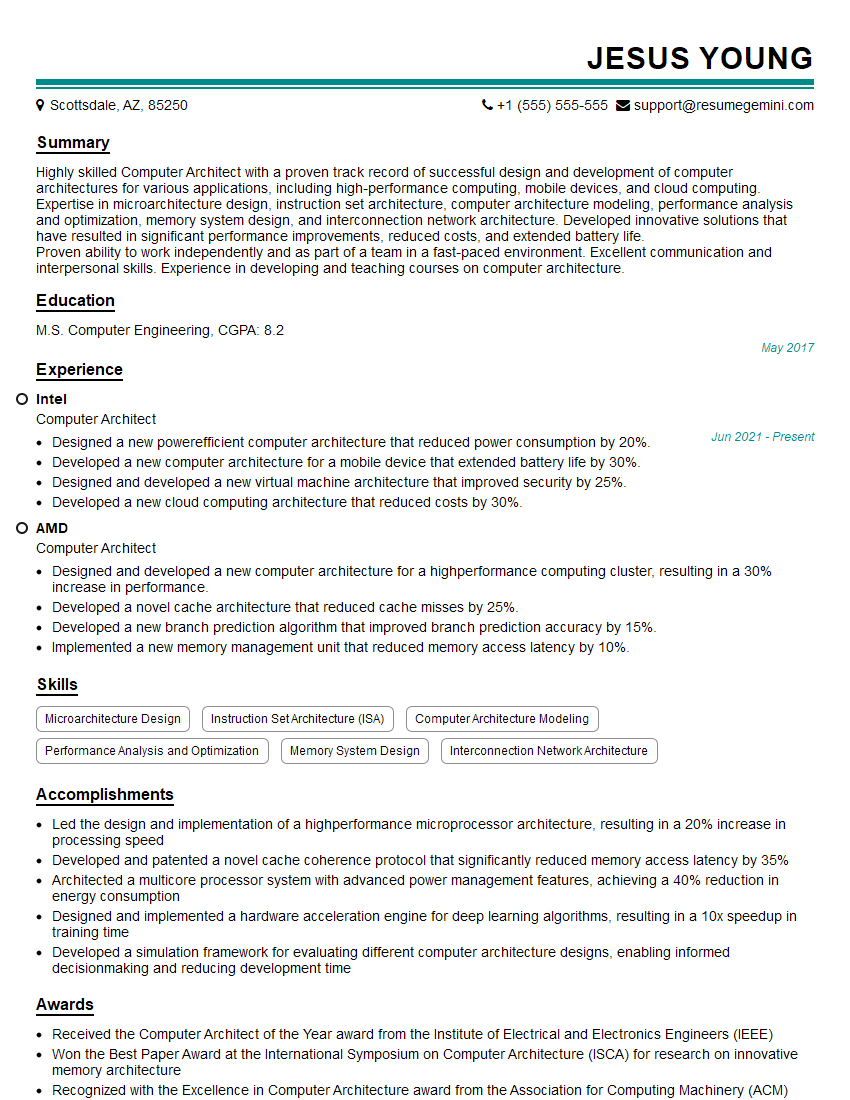
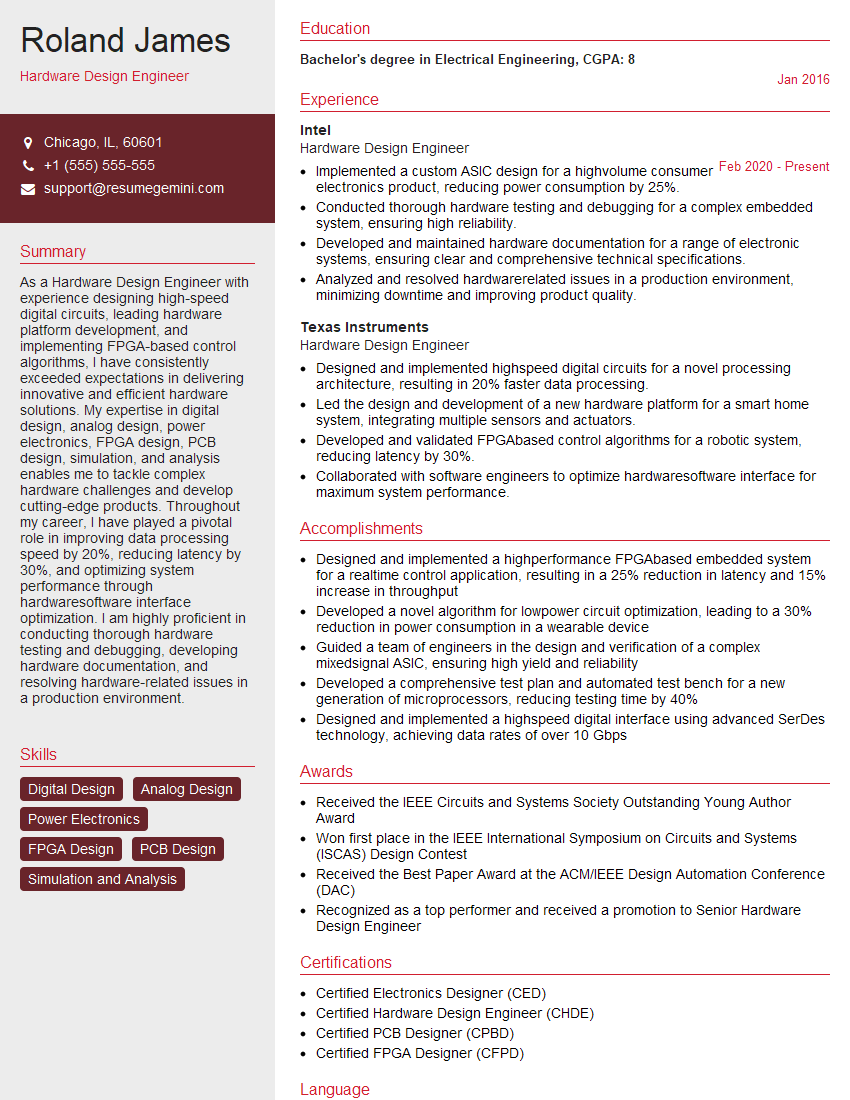
Mastering Digital Circuit Design opens doors to exciting careers in various industries, from semiconductor design to embedded systems development. To maximize your job prospects, invest time in crafting a strong, ATS-friendly resume that highlights your skills and experience. ResumeGemini is a trusted resource that can help you build a professional resume that stands out. They even provide examples of resumes tailored specifically to Digital Circuit Design, giving you a head start in presenting your qualifications effectively. Take advantage of these resources to present yourself as the ideal candidate.


Explore more articles
Users Rating of Our Blogs
Share Your Experience
We value your feedback! Please rate our content and share your thoughts (optional).
What Readers Say About Our Blog
Very informative content, great job.
good