The right preparation can turn an interview into an opportunity to showcase your expertise. This guide to Digital Control Systems interview questions is your ultimate resource, providing key insights and tips to help you ace your responses and stand out as a top candidate.
Questions Asked in Digital Control Systems Interview
Q 1. Explain the difference between open-loop and closed-loop control systems.
The core difference between open-loop and closed-loop control systems lies in their feedback mechanisms. An open-loop system operates without feedback; it simply executes a predetermined command sequence without considering the actual output. Think of a toaster: you set the time, it runs for that duration, and regardless of whether the bread is perfectly toasted, it stops. The system doesn’t measure the ‘toastedness’ to adjust its operation.
A closed-loop system, also known as a feedback control system, uses feedback to compare the desired output (setpoint) with the actual output. This difference (error) is then used to adjust the control input to minimize the error. Consider a cruise control system in a car: the system constantly monitors the car’s speed and adjusts the throttle to maintain the desired speed, compensating for changes in incline or wind resistance. The feedback loop ensures the system actively corrects deviations from the setpoint.
In short: Open-loop systems are simpler but less accurate, while closed-loop systems are more complex but provide higher accuracy and robustness.
Q 2. Describe the components of a PID controller and their functions.
A PID (Proportional-Integral-Derivative) controller is a widely used feedback controller with three core components:
- Proportional (P) term: This term produces a control signal proportional to the current error. A larger error results in a larger corrective action. It’s responsive to immediate changes but may result in a steady-state error (a persistent difference between the setpoint and actual output).
- Integral (I) term: This term addresses the steady-state error by accumulating the error over time. The integral action continues to apply corrective force even if the error is small, eventually eliminating the steady-state error. However, it can lead to overshoot and oscillations if not properly tuned.
- Derivative (D) term: This term anticipates future error by considering the rate of change of the error. It dampens oscillations and improves the system’s response speed, preventing overshoot. However, it can make the system sensitive to noise if overemphasized.
The overall output of a PID controller is the sum of these three terms: Output = Kp * e(t) + Ki * ∫e(t)dt + Kd * de(t)/dt, where Kp, Ki, and Kd are the proportional, integral, and derivative gains respectively, and e(t) is the error at time t.
Q 3. How do you tune a PID controller for optimal performance?
PID tuning is crucial for optimal performance. There’s no single ‘best’ method, but several techniques exist, each with its strengths and weaknesses:
- Zeigler-Nichols method: This empirical method involves pushing the system to the point of sustained oscillation and then calculating the gain and period. The PID gains are then derived using simple formulas based on these values. It’s quick but may not yield optimal performance.
- Trial and error: This iterative approach involves adjusting the gains one by one, observing the system’s response, and refining the gains until satisfactory performance is achieved. It’s intuitive but time-consuming and relies on experience.
- Auto-tuning: Many modern control systems offer auto-tuning features that automatically adjust the PID gains based on the system’s response. This method is convenient but may require a good understanding of the system dynamics to fine-tune the results.
- Advanced tuning methods: More sophisticated techniques, like optimal control theory or fuzzy logic, can be used for complex systems to achieve optimal performance.
Regardless of the method used, the goal is to find the right balance: fast response time, minimal overshoot, and accurate tracking of the setpoint. This often involves a trade-off between these factors.
Q 4. What are the advantages and disadvantages of using digital control systems over analog systems?
Digital control systems offer several advantages over analog systems:
- Flexibility and programmability: Digital controllers are easily reprogrammed to adjust the control algorithm or modify parameters. This flexibility is particularly beneficial when dealing with changing system dynamics or requirements.
- Accuracy and precision: Digital controllers can achieve much higher accuracy and precision than analog systems due to the absence of component tolerances and drift.
- Cost-effectiveness: The cost of implementing digital control has significantly decreased over the years, making it a cost-effective alternative to analog systems, especially for complex applications.
- Advanced algorithms: Digital control allows for implementing sophisticated algorithms like adaptive control, predictive control, and fuzzy logic controllers which are difficult or impossible to implement in analog systems.
However, digital control also has disadvantages:
- Sampling and quantization effects: Digital systems sample continuous signals at discrete intervals, introducing potential inaccuracies and limitations on control bandwidth.
- Computational delay: The time required for computation introduces a delay that can affect stability and performance, especially in fast dynamic systems.
- Complexity: Implementing and debugging digital control systems can be more complex than analog systems, requiring specialized knowledge and software tools.
The choice between digital and analog systems depends on the specific application and its requirements. For simple, low-accuracy applications, an analog system may suffice. However, for complex systems requiring high accuracy, flexibility, and advanced algorithms, digital control is the preferred approach.
Q 5. Explain the concept of sampling and quantization in digital control systems.
Sampling and quantization are fundamental concepts in digital control systems. Because digital controllers operate on discrete-time signals, continuous signals from the plant need to be converted to digital form. This involves two key steps:
- Sampling: This process converts a continuous-time signal into a discrete-time sequence by taking samples at regular intervals (sampling period, T). The sampling frequency (fs = 1/T) determines how accurately the continuous signal is represented. A higher sampling frequency leads to a more accurate representation but increases the computational load.
- Quantization: After sampling, the amplitude of each sample is converted into a finite number of discrete levels. This process introduces quantization error, as the actual sample value is approximated by the closest quantized level. The number of bits used for quantization determines the resolution and thus the quantization error. More bits lead to lower error but increase memory and processing requirements.
These two processes introduce limitations on the performance of the digital control system. The sampling frequency must be sufficiently high (typically at least twice the highest frequency component in the continuous signal, per the Nyquist-Shannon sampling theorem) to avoid aliasing. The quantization error must be minimized to ensure accuracy, but it’s impossible to completely eliminate.
Q 6. What is the Z-transform and how is it used in digital control system analysis?
The Z-transform is a mathematical tool used to analyze and design digital control systems. It transforms a discrete-time signal (sequence) into a complex frequency-domain representation. Just as the Laplace transform is used for continuous-time systems, the Z-transform handles discrete-time sequences.
The Z-transform of a discrete-time signal x[n] is defined as: X(z) = Σ (x[n] * z^(-n)), where the summation is from n = 0 to infinity, and z is a complex variable. The Z-transform allows us to:
- Analyze system stability: The location of the poles of the system’s transfer function in the Z-plane determines the stability of the discrete-time system. Poles inside the unit circle indicate stability.
- Design controllers: Z-transform techniques are used to design digital controllers that meet specific performance requirements, such as desired response time, damping ratio, and steady-state error.
- Analyze system response: The inverse Z-transform can be used to obtain the time-domain response of the system from its Z-domain transfer function.
The Z-transform simplifies the analysis and design of discrete-time systems by providing a powerful mathematical framework for working in the frequency domain.
Q 7. Describe different digital control algorithms (e.g., predictive control, model predictive control).
Beyond PID control, many other digital control algorithms exist, each suited to different applications:
- Predictive Control: This class of algorithms predicts the future behavior of the system based on a model and uses this prediction to optimize the control actions. It anticipates disturbances and optimizes performance over a prediction horizon. Model Predictive Control (MPC) is a widely used example.
- Model Predictive Control (MPC): MPC explicitly uses a model of the plant to predict its future behavior and computes a sequence of control actions that optimize a given performance index over a finite time horizon. It’s particularly effective in handling constraints and multivariable systems, making it suitable for applications like process control and robotics.
- Adaptive Control: Adaptive control algorithms adjust their parameters in response to changes in the system’s dynamics. This is crucial for systems where the model is uncertain or subject to change over time. Examples include self-tuning regulators and model reference adaptive controllers.
- Fuzzy Logic Control: This approach uses fuzzy sets and fuzzy rules to represent the control logic. It is well-suited for systems with complex, nonlinear behavior where a precise mathematical model is difficult to obtain. It can handle uncertainty and vagueness effectively.
The choice of the appropriate algorithm depends on the specific system characteristics, performance requirements, and complexity considerations.
Q 8. Explain the concept of stability in digital control systems and how to analyze it.
Stability in a digital control system refers to the system’s ability to maintain a desired output or equilibrium point even when faced with disturbances or changes in input. An unstable system will exhibit unbounded oscillations or diverge from the setpoint, potentially leading to catastrophic failure. Analyzing stability involves examining the system’s response to these disturbances.
We typically analyze stability using several methods:
- Pole-Zero Analysis: In the Z-domain, the system’s transfer function is analyzed. If all poles (roots of the denominator) lie within the unit circle in the complex Z-plane, the system is stable. Poles outside the unit circle indicate instability. Poles on the unit circle suggest marginal stability (oscillations that don’t decay or grow).
- Root Locus: This graphical technique shows how the poles of a closed-loop system move as a gain parameter is varied. By observing if the poles ever cross the unit circle, we can determine the range of gains for stability.
- Bode Plots: These plots show the magnitude and phase response of the system as a function of frequency. The gain and phase margins are determined from the Bode plots, indicating how much gain or phase change can be tolerated before instability occurs.
- Nyquist Stability Criterion: This method is useful for systems with multiple feedback loops. It involves plotting the frequency response on the complex plane and determining if the plot encircles the critical point (-1, 0).
- Simulation: Simulating the system’s response to various inputs and disturbances can provide a visual confirmation of stability. Software like MATLAB/Simulink is commonly used for this purpose.
For example, consider a simple digital PID controller. If the proportional gain (Kp) is set too high, the system might oscillate uncontrollably, indicating instability. Proper tuning of the PID gains is crucial for achieving stability. Imagine a robot arm: unstable control would lead to jerky movements or even the arm crashing.
Q 9. What are the effects of aliasing and how can it be avoided?
Aliasing is a phenomenon that occurs when sampling a continuous-time signal at a rate that is too low to accurately capture its high-frequency components. This results in the high-frequency components appearing as lower-frequency components in the sampled signal, effectively distorting the original signal. Think of it like taking snapshots of a spinning wheel: if the shutter speed is too slow, the wheel might appear to be spinning slower than it actually is or even appear stationary.
The effects of aliasing can be severe, leading to inaccurate measurements and erroneous control actions. It can manifest as spurious oscillations or unexpected system behavior.
Aliasing can be avoided by:
- Using a sufficiently high sampling rate: The Nyquist-Shannon sampling theorem states that the sampling rate must be at least twice the highest frequency present in the signal (the Nyquist rate). In practice, a higher sampling rate (e.g., several times the Nyquist rate) is often preferred to provide a safety margin.
- Anti-aliasing filtering: Before sampling, a low-pass filter (anti-aliasing filter) is used to attenuate frequencies above the Nyquist frequency. This filter removes the high-frequency components that could cause aliasing.
For instance, in a process control system, measuring a rapidly changing temperature with a low sampling rate might lead to inaccurate readings due to aliasing. Implementing a proper anti-aliasing filter and a suitably high sampling rate are critical to avoid this problem.
Q 10. How do you handle sensor noise in a digital control system?
Sensor noise is an unavoidable reality in most digital control systems. It’s random, unwanted variations in the sensor’s output. This noise can degrade control performance, leading to inaccurate control actions and instability. Handling sensor noise requires a multi-pronged approach:
- Proper Sensor Selection: Choosing a sensor with low inherent noise is the first line of defense. High-quality sensors will have lower noise levels and better signal-to-noise ratios.
- Signal Filtering: Applying digital filters to the sensor readings is a very common method to smooth out the noise. Moving average filters, Kalman filters, and other advanced filtering techniques can effectively remove noise while preserving the useful signal information. A moving average simply averages a number of consecutive samples, smoothing out short-term fluctuations. Kalman filters are more sophisticated and can adapt to changing noise characteristics.
- Data Conditioning: Before filtering, data conditioning techniques such as scaling, offset removal, and linearization can improve signal quality. For example, if the sensor has a non-linear response, linearization can make it easier to filter the noise.
- Robust Control Design: Design controllers that are less sensitive to noise. For instance, carefully tuning a PID controller can reduce the impact of noise. Techniques like model predictive control (MPC) can explicitly account for noise and disturbances in the control design.
Imagine a robotic surgery system where precise movements are critical. Even tiny amounts of sensor noise in the position feedback could lead to catastrophic errors. Filtering and robust control are paramount in such applications.
Q 11. Explain the concept of anti-windup in PID controllers.
Anti-windup is a crucial mechanism for PID controllers designed to prevent integrator windup. Integrator windup occurs when the integral term in a PID controller accumulates excessively, leading to a large overshoot or sluggish response. This often happens when the controller output is saturated (reaches its limits), yet the error persists.
During saturation, the integral term continues to accumulate error, even though the actuator can’t respond further. Once the saturation condition ends, the large accumulated integral term can cause an overshoot or oscillations. Anti-windup mechanisms prevent this undesirable behavior.
Several anti-windup strategies exist:
- Back-calculation: The integral term is only updated if the controller output is within the saturation limits.
- Conditional integration: The integral term is only updated if the error is within a specific range.
- Trapezoidal integration: A modified integration method that reduces the effect of saturation.
- External reset: The integral term is reset to zero when saturation occurs.
The choice of anti-windup technique depends on the specific application and the characteristics of the plant. Proper implementation of anti-windup can significantly improve the performance and robustness of PID controllers.
For example, consider a motor control system. If the motor is already at its maximum speed, yet the controller still commands an increased speed, the integral term will wind up. Anti-windup prevents this from causing a large overshoot once the motor speed can increase again.
Q 12. What are some common digital control system architectures?
Digital control system architectures vary based on application requirements and complexity. Some common architectures include:
- Single-loop control: A simple architecture where a single controller regulates a single process variable. This is ideal for simple applications.
- Multi-loop control: Several controllers interact to regulate multiple process variables, often with interdependencies between loops. This is suitable for more complex systems.
- Cascade control: A master controller regulates a secondary controller, which directly interacts with the process. This is useful for improving performance when there are significant disturbances or slow dynamics in the process.
- Feedforward control: The controller anticipates disturbances and takes corrective action before they affect the process variable. This is used to improve transient response.
- Model Predictive Control (MPC): This sophisticated control technique uses a model of the process to predict future behavior and optimize control actions over a prediction horizon. It is suitable for complex systems with constraints.
- Distributed Control Systems (DCS): Used in large industrial processes, DCS utilizes multiple controllers and communication networks to coordinate the operation of numerous controlled processes. This allows for centralized monitoring and control.
The choice of architecture depends on factors such as the complexity of the system, the presence of disturbances, the required performance specifications, and cost considerations. For example, a simple thermostat uses single-loop control, while a modern aircraft uses a complex, multi-loop architecture involving numerous control systems that interact in intricate ways.
Q 13. Describe your experience with different types of digital controllers (e.g., PLC, microcontroller).
I have extensive experience with various types of digital controllers, including Programmable Logic Controllers (PLCs) and microcontrollers.
My experience with PLCs spans across different industrial applications, including process control, robotics, and automation. I have worked with various PLC platforms (e.g., Siemens, Allen-Bradley), programming in languages like ladder logic and structured text. PLCs are well-suited for high-reliability, real-time applications requiring deterministic behavior. I have experience designing and implementing PLC programs to control complex industrial machinery, managing safety and interlocks crucial in these environments.
Regarding microcontrollers, my experience encompasses a wide range of embedded systems. I am proficient in programming microcontrollers using C/C++ and have worked with different microcontroller architectures (e.g., ARM Cortex-M, AVR). I’ve designed and implemented control algorithms for applications such as motor control, sensor data acquisition, and communication protocols (e.g., CAN, SPI, I2C). The flexibility of microcontrollers allows for highly tailored solutions for specialized tasks, and I’ve developed firmware for numerous applications requiring precise control and resource management.
In a past project, I used a PLC to control a large automated packaging line, overseeing the entire sequence, including sensors monitoring product flow, conveyor belts, and final product sealing. In another project, I programmed a microcontroller-based system for precise temperature control in a scientific instrument, which involved careful calibration, noise reduction, and precise control loop design using a PID controller.
Q 14. How do you design a digital control system for a specific application?
Designing a digital control system for a specific application is an iterative process that involves several key steps:
- Problem Definition and Requirements: Clearly define the goals of the control system, including the process to be controlled, the desired performance characteristics (e.g., accuracy, speed of response, stability), and constraints (e.g., cost, size, power consumption). A thorough understanding of the process dynamics is essential.
- System Modeling: Develop a mathematical model of the system to be controlled. This model can be based on first principles (physics-based modeling), system identification (experimental data fitting), or a combination of both. The model is crucial for designing and analyzing the controller.
- Controller Selection and Design: Choose an appropriate controller type (e.g., PID, MPC, state-space controller) based on the system characteristics and performance requirements. Design and tune the controller parameters to achieve the desired performance. Simulation is crucial during this step to verify performance and stability.
- Hardware and Software Selection: Select the appropriate hardware (e.g., PLC, microcontroller, sensors, actuators) based on performance, cost, and environmental considerations. Choose the appropriate programming language and development tools.
- Implementation and Testing: Implement the control algorithm in the chosen hardware and software. Thorough testing is necessary to validate the system’s performance, stability, and robustness. This includes unit testing, integration testing, and system-level testing.
- Commissioning and Deployment: Once the system has passed rigorous testing, it is commissioned in the real-world environment. Ongoing monitoring and adjustments may be necessary.
For example, in designing a temperature control system for an oven, we would first define the required temperature accuracy and response time. We’d then create a model of the oven’s thermal dynamics, potentially using experimental data. Next, we would select a controller (like a PID) and determine the optimal gains. Following that, we choose appropriate hardware (sensors, heaters, and a microcontroller), implement the control algorithm, and rigorously test the system before deployment.
Q 15. Explain the importance of real-time operating systems (RTOS) in digital control.
Real-Time Operating Systems (RTOS) are crucial in digital control because they guarantee the timely execution of control algorithms. Imagine a robotic arm needing to precisely pick and place objects; delays in processing commands could lead to inaccurate movements or even damage. An RTOS ensures that control tasks are completed within strict deadlines, preventing such issues. They achieve this by managing resources efficiently, prioritizing tasks based on their importance and deadlines, and providing deterministic timing behavior. This is unlike general-purpose operating systems (like Windows or macOS), which are not designed for real-time, predictable performance.
In practice, an RTOS assigns specific time slots to each control task, ensuring that each algorithm receives the necessary processing power within its allocated time frame. This is vital for stability and performance in closed-loop control systems. For instance, in a flight control system, the RTOS ensures that the feedback loop runs often enough to keep the aircraft stable; if it missed a deadline, the plane could become unstable.
Key features of an RTOS relevant to digital control include preemptive multitasking, interrupt handling, real-time scheduling (e.g., Round Robin, Rate Monotonic), and memory management designed to minimize latency.
Career Expert Tips:
- Ace those interviews! Prepare effectively by reviewing the Top 50 Most Common Interview Questions on ResumeGemini.
- Navigate your job search with confidence! Explore a wide range of Career Tips on ResumeGemini. Learn about common challenges and recommendations to overcome them.
- Craft the perfect resume! Master the Art of Resume Writing with ResumeGemini’s guide. Showcase your unique qualifications and achievements effectively.
- Don’t miss out on holiday savings! Build your dream resume with ResumeGemini’s ATS optimized templates.
Q 16. What are some common communication protocols used in digital control systems?
Digital control systems rely on various communication protocols to exchange data between different components. The choice of protocol depends on factors such as data rate, distance, reliability, and cost. Some common protocols include:
- CAN (Controller Area Network): Widely used in automotive and industrial applications due to its robustness and real-time capabilities. It’s particularly suitable for distributed control systems where multiple nodes need to communicate efficiently.
- Ethernet/IP (Industrial Ethernet): Provides high bandwidth and flexibility, ideal for complex systems needing to transfer large amounts of data. Often used in factory automation.
- Modbus: A simpler, serial communication protocol often found in older or simpler systems. Its ease of use and widespread adoption make it a prevalent choice.
- Profibus: A fieldbus protocol frequently used in process automation, offering high speed and robustness in industrial environments.
- Fieldbus Foundation’s FOUNDATION fieldbus: This is a digital communication protocol that offers real-time data transmission and high speed. It is commonly used in process automation settings.
Choosing the right protocol involves carefully considering the specific needs of the application. For instance, a high-speed robotic arm might benefit from Ethernet/IP’s high bandwidth, while a less demanding application like controlling a simple temperature sensor might utilize Modbus’ simplicity.
Q 17. Describe your experience with system identification techniques.
System identification is the process of building a mathematical model of a dynamic system based on observed input-output data. My experience encompasses various techniques, including:
- Frequency Response Methods: Analyzing the system’s response to sinusoidal inputs at different frequencies to estimate its transfer function. This is useful for linear systems and is often used with tools like Bode plots and Nyquist plots.
- Impulse Response Methods: Applying an impulse input to the system and observing its output, which directly reflects the system’s impulse response. This method is suitable for linear time-invariant (LTI) systems.
- Step Response Methods: Similar to impulse response methods, but uses a step input instead. This is easier to implement in practice than impulse response and also suitable for LTI systems.
- Correlation Methods: These are particularly useful when dealing with noisy data. Correlation analysis helps to identify the relationship between input and output signals, even in the presence of noise.
- ARX/ARMAX models: These are parametric models that use autoregressive and moving average techniques to fit a model to the observed data.
I’ve applied these techniques in various projects, such as identifying the dynamics of a robotic manipulator arm (using frequency response analysis to determine its transfer function) and modeling the thermal dynamics of a chemical reactor (employing step response methods). The choice of technique depends heavily on the system’s characteristics, the quality of available data, and the desired level of model accuracy.
Q 18. How do you troubleshoot problems in a digital control system?
Troubleshooting a digital control system requires a systematic approach. My process usually involves:
- Identify the symptom: Clearly define the problem – is the system unstable, inaccurate, or unresponsive?
- Examine the control loop: Check sensor readings, actuator outputs, and the control algorithm’s performance. Are there unexpected values or behavior?
- Check for saturation: Are actuators reaching their limits? This can often mask underlying problems.
- Analyze communication: Are communication protocols functioning correctly? Are there data loss or delays?
- Review the code: If a software problem is suspected, debugging tools and code reviews are crucial. Are there errors or unexpected conditions in the control algorithm?
- Simulate the system: Replicate the problem in a simulation environment to isolate and diagnose the root cause. This avoids potentially damaging the actual system.
- Use diagnostic tools: Leverage built-in diagnostics, data loggers, oscilloscopes, and other tools to gain insights into the system’s behavior.
For example, if a robot arm isn’t moving as expected, I would first check the sensor readings to confirm the arm’s position. Then, I’d look at the control signals sent to the actuators and compare them to the expected values based on the control algorithm. If everything looks correct there, I would investigate communication issues and look for saturation. Often a combination of these steps is necessary to effectively pinpoint the issue.
Q 19. What are some common challenges in implementing digital control systems?
Implementing digital control systems presents several challenges:
- Sampling and Quantization: The discrete nature of digital systems introduces errors due to sampling and quantization of signals. These errors can affect the system’s accuracy and stability.
- Computational delays: Processing time within the digital controller introduces delays, which can destabilize the system, especially in high-speed applications. Real-time constraints and optimizing code are crucial.
- Noise and disturbances: Digital systems are susceptible to noise from various sources, such as sensors and actuators. Robust control techniques are needed to mitigate the effects of these disturbances.
- Software complexity: Developing and maintaining complex control software can be challenging, requiring careful design, testing, and debugging.
- Hardware limitations: Computational power, memory, and input/output capabilities of the hardware can restrict the complexity and performance of the control system.
- Security concerns: Digital control systems are increasingly connected, raising concerns about cybersecurity vulnerabilities. Protecting against unauthorized access and attacks is vital.
Addressing these challenges requires careful system design, selection of appropriate hardware and software, and the implementation of robust control strategies. Techniques like anti-aliasing filters, advanced digital control algorithms (e.g., model predictive control), and error handling mechanisms are essential for building reliable and efficient digital control systems.
Q 20. Explain the concept of state-space representation of a control system.
The state-space representation describes a dynamic system using a set of first-order differential (or difference) equations. Instead of a transfer function, it uses matrices to model the system’s internal state, inputs, and outputs. This representation is particularly useful for complex systems with multiple inputs and outputs.
The general form is:
ẋ = Ax + Buy = Cx + DuWhere:
xis the state vector (a column vector representing the internal state variables of the system)uis the input vector (a column vector representing the system’s inputs)yis the output vector (a column vector representing the system’s outputs)Ais the state matrixBis the input matrixCis the output matrixDis the direct transmission matrix (often 0 for many systems)
Consider a simple spring-mass-damper system. The state variables could be the position and velocity of the mass. The input would be the applied force. The output might be the position of the mass. The matrices A, B, C, and D would then define the relationships between these variables. The state-space representation provides a powerful and flexible framework for analyzing and controlling complex systems.
Q 21. How do you design a digital controller using state-space methods?
Designing a digital controller using state-space methods involves several steps:
- System modeling: Develop a state-space model of the plant (the system being controlled). This might involve system identification techniques or using physical principles to derive the equations.
- Controller design: Choose a control strategy based on the desired performance characteristics. Common approaches include:
- Pole placement: Selecting the closed-loop poles of the system to achieve desired stability and response characteristics. This involves finding a gain matrix (
K) such that the eigenvalues of (A - BK) are in the desired locations in the complex plane. - Linear Quadratic Regulator (LQR): An optimal control method that minimizes a cost function representing a trade-off between control effort and state deviations.
- Kalman filter: A state estimator that uses noisy measurements to estimate the system’s state. Useful when sensor data is unreliable.
- Discretization: Convert the continuous-time state-space model into a discrete-time model. This is necessary because digital controllers operate in discrete time. Methods like the zero-order hold or bilinear transform are commonly used.
- Implementation: Implement the designed controller in software or hardware, ensuring that the controller’s execution is within the real-time constraints of the system.
- Testing and tuning: Test the closed-loop system’s performance and tune the controller parameters to optimize its response. Simulation is an important tool in this phase.
For example, in designing a controller for a robotic arm, you would first create a state-space model based on the arm’s dynamics. Then, you might employ the LQR method to design a controller that optimizes both speed and accuracy while minimizing energy consumption. The continuous-time LQR controller is then discretized to be implemented on a microcontroller. Finally, extensive simulations and experiments are conducted to fine-tune the controller parameters and ensure stable and accurate performance.
Q 22. What is the role of digital signal processing (DSP) in digital control systems?
Digital Signal Processing (DSP) is the heart of digital control systems. It’s the bridge between the analog world of sensors and actuators and the digital world of computation and control algorithms. Think of it like this: your sensors (e.g., temperature sensor, pressure sensor) measure physical quantities, producing analog signals. These signals are then converted into digital form using an Analog-to-Digital Converter (ADC). DSP algorithms then process these digital signals to extract meaningful information, perform calculations according to the control strategy, and potentially perform signal filtering or noise reduction. Finally, the processed digital signal is converted back into an analog signal using a Digital-to-Analog Converter (DAC) to drive the actuators (e.g., motor, valve).
For example, in a temperature control system, the DSP might implement a Proportional-Integral-Derivative (PID) controller. The ADC converts the temperature reading from a thermocouple into a digital value. The PID algorithm then processes this digital value and calculates the required change in heating element power. The DAC converts this power setting into an analog voltage signal which drives the heating element. Without DSP, efficient and precise digital control would be impossible.
- Signal conditioning: DSP algorithms filter out noise and unwanted signals from sensor readings, improving the accuracy and reliability of the control system.
- Control algorithm implementation: Complex control algorithms like adaptive control, model predictive control, and fuzzy logic controllers are easily implemented using DSP techniques.
- Data analysis and monitoring: DSP facilitates real-time data analysis and monitoring, allowing for better system understanding and troubleshooting.
Q 23. Explain your experience with control system simulation software (e.g., MATLAB/Simulink).
I have extensive experience with MATLAB/Simulink, utilizing it throughout the design, simulation, and testing phases of numerous digital control projects. I’m proficient in creating detailed models of both hardware and control algorithms, allowing for rigorous testing before physical implementation. For example, in a recent project involving the control of a robotic arm, I used Simulink to model the arm’s dynamics, create a PID control algorithm, and simulate various scenarios such as different payloads and disturbances. This allowed us to tune the controller parameters virtually, ensuring optimal performance and stability before deploying it on the physical robot.
My skills include:
- Model building: I’m adept at creating detailed system models using Simulink blocks, including transfer functions, state-space representations, and discrete-time models.
- Controller design: I’m experienced in designing various types of controllers, such as PID, state-feedback, and model predictive controllers, and in analyzing their performance using Simulink’s analysis tools.
- Simulation and analysis: I utilize Simulink’s simulation capabilities to test system response under various conditions, and I use its analysis tools to assess stability, robustness, and performance metrics.
- Code generation: I’ve used Simulink’s code generation capabilities to automatically generate C code for embedded systems, streamlining the implementation process.
Beyond Simulink, I’m also familiar with other simulation tools like Python with control libraries such as Control Systems Toolbox.
Q 24. How do you ensure the safety and reliability of a digital control system?
Ensuring safety and reliability in digital control systems is paramount, and I approach this with a multi-layered strategy. It’s not just about writing correct code; it’s about building robust and resilient systems that can handle unexpected events.
- Redundancy and fault tolerance: Implementing redundant hardware and software components can mitigate the risk of single-point failures. For instance, using dual processors with failover capabilities or having backup control loops can prevent catastrophic system failures.
- Safety critical design: For safety-critical applications, I employ techniques like formal verification and model checking to rigorously prove the correctness and safety of the control algorithms. This involves using tools and methods to mathematically demonstrate the absence of undesirable behaviors.
- Robust control design: Designing controllers that are robust to uncertainties and disturbances is crucial. This involves techniques like H-infinity control or robust adaptive control to maintain stability and performance despite unexpected variations in the system.
- Extensive testing: Rigorous testing is vital, including unit testing, integration testing, and system testing. This involves simulating various scenarios, including fault injection tests to assess the system’s resilience to failures.
- Regular maintenance and updates: Regular updates and maintenance are crucial for addressing bugs and vulnerabilities that might arise over time. This includes software updates, hardware checks, and system audits.
The specific techniques used depend heavily on the application’s criticality. A simple temperature controller will have different safety requirements than a flight control system.
Q 25. What are some industry standards and certifications relevant to digital control systems?
Several industry standards and certifications are relevant to digital control systems, depending on the application. For safety-critical systems, adherence to these standards is crucial.
- IEC 61508: This is a functional safety standard for electrical/electronic/programmable electronic safety-related systems. It’s a foundational standard influencing others in specific industries.
- ISO 26262: This standard focuses on functional safety for road vehicles. It specifies requirements for the development of electronic systems in automobiles.
- IEC 61131-3: This standard defines programming languages for programmable logic controllers (PLCs), commonly used in industrial control systems.
- DO-178C (Software Considerations in Airborne Systems and Equipment Certification): This standard covers software development for airborne systems, emphasizing rigorous verification and validation processes.
These standards often dictate rigorous development processes, including requirements management, design reviews, testing, and documentation. Certification to these standards demonstrates a high level of system safety and reliability.
Q 26. Describe your experience with different types of actuators and sensors used in control systems.
My experience encompasses a wide range of actuators and sensors used in control systems. The choice of actuators and sensors depends significantly on the application and desired performance characteristics.
- Actuators: I’ve worked with various types, including:
- Electric motors (DC, AC servo, stepper): Commonly used for precise motion control in robotics, manufacturing, and automation systems.
- Hydraulic actuators: Used where high force or torque is needed, such as in heavy machinery and aerospace applications.
- Pneumatic actuators: Suited for applications requiring fast response and simple control, such as in automated assembly lines.
- Solenoids and valves: Used for on/off control in various applications.
- Sensors: I have experience with:
- Temperature sensors (thermocouples, RTDs, thermistors): For monitoring and controlling temperature in various processes.
- Pressure sensors: For measuring pressure in fluid systems.
- Position sensors (encoders, potentiometers): Used to measure the position of actuators or other mechanical components.
- Flow sensors: Used to measure the flow rate of fluids.
- Accelerometers and gyroscopes: Used for inertial measurement in robotics and navigation systems.
Selecting the right sensors and actuators is crucial for achieving desired system performance and reliability. Factors such as accuracy, response time, power consumption, and environmental robustness all play a role in this decision-making process.
Q 27. What is your experience with different programming languages used in digital control systems (e.g., C, C++, Python)?
Proficiency in programming languages is vital for implementing digital control algorithms. My experience spans several languages commonly used in this field:
- C/C++: These are frequently used for embedded systems due to their efficiency and direct hardware access. I’ve used C/C++ extensively for programming microcontrollers and real-time operating systems (RTOS) in various control applications. For example, I’ve implemented PID controllers in C for a temperature control system on a microcontroller.
- Python: Python’s ease of use and extensive libraries (like NumPy, SciPy, and control systems toolboxes) make it ideal for prototyping, algorithm development, and data analysis. I frequently use Python for simulating control systems, analyzing data from experiments, and developing scripts for automating tasks.
#Example Python code snippet for a simple PID controller: import numpy as np class PIDController: def __init__(self, Kp, Ki, Kd): self.Kp = Kp self.Ki = Ki self.Kd = Kd self.integral = 0 self.last_error = 0 def control(self, error, dt): self.integral += error * dt derivative = (error - self.last_error) / dt output = self.Kp * error + self.Ki * self.integral + self.Kd * derivative self.last_error = error return output
The choice of language often depends on the project’s requirements. For resource-constrained embedded systems, C/C++ is preferred due to its efficiency. For applications requiring rapid prototyping or data analysis, Python is often the more suitable choice.
Key Topics to Learn for Digital Control Systems Interview
- Sampling and Quantization: Understand the effects of sampling rate and quantization on system performance and stability. Consider the implications for signal reconstruction and aliasing.
- Z-Transform and Transfer Functions: Master the Z-transform to analyze and design digital control systems. Learn how to derive transfer functions and analyze system response in the z-domain.
- Discrete-Time System Analysis: Become proficient in analyzing stability, transient response, and steady-state error of discrete-time systems. Familiarize yourself with methods like the Jury test and root locus analysis in the z-plane.
- Digital Controller Design Techniques: Explore various design methods, including pole placement, PID control, and model predictive control (MPC) for discrete-time systems. Understand the trade-offs between different techniques.
- State-Space Representation: Learn how to represent and analyze digital control systems using state-space models. Understand concepts like controllability and observability.
- Practical Applications: Be prepared to discuss real-world applications of digital control systems in areas such as robotics, automotive engineering, process control, and power systems. Examples include motor control, temperature regulation, and autonomous vehicle navigation.
- Digital Signal Processing (DSP) Fundamentals: A solid understanding of DSP concepts like filtering, FFT, and signal processing algorithms is crucial for many digital control applications.
- Troubleshooting and Debugging: Be prepared to discuss strategies for identifying and resolving issues in digital control systems, including sensor noise, actuator limitations, and software bugs.
Next Steps
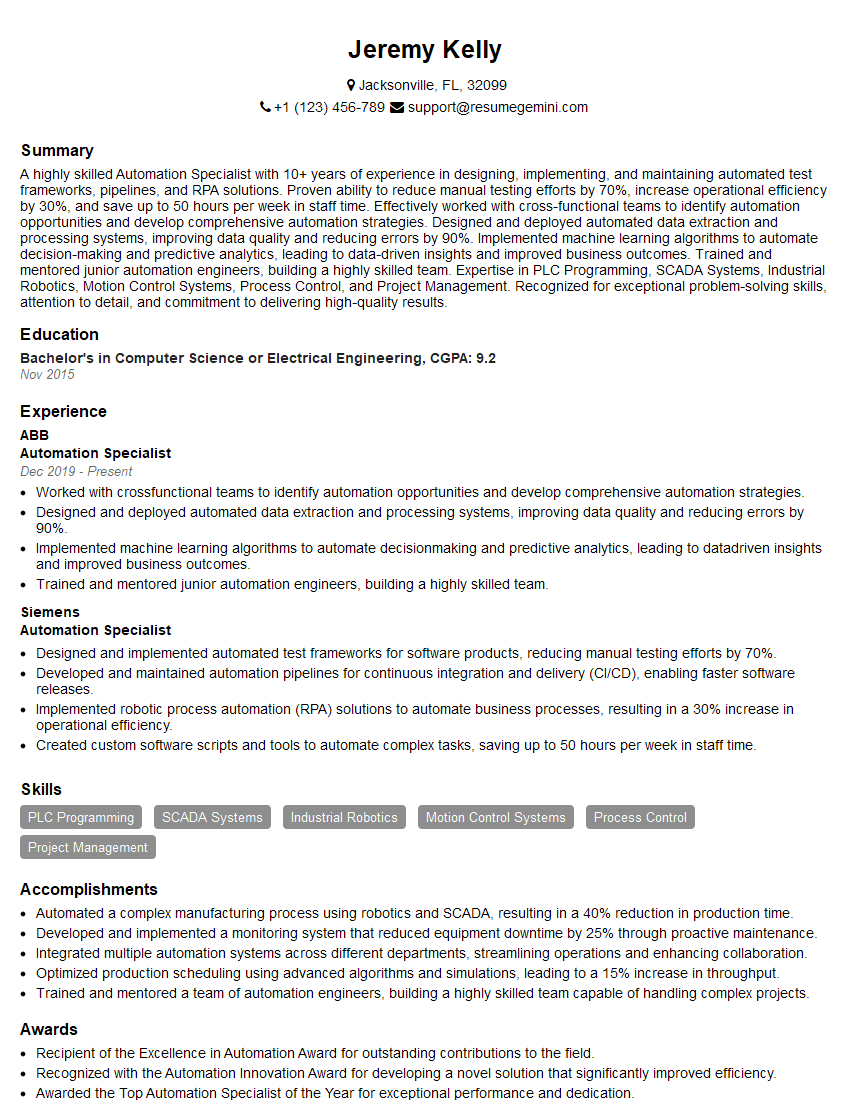
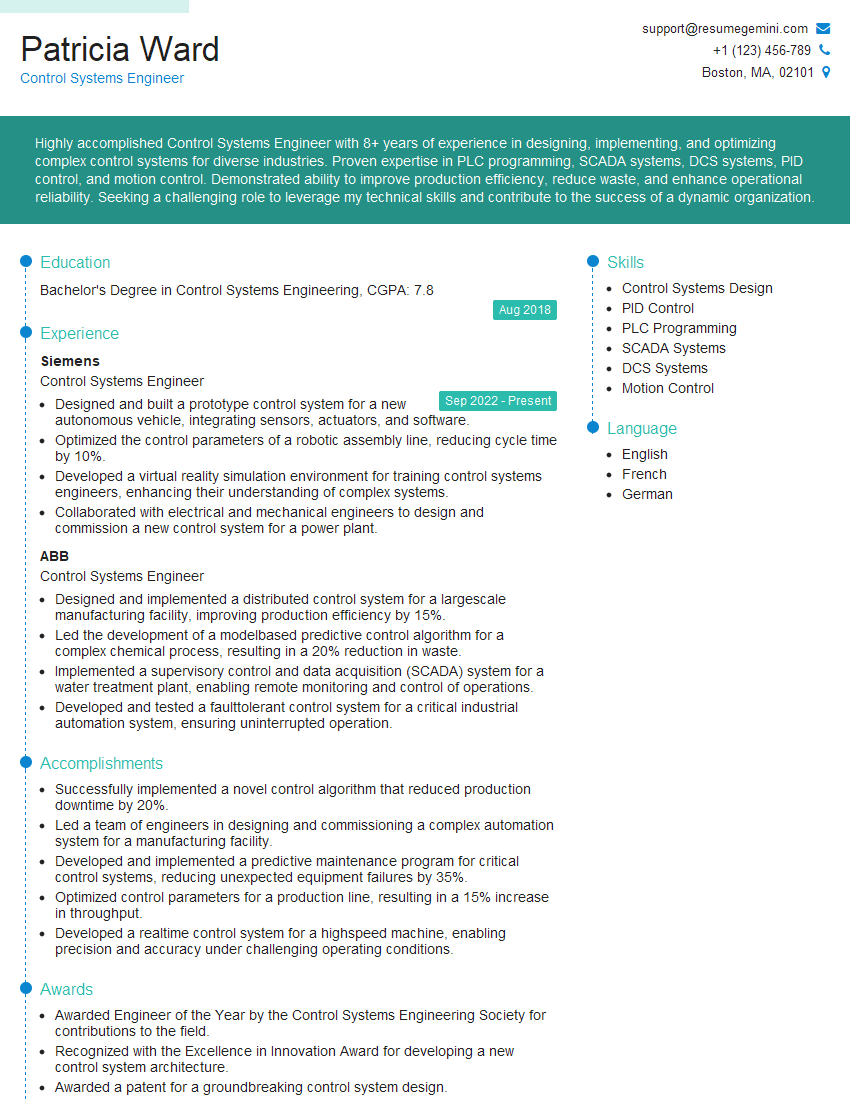
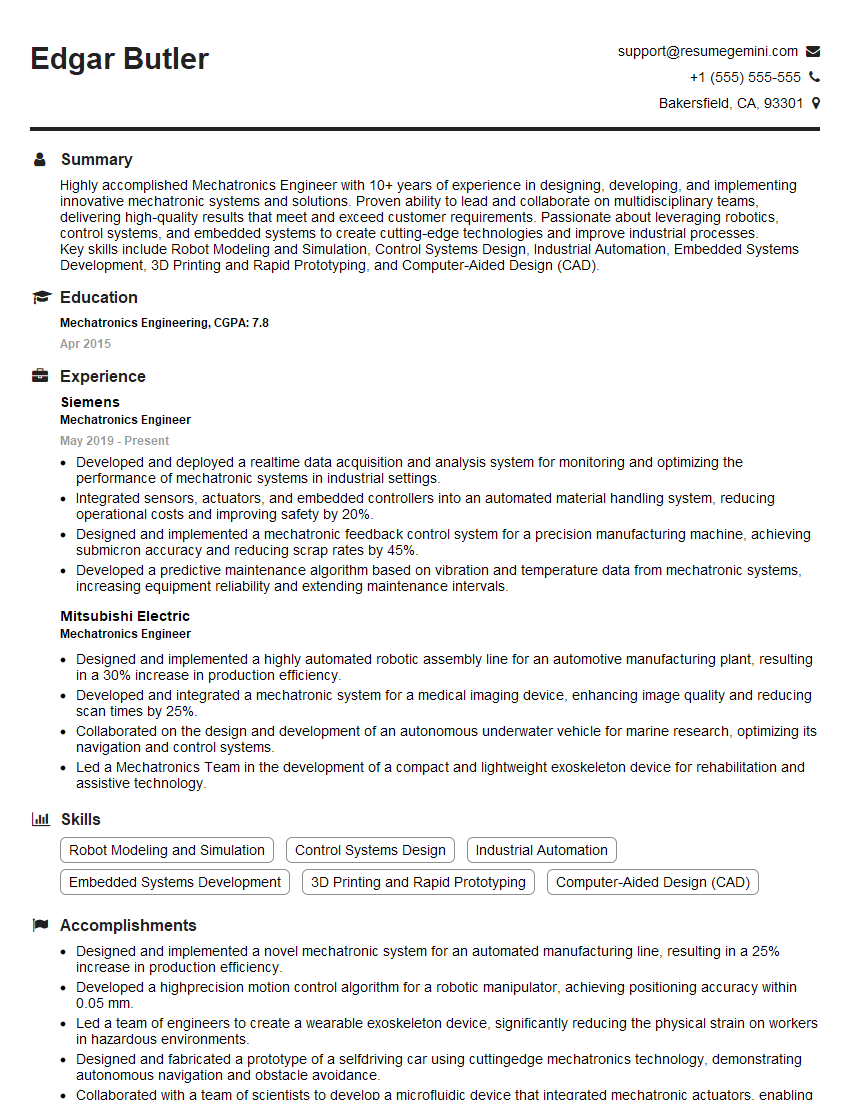
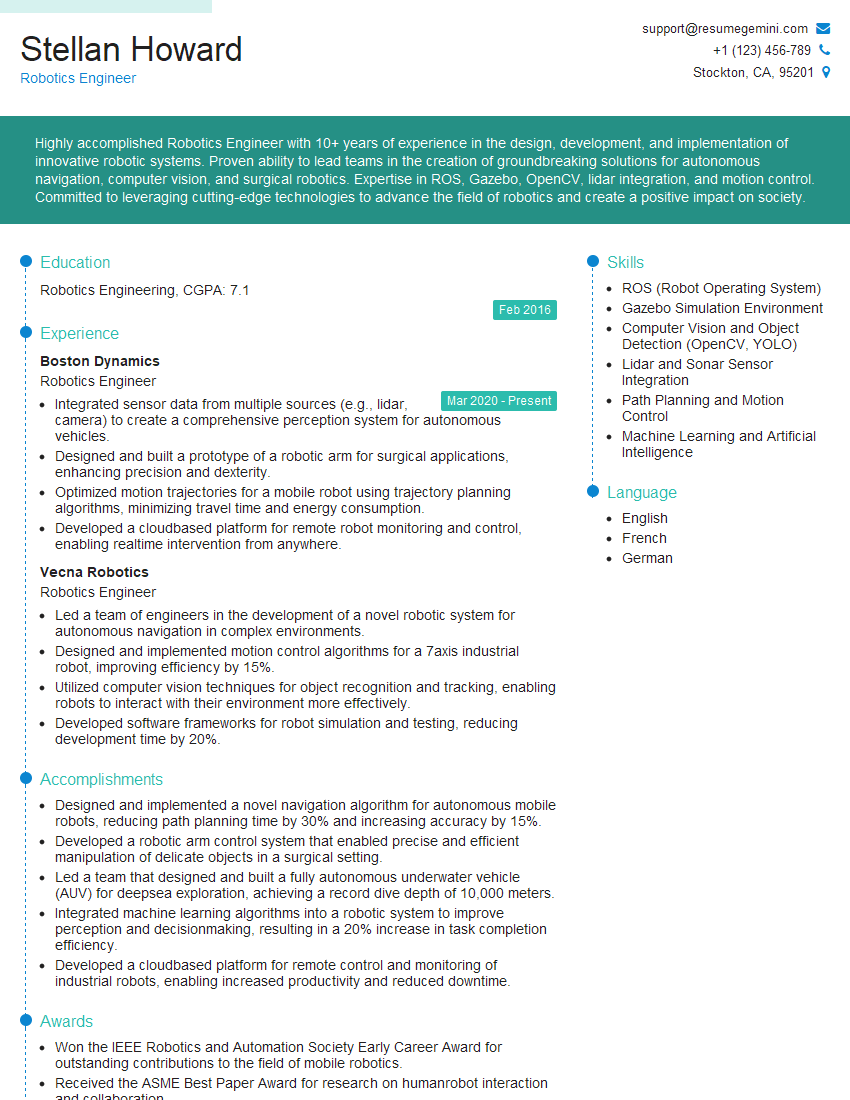
Mastering Digital Control Systems opens doors to exciting and rewarding careers in various high-tech industries. To maximize your job prospects, crafting a strong, ATS-friendly resume is essential. ResumeGemini can help you build a compelling resume that highlights your skills and experience effectively. They provide examples of resumes tailored to the Digital Control Systems field, ensuring your application stands out from the competition. Take the next step towards your dream career by leveraging ResumeGemini’s expertise in resume creation.
Explore more articles
Users Rating of Our Blogs
Share Your Experience
We value your feedback! Please rate our content and share your thoughts (optional).
What Readers Say About Our Blog
Very informative content, great job.
good