Interviews are opportunities to demonstrate your expertise, and this guide is here to help you shine. Explore the essential Digital Media Strategy interview questions that employers frequently ask, paired with strategies for crafting responses that set you apart from the competition.
Questions Asked in Digital Media Strategy Interview
Q 1. Explain your understanding of the current digital media landscape.
The current digital media landscape is incredibly dynamic and fragmented. We’re moving beyond the simple website-centric model to a multi-platform ecosystem. This includes a vast array of channels like social media platforms (Facebook, Instagram, TikTok, X (formerly Twitter), LinkedIn, etc.), search engines (Google, Bing), email marketing, podcasts, video platforms (YouTube, streaming services), influencer marketing, and emerging technologies like the metaverse and Web3. The key challenge is understanding audience behavior across these diverse platforms and crafting integrated strategies that reach them effectively. For example, a younger demographic might be heavily engaged on TikTok, while a professional audience might be more receptive to LinkedIn content. Effective strategies require a deep understanding of these nuanced differences and a data-driven approach to optimize across all channels.
Another important aspect is the increasing focus on data privacy and user consent. Regulations like GDPR and CCPA are shaping how businesses collect and utilize user data, demanding more transparency and user control. This necessitates a shift towards privacy-focused marketing strategies and a greater emphasis on first-party data collection.
Q 2. Describe your experience with SEO best practices.
My SEO experience encompasses both on-page and off-page optimization techniques. On-page involves optimizing website content, including keyword research (using tools like SEMrush and Ahrefs), meta descriptions, title tags, header tags (H1-H6), and image alt text to improve search engine ranking. Off-page optimization focuses on building high-quality backlinks from reputable websites. I’ve worked on strategies that include guest blogging, creating valuable content that naturally attracts links, and building relationships with other websites in the same niche. For example, I successfully increased organic traffic for a client by 30% in six months through a combination of keyword optimization and a robust backlinking strategy.
I also stay updated on Google’s algorithm updates and best practices, ensuring websites are compliant with their guidelines. Technical SEO, including site speed optimization, mobile responsiveness, and structured data markup (Schema), is also critical to ensure websites are easily crawlable and indexed. I’ve successfully resolved numerous technical SEO issues, such as improving website loading speed by implementing image compression and optimizing server configurations, leading to improved user experience and search ranking.
Q 3. How do you measure the success of a digital media campaign?
Measuring the success of a digital media campaign requires a multi-faceted approach that goes beyond simple vanity metrics. Key Performance Indicators (KPIs) should be aligned with the campaign’s overall objectives. For example, if the goal is brand awareness, KPIs might include reach, impressions, and engagement rates on social media. If the goal is lead generation, KPIs might include website traffic, conversion rates, and cost per lead. For e-commerce campaigns, sales conversions, average order value, and return on ad spend (ROAS) are crucial.
I use a combination of tools like Google Analytics, social media analytics dashboards (provided by each platform), and marketing automation platforms to track key metrics. I also regularly analyze data to identify trends, optimize campaigns, and report on performance against pre-defined targets. A/B testing is a critical component of optimization, allowing me to continually refine campaigns for improved results.
Q 4. What are your preferred social media analytics tools and why?
My preferred social media analytics tools include the native analytics dashboards provided by each platform (Facebook Insights, Instagram Insights, Twitter Analytics, etc.), as they offer the most accurate and comprehensive data on each specific platform. However, I also utilize tools like Sprout Social and Hootsuite for social listening, scheduling, and reporting across multiple platforms. These tools allow for a consolidated view of performance across different channels, making it easier to identify overall trends and areas for improvement. For example, Sprout Social’s reporting features enable the creation of custom reports that visually communicate key insights to stakeholders.
The choice of tool depends on the specific needs of the campaign and the client’s budget. For smaller businesses with limited resources, the native analytics dashboards often suffice, while larger organizations with more complex needs might benefit from more comprehensive platforms.
Q 5. Outline your process for developing a social media strategy.
My process for developing a social media strategy follows a structured approach:
- Define Goals and Objectives: What are we trying to achieve? Increased brand awareness? Lead generation? Driving sales? Clearly defined goals provide a framework for all subsequent decisions.
- Audience Research: Who are we trying to reach? What are their demographics, interests, and online behavior? Understanding the target audience is essential for crafting relevant and engaging content.
- Competitive Analysis: Who are our competitors? What are they doing well? Where are there opportunities for differentiation? Benchmarking against competitors helps identify best practices and potential gaps.
- Platform Selection: Which platforms are most relevant to our target audience? We select the platforms where our target audience spends their time.
- Content Strategy: What types of content will we create? This should align with the target audience’s interests and preferences, encompassing a variety of formats (images, videos, text, etc.).
- Content Calendar: A schedule for publishing content, ensuring consistent posting and engagement.
- Engagement Strategy: How will we interact with our audience? This includes responding to comments, running contests, and using relevant hashtags.
- Measurement and Reporting: Tracking KPIs and reporting on performance against the pre-defined goals.
Throughout this process, I emphasize iterative improvements based on data analysis and audience feedback, ensuring continuous optimization and maximizing campaign effectiveness.
Q 6. How would you handle a crisis on social media?
Handling a social media crisis requires a swift, transparent, and empathetic response. My approach involves these steps:
- Assess the Situation: Identify the severity of the crisis and the potential impact on the brand’s reputation.
- Assemble a Crisis Team: Gather relevant stakeholders (PR, marketing, legal) to coordinate a unified response.
- Monitor the Conversation: Track mentions across all social media platforms to understand the scope of the issue and public sentiment.
- Craft a Response: Develop a clear, concise, and empathetic message acknowledging the issue and outlining the steps being taken to address it. Transparency is crucial.
- Communicate Proactively: Disseminate the response across relevant platforms and engage directly with concerned users. Respond promptly to comments and direct messages.
- Take Corrective Action: Address the underlying cause of the crisis to prevent future occurrences.
- Monitor and Evaluate: Continue tracking mentions and sentiment to assess the effectiveness of the response and make adjustments as needed.
It’s essential to avoid deleting negative comments or ignoring the issue, as this can escalate the crisis. Taking responsibility and demonstrating empathy are key to mitigating damage and rebuilding trust.
Q 7. Explain your experience with paid media advertising (e.g., Google Ads, Social Media Ads).
I have extensive experience managing paid media campaigns across various platforms, including Google Ads and various social media advertising platforms. My approach involves a data-driven strategy focused on optimizing for key metrics like ROAS, conversion rates, and cost per acquisition (CPA). I utilize keyword research, audience targeting, ad copy testing, and landing page optimization to maximize campaign performance.
With Google Ads, I’ve managed campaigns using various bidding strategies, including automated bidding and manual bidding, depending on the campaign goals and budget. I’ve successfully leveraged Google Ads features like remarketing and audience targeting to reach specific customer segments effectively. For example, I improved the conversion rate of a client’s Google Ads campaign by 25% by refining keyword targeting and optimizing ad copy based on A/B testing results.
On social media platforms, I’ve developed and implemented targeted advertising campaigns using demographic, interest, and behavioral data. I’ve also managed influencer marketing campaigns, leveraging the reach and engagement of key influencers to promote products or services. I always track campaign performance meticulously, making data-driven adjustments throughout the campaign lifecycle to ensure optimal performance and ROI.
Q 8. Describe your approach to content marketing and strategy.
My approach to content marketing starts with a deep understanding of the target audience and their needs. It’s not about just creating content; it’s about creating valuable content that resonates with them and solves their problems. I begin with a thorough content audit to assess existing materials and identify gaps. Then, I develop a comprehensive content strategy, which includes:
- Defining clear goals: What do we want to achieve with this content? Increased brand awareness? Lead generation? Sales? Defining these goals guides every decision.
- Audience persona creation: Developing detailed profiles of our ideal customers, understanding their demographics, psychographics, pain points, and online behavior.
- Keyword research: Identifying relevant keywords and phrases that our target audience uses when searching for information online. This ensures our content is discoverable.
- Content pillar development: Creating in-depth, comprehensive content pieces around core topics relevant to our audience. These serve as hubs for related, shorter-form content.
- Content calendar creation: Planning and scheduling content distribution across various platforms to maintain consistency and maximize reach. This includes the type of content (blog posts, videos, infographics, etc.) and the platform (social media, email, website).
- Content promotion and distribution: Utilizing various channels like social media marketing, email marketing, search engine optimization (SEO), and paid advertising to amplify our content’s reach.
- Analytics and optimization: Regularly tracking key performance indicators (KPIs) to measure the success of our content marketing efforts and make data-driven improvements.
For example, in a recent project for a SaaS company, we focused on creating in-depth case studies and white papers to showcase the software’s effectiveness and address specific customer pain points. This resulted in a significant increase in qualified leads and conversions.
Q 9. How do you identify and target key demographics for digital campaigns?
Identifying and targeting key demographics for digital campaigns involves a multi-faceted approach. It’s not just about age and gender; it’s about understanding the audience’s interests, behaviors, and online habits. I leverage a combination of methods:
- Market research: Utilizing data from sources like industry reports, competitor analysis, and customer surveys to understand market trends and identify target segments.
- Data analytics: Analyzing website analytics (Google Analytics), social media insights, and CRM data to gain insights into existing customer behavior and identify potential new audiences. This includes looking at demographics, geographic location, interests, and online behavior.
- Social media listening: Monitoring social media conversations to understand what people are saying about our brand, our competitors, and the industry in general. This provides valuable insights into audience sentiment and needs.
- Persona development: Creating detailed profiles of our ideal customers, incorporating data from the above sources to paint a complete picture of their characteristics and behaviors.
- Targeted advertising: Using platforms like Google Ads and social media advertising to reach specific demographics through precise targeting options based on demographics, interests, behaviors, and even custom audiences.
For instance, in a campaign for a sustainable fashion brand, we targeted environmentally conscious consumers aged 25-45 with interests in ethical fashion and sustainable living, using precise targeting options on Facebook and Instagram. This significantly increased campaign efficiency and return on investment (ROI).
Q 10. What experience do you have with A/B testing and optimization?
A/B testing and optimization are integral to my digital marketing strategy. It’s a data-driven approach to improve campaign effectiveness and maximize ROI. My experience includes designing and implementing A/B tests across various platforms and channels, including website landing pages, email marketing campaigns, and social media ads. I use A/B testing to:
- Optimize website conversion rates: Testing different headlines, calls to action, and page layouts to identify what resonates best with visitors and drives conversions.
- Improve email open and click-through rates: Testing subject lines, email content, and call-to-action buttons to improve email engagement.
- Enhance social media ad performance: Testing different ad creatives, targeting options, and bidding strategies to optimize ad performance and reduce costs.
For example, I recently conducted an A/B test on a client’s website landing page, comparing two different headline variations. The test revealed that one headline increased conversion rates by 15%, demonstrating the value of data-driven optimization. I use tools like Google Optimize and Optimizely to manage and analyze A/B tests.
Q 11. How do you stay up-to-date with the ever-changing digital media trends?
Staying up-to-date with the ever-evolving digital media landscape requires continuous learning and a proactive approach. I employ several strategies:
- Industry publications and blogs: Regularly reading industry publications, blogs, and newsletters from reputable sources like Search Engine Journal, Marketing Land, and Neil Patel’s blog to stay informed about the latest trends and best practices.
- Industry events and conferences: Attending industry conferences and webinars to network with other professionals and learn about emerging technologies and strategies. This provides valuable networking opportunities and insights.
- Online courses and certifications: Taking online courses and pursuing certifications from platforms like Coursera, edX, and Google Digital Garage to expand my knowledge and skills.
- Following industry influencers: Following thought leaders and influencers on social media and subscribing to their newsletters to stay abreast of current discussions and emerging trends.
- Experimentation and data analysis: Constantly experimenting with new tools and technologies and analyzing the data to understand what works best in different contexts.
This multi-pronged approach allows me to remain adaptable and effectively integrate new developments into my strategies.
Q 12. Explain your understanding of different types of digital media content (video, audio, text, image).
Different types of digital media content cater to various audience preferences and consumption habits. My understanding encompasses:
- Text-based content: This includes blog posts, articles, website copy, social media updates, and email newsletters. It’s crucial for SEO and providing in-depth information.
- Image-based content: Includes photos, infographics, and illustrations. Visually appealing content is important for capturing attention and conveying information quickly.
- Video content: This includes short-form videos for social media (TikTok, Reels, Shorts), longer-form explainer videos, product demos, and webinars. Video content is highly engaging and can effectively communicate complex information.
- Audio content: This encompasses podcasts, audio ads, and voiceovers. Audio provides a convenient way for audiences to consume information while multitasking.
The key is to select the right content type for the right platform and audience. A short, snappy video might be ideal for TikTok, while a detailed blog post works better for providing comprehensive information on a website.
Q 13. Describe your experience with creating and managing a digital marketing budget.
My experience in creating and managing digital marketing budgets involves a structured approach emphasizing strategic allocation and ROI measurement. I begin by:
- Defining clear objectives: Establishing specific, measurable, achievable, relevant, and time-bound (SMART) goals to guide budget allocation.
- Market research: Conducting thorough market research to understand the competitive landscape and determine the optimal channels for reaching our target audience.
- Budget allocation: Developing a detailed budget breakdown, allocating funds across different channels based on their potential ROI and aligning with the overall strategy. This often involves using a combination of paid, earned, and owned media.
- Tracking and reporting: Regularly monitoring campaign performance and generating reports to assess the effectiveness of our spending and make data-driven adjustments.
- Contingency planning: Building in a contingency fund to handle unexpected expenses or opportunities.
For instance, in a recent project, we developed a tiered budget based on campaign performance. This allowed us to reallocate funds from underperforming channels to high-performing ones, maximizing our ROI. Using tools like Google Ads, social media ad managers, and marketing analytics platforms helps to track campaign costs and ROI.
Q 14. What are the key performance indicators (KPIs) you track for digital campaigns?
The key performance indicators (KPIs) I track for digital campaigns vary depending on the specific goals, but generally include:
- Website traffic: Measures the number of visitors to the website, including sources and demographics.
- Conversion rates: Tracks the percentage of website visitors who complete a desired action (e.g., making a purchase, filling out a form).
- Engagement metrics: Measures user engagement with content, including time on site, bounce rate, and social media interactions.
- Return on investment (ROI): Calculates the return on investment for each campaign, considering both costs and revenue generated.
- Brand awareness metrics: Tracks brand mentions, social media reach, and website traffic from branded searches.
- Customer acquisition cost (CAC): Measures the cost of acquiring a new customer.
- Customer lifetime value (CLTV): Estimates the total revenue generated by a customer throughout their relationship with the brand.
By consistently monitoring these KPIs, I can identify areas for improvement and optimize campaigns for maximum effectiveness. The tools used for tracking include Google Analytics, social media analytics dashboards, and marketing automation platforms.
Q 15. How do you use data analytics to inform digital media strategy?
Data analytics is the cornerstone of any effective digital media strategy. It allows us to move beyond guesswork and make data-driven decisions. I use analytics to understand audience behavior, campaign performance, and ultimately, optimize our strategies for better results.
For example, I leverage Google Analytics to track website traffic, identifying sources, popular pages, and user engagement metrics like bounce rate and time on site. This helps pinpoint what content resonates with our audience and what needs improvement. Beyond website analytics, I also analyze social media engagement, email open and click-through rates, and campaign conversion data to get a holistic view of performance. This data informs decisions about budget allocation, content creation, and channel prioritization. We might find, for instance, that a particular social media platform delivers a significantly higher ROI than others, leading us to reallocate resources accordingly.
Furthermore, A/B testing – comparing two versions of a webpage or ad – is crucial. By analyzing the results, we can determine which version performs better and continuously refine our approach. This iterative process, fueled by data, ensures that our campaigns are constantly improving.
Career Expert Tips:
- Ace those interviews! Prepare effectively by reviewing the Top 50 Most Common Interview Questions on ResumeGemini.
- Navigate your job search with confidence! Explore a wide range of Career Tips on ResumeGemini. Learn about common challenges and recommendations to overcome them.
- Craft the perfect resume! Master the Art of Resume Writing with ResumeGemini’s guide. Showcase your unique qualifications and achievements effectively.
- Don’t miss out on holiday savings! Build your dream resume with ResumeGemini’s ATS optimized templates.
Q 16. Describe your experience with email marketing and automation.
My experience with email marketing encompasses strategy development, list segmentation, campaign creation, automation, and performance analysis. I’m proficient in using various email marketing platforms, such as Mailchimp and Constant Contact, to build and manage email lists, design engaging email templates, and automate email sequences.
For instance, I’ve implemented automated welcome email sequences for new subscribers, nurturing them with valuable content and gradually guiding them towards conversion. I’ve also designed automated abandoned cart emails for e-commerce clients, reminding customers of items left in their shopping carts and encouraging them to complete their purchase. Segmentation is key; I use data to segment audiences based on demographics, behavior, and purchase history, allowing for personalized email messaging and improved campaign effectiveness. Finally, I closely monitor key performance indicators (KPIs) like open rates, click-through rates, and conversion rates to continuously optimize email campaigns and ensure maximum impact.
Q 17. How do you integrate various digital marketing channels into a cohesive strategy?
Integrating various digital marketing channels requires a holistic approach centered around a clear understanding of the target audience and campaign goals. It’s not about using every channel but strategically selecting the ones that best reach and engage your audience. This often involves a multi-channel strategy where different channels support and reinforce each other.
For example, a cohesive strategy might involve using social media platforms (like Facebook and Instagram) for brand building and audience engagement, search engine optimization (SEO) for organic website traffic, paid advertising (like Google Ads and social media ads) for targeted reach, and email marketing for lead nurturing and customer retention. The key is to ensure a consistent brand message and experience across all channels. Think of it like a symphony orchestra – each instrument (channel) plays its part, but the conductor (overall strategy) ensures harmony and effectiveness.
We utilize tools like marketing automation platforms to streamline workflows across channels, ensuring messages are consistent and timely. For example, a lead generated through a Facebook ad might automatically be added to an email nurture sequence, fostering continued engagement.
Q 18. How do you measure the ROI of your digital marketing campaigns?
Measuring ROI in digital marketing requires a clear understanding of your campaign goals and the metrics that directly correlate with those goals. It’s not just about vanity metrics like likes and followers; it’s about identifying tangible results.
For example, if the goal is lead generation, we track the number of leads generated, their cost per lead (CPL), and ultimately, their conversion rate into customers. If the goal is e-commerce sales, we track sales revenue, return on ad spend (ROAS), and customer acquisition cost (CAC). We use analytics platforms to track these metrics and attribute conversions to specific channels and campaigns. Attribution modeling helps determine which touchpoints in the customer journey contributed most to the conversion.
A critical aspect is setting clear baseline metrics before a campaign begins. This provides a benchmark against which to measure the campaign’s success. We then use tools to analyze data and calculate the return on investment (ROI) for each campaign, allowing us to optimize future strategies based on what works best.
Q 19. What is your experience with content management systems (CMS) such as WordPress?
I have extensive experience working with WordPress, a popular and versatile content management system (CMS). My expertise includes website design and development, plugin integration, theme customization, and content management. I understand the importance of user-friendliness and search engine optimization when building and maintaining websites using WordPress.
I’ve used WordPress to build various websites, ranging from simple blogs to complex e-commerce sites. My experience includes creating custom post types and taxonomies to tailor the CMS to specific client needs. I’m familiar with using various WordPress plugins to enhance functionality, such as SEO plugins for improving search engine rankings, e-commerce plugins for online sales, and security plugins to protect the website from vulnerabilities. I also understand the importance of regular updates and maintenance to ensure website security and performance.
Q 20. Explain your understanding of search engine algorithms and their impact on SEO.
Search engine algorithms are complex computer programs that determine the ranking of websites in search engine results pages (SERPs). Understanding these algorithms is crucial for effective search engine optimization (SEO). They consider various factors, including website content, technical SEO, backlinks, and user experience.
Major search engines like Google constantly update their algorithms to improve search results and combat manipulative SEO tactics. Factors such as keyword relevance, website authority (measured by backlinks and domain age), site speed, mobile-friendliness, and high-quality content are all significant ranking factors. Understanding how these factors impact search rankings allows us to optimize websites to improve their visibility and attract more organic traffic.
Staying updated on algorithm changes and best practices is crucial. This involves continuous learning, monitoring industry news, and using SEO tools to analyze website performance and identify areas for improvement. Think of it as a continuous game of adaptation; algorithms evolve, and so must our SEO strategies.
Q 21. How do you develop a content calendar and editorial strategy?
Developing a content calendar and editorial strategy is a crucial step in any successful digital marketing plan. It involves planning and scheduling the creation and publication of content across various platforms. This strategy ensures consistency, relevance, and maximizes the impact of your content efforts.
The process starts with defining clear goals and target audiences. We then brainstorm content ideas aligned with these goals and the audience’s interests. This could include blog posts, social media updates, videos, infographics, and more. Once we have a list of content ideas, we develop a content calendar, scheduling the publication of content over a specific timeframe. This calendar helps maintain a consistent publishing schedule and ensures that content aligns with marketing campaigns and seasonal trends.
The editorial strategy ensures the quality and consistency of the content. This involves establishing style guidelines, content formats, and a review process to ensure accuracy and brand consistency. It also involves tracking the performance of content using analytics to identify what resonates with the audience and refine future content creation.
Q 22. How would you approach the creation of a social media influencer campaign?
A successful social media influencer campaign starts with meticulous planning. It’s not just about finding a popular influencer; it’s about strategic alignment. First, I’d define clear campaign goals – increased brand awareness, lead generation, or driving sales. Then, I’d identify target audiences and select influencers whose followers closely match that demographic and share the brand’s values. This involves analyzing their audience engagement, authenticity, and past collaborations. Crucially, I’d create a detailed brief outlining campaign objectives, deliverables (e.g., posts, stories, videos), timelines, and key performance indicators (KPIs). We’d then negotiate contracts specifying deliverables, payment structures (often a mix of flat fees and performance-based incentives), and content guidelines to maintain brand consistency. Post-campaign, thorough analysis of the data is crucial to understand ROI and optimize future collaborations. For instance, a campaign for a sustainable clothing brand might focus on micro-influencers known for their eco-conscious lifestyle, ensuring authenticity and higher engagement.
- Audience Research: Understanding demographics, interests, and online behavior of the target audience is paramount.
- Influencer Selection: Choosing influencers based on relevance, engagement rate, and audience alignment.
- Content Strategy: Developing engaging content that resonates with the influencer’s audience and aligns with brand messaging.
- Campaign Tracking and Measurement: Using analytics to monitor performance and measure ROI.
Q 23. Describe your experience using analytics tools like Google Analytics or similar.
I have extensive experience using Google Analytics, along with other analytics platforms like Adobe Analytics and social media’s built-in analytics. My expertise extends beyond simply looking at numbers; I focus on deriving actionable insights. For example, using Google Analytics, I can analyze website traffic sources, user behavior (bounce rate, time on site, pages per visit), and conversion rates. This helps identify areas for improvement. If I see a high bounce rate on a specific landing page, I’d investigate the page’s content, design, and user experience. If a particular marketing channel is underperforming, I’d adjust the strategy for that channel. I also use segmentation to analyze data based on demographics, location, and other user characteristics to tailor campaigns. Furthermore, I’m proficient in using custom dashboards to visualize key metrics and track progress against goals. Imagine a scenario where website traffic is down – I’d use GA to see if it’s a problem with organic search, paid advertising, or referral traffic, then I’d drill down to pinpoint the root cause.
Example: Using Google Analytics' Audience > Acquisition > All Traffic report to pinpoint traffic source issues.Q 24. Explain your understanding of different advertising platforms and their capabilities.
I’m familiar with a wide range of advertising platforms, each with its strengths and weaknesses. Google Ads is excellent for search engine marketing (SEM) and display advertising, offering precise targeting options based on keywords, demographics, and interests. Facebook Ads excels at targeting specific demographics and interests through detailed audience segmentation and retargeting capabilities. Instagram Ads, naturally, are powerful for visual campaigns and influencer marketing. LinkedIn Ads are particularly effective for B2B marketing, reaching professionals in specific industries. TikTok Ads are rising in popularity for reaching younger demographics with short-form video content. Each platform requires a different approach. For instance, while Google Ads focuses on keyword relevance, Facebook Ads leverage behavioral and interest data for targeting. Choosing the right platform depends on the campaign goals, target audience, and budget. I’d never limit myself to a single platform but instead design an integrated strategy leveraging the strengths of multiple platforms to achieve optimal reach and engagement.
Q 25. How would you address a decline in website traffic or engagement?
A decline in website traffic or engagement requires a systematic investigation. My approach involves a multi-step process: First, I’d use analytics tools (like Google Analytics) to identify the cause. Is it a drop in organic search traffic, a decrease in social media referrals, or a problem with paid campaigns? Once the source is identified, we can focus our efforts. If it’s organic search, a site audit might reveal SEO issues (broken links, slow loading times, poor keyword optimization). If it’s social media, we might need to reassess the content strategy, explore new content formats or platforms, and refine our posting schedule. If paid campaigns are the issue, we need to analyze keyword effectiveness, ad creatives, and targeting parameters. Beyond technical SEO and content, we also need to consider external factors – is there a competitor doing something new, or has there been an algorithmic update impacting visibility? A decline could also signal a need for a website redesign or a change in brand messaging to better resonate with the target audience. This needs a combination of technical expertise and a sharp understanding of marketing trends.
Q 26. How do you measure the effectiveness of your social media presence?
Measuring the effectiveness of social media presence goes beyond simply looking at follower count. I use a combination of quantitative and qualitative metrics. Quantitative metrics include reach, engagement (likes, comments, shares), website clicks, conversions (e.g., purchases, lead generation), and brand mentions. Qualitative metrics involve sentiment analysis (understanding the overall tone of mentions) and monitoring audience feedback to gauge brand perception. Tools like Brand24 and social listening platforms help track brand mentions and analyze sentiment. For instance, if we see a high number of negative comments, we address the issues. A drop in engagement may require a change in content strategy. We can also use A/B testing on various content types (images, videos, captions) to optimize engagement. It’s a continuous process of monitoring, analyzing, adapting, and refining the strategy to maximize impact. Ultimately, the success of social media is tied to achieving business goals – whether it’s boosting brand awareness or driving conversions.
Q 27. Describe your approach to identifying and resolving digital marketing challenges.
My approach to identifying and resolving digital marketing challenges is data-driven and iterative. I start by defining the problem clearly: is it a decline in conversions, a decrease in website traffic, or something else? Then, I delve into the data using analytical tools to identify potential root causes. For instance, a drop in organic search traffic might point towards issues with SEO, website speed, or content quality. Once the root causes are identified, I develop a hypothesis-driven approach, formulating potential solutions and testing them using A/B testing or other methods. This process involves close collaboration with the team, open communication, and a willingness to adapt based on the data and results. If SEO is the problem, I may implement a revised SEO strategy. If user experience is the bottleneck, we may redesign the website. I document each step, including the problem definition, the hypothesis, the tests performed, and the conclusions drawn. This systematic approach allows me to learn from past challenges, improve future campaigns, and ensure that solutions are sustainable and effective.
Key Topics to Learn for Digital Media Strategy Interview
- Digital Marketing Fundamentals: Understand the core principles of digital marketing, including SEO, SEM, social media marketing, email marketing, and content marketing. Be prepared to discuss the interplay between these channels.
- Audience Analysis & Segmentation: Demonstrate your ability to identify target audiences, analyze their behavior, and create tailored strategies for reaching them effectively across various digital platforms.
- Campaign Planning & Execution: Showcase your experience in developing comprehensive digital marketing campaigns, including setting objectives, defining KPIs, allocating budgets, and managing timelines.
- Data Analysis & Reporting: Highlight your proficiency in using analytics tools (Google Analytics, etc.) to track campaign performance, identify areas for improvement, and present data-driven insights to stakeholders.
- Content Strategy & Creation: Discuss your understanding of developing engaging and effective content that aligns with marketing objectives and resonates with the target audience across various formats (blog posts, videos, social media updates).
- Social Media Strategy & Management: Explain your knowledge of different social media platforms and their best practices for organic and paid social media campaigns. Be ready to discuss community management and engagement.
- Budget Allocation & ROI Measurement: Demonstrate your understanding of how to effectively allocate budget across different digital channels and measure the return on investment (ROI) for each campaign.
- Emerging Trends & Technologies: Stay updated on the latest trends in digital media, such as influencer marketing, AI-powered tools, and the evolving digital landscape. Be ready to discuss how these trends impact strategy.
- Problem-Solving & Case Studies: Prepare to discuss past experiences where you successfully overcame challenges in digital media strategy. Highlight your problem-solving skills and analytical approach.
Next Steps
Mastering Digital Media Strategy is crucial for career advancement in today’s dynamic digital world. A strong understanding of these concepts will significantly enhance your job prospects and open doors to exciting opportunities. To maximize your chances of landing your dream role, creating an ATS-friendly resume is essential. This ensures your qualifications are effectively highlighted to recruiters and applicant tracking systems. We strongly recommend using ResumeGemini, a trusted resource for building professional resumes. ResumeGemini offers examples of resumes tailored to Digital Media Strategy to help you craft a compelling application that showcases your skills and experience effectively.
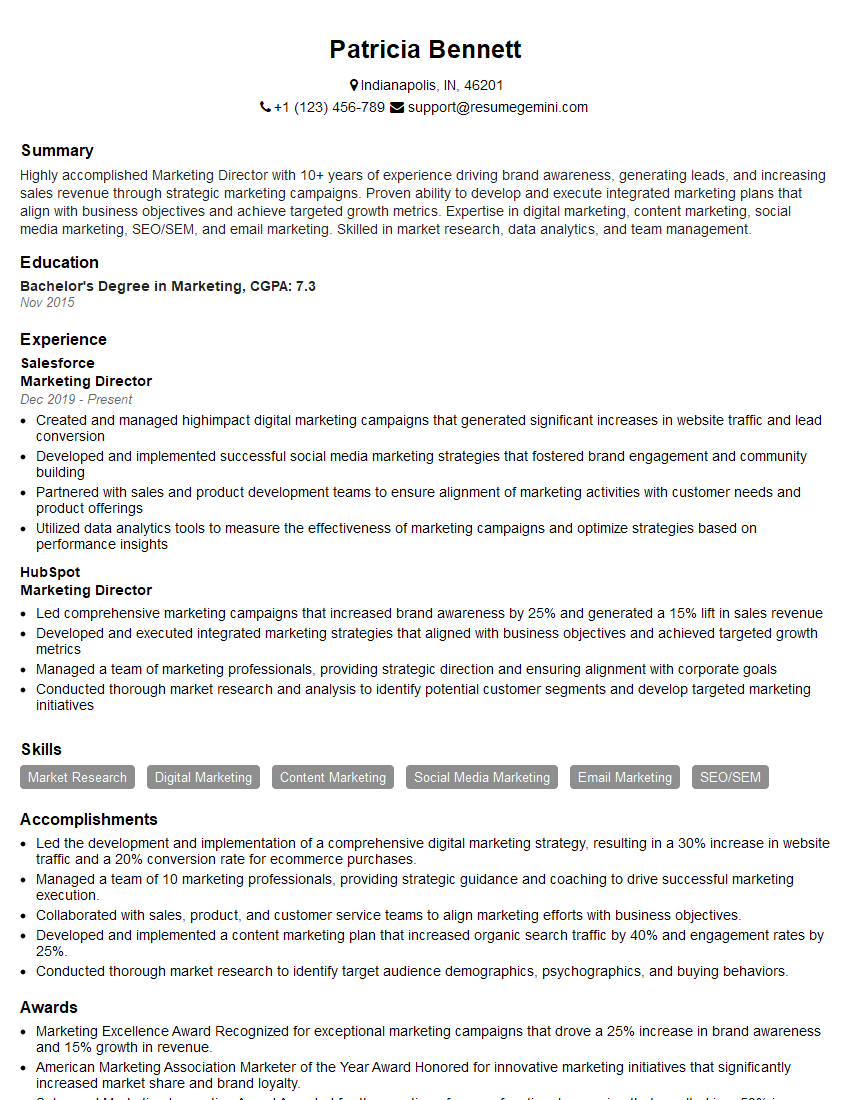
Marketing Director Resume Sample
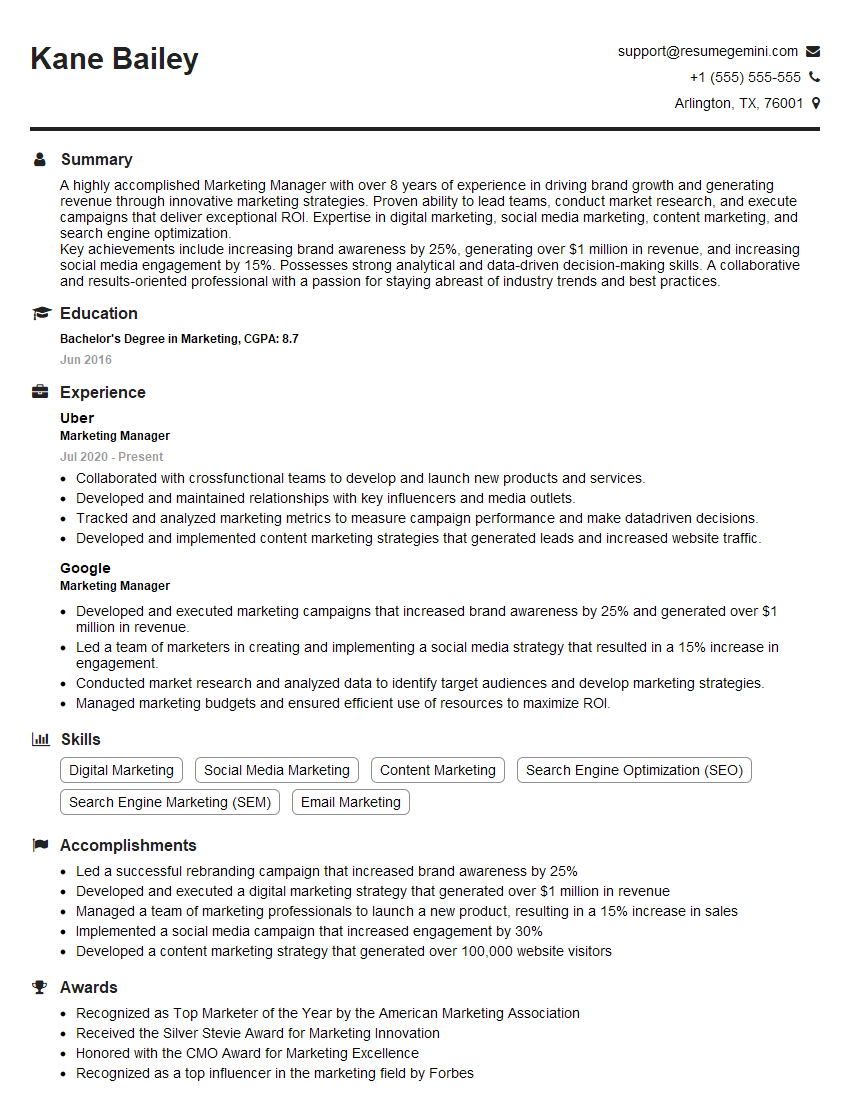
Marketing Manager Resume Sample

Marketing Communications Manager Resume Sample

Social Media Manager Resume Sample
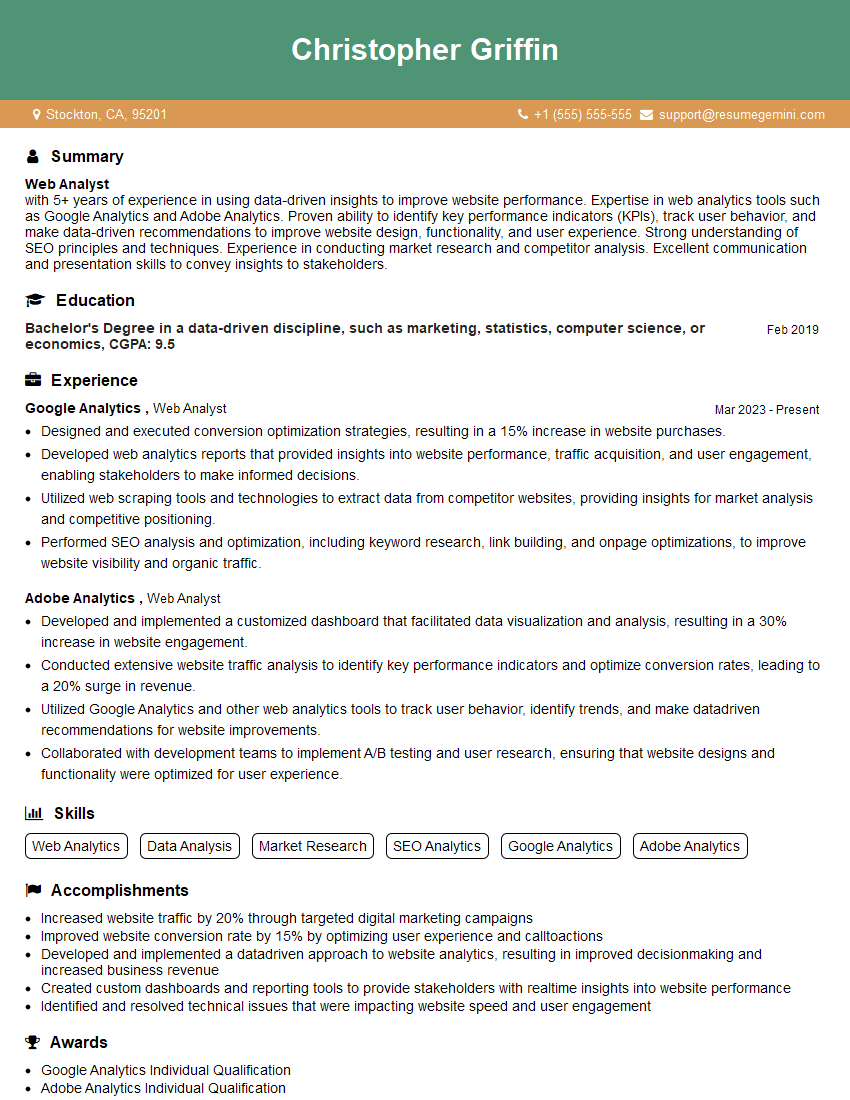
Web Analyst Resume Sample

Content Strategist Resume Sample

Growth Hacker Resume Sample
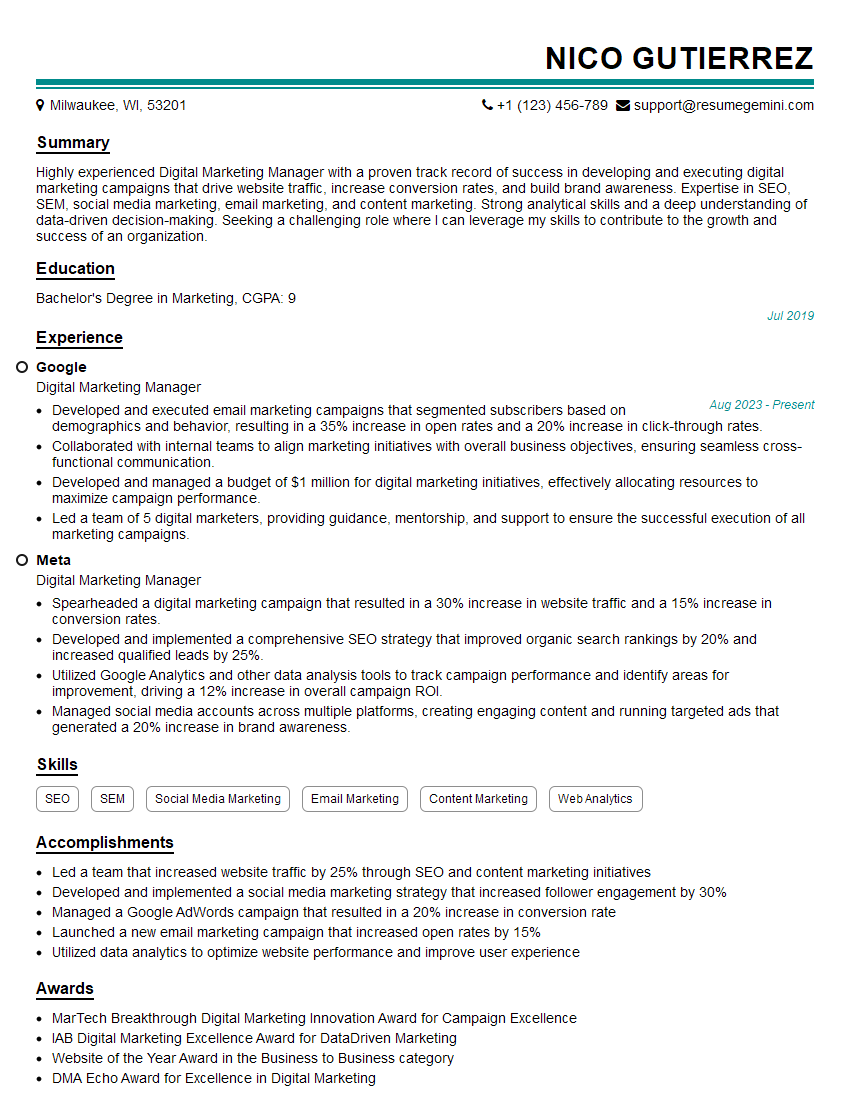
Digital Marketing Manager Resume Sample
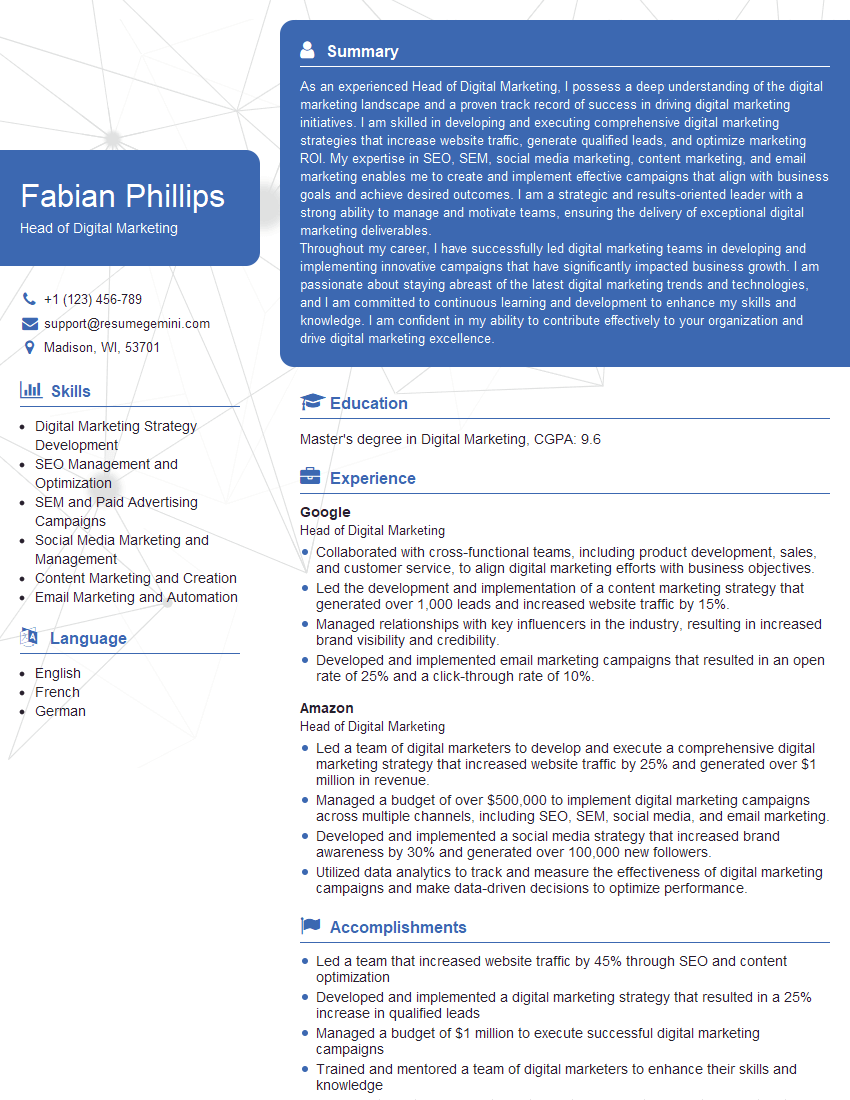
Head of Digital Marketing Resume Sample
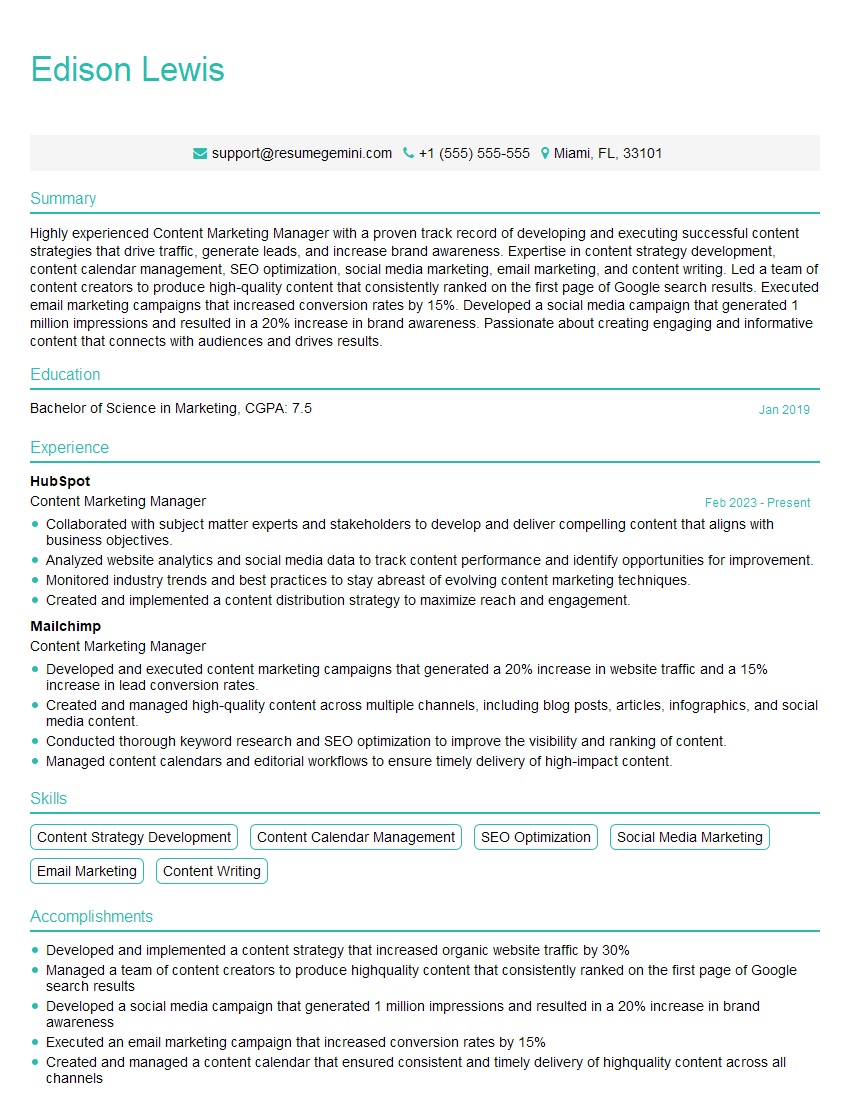
Content Marketing Manager Resume Sample

Social Media Marketing Manager Resume Sample
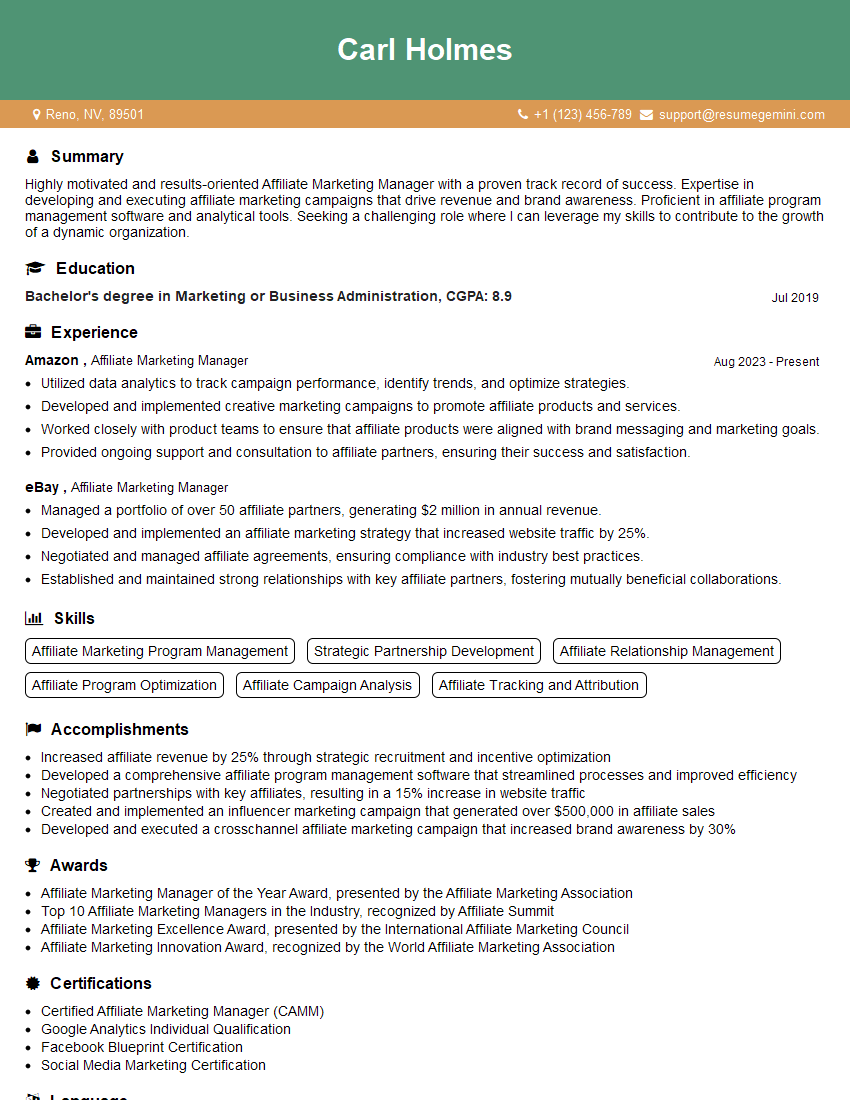
Affiliate Marketing Manager Resume Sample

Influencer Marketing Manager Resume Sample
- Marketing Director
- Marketing Manager
- Marketing Communications Manager
- Social Media Manager
- Web Analyst
- Content Strategist
- Growth Hacker
- Digital Marketing Manager
- Head of Digital Marketing
- Content Marketing Manager
- Social Media Marketing Manager
- Affiliate Marketing Manager
- Influencer Marketing Manager
Explore more articles
Users Rating of Our Blogs
Share Your Experience
We value your feedback! Please rate our content and share your thoughts (optional).
What Readers Say About Our Blog
Very informative content, great job.
good