Interviews are more than just a Q&A session—they’re a chance to prove your worth. This blog dives into essential Directing and Accompanying Ensembles interview questions and expert tips to help you align your answers with what hiring managers are looking for. Start preparing to shine!
Questions Asked in Directing and Accompanying Ensembles Interview
Q 1. Describe your experience in score analysis for ensemble preparation.
Score analysis is the cornerstone of effective ensemble preparation. It’s not just about reading notes; it’s about understanding the composer’s intent, the musical architecture, and the inherent challenges the piece presents. My approach involves a multi-stage process. First, I thoroughly examine the score for overall structure, identifying key thematic material, harmonic progressions, and formal divisions. This gives me a ‘bird’s-eye view’ of the piece. Then, I delve into the individual parts, analyzing melodic lines, rhythmic complexities, and technical demands for each instrument. I look for potential problem areas – awkward leaps, difficult rhythms, unusual articulations – and identify sections requiring specific attention during rehearsal. Finally, I consider the balance and blend of the different instrumental parts, anticipating potential challenges in achieving a cohesive sonic texture. For example, in a piece with prominent solo sections, I’d meticulously analyze the accompaniment to ensure it provides appropriate support without overpowering the soloist. This comprehensive analysis informs my rehearsal planning, allowing me to target specific areas requiring focused attention and guide my musicians effectively.
Q 2. How do you manage rehearsal time effectively for diverse skill levels?
Managing rehearsal time effectively with diverse skill levels requires a flexible and adaptable approach. I believe in differentiated instruction, tailoring my teaching to meet the needs of each musician. This starts with a thorough assessment of each member’s abilities. I might use informal assessments during the first rehearsal or request recordings or examples of their work. Then, I structure rehearsals with a mix of activities, beginning with warm-ups and foundational exercises that address common technical challenges. For advanced players, I might introduce more challenging excerpts or focus on interpretive nuances. Meanwhile, I provide individualized attention to less experienced players, focusing on fundamental techniques or problem areas. I often use small group work where players of similar skill levels can learn from each other and support each other’s development. It’s also essential to plan short, frequent breaks to maintain focus and avoid fatigue. Finally, I prioritize clear communication, ensuring that everyone understands their individual roles and the overall goals of the rehearsal. Thinking of it like building a house, every brick is important, and you have to make sure that the foundation is strong before moving to higher levels.
Q 3. Explain your approach to addressing technical challenges within an ensemble.
Addressing technical challenges requires a methodical and supportive approach. My first step is accurate identification. This involves careful listening and observation during rehearsals, identifying specific areas where technical difficulties emerge. Next, I analyze the nature of the problem, determining if it’s due to fingering issues, rhythmic inaccuracy, intonation problems, or other technical limitations. I address these using a combination of strategies. This can include demonstrating correct technique, providing targeted exercises, suggesting alternative fingerings or bowings, or using visual aids such as slow-motion playback or video analysis. For example, if a string player struggles with a particular passage, I might work with them on bow control exercises, or suggest using a different bowing pattern. For wind players, I might focus on breath support or embouchure adjustments. I encourage self-assessment and peer learning, fostering a collaborative atmosphere where musicians can learn from each other’s experiences and offer support. The key is patience and persistence. Addressing technical issues often requires multiple repetitions and incremental progress.
Q 4. What strategies do you use to foster collaboration and communication within the ensemble?
Fostering collaboration and communication is paramount for a cohesive and successful ensemble. I create a positive and supportive rehearsal environment where everyone feels comfortable contributing their ideas and perspectives. I encourage open dialogue, creating opportunities for musicians to share their interpretations and discuss their technical challenges. I also use collaborative activities, such as section rehearsals or partner exercises, to encourage team work. Regular feedback sessions, both individual and group, are essential, and I make sure to provide positive reinforcement while offering constructive criticism. I often utilize ‘blind’ listening exercises to help members discern the overall balance and blend of their sound. This helps the players develop a keen sense of listening skills and to understand their roles within the larger context. It’s like a sports team, everyone has to work together to win. Creating a supportive atmosphere where individual contributions matter is a top priority.
Q 5. How do you adapt your conducting style to different musical genres and ensemble sizes?
Adapting my conducting style to different genres and ensemble sizes is crucial for effective communication. My approach is informed by a deep understanding of the musical style. With Baroque music, my conducting might be more precise and articulated, focusing on clear articulation and phrasing. For Romantic music, my gestures might be broader and more expressive, emphasizing dynamic contrasts and emotional depth. The size of the ensemble also greatly influences my technique. With a small chamber ensemble, my movements are generally more subtle and nuanced, allowing for more intimate interaction with the musicians. With a large orchestra, my gestures need to be larger and more expansive to ensure everyone is aware of the dynamics and tempo changes. A good conductor is like a translator, conveying the composer’s message to the players by employing a variety of techniques.
Q 6. Describe your method for selecting repertoire suitable for a specific ensemble.
Selecting repertoire involves careful consideration of the ensemble’s skill level, instrumentation, and musical preferences. I begin by assessing the ensemble’s strengths and weaknesses through auditions, informal rehearsals, and discussions with the musicians. This helps me understand their technical capabilities and their musical tastes. Then, I research potential pieces, considering factors such as the technical difficulty, musical style, and duration of the work. I also look for pieces that offer a balance of challenges and opportunities for growth. It’s important to choose a variety of pieces that cater to different musical styles and textures. For instance, a program might include a challenging technical piece, a lyrical work, and a piece that showcases the ensemble’s versatility. Finally, I consider the context of the performance, such as the venue and the audience. The selection process is a careful balancing act between artistic ambition and practical considerations.
Q 7. Explain your approach to providing constructive feedback to ensemble members.
Providing constructive feedback is crucial for the ensemble’s development. My approach is always positive and supportive. I avoid generalized criticism, focusing instead on specific areas for improvement. For example, instead of saying ‘your intonation is bad,’ I would say ‘in measure 15, the intonation in the high register could be improved; let’s focus on tuning those intervals carefully.’ I use a combination of verbal and non-verbal cues, demonstrating correct technique where necessary and offering suggestions for improvement. I encourage self-assessment and peer feedback, creating a supportive learning environment where musicians feel comfortable sharing their thoughts and experiences. I focus on both technical accuracy and artistic interpretation. Effective feedback should be specific, actionable, and encouraging, guiding the ensemble toward a higher level of performance.
Q 8. How do you handle conflicts or disagreements among ensemble members?
Conflict is inevitable in any collaborative art form. My approach to resolving disagreements within an ensemble prioritizes open communication and respect. I encourage a safe space where members feel comfortable expressing concerns without fear of judgment.
My first step is to understand the root cause of the conflict. Is it a misunderstanding about musical interpretation? A personality clash? A scheduling issue? Once the source is identified, I facilitate a discussion, acting as a mediator rather than a judge. I encourage active listening and help each member articulate their perspective clearly.
Sometimes, a compromise is necessary. Perhaps we can try different approaches to a specific passage, incorporating elements from each perspective. Other times, a firm decision needs to be made based on the overall artistic vision. In those cases, transparency and clear explanations are crucial, ensuring that every member understands the rationale behind the final decision. I always strive for a collaborative outcome where everyone feels heard and valued, even if they don’t always get their way.
For instance, in a recent production of a Mahler symphony, a disagreement arose regarding the tempo of a particular movement. One section felt it should be faster, emphasizing the dramatic intensity; others preferred a more deliberate tempo, highlighting the lyrical passages. Through discussion, we experimented with both tempos, ultimately settling on a compromise that incorporated elements of both approaches, resulting in a richer and more nuanced performance.
Q 9. How do you balance artistic vision with the practical limitations of the ensemble?
Balancing artistic vision with practical limitations is a constant juggling act for any ensemble director. The ideal performance is always a compromise between aspiration and reality. This involves careful planning, realistic scheduling, and an awareness of the ensemble’s capabilities.
My process starts with a thorough assessment of the ensemble’s strengths and weaknesses. This includes individual instrumental skills, collective playing abilities, and available rehearsal time. Then, I tailor the artistic vision to fit within these constraints. This might involve simplifying challenging passages, adjusting the repertoire selection, or strategically allocating rehearsal time to focus on the most demanding sections.
For example, if the ensemble lacks experience with a specific musical style, I wouldn’t choose a program exclusively featuring that style. Instead, I’d include pieces that gradually introduce the relevant techniques and allow the musicians to grow their skills. Open communication with the musicians is vital in this process. Their feedback can be invaluable in identifying potential challenges and finding creative solutions. Sometimes, even the most ambitious artistic vision needs to be adjusted to account for the realities of limited time or personnel. The key is to remain flexible and adaptable, while striving for excellence within the given parameters.
Q 10. What techniques do you employ to maintain ensemble cohesion and morale?
Ensemble cohesion and morale are paramount to a successful performance. I employ several strategies to foster a positive and productive environment. Building strong interpersonal relationships is crucial.
- Team-building activities: Informal gatherings outside rehearsals can help break down barriers and foster camaraderie.
- Open communication: Creating a safe space for feedback and suggestions encourages active participation and ownership.
- Recognition and appreciation: Celebrating individual and collective achievements boosts morale and reinforces positive behavior.
- Clear expectations and goals: Setting shared objectives and outlining clear roles enhances focus and minimizes confusion.
- Fairness and equity: Ensuring equal opportunities and treating all members with respect fosters a sense of belonging.
For instance, I’ve organized informal social events after rehearsals, such as potlucks or outings, to strengthen bonds between musicians. I also make a point of acknowledging individual achievements during rehearsals, highlighting their contributions to the overall sound and performance. A strong sense of community, built on mutual respect and trust, contributes significantly to maintaining a positive and productive environment. This leads to more focused and enjoyable rehearsals, ultimately culminating in a powerful and cohesive performance.
Q 11. Describe your experience with different rehearsal techniques.
My rehearsal techniques are diverse and tailored to the specific needs of the ensemble and the repertoire. I employ a mix of approaches, including:
- Sectional Rehearsals: Focusing on individual sections allows for detailed work on technical challenges and balances, before bringing everything together.
- Full Ensemble Rehearsals: Essential for integrating sections and refining the overall performance.
- Score Study: Deep analysis of the music’s structure, harmony, and form informs interpretation and performance practice.
- Listening Exercises: Improving musicians’ listening skills is vital for ensemble playing and responding dynamically to one another.
- Improvisation Exercises: Encouraging musical exploration can unlock creativity and develop responsiveness within the ensemble.
I believe in a balance between structured exercises and more open, exploratory rehearsal sessions. The choice of approach depends heavily on the repertoire and the ensemble’s level of experience. For example, when working on a complex piece of contemporary music, I might incorporate more improvisation exercises to help the players internalize the unusual rhythms and harmonies. Conversely, when working on a baroque piece, I might place more emphasis on historically-informed performance practices and detailed score study.
Q 12. How do you incorporate technology into your rehearsal and performance processes?
Technology plays a significant role in both rehearsal and performance. I utilize various technologies to enhance efficiency and artistic expression.
- Digital Score Libraries and Notation Software: Facilitates easy access to scores, annotations, and efficient score sharing among musicians.
- Audio and Video Recording: Allows for self-assessment and detailed analysis of performances, highlighting areas for improvement.
- Virtual Collaboration Platforms: Enables remote rehearsals and collaboration, particularly beneficial for geographically dispersed ensembles.
- Sound Reinforcement and Playback Systems: Enhances the acoustic environment during rehearsals and performances, contributing to clarity and balance.
- Interactive projection systems: Can be used to display scores, visual aids, or even video clips to enhance understanding and engagement during rehearsals and performances.
For example, I frequently use audio recordings of rehearsals to pinpoint specific technical issues or ensemble imbalances. This allows us to revisit challenging passages and refine our playing with precision. The use of virtual collaboration tools has been particularly valuable in recent years, enabling me to work effectively with musicians who are not always able to participate in person. Technology can be a powerful tool when appropriately integrated into our processes.
Q 13. What is your approach to selecting and working with guest artists or soloists?
Selecting and working with guest artists or soloists requires a careful consideration of musical compatibility and personality. I start by identifying artists whose skills and style align with the ensemble’s aesthetic and the demands of the repertoire.
I prioritize artists who have a reputation for professionalism, collaboration, and a positive working relationship with ensembles. Before engaging an artist, I typically review recordings and seek recommendations from colleagues. Once selected, clear communication regarding the artistic vision, technical requirements, and rehearsal schedule are crucial. I aim to foster a collaborative relationship where the soloist feels respected and fully integrated into the ensemble, rather than an isolated performer.
This collaboration is often invaluable, even extending to collaborative interpretation of the piece. Successful collaborations with guest artists often result in elevated performances and creative energy for both the ensemble and the soloist. For instance, in a past collaboration with a renowned violinist, we engaged in detailed discussions about the musical interpretation of a challenging concerto, shaping the performance through mutual understanding and creative input.
Q 14. How do you assess the musical strengths and weaknesses of individual ensemble members?
Assessing the musical strengths and weaknesses of individual ensemble members is an ongoing process that informs my rehearsal planning and individual coaching. This involves a multi-faceted approach.
- Listening Carefully: During rehearsals, I pay close attention to individual playing, identifying technical skills, musicality, and intonation.
- Formal Assessments: Periodic individual auditions or small group assessments can provide objective data.
- Informal Feedback: Regular, constructive feedback during rehearsals helps musicians recognize their strengths and target areas for improvement.
- Observation: Observing musicians during rehearsals can highlight technical issues, such as posture or bow hold, that may impact their performance.
By combining these methods, I develop a comprehensive understanding of each musician’s abilities. This allows me to tailor my rehearsals to address individual needs while also promoting collective improvement. For example, if a particular musician struggles with intonation, I might design specific exercises to address that weakness. This individual attention is coupled with encouraging the musician to actively identify areas they wish to improve, fostering a proactive approach to skill development.
Q 15. Describe your experience working with diverse populations or abilities within an ensemble.
Working with diverse ensembles requires a deeply inclusive approach. It’s not just about accommodating different abilities; it’s about leveraging the unique strengths each member brings. I’ve had the pleasure of working with ensembles encompassing a wide range of ages, musical backgrounds, and physical capabilities. For example, in one community orchestra, I worked with musicians ranging from teenagers to retirees, some with visual impairments, others with mobility challenges. My approach centers around personalized instruction and adaptable rehearsal techniques.
- Individualized Feedback: I provide tailored feedback that considers individual learning styles and physical limitations. Instead of generic corrections, I offer specific suggestions focusing on what each musician can realistically achieve and build upon. For example, for a musician with limited mobility, I might focus on improving breath control and tone quality rather than demanding complex bowing techniques.
- Adaptive Rehearsal Strategies: Rehearsals are structured with flexibility in mind. This might involve using large-print music, offering verbal cues instead of written ones, or providing extra time for musicians who need it. I create an atmosphere of mutual respect and understanding where everyone feels comfortable contributing their unique talents.
- Collaborative Problem-Solving: Challenges are addressed collaboratively. If a musician faces a specific challenge, we work together to find creative solutions. We might adjust the musical arrangement slightly or explore alternative fingering or bowing techniques that are more accessible.
The result is a richer musical experience for everyone involved, fostering a sense of community and mutual support.
Career Expert Tips:
- Ace those interviews! Prepare effectively by reviewing the Top 50 Most Common Interview Questions on ResumeGemini.
- Navigate your job search with confidence! Explore a wide range of Career Tips on ResumeGemini. Learn about common challenges and recommendations to overcome them.
- Craft the perfect resume! Master the Art of Resume Writing with ResumeGemini’s guide. Showcase your unique qualifications and achievements effectively.
- Don’t miss out on holiday savings! Build your dream resume with ResumeGemini’s ATS optimized templates.
Q 16. How do you prepare an ensemble for auditions or competitions?
Preparing an ensemble for auditions or competitions involves a multi-faceted approach that extends beyond simply polishing the chosen pieces. It’s about building confidence, refining technique, and ensuring the ensemble functions as a cohesive unit.
- Targeted Rehearsal Plan: We begin by creating a detailed rehearsal plan, identifying specific areas needing improvement (e.g., intonation, balance, dynamics). Each rehearsal session is structured to address these issues strategically. This might include focused exercises on specific techniques, such as intonation drills or rhythmic accuracy exercises.
- Mock Auditions/Competitions: We conduct several mock auditions or competitions to simulate the actual event. This allows the musicians to get accustomed to the pressure and refine their performance under scrutiny. It also helps me identify any weaknesses or areas needing further work.
- Performance Refinement: We carefully analyze the pieces’ expressive details. This involves in-depth discussions about phrasing, dynamics, and articulation, ensuring a consistent and nuanced interpretation. We’ll listen to recordings of other great interpretations to gain inspiration, always keeping the unique characteristics of our ensemble in mind.
- Mental Preparation: Just as important as technical preparation is mental preparation. We discuss strategies to manage performance anxiety and build confidence. This may include relaxation techniques, visualization exercises, and positive self-talk.
By incorporating these elements, the ensemble enters the audition or competition well-prepared, confident, and ready to showcase their abilities.
Q 17. Explain your method for developing individualized performance plans for ensemble members.
Developing individualized performance plans is crucial for ensemble success. It’s about recognizing that each musician learns and progresses at their own pace and has unique strengths and weaknesses. My approach involves a combination of observation, assessment, and ongoing communication.
- Initial Assessment: I start with a thorough assessment of each musician’s skills, including technical proficiency, musicality, and understanding of the repertoire. This involves listening to their playing, observing their technique, and engaging in discussions about their musical goals.
- Goal Setting: Together, we collaboratively set realistic and achievable goals for the individual. These goals are tailored to the musician’s current skill level and address areas needing improvement. The goals are specific, measurable, achievable, relevant, and time-bound (SMART goals).
- Regular Feedback and Adjustments: I provide regular, constructive feedback, focusing on both strengths and areas needing improvement. The plans are flexible and adaptable, updated regularly based on progress and new challenges.
- Personalized Practice Strategies: I offer personalized practice strategies, suggesting exercises and materials that address specific needs. I help them design effective and efficient practice routines that optimize their time and effort.
By tailoring the learning process to each musician’s individual needs, I ensure that everyone is challenged appropriately and progresses at their optimal pace. This personalized approach not only improves individual performance but also contributes to a stronger and more cohesive ensemble.
Q 18. How do you ensure that the ensemble’s performance meets professional standards?
Ensuring professional standards involves a holistic approach that encompasses technical excellence, musical interpretation, and overall presentation.
- Technical Proficiency: High technical standards are achieved through diligent rehearsal and individual practice. I employ various techniques to enhance intonation, articulation, balance, and rhythm. Regular sectional rehearsals focus on specific technical challenges within the chosen repertoire.
- Musicality and Interpretation: Musicality is nurtured through careful attention to phrasing, dynamics, and articulation. We explore the composer’s intentions and strive to communicate the emotional content of the music. This often involves listening to recordings of renowned performances and analyzing their interpretive choices.
- Performance Practice and Presentation: Attention to detail extends beyond the music itself. Ensemble members are coached on stage presence, posture, and attire, ensuring a polished and professional presentation. Careful consideration is given to stage management and organization, ensuring a smooth and efficient performance.
- Regular Evaluation and Refinement: The ensemble’s performance is regularly evaluated, often through recordings and feedback sessions. This process facilitates ongoing refinement and improvement, pushing the ensemble towards professional excellence.
Maintaining professional standards is an ongoing process, requiring constant attention to detail and commitment to improvement. It is a collaborative effort between the director and the ensemble members, ensuring a unified and high-quality performance.
Q 19. What is your philosophy on musical interpretation and expression?
My philosophy on musical interpretation centers on a balance between scholarly understanding and artistic expression. I believe that music is a powerful form of communication, capable of conveying a vast array of emotions and ideas. My goal is to help musicians not just play the notes accurately, but to delve into the soul of the music and share its essence with the audience.
- Historical Context: I emphasize the importance of understanding the historical context of the music, exploring the composer’s life and the cultural influences that shaped their work. This background knowledge informs interpretive choices and brings depth to the performance.
- Collaborative Interpretation: I foster a collaborative environment where musicians are encouraged to contribute their own perspectives and insights. The interpretive process is a dialogue, a shared journey towards a nuanced and compelling performance.
- Authenticity and Emotional Honesty: I value authenticity and emotional honesty in musical expression. The performance should be genuine and reflective of the musicians’ connection with the music. The aim is not to impose a pre-conceived interpretation but to guide musicians to discover their own authentic voice.
Ultimately, my aim is to facilitate a performance that is both technically proficient and emotionally resonant, a performance that touches the hearts and minds of the audience.
Q 20. How do you manage the logistics of rehearsals, performances, and travel?
Managing the logistics of rehearsals, performances, and travel requires meticulous planning and effective communication. It’s about anticipating potential challenges and putting systems in place to ensure a smooth and efficient process.
- Detailed Scheduling: I develop detailed rehearsal schedules well in advance, ensuring sufficient time for preparation and refinement. This includes coordinating rehearsal times and locations to accommodate the availability of all ensemble members.
- Communication and Coordination: Effective communication is vital. I utilize various tools (emails, online calendars, group messaging apps) to keep everyone informed about rehearsals, performance details, and travel arrangements. I assign clear responsibilities to various members of the ensemble to lighten the load.
- Venue Coordination: For performances, I secure venues and coordinate with venue staff to arrange for technical requirements (lighting, sound, seating). This includes managing stage set-up, ensuring everything runs smoothly on performance day.
- Travel Arrangements: For travel, I plan transportation, accommodation, and meals. I ensure that all travel-related documents are prepared and distributed well in advance. Safety and comfort are top priorities, with appropriate arrangements for transport, including alternatives in case of emergencies.
By meticulously planning and communicating, I ensure that logistical issues don’t overshadow the musical process. A well-organized logistical plan allows the ensemble to focus on what truly matters: making music.
Q 21. Describe your experience with budgeting and resource allocation for an ensemble.
Budgeting and resource allocation are essential for the sustainability of any ensemble. It requires a careful balance between artistic ambitions and financial realities. My approach involves creating a detailed budget, securing funding, and managing resources effectively.
- Detailed Budget Creation: I create a comprehensive budget that accounts for all anticipated expenses, including rehearsal space rental, music acquisition, equipment maintenance, travel costs, and performer fees. This budget is reviewed and updated regularly.
- Funding Acquisition: I actively seek funding through various channels, including grants, sponsorships, fundraising events, and ticket sales. I prepare compelling grant proposals outlining the ensemble’s artistic goals and community impact.
- Resource Management: I manage resources effectively, ensuring that expenditures are aligned with the budget. This includes negotiating favorable rates with vendors, optimizing the use of equipment, and exploring cost-effective solutions.
- Transparency and Accountability: I maintain transparent financial records, keeping the ensemble members informed about the budget and expenditure. I ensure accountability by maintaining detailed receipts and financial reports.
By implementing a sound financial strategy, I ensure the long-term stability and success of the ensemble, allowing it to thrive artistically while remaining financially responsible.
Q 22. How do you evaluate the overall success of an ensemble’s performance?
Evaluating an ensemble’s success goes beyond simply a technically proficient performance. It’s a holistic assessment encompassing musicality, interpretation, communication, and overall impact.
- Musicality: This considers the ensemble’s intonation, rhythm, balance, phrasing, dynamics, and articulation. Did they create a cohesive and expressive musical narrative? For example, a string quartet might demonstrate impeccable musicality through perfectly blended tone, nuanced dynamics reflecting the composer’s intent, and seamless transitions between sections.
- Interpretation: Did the ensemble convey the composer’s intended emotions and message? A successful interpretation goes beyond accurate note playing; it involves understanding the historical context, style, and emotional arc of the piece. A choir performing a Renaissance motet, for example, needs to capture the solemnity and spiritual depth inherent in the music.
- Communication: Did the performance connect with the audience? Did the musicians convey their passion and engagement? This includes visual elements such as posture and eye contact as well as the energy projected through the music. Even a small chamber group can powerfully communicate through focused expression and shared musical intent.
- Technical Proficiency: This involves the accuracy of notes, rhythms, and dynamics. While essential, it’s only one aspect of a successful performance. An ensemble might be technically proficient but lack emotional depth or interpretive insight.
Ultimately, a successful ensemble performance leaves the audience moved, engaged, and perhaps even inspired, leaving a lasting impression well beyond the final note.
Q 23. Explain your process for selecting and preparing accompaniment materials.
Selecting and preparing accompaniment materials is a crucial step in supporting an ensemble. My process is meticulous and focuses on enhancing the performers’ experience and the overall artistic result.
- Understanding the Ensemble: I begin by thoroughly understanding the ensemble’s capabilities, their repertoire, and their stylistic preferences. This might involve listening to recordings, reviewing scores, and having conversations with the ensemble members themselves.
- Score Analysis: A detailed analysis of the chosen piece is crucial. This includes identifying technical challenges, harmonic progressions, and stylistic nuances that require specific accompaniment choices.
- Material Selection: The choice of accompaniment material depends on various factors, including the piece’s style, the ensemble’s instrumentation, and the available resources. Sometimes a simple piano accompaniment suffices, while other pieces might benefit from a richer orchestration. I always prioritize material that complements and enhances, not overshadows, the ensemble’s sound.
- Adaptation and Arrangement: Often, existing arrangements need modification to perfectly suit the ensemble. This might involve simplifying complex passages, re-voicing parts, or adding or subtracting instrumental lines. I might use notation software like Sibelius or Finale to facilitate this process.
- Rehearsal and Refinement: Rehearsals with the ensemble are essential for fine-tuning the accompaniment. This involves actively listening for any imbalances, technical difficulties, or expressive needs that require adjustments.
For instance, when accompanying a vocal ensemble performing a Baroque piece, I might choose a harpsichord realization, selecting a version that emphasizes the interplay between voices and continuo. Conversely, for a contemporary piece, a prepared piano might be appropriate to enhance the textural uniqueness of the composition.
Q 24. Describe your experience in adapting accompaniment to suit different instrumental or vocal styles.
Adapting accompaniment to different styles requires a deep understanding of musical history and a flexible approach to performance practice. My experience spans a wide range of genres, allowing me to seamlessly tailor my accompaniment to enhance various instrumental and vocal styles.
- Historical Styles: Accompanying Baroque music requires a different approach than accompanying Romantic music. For example, a Baroque piece demands a continuo realization, often employing ornamentation and a clear articulation of the bass line. A Romantic piece might need a more lush and expressive accompaniment, mirroring the style’s emotional intensity.
- Instrumental Styles: The texture and timbre of the instruments being accompanied inform my choices. Accompanying a string quartet requires a delicate touch and careful balancing of the piano’s sound, whereas accompanying a brass ensemble demands a bolder, more assertive style.
- Vocal Styles: Vocal styles vary tremendously. Accompanying a choir requires a different approach than accompanying a solo singer. Accompanying opera demands responsiveness, sensitivity to phrasing, and a thorough knowledge of vocal technique.
- Improvisation: In certain contexts, such as accompanying jazz or folk music, improvisation is essential. This requires a strong sense of rhythm, harmonic awareness, and the ability to respond dynamically to the ensemble’s musical ideas.
For example, when accompanying a klezmer ensemble, I’ve adapted my style to incorporate elements of klezmer music, such as syncopation, ornamentation, and modal improvisation, ensuring the accompaniment complements the distinct rhythmic drive and emotional expression of the music.
Q 25. How do you maintain a balanced and supportive relationship with the ensemble members?
Maintaining a balanced and supportive relationship with ensemble members is crucial for a successful collaboration. It’s about building trust, fostering open communication, and creating a positive and collaborative atmosphere.
- Open Communication: I encourage open dialogue and feedback. This involves actively listening to the ensemble’s concerns, suggestions, and perspectives, creating a space for mutual respect and understanding.
- Shared Goals: I work collaboratively with the ensemble to establish shared artistic goals. This means discussing interpretation, stylistic choices, and technical challenges, ensuring everyone is on the same page.
- Individual Attention: I’m aware that each member has individual strengths and weaknesses. I strive to provide individual attention and support, addressing specific challenges and encouraging personal growth within the ensemble context. This may involve providing tailored practice suggestions or offering extra help during rehearsals.
- Respectful Collaboration: I lead with respect and understanding, acknowledging the expertise and contributions of each ensemble member. My role is to guide and support, not to control or dominate.
- Positive Reinforcement: Positive reinforcement and constructive feedback are essential. Celebrating successes and acknowledging progress are vital for boosting morale and fostering a cohesive team spirit.
For example, if a specific instrumental part was struggling during rehearsal, I might offer an alternative fingering or a simpler passage to build their confidence and ensure they feel supported.
Q 26. How do you handle unexpected technical difficulties during a performance?
Unexpected technical difficulties during a performance are unavoidable. The key is to be prepared and to react calmly and professionally.
- Preparedness: Before any performance, I make sure to have backup plans. This might include having extra cables, instrument parts, or even alternative scores. It is imperative that all necessary technology is checked and tested prior to a performance.
- Problem-Solving Skills: When a problem arises, I calmly assess the situation, working swiftly with the ensemble to find the best solution. This may involve improvising a section, making a slight alteration to the arrangement, or pausing briefly to address the technical issue.
- Communication: Clear and calm communication with the ensemble and the audience is vital. If a problem requires a brief pause, I would briefly explain the situation to the audience to prevent any unnecessary confusion or panic.
- Adaptability: It’s important to remember the audience is there for the music, even amidst technical difficulties. I prioritize a smooth continuation of the performance; focusing on the most important aspect: conveying the art.
Once during a performance, a microphone malfunctioned unexpectedly. I quickly communicated with the sound engineer, adjusting the amplification to use the closest available microphone. We smoothly continued the performance, ensuring the audience was barely aware of the technical hitch.
Q 27. What are your preferred methods for assessing musical progress in an ensemble?
Assessing musical progress requires a multifaceted approach, moving beyond just technical proficiency.
- Regular Rehearsals: Consistent rehearsals provide opportunities to observe individual and collective progress. I note improvements in intonation, rhythm, phrasing, dynamics, and overall musical expression.
- Informal Assessments: During rehearsals, I provide ongoing feedback, focusing on specific areas for improvement. I carefully listen for problems such as balance issues, intonation problems, or rhythmic inaccuracies. Casual interactions with individual musicians provides additional insight into their understanding and challenges.
- Formal Evaluations: Periodic formal assessments, such as mock performances, allow for a more comprehensive evaluation of the ensemble’s progress. This provides opportunities to gauge their overall musicianship and musical maturity.
- Recordings and Analyses: Audio or video recordings provide valuable insights into the ensemble’s performance. Analyzing these recordings allows for objective evaluation of technical precision, musicality, and overall effectiveness.
- Self-Assessment: Encouraging ensemble members to self-assess their progress fosters their individual responsibility and deeper understanding of their musical development.
For example, if I notice a section consistently struggling with intonation, I’ll work with them individually and as a group to identify the root cause – be it individual technique or ensemble balance – before adjusting rehearsal strategies to address it. I often use a combination of methods to understand progress fully.
Q 28. How do you promote the ensemble and engage with the community?
Promoting the ensemble and engaging with the community are crucial for its success and longevity. It involves a multi-pronged approach, creating a buzz and connecting with the broader audience.
- Social Media Presence: Utilizing social media platforms like Facebook, Instagram, and YouTube enables regular updates on performances, rehearsals, and upcoming events. High-quality photos and videos are crucial here.
- Website and Email List: A well-maintained website and email list provide centralized information on the ensemble, facilitating direct communication with fans and potential audience members.
- Community Outreach: Actively engaging with the community through collaborations, workshops, masterclasses, and educational programs expands awareness and builds goodwill. This could involve outreach to local schools, community centers, or collaborating with other arts organizations.
- Public Performances: Regular performances in a variety of settings—concerts, festivals, community events— increase visibility and attract new listeners.
- Press Releases and Media Engagement: Sending press releases to local media outlets publicizes performances and creates a media buzz. Engaging with local journalists and bloggers for interviews or features helps extend the ensemble’s reach.
For example, we’ve successfully engaged the community by offering free introductory workshops to young musicians, leading to a considerable increase in our audience and the creation of a broader base of support.
Key Topics to Learn for Directing and Accompanying Ensembles Interview
- Score Study & Interpretation: Understanding the composer’s intent, stylistic elements, and technical challenges within the score. This includes analyzing phrasing, dynamics, articulation, and overall musical structure.
- Rehearsal Techniques: Developing effective strategies for communicating musical ideas to ensemble members, including providing constructive feedback and addressing technical issues. Practical application includes planning efficient rehearsal schedules and employing various teaching methodologies.
- Ensemble Balancing & Blending: Mastering techniques to achieve a cohesive and balanced sound, considering individual instrumental contributions and addressing potential sonic imbalances. Practical application involves adjusting individual parts and employing microphone techniques to achieve optimal sound.
- Accompaniment Styles & Techniques: Demonstrating a comprehensive understanding of various accompaniment styles (e.g., chordal accompaniment, figured bass realization, continuo playing) and adapting to diverse musical genres and performance contexts. This includes demonstrating stylistic sensitivity and rhythmic accuracy.
- Problem-Solving & Troubleshooting: Developing strategies for addressing challenges during rehearsals and performances, including managing interpersonal dynamics within the ensemble, resolving technical difficulties, and adapting to unexpected situations. This could involve adapting arrangements or addressing intonation issues.
- Communication & Collaboration: Effectively communicating with musicians of varied skill levels and personalities, fostering a positive and collaborative rehearsal environment. This includes active listening and conflict resolution.
- Program Planning & Curricular Design (if applicable): If the role involves curriculum development, understanding principles of pedagogical design, selecting repertoire appropriate for the ensemble’s skill level, and developing long-term artistic goals for the ensemble.
Next Steps
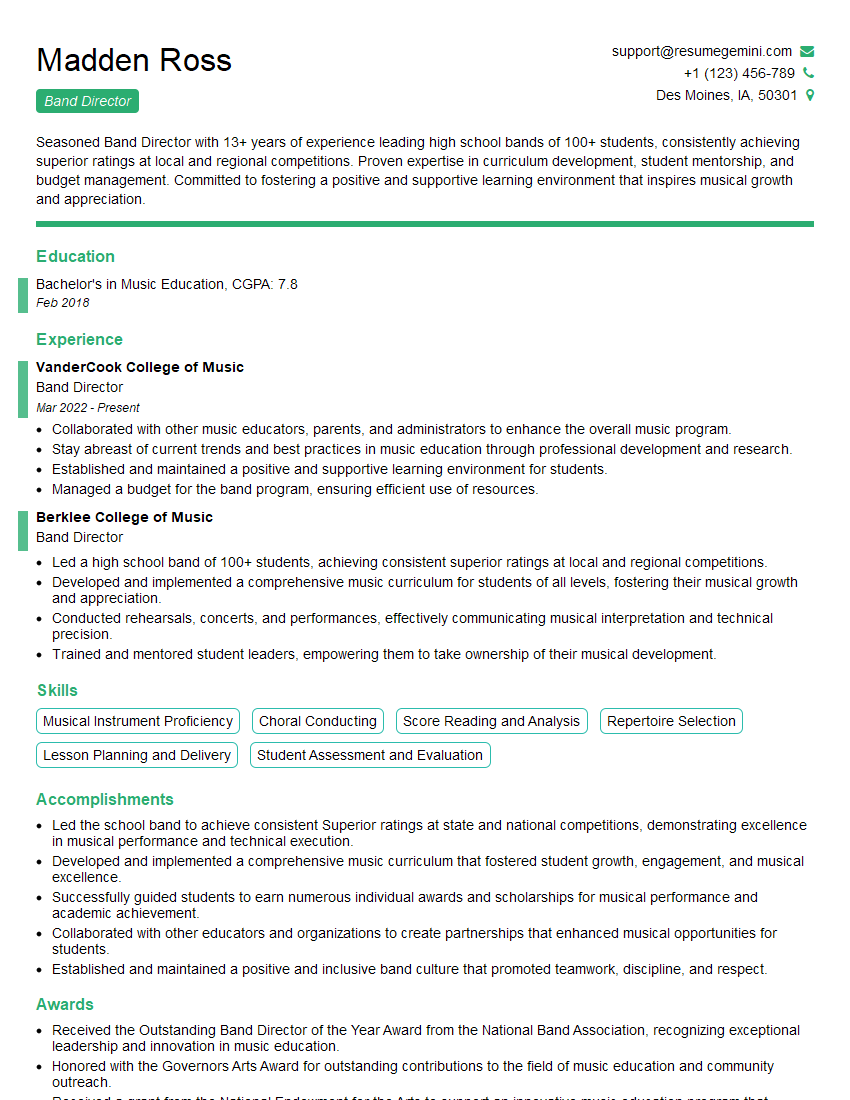
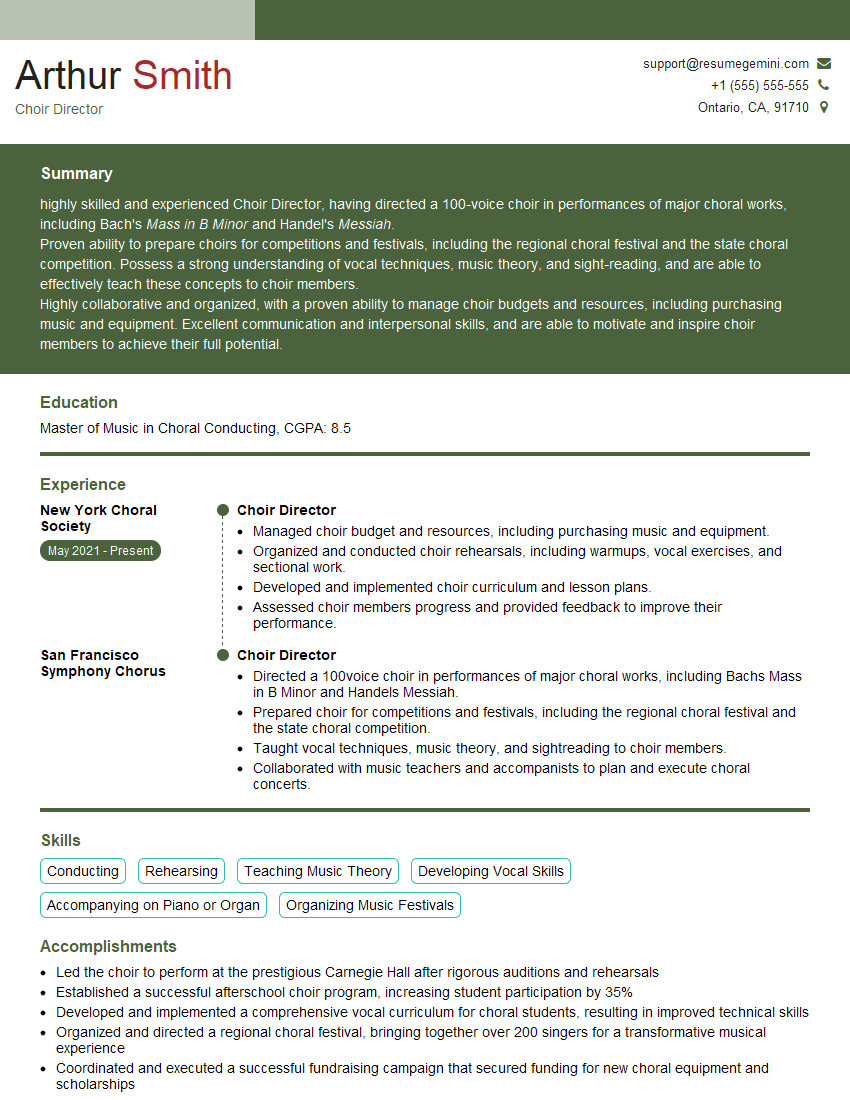
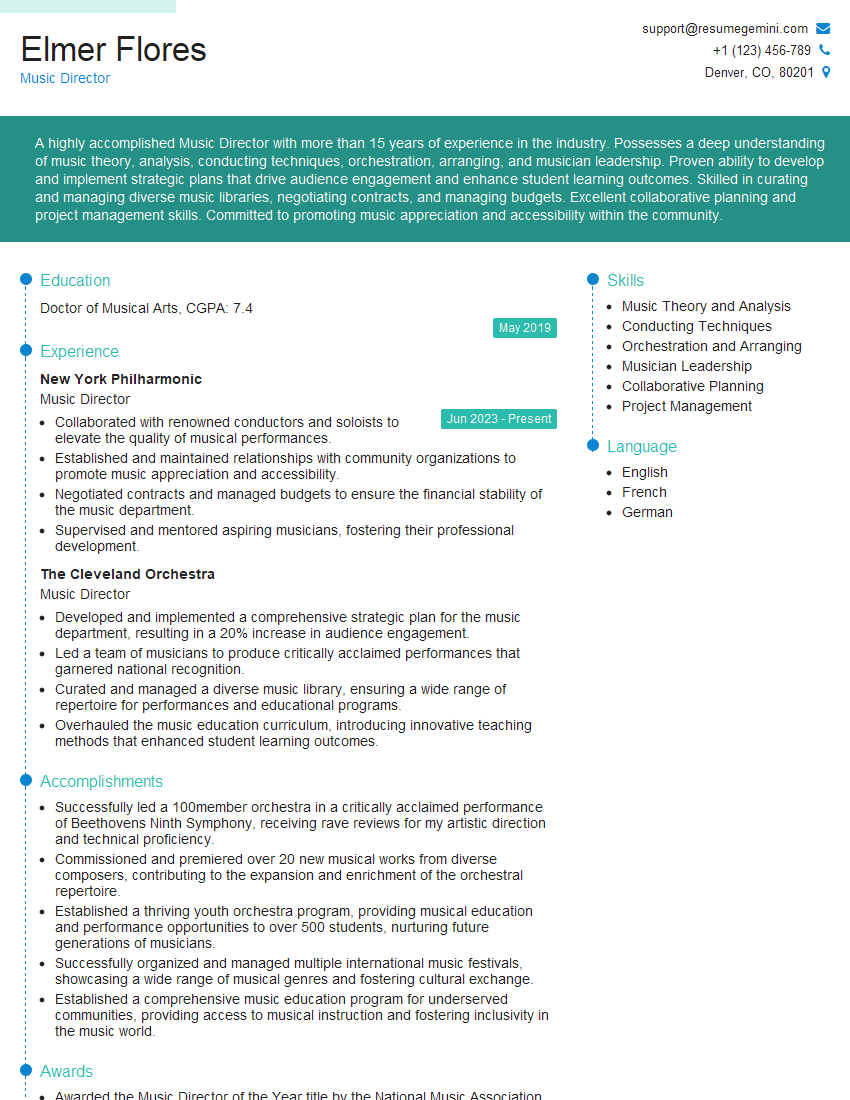
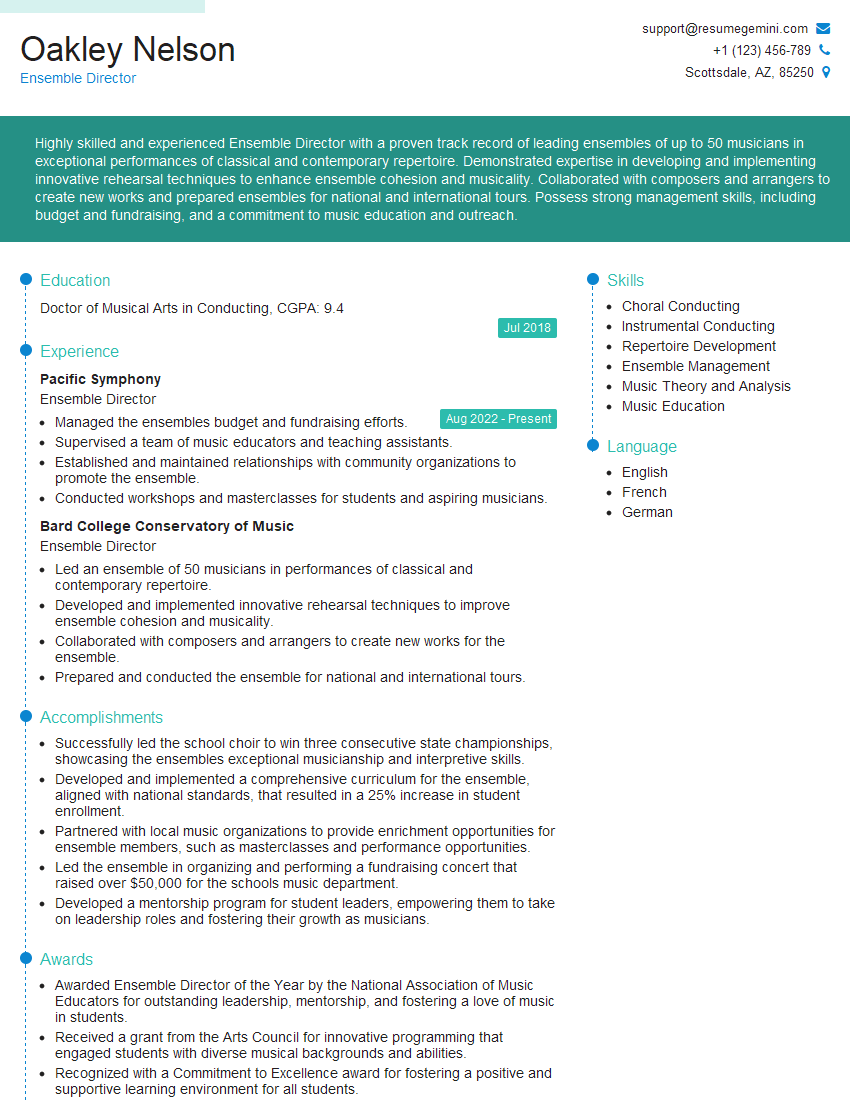
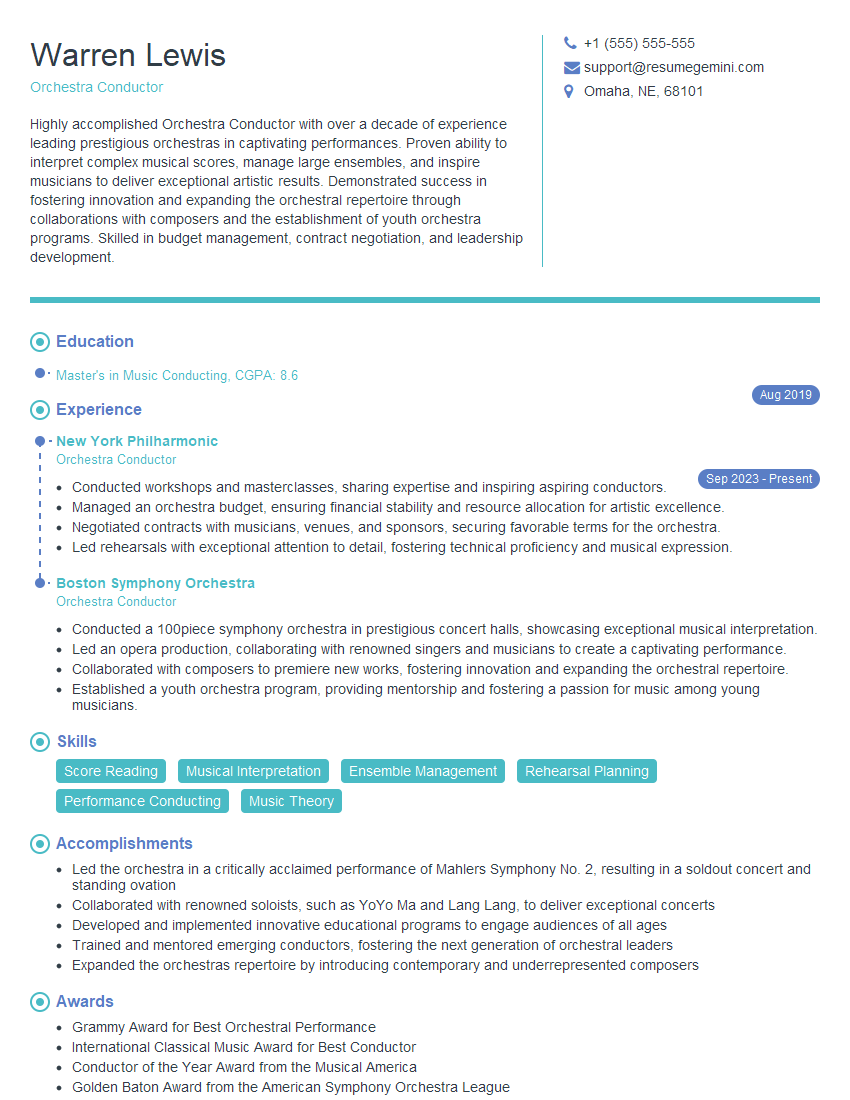
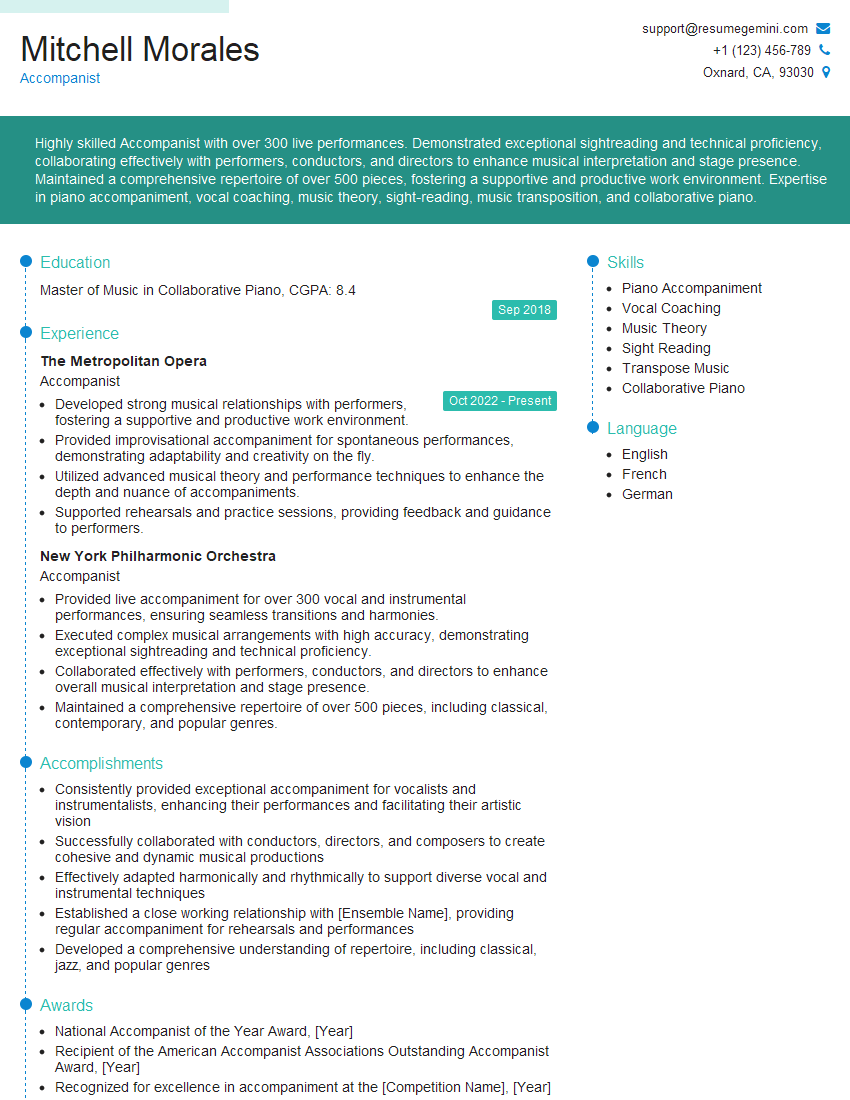
Mastering Directing and Accompanying Ensembles is crucial for career advancement in music education, performance, and related fields. A strong command of these skills showcases your leadership, musicality, and problem-solving abilities – qualities highly sought after by employers. To maximize your job prospects, create an ATS-friendly resume that highlights your relevant experience and skills. ResumeGemini is a trusted resource that can help you build a professional and impactful resume, ensuring your qualifications shine. Examples of resumes tailored to Directing and Accompanying Ensembles are available to further guide your preparation.
Explore more articles
Users Rating of Our Blogs
Share Your Experience
We value your feedback! Please rate our content and share your thoughts (optional).
What Readers Say About Our Blog
good