Interviews are opportunities to demonstrate your expertise, and this guide is here to help you shine. Explore the essential Drilling and Completion Optimization interview questions that employers frequently ask, paired with strategies for crafting responses that set you apart from the competition.
Questions Asked in Drilling and Completion Optimization Interview
Q 1. Explain the difference between rotary and top-drive drilling systems.
Rotary and top-drive drilling systems both achieve the same goal – rotating the drillstring to bore a well – but they differ significantly in their mechanisms. In a rotary system, the drillstring is rotated by a rotary table located on the rig floor. This table drives a kelly, a heavy square or hexagonal pipe that transmits the rotation to the drillstring. Think of it like a giant wrench turning a bolt. It’s a simpler, more established technology but can be less efficient for certain operations.
A top-drive system, however, uses a powerful motor mounted on the top drive itself to directly rotate the drillstring. This eliminates the kelly and allows for more precise control over the rotational speed and torque. Imagine a powerful electric screwdriver replacing the wrench. This improved control is especially beneficial during complex operations such as directional drilling and underbalanced drilling. Top drives offer advantages in terms of speed, automation, and overall efficiency, although they represent a higher initial investment.
Q 2. Describe the different types of drilling fluids and their applications.
Drilling fluids, also known as muds, are crucial for wellbore stability and efficient drilling. Different types cater to varying well conditions and geological formations. They are broadly categorized as follows:
- Water-based muds (WBM): These are the most common, using water as the base fluid. Additives like clay, polymers, and weighting agents are added to control density, viscosity, and filtration properties. They are generally environmentally friendly and cost-effective but may not always be suitable for high-temperature or high-pressure wells.
- Oil-based muds (OBM): These utilize oil as the base fluid, offering better lubricity, shale inhibition, and thermal stability. They are effective in challenging formations but are more expensive and present environmental concerns due to the oil content. Synthetic-based muds (SBM) are a more environmentally friendly alternative.
- Air/gas drilling: Instead of liquid mud, compressed air or gas is used as the drilling fluid. This reduces friction and increases drilling rate, but it’s only suitable for specific formations and poses challenges in terms of cuttings removal and wellbore stability.
The selection of drilling fluid depends on factors like formation pressure, temperature, lithology (rock type), and environmental regulations. For example, an OBM might be preferred in a shale formation prone to swelling, while a WBM would be suitable for softer, less reactive formations.
Q 3. How do you optimize drilling parameters to minimize non-productive time (NPT)?
Minimizing Non-Productive Time (NPT) is paramount for efficient drilling operations. Optimization strategies focus on proactive planning and real-time adjustments. Here’s a multi-pronged approach:
- Predictive Modeling: Utilizing data from previous wells and advanced software, we can predict potential issues and optimize drilling parameters proactively. This could involve adjusting weight on bit (WOB) to prevent excessive wear or altering rotary speed to optimize penetration rate.
- Real-time Monitoring: Continuous monitoring of drilling parameters like rate of penetration (ROP), torque, and pressure provides immediate feedback, enabling timely adjustments to prevent problems. For instance, a sudden increase in torque might indicate a problem with the bit, requiring an immediate change.
- Optimized Drilling Parameters: The selection of optimal WOB, rotary speed, and mud properties is critical. This often involves trial and error, aided by real-time data analysis and experience. Finding the “sweet spot” balances speed and equipment longevity.
- Proactive Maintenance: Preventative maintenance schedules, reducing downtime associated with equipment failures. A well-maintained rig minimizes unexpected delays.
- Efficient Crew Management: Well-trained crews and efficient workflows are crucial. Training and clear communication streamline operations and reduce unnecessary delays.
A real-world example: By analyzing real-time ROP data and predicting potential bit wear, we could adjust WOB and speed to maintain optimal drilling efficiency and extend bit life, avoiding costly trips to change the bit and minimizing NPT.
Q 4. Explain the concept of wellbore stability and how it relates to drilling optimization.
Wellbore stability refers to maintaining the integrity of the wellbore while drilling. It’s crucial because instability can lead to various issues such as stuck pipe, hole enlargement, and wellbore collapse. This translates directly to increased costs and NPT.
Several factors influence wellbore stability, including formation pressure, pore pressure, stress conditions, and the interaction between the formation and the drilling fluid. Optimization strategies involve:
- Accurate Geomechanical Modeling: Understanding the stress state and mechanical properties of the formation allows for the prediction of potential instability zones.
- Mud Weight Optimization: Maintaining appropriate mud weight (density) is critical to prevent formation fracturing (overbalanced drilling) or wellbore collapse (underbalanced drilling).
- Mud Chemistry Control: Proper selection and control of drilling fluids (especially inhibitors) prevent shale swelling and improve wellbore stability.
- Real-time Monitoring and Adjustment: Continuous monitoring of drilling parameters and wellbore conditions aids in identifying and addressing early signs of instability.
For example, in a shale formation, choosing the right mud with shale inhibitors and optimizing mud weight prevents shale swelling and collapse, leading to a stable wellbore and avoiding costly remedial actions.
Q 5. Describe the process of hydraulic fracturing and its impact on well productivity.
Hydraulic fracturing, or fracking, is a well stimulation technique used to enhance the permeability of low-permeability reservoir rocks, primarily shale formations. It involves injecting high-pressure fluid (water, sand, and chemicals) into the wellbore to create fractures in the formation, improving the flow of hydrocarbons towards the well.
The process involves:
- Well Preparation: The well is drilled and cased to the target depth.
- Perforation: The casing is perforated to allow the fracturing fluid to enter the formation.
- Fracturing Fluid Injection: High-pressure fluid is injected, creating fractures in the rock.
- Proppant Placement: Sand or other proppants are carried with the fluid to hold the fractures open after the fluid is withdrawn.
Fracking significantly impacts well productivity by increasing the surface area for hydrocarbon flow. It has revolutionized the extraction of unconventional resources like shale gas and oil, allowing for significant production increases from previously uneconomical reservoirs. However, environmental and societal concerns related to water usage and potential groundwater contamination require careful consideration and responsible practices.
Q 6. What are the key considerations for selecting appropriate completion techniques?
Selecting appropriate completion techniques is critical for maximizing well productivity and longevity. The choice depends on several factors:
- Reservoir characteristics: Permeability, pressure, temperature, and fluid properties of the reservoir greatly influence the selection of completion methods.
- Wellbore conditions: The diameter, inclination, and stability of the wellbore impact completion choices.
- Production goals: The desired production rate and longevity of the well influence the complexity and cost of the completion.
- Economic considerations: The cost-effectiveness of different completion methods needs careful evaluation.
Common completion techniques include:
- Openhole completion: The simplest, suitable for high-permeability reservoirs.
- Cased-hole completion: The wellbore is cased, with perforations allowing hydrocarbon flow.
- Gravel packing: Gravel is packed around the perforations to prevent sand production.
- Fracturing: Stimulating the reservoir with hydraulic fracturing.
For example, in a low-permeability shale formation, a cased-hole completion with hydraulic fracturing is typically employed to stimulate production. In contrast, a high-permeability sandstone might only require an openhole completion.
Q 7. Explain the importance of real-time data analysis in drilling and completion operations.
Real-time data analysis is crucial for optimizing drilling and completion operations, enabling proactive decision-making and minimizing NPT. Modern drilling rigs generate a vast amount of data from various sensors, including pressure, temperature, torque, and rate of penetration (ROP).
Real-time data analysis allows for:
- Early Problem Detection: Anomalies in data can signal potential problems, such as stuck pipe or formation instability, allowing for timely intervention.
- Optimized Drilling Parameters: Real-time feedback enables fine-tuning of drilling parameters (WOB, rotary speed, mud properties) for improved efficiency and reduced costs.
- Improved Wellbore Stability: Monitoring wellbore pressure and other parameters allows for proactive adjustments to prevent instability.
- Enhanced Completion Efficiency: Real-time data during fracturing helps to optimize the stimulation process, maximizing productivity.
- Data-driven Decision-Making: Data analysis provides the basis for informed decisions related to well design, drilling strategy, and completion methods.
For instance, in a directional well, real-time data on wellbore trajectory and inclination allows adjustments to maintain the desired path, preventing costly deviations. This continuous feedback loop reduces risks, costs and improves overall efficiency and safety.
Q 8. How do you manage risks associated with drilling and completion operations?
Managing risks in drilling and completion is paramount to ensuring safety, efficiency, and profitability. We employ a multi-layered approach, starting with a thorough pre-drill risk assessment. This involves identifying potential hazards – from geological uncertainties like high-pressure zones or unexpected formations, to equipment malfunctions and human error. We use techniques like quantitative risk assessment (QRA) to model potential scenarios and assign probabilities and consequences. This allows us to prioritize mitigation strategies.
Once the risks are identified, we develop a comprehensive risk mitigation plan. This might involve using specialized drilling fluids to control wellbore pressure, employing advanced wellbore monitoring technologies to detect anomalies early, and implementing stringent safety protocols and training programs for the personnel. Regular safety meetings, hazard identification and risk assessment (HIRA) sessions, and emergency response drills are crucial parts of the process. For example, if we anticipate a high-pressure zone, we would implement a managed pressure drilling (MPD) system to maintain precise control over wellbore pressure, preventing kicks and blowouts.
Post-incident analysis is vital to continuously improve safety and efficiency. After any incident, no matter how minor, a thorough investigation is conducted to understand its root causes, identify weaknesses in our procedures, and implement corrective actions to prevent future occurrences. This iterative approach ensures that our risk management framework is constantly evolving and improving.
Q 9. Describe the different types of well completions and their suitability for various reservoir types.
Well completion refers to the processes performed after drilling to prepare the well for production. There are several types, each suited to different reservoir characteristics:
- Openhole Completion: This is the simplest type where the wellbore is left open, allowing the reservoir fluids to flow directly into the well. It’s suitable for consolidated formations with high permeability and minimal sand production risk. Imagine a simple straw – you simply stick it into the drink (reservoir) and suck (produce).
- Cased-Hole Completion: Here, the wellbore is lined with casing and perforated to allow reservoir fluid inflow. This offers better wellbore stability and control, particularly in unconsolidated sands or formations prone to collapse. Think of it as using a strainer on your straw – it allows the fluid to pass but prevents sand from coming through.
- Gravel Pack Completion: This involves placing a gravel pack around the wellbore to prevent sand production while maintaining high permeability. This is crucial in unconsolidated formations with high sand production potential. This is like adding a filter to your straw to keep any sediment out.
- Fractured Completions: This technique involves creating artificial fractures in the reservoir rock to enhance permeability and productivity, particularly in low-permeability formations like tight gas or shale reservoirs. Think of this like creating more holes in your straw to increase the flow rate.
The choice of completion method depends on factors like reservoir permeability, pressure, formation integrity, and the desired production rate. For instance, an openhole completion might be suitable for a high-permeability sandstone reservoir, while a fractured completion would be more appropriate for a tight shale gas reservoir.
Q 10. What are the key performance indicators (KPIs) used to assess the success of drilling and completion operations?
Key Performance Indicators (KPIs) for drilling and completion operations are crucial for evaluating performance and identifying areas for improvement. Some key KPIs include:
- Drilling Rate of Penetration (ROP): Measures the speed at which the drill bit penetrates the formation. A higher ROP translates to faster drilling and lower costs.
- Non-Productive Time (NPT): Represents the time spent on non-drilling activities like equipment repairs or tripping operations. Minimizing NPT is key to improving efficiency.
- Wellbore Stability: Measured by the frequency of events like wellbore instability or stuck pipe. Lower rates indicate improved drilling practices.
- Completion Time: The time required to complete the well from the point of reaching total depth. Shorter completion times mean faster time to production.
- Initial Production Rate (IPR): The rate of production immediately after completion. A higher IPR indicates successful completion and reservoir stimulation.
- Cost per Foot: This KPI measures the cost of drilling each foot of the well. Lower costs indicate improved operational efficiency.
- Days to First Production: Time from well completion to first hydrocarbon production. A reduced time emphasizes efficient operational performance.
Tracking and analyzing these KPIs allows for data-driven decision-making, process optimization, and improved overall performance.
Q 11. Explain the concept of directional drilling and its applications.
Directional drilling involves deviating from the vertical to reach a target location subsurface that is not directly below the surface location. This technology is essential for accessing reservoirs that are not easily reachable by vertical wells. Imagine trying to get water from a river that runs horizontally beneath a hill; you can’t just dig straight down, you need to drill at an angle.
Directional drilling uses specialized tools such as mud motors and steerable drilling assemblies to control the wellbore trajectory. It is primarily applied in:
- Reaching offshore reservoirs from land-based platforms: This significantly reduces the number of platforms needed offshore, making it more cost-effective.
- Accessing multiple reservoirs from a single wellbore: This technique, called multilateral drilling, allows for increased production from a smaller surface footprint.
- Drilling horizontal wells: Horizontal wells significantly increase reservoir contact, enhancing production from low-permeability reservoirs.
- Bypassing obstacles: Directional drilling helps navigate around geological obstacles, such as faults or obstructions.
The application of directional drilling depends heavily on reservoir geometry, surface constraints and the operational cost involved. Detailed reservoir modeling and well planning are crucial for successful directional drilling operations.
Q 12. How do you ensure wellbore integrity during drilling and completion?
Ensuring wellbore integrity is critical for safety and production efficiency. This involves maintaining the strength and stability of the wellbore throughout the drilling and completion process. We achieve this through several methods:
- Proper casing design and cementing: Steel casing provides structural support and prevents formation collapse. Cement ensures a robust seal between the casing and the formation, preventing fluid migration.
- Advanced mud technology: Drilling muds are carefully selected to control wellbore pressure, prevent formation damage, and stabilize the wellbore. We frequently adjust the mud properties depending on the formations encountered.
- Real-time wellbore monitoring: Advanced sensors and data acquisition systems provide real-time information on wellbore pressure, temperature, and other parameters, helping identify and mitigate potential issues early.
- Geomechanical modeling: This helps predict and manage potential wellbore instability issues, such as formation fracturing or shear failure. Predicting and mitigating risks is key to successful operations.
- Regular wellbore integrity testing: Techniques like pressure testing and logging are used to verify the wellbore integrity at different stages of drilling and completion.
For instance, in areas with high-pressure formations, we might use a high-density drilling fluid and a robust casing and cementing design to prevent wellbore collapse or blowouts.
Q 13. Describe the various methods used for cementing operations.
Cementing is a crucial step in well construction, ensuring a reliable seal between the casing and the formation. Various methods exist, depending on well conditions:
- Primary Cementing: This involves placing a cement slurry in the annular space between the casing and the borehole to isolate different zones and prevent fluid migration. This is the most common cementing operation.
- Secondary Cementing: This is done to repair or improve an existing cement job, addressing issues like channeling or inadequate cement placement.
- Squeeze Cementing: This technique involves injecting cement under high pressure to seal off permeable zones, cracks, or leaks. This is commonly used to fix leaks found during pressure testing.
- Plug and Abandonment Cementing: This involves permanently sealing off a well at the end of its life, preventing any further fluid migration.
The selection of cementing method, cement type, and placement techniques depends on several factors, including well depth, formation pressure, temperature, and the desired level of zonal isolation. For instance, a high-temperature well might require a special cement formulation designed to withstand high temperatures and maintain its integrity.
Q 14. Explain the role of geomechanics in drilling and completion optimization.
Geomechanics plays a critical role in drilling and completion optimization by providing a detailed understanding of the mechanical properties of the subsurface formations. This understanding is crucial for predicting and mitigating potential issues like wellbore instability, formation fracturing, and sand production.
Geomechanical models use data from various sources, including core samples, well logs, and seismic surveys, to create a 3D representation of the stress state and rock properties in the subsurface. This information is then used to:
- Optimize drilling parameters: Understanding the formation stresses allows us to optimize mud weight and drilling practices to prevent wellbore instability and avoid damaging the formation.
- Design effective well completions: Geomechanical models can help predict the effectiveness of different completion techniques, such as hydraulic fracturing, and optimize the placement of perforations.
- Assess the risk of sand production: This is crucial for selecting appropriate completion methods, such as gravel packing, to prevent sand production and maintain well productivity.
- Predict casing and cement integrity: Geomechanical modeling helps design casing strings and cementing procedures that can withstand the formation stresses and prevent leaks.
By integrating geomechanical data into the drilling and completion planning process, we can significantly reduce risks, improve wellbore stability, enhance production efficiency, and ultimately increase the profitability of the well.
Q 15. What are the challenges associated with drilling in unconventional reservoirs?
Drilling in unconventional reservoirs, like shale gas and tight oil formations, presents unique challenges compared to conventional drilling. These formations are characterized by low permeability and porosity, meaning hydrocarbons are trapped within tiny pore spaces and don’t flow easily. This leads to several significant hurdles:
- Formation Fracturing and Stability: These formations are often brittle and prone to fracturing during drilling, potentially leading to wellbore instability and increased non-productive time (NPT). Precise wellbore trajectory control and the use of specialized drilling fluids are crucial.
- Longer Drilling Times and Increased Costs: The low permeability requires slower drilling rates and specialized drilling techniques like directional drilling and hydraulic fracturing to access and produce hydrocarbons. This translates into higher operational costs and longer project timelines.
- Complex Well Completions: To enhance production, extensive hydraulic fracturing (fracking) is necessary to create artificial permeability pathways. This process is complex, requires specialized equipment, and has potential environmental implications.
- Sand Production: The fracturing process can result in significant sand production, which can damage equipment and reduce well productivity. Effective sand control measures, such as screens or gravel packs, are essential.
- Data Acquisition and Interpretation: Understanding the complex geological characteristics of unconventional reservoirs requires advanced data acquisition and interpretation techniques, including advanced imaging and geomechanics modeling. Accurate data is critical for optimal well placement and completion design.
For example, a shale gas well might experience significant wellbore instability due to the shale’s tendency to swell when exposed to water-based drilling fluids. This could necessitate the use of oil-based muds or specialized inhibitors to prevent wellbore collapse.
Career Expert Tips:
- Ace those interviews! Prepare effectively by reviewing the Top 50 Most Common Interview Questions on ResumeGemini.
- Navigate your job search with confidence! Explore a wide range of Career Tips on ResumeGemini. Learn about common challenges and recommendations to overcome them.
- Craft the perfect resume! Master the Art of Resume Writing with ResumeGemini’s guide. Showcase your unique qualifications and achievements effectively.
- Don’t miss out on holiday savings! Build your dream resume with ResumeGemini’s ATS optimized templates.
Q 16. How do you handle unexpected events or complications during drilling and completion operations?
Handling unexpected events during drilling and completion is paramount. A robust risk management plan and a well-defined emergency response procedure are crucial. This involves:
- Proactive Risk Assessment: Identifying potential hazards beforehand through thorough geological modeling, well planning, and historical data analysis is essential. This helps anticipate and mitigate potential issues.
- Real-time Monitoring and Data Analysis: Continuous monitoring of drilling parameters (e.g., weight on bit, torque, rate of penetration) and downhole conditions (using MWD/LWD tools) provides crucial insights into the well’s behavior. Any deviation from the expected parameters triggers immediate investigation.
- Decision Support Systems: Software and expert systems can analyze real-time data and provide recommendations for corrective actions, helping engineers make informed, timely decisions.
- Emergency Response Protocols: Well-defined procedures for handling various emergencies (e.g., kick, lost circulation, stuck pipe) must be in place and regularly practiced by the drilling crew.
- Adaptability and Problem-Solving Skills: The ability to quickly assess the situation, identify the root cause of the problem, and develop effective solutions is crucial. This often requires collaboration and expertise from various disciplines.
For instance, if a kick (influx of formation fluids) occurs, the drilling team needs to swiftly implement the well control procedures, shut down the well, and safely circulate the fluids out of the wellbore. The exact response will depend on the type of kick and the well’s characteristics.
Q 17. Describe the process of well testing and its importance.
Well testing is a crucial process that involves temporarily producing a well to assess its productivity and reservoir characteristics. It provides valuable information for reservoir management and production optimization.
The process typically involves:
- Pre-test Preparation: This includes verifying well integrity, installing necessary surface and downhole equipment, and planning the test procedure.
- Test Execution: This involves opening the wellbore to flow, controlling the flow rate, and measuring the pressure, temperature, and flow rates at various points. Specialized tools may be used to collect fluid samples.
- Data Acquisition and Analysis: During the test, pressure, temperature, and flow rate data are continuously monitored and recorded. This data is then analyzed using specialized software to determine reservoir parameters such as permeability, porosity, and skin factor.
- Post-test Evaluation: After the test, the well is shut-in, and the pressure data is analyzed to determine reservoir pressure and other characteristics. The results are used to update the reservoir model and optimize production strategies.
Well testing is vital because it provides accurate data on the reservoir’s ability to produce hydrocarbons. This data is essential for making informed decisions on completion design, production optimization, and future development plans. For example, a well test might reveal a lower-than-expected permeability, indicating the need for further stimulation treatments.
Q 18. What are the environmental considerations related to drilling and completion?
Environmental considerations are paramount in drilling and completion operations. The industry is subject to stringent regulations aimed at minimizing the impact on air, water, and land. Key environmental concerns include:
- Wastewater Management: Drilling and completion operations generate significant volumes of wastewater, containing various chemicals and potentially harmful substances. Responsible disposal or treatment of wastewater is critical. This often involves advanced treatment processes and adherence to strict regulatory guidelines.
- Air Emissions: Drilling rigs and associated equipment emit various gases, including methane and volatile organic compounds (VOCs). Minimizing emissions requires efficient equipment, regular maintenance, and the use of emission control technologies.
- Soil and Groundwater Contamination: Spills and leaks of drilling fluids or produced fluids can contaminate soil and groundwater. Effective spill prevention and response plans are necessary to mitigate this risk.
- Habitat Disturbance: Drilling operations can lead to habitat disruption and loss of biodiversity. Minimizing the footprint of operations, restoring affected areas, and adhering to environmental permitting requirements are crucial.
- Seismic Activity (Induced Seismicity): The disposal of wastewater from hydraulic fracturing can, in some cases, induce seismic activity. Monitoring seismic activity and employing best practices for wastewater management is vital.
For instance, the use of closed-loop systems for managing drilling fluids minimizes the environmental footprint by preventing spills and reducing the amount of wastewater generated.
Q 19. Explain the use of advanced technologies such as downhole sensors and MWD in drilling and completion optimization.
Advanced technologies play a crucial role in optimizing drilling and completion operations. Downhole sensors and Measurement While Drilling (MWD) and Logging While Drilling (LWD) systems provide real-time data that allows for improved decision-making.
- Downhole Sensors: These sensors measure various parameters, such as pressure, temperature, flow rate, and formation properties, while the drill bit is actively drilling. This real-time data provides valuable insights into formation characteristics and helps optimize drilling parameters.
- MWD: MWD tools transmit directional data (inclination and azimuth) to the surface, enabling precise control of the wellbore trajectory. This is crucial for reaching target zones effectively and efficiently, particularly in complex geological settings.
- LWD: LWD tools measure various formation properties, such as porosity, permeability, and resistivity. This data helps in formation evaluation and improves the selection of completion strategies.
- Integrated Operations: Combining data from various sources (MWD, LWD, surface measurements) through integrated operations centers allows for real-time data analysis and improved decision-making. This enhances efficiency and reduces non-productive time.
For example, using real-time formation evaluation data from LWD, engineers can accurately determine the optimal location for setting casing and perforating the well, thereby maximizing hydrocarbon production. Similarly, MWD enables precise wellbore placement in complex formations, minimizing the risk of wellbore instability.
Q 20. How do you interpret pressure data from drilling and completion operations?
Interpreting pressure data from drilling and completion operations is critical for understanding reservoir properties and optimizing production. The analysis involves several steps:
- Data Cleaning and Validation: The initial step involves checking the pressure data for accuracy and consistency. Any anomalies or errors need to be identified and corrected.
- Pressure Transient Analysis: This involves analyzing the pressure changes over time during and after a well test. Specialized software and techniques are used to determine reservoir properties such as permeability, porosity, and skin factor. This data provides insights into the reservoir’s ability to deliver hydrocarbons.
- Pressure Build-up Analysis: After a production period, shutting the well in and observing the pressure increase provides valuable insights into reservoir properties. This analysis helps determine the well’s productivity index and reservoir pressure.
- Pressure Gradient Analysis: Examining the pressure gradient along the wellbore can help identify potential problems such as wellbore instability or formation damage.
- Correlation with Other Data: Pressure data is integrated with other geological and geophysical data to build a comprehensive understanding of the reservoir.
For example, a sharp pressure drop during a well test might indicate a highly permeable reservoir, while a slow pressure increase during a build-up test may indicate a low permeability formation. Analyzing these pressure changes allows for informed decisions regarding completion design and production optimization.
Q 21. How do you optimize drilling fluid rheology for specific drilling conditions?
Optimizing drilling fluid rheology is crucial for efficient and safe drilling operations. Rheology refers to the flow properties of the drilling fluid, including viscosity, yield point, and gel strength. These properties must be tailored to the specific drilling conditions to prevent issues such as wellbore instability, lost circulation, and formation damage.
Factors influencing drilling fluid rheology optimization include:
- Formation Type: Different formations require different drilling fluid properties. For instance, shale formations often necessitate drilling fluids with low invasion properties to minimize formation damage.
- Depth: As the depth increases, pressure and temperature increase, impacting the drilling fluid’s rheological behavior. The fluid must be formulated to maintain its properties under these conditions.
- Wellbore Stability: The drilling fluid should provide sufficient pressure to prevent wellbore collapse and maintain stability, especially in challenging formations.
- Hole Cleaning: The drilling fluid must effectively remove cuttings from the wellbore to maintain the rate of penetration (ROP). Proper rheological properties ensure efficient hole cleaning.
- Lost Circulation: In formations with fractures or high permeability, the drilling fluid can be lost into the formation. In such scenarios, the rheology may need to be adjusted to minimize fluid loss.
To optimize rheology, various additives are used to control the fluid’s properties. For example, polymers are used to increase viscosity, while weighting agents are used to increase the fluid density. Careful laboratory testing and field observations are necessary to determine the optimal fluid properties for a given well.
Q 22. What are the advantages and disadvantages of different types of well completions?
Well completion refers to the processes undertaken after drilling to prepare a well for production. Different completion types offer varying advantages and disadvantages, depending on reservoir characteristics and production goals.
Openhole Completion:
This is the simplest method, leaving the wellbore open. It’s cost-effective and suitable for high-permeability formations. However, it offers limited control over fluid flow and can be susceptible to formation damage or instability in weak rock.
Cased and Perforated Completion:
This involves running casing and cementing it in place, then perforating the casing to create flow paths into the reservoir. It offers better control over wellbore integrity and allows for selective stimulation treatments in targeted zones. It’s more expensive than openhole completion.
Gravel Pack Completion:
Used for formations prone to sand production, a gravel pack is placed around the wellbore to prevent sand from entering the well and damaging equipment. This enhances well productivity but adds to the complexity and cost.
Packer Completion:
Packers isolate different zones within the wellbore, allowing for independent production from multiple reservoir layers. This is especially useful in heterogeneous reservoirs but introduces the complexity of packer integrity management.
Horizontal Completion:
Horizontal wells are drilled parallel to the reservoir formation and typically require multiple perforations along their length to maximise contact with the pay zone. The extended contact area substantially increases production but is generally more expensive and technically challenging.
The choice of completion type is a critical decision that requires careful consideration of factors like reservoir pressure, formation characteristics, fluid properties, and production targets. For instance, a high-pressure, low-permeability reservoir might necessitate a cased and perforated completion with hydraulic fracturing to enhance permeability.
Q 23. Describe your experience with drilling and completion simulation software.
I have extensive experience using various drilling and completion simulation software packages, including Petrel, CMG, and Schlumberger’s Eclipse. These tools are invaluable for optimizing well design and completion strategies.
For example, in a recent project involving a challenging shale gas reservoir, we used Petrel to model the reservoir’s complex fracture network and simulate the impact of different completion designs (number of stages, proppant placement, etc.) on production rates. This allowed us to identify the optimal completion design that maximized hydrocarbon recovery while minimizing costs. The simulation results revealed that a higher density of shorter fractures was more effective than a lower density of longer fractures, a conclusion we wouldn’t have reached without the software.
Furthermore, my experience extends to using these simulators to optimize drilling parameters, such as mud weight, drilling rate, and directional drilling strategy, to minimize drilling problems and ensure wellbore stability. For example, using CMG's geomechanical module, we predicted and avoided potential wellbore instability issues in a high-pressure, weak rock formation by modifying the drilling mud weight and planning a more gradual change in trajectory.
Q 24. How do you use data analytics to improve the efficiency of drilling and completion operations?
Data analytics plays a crucial role in enhancing the efficiency of drilling and completion operations. We leverage various data sources including real-time drilling data (ROP, torque, drag), well logs, seismic surveys, and production data to identify trends, anomalies, and areas for improvement.
For instance, we utilize machine learning algorithms to predict drilling problems like stuck pipe or lost circulation in advance. By analyzing historical drilling data and incorporating real-time measurements, we build predictive models that alert the drilling team to potential issues, allowing for proactive intervention and preventing costly delays.
Similarly, we employ statistical analysis to optimize hydraulic fracturing designs. Analyzing production data from previous fracking jobs allows us to correlate treatment parameters (e.g., proppant type, fluid volume) with ultimate production performance, enabling us to refine designs for future completions and improve their effectiveness.
Data visualization tools are also essential. Dashboards that display key performance indicators (KPIs) such as drilling rate, cost per foot, and production rates provide real-time insights into operational efficiency, allowing us to promptly identify and address any deviations from planned targets.
Q 25. Explain your experience with cost optimization strategies in drilling and completions.
Cost optimization is a critical aspect of drilling and completion projects. My approach focuses on a holistic strategy encompassing various phases and techniques.
Well design optimization:
Careful planning of well trajectories and completion designs using simulation software significantly reduces drilling time and operational expenses. For example, designing a longer lateral reach in horizontal wells can maximize reservoir contact and significantly increase production, offsetting higher drilling costs.
Efficient use of resources:
Optimizing mud weight, drilling fluids, and cementing procedures can reduce material costs and minimize environmental impact. Negotiating favourable contracts with service providers also contributes significantly to cost reduction.
Real-time monitoring and control:
Employing real-time data analytics helps detect anomalies and address them promptly, preventing costly downtime. For example, predictive analytics for potential stuck pipe scenarios can save considerable time and money.
Data-driven decision-making:
Analyzing historical data to benchmark performance against industry standards allows for continuous improvement and cost reduction. This approach helps to identify areas with above-average costs and develop targeted strategies for improvement.
In one project, by implementing a combination of these strategies, we managed to reduce the overall cost of a drilling and completion project by 15% without compromising safety or production goals. This demonstrates the significant impact achievable through targeted cost optimization measures.
Q 26. How do you ensure regulatory compliance during drilling and completion activities?
Ensuring regulatory compliance during drilling and completion activities is paramount. We adhere to all relevant regulations at the national and international level, including those pertaining to environmental protection (wastewater disposal, emissions), safety (well control, personnel safety), and operational guidelines (well casing design, pressure testing).
We maintain thorough documentation of all operations, including permits, risk assessments, and environmental monitoring reports. Regular audits ensure our operations remain in line with the latest regulatory requirements. We also actively participate in industry best practices and regulatory forums to stay informed about any updates or changes in regulations.
Specifically, we employ a rigorous well control management system, including regular safety drills and emergency response protocols, ensuring compliance with industry standards. Our commitment to responsible waste management and environmental monitoring procedures ensures that we meet environmental regulations.
Our commitment to compliance isn’t simply a matter of avoiding penalties; it’s a fundamental element of responsible and sustainable operations.
Q 27. Describe your experience with managing drilling and completion projects.
My experience in managing drilling and completion projects spans various roles, from project engineer to project manager, covering onshore and offshore projects across diverse geographical locations and reservoir types. My approach emphasizes:
Detailed planning and execution:
A detailed project plan is crucial, encompassing all aspects from well design to completion, including a clear budget, timeline, and risk assessment. Regular progress reviews and stakeholder communication ensure the project remains on track.
Effective teamwork and communication:
Drilling and completion projects require strong collaboration among various teams (drilling, completion, engineering, operations). Open communication channels and clear roles are vital to ensure efficient and safe operations.
Risk management:
Identifying and mitigating potential risks is crucial to avoid delays and cost overruns. Proactive risk management involves contingency planning and using safety protocols to proactively handle unforeseen issues.
Cost control and optimization:
Continuous monitoring of expenditures and employing cost-optimization techniques are vital throughout the project lifecycle.
For example, on a recent offshore project, through careful planning and proactive risk management, we successfully completed the project ahead of schedule and under budget, despite facing several unforeseen challenges.
Q 28. What are your strengths and weaknesses related to drilling and completion optimization?
My strengths lie in my analytical skills, problem-solving abilities, and deep understanding of drilling and completion technologies and data analysis. I am adept at leveraging data-driven insights to optimize well design and completion strategies, resulting in improved efficiency and cost savings.
While my experience is extensive, I constantly seek to expand my knowledge, particularly in the rapidly evolving area of advanced drilling technologies, like extended-reach drilling and digital drilling automation. I also acknowledge that my delegation skills could benefit from further refinement, as efficient management of large teams and complex projects requires seamless delegation and monitoring.
I actively engage in continuous learning to overcome this weakness, seeking opportunities to mentor junior team members, and utilizing project management tools and techniques for enhanced task allocation and progress monitoring.
Key Topics to Learn for Drilling and Completion Optimization Interview
- Wellbore Trajectory Optimization: Understanding the principles of well planning, directional drilling, and their impact on reservoir contact and completion efficiency. Practical application: Analyzing well paths to minimize drilling costs and maximize production.
- Reservoir Simulation and Modeling: Applying reservoir simulation techniques to predict well performance and optimize completion strategies. Practical application: Using simulation data to assess the impact of different completion designs on ultimate recovery.
- Hydraulic Fracturing Optimization: Mastering the design and execution of hydraulic fracturing treatments to enhance reservoir permeability and productivity. Practical application: Designing fracture stages, proppant placement, and fluid selection based on reservoir characteristics.
- Completion Techniques and Technologies: Understanding various completion types (e.g., cemented liners, gravel packs, sand screens) and their suitability for different reservoir conditions. Practical application: Selecting the most appropriate completion method to maximize production and minimize wellbore damage.
- Production Logging and Data Analysis: Interpreting production logging data to assess well performance and identify areas for optimization. Practical application: Identifying flow restrictions, water coning, and other production issues to guide remedial actions.
- Drilling Optimization Techniques: Utilizing real-time drilling data and advanced analytics to optimize drilling parameters (e.g., weight on bit, rotary speed) and reduce non-productive time. Practical application: Implementing strategies to minimize drilling costs and improve drilling efficiency.
- Cost and Risk Management: Evaluating the economic viability of different drilling and completion strategies and managing associated risks. Practical application: Conducting cost-benefit analyses and risk assessments to make informed decisions.
- Data Analytics and Machine Learning: Applying advanced analytics and machine learning techniques to analyze large datasets and identify trends to improve decision-making in drilling and completion operations. Practical application: Building predictive models for well performance and optimizing operational parameters.
Next Steps
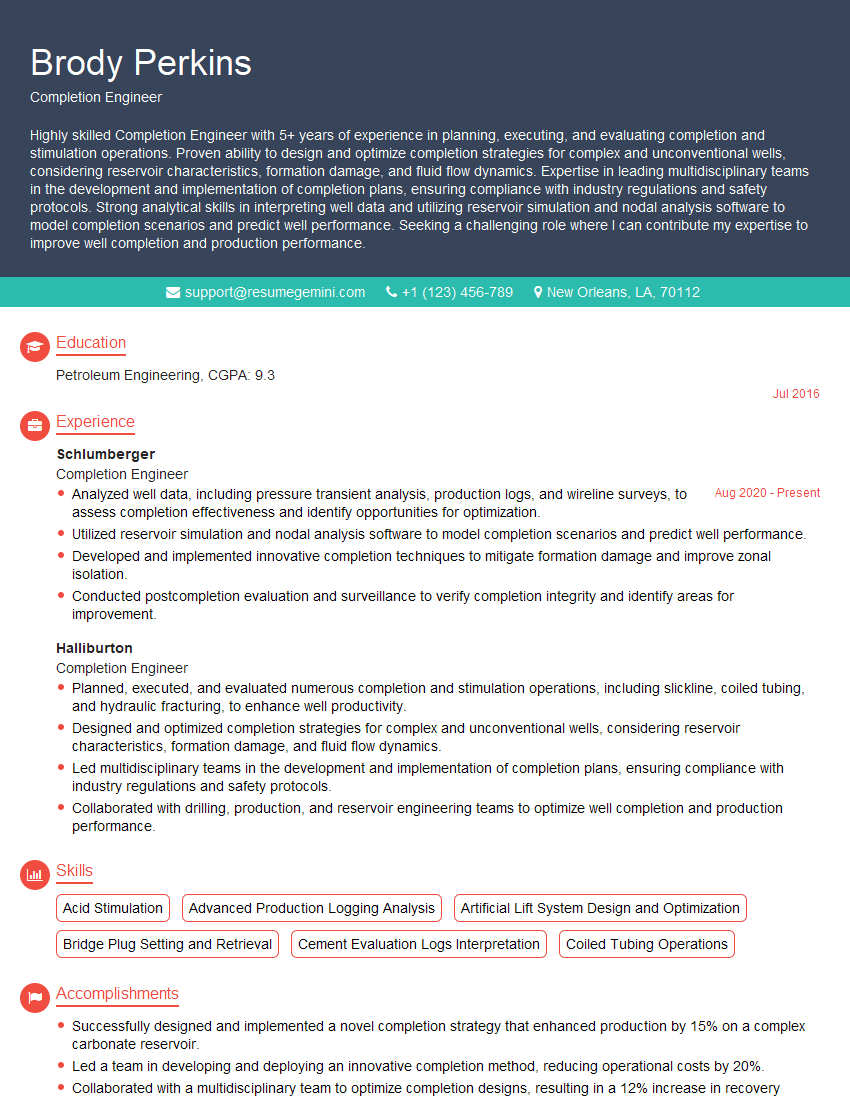
Mastering Drilling and Completion Optimization is crucial for career advancement in the energy sector, opening doors to leadership roles and higher earning potential. A well-crafted, ATS-friendly resume is your key to unlocking these opportunities. ResumeGemini is a trusted resource that can help you build a compelling resume showcasing your skills and experience effectively. Take advantage of their tools and explore the examples of resumes tailored to Drilling and Completion Optimization to present yourself as the ideal candidate.
Explore more articles
Users Rating of Our Blogs
Share Your Experience
We value your feedback! Please rate our content and share your thoughts (optional).
What Readers Say About Our Blog
Very informative content, great job.
good