Feeling uncertain about what to expect in your upcoming interview? We’ve got you covered! This blog highlights the most important Drills and Practice Planning interview questions and provides actionable advice to help you stand out as the ideal candidate. Let’s pave the way for your success.
Questions Asked in Drills and Practice Planning Interview
Q 1. Explain your process for designing effective drills.
Designing effective drills starts with a clear understanding of the specific skills or techniques you aim to improve. I begin by identifying the learning objectives – what measurable outcome do I want to see from the drill? Then, I consider the athletes’ current skill level and the context of the sport. A good drill is both challenging and achievable. I break down complex skills into smaller, manageable components, creating a progression of drills from basic to advanced. Each drill needs a clear structure, providing specific instructions, demonstrations, and a method for feedback. For example, if I’m working on shooting accuracy in basketball, I might start with stationary shots close to the basket, progressing to shots from further away, then incorporating movement such as dribbling before shooting, ultimately integrating game-like scenarios such as shooting under pressure with a defender.
- Identify Learning Objectives: What specific skill are we targeting?
- Assess Current Skill Level: Tailor the drill’s difficulty to the players’ abilities.
- Break Down Complex Skills: Create a progressive sequence of drills.
- Structure and Feedback: Clear instructions, demonstrations, and a system for providing feedback are crucial.
Q 2. How do you assess the effectiveness of a drill after implementation?
Assessing drill effectiveness involves both qualitative and quantitative measures. Quantitatively, I track metrics like completion rates, accuracy, speed, and consistency. For example, in a passing drill, I’d measure the percentage of successful passes, the time taken to complete the drill, and the precision of the passes. Qualitatively, I observe player performance during and after the drill, looking for improvements in technique, decision-making, and overall performance. Post-drill discussions and player feedback are also invaluable. Did the players understand the objectives? Did they find the drill challenging yet engaging? Was there a noticeable improvement in their performance after the drill? If the data or observations don’t show improvement, I analyze why the drill wasn’t effective and revise it accordingly. This might involve adjusting the difficulty, modifying the instructions, or changing the drill entirely.
Q 3. Describe a time you had to adapt a drill due to unforeseen circumstances.
During a soccer practice, we were working on a passing drill requiring precise, long passes across the field. However, a sudden downpour made the field extremely muddy and slippery. The initial drill, which required players to maintain a specific running trajectory, became unsafe and ineffective. Instead of abandoning the drill altogether, we adapted it. We shortened the passing distance, focused on shorter, more controlled passes, and emphasized proper footwork for maintaining balance on the slick surface. We also incorporated some quick passing drills in a smaller, less slippery area. This ensured the players still practiced passing skills, but in a way that prioritized safety and maintained engagement given the unforeseen circumstances.
Q 4. What are the key elements of a well-structured practice plan?
A well-structured practice plan is more than just a collection of drills; it’s a carefully orchestrated sequence designed to maximize learning and player development. It generally consists of a warm-up, the main body of practice (drills and skill development), and a cool-down. Each section has a purpose. The warm-up prepares the body for the activity, the main body focuses on specific skills through progressive drills, and the cool-down helps reduce muscle soreness and promotes recovery. A well-structured plan also includes sufficient rest and recovery periods between drills to prevent fatigue and optimize performance. It also considers the psychological aspect of practice, incorporating motivational elements and encouraging player engagement throughout the session. Finally, a good plan is flexible, allowing for adjustments based on player performance and unforeseen circumstances.
- Warm-up: Prepare the body and mind for activity.
- Main Body: Drills focused on specific skills, progressing in difficulty.
- Cool-down: Gentle exercises for recovery.
- Rest and Recovery: Prevent fatigue and optimize performance.
- Flexibility: Adapt to player performance and unforeseen issues.
Q 5. How do you incorporate progressive overload into your drills and practice plans?
Progressive overload is a fundamental principle in training; it involves gradually increasing the demands placed on the athlete over time. In drills, this could mean increasing the difficulty of the task (e.g., increasing the speed of a passing drill), the duration of the drill, or the number of repetitions. For example, in a weightlifting practice, we might start with a lighter weight and fewer reps, gradually increasing both as the athlete’s strength improves. In a practice plan, progressive overload might involve moving from basic skills to more complex game scenarios or introducing higher-pressure situations as the athletes progress. It’s crucial to monitor players closely to ensure the overload is appropriate and doesn’t lead to injury or burnout.
Q 6. Explain your approach to differentiating drills for various skill levels.
Differentiation is crucial for ensuring all players are challenged and engaged. I differentiate drills by adjusting several factors: the complexity of the task (simpler drills for beginners, more complex ones for advanced players), the speed of execution, the number of repetitions, the level of assistance provided, and the introduction of game-specific situations. For instance, in a basketball shooting drill, beginners might focus on close-range shots with ample time, while advanced players might practice shooting under pressure with a defender. This approach allows each player to work at their appropriate level, maximizing their learning and development.
Q 7. How do you ensure players are engaged and motivated during drills?
Player engagement is paramount for effective practice. I use several strategies to keep players motivated: I incorporate game-like scenarios, making the drills more realistic and fun. I use positive reinforcement, celebrating successes and providing constructive feedback. I foster a sense of competition, using team-based challenges to promote camaraderie and engagement. I also ensure drills are varied and not repetitive, keeping the practice sessions exciting and dynamic. Regular communication with the players, understanding their needs and preferences, and incorporating their ideas can also significantly boost their motivation and participation.
Q 8. Describe your method for providing feedback during drills and practices.
My feedback method during drills and practices focuses on a balanced approach of immediate, specific, and positive reinforcement. I believe in a ‘sandwich’ method: starting with positive feedback highlighting what they did well, then constructively addressing areas for improvement, and finally ending with another positive note emphasizing their potential. This keeps the athlete motivated and focused on growth.
For example, after a shooting drill, I might say: “Your form on those last three shots was excellent – great follow-through! To improve consistency, let’s focus on your pre-shot routine to ensure a consistent stance. You’ve got a great natural arc to your shot, and with a bit more work on that routine, you’ll be unstoppable!”.
I also utilize visual aids like video analysis, showing athletes exactly what they are doing well and where they can make adjustments. This removes any ambiguity and lets them see their performance objectively. I always ensure feedback is tailored to the individual athlete’s learning style and skill level, avoiding overwhelming them with too much information at once.
Q 9. How do you use technology to enhance drills and practice planning?
Technology plays a huge role in enhancing my drill and practice planning. I use software like Coach’s Eye or Hudl to record and analyze practices. This allows me to easily track progress, identify recurring errors, and share specific feedback with athletes. For instance, I can slow down video footage to highlight subtle nuances in a player’s technique, something that’s difficult to convey verbally.
I also use apps to create personalized training plans, assigning drills and exercises based on individual needs and goals. These apps often include features to track player performance metrics and automatically adjust future workouts based on data trends. Data visualization tools show me the bigger picture, enabling me to design practices that directly address team-wide weaknesses.
Furthermore, online resources provide access to a wealth of drills and practice plans, fostering innovation and allowing me to adapt my approach according to the latest research and best practices. Technology helps to make practice planning more efficient and data-driven, leading to more effective training.
Q 10. How do you measure the learning outcomes of your drills and practices?
Measuring learning outcomes involves a multi-faceted approach that goes beyond simply observing performance during drills. I use a combination of quantitative and qualitative methods. Quantitative measures include tracking statistics like shooting percentages, successful tackles, or successful pass completion rates. This gives a clear, numerical indication of improvement.
Qualitative assessment focuses on observation of skill execution and game understanding. I use checklists to evaluate specific technical aspects (e.g., proper footwork, grip, follow-through), and I document players’ decision-making during game-like scenarios. Post-practice questionnaires can help gather player feedback on their understanding of drills and their perceived improvements.
A crucial aspect is comparing pre- and post-practice assessments. For example, if we’re working on improving first-touch control, a pre-practice test might measure the number of successful controlled passes in a row. We would then re-test after the practice session to see if the number has increased, providing objective evidence of skill development.
Q 11. What are some common mistakes to avoid when designing drills?
Common mistakes in drill design often stem from a lack of focus on specific learning objectives or poorly structured progressions. One frequent error is designing drills that are too complex or too long, leading to fatigue and reduced concentration. This results in poor quality repetitions and limited learning.
- Lack of clear objectives: Drills should target specific skills. A drill without a defined outcome is unproductive. For example, a passing drill should aim for accuracy, speed, or a specific type of pass, rather than just general passing.
- Poor progression: Drills should gradually increase in difficulty. Starting with simple variations and progressively adding challenges ensures athletes build a solid foundation before tackling more complex skills. Jumping straight into advanced drills can lead to frustration and discouragement.
- Ignoring individual needs: Not differentiating drills based on players’ skill levels. Drills must be adaptable to cater to the varied abilities within a group. This could involve using different sizes or weights of equipment or adjusting the speed and complexity of the drill.
- Lack of feedback mechanisms: Not providing immediate feedback during drills. Athletes need to understand how they’re performing in real-time to make adjustments and improve. This can be done through coaching cues, visual aids, or peer feedback.
Careful planning and consideration of these points ensures drills are effective and enjoyable for athletes.
Q 12. How do you handle unexpected challenges during a practice session?
Handling unexpected challenges during a practice session requires adaptability and problem-solving skills. My approach is to assess the situation quickly, adapt the plan, and focus on maximizing the learning opportunities even amidst the disruption. This might involve a change of plans or improvised activities.
For example, if a key player gets injured, I would adjust the drills to accommodate the reduced number of players, possibly focusing on individual skill development rather than team-based exercises. If equipment malfunctions, I might use improvised alternatives, perhaps substituting cones for missing markers. The key is to maintain a positive atmosphere and use the unexpected event as a teachable moment.
Communication is vital. I’ll clearly explain the changes to the players, ensuring they understand the rationale behind the adjustments. Maintaining flexibility and focusing on positive problem-solving help maintain morale and ensure the practice remains productive, even with setbacks.
Q 13. How do you balance skill development with game-like scenarios in practice?
Balancing skill development with game-like scenarios is crucial for effective practice planning. I achieve this through a progressive approach, starting with fundamental skill drills to build a strong foundation, then gradually incorporating game-like scenarios that require the application of those skills in a more realistic context. This ensures that athletes can transfer their learned skills to actual game situations.
For example, if we’re focusing on passing, we might start with a simple passing drill at close range, gradually increasing the distance and introducing defenders. We would then progress to small-sided games where players must use their improved passing skills within the context of game strategies and under pressure. The intensity and complexity of the game-like scenarios should increase progressively alongside the improvement of skills.
This approach ensures that athletes aren’t just practicing isolated skills but also learning how to apply those skills under pressure and make strategic decisions. Regular review and adjustment of the balance are crucial based on player progress and game demands.
Q 14. Describe your approach to incorporating rest and recovery into practice plans.
Incorporating rest and recovery is as vital as the drills themselves. Overtraining leads to fatigue, injuries, and decreased performance. My approach involves strategically placing rest periods within and between drills. I utilize active recovery techniques like light jogging or stretching during breaks to aid in muscle recovery and maintain blood flow.
I vary the intensity of drills throughout the session, alternating between high-intensity activities and lower-intensity skill work. This prevents burnout and ensures players maintain focus and energy levels. The length of rest periods is determined by the intensity and duration of the preceding activity. I also factor in hydration breaks and encourage players to stay hydrated throughout the practice.
Furthermore, the overall training schedule incorporates rest days and lighter training weeks to allow for complete physical and mental recovery. Adequate rest is vital for optimizing performance and injury prevention. I’m mindful of individual player needs and might adjust recovery times based on their physical condition and training history.
Q 15. How do you create a positive and supportive learning environment during drills?
Creating a positive and supportive learning environment during drills is crucial for player development and team cohesion. It’s about fostering a culture of trust, encouragement, and constructive feedback, where players feel comfortable taking risks and learning from mistakes without fear of judgment.
- Positive Reinforcement: Focus on praising effort and improvement, rather than solely on results. For example, instead of just saying ‘You missed that shot,’ try ‘Your aim was good, let’s work on your follow-through.’
- Constructive Feedback: Offer specific, actionable feedback that players can use to improve. Avoid vague criticism. Instead of ‘You need to play better,’ say ‘Let’s work on your positioning during this passing drill to ensure you’re always open for a pass.’
- Teamwork and Collaboration: Design drills that promote cooperation and communication. Small-sided games are excellent for this. Emphasize the importance of supporting teammates and celebrating successes together.
- Individualized Attention: Recognize that players learn at different paces. Provide personalized instruction and support to address individual needs and challenges. This might involve extra coaching for a specific player struggling with a particular skill.
- Fun and Engagement: Keep drills engaging and fun. Vary the drills to prevent boredom and maintain player motivation. Incorporating games and challenges can significantly boost morale and enthusiasm.
Think of it like this: a supportive drill environment is like a well-tended garden. You need to provide the right conditions – encouragement, constructive criticism, and opportunities for growth – for players to flourish.
Career Expert Tips:
- Ace those interviews! Prepare effectively by reviewing the Top 50 Most Common Interview Questions on ResumeGemini.
- Navigate your job search with confidence! Explore a wide range of Career Tips on ResumeGemini. Learn about common challenges and recommendations to overcome them.
- Craft the perfect resume! Master the Art of Resume Writing with ResumeGemini’s guide. Showcase your unique qualifications and achievements effectively.
- Don’t miss out on holiday savings! Build your dream resume with ResumeGemini’s ATS optimized templates.
Q 16. What is your experience with various drill formats (e.g., station-based, small-sided games)?
I have extensive experience with various drill formats, tailoring my approach to the specific needs of the team and the skill being practiced.
- Station-based drills are excellent for focusing on specific technical skills in a controlled environment. For example, a station could focus solely on passing accuracy, another on dribbling agility, and a third on shooting technique. This allows for targeted improvement and immediate feedback.
- Small-sided games (SSGs) are invaluable for developing tactical awareness, decision-making under pressure, and game-specific skills. The smaller the pitch, the higher the intensity and frequency of touches on the ball, leading to faster learning. Variations in size and rules can emphasize specific tactical aspects, like pressing or counter-attacking.
- Conditioned games introduce competitive elements while maintaining a focus on specific skills or tactics. For instance, a game could be designed to practice quick transitions, with points awarded for successful fast breaks.
- Scrimmages: These are game-like situations designed to integrate all practiced skills and allow players to apply their knowledge in a more realistic setting. They should be incorporated gradually and only after players have mastered the fundamentals of specific skills and tactics.
I often combine these formats within a single practice session to create a dynamic and comprehensive training experience. For example, a practice might start with station-based drills to refine technique, followed by small-sided games to apply those skills in a game-like context, culminating in a short scrimmage.
Q 17. How do you tailor your practice plans to meet specific team goals?
Tailoring practice plans to meet specific team goals is paramount. This involves a thorough assessment of the team’s strengths and weaknesses, followed by the development of a structured plan that addresses those areas.
- Needs Assessment: I’ll analyze game footage, player statistics, and conduct informal assessments to pinpoint areas for improvement – whether it’s improving passing accuracy, enhancing defensive pressure, or strengthening attacking transitions.
- Goal Setting: Based on the assessment, I’ll define clear, measurable, achievable, relevant, and time-bound (SMART) goals. For example, a goal might be ‘Increase successful passes from 70% to 80% within four weeks.’
- Drill Selection: I choose drills that directly address the identified weaknesses and reinforce strengths. This requires a deep understanding of the relationship between drills and game performance. A drill focusing on quick passing under pressure directly translates to improved passing accuracy in a game context.
- Progression and Variation: Practice plans should be progressive, starting with simpler drills and gradually increasing complexity to challenge players and prevent stagnation. The introduction of variations keeps drills engaging and ensures players don’t become complacent.
- Monitoring and Evaluation: Regularly evaluate the effectiveness of the practice plan through ongoing observation, feedback from players, and statistical analysis (e.g., tracking passing accuracy during drills and games). Adjustments are made based on this evaluation.
For example, if a team struggles with maintaining possession under pressure, the practice plan might focus on drills involving close-quarter passing, defensive pressure simulations, and small-sided games emphasizing ball retention.
Q 18. How do you use data to inform your drills and practice planning decisions?
Data plays a vital role in informing my drills and practice planning decisions. It provides objective insights into player performance and team dynamics, enabling data-driven decision-making.
- Performance Tracking: I use various tools, including video analysis software and performance tracking apps to collect data on player statistics like passing accuracy, shot conversion rates, and defensive actions.
- Data Analysis: This data is analyzed to identify trends and patterns that indicate areas for improvement or reinforcement. For instance, consistently low passing accuracy in a certain area of the field might indicate a need for drills focused on passing accuracy under pressure from that specific position.
- Feedback Loops: This data directly feeds into the design and modification of drills. If the analysis reveals poor first-touch control, drills focusing on improving first-touch technique will be prioritized.
- Individualized Training: Data can also be used to personalize training programs for individual players. Players who struggle in a particular area receive targeted drills and coaching to address their specific weaknesses.
- Objective Measurement: Data provides an objective measure of progress, allowing us to monitor the effectiveness of drills and training sessions over time.
For example, if GPS data reveals a player consistently sprints less during games than in training, we can integrate drills that focus on increasing their intensity and stamina during practice.
Q 19. Describe your process for selecting appropriate drills for a specific skill.
Selecting appropriate drills for a specific skill involves a systematic process that considers various factors.
- Skill Analysis: First, I clearly define the specific skill to be improved. For example, this could be improving the accuracy of a player’s long passes, improving their first touch, or mastering a specific type of shot.
- Drill Selection Criteria: I then choose drills that directly target the components of that skill. Drills should be progressive, starting with fundamental techniques and gradually increasing in complexity.
- Contextualization: The drill must also be contextualized within the game. A drill improving passing accuracy must simulate game-like pressure and decision-making to ensure transferability of the skill to match situations.
- Progressive Overload: Drills should progressively challenge the player, gradually increasing the difficulty to avoid plateauing. This could involve increasing the speed of play, the distance of passes, or the number of defenders.
- Feedback Mechanisms: Incorporate mechanisms for immediate feedback during the drills, either self-correction or coaching input, to ensure players are aware of their performance and make adjustments.
For example, to improve a player’s first touch, I might start with simple stationary ball control drills, gradually progressing to moving drills involving dribbling and receiving passes under pressure. This ensures the player develops both the technical skill and the ability to use it effectively in a game environment.
Q 20. How do you integrate feedback from players into your practice planning?
Integrating player feedback into practice planning is essential for creating a collaborative and effective training environment. Players’ perspectives provide valuable insights that can significantly enhance the training process.
- Regular Feedback Sessions: I conduct regular feedback sessions with players, both individually and as a team. These sessions provide a platform for players to express their thoughts and feelings about the training sessions and drills.
- Open Communication: I foster an environment of open communication where players feel comfortable sharing their opinions and concerns without fear of judgment.
- Active Listening: I actively listen to player feedback, considering their suggestions and perspectives when designing and modifying practice plans.
- Adaptability: I demonstrate flexibility and adaptability by adjusting practice plans based on player feedback. If players find a particular drill ineffective or frustrating, I’m open to making changes.
- Collaborative Approach: I view player feedback as a valuable resource and actively involve players in the planning process. This could involve consulting with players on drill selection or incorporating their suggestions into future sessions.
For example, if players consistently express frustration with a particular drill, I might modify it to make it more engaging or less repetitive. If they suggest an alternative approach, I am open to considering it. This collaborative approach increases player buy-in and ensures the effectiveness of the training program.
Q 21. How do you ensure drills are safe and prevent injuries?
Ensuring drills are safe and injury-free is paramount. Safety must be prioritized at all times. This requires careful planning and execution.
- Proper Warm-up: Every practice session begins with a thorough warm-up that prepares players physically and mentally for the drills. This helps to prevent muscle strains and other injuries.
- Appropriate Intensity: The intensity level of drills is carefully controlled to avoid overexertion and fatigue, which can increase the risk of injury. Regular hydration breaks are crucial.
- Safe Environment: The practice area should be properly maintained and free of hazards. Equipment should be checked regularly for damage. Cones should be appropriately spaced to avoid collisions.
- Proper Technique: Players are taught proper techniques to minimize the risk of injury. Correct tackling technique is absolutely essential to prevent injuries during contact drills.
- Risk Management: Drills are carefully designed and adjusted to minimize risks. High-impact drills should be introduced progressively, ensuring players adapt to the increased demands.
- Medical Personnel: If feasible, having a qualified medical professional present during training sessions can significantly enhance safety. This is especially important during contact-heavy drills.
- Emergency Plan: A clear emergency plan should be in place, and all participants should be familiar with the procedures to follow in case of an injury.
Think of it like this: safety is not just about avoiding injuries; it’s about creating an environment where players feel confident, protected, and empowered to perform at their best.
Q 22. What strategies do you use to maintain player focus and attention during practice?
Maintaining player focus during practice is crucial for effective learning and skill development. It’s like keeping a group of puppies engaged – you need a mix of stimulation, clear direction, and positive reinforcement. My strategies revolve around three key principles: variety, clear communication, and positive reinforcement.
Variety: I incorporate diverse drills and activities to prevent monotony. For example, I might alternate between high-intensity interval training (HIIT) drills and more technical skill-building exercises. This keeps players mentally and physically stimulated, preventing boredom and maintaining engagement.
Clear Communication: I ensure every player understands the objective, instructions, and expectations for each drill. Clear, concise explanations, demonstrated examples, and frequent check-ins are essential. This ensures everyone is on the same page and minimizes confusion, a major cause of distraction.
Positive Reinforcement: I focus on celebrating successes, no matter how small. Positive feedback, encouragement, and acknowledging effort build confidence and motivation, reinforcing positive learning behaviors. A simple ‘Great job!’ or specific praise for improved technique goes a long way.
For instance, if players are lagging during a repetitive passing drill, I might introduce a game-like element, like a timed competition or a point system, to reignite their focus and motivation.
Q 23. How do you manage time effectively during a practice session?
Effective time management during practice is vital to maximize training efficiency. Think of it like running a well-oiled machine – each part needs to function smoothly and seamlessly. My approach is based on meticulous planning and execution.
Pre-practice preparation: I carefully outline the practice plan beforehand, allocating specific time slots for each drill or activity. This prevents wasted time and ensures all planned activities are covered.
Organized transitions: I ensure smooth transitions between drills, minimizing downtime. This often involves having equipment pre-set and clearly communicating instructions in advance. Efficient transitions keep the momentum going.
Flexibility: I build in some flexibility within the plan to accommodate unforeseen circumstances or adjust based on player performance. It’s crucial to be adaptable and not rigidly stick to the schedule if adjustments are needed for optimal learning.
Timely conclusion: I ensure the session ends on time and leaves players feeling both challenged and satisfied. This fosters a positive association with practice and contributes to improved motivation for future sessions.
For example, if a drill is taking significantly longer than planned, I might shorten it or modify it slightly to stay on schedule without compromising learning objectives.
Q 24. Describe your approach to creating a practice plan for a new team or group.
Creating a practice plan for a new team requires a thorough assessment of the players’ skill levels, strengths, weaknesses, and learning styles. It’s like building a house – you need a strong foundation before adding the walls and roof.
Assessment: I begin with a thorough assessment of the team’s current skill level. This often involves observation during initial practice sessions, skill tests, and discussions with players. This helps me identify areas needing improvement and tailoring drills accordingly.
Goal Setting: I collaboratively set realistic short-term and long-term goals with the team. These goals provide a clear direction for the practice plan, ensuring the drills directly support the team’s overall objectives.
Drill Selection: I select drills that target the specific skill areas identified during the assessment, focusing on fundamental skills first before progressing to more advanced techniques. The progression should be gradual and build upon previously learned skills.
Plan Structure: I structure the practice plan logically, progressing from warm-up activities to skill-focused drills, followed by small-sided games and cool-down exercises. This structured approach enhances learning and minimizes the risk of injury.
Feedback and Revision: I regularly evaluate the effectiveness of the practice plan and make necessary adjustments based on player feedback and performance. This iterative approach ensures the plan remains relevant and effective.
For example, if a new team struggles with passing accuracy, the initial plan will heavily emphasize passing drills with progressively increasing difficulty and various drills to correct common errors.
Q 25. How do you adapt your drills and practice plans for different learning styles?
Catering to different learning styles is essential for inclusive and effective coaching. Just as a chef uses different spices to create a variety of dishes, I use a variety of teaching methods to reach every player.
Visual Learners: I use demonstrations, diagrams, and videos to illustrate techniques. For example, I might show a player a video of a proper shooting technique, then have them practice the form in front of a mirror.
Auditory Learners: I use verbal explanations, discussions, and feedback to help them understand concepts. I’ll often describe the steps involved in a skill verbally and check for understanding before moving on.
Kinesthetic Learners: I involve them in hands-on activities, allowing them to physically experience and practice the skills. This might include having them practice a skill repeatedly until it feels natural.
I also incorporate a mix of individual, group, and team drills to appeal to various preferences and learning styles. By understanding these different styles, I can create a more effective and engaging learning environment for everyone.
Q 26. How do you ensure your practice plans are aligned with the overall training program?
Alignment between practice plans and the overall training program is paramount for consistent progress and achieving long-term goals. It’s like a roadmap – each practice session should be a step toward the destination.
I achieve this by:
Understanding the Program’s Objectives: I thoroughly review the overarching training program to understand its goals, periodization (the planned variation in training intensity over time), and target outcomes. This provides context for my practice planning.
Prioritizing Key Skills: I prioritize drills that directly support the program’s focus areas. If the program emphasizes speed and agility in a particular phase, then speed and agility drills will dominate my practice plans for that period.
Monitoring Progress: I regularly monitor player performance and adjust the practice plans as needed. This ensures that the practices remain relevant and effective in achieving the program’s objectives.
Communication: Open communication with the head coach or program director is crucial. Regular discussions ensure alignment and prevent inconsistencies.
For instance, if the training program is emphasizing strength and conditioning, my practice plans might include more high-intensity interval training (HIIT) drills to enhance fitness levels alongside skill-specific work.
Q 27. What software or tools do you utilize for practice planning and tracking?
Several software and tools can significantly enhance practice planning and tracking. The best choice depends on individual preferences and team needs. However, I utilize a combination of tools to maximize efficiency.
Spreadsheet Software (e.g., Google Sheets, Microsoft Excel): I use spreadsheets to organize practice plans, track player progress, and analyze data. I can easily create charts and graphs to visualize performance trends.
Practice Planning Software (e.g., TeamSnap, CoachMe): Dedicated practice planning software allows for easier drill creation, scheduling, and communication with players. These platforms also often include features for tracking attendance and player statistics.
Video Analysis Software (e.g., Hudl, Coach’s Eye): I leverage video analysis tools to review practice sessions, provide detailed feedback to players, and identify areas for improvement. This allows for more targeted and effective drill design for subsequent practices.
The combination of these tools allows for a comprehensive and data-driven approach to practice planning, ultimately leading to enhanced player development.
Q 28. How do you handle conflict or disagreements among players during practice?
Conflict resolution is a crucial aspect of coaching. A coach is not just a drill instructor but also a mediator and leader. My approach involves addressing conflicts promptly, fairly, and constructively.
Immediate intervention: If a disagreement arises, I intervene immediately to prevent escalation. I separate the involved parties if necessary to calm the situation.
Listen to all sides: I actively listen to each player’s perspective, creating a safe space for them to express their feelings and concerns without interruption.
Facilitate discussion: I guide the players towards a solution by asking open-ended questions that encourage understanding and compromise. My goal is to help them resolve the conflict themselves, with my guidance.
Focus on behavior, not personality: I emphasize addressing specific behaviors rather than attacking players’ personalities. This keeps the focus on resolving the immediate issue, not making personal attacks.
Reinforce teamwork and sportsmanship: I emphasize the importance of teamwork, respect, and sportsmanship in all situations. I reinforce this message during team meetings and throughout the practices.
For example, if two players argue over a missed pass, I’ll ask them to explain their perspectives and then work together to identify how they can communicate more effectively to improve teamwork on the field.
Key Topics to Learn for Drills and Practice Planning Interview
- Drill Design and Methodology: Understanding the principles of effective drill design, including progressive overload, specificity, and individualization. Consider various training methods and their applications.
- Practice Planning & Periodization: Learn about long-term and short-term planning, incorporating different training phases (e.g., preparatory, competitive, transition) and their impact on athlete performance. Explore the concept of periodization and its variations.
- Skill Acquisition and Motor Learning: Grasp the stages of skill acquisition and how practice design facilitates learning. Discuss different practice structures (blocked vs. random, constant vs. variable) and their effectiveness.
- Performance Monitoring and Evaluation: Understand methods for tracking progress, analyzing performance data, and making adjustments to drills and practice plans based on objective and subjective feedback.
- Technology in Drills and Practice Planning: Explore the use of technology such as video analysis, wearable sensors, and data tracking software to enhance performance analysis and practice design.
- Adaptation and Individualization: Discuss the importance of adapting drills and practice plans to meet the specific needs and abilities of individual athletes or teams. Consider factors such as age, experience level, and physical limitations.
- Safety and Injury Prevention: Understand how to design safe and effective drills and practices that minimize the risk of injury. Incorporate proper warm-up and cool-down routines and address potential safety concerns.
Next Steps
Mastering Drills and Practice Planning is crucial for career advancement in sports science, coaching, and related fields. A strong understanding of these concepts demonstrates your ability to optimize athlete performance and achieve tangible results. To maximize your job prospects, focus on building an ATS-friendly resume that highlights your skills and experience. ResumeGemini is a trusted resource for creating professional and impactful resumes. We provide examples of resumes tailored to Drills and Practice Planning to help you showcase your expertise effectively. Use these resources to craft a compelling resume that captures the attention of potential employers.
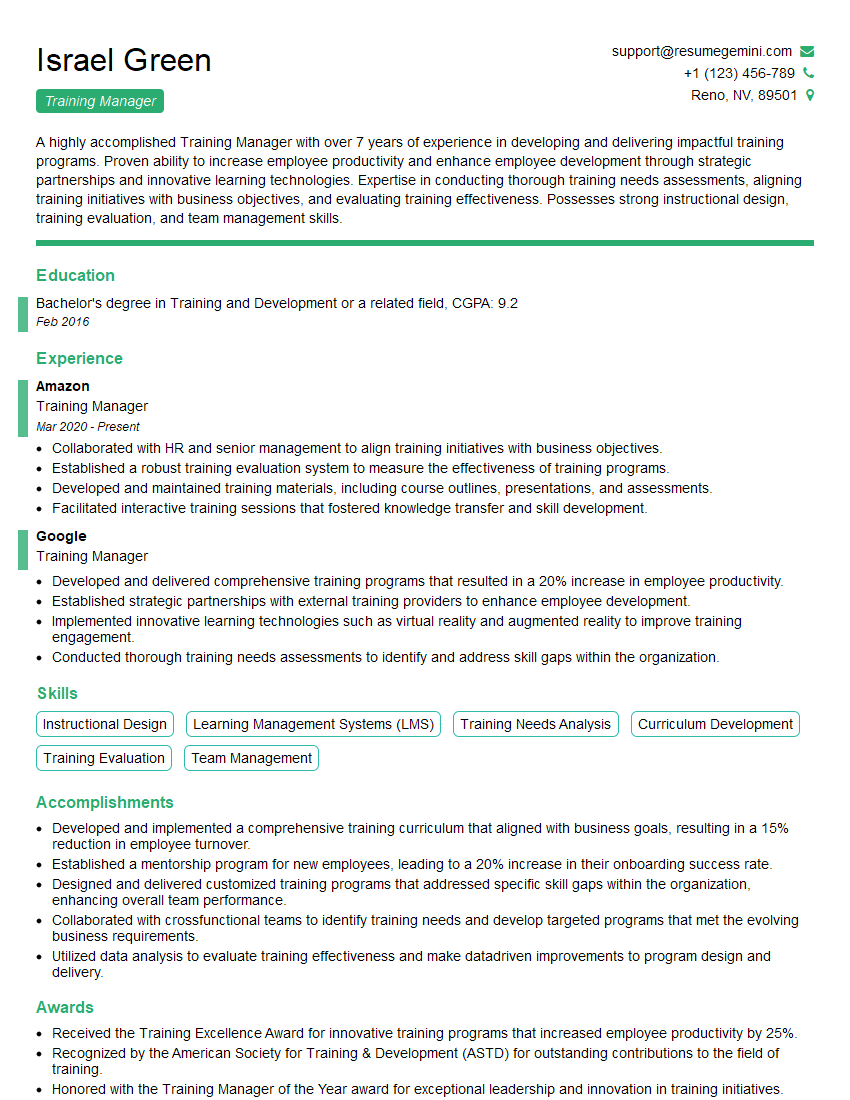
Training Manager Resume Sample
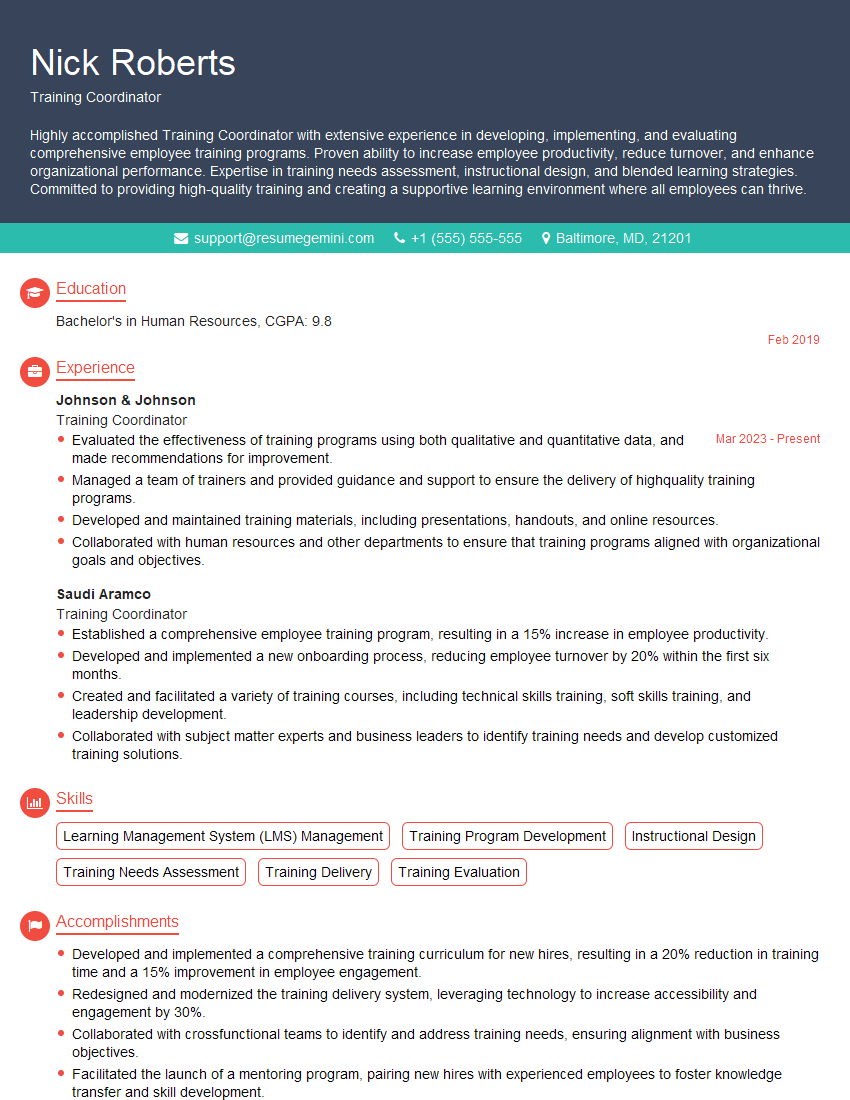
Training Coordinator Resume Sample
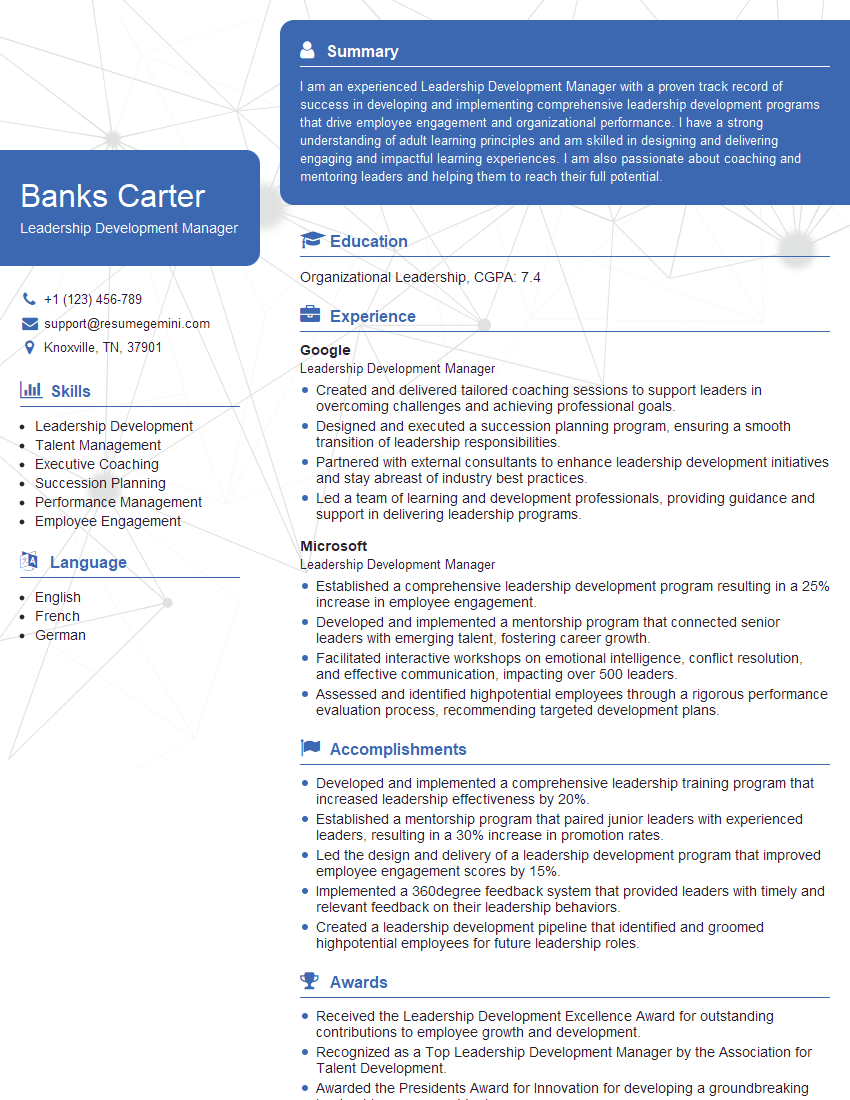
Leadership Development Manager Resume Sample
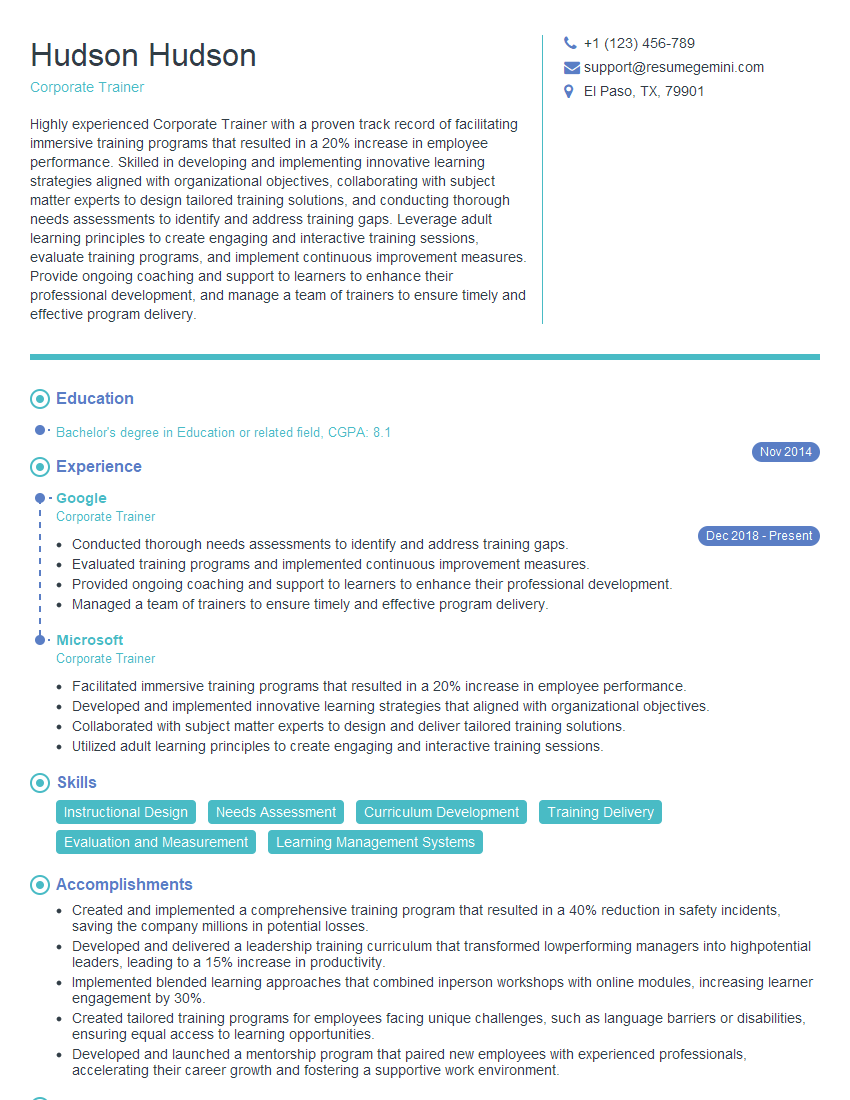
Corporate Trainer Resume Sample

Curriculum Developer Resume Sample
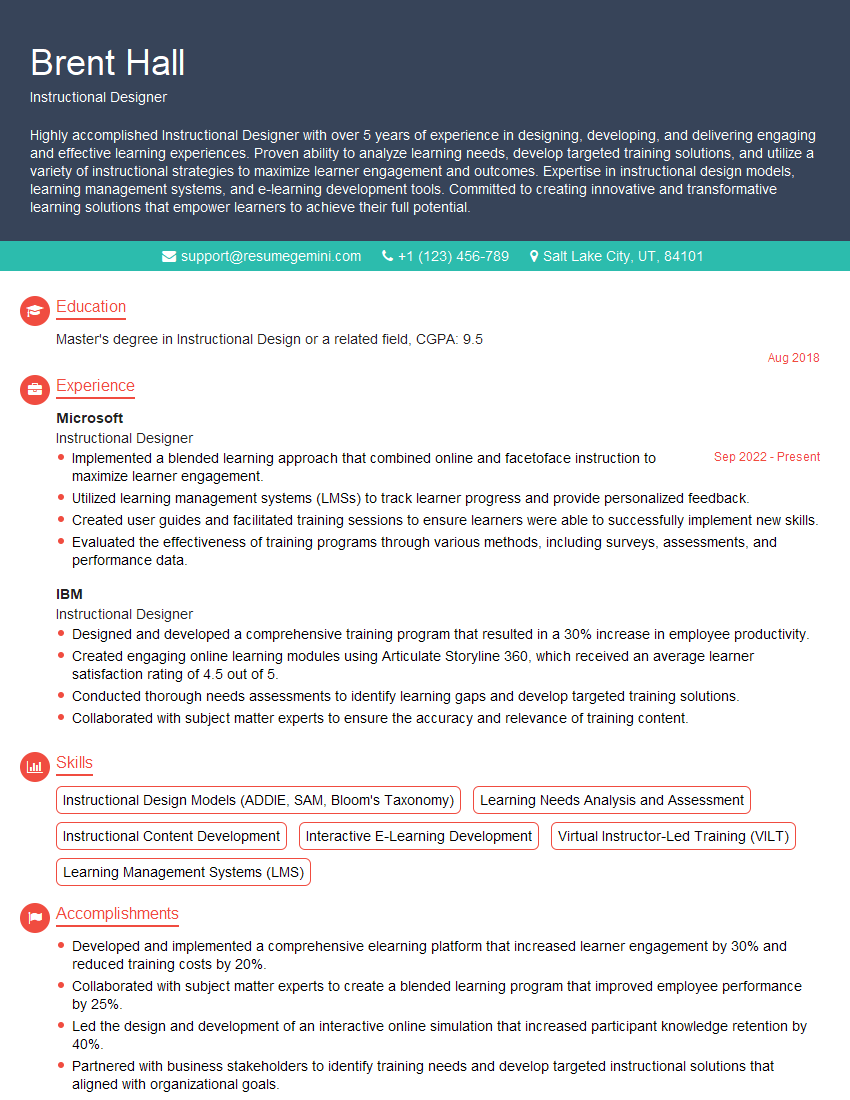
Instructional Designer Resume Sample

Educational Technologist Resume Sample
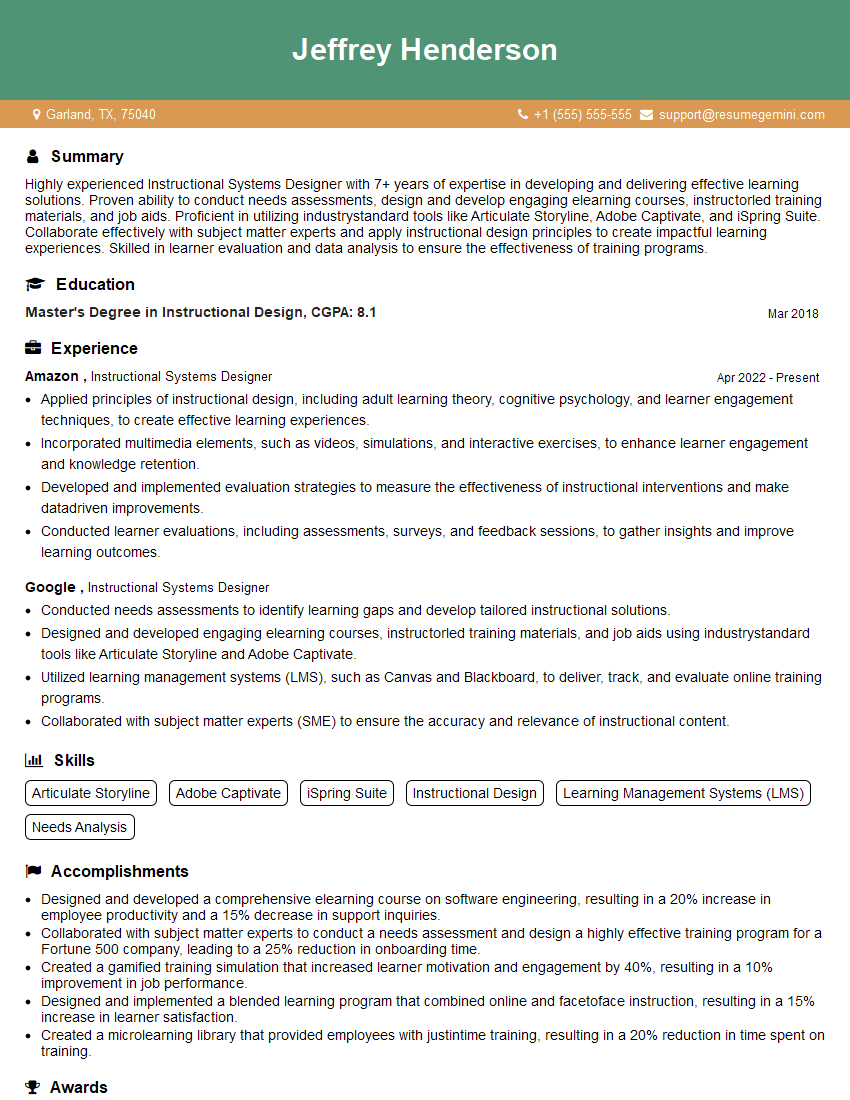
Instructional Systems Designer Resume Sample
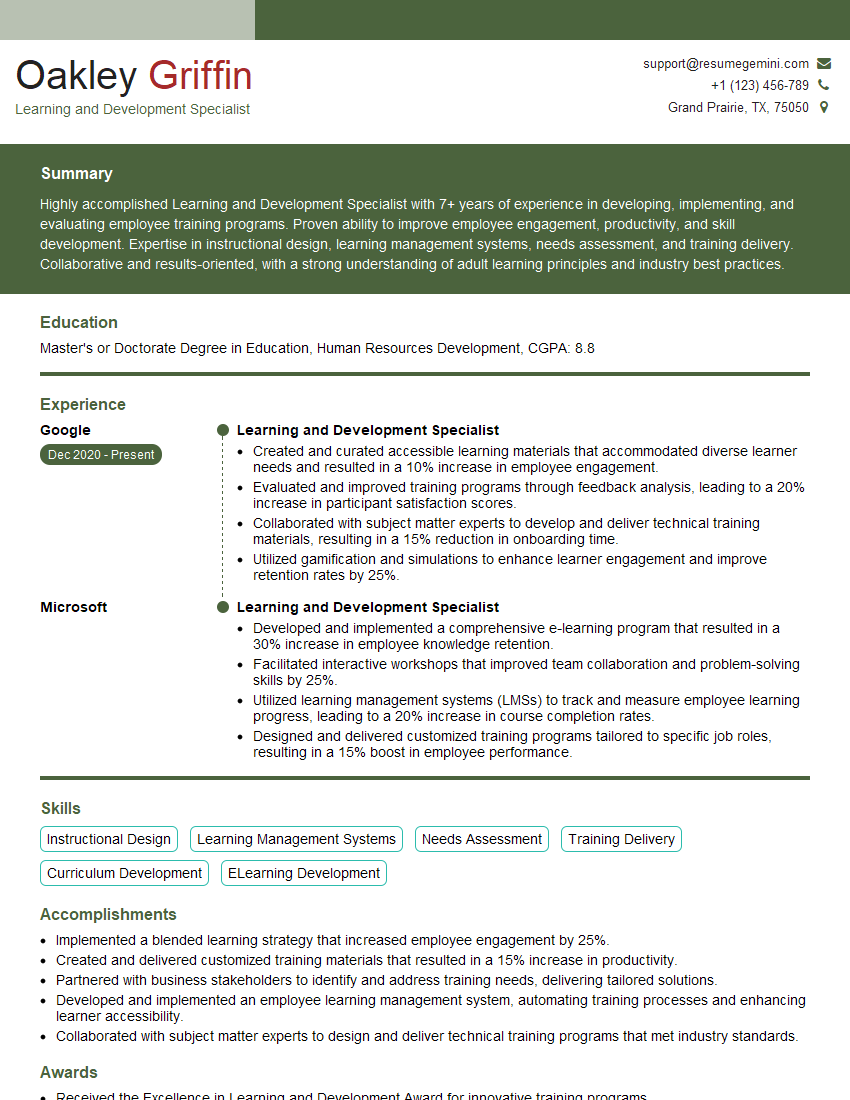
Learning and Development Specialist Resume Sample
Explore more articles
Users Rating of Our Blogs
Share Your Experience
We value your feedback! Please rate our content and share your thoughts (optional).
What Readers Say About Our Blog
Very informative content, great job.
good