Are you ready to stand out in your next interview? Understanding and preparing for Drywall Sawing interview questions is a game-changer. In this blog, we’ve compiled key questions and expert advice to help you showcase your skills with confidence and precision. Let’s get started on your journey to acing the interview.
Questions Asked in Drywall Sawing Interview
Q 1. What types of saws are commonly used for drywall cutting?
Several saws excel at cutting drywall, each with its strengths. The most common are the drywall saw (also known as a keyhole saw), the utility knife, and the circular saw (with a fine-tooth blade). Less common, but useful in specific situations, are jigsaw and reciprocating saws. The choice depends heavily on the type of cut needed – a small hole, a straight line, a curved cut, or a large quantity of cuts.
- Drywall Saw: Ideal for precise, smaller cuts and intricate work, like making openings for electrical boxes.
- Utility Knife: Best for scoring drywall for clean, straight breaks on long cuts. It’s fast and efficient for straight cuts but requires a bit more skill to get perfectly straight lines.
- Circular Saw: Provides speed and efficiency for large-scale cutting or repetitive cuts, but requires a special fine-tooth blade designed for drywall to prevent tearing.
- Jigsaw & Reciprocating Saw: Useful for curved cuts or intricate shapes, but may result in a less clean cut than other options.
Q 2. Explain the proper techniques for using a drywall saw.
Proper technique is key to clean cuts and safety. With a drywall saw, use a gentle, back-and-forth motion, avoiding excessive pressure. Keep the saw blade perpendicular to the drywall surface. For a utility knife, score the face of the drywall firmly enough to break the paper. For circular saws, use a guide if making a long straight cut for optimal precision and accuracy. Always maintain a firm grip and a controlled pace. Practice makes perfect; start with scrap pieces to hone your skills before tackling important cuts.
Imagine sawing a piece of cake; you wouldn’t force the knife through – you’d use smooth, controlled movements. Drywall cutting is much the same. Smooth, controlled movements provide the best results.
Q 3. How do you ensure clean, straight cuts when sawing drywall?
Achieving clean, straight cuts involves a combination of factors: the right tool, proper technique, and preparation. For straight cuts, use a straight edge (like a metal ruler or a framing square) as a guide for your saw or knife. For circular saws, a guide is essential. Score the face of the drywall cleanly with a utility knife before snapping it along the score line for thin drywall. For thicker drywall, it may require sawing all the way through. Ensure your saw blade is sharp and clean, free from debris which can cause jagged cuts.
Think of it like drawing a line: The straighter your guide, the straighter your line will be. This principle applies directly to drywall cutting.
Q 4. What safety precautions should be taken when using a drywall saw?
Safety is paramount. Always wear safety glasses to protect your eyes from flying debris. Dust masks are also highly recommended to avoid inhaling drywall dust, especially with moisture-resistant drywall which may contain added chemicals. For circular saws, use a dust collection system to improve your workspace, making for a cleaner working environment. Never rush the process. Take your time and focus on your work to minimize the risk of injury.
I always tell my apprentices, ‘Safety isn’t an option; it’s the foundation.’ These precautions are not just suggestions; they are vital for preventing accidents.
Q 5. How do you handle different types of drywall (e.g., moisture-resistant)?
Moisture-resistant drywall (often green-colored) is denser and more durable than standard drywall. It requires more power and possibly a sharper blade to cut cleanly. The same principles of technique still apply, but you may need to increase the pressure slightly depending on your tool. Be aware that the dust from moisture-resistant drywall may contain additional chemicals and should be handled appropriately with proper ventilation and dust control.
I’ve found that a sharp blade makes a huge difference with moisture-resistant drywall. A dull blade will only result in frustration and a less-than-perfect cut.
Q 6. Describe your experience with various drywall sawing tools.
My experience spans a wide range of drywall sawing tools. I’ve used everything from the basic drywall saw for intricate tasks to circular saws with various blades for larger projects and repetitive cuts. I’ve also had experience with jigsaws for more complex cuts and even specialized scoring tools for incredibly precise work. Each tool has its place; it’s about selecting the correct tool for the job and understanding its limitations. Understanding the nuances of each tool allows for greater efficiency and precision. For instance, a circular saw can greatly speed up bulk cutting, while a utility knife is perfect for fine control over scoring.
Q 7. How do you measure and mark drywall for accurate cutting?
Accurate measurement and marking are crucial for successful drywall installation. I always start by carefully measuring the area where the drywall needs to be cut using a tape measure. I then transfer these measurements onto the drywall using a pencil and a straight edge, ensuring the lines are perfectly aligned. For complex cuts, I often use templates or create patterns to ensure precision. Double-checking measurements before cutting is a habit I’ve developed over years of experience. This simple step prevents costly mistakes.
Think of it as baking a cake. Accurate measurements are as important in drywall cutting as they are in baking – inaccurate measurements yield subpar results.
Q 8. How do you handle curved cuts in drywall?
Curved cuts in drywall require a flexible approach. Forget trying to force a straight saw! Instead, I utilize a special drywall knife or a jigsaw with a fine-tooth blade. For smoother, more precise curves, especially in larger radii, I’ll use a jab saw. The key is to make multiple shallow cuts, gradually following the curve. Think of it like carving wood – lots of small cuts create a fluid shape. For very tight curves, I might even use a utility knife, scoring the face and then snapping the drywall along the score line. This is a more delicate method, requiring practice to avoid fracturing the board.
Example: When installing a curved soffit, I’d use a jigsaw with a fine-tooth blade, making repeated passes to follow the curved template. For smaller curves, around pipes for instance, a jab saw or utility knife is more appropriate.
Q 9. What are the common problems encountered while sawing drywall, and how do you troubleshoot them?
Common problems during drywall sawing often stem from improper technique or tool selection. Dust is a frequent issue; a good quality dust collection system is essential, both for cleaner work and to protect your lungs. Blade dullness leads to jagged cuts and increased effort, demanding frequent blade changes or sharpening. Another issue is chipping – this usually comes from applying too much pressure, pushing the blade instead of letting it cut. Incorrect blade selection can result in inefficient cutting or even damage to the drywall. Finally, measuring incorrectly leads to wasted materials.
- Troubleshooting: For excessive dust, invest in a dust shroud or vacuum system. Dull blades need replacement or sharpening. Chipping is fixed by applying gentle, even pressure and using the right speed. To prevent material wastage, always double-check your measurements before cutting.
Q 10. Explain your experience with different blade types and their applications.
My experience encompasses various blade types: The standard utility knife for scoring and snapping, crucial for smaller, precise cuts and scoring lines before snapping. Jigsaws with fine-tooth blades are my go-to for curved cuts and intricate shapes. Circular saws, fitted with drywall blades (with carbide-tipped teeth for cleaner cuts), excel at straight cuts, especially on thicker drywall. Jab saws, with their short, stiff blades, are perfect for those hard-to-reach places and tight, internal cuts. Each blade’s tooth design and material heavily influence performance; carbide-tipped are far superior for longevity and clean cuts compared to standard steel blades.
Example: For a large, straight cut across a wall, a circular saw is faster. For a curved cutout around a window frame, a jigsaw is essential. For cutting small access holes, I prefer a jab saw. A utility knife is indispensable for scoring and snapping.
Q 11. How do you manage waste materials during drywall sawing?
Waste management is vital on any drywall job. I always use a designated area for scrap disposal – this could be a large bin, or on smaller jobs, a sturdy tarp on the floor. I sort scraps whenever possible: Large pieces are often reusable for smaller tasks. Small scraps I usually bag up for proper disposal, often separating them by type of material (drywall vs. wood scraps, etc.). On larger jobs, I coordinate with the waste management team to ensure timely and efficient removal of the debris. Proper disposal is crucial; many jurisdictions have specific regulations regarding drywall waste. I always adhere to these guidelines.
Q 12. How do you ensure the safety and stability of the drywall during cutting?
Safety and stability are paramount. Drywall sheets are large and can be awkward to handle. I always use appropriate safety equipment – safety glasses are a must, and a dust mask is also crucial. For larger sheets, I’ll enlist a helper to assist in positioning and handling. The drywall needs to be securely supported, either on sawhorses or sturdy supports – never cut freely hanging sheets. Clamps can be helpful to secure the drywall to the supports, especially for complex cuts. If necessary, I may use additional supports to keep the drywall from shifting mid-cut.
Example: When cutting a large sheet, I’d have a colleague help hold the drywall while I made the cut, preventing it from shifting unexpectedly.
Q 13. What are the different methods for making accurate angle cuts in drywall?
Accurate angle cuts depend on the right tools and techniques. For simple angles, a miter box and hand saw, or a miter saw, offers precision. A speed square or a protractor allows you to mark the exact angles. For more complex angles, a circular saw with an adjustable bevel might be used. Careful marking is crucial – the time you spend accurately marking your cuts will save you time in the long run and prevent wasted materials. The key is always to double-check your markings before you start cutting. A final tip – make test cuts on scrap drywall first to get the exact settings dialed in before working on the final piece.
Q 14. How do you deal with unexpected issues during the cutting process?
Unexpected issues happen. A cracked or damaged sheet might require adjusting the cut or using a patch. If a blade breaks mid-cut, I’d immediately stop and replace the blade before proceeding. A power outage requires a pause until power is restored. My approach emphasizes careful planning and preparedness. Having extra blades, supplies, and backup plans helps minimize disruption. I always assess the situation calmly, prioritising safety, and then determine the best course of action based on the specific problem. Communicating with the team or client about unexpected delays is also critical.
Q 15. Describe your experience with cutting drywall around obstacles like pipes or electrical boxes.
Cutting drywall around obstacles requires precision and careful planning. My approach always begins with assessing the situation. I carefully measure the distance around the obstacle – be it a pipe, electrical box, or ductwork – using a tape measure and marking the cut lines with a pencil. For tight spaces, I often use a keyhole saw or a jigsaw with a fine-tooth blade for maximum maneuverability.
For instance, when cutting around a pipe, I’ll make a series of small, overlapping cuts to create a precise opening. I avoid forcing the saw, as this can lead to chipping or damage to the drywall. I use a utility knife to carefully score the drywall along the cut lines before using the saw, which ensures cleaner, more accurate cuts. Finally, I always double-check my measurements to prevent errors.
Working with electrical boxes requires extra caution. Before making any cuts, I always verify that the power is turned off and the box is properly secured. I prefer using a jab saw for these situations, as its small size and sharp blade allows me to precisely remove the drywall around the box without causing damage.
Career Expert Tips:
- Ace those interviews! Prepare effectively by reviewing the Top 50 Most Common Interview Questions on ResumeGemini.
- Navigate your job search with confidence! Explore a wide range of Career Tips on ResumeGemini. Learn about common challenges and recommendations to overcome them.
- Craft the perfect resume! Master the Art of Resume Writing with ResumeGemini’s guide. Showcase your unique qualifications and achievements effectively.
- Don’t miss out on holiday savings! Build your dream resume with ResumeGemini’s ATS optimized templates.
Q 16. What are the best practices for storing and maintaining drywall sawing equipment?
Proper storage and maintenance are crucial for extending the lifespan of drywall sawing equipment. I always store my saws in a dry, clean location, away from moisture and extreme temperatures. This prevents rust and corrosion, particularly important for blades. Blades should be cleaned thoroughly after each use to remove dust and debris.
I use a blade storage case to protect the teeth from damage. For power tools, I regularly check the cords for any fraying or damage and replace them if necessary. A well-maintained tool reduces the risk of accidents and improves the quality of cuts. Regular lubrication (according to the manufacturer’s recommendations) of moving parts in power tools is essential for smooth operation and longevity. Before using any tool I always conduct a safety check ensuring all parts are properly assembled and functional.
Q 17. Explain your understanding of drywall thickness and its impact on cutting techniques.
Drywall thickness significantly impacts cutting techniques. Thicker drywall (e.g., 5/8 inch) requires more power and potentially a different blade than thinner drywall (e.g., 1/2 inch). The thicker the material, the greater the resistance, potentially leading to slower cuts and increased risk of blade binding.
For thicker drywall, I often use a more robust saw like a drywall saw with a thicker blade, or a reciprocating saw with a coarse-tooth blade for faster cutting. With thinner drywall, a utility knife is often sufficient for straight cuts, while a keyhole or jab saw may be used for curved cuts. Understanding the thickness allows me to select the appropriate tool and technique for a clean, efficient cut minimizing the risk of damage to the material. For example, using a fine-tooth blade on thick drywall would lead to unnecessarily slow progress and blade wear.
Q 18. How do you select the appropriate saw blade for a particular job?
Selecting the right saw blade depends on several factors, primarily the material thickness and the type of cut needed. For straight cuts in thinner drywall, a utility knife or a drywall saw with a fine-tooth blade is ideal for precise work and clean edges.
If I need to cut thicker drywall or make curved cuts, I’ll switch to a reciprocating saw with a coarse-tooth blade for faster cutting and easier maneuverability in tight spaces. For precise interior cuts, a keyhole saw or jab saw is preferred. A dull or damaged blade will result in ragged cuts. Therefore, regularly inspecting the blade for wear and tear and replacing it when necessary is crucial for obtaining clean, accurate cuts and avoiding accidents.
Q 19. How do you ensure that your cuts are consistent and precise?
Consistent and precise cuts require a combination of factors: proper tools, accurate measurements, and a steady hand. Before making any cut, I ensure the drywall is securely supported and my measurements are precise. I use a marking tool like a pencil and straight edge to create clear cutting lines.
For straight cuts, I employ a scoring technique before cutting, especially with thinner drywall, helping to prevent chipping. I make sure the saw blade is perpendicular to the drywall surface and use steady, even pressure while cutting. A miter saw or a circular saw with a guide rail provides the most precision for long straight cuts. For curved cuts, I use a jigsaw or keyhole saw, allowing for greater control and maneuverability. Practicing and honing skills over years of experience has significantly improved my consistency.
Q 20. What are your methods for minimizing dust generation during drywall sawing?
Minimizing dust generation during drywall sawing is essential for maintaining a clean work environment and protecting worker’s health. My approach involves using appropriate dust control measures.
The most effective method is to use a shop vacuum with a dust collection attachment connected directly to the saw, if the saw has that capability. This captures dust at the source, preventing it from spreading throughout the area. Wearing a dust mask is crucial for personal protection, even with dust collection methods in place. Moreover, using a wet saw for cutting can significantly reduce dust. Pre-drilling holes before cutting also can help contain dust. Finally, covering areas near the cutting zone with plastic sheeting reduces dust spread. Following these precautions ensures efficient and safe work practices.
Q 21. Describe your experience working with various drywall materials.
My experience encompasses working with various drywall materials, including standard gypsum drywall, moisture-resistant drywall (MR), fire-resistant drywall (Type X), and even some specialized types like sound-dampening drywall.
Each material has unique properties that influence cutting techniques. For instance, moisture-resistant drywall is denser and can be slightly more challenging to cut than standard drywall. Fire-resistant drywall, being denser and often thicker, requires more powerful saws and potentially slower cutting speeds. I adjust my saw selection and technique accordingly to minimize chipping and maximize cut quality, always prioritizing safety and ensuring the correct tools and techniques are used for each material.
Q 22. How familiar are you with different types of drywall screws?
Drywall screws come in a variety of types, each suited for different applications. The most common distinctions are based on screw type, material, and length. For example, we have self-tapping screws, which easily penetrate drywall without pre-drilling, and self-drilling screws, that also countersink into the drywall. These are typically made of steel, sometimes with a phosphate coating for corrosion resistance. Then you have different head types: Phillips, square drive, and even Torx. The length of the screw is crucial; it needs to be long enough to penetrate the drywall and securely fasten into the framing behind. Choosing the right length is vital to avoid damaging the framing or causing the screw head to protrude through the drywall. A shorter screw can cause instability. I’ve even had to switch from a standard screw to a longer one mid-project when unexpectedly encountered thicker framing members. Different materials like stainless steel are also available for wet areas or exterior applications to prevent rust and corrosion.
- Self-Tapping: These require less force, ideal for faster installation.
- Self-Drilling: Excellent for use in areas where pre-drilling isn’t possible or practical.
- Steel vs. Stainless Steel: Consider the environmental conditions – stainless steel for damp areas.
- Head Type: Phillips is the most common but square drive and Torx offer better resistance to stripping.
Q 23. How do you work efficiently and effectively as part of a drywall installation team?
Efficiency and effectiveness in a drywall installation team is all about communication, coordination, and understanding each other’s roles. On many projects, we’ve followed a streamlined approach: One person cuts and preps the drywall sheets according to the layout, another handles lifting and positioning, and a third team member focuses on securing the sheets with screws. This division of labor minimizes downtime and maximizes output. It’s vital to anticipate each other’s needs, pre-plan the cutting sequences, and ensure the right tools and materials are readily available. If someone encounters a problem, like an unexpected obstruction in the wall, clear communication is key to avoiding delays and finding a solution together. I’ve found that a positive and collaborative attitude is essential to build a team atmosphere, fostering smooth operation and better results.
Q 24. What are your experience with using power saws for drywall?
I’m very experienced with power saws for drywall, primarily using circular saws with fine-tooth blades for straight cuts and reciprocating saws for more intricate cuts and those in tight spaces. Safety is always paramount. I always use appropriate safety glasses and hearing protection. Before each cut, I measure twice, cut once, ensuring the saw is set at the right depth to avoid cutting too deep. Using the proper blade for the application (e.g., a blade designed for drywall, not wood) is important. I regularly inspect the saw blade for wear and tear, replacing or sharpening as needed to avoid uneven cuts or damage. For example, on a recent job, using a circular saw for cutting large sheets to size allowed us to work through the job twice as quickly, compared to manually scoring and snapping sheets.
Q 25. Describe your experience with hand saws for intricate drywall cuts.
Hand saws, especially drywall jab saws, are indispensable for precise, intricate cuts where a power saw might be too bulky or risk damaging surrounding areas. I’ve used them extensively for cutting around electrical boxes, pipes, or making curved cuts. A sharp blade is crucial for clean, accurate cuts. It’s a matter of skill and patience; small, controlled cuts are key to maintaining accuracy. I’ve found that using a utility knife to score the drywall along the cut line first and then using a jab saw to complete the cut makes the process smoother. It’s much like drawing a line before you start cutting; you don’t have to think so hard about accuracy.
Q 26. How do you manage your workload and ensure timely completion of drywall sawing tasks?
Managing workload and ensuring timely completion involves careful planning and efficient execution. Before starting, I meticulously review the blueprints and drawings, accurately estimating the number of cuts and their complexity. This assessment helps me determine the ideal tools and resources needed. I prioritize tasks based on urgency and dependencies. For example, cutting crucial pieces for critical areas needs to happen before other tasks. Regular communication with the team and the project manager is vital to address any unexpected issues or delays, ensuring everyone is on the same page. I’ve utilized various project management tools such as spreadsheets or even simple checklists to track progress and make sure we don’t miss deadlines. I can easily adjust my workflow by focusing on high-priority tasks and delegating if appropriate.
Q 27. What are the different ways to make a flush cut on drywall?
Achieving a flush cut is essential for a professional finish. There are several ways to do this. One method is to use a sharp utility knife to score the drywall along the cut line, then carefully snap the drywall along the score. This works well for straight cuts. For more precise cuts, especially around outlets or fixtures, I use a jab saw to make a controlled cut. If the cut is slightly proud, I might use a sanding block or a drywall rasp to remove any excess material, ensuring a seamless surface. For cuts that are slightly recessed, you could add a thin layer of joint compound to fill the gap before finishing.
Q 28. What are the signs of a dull drywall saw blade, and how do you replace or sharpen it?
A dull drywall saw blade shows several signs: it produces rough, jagged cuts, requires more force to cut, and may even leave a burr or frayed edges on the drywall. Sometimes, you might notice the blade bending or chipping. When I see these signs, it’s time for replacement or sharpening. I prefer to replace a blade rather than sharpen it, particularly if it shows any signs of chipping. Replacement is safer, cleaner, and ensures optimal performance. The process is relatively straightforward: I simply remove the old blade, following the manufacturer’s instructions, and securely install the new blade. Always use proper safety precautions such as eye protection and gloves.
Key Topics to Learn for Your Drywall Sawing Interview
- Types of Drywall and Saw Selection: Understanding the different types of drywall (e.g., standard, fire-resistant) and selecting the appropriate saw (e.g., circular saw, reciprocating saw, drywall saw) for each application. Consider factors like thickness and material composition.
- Safe Saw Operation and Techniques: Mastering safe handling techniques, including proper blade alignment, depth adjustment, and use of safety equipment (e.g., eye protection, dust mask). Practice consistent, controlled cuts to avoid damage.
- Cutting Precise Shapes and Angles: Developing proficiency in making accurate cuts, including straight lines, curves, and angles. Discuss strategies for achieving clean, consistent cuts, minimizing waste and rework.
- Troubleshooting Common Issues: Identifying and resolving problems such as blade binding, uneven cuts, or dust accumulation. This includes understanding the causes and implementing preventative measures.
- Drywall Repair and Finishing: Understanding the basics of patching and repairing cuts to ensure a smooth, professional finish. Knowing about joint compound and taping techniques is crucial.
- Health and Safety Regulations: Familiarity with relevant safety regulations and best practices for dust control, personal protective equipment, and proper disposal of waste materials.
- Efficiency and Productivity: Discuss strategies for maximizing efficiency and minimizing downtime, including proper planning, tool maintenance, and work organization. This might involve understanding project timelines and resource allocation.
Next Steps
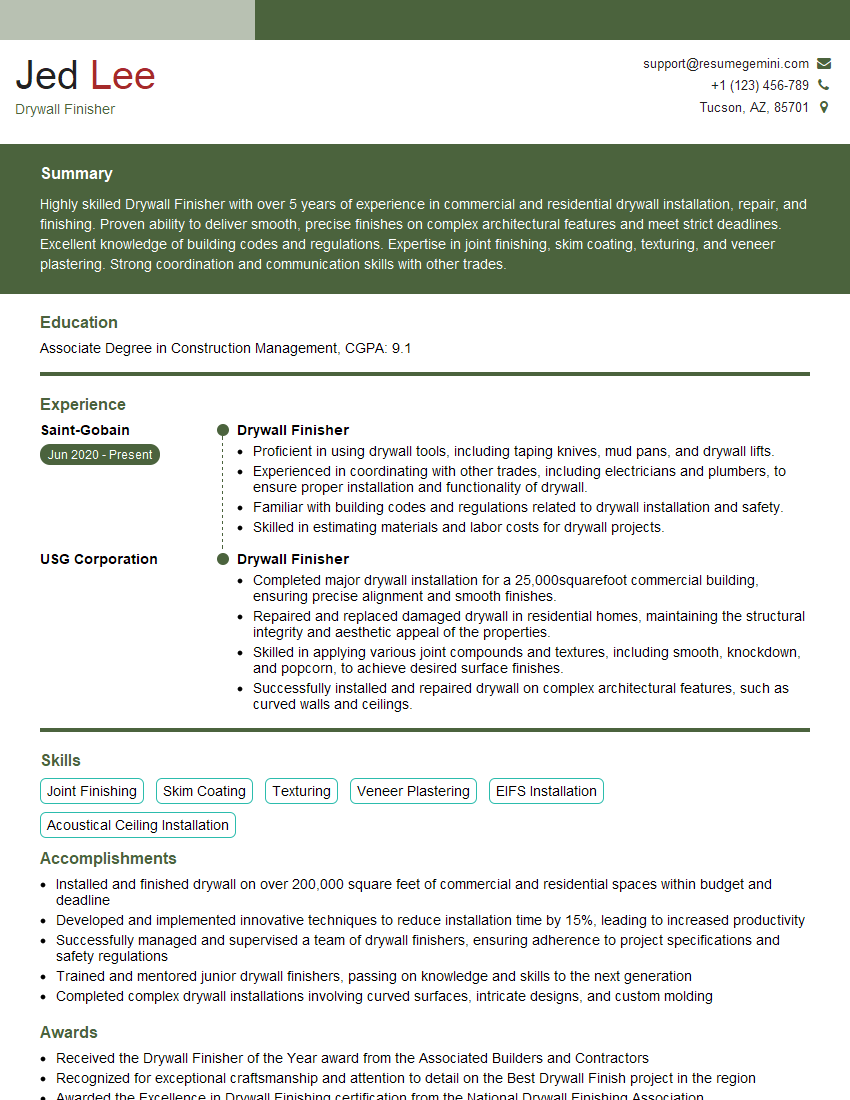
Mastering drywall sawing opens doors to a rewarding career with opportunities for growth and specialization. A strong resume is your key to unlocking these opportunities. Make sure your resume is ATS-friendly to get noticed by recruiters and hiring managers. Use ResumeGemini to build a professional and impactful resume that highlights your skills and experience effectively. ResumeGemini provides examples of resumes tailored specifically to the Drywall Sawing field, helping you create a document that showcases your qualifications in the best possible light. Take the next step in your career journey today!




Explore more articles
Users Rating of Our Blogs
Share Your Experience
We value your feedback! Please rate our content and share your thoughts (optional).
What Readers Say About Our Blog
Very informative content, great job.
good