Unlock your full potential by mastering the most common Efficient in Radio Communication and Signal Monitoring interview questions. This blog offers a deep dive into the critical topics, ensuring you’re not only prepared to answer but to excel. With these insights, you’ll approach your interview with clarity and confidence.
Questions Asked in Efficient in Radio Communication and Signal Monitoring Interview
Q 1. Explain the difference between amplitude modulation and frequency modulation.
Amplitude Modulation (AM) and Frequency Modulation (FM) are two fundamental techniques for transmitting information over radio waves. They differ in how the information is encoded onto the carrier wave.
In AM, the amplitude (height) of the carrier wave is varied in proportion to the instantaneous amplitude of the message signal. Think of it like shouting louder or softer – the loudness (amplitude) changes, but the pitch (frequency) remains constant. AM is simple to implement and demodulate, making it suitable for broadcasting applications like AM radio. However, it is susceptible to noise and interference.
In FM, the frequency of the carrier wave is varied in proportion to the instantaneous amplitude of the message signal. Imagine whistling a tune – the pitch (frequency) changes, but the loudness (amplitude) stays relatively consistent. FM offers better noise immunity than AM because noise affects the amplitude, not the frequency. FM radio broadcasting and some two-way radios utilize this technique.
In short: AM changes the amplitude, FM changes the frequency. This difference in encoding leads to differing performance characteristics, particularly concerning noise immunity.
Q 2. Describe different types of antennas and their applications.
Antennas are crucial components in any radio communication system. Their design and type significantly impact the system’s performance. Several types exist, each optimized for specific applications.
- Dipole Antennas: These simple antennas, consisting of two conductors of equal length, are commonly used for receiving and transmitting radio waves across a broad frequency range. A common example is the rabbit-ear antenna on older televisions.
- Yagi-Uda Antennas (Yagi Antennas): These directional antennas utilize multiple elements to achieve high gain and directivity. They are frequently used in satellite TV reception and long-range wireless communication due to their ability to focus signal strength in one direction.
- Patch Antennas: These planar antennas are widely used in mobile devices and wireless communication systems due to their compact size and ease of integration into printed circuit boards. They are commonly found in cell phones and laptops.
- Horn Antennas: These antennas have a flared opening that directs radio waves in a specific direction, offering high gain and improved directivity. They find applications in microwave systems and radar.
- Microstrip Antennas: These planar antennas are compact and easy to integrate into printed circuit boards, making them suitable for various applications, including GPS and Wi-Fi.
The choice of antenna depends heavily on factors like frequency of operation, desired gain, directivity requirements, size constraints, and the application environment.
Q 3. What are the key performance indicators (KPIs) for a radio communication system?
Key Performance Indicators (KPIs) for a radio communication system are crucial for assessing its effectiveness and identifying areas for improvement. They can be broadly categorized as:
- Signal Strength/Quality: Measured in terms of Received Signal Strength Indicator (RSSI) and signal-to-noise ratio (SNR), this indicates the reliability and strength of the received signal.
- Bit Error Rate (BER): This represents the proportion of erroneous bits received in relation to the total number of bits transmitted, directly impacting data integrity.
- Throughput/Data Rate: The amount of data successfully transmitted per unit of time; this determines the system’s efficiency in conveying information.
- Latency: The time delay between the transmission and reception of data. This is critical for real-time applications requiring low latency, like voice communication.
- Coverage Area: The geographical region where the system provides satisfactory signal strength and communication quality. Effective coverage is essential for widespread service.
- Availability: The percentage of time the system is operational and readily available for communication. High availability is critical for reliable service.
Monitoring these KPIs allows for proactive maintenance and optimization of the communication system.
Q 4. How do you troubleshoot signal interference in a wireless network?
Troubleshooting signal interference in a wireless network requires a systematic approach. Here’s a step-by-step guide:
- Identify the Problem: Determine the symptoms of interference, such as slow speeds, dropped connections, or intermittent connectivity. Note the time and location of these occurrences.
- Check the Obvious: Verify the network’s physical infrastructure, including cables, connectors, and antenna placement. Ensure that devices are properly connected and functioning correctly.
- Analyze Signal Strength: Use a network analyzer or Wi-Fi analyzer to measure signal strength and identify areas with weak or inconsistent signals. This often pinpoints the source of interference.
- Identify Potential Sources: Common sources include other Wi-Fi networks (overlapping channels), cordless phones, microwaves, Bluetooth devices, and even electrical devices. Check for devices operating on the same or adjacent frequencies.
- Change Channels: If multiple Wi-Fi networks are using the same channels, try switching your router’s channel to a less congested one. Most routers allow you to configure the Wi-Fi channel.
- Optimize Antenna Placement: Improper antenna placement can significantly impact signal strength and reception. Experiment with different locations to improve signal quality.
- Reduce Interference: Move interfering devices away from the router or use shielded cables to minimize interference.
- Firmware Updates: Ensure your router and other network devices have the latest firmware updates. These often include improvements in interference mitigation.
A combination of these steps usually helps isolate and resolve signal interference problems. If the problem persists, consider contacting a network professional.
Q 5. Explain the concept of signal-to-noise ratio (SNR) and its importance.
Signal-to-Noise Ratio (SNR) is a crucial metric in radio communication that measures the strength of the desired signal relative to the background noise. It’s expressed in decibels (dB).
A high SNR indicates a strong signal with minimal noise, resulting in high-quality communication. Think of it as trying to hear someone speak in a quiet room (high SNR) versus a noisy stadium (low SNR). In the stadium, the noise masks the speaker’s voice making it difficult to understand.
A low SNR implies a weak signal overwhelmed by noise, potentially leading to data corruption, errors, and unreliable communication. It directly impacts the clarity and fidelity of the received signal and impacts the success of signal detection and decoding.
Importance: SNR is fundamental for determining the quality and reliability of a communication system. A sufficient SNR is necessary for accurate data reception and reduces the likelihood of errors. Many communication systems specify a minimum SNR requirement for satisfactory performance.
Q 6. What are the common methods for signal detection and decoding?
Signal detection and decoding are critical processes in radio communication. They involve identifying and extracting the intended information from the received signal which may be corrupted by noise and interference.
- Matched Filtering: This technique is widely used for optimal signal detection in the presence of additive white Gaussian noise (AWGN). It involves correlating the received signal with a replica of the expected signal.
- Correlation Receivers: These receivers use correlation to detect the presence of a known signal in the received signal. They are robust to noise and often used in spread-spectrum communication.
- Energy Detection: This method involves measuring the energy in the received signal and comparing it to a threshold to determine the presence of a signal. It’s simple but less efficient than other methods.
- Cyclostationary Feature Detection: This approach exploits the periodic statistical properties of modulated signals to distinguish them from noise.
Decoding follows detection and depends on the modulation scheme used. Common decoding techniques include:
- Reed-Solomon Decoding: A powerful error-correcting code capable of correcting multiple errors in data transmission.
- Turbo Decoding: An iterative decoding algorithm that achieves near-Shannon-limit performance.
- Viterbi Decoding: An algorithm for decoding convolutional codes, commonly used in digital communication systems.
The choice of detection and decoding methods depends on factors like the modulation technique, channel characteristics, and the desired level of error correction.
Q 7. Describe different types of modulation techniques and their advantages/disadvantages.
Numerous modulation techniques exist, each with its advantages and disadvantages. Here are a few examples:
- Amplitude Shift Keying (ASK): The amplitude of the carrier wave changes to represent data bits. Simple to implement but susceptible to noise.
- Frequency Shift Keying (FSK): The frequency of the carrier wave changes to represent data bits. More robust to noise than ASK.
- Phase Shift Keying (PSK): The phase of the carrier wave changes to represent data bits. Offers better spectral efficiency than ASK and FSK.
- Quadrature Amplitude Modulation (QAM): Uses both amplitude and phase to transmit data. High spectral efficiency but more complex to implement.
- Orthogonal Frequency-Division Multiplexing (OFDM): Divides the signal into multiple orthogonal subcarriers. Robust to multipath fading, making it ideal for wireless communication.
Advantages and Disadvantages Summary:
| Modulation Technique | Advantages | Disadvantages |
|---|---|---|
| ASK | Simple | Susceptible to noise |
| FSK | Relatively robust to noise | Lower spectral efficiency |
| PSK | Better spectral efficiency than ASK/FSK | More complex than ASK/FSK |
| QAM | High spectral efficiency | Complex, susceptible to noise |
| OFDM | Robust to multipath fading | Complex implementation |
The optimal choice depends on the specific application requirements, balancing factors like bandwidth efficiency, power consumption, complexity, and robustness to noise and interference.
Q 8. Explain the concept of frequency hopping spread spectrum (FHSS).
Frequency Hopping Spread Spectrum (FHSS) is a modulation technique used in radio communication to enhance security and resistance to interference. Imagine a conversation happening across multiple phone lines – FHSS rapidly switches the communication frequency among a predefined set of frequencies, making it difficult for an interceptor to listen in continuously.
Here’s how it works: The transmitter and receiver agree on a pseudorandom sequence of frequencies. The transmitter hops between these frequencies at a specific rate. The receiver, using the same pseudorandom sequence, jumps to the corresponding frequencies to receive the transmitted data. This rapid hopping makes it difficult for narrowband interference to disrupt the entire communication, as the interference will only affect the signal during the brief time it occupies that particular frequency. It also provides a degree of security as an eavesdropper needs to know both the hopping sequence and the frequencies used.
Example: Bluetooth uses FHSS to allow multiple devices to communicate concurrently without significant interference. The hopping rate and frequencies are standardized within Bluetooth specifications.
Q 9. How does a spectrum analyzer work?
A spectrum analyzer is like a sophisticated radio receiver that displays the power of radio frequencies within a specified range. Think of it as a visual representation of the radio landscape. It’s a crucial tool for identifying signals, measuring their strength, and detecting interference. It works by receiving radio signals, separating them based on their frequencies, and then presenting this data as a graph, showing the signal strength (often in dBm) plotted against frequency (typically in MHz or GHz).
The core process involves several steps:
- Signal Reception: The analyzer receives the radio waves through an antenna.
- Signal Mixing: A mixer downconverts the received signals to a lower, intermediate frequency (IF) for easier processing.
- Signal Amplification: Amplifiers boost the signal to a suitable level for accurate measurement.
- Signal Filtering: Filters select the desired frequency range.
- Signal Detection: A detector measures the power of the signal.
- Signal Display: The processed data is displayed on a screen as a graph or spectrum.
Practical Application: Spectrum analyzers are essential for troubleshooting communication systems, identifying sources of interference, and ensuring compliance with regulatory standards. Engineers utilize them in diverse fields including wireless communications, broadcast engineering, and radar systems.
Q 10. What are the regulatory requirements for radio communication in your region?
Regulatory requirements for radio communication vary significantly depending on the region. For this response, I will focus on a hypothetical region, but note that actual regulations must be checked with relevant authorities. In this hypothetical region, the primary regulatory body, let’s call it the ‘National Communications Authority (NCA)’, dictates the allocation of radio frequencies, power limits, and emission standards.
Key aspects of regulation would include:
- Frequency Allocation: Specific frequency bands are assigned for different purposes (e.g., cellular, Wi-Fi, broadcasting). Using an unauthorized frequency is illegal.
- Power Limits: Transmitters must adhere to maximum power output levels to prevent interference. These limits are often frequency-dependent.
- Emission Standards: Regulations specify the allowed levels of spurious emissions (unwanted signals outside the designated frequency band) to minimize interference with other systems.
- Licensing: Certain radio services require licenses (e.g., broadcast stations, cellular networks) to operate legally. This often involves technical demonstrations of compliance with regulations.
- Equipment Certification: Radio equipment intended for use in this region usually needs to undergo testing and receive certification to demonstrate compliance before it can be legally sold or used.
Failure to comply with these regulations can result in substantial fines or legal action.
Q 11. Explain the concept of channel capacity and how it’s affected by noise and interference.
Channel capacity refers to the maximum rate of data transmission over a communication channel. Think of it as the maximum amount of information you can send reliably through a pipe per unit of time. It’s heavily influenced by two key factors: noise and interference.
Noise: Noise represents unwanted signals that corrupt the transmitted signal. Thermal noise (due to the random motion of electrons) and atmospheric noise are common examples. Higher noise levels reduce the signal-to-noise ratio (SNR), decreasing the channel capacity.
Interference: Interference comes from other signals operating on or near the same frequency. This can cause the signals to overlap, making it hard to distinguish the desired signal from the interference. Interference also reduces SNR and consequently, the channel capacity.
The Shannon-Hartley Theorem provides a mathematical model for channel capacity:
C = B * log₂(1 + SNR)
Where:
Cis the channel capacity (bits per second)Bis the bandwidth of the channel (Hertz)SNRis the signal-to-noise ratio
This equation shows that increasing bandwidth or improving the SNR directly increases the channel capacity. Techniques like error correction codes and modulation schemes help improve the effective channel capacity by mitigating the impact of noise and interference.
Q 12. What are the different types of wireless protocols (e.g., Wi-Fi, Bluetooth, Zigbee)?
Wireless protocols define the rules and standards for communication over a wireless medium. Several protocols cater to different needs and applications. Here are some common examples:
- Wi-Fi (IEEE 802.11): Widely used for local area networks (LANs), offering relatively high bandwidth and moderate range. It’s based on the 802.11 standard and has several variations (a, b, g, n, ac, ax) with differing speeds and capabilities.
- Bluetooth (IEEE 802.15.1): A short-range, low-power protocol used for connecting devices like headsets, keyboards, and smartphones. It offers convenient, low-energy communication for personal area networks (PANs).
- Zigbee (IEEE 802.15.4): A low-power, low-data-rate protocol ideal for sensor networks and smart home applications. It’s designed for longer battery life and simpler network management than other protocols.
- Cellular (e.g., 4G LTE, 5G): Used for mobile communication, providing high bandwidth and wide coverage areas. Different generations (2G, 3G, 4G, 5G) offer progressively higher speeds and capabilities.
- LoRaWAN (Long Range Wide Area Network): Designed for long-range, low-power communication suitable for IoT applications covering large geographical areas.
The choice of protocol depends on factors such as required data rate, range, power consumption, cost, and security needs.
Q 13. Describe your experience with RF testing and measurement equipment.
My experience with RF testing and measurement equipment is extensive. I’ve worked with a wide range of instruments, from basic signal generators and spectrum analyzers to sophisticated network analyzers and channel emulators.
Specific examples include:
- Using spectrum analyzers to identify and characterize interference in wireless communication systems.
- Employing signal generators to test the performance of receivers under various conditions (e.g., different signal strengths, noise levels).
- Utilizing network analyzers to measure the scattering parameters (S-parameters) of antennas and RF components.
- Working with channel emulators to simulate real-world propagation conditions for robust testing.
- Experience with power meters and antenna analyzers for comprehensive RF characterization.
I am proficient in using both standalone instruments and integrated test systems. I also have experience with software-defined radio (SDR) platforms which offer increased flexibility in signal processing and analysis.
Q 14. How do you perform signal strength measurements and analysis?
Signal strength measurements and analysis involve quantifying and interpreting the power of a radio signal at a specific location. This is crucial for understanding coverage areas, identifying potential problems, and optimizing system performance.
The process generally includes:
- Selection of Measurement Equipment: A spectrum analyzer, power meter, or a dedicated signal strength meter is selected based on the required accuracy and frequency range.
- Antenna Selection: The choice of antenna depends on the frequency and desired measurement characteristics (e.g., directivity).
- Measurement Setup: The equipment is calibrated, and the antenna is appropriately positioned for accurate measurements.
- Data Acquisition: Signal strength is measured at multiple locations, providing a spatial map of signal coverage. This might involve driving a vehicle with measurement equipment to map a larger area or walking with portable equipment for more detailed readings.
- Data Analysis: Measured data is analyzed to identify areas of weak signal coverage, interference sources, and overall signal quality. Graphs and maps are often created to visualize the results.
- Report Generation: A report summarizing the measurements, analysis, and conclusions is often generated.
Example: In a cellular network deployment, signal strength measurements are vital for optimizing base station placement and ensuring adequate coverage for users. Low signal strength in certain areas could indicate the need to add more base stations or improve antenna configuration.
Q 15. Explain the concept of time division multiple access (TDMA).
Time Division Multiple Access (TDMA) is a channel access method where multiple users share the same frequency channel by dividing the time into slots. Imagine a highway with only one lane – TDMA is like assigning each car a specific time slot to use that lane. Each user gets exclusive use of the channel for a short period, then it’s passed on to the next user. This avoids interference because only one user transmits at any given time.
How it works: A frame is created, divided into time slots. Each user is assigned a unique time slot within that frame. The users transmit their data only during their allocated time slot. Synchronization is crucial to ensure users transmit and receive in their assigned slots. This often involves a common timing signal.
Example: GSM (Global System for Mobile Communications) uses TDMA. Each cell tower’s frequency is divided into multiple time slots, allowing multiple calls to be carried simultaneously on the same frequency.
Advantages: Simple to implement, relatively efficient spectrum utilization.
Disadvantages: Susceptible to timing errors, requires precise synchronization, less flexible than other techniques.
Career Expert Tips:
- Ace those interviews! Prepare effectively by reviewing the Top 50 Most Common Interview Questions on ResumeGemini.
- Navigate your job search with confidence! Explore a wide range of Career Tips on ResumeGemini. Learn about common challenges and recommendations to overcome them.
- Craft the perfect resume! Master the Art of Resume Writing with ResumeGemini’s guide. Showcase your unique qualifications and achievements effectively.
- Don’t miss out on holiday savings! Build your dream resume with ResumeGemini’s ATS optimized templates.
Q 16. Explain the concept of code division multiple access (CDMA).
Code Division Multiple Access (CDMA) is a channel access method where multiple users share the same frequency channel simultaneously by using different codes. Think of it like many people speaking at once in a crowded room, but each person speaking a different language. Each user’s signal is encoded with a unique code, and the receiver uses the same code to decode only the intended signal, filtering out the others.
How it works: Each user is assigned a unique spreading code. This code is used to spread the user’s signal across a wider bandwidth. The receiver uses the complementary code to despread and reconstruct the signal. The codes are designed to be orthogonal (meaning they don’t interfere with each other).
Example: CDMA was used in older 3G cellular networks (like CDMA2000) and some satellite communication systems. GPS also utilizes a form of CDMA.
Advantages: Soft handoff (smooth transition between cells), better performance in multipath environments, high capacity.
Disadvantages: More complex implementation, susceptible to near-far effect (stronger signals can overwhelm weaker ones).
Q 17. Explain the concept of orthogonal frequency-division multiplexing (OFDM).
Orthogonal Frequency-Division Multiplexing (OFDM) is a modulation scheme that divides a high-rate data stream into several lower-rate data streams and transmits them simultaneously over multiple orthogonal subcarriers. Imagine sending a large package by breaking it into many smaller packages and sending them simultaneously on different transport methods (like trains, trucks, and airplanes). This method makes it more resistant to interference and multipath effects.
How it works: A high-rate data stream is divided into several lower-rate data streams. Each stream is modulated onto a separate subcarrier frequency. The subcarriers are orthogonal, meaning they don’t interfere with each other at the receiver. A cyclic prefix is added to each OFDM symbol to mitigate inter-symbol interference (ISI) caused by multipath propagation.
Example: OFDM is used widely in Wi-Fi (802.11a/g/n/ac/ax), WiMAX, LTE (4G), and 5G cellular networks. Digital Video Broadcasting (DVB) also uses OFDM.
Advantages: High spectral efficiency, robust against multipath fading, high data rates.
Disadvantages: High computational complexity at both the transmitter and receiver, sensitive to frequency synchronization errors.
Q 18. What are the challenges of designing efficient radio communication systems?
Designing efficient radio communication systems presents several significant challenges:
- Multipath Propagation: Signals reflecting off multiple surfaces can lead to signal distortion and fading.
- Noise and Interference: Atmospheric noise, thermal noise, and interference from other sources can corrupt signals.
- Limited Bandwidth: The available radio frequency spectrum is a scarce resource.
- Power Constraints: Transmitter power must be carefully managed to conserve energy and comply with regulations.
- Security Threats: Protecting communication data from eavesdropping and unauthorized access is critical.
- Mobility Management: Handoff procedures and efficient cell management are crucial in mobile networks.
- Cost and Complexity: Balancing performance, cost, and complexity in system design.
Addressing these challenges requires careful system design, advanced signal processing techniques, efficient modulation schemes, and robust error-correction codes.
Q 19. How do you address issues related to multipath propagation?
Multipath propagation is a major challenge in radio communication, causing signal fading and distortion. Several techniques can be used to mitigate its effects:
- Equalization: This technique uses digital signal processing to compensate for the distortion caused by multipath. Adaptive equalizers adjust to changing channel conditions.
- Diversity Techniques: Using multiple antennas (spatial diversity), different frequencies (frequency diversity), or different time slots (temporal diversity) can improve signal reliability. If one signal path is weak, another may be strong.
- Coding Techniques: Error-correction codes can help correct errors introduced by multipath fading. Forward Error Correction (FEC) is commonly employed.
- OFDM: As mentioned earlier, the use of multiple orthogonal subcarriers in OFDM provides inherent robustness to multipath fading.
The choice of technique depends on the specific application and the characteristics of the propagation environment. Often a combination of techniques is employed for optimal performance.
Q 20. How do you ensure the security of a radio communication system?
Ensuring the security of a radio communication system is crucial to protect sensitive information. Several measures can be taken:
- Encryption: Encrypting the data using strong encryption algorithms prevents unauthorized access to the information.
- Authentication: Verifying the identity of communicating parties ensures that only legitimate users can access the system.
- Access Control: Restricting access to the system and its resources based on user roles and permissions.
- Data Integrity Checks: Using checksums or other methods to verify that data has not been altered during transmission.
- Frequency Hopping: Changing the communication frequency periodically makes it harder for eavesdroppers to intercept the signal.
- Spread Spectrum Techniques: Spread spectrum techniques make it difficult for unauthorized receivers to decode the signal.
Security measures should be carefully chosen based on the specific needs of the system and the sensitivity of the data being transmitted. A layered approach, combining multiple security techniques, is often the most effective.
Q 21. Describe your experience with different types of modulation schemes (e.g., ASK, FSK, PSK).
My experience encompasses a wide range of modulation schemes, including Amplitude Shift Keying (ASK), Frequency Shift Keying (FSK), and Phase Shift Keying (PSK), and their variations (e.g., QPSK, 8PSK, etc.).
ASK: ASK represents digital data by changing the amplitude of a carrier wave. Simple to implement, but susceptible to noise. Used in simpler remote control systems.
FSK: FSK represents digital data by changing the frequency of a carrier wave. More robust to noise than ASK. Used in some older modems and data transmission systems.
PSK: PSK represents digital data by changing the phase of a carrier wave. More spectrally efficient than ASK and FSK, offering higher data rates for the same bandwidth. QPSK (Quadrature PSK) and higher-order PSK are widely used in modern digital communication systems like satellite communications and cellular networks. For instance, I’ve worked on optimizing QPSK performance in a high-interference environment by implementing advanced equalization techniques.
In my work, I’ve often had to select the optimal modulation scheme based on factors such as bandwidth constraints, power limitations, noise levels, and required data rate. The selection process involves trade-offs between spectral efficiency, power efficiency, and robustness to noise and interference.
Q 22. What are the advantages and disadvantages of using different antenna types?
Choosing the right antenna is crucial for efficient radio communication. Different antenna types offer varying advantages and disadvantages depending on the specific application and environment. Let’s explore some common types:
- Dipole Antennas: These are simple, relatively inexpensive, and offer a good balance of performance. However, their gain is moderate, and their radiation pattern is omnidirectional in the horizontal plane – meaning they radiate equally in all directions, which can be both an advantage and a disadvantage depending on your needs. They’re often used in amateur radio and some broadcast applications.
- Yagi-Uda Antennas (Yagi Antennas): These directional antennas offer high gain and directivity, focusing the signal in a specific direction. This is ideal for point-to-point communication where you want to maximize signal strength in a particular area, reducing interference from other sources. However, they are more complex to design and build, and their performance is highly dependent on frequency and orientation.
- Patch Antennas: These are compact, low-profile antennas often integrated into devices like smartphones and laptops. They are suitable for applications where space is limited, but their gain is typically lower than other types. They’re commonly found in mobile devices and WiFi systems.
- Horn Antennas: These antennas provide a wider bandwidth and are often used in applications requiring high gain and precise beam control, such as satellite communications or microwave links. They are, however, bulky and not as easily portable as some other options.
In short: The ‘best’ antenna depends entirely on your needs. Factors to consider include desired gain, directivity, size constraints, frequency range, and environmental factors like multipath propagation. A poorly chosen antenna can severely limit range and performance, even if other parts of the system are well-designed.
Q 23. How do you design a robust and reliable radio communication system?
Designing a robust and reliable radio communication system involves careful consideration of several key factors. It’s an iterative process of planning, testing, and refinement.
- Link Budget Analysis: This crucial step involves meticulously calculating the signal power at the receiver, taking into account transmit power, antenna gains, path loss, and other factors. This ensures sufficient signal strength to overcome noise and interference.
- Channel Modeling and Propagation Prediction: Understanding the radio propagation environment is crucial. Free-space path loss models can provide a basic estimate, but for realistic scenarios, we need more sophisticated models (like those incorporating multipath and shadowing effects). This allows us to predict signal strength and fading characteristics.
- Error Correction Coding: Using techniques like Reed-Solomon or turbo codes allows us to add redundancy to the transmitted data. This helps to correct errors introduced by noise and fading, ensuring data integrity.
- Diversity Techniques: These techniques aim to mitigate the effects of fading by employing multiple antennas or receivers. Spatial diversity uses multiple antennas, exploiting the fact that fading is rarely correlated across different locations. Frequency diversity uses multiple frequencies. Time diversity uses multiple transmissions over time.
- Power Control: Adapting the transmit power based on the channel conditions can significantly improve reliability and battery life. This is particularly important in mobile communication.
- Appropriate Modulation Scheme: Choosing a robust modulation scheme (like M-QAM or OFDM) that can tolerate a certain level of noise and interference is vital for reliable communication. OFDM, in particular, is resilient against multipath fading.
Example: In a critical application like emergency services, a system might employ multiple redundant communication paths, error-correction coding, diversity techniques, and automatic power control to ensure reliable communication even under adverse conditions.
Q 24. Explain your experience with digital signal processing (DSP) techniques in radio communication.
My experience with digital signal processing (DSP) in radio communication is extensive. DSP techniques are fundamental to modern radio systems, allowing us to process and manipulate signals in ways that were impossible with analog methods. I’ve utilized DSP for:
- Demodulation and Modulation: Implementing and optimizing digital modulation schemes (like QAM, OFDM, and FSK) is a key aspect. I have experience designing and implementing demodulators using various algorithms such as matched filtering and maximum likelihood estimation.
- Equalization: In wireless channels, signals suffer from multipath distortion. I’ve worked with various equalization techniques (e.g., linear equalization, decision feedback equalization) to compensate for this distortion and improve data integrity.
- Channel Estimation: Accurately estimating the characteristics of the wireless channel is crucial for effective equalization and other signal processing tasks. I’m familiar with pilot-symbol-assisted channel estimation techniques.
- Filtering: I’ve used various digital filter designs (FIR, IIR) to remove noise, interference, and unwanted frequency components from received signals.
- Synchronization: Precise timing and carrier frequency synchronization is crucial for reliable demodulation. I have worked with algorithms such as clock recovery and carrier phase estimation.
Example: In one project, I implemented a complex OFDM receiver using MATLAB and a dedicated DSP platform. This involved designing channel estimators, equalizers, and demodulators, optimizing for low latency and high throughput. I carefully evaluated different algorithms and chose the most appropriate ones for the specific system requirements.
Q 25. How do you mitigate the effects of fading in wireless communication?
Fading, the variation in signal strength over time or location, is a major challenge in wireless communication. Several techniques can mitigate its effects:
- Diversity Techniques: As mentioned earlier, employing multiple antennas (spatial diversity), frequencies (frequency diversity), or transmission times (time diversity) allows exploitation of the fact that fading is rarely correlated across different dimensions. If one signal fades, others may be stronger, thereby improving overall reliability.
- Adaptive Modulation and Coding: This involves adjusting the modulation scheme and coding rate based on the instantaneous channel conditions. When the channel is good, higher data rates can be used. When fading is severe, lower rates provide more reliability.
- Equalization: Sophisticated equalization algorithms, as discussed previously, can compensate for the distortions caused by multipath fading.
- Interleaving: This technique spreads the data across time or frequency, reducing the impact of burst errors caused by fading. If a burst of errors occurs, the impact is reduced because the data is scattered.
- Power Control: Adjusting the transmit power dynamically based on channel conditions can improve reliability in fading environments, reducing the likelihood of deep fades.
Example: In a cellular network, a base station might use adaptive modulation and coding to switch between different modulation schemes depending on the signal strength from a mobile device. This ensures that data is transmitted efficiently during good channel conditions, while maintaining reliability during fades.
Q 26. Explain your experience with different types of radio propagation models (e.g., free space, two-ray).
My experience encompasses various radio propagation models, each suited to different scenarios. Here are a few:
- Free Space Path Loss (FSPL): This model provides a basic estimate of signal attenuation in free space, assuming no obstacles. It’s a good starting point for link budget calculations but doesn’t account for real-world factors. The formula is:
P_r = P_t * G_t * G_r * λ² / (4πd)²whereP_ris received power,P_tis transmitted power,G_tandG_rare antenna gains,λis wavelength, anddis distance.- Two-Ray Ground Reflection Model: This model considers both the direct path and the ground-reflected path between transmitter and receiver. It provides a more accurate prediction than FSPL, especially at lower frequencies and shorter distances. It accounts for constructive and destructive interference due to path differences.
- Ray Tracing: This sophisticated technique simulates the propagation of radio waves by tracing multiple rays reflecting and diffracting from various obstacles in the environment. It provides highly accurate predictions, but it’s computationally intensive.
- Empirical Models (e.g., Okumura-Hata, COST-231): These models are based on extensive measurements and provide statistical estimates of path loss in specific environments (urban, suburban, rural). They are widely used in system design and planning.
Practical Application: In planning a cellular network, I might use the Okumura-Hata model to estimate coverage areas in urban environments, incorporating factors like building density and antenna heights. For a point-to-point microwave link, I’d likely employ ray tracing to accurately predict signal strength and account for terrain features.
Q 27. How do you use signal processing tools to analyze and interpret radio signals?
Signal processing tools are essential for analyzing and interpreting radio signals. My experience involves using tools like MATLAB, Python (with libraries like SciPy and NumPy), and specialized software packages for signal analysis. These tools allow for:
- Signal Visualization: Plotting time-domain and frequency-domain representations (waveforms, spectrograms) helps to identify key characteristics of signals, such as modulation type, frequency components, and noise levels.
- Signal Filtering and Processing: Applying filters to remove noise, interference, and unwanted frequency components is a key step in signal analysis. I use both time-domain and frequency-domain filters.
- Feature Extraction: Identifying relevant features from the signal (e.g., signal strength, modulation parameters, time of arrival) is essential for tasks like signal classification and detection.
- Signal Classification and Detection: Using machine learning techniques to automatically classify signals based on their characteristics (e.g., identifying different types of modulation) is a growing area of importance.
- Parameter Estimation: Estimating parameters such as signal amplitude, frequency, phase, and time delay is crucial for signal synchronization and decoding.
Example: In a radio monitoring application, I might use MATLAB to analyze a captured signal, apply various filtering techniques to isolate the signal of interest, then perform parameter estimation to extract relevant information. This information could be used to identify the source of the signal, its modulation type, or its data content.
Q 28. Describe your experience with software-defined radio (SDR) technology.
Software-defined radio (SDR) technology offers unprecedented flexibility and programmability in radio communication systems. My experience includes working with various SDR platforms, including USRPs and software packages such as GNU Radio. I have used SDRs for:
- Prototype development and testing: SDRs allow rapid prototyping and testing of various modulation schemes, communication protocols, and signal processing algorithms without requiring dedicated hardware for each configuration. This speeds up development cycles considerably.
- Cognitive Radio Applications: SDRs are ideal for implementing cognitive radio systems, which can dynamically adapt to changing channel conditions and available spectrum resources. They are central to dynamically allocating spectrum based on need.
- Radio Monitoring and Spectrum Sensing: SDRs can be used to monitor the radio frequency spectrum and detect unused frequency bands or identify potential sources of interference, facilitating efficient spectrum management.
- Custom Receiver and Transmitter Designs: SDR allows creating custom receivers and transmitters tailored to specific application needs, offering enhanced flexibility compared to using off-the-shelf hardware.
Example: In a project involving spectrum sensing, I used a USRP to implement a wideband receiver capable of simultaneously monitoring multiple frequency bands. The data acquired was then processed using GNU Radio to identify potential sources of interference and assess the availability of specific frequencies. This helped in optimizing frequency allocation.
Key Topics to Learn for Efficient in Radio Communication and Signal Monitoring Interview
- Fundamentals of Radio Wave Propagation: Understanding factors affecting signal strength, range, and attenuation (e.g., frequency, terrain, atmospheric conditions).
- Radio Frequency (RF) Systems: Knowledge of transmitters, receivers, antennas, and their characteristics. Practical application: Troubleshooting RF system performance issues.
- Signal Modulation and Demodulation Techniques: Understanding various modulation schemes (AM, FM, digital modulation) and their strengths and weaknesses. Practical application: Analyzing modulated signals to extract information.
- Signal Processing Techniques: Familiarity with filtering, amplification, and signal detection methods. Practical application: Designing and implementing signal processing algorithms for noise reduction and signal enhancement.
- Spectrum Analysis and Monitoring: Understanding spectrum analyzers and their use in identifying and analyzing radio signals. Practical application: Identifying sources of interference and managing spectrum usage.
- Digital Signal Processing (DSP) in Radio Communication: Applying DSP techniques for signal processing, error correction, and data compression. Practical application: Improving the efficiency and reliability of radio communication systems.
- Security in Radio Communication: Understanding encryption techniques and protocols used to secure radio transmissions. Practical application: Implementing security measures to protect sensitive information.
- Troubleshooting and Problem-Solving: Developing systematic approaches to diagnosing and resolving issues in radio communication and signal monitoring systems.
- Relevant Standards and Regulations: Familiarity with industry standards and regulations related to radio frequency usage and spectrum management.
Next Steps
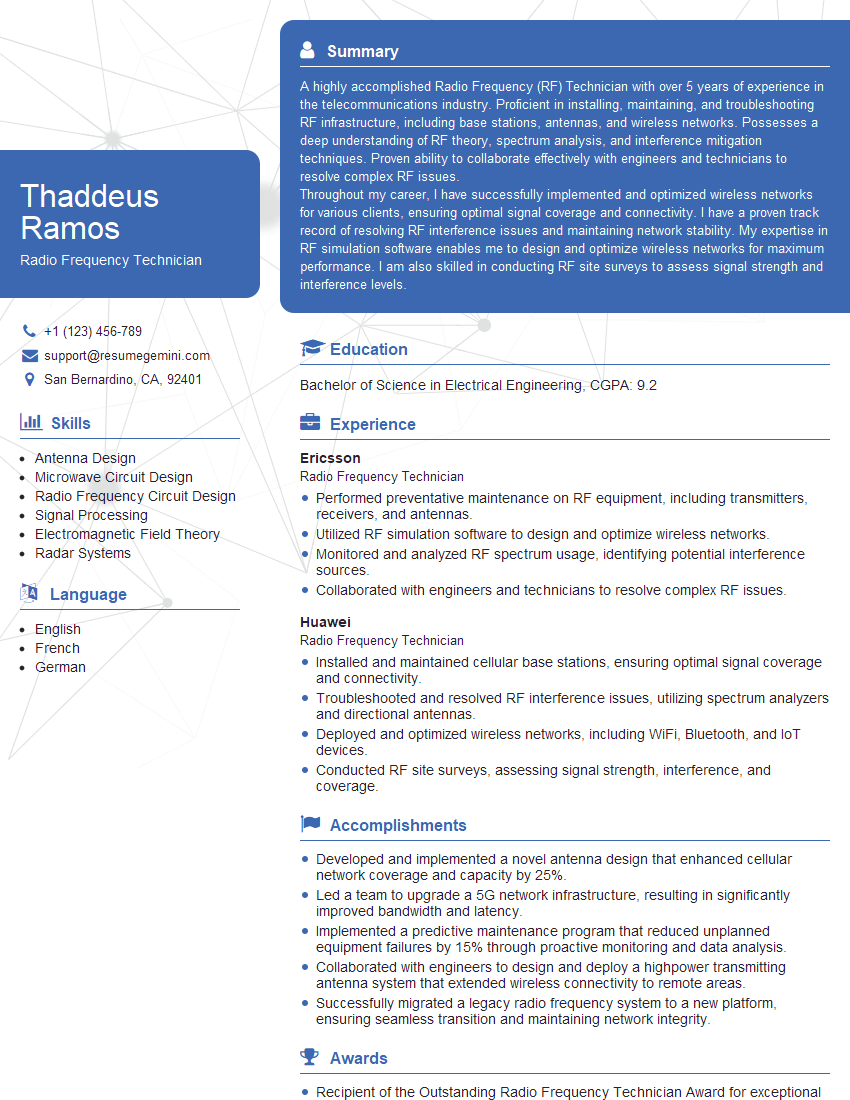
Mastering efficient radio communication and signal monitoring is crucial for a successful career in this dynamic field. Strong skills in this area open doors to exciting opportunities and demonstrate a valuable expertise to potential employers. To significantly boost your job prospects, creating an ATS-friendly resume is essential. ResumeGemini is a trusted resource to help you build a professional and impactful resume that showcases your qualifications effectively. Examples of resumes tailored to Efficient in Radio Communication and Signal Monitoring are available within ResumeGemini to help guide your resume creation. Invest the time to craft a compelling resume – it’s your first impression and a key factor in landing your dream job.
Explore more articles
Users Rating of Our Blogs
Share Your Experience
We value your feedback! Please rate our content and share your thoughts (optional).
What Readers Say About Our Blog
Very informative content, great job.
good