Interviews are opportunities to demonstrate your expertise, and this guide is here to help you shine. Explore the essential Electrical Component Handling and Placement interview questions that employers frequently ask, paired with strategies for crafting responses that set you apart from the competition.
Questions Asked in Electrical Component Handling and Placement Interview
Q 1. Explain the difference between Surface Mount Technology (SMT) and Through-Hole Technology (THT).
Surface Mount Technology (SMT) and Through-Hole Technology (THT) are two fundamental methods for mounting electronic components onto printed circuit boards (PCBs). The key difference lies in how the components are attached.
- SMT: Components are placed directly onto the surface of the PCB and soldered to surface mount pads. These components are typically smaller and more compact, leading to smaller PCBs. Think of it like sticking tiny LEGO bricks directly onto a baseplate.
- THT: Components have leads (legs) that are inserted through holes in the PCB and soldered on the underside. This method is often used for larger components or those requiring more robust connections. Imagine pushing the legs of a larger LEGO piece through holes and then securing it from below.
SMT is now the dominant technology due to its efficiency, miniaturization capabilities, and automation potential. However, THT still finds its niche in applications requiring high power handling or robust connections.
Q 2. Describe the process of component placement using a pick-and-place machine.
Pick-and-place machines are automated systems used in electronics manufacturing to precisely place electronic components onto a PCB. The process typically involves these steps:
- Component Recognition: The machine identifies and verifies the type and orientation of the component using vision systems.
- Pick-up: A vacuum nozzle or other pick-up mechanism lifts the component from its feeder (a tray holding many components).
- Placement: The component is moved to the designated location on the PCB with high precision, guided by the machine’s vision and control system.
- Verification: Post-placement verification sometimes occurs to ensure accurate positioning.
The speed and precision of pick-and-place machines are crucial for high-volume manufacturing. Modern machines can place thousands of components per hour with incredible accuracy. This efficiency is a key factor in modern electronics manufacturing.
Q 3. What are the common causes of component misalignment during placement?
Component misalignment during placement can stem from several sources:
- Inaccurate component feeder settings: Incorrectly set feeders can lead to the component being fed at the wrong angle or position.
- Vacuum nozzle issues: A faulty nozzle may not grip the component securely, leading to tilting or dropping.
- PCB defects: Warped or damaged PCBs can affect the placement accuracy.
- Machine calibration problems: A poorly calibrated machine will produce inaccurate placement results.
- Static electricity: Static discharge can affect the pick-up and placement of sensitive components.
- Software errors: Errors in the pick-and-place program can cause components to be placed incorrectly.
Addressing these issues often involves careful machine maintenance, regular calibration, and precise component handling techniques.
Q 4. How do you ensure proper component orientation during placement?
Ensuring proper component orientation is critical for successful soldering and PCB functionality. Several strategies are used:
- Component Feeders: Feeders are designed to orient components correctly. Careful attention to the feeder design and orientation is crucial.
- Vision Systems: Sophisticated vision systems within the pick-and-place machine identify component orientation and adjust the pick-up accordingly.
- Polarity Marks: Components often have markings (dots, notches, or other indicators) to show correct orientation. The pick-and-place machine is programmed to recognize these marks.
- Mechanical Constraints: Some machines use mechanical guides to enforce correct orientation during placement.
Failure to ensure proper orientation can lead to short circuits, incorrect functionality, and even irreparable damage to the PCB.
Q 5. What are the different types of soldering techniques used in electronics assembly?
Several soldering techniques are used in electronics assembly, each with its advantages and disadvantages:
- Reflow Soldering: Primarily used for SMT, where solder paste is applied to the PCB pads, components are placed, and then the assembly is heated in a reflow oven to melt the solder and create the joints. This is the most common method for SMT.
- Wave Soldering: Commonly used for THT, where the PCB is passed over a wave of molten solder, allowing solder to flow onto the component leads. It’s a very high-throughput technique.
- Hand Soldering: Used for smaller-scale production, prototyping, or repairs, employing a soldering iron to manually melt the solder.
- Selective Soldering: For both SMT and THT, it selectively applies solder to specific components or areas of a PCB, often used to reduce material costs and improve control.
The choice of soldering technique depends heavily on factors such as the scale of production, component type, and cost considerations.
Q 6. Explain the importance of solder paste application in SMT.
Solder paste is a crucial element in SMT. It’s a mixture of tiny solder spheres and a flux, applied to the PCB pads before component placement. Its importance is multi-faceted:
- Solder Joint Formation: The solder paste provides the solder material for creating the joints between the component and the PCB.
- Component Adhesion: It helps temporarily hold the components in place before reflow soldering.
- Fluxing Action: The flux in the paste cleans and prepares the surfaces for soldering, improving the quality and reliability of the joints.
- Uniformity: Consistent solder paste application ensures even solder joints.
Inadequate solder paste application can lead to poor solder joints, causing components to become detached or malfunction.
Q 7. Describe the process of reflow soldering.
Reflow soldering is a crucial step in SMT. It’s a process where the assembled PCB (with components and solder paste) is passed through a reflow oven. Here’s a breakdown:
- Preheating: The PCB is gradually heated to drive off solvents from the solder paste and reduce thermal shock.
- Reflow Zone: The PCB reaches a temperature where the solder melts, forming strong joints between the component leads and the pads.
- Cooling Zone: The PCB is gradually cooled to solidify the solder joints.
Precise temperature profiles are crucial to ensure proper solder reflow without damaging the components. This profile is carefully controlled and optimized depending on the components used. Improper reflow can result in bridging between pads, insufficient solder, or even damage to sensitive components. Think of it as carefully baking a cake – the right temperature and timing are essential for a perfect result.
Q 8. What are the common defects found in soldered joints?
Solder joint defects are common issues in electronics assembly that can significantly impact the reliability and functionality of a product. These defects arise from various factors during the soldering process, including improper technique, insufficient heat, or contaminated materials. Common defects include:
- Cold Solder Joints: These joints appear dull, lack a shiny, concave meniscus, and have poor mechanical strength. They are caused by insufficient heat during soldering, resulting in poor wetting of the solder to the components.
- Solder Bridging: This occurs when excess solder connects two or more adjacent leads or pads unintentionally. This causes short circuits and malfunction.
- Insufficient Solder: A lack of sufficient solder creates a weak connection, leaving the joint susceptible to failure.
- Excess Solder: Excessive solder, like bridging, can cause shorts and overheating.
- Solder Balls: Small spheres of solder that form during the soldering process and can cause shorts or open circuits.
- Tombstoning: This happens when one lead of a component is soldered while the other isn’t, causing the component to stand upright resembling a tombstone.
- Head-in-pillow: Similar to tombstoning, but the component is tilted due to uneven soldering.
Identifying and addressing these defects is crucial for ensuring the quality and longevity of electronic devices.
Q 9. How do you identify and correct solder bridging?
Solder bridging is easily identifiable under magnification as a blob of solder connecting two or more pins or pads that shouldn’t be connected. It often results in short circuits, leading to device malfunction.
Correction involves carefully removing the excess solder. This can be done using various methods:
- Solder Wick: A braided copper mesh that absorbs molten solder when applied to the bridge and heated with a soldering iron. This is a common and effective method for smaller bridges.
- Solder Sucker/Vacuum Pen: A tool that uses suction to remove molten solder. Useful for smaller bridges, but requires precision.
- Desoldering Braid: Similar to solder wick but offers finer control.
- Hot Air Rework Station: For more complex or delicate situations, a hot air rework station can be used to carefully melt the solder bridge without damaging nearby components. This often requires more skill and experience.
After removing the bridge, it’s crucial to inspect the joint visually to ensure a clean and properly soldered connection is established.
Q 10. How do you identify and correct cold solder joints?
Cold solder joints are characterized by a dull, grayish, and uneven appearance. Unlike a good solder joint which has a shiny, concave meniscus (a curved surface resembling a lens), a cold solder joint lacks this. They are weak and prone to failure due to poor electrical and mechanical conductivity.
Identifying them often requires magnification, either through a microscope or magnifying glass. They often appear grainy or crystalline instead of smooth and glossy. Touching the joint may reveal it to be unusually brittle.
Correcting cold solder joints requires careful rework. Here’s a typical approach:
- Heat the Joint: Apply heat from a soldering iron to melt the existing solder. Ensure proper heat transfer to fully melt the existing solder.
- Remove the Solder: Use a solder wick or vacuum pen to remove the old solder completely. Ensure no traces of the poor solder remains.
- Apply New Solder: Apply fresh solder, ensuring proper wetting and a smooth, concave meniscus. The new solder should appear shiny and bright.
- Inspect the Joint: Visually inspect the repaired joint using magnification to ensure a proper connection.
Proper cleaning of the joint surfaces prior to re-soldering can prevent this defect from reoccurring.
Q 11. What are the different types of inspection methods used in electronics assembly?
Various inspection methods are used in electronics assembly to ensure quality and reliability. These methods range from simple visual checks to advanced automated systems. Common methods include:
- Visual Inspection (VI): A manual inspection conducted using magnification aids such as microscopes or magnifying glasses. It’s effective for identifying gross defects but is time-consuming and subjective.
- Automated Optical Inspection (AOI): A sophisticated automated system using cameras and advanced image processing to detect a wide range of defects with high speed and accuracy. It’s significantly faster than VI.
- X-Ray Inspection: Used to detect internal defects in the assembly, such as hidden solder voids or cracks within components. This is crucial for complex assemblies.
- Automated X-Ray Inspection (AXI): An automated version of X-ray inspection that provides rapid inspection of large quantities of PCBs.
- Electrical Testing: Functional testing to verify the board’s electrical functionality. This often includes continuity testing, impedance testing, and functional tests.
The choice of method depends on the complexity of the assembly, required level of precision, and budget constraints.
Q 12. Describe the use of an AOI (Automated Optical Inspection) machine.
An Automated Optical Inspection (AOI) machine is a crucial tool in modern electronics manufacturing. It uses high-resolution cameras, sophisticated lighting systems, and image processing software to automatically inspect printed circuit boards (PCBs) for various defects. The machine captures images of the PCB and compares them to pre-programmed reference images (CAD data). Any deviation, such as missing components, solder bridges, cold solder joints, or component misalignment, is flagged as a defect.
AOI machines offer several advantages:
- High Speed and Throughput: Significantly faster than manual inspection, enabling higher production rates.
- High Accuracy and Consistency: Reduces human error and ensures consistent inspection quality.
- Comprehensive Defect Detection: Can detect a wider range of defects than manual inspection, including subtle anomalies.
- Improved Quality Control: Helps improve the overall quality and reliability of electronic products.
The AOI machine provides detailed reports highlighting detected defects and their locations, assisting in immediate corrective action.
Q 13. Explain the importance of IPC standards in electronics assembly.
IPC (Institute for Printed Circuits) standards are a set of globally recognized specifications and guidelines for the design, manufacturing, and testing of printed circuit boards and electronic assemblies. Adherence to these standards is crucial for ensuring product quality, reliability, and safety.
The importance of IPC standards include:
- Standardization: Provides common terminology, processes, and requirements across the electronics industry, enhancing communication and collaboration.
- Quality Assurance: Establishes clear criteria for acceptable workmanship, leading to improved product quality and reduced defects.
- Reliability Enhancement: IPC standards contribute to increased product lifespan and reduced failures.
- Cost Savings: Improved quality and consistency reduce rework, scrap, and warranty claims, resulting in cost savings.
- Legal Compliance: Meeting IPC standards ensures compliance with various regulatory and safety requirements.
Following IPC standards demonstrates a commitment to producing high-quality, reliable products and meeting customer expectations.
Q 14. What is the significance of ESD (Electrostatic Discharge) protection in handling electronic components?
Electrostatic Discharge (ESD) is a sudden flow of static electricity between two objects with different electrical potentials. This discharge can be extremely damaging to sensitive electronic components, potentially causing latent failures or immediate destruction. ESD protection is therefore paramount during the handling and placement of electronic components.
The significance of ESD protection includes:
- Preventing Component Damage: ESD can damage components at a microscopic level, leading to malfunctions, reduced lifespan, or complete failure. This is especially true for integrated circuits (ICs) and other sensitive devices.
- Maintaining Product Quality: Protecting components from ESD ensures product quality and reliability by preventing latent failures.
- Reducing Repair Costs: Preventing ESD-related failures significantly reduces repair costs and warranty claims.
- Safety: While ESD damage is predominantly to the components, extremely high voltage discharges can pose safety risks to personnel.
Implementing ESD protection involves the use of ESD-safe work surfaces, grounding straps, anti-static bags and packaging, and proper handling techniques. A comprehensive ESD control program is necessary to minimize the risks associated with ESD.
Q 15. How do you handle sensitive components to prevent damage?
Handling sensitive components requires meticulous care to avoid damage. Think of these components as delicate works of art – a single misplaced touch could ruin them. My approach prioritizes electrostatic discharge (ESD) protection and prevents mechanical stress.
ESD Protection: I always use ESD mats, wrist straps, and appropriate grounding to prevent static electricity buildup, which can cause irreversible damage to integrated circuits (ICs) and other sensitive components. Imagine static electricity as tiny sparks that can fry these components.
Proper Handling Techniques: I handle components using specialized tools like tweezers with blunt tips or vacuum pens to avoid scratching or bending leads. For surface mount devices (SMDs), I use a vacuum pick-up tool. It’s like using specialized surgical instruments for a delicate operation.
Cleanliness: Maintaining a clean workspace is critical. Dust and debris can contaminate components and lead to malfunction. Think of it like a surgeon maintaining a sterile operating room.
Packaging and Storage: Components should be stored in their original anti-static packaging until used. Improper storage can lead to damage from humidity or physical impact. It’s about protecting your investment.
Career Expert Tips:
- Ace those interviews! Prepare effectively by reviewing the Top 50 Most Common Interview Questions on ResumeGemini.
- Navigate your job search with confidence! Explore a wide range of Career Tips on ResumeGemini. Learn about common challenges and recommendations to overcome them.
- Craft the perfect resume! Master the Art of Resume Writing with ResumeGemini’s guide. Showcase your unique qualifications and achievements effectively.
- Don’t miss out on holiday savings! Build your dream resume with ResumeGemini’s ATS optimized templates.
Q 16. What safety precautions should be taken during soldering?
Soldering is a potentially hazardous process if safety precautions aren’t followed diligently. My focus is on preventing burns, eye injuries, and inhalation of harmful fumes.
Personal Protective Equipment (PPE): I always wear safety glasses to protect my eyes from solder spatter, and heat-resistant gloves to prevent burns. A well-ventilated workspace is also crucial to avoid inhaling fumes from the solder and flux.
Proper Soldering Techniques: Using the correct soldering iron temperature is essential. Too high a temperature can damage components, and too low will result in a poor solder joint. I use a temperature-controlled soldering iron and adjust the heat based on the component type. I avoid overheating components and ensure that my solder joints are neat and strong.
Fire Safety: Keep a fire extinguisher nearby and be mindful of flammable materials in the workspace. Soldering irons are hot and can ignite nearby flammable substances.
Proper Disposal of Waste: Solder and flux waste should be disposed of properly according to local regulations. Improper disposal can be harmful to the environment.
Q 17. How do you troubleshoot common assembly problems?
Troubleshooting assembly problems involves a systematic approach, starting with visual inspection and moving towards more advanced techniques. It’s like detective work for electronics.
Visual Inspection: This is the first step. I check for obvious issues like misplaced or damaged components, cold solder joints (weak connections), or shorts. A magnifying glass can be helpful in spotting small defects.
Multimeter Testing: I use a multimeter to test continuity, voltage, and resistance in the circuit. This helps identify open circuits, short circuits, or faulty components.
Signal Tracing: For more complex issues, I use a logic analyzer or oscilloscope to trace signals and identify points of failure in the circuit. This allows for precise identification of the faulty component or connection.
Reflow Oven for SMDs: Sometimes, faulty surface mount devices are tricky to troubleshoot and the best solution is to remove and replace them using hot air rework equipment and a fresh set of parts.
Documentation: Keeping detailed records of the troubleshooting process is crucial, both for resolving the immediate issue and for preventing similar problems in the future.
Q 18. Describe your experience with different types of component feeders.
My experience encompasses several types of component feeders, each with its own advantages and disadvantages. The choice depends on the component type, production volume, and budget.
Vibratory Feeders: These are commonly used for through-hole components and smaller SMDs. They use vibrations to orient and feed components. They are cost-effective but can be less efficient for larger or irregularly shaped parts.
Tape and Reel Feeders: These are ideal for high-volume production of SMDs. Components are packaged on reels of tape, which are fed into the placement machine. They’re very efficient but require components to be packaged in this specific format.
Linear Feeders: These are used for larger components or those that don’t readily orient themselves on vibratory feeders. They are more adaptable but typically slower and less suited to large-scale production runs.
Pick and Place Robots: While not feeders themselves, some sophisticated automated systems use robotic arms to hand-pick components from various sources (trays, tubes, etc.). This approach offers flexibility in handling all different types of components and packaging.
Q 19. How do you manage inventory of electronic components?
Effective component inventory management is crucial for efficient production and minimizes downtime. My approach uses a combination of software and physical practices.
Inventory Management Software: I utilize software to track component quantities, lead times, and suppliers. This allows for real-time monitoring of stock levels and helps predict potential shortages.
First In, First Out (FIFO): This method ensures that older components are used before newer ones, minimizing the risk of obsolescence. This is particularly important for components with limited shelf life.
Regular Audits: Periodic physical inventory checks verify the accuracy of the software records and identify any discrepancies.
Supplier Relationships: Maintaining strong relationships with reliable suppliers is key to ensuring timely component delivery and managing potential supply chain disruptions.
Component Storage: Proper storage is essential to maintain component quality and prevent damage. I ensure components are stored in appropriate conditions to prevent degradation.
Q 20. What is your experience with different types of soldering irons?
My experience includes various types of soldering irons, each suited to different tasks and component types. The choice of iron depends on factors like heat output, tip size, and temperature control.
Temperature-Controlled Soldering Irons: These are my preferred choice because they allow for precise temperature control, minimizing damage to sensitive components. They are essential for working with SMDs and other delicate components.
Pencil Soldering Irons: These are simpler, less expensive irons suitable for general-purpose soldering, particularly with larger through-hole components. They’re more forgiving, easier to use for beginners but less ideal for precision work.
Soldering Stations: These include integrated temperature control, often with additional features like adjustable power, tip cleaning mechanisms, and additional functions such as hot-air rework.
Specialized Soldering Irons: For specific applications, such as SMD rework, I utilize more specialized irons with fine-tipped nozzles and precise temperature control.
Q 21. Explain your experience with rework and repair techniques.
Rework and repair techniques are essential for correcting assembly errors and fixing faulty components. My approach is methodical and aims to minimize further damage.
Desoldering Tools: I use various desoldering tools, including desoldering pumps, wick, and hot air rework stations, to remove faulty components carefully. The choice of tool depends on the component type and the complexity of the circuit.
Component Removal and Replacement: After removing the faulty component, I thoroughly clean the pads and leads before installing the replacement component. This prevents shorts and ensures a reliable connection.
Hot Air Rework Stations: For surface mount devices (SMDs), I use hot air rework stations to remove and replace components without damaging the surrounding circuitry. This technique requires skill and practice to avoid damaging nearby components.
Inspection and Testing: After rework, I conduct thorough inspection and testing to ensure the repair was successful and that the circuit is functioning correctly.
Documentation: Maintaining detailed records of rework procedures is vital for troubleshooting and future reference. This documentation keeps track of replaced parts and notes any unusual findings.
Q 22. How do you maintain a clean and organized workspace?
Maintaining a clean and organized workspace is paramount in electrical component handling and placement. It’s not just about aesthetics; it directly impacts efficiency, reduces errors, and ensures the quality of the final product. Think of it like a surgeon’s operating room – meticulous cleanliness is essential for success.
- Designated Areas: I always have specific zones for different tasks: component storage, PCB preparation, soldering, and inspection. This prevents cross-contamination and wasted time searching for items.
- Regular Cleaning: I incorporate regular cleaning into my workflow. This includes wiping down surfaces with anti-static wipes, using compressed air to remove dust and debris from components, and properly disposing of waste materials.
- Component Organization: Components are stored in anti-static containers, labeled clearly, and organized by type and value. This prevents mix-ups and speeds up the assembly process. I utilize trays with dividers for smaller components to improve visibility and prevent accidental spills.
- Inventory Management: I maintain a meticulous inventory of components, using a system (physical or digital) to track stock levels and identify potential shortages. This minimizes downtime and ensures project continuity.
For example, during a recent project involving surface mount devices (SMDs), maintaining a clean workspace prevented electrostatic discharge (ESD) damage, a common issue that can render components unusable. A clean environment ensured my work was efficient and accurate, leading to a high-quality final product.
Q 23. What are the common challenges faced in high-volume electronics assembly?
High-volume electronics assembly presents unique challenges, demanding both precision and speed. The key hurdles include:
- Speed vs. Accuracy: The need for high throughput often clashes with the requirement for meticulous placement accuracy, especially with smaller components. A balance needs to be struck to avoid sacrificing quality for speed.
- Component Handling: Handling fragile, miniature components without damage is a continuous challenge. This requires specialized tools and techniques to minimize risk and prevent costly rework.
- ESD Control: Static electricity poses a significant threat, potentially damaging sensitive electronic components. Strict ESD control measures, including anti-static mats, wrist straps, and proper grounding are essential.
- Quality Control: Maintaining consistent quality across a large number of assemblies is demanding. Robust quality control processes, including automated optical inspection (AOI) and statistical process control (SPC), are critical.
- Process Optimization: Continuously improving efficiency and reducing cycle time is crucial in high-volume environments. This requires analyzing processes, identifying bottlenecks, and implementing improvements.
For instance, in one project involving thousands of tiny 0402 resistors, we optimized the pick-and-place process using specialized tooling and software to minimize placement errors and improve throughput without compromising quality.
Q 24. Describe your experience with different types of PCB boards.
My experience encompasses a wide range of PCB board types, each with its own characteristics and assembly requirements. These include:
- Single-Sided PCBs: These are the simplest, with components mounted on only one side. Assembly is relatively straightforward, but careful component placement is still essential.
- Double-Sided PCBs: Components are mounted on both sides, requiring more intricate planning and often the use of through-hole technology. Precise alignment is crucial.
- Multilayer PCBs: These boards contain multiple layers of circuitry, offering increased complexity and density. Assembly requires expertise and specialized equipment.
- Flexible PCBs: These are flexible and often used in applications requiring bendability or conformability. They present unique challenges in handling and placement.
- High-Density Interconnect (HDI) PCBs: These boards feature extremely high component density, necessitating precise placement and advanced assembly techniques.
For example, I’ve worked extensively with HDI PCBs in the development of compact, high-performance devices, requiring intricate handling and specialized soldering techniques to ensure reliable connections within limited spaces.
Q 25. How familiar are you with various component package types (e.g., QFN, BGA, SOIC)?
I am very familiar with a variety of component package types, each with its own unique characteristics and placement requirements. My experience includes:
- QFN (Quad Flat No-lead): These small, surface-mount packages present a challenge due to their fine pitch and delicate leads. Proper handling and placement require specialized equipment and techniques.
- BGA (Ball Grid Array): These packages utilize solder balls for connection, demanding precision placement to ensure proper contact and functionality. X-ray inspection is often necessary to verify solder joint integrity.
- SOIC (Small Outline Integrated Circuit): These are common surface-mount packages, relatively easy to handle, but still require precise placement.
- DIP (Dual In-line Package): These are through-hole packages, requiring insertion into the PCB and soldering of the leads. Proper alignment is crucial to prevent shorts and opens.
- SMD (Surface Mount Device): This is a general category that includes many different package types such as QFN, BGA, SOIC, etc., and covers a broad range of component sizes and complexity.
I am proficient in using specialized equipment for each package type to ensure accurate and reliable placement, including pick-and-place machines, microscopes, and soldering tools tailored to specific requirements.
Q 26. What is your experience with using a microscope for inspection?
Microscope use is essential for inspecting intricate components and solder joints, particularly in high-density assemblies. I am proficient in using various types of microscopes, including stereo microscopes and video inspection systems.
- Inspection Techniques: I utilize different magnification levels and lighting techniques to thoroughly inspect components for defects, solder bridges, opens, shorts, and other anomalies.
- Documentation: I meticulously document inspection findings, including images and detailed descriptions, to maintain a complete record for quality control.
- Troubleshooting: The microscope is invaluable for troubleshooting placement and soldering issues, providing detailed visualization to facilitate effective problem-solving.
For instance, during a recent project involving BGA components, the microscope allowed for precise inspection of solder joints, enabling us to identify and correct a few defective connections, ensuring the final product’s reliability.
Q 27. How do you ensure quality control throughout the assembly process?
Quality control is an integral part of the assembly process and is implemented at every stage. My approach involves:
- Incoming Inspection: I meticulously inspect all incoming components for defects, ensuring they meet specifications and are properly packaged.
- Process Monitoring: I continuously monitor the assembly process to identify potential issues early, employing statistical process control (SPC) charts to track key parameters.
- Automated Optical Inspection (AOI): Where appropriate, I utilize AOI to automatically inspect PCBs for defects, providing quick feedback and reducing human error.
- Manual Inspection: Thorough manual inspection is conducted using microscopes to detect subtle defects that automated systems may miss. This is particularly important for high-value or critical components.
- Functional Testing: Once assembled, PCBs undergo rigorous functional testing to verify their performance and ensure they meet specifications.
For example, implementing AOI in a recent production run resulted in a significant reduction in the number of faulty boards discovered in final testing, saving both time and resources.
Q 28. Describe a time you had to solve a challenging component placement issue.
In one project, we encountered a challenging placement issue with a new type of QFN component with extremely fine pitch leads. The automated pick-and-place machine struggled to accurately place the component, resulting in frequent misalignments and short circuits. This threatened project timelines and budget.
Here’s how I approached the problem:
- Root Cause Analysis: We meticulously analyzed the machine settings and component characteristics, pinpointing the issue to the machine’s nozzle not having sufficient gripping pressure for the component size and the delicate nature of the component leads.
- Solutions Exploration: We explored several solutions, including adjusting machine settings, using different nozzles, and even replacing the machine altogether (a last resort). We also investigated manual placement as a temporary alternative.
- Solution Implementation: We ultimately opted for a combination of fine-tuning the machine’s settings (nozzle pressure and speed) and using a specialized vacuum nozzle designed for delicate components. This solution was a blend of cost-effectiveness and speed enhancement.
- Verification and Monitoring: After implementing the solution, we conducted thorough testing to verify the accuracy of the placement. We continued monitoring the process to ensure consistent performance, using SPC to identify potential future deviations.
This experience reinforced the importance of thorough problem analysis and the need for flexibility in choosing appropriate solutions, ensuring project success despite unforeseen challenges. It also highlighted the value of utilizing specialized tools and techniques for delicate components.
Key Topics to Learn for Electrical Component Handling and Placement Interview
- ESD (Electrostatic Discharge) Protection: Understanding ESD risks, preventative measures (wrist straps, mats, etc.), and the implications of improper handling on component lifespan and circuit functionality.
- Component Identification and Verification: Mastering techniques for identifying components (using datasheets, markings, visual inspection), verifying their functionality (using multimeters or other test equipment), and detecting defects.
- Soldering and Desoldering Techniques: Proficiency in various soldering techniques (e.g., through-hole, surface mount), understanding different solder types, and safe desoldering practices to avoid damage.
- Component Placement Techniques: Understanding different placement methods (manual vs. automated), precision and accuracy requirements, and the impact of incorrect placement on circuit performance.
- Quality Control and Inspection: Familiarity with quality control procedures, visual inspection techniques, and using appropriate testing equipment to ensure component integrity and adherence to industry standards.
- IPC Standards and Best Practices: Knowledge of relevant IPC standards and best practices related to component handling, placement, and soldering for ensuring high-quality and reliable assemblies.
- Troubleshooting and Problem-Solving: Developing skills in diagnosing issues related to component placement, soldering defects, and other potential problems encountered during the assembly process.
- Safety Procedures and Regulations: Understanding and adhering to relevant safety regulations and procedures related to handling electrical components, including the use of personal protective equipment (PPE).
Next Steps
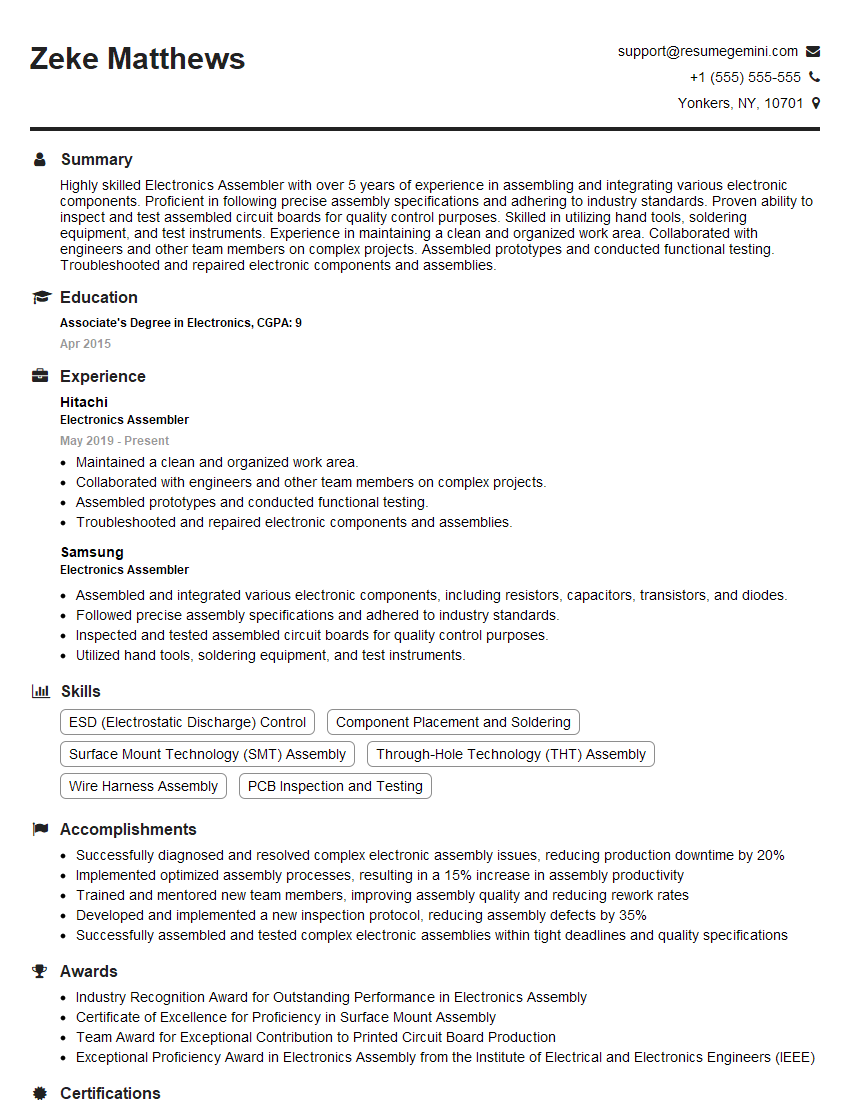
Mastering Electrical Component Handling and Placement is crucial for a successful and rewarding career in electronics manufacturing and related fields. It demonstrates your attention to detail, technical proficiency, and commitment to quality – highly valued attributes by employers. To significantly improve your job prospects, create an ATS-friendly resume that highlights these skills effectively. ResumeGemini is a trusted resource to help you build a professional and impactful resume. They offer examples of resumes tailored to Electrical Component Handling and Placement that can help you craft your own compelling application materials. Take the next step towards your dream career – build a standout resume with ResumeGemini today!

Explore more articles
Users Rating of Our Blogs
Share Your Experience
We value your feedback! Please rate our content and share your thoughts (optional).
What Readers Say About Our Blog
Very informative content, great job.
good