Interviews are opportunities to demonstrate your expertise, and this guide is here to help you shine. Explore the essential Electrical Standards and Codes interview questions that employers frequently ask, paired with strategies for crafting responses that set you apart from the competition.
Questions Asked in Electrical Standards and Codes Interview
Q 1. Explain the National Electrical Code (NEC) and its purpose.
The National Electrical Code (NEC) is a widely adopted standard for the safe installation of electrical wiring and equipment in the United States. Think of it as the rule book for electrical safety. Its purpose is to safeguard people and property from electrical hazards. It provides requirements for everything from wiring methods and overcurrent protection to grounding and bonding. The NEC is regularly updated to reflect advancements in technology and address emerging safety concerns. For instance, recent updates have incorporated more stringent requirements for arc flash mitigation and the use of renewable energy sources.
The NEC isn’t a law itself; local authorities adopt it and incorporate it into their building codes, making it legally enforceable. Compliance with the NEC is crucial for ensuring safe electrical installations in homes, businesses, and industrial settings. Failing to comply can lead to hefty fines, insurance issues, and, most importantly, serious injury or death.
Q 2. Describe the difference between grounding and bonding.
Grounding and bonding are both crucial for electrical safety, but they serve different purposes. Imagine a house: grounding is like connecting the house to the earth, providing a safe path for fault currents to escape. Bonding, on the other hand, is like connecting all the metal parts within the house to each other, ensuring that they are all at the same electrical potential.
- Grounding: This connects non-current-carrying metal parts of an electrical system to the earth. The primary purpose is to provide a low-impedance path for fault currents to flow to the ground, thus preventing dangerous voltage buildup and protecting people from electrical shock. Think of it as a safety valve for stray electricity.
- Bonding: This connects metal parts within an electrical system to each other. This is done to ensure that they’re at the same electrical potential, preventing voltage differences between them that could lead to dangerous shock hazards. Imagine multiple metal pipes touching – bonding ensures they’re all electrically connected to prevent a voltage difference that might cause sparking or shock.
A common example is a grounded metal electrical box. The box is grounded (connected to earth) for safety, and the metal parts of the box are bonded together to ensure they are all at the same electrical potential. In effect, both protect against hazards from electrical faults.
Q 3. What are the requirements for arc flash hazard analysis?
Arc flash hazard analysis is critical for ensuring the safety of workers who might come into contact with energized electrical equipment. An arc flash is a sudden, high-energy release of electrical energy, often resulting in severe burns, blindness, and even death. Think of a miniature lightning strike.
The requirements for arc flash hazard analysis typically include:
- System identification and modeling: Identifying the electrical system components and their characteristics to create a model of the electrical system.
- Fault current calculations: Determining the magnitude of fault currents that could flow through the system.
- Incident energy calculations: Calculating the amount of energy released during a potential arc flash event. This is usually expressed in calories per square centimeter (cal/cm²).
- Arc flash boundary determination: Establishing a safe working distance around the equipment based on the calculated incident energy.
- Personal protective equipment (PPE) selection: Choosing appropriate PPE, such as arc flash suits and face shields, to protect workers based on the calculated incident energy.
- Labeling and warning signs: Clearly labeling equipment with arc flash hazard information, including incident energy levels and required PPE.
Software and specialized training are used to perform these calculations. OSHA regulations require employers to perform arc flash hazard analysis for most electrical systems to minimize employee injury.
Q 4. How do you determine the appropriate size of conductors for a given load?
Determining the appropriate conductor size involves considering several factors to ensure safe and efficient operation of the electrical system. Think of it like choosing the right size pipe for water flow: too small and it restricts flow; too large and it’s wasteful.
The process typically involves:
- Calculating the total load: Determining the total current (amperes) drawn by all the connected equipment. This includes adding up the individual loads of all appliances, lights and motors.
- Applying appropriate derating factors: The NEC requires derating factors to be applied to account for factors like ambient temperature, number of conductors in a raceway, and installation methods. These factors reduce the allowable ampacity (current-carrying capacity) of the conductors.
- Consulting the NEC tables: Using the NEC tables to find the minimum conductor size that can safely carry the calculated load current after derating.
- Checking for voltage drop: Ensuring that the voltage drop along the conductors is within acceptable limits (typically 3% for branch circuits and 5% for feeders).
For example, if the calculated load is 20 amps, and after applying derating factors, the required ampacity is 25 amps, you would refer to the NEC tables to find a conductor size that has a sufficient ampacity. This is a crucial step in preventing overheating and potential fire hazards.
Q 5. Explain the concept of voltage drop and its impact on electrical systems.
Voltage drop is the reduction in voltage between the source and the load in an electrical circuit. Think of it like water pressure in a pipe; the further away from the source, the lower the pressure. This reduction impacts the efficiency and performance of electrical systems. Excessive voltage drop can cause motors to overheat, lights to dim, and equipment to malfunction. It also reduces the power delivered to the load.
Factors affecting voltage drop include:
- Conductor length: Longer conductors result in a greater voltage drop.
- Conductor size: Smaller conductors have higher resistance and therefore result in a greater voltage drop.
- Load current: Higher currents lead to higher voltage drop.
- Conductor material: Different materials have different resistivities, impacting voltage drop.
Calculating voltage drop is crucial during the design phase to ensure that the voltage at the load is sufficient for proper operation. Using appropriate conductor sizes and short distances minimizes voltage drop. Ignoring voltage drop can lead to system inefficiency, equipment failure, and even safety hazards.
Q 6. What are the safety regulations regarding working with high-voltage equipment?
Working with high-voltage equipment presents significant safety risks. The regulations emphasize a layered approach to safety, including:
- Lockout/Tagout (LOTO): This is a critical procedure to prevent accidental energization of equipment during maintenance or repair. It involves isolating the equipment from its power source and using locks and tags to prevent accidental re-energization.
- Personal Protective Equipment (PPE): Workers must wear appropriate PPE, including insulated gloves, protective clothing, and face shields, depending on the voltage level.
- Training and qualification: Personnel working with high-voltage equipment must receive specialized training on safety procedures, hazard identification, and emergency response.
- Permit-required confined space entry: If working in a confined space containing high-voltage equipment, specific procedures and permits are required to ensure safe entry and exit.
- Safe work practices: Following strict work practices, including using insulated tools, maintaining a safe distance, and using proper grounding techniques, is essential.
- Emergency response plan: A well-defined emergency response plan is crucial to handle unexpected events such as electrical shocks or arc flashes.
These are not mere suggestions; they are mandated by OSHA and other relevant regulatory bodies, designed to ensure the safety of workers handling potentially lethal equipment.
Q 7. Describe the different types of grounding electrodes and their applications.
Grounding electrodes provide a low-impedance path to earth for fault currents. Different types of electrodes are used depending on soil conditions and the specific application. Think of them as anchors for the electrical system, connecting it safely to the ground.
- Rod electrodes: These are metal rods driven vertically into the earth. They are commonly used in residential and some commercial applications.
- Plate electrodes: These are large metal plates buried horizontally in the earth. They are particularly effective in areas with high soil resistivity.
- Pipe electrodes: Metal pipes driven vertically into the earth, often used in industrial applications because of their relatively large surface area.
- Ground rings: These are continuous loops of grounding conductor buried in the earth. They are commonly used in substations and other large electrical installations to provide a low impedance path for fault currents.
- Building steel reinforcement: The reinforcing steel in concrete building foundations can also be used as a grounding electrode, reducing the need for additional electrodes in large buildings.
The choice of grounding electrode depends on factors like soil resistivity, the required grounding resistance, and the size of the electrical system. Proper grounding is paramount for safety and preventing damage to equipment during faults.
Q 8. Explain the requirements for installing electrical equipment in hazardous locations.
Installing electrical equipment in hazardous locations demands stringent adherence to safety standards to prevent explosions or fires. These locations, classified by their potential for ignitable gases, dusts, or fibers, require specialized equipment and installation techniques. The primary standard in the US is NFPA 70, the National Electrical Code (NEC), Article 500 and following. This article details specific requirements based on the location’s classification (Class I, II, or III, further divided into Divisions 1 and 2 based on likelihood and duration of hazard presence).
- Class I: Flammable gases or vapors.
- Class II: Combustible dusts.
- Class III: Easily ignitable fibers or flyings.
For example, in a Class I, Division 1 location (like a petroleum refinery processing area), you’d use explosion-proof equipment with features like hermetically sealed enclosures to prevent ignition sources from reaching the hazardous atmosphere. In a Class II, Division 2 location (like a grain elevator’s less hazardous areas), less stringent but still specialized equipment might suffice. The NEC specifies acceptable equipment types, wiring methods, and installation techniques for each classification to ensure safety.
Proper grounding and bonding are crucial to mitigate the risk of static electricity buildup, a major ignition source in hazardous areas. Regular inspections and maintenance are also essential to maintain the integrity of the electrical system and prevent hazards.
Q 9. What are the common causes of electrical fires and how can they be prevented?
Electrical fires, unfortunately, are a frequent occurrence, stemming mainly from overheating, short circuits, and faulty wiring. Overheating can be caused by overloaded circuits, loose connections creating resistance and heat, or malfunctioning equipment. Short circuits occur when live wires touch, creating a high-current flow that generates intense heat. Faulty wiring, including damaged insulation or improper connections, is a major culprit.
- Overloaded Circuits: Too many appliances drawing power from a single circuit.
- Loose Connections: Resistance at loose connections generates heat, potentially leading to fires.
- Faulty Wiring: Damaged insulation or improper wiring practices can cause shorts.
- Overheating Appliances: Malfunctioning motors or heating elements can overheat.
Prevention involves diligent maintenance and adherence to electrical codes. Regular inspections of wiring, outlets, and appliances can identify and address potential issues. Using properly sized circuit breakers and fuses prevents overloads. Ensuring good ventilation around electrical equipment reduces heat buildup. Regular maintenance and replacement of aged or damaged equipment also lessen risks. Think of it like regular car maintenance – catching small problems early prevents major breakdowns, and in this case, potentially catastrophic fires.
Q 10. Explain the importance of lockout/tagout procedures.
Lockout/Tagout (LOTO) procedures are critical safety protocols designed to prevent the accidental energization or startup of equipment during maintenance or repair. They involve physically locking out and tagging equipment’s power sources to ensure no one can accidentally turn them on while someone is working on it. This prevents injuries or fatalities from unexpected energization.
The process typically involves:
- Preparation: Identifying the energy sources to be controlled.
- Lockout: Using a lock to physically prevent the operation of the energy isolating device.
- Tagout: Affixing a tag with warnings and the worker’s name.
- Verification: Checking that the equipment is de-energized before beginning work.
- Release: Only the person who applied the lockout can remove it after verifying the work is complete and the equipment is safe.
Imagine a scenario where an electrician is working on a panel. Without LOTO, someone could inadvertently switch the power back on, resulting in a severe electrical shock or electrocution for the working electrician. LOTO prevents this scenario. It’s a crucial part of a safe work environment in electrical work and any work involving potentially hazardous equipment.
Q 11. Describe the process for obtaining necessary permits for electrical work.
Obtaining permits for electrical work varies by location, but generally involves submitting an application to the local authority having jurisdiction (AHJ), which is often the city or county building department. The application usually requires detailed information about the project, including specifications, drawings, and the qualifications of the electrician involved. Some localities require online submissions.
The process typically includes:
- Application Submission: Providing detailed information about the planned electrical work.
- Plan Review: The AHJ reviews the plans to ensure they comply with local electrical codes.
- Inspection Scheduling: Once approved, inspections are scheduled at different stages of the project (e.g., rough-in, final).
- Inspection and Permit Issuance: Upon successful inspections, the permit is issued, authorizing the work to proceed.
Failing to obtain necessary permits can lead to hefty fines, project delays, and potential safety hazards. Think of the permit as a sign-off that the plan is compliant with all regulations and ready for execution. It is always crucial to follow the local regulations and timelines.
Q 12. What are the requirements for electrical inspections?
Electrical inspections are essential for ensuring compliance with safety codes and identifying potential hazards. Inspections are typically conducted by authorized inspectors from the AHJ at various stages of a project (rough-in, final) and may also be performed for existing installations. They verify that the electrical work is done correctly and safely, according to the standards laid out in the NEC and local codes.
Inspectors will check aspects such as:
- Wiring Methods: Proper routing, installation, and securing of conductors.
- Grounding and Bonding: Effective grounding and bonding to prevent shocks.
- Overcurrent Protection: Correct sizing and placement of circuit breakers and fuses.
- Equipment Installation: Proper installation and connection of electrical equipment.
- Compliance with Codes: Adherence to all relevant electrical codes and standards.
Regular inspections, whether for new installations or existing systems, are vital for proactive hazard mitigation. Think of it as a health check for your electrical system; catching problems early prevents more significant issues down the line.
Q 13. How do you interpret electrical drawings and schematics?
Interpreting electrical drawings and schematics is a fundamental skill for electricians and electrical engineers. These drawings provide a visual representation of the electrical system, showing the layout of circuits, components, and wiring. They’re akin to blueprints for a building, but for electricity.
Understanding the symbols, line types, and annotations is key. For example, a circle might represent a light fixture, a square a breaker panel, and different line thicknesses may indicate different voltage levels. There are industry-standard symbols to understand. Schematics show the logical connections between components, illustrating the electrical flow path, while wiring diagrams show the physical layout and routing of wires.
The process involves:
- Familiarization with Symbols: Understanding the standardized symbols used in electrical drawings.
- Tracing Circuits: Following the wiring paths to understand how components are interconnected.
- Identifying Components: Recognizing and understanding the function of different components.
- Analyzing Load Calculations: Determining the load on different circuits.
This ability is critical for designing, troubleshooting, and maintaining electrical systems; it is a cornerstone of effective electrical work. Proficiency in this skill leads to more efficient and safer electrical practices.
Q 14. Explain the different types of overcurrent protection devices.
Overcurrent protection devices are safety mechanisms designed to prevent damage to electrical equipment and reduce the risk of fire by interrupting the flow of excessive current. They are essential components in any electrical system. Several types exist, each with its own characteristics:
- Fuses: A simple and inexpensive device containing a wire that melts and breaks the circuit when excessive current flows through it. Once blown, it must be replaced.
- Circuit Breakers: More sophisticated devices that use a thermal or magnetic mechanism to interrupt the circuit when an overload or short circuit occurs. They can be reset after tripping, unlike fuses.
- Ground Fault Circuit Interrupters (GFCIs): Designed to protect against electrical shocks by detecting small imbalances in current flow to ground. They are commonly found in bathrooms, kitchens, and outdoor locations.
- Arc Fault Circuit Interrupters (AFCIs): Detect and interrupt arcing faults, a common cause of electrical fires. Often used in bedroom circuits to enhance fire safety.
The choice of device depends on the application and the level of protection required. Proper selection and installation of overcurrent protection devices are crucial for safety and preventing electrical hazards. It’s like having a fire extinguisher in your home—you hope you never need it, but it’s a vital safeguard.
Q 15. What are the requirements for installing and maintaining emergency lighting systems?
Emergency lighting systems are crucial for safety during power outages. Installation and maintenance must adhere to strict codes, primarily to ensure reliable operation when needed most. These codes vary slightly by region (e.g., NFPA 101 in the US, BS 5266 in the UK), but core principles remain consistent.
- Installation Requirements: Systems must be designed to provide illumination for a minimum duration (typically 90 minutes), with sufficient luminance levels specified for different areas (e.g., exit routes, corridors). Batteries need regular testing, and the entire system should be regularly inspected for proper placement and functionality. Backup power sources (like generators) are often incorporated into the overall emergency power plan.
- Maintenance Requirements: Regular testing and maintenance are paramount. This includes battery testing (often monthly), lamp replacement, and visual inspections to ensure there’s no damage or obstruction. Documentation is crucial – keeping records of testing, maintenance, and repairs is essential to demonstrate compliance. A documented maintenance schedule is a must.
Example: Imagine a hospital – emergency lighting along corridors must be exceptionally reliable. Regular testing ensures that during a power outage, patients and staff can safely evacuate. Failure to maintain these systems properly could have serious consequences.
Career Expert Tips:
- Ace those interviews! Prepare effectively by reviewing the Top 50 Most Common Interview Questions on ResumeGemini.
- Navigate your job search with confidence! Explore a wide range of Career Tips on ResumeGemini. Learn about common challenges and recommendations to overcome them.
- Craft the perfect resume! Master the Art of Resume Writing with ResumeGemini’s guide. Showcase your unique qualifications and achievements effectively.
- Don’t miss out on holiday savings! Build your dream resume with ResumeGemini’s ATS optimized templates.
Q 16. Describe the requirements for electrical systems in healthcare facilities.
Healthcare facilities have stringent electrical requirements due to the critical nature of the environment and the sensitivity of medical equipment. These are usually detailed in codes such as NFPA 99 (US) and similar international standards. Safety and reliability are paramount.
- Power Quality: Consistent voltage and frequency are essential to prevent malfunctions of sensitive medical equipment. This often involves using UPS (Uninterruptible Power Supply) systems and generators to provide backup power during outages.
- Redundancy: Critical systems (like life support equipment) often have redundant power supplies to minimize downtime in case of failures. Multiple paths to power are often installed.
- Grounding and Bonding: Proper grounding and bonding are essential to prevent electrical shocks and equipment damage. Special attention is given to locations where water is present, or where patients might come into contact with metal surfaces.
- Isolation Transformers: These transformers are often used to isolate medical equipment from the main power supply, providing added electrical safety. This reduces the risk of electrical shock.
- Special Outlets: Dedicated outlets are often required for specific medical equipment, with different grounding and safety measures integrated.
Example: An operating room requires exceptionally reliable power. A failure of the power supply during surgery could be catastrophic. Therefore, multiple redundant power systems and backup generators are critical.
Q 17. Explain the difference between a circuit breaker and a fuse.
Both circuit breakers and fuses are protective devices that interrupt the flow of electricity to prevent damage to equipment or injury to personnel, but they operate differently.
- Circuit Breaker: A circuit breaker is a reusable device that automatically switches off when the current exceeds a predetermined limit (its rating). It is resettable after the fault condition is cleared. Think of it like a self-resetting switch that protects against overcurrents and short circuits.
- Fuse: A fuse is a one-time use device containing a thin wire that melts and breaks the circuit when excessive current flows. Once blown, it must be replaced. It’s a sacrificial device that protects the circuit from overload.
Key Differences: Circuit breakers are reusable, while fuses are not. Circuit breakers offer more flexibility and control, allowing for faster tripping in some cases. Fuses provide simpler protection, often at a lower cost.
Example: A household circuit breaker might trip if too many appliances are used simultaneously. In contrast, a fuse in an older car might blow if a short circuit occurs in the wiring.
Q 18. What are the requirements for grounding electrical systems in a commercial building?
Grounding in commercial buildings is crucial for safety and protection against electrical hazards. The goal is to provide a low-impedance path for fault currents to flow to the earth, minimizing the risk of electric shock and equipment damage. National Electrical Code (NEC) in the US, or equivalent standards in other regions, govern this process.
- Grounding Electrodes: These are conductive elements (like metal rods or plates) driven into the earth. They provide a connection between the building’s electrical system and the earth.
- Grounding Wires: These wires connect grounding electrodes to the building’s electrical system and equipment, creating a continuous path for fault currents.
- Grounding System Design: The design considers factors like soil resistivity, the size of the building, and the type of electrical system. A properly designed grounding system ensures efficient fault current dissipation.
- Bonding: Metallic parts of the building’s structure (like metal pipes and conduits) must be bonded together to create a continuous grounding path.
Example: A commercial building’s electrical panel will have a main grounding conductor connected to the grounding electrodes and the building’s metallic structure. This ensures that if a fault occurs, the current will safely flow to the earth, preventing shocks and equipment damage.
Q 19. How do you calculate the power factor of an electrical system?
The power factor (PF) is a measure of how efficiently electrical power is used in an AC circuit. It is the ratio of real power (kW) to apparent power (kVA). A power factor of 1 indicates perfect efficiency (all power is used for useful work); a lower power factor indicates less efficient use.
Calculation:
Power Factor (PF) = Real Power (kW) / Apparent Power (kVA)
Apparent Power (kVA) = √(kW² + kVAr²)
where:
- kW is the real power (kilowatts), representing the actual work done.
- kVA is the apparent power (kilovolt-amperes), the total power supplied.
- kVAr is the reactive power (kilovolt-amperes reactive), representing power that flows back and forth without doing useful work.
Example: If a motor draws 10 kVA and has a real power of 8 kW, its power factor is 8 kW / 10 kVA = 0.8. This means that only 80% of the power supplied is used for useful work, while 20% is wasted.
Q 20. What are the safety precautions for working at heights involving electrical work?
Working at heights involving electrical work presents significant risks. Falls, electric shock, and burns are all major hazards. Safety protocols are crucial and vary by jurisdiction, but generally adhere to OSHA (US) or similar safety standards.
- Lockout/Tagout Procedures: Before commencing any work, the power must be completely de-energized and locked out/tagged out to prevent accidental re-energization. This is a critical safety procedure.
- Fall Protection: Use appropriate fall protection equipment such as harnesses, lifelines, and anchor points. Proper training in fall protection techniques is mandatory.
- Insulated Tools: Use tools with insulated handles and appropriate voltage ratings to prevent electric shock. Regularly inspect tools for any damage.
- Arc Flash Protection: If there’s a risk of arc flash (a sudden, high-energy release of electrical energy), appropriate personal protective equipment (PPE) including arc flash suits and face shields is essential.
- Spotters and Communication: Always have a spotter when working at heights, and utilize proper communication systems to coordinate activities.
Example: Replacing a light fixture on a high pole requires de-energizing the circuit, using insulated tools, and implementing fall protection measures like a harness and lifeline. A spotter is necessary to ensure safety.
Q 21. Explain the importance of regular electrical maintenance.
Regular electrical maintenance is vital for ensuring safety, reliability, and efficiency of electrical systems. Neglecting maintenance can lead to costly repairs, equipment failures, and potential hazards.
- Reduced Risk of Failures: Regular inspections and maintenance identify and address potential problems before they escalate into major failures. This minimizes downtime and prevents unexpected outages.
- Enhanced Safety: Maintenance helps prevent electrical hazards like shorts, overheating, and arc flash incidents. This protects personnel and equipment.
- Increased Efficiency: Clean connections, properly functioning equipment, and optimized settings improve the overall efficiency of the electrical system, reducing energy consumption and costs.
- Extended Equipment Life: Regular maintenance extends the lifespan of electrical components, minimizing replacement costs and interruptions.
- Compliance with Codes: Regular maintenance helps maintain compliance with relevant electrical codes and standards, avoiding potential fines and legal issues.
Example: Regular tightening of connections in an electrical panel prevents overheating and potential fire hazards. Cleaning and inspecting transformers improves efficiency and extends their service life.
Q 22. How do you identify and address potential electrical hazards in a workplace?
Identifying and addressing electrical hazards in the workplace requires a systematic approach combining visual inspection, testing, and adherence to safety standards. Think of it like a medical checkup for your electrical system.
Visual Inspection: This is the first line of defense. We look for frayed wires, damaged insulation, overloaded circuits (too many appliances on one circuit), exposed wiring, improper grounding, and signs of overheating (scorching, discoloration).
Testing: This involves using specialized equipment like multimeters to test voltage, current, and resistance. We also use ground fault circuit interrupters (GFCIs) testers and insulation resistance testers to ensure safety and proper functioning.
Lockout/Tagout Procedures: Before working on any electrical equipment, we always follow lockout/tagout procedures to ensure the power is completely disconnected and the equipment is safe to handle. This prevents accidental energization and potential electrocution.
Compliance with Standards: We strictly adhere to standards like the National Electrical Code (NEC) and OSHA regulations to ensure the workplace meets minimum safety requirements. These codes provide guidelines for safe installation, maintenance, and operation of electrical systems. For example, NEC specifies the proper grounding techniques and the requirements for arc flash protection.
Documentation: All inspections and tests are meticulously documented. This creates a record of the electrical system’s condition, identifies areas needing attention, and aids in future maintenance planning.
Example: During a recent inspection, I noticed a loose connection in a junction box, a clear fire hazard. I immediately de-energized the circuit using proper lockout/tagout procedures, tightened the connection, and documented the repair. This proactive approach prevented a potential electrical fire.
Q 23. Describe the role of a ground fault circuit interrupter (GFCI).
A Ground Fault Circuit Interrupter (GFCI) is a life-saving device designed to protect people from electrical shock. Imagine it as a highly sensitive tripwire for electricity. It works by continuously monitoring the current flowing in a circuit and comparing the current entering and leaving.
If there’s an imbalance – even a tiny one, such as a small current leaking to ground (e.g., someone touching a live wire) – the GFCI rapidly interrupts the power flow, preventing a potentially fatal shock. This is far faster than a standard circuit breaker.
How it works: GFCIs use a small transformer to detect this imbalance. If the current difference exceeds a certain threshold (typically 5 milliamps), the GFCI trips and cuts off the power. They are crucial in areas with higher risk of electrical shock, like bathrooms, kitchens, and outdoor outlets.
Example: A person accidentally touches a faulty appliance with a ground fault. A standard circuit breaker would likely not trip because the fault current might be too small. However, the GFCI will instantly cut off the power, preventing serious injury or death.
Q 24. What are the requirements for installing and maintaining electrical panels?
Installing and maintaining electrical panels requires strict adherence to safety regulations and best practices. It’s like building the heart of your home’s electrical system.
Installation: Panels must be installed in accordance with the NEC, ensuring proper grounding, bonding, and adequate clearance. They need to be installed in a dry, accessible location and properly sized for the anticipated load. Using the incorrect size breaker or wire gauge can lead to overheating and fires. Incorrect grounding can cause electrocution risks.
Maintenance: Regular inspections are crucial. We look for loose connections, signs of overheating, corrosion, and damage to the panel itself. We also verify that circuit breakers are functioning correctly and that the panel is not overloaded.
Proper Labeling: All circuits must be clearly labeled to identify the load served. This is crucial for troubleshooting and maintenance.
Arc Flash Protection: For larger panels, arc flash mitigation measures must be in place, which might include protective equipment and procedures to minimize the risk of arc flash incidents (powerful electrical explosions that can cause severe injuries).
Example: During a panel inspection, I found that several breakers were improperly labeled and some connections were loose. This could lead to incorrect breaker tripping or even an electrical fire. I immediately addressed the issues, corrected the labeling, and tightened the connections, documenting all work performed.
Q 25. Explain the principles of electrical power distribution.
Electrical power distribution is the process of delivering electricity from the generation source (power plant) to end users. Imagine it as a vast network of roads and highways for electricity.
Principles:
Generation: Electricity is generated at power plants using various methods (e.g., coal, nuclear, solar, wind).
Transmission: High-voltage lines carry electricity over long distances from generation points to substations.
Substations: These facilities reduce the voltage and distribute power to local areas through distribution networks.
Distribution: Lower-voltage lines deliver power to homes, businesses, and industries.
Protection and Control: Circuit breakers, relays, and other protective devices safeguard the system and prevent outages and damage. SCADA (Supervisory Control and Data Acquisition) systems monitor and control the entire network.
Example: A typical power distribution system starts with a high-voltage transmission line, then steps down the voltage at a substation. From the substation, lower voltage lines feed to residential neighborhoods, eventually reaching individual homes through transformers and service drops.
Q 26. How do you ensure compliance with relevant electrical standards and codes?
Ensuring compliance with electrical standards and codes is paramount to safety and legality. This is achieved through a multi-pronged approach. Think of it as a checklist to ensure everything is up to code.
Regular Inspections: Conducting regular inspections and testing to identify and rectify potential hazards before they cause problems.
Documentation: Maintaining detailed records of inspections, tests, and repairs. This documentation is crucial for demonstrating compliance and for future reference.
Staying Updated: Keeping abreast of the latest updates and revisions in relevant codes (like the NEC) and standards (like those from IEEE and IEC).
Training and Certification: Ensuring that all personnel involved in electrical work are adequately trained and certified to perform their tasks safely and in compliance with regulations.
Third-Party Audits: Engaging third-party auditing companies for independent verification of compliance. This adds an objective layer to the compliance process.
Example: Before starting any project, we always review the relevant codes to ensure our design and installation methods align with the latest requirements. We then document every step, creating a comprehensive record of our work that can be readily audited.
Q 27. Describe your experience with different types of electrical testing equipment.
My experience with electrical testing equipment encompasses a broad range of instruments. I’m proficient in using various tools to ensure electrical safety and diagnose problems.
Multimeters: I regularly use multimeters to measure voltage, current, and resistance. This helps identify faulty circuits, wiring problems, and other issues.
Clamp Meters: These allow for non-contact current measurement, vital for safety and troubleshooting in live circuits.
Insulation Resistance Testers (Meggers): These are used to check the integrity of insulation, preventing shocks and fires.
Ground Testers: Critical for verifying proper grounding, reducing the risk of electric shock.
Loop Impedance Testers: Used to ensure that protective devices (circuit breakers) will function correctly.
GFCI Testers: Used to verify that ground fault circuit interrupters (GFCIs) are working as they should.
Example: Recently, I used a megger to test the insulation resistance of a motor winding. The low resistance reading indicated compromised insulation, which helped prevent a potential fire hazard.
Q 28. Explain your familiarity with relevant software used for electrical design and analysis.
My familiarity with electrical design and analysis software includes several widely used packages. This allows for efficient and accurate project planning and execution.
AutoCAD Electrical: I use AutoCAD Electrical for creating detailed electrical schematics, panel layouts, and wiring diagrams.
ETAP (Electrical Transient Analysis Program): I use ETAP for power system analysis, including short-circuit calculations, load flow studies, and protective device coordination studies.
SKM PowerTools for Windows: I use SKM for similar power system analysis as ETAP, providing another avenue for analysis and ensuring system safety and reliability.
Example: For a recent project, I utilized ETAP to perform a short-circuit analysis on a new substation design, ensuring that the protection system would adequately clear faults and protect equipment.
Key Topics to Learn for Electrical Standards and Codes Interview
- National Electrical Code (NEC): Understanding the fundamental principles and applications of the NEC, including wiring methods, grounding, overcurrent protection, and safety regulations. Focus on common code articles and their practical implications.
- Electrical Safety Regulations: Explore OSHA regulations and other relevant safety standards related to electrical work. Understand the practical application of lockout/tagout procedures and arc flash hazard mitigation.
- Wiring Diagrams and Schematics: Mastering the ability to interpret and create wiring diagrams and schematics for various electrical systems. Practice analyzing circuits and troubleshooting potential issues.
- Power Systems Analysis: Develop a strong understanding of power system components, including transformers, generators, and protection devices. Be prepared to discuss basic power system calculations and analysis techniques.
- Relevant Standards (Beyond NEC): Familiarize yourself with other pertinent standards like IEEE, IEC, and ANSI standards depending on your specific area of expertise. Understanding the differences and applications of these standards is crucial.
- Problem-Solving and Troubleshooting: Practice applying your knowledge to solve practical problems related to electrical systems. Be prepared to explain your thought process and problem-solving strategies during the interview.
- Code Interpretation and Application: Focus on the ability to interpret code requirements and apply them correctly in real-world scenarios. This includes understanding exceptions and special conditions outlined in the code.
Next Steps
Mastering Electrical Standards and Codes is paramount for career advancement in the electrical field. A strong understanding of these codes ensures safety, compliance, and opens doors to more challenging and rewarding roles. To significantly boost your job prospects, create an ATS-friendly resume that highlights your relevant skills and experience. We highly recommend using ResumeGemini to build a professional and impactful resume. ResumeGemini provides a streamlined process and offers examples of resumes tailored to Electrical Standards and Codes professionals, giving you a head start in showcasing your qualifications effectively.

Electrical Superintendent Resume Sample
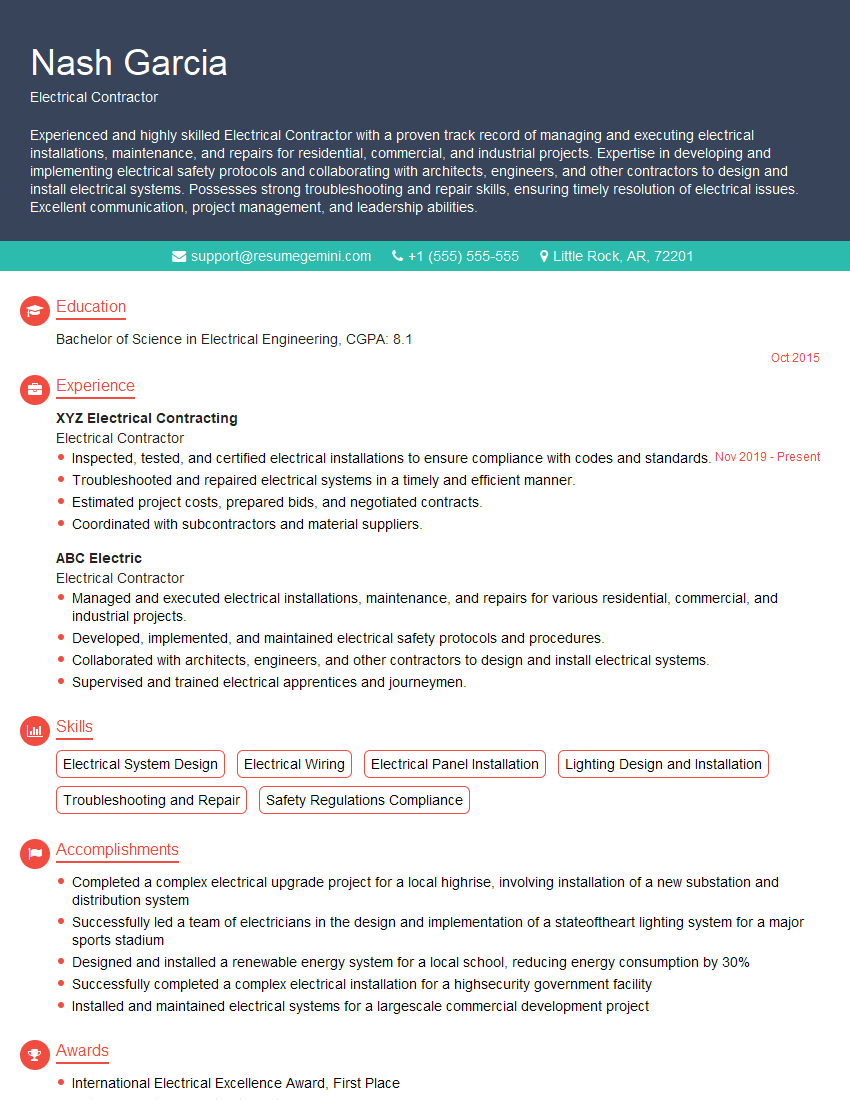
Electrical Contractor Resume Sample
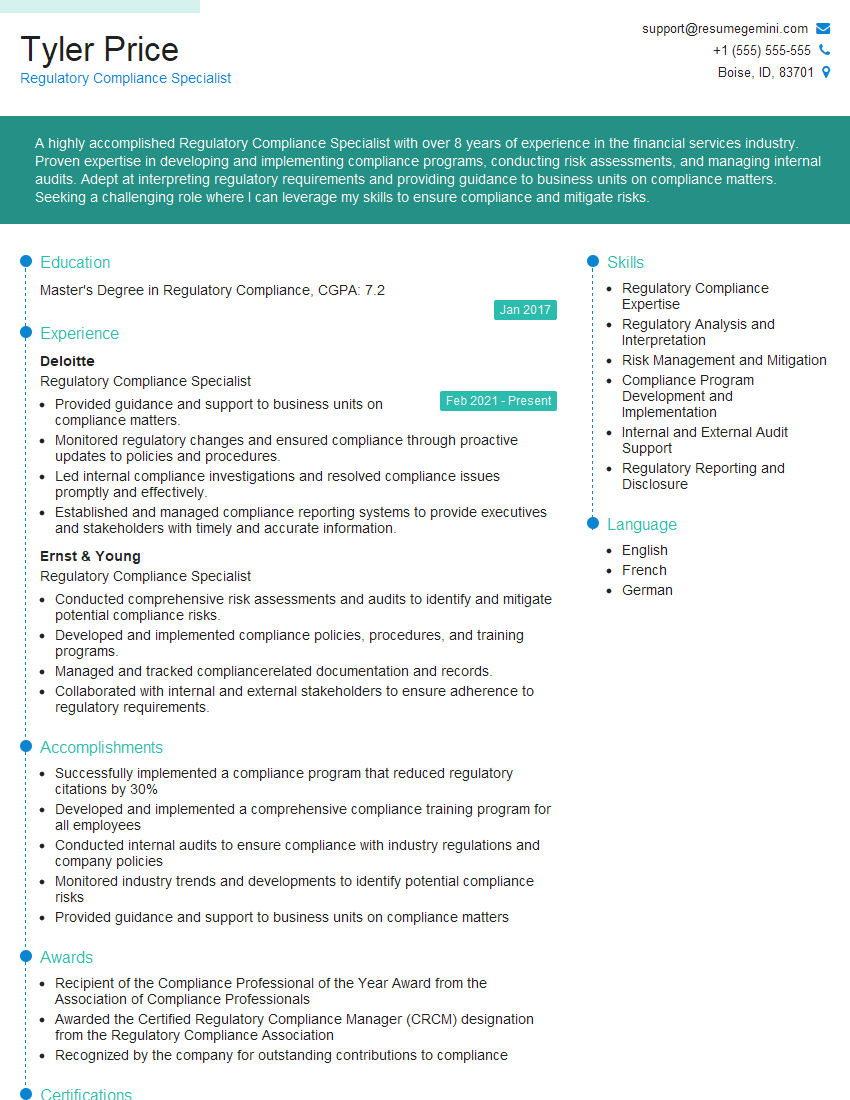
Regulatory Compliance Specialist Resume Sample
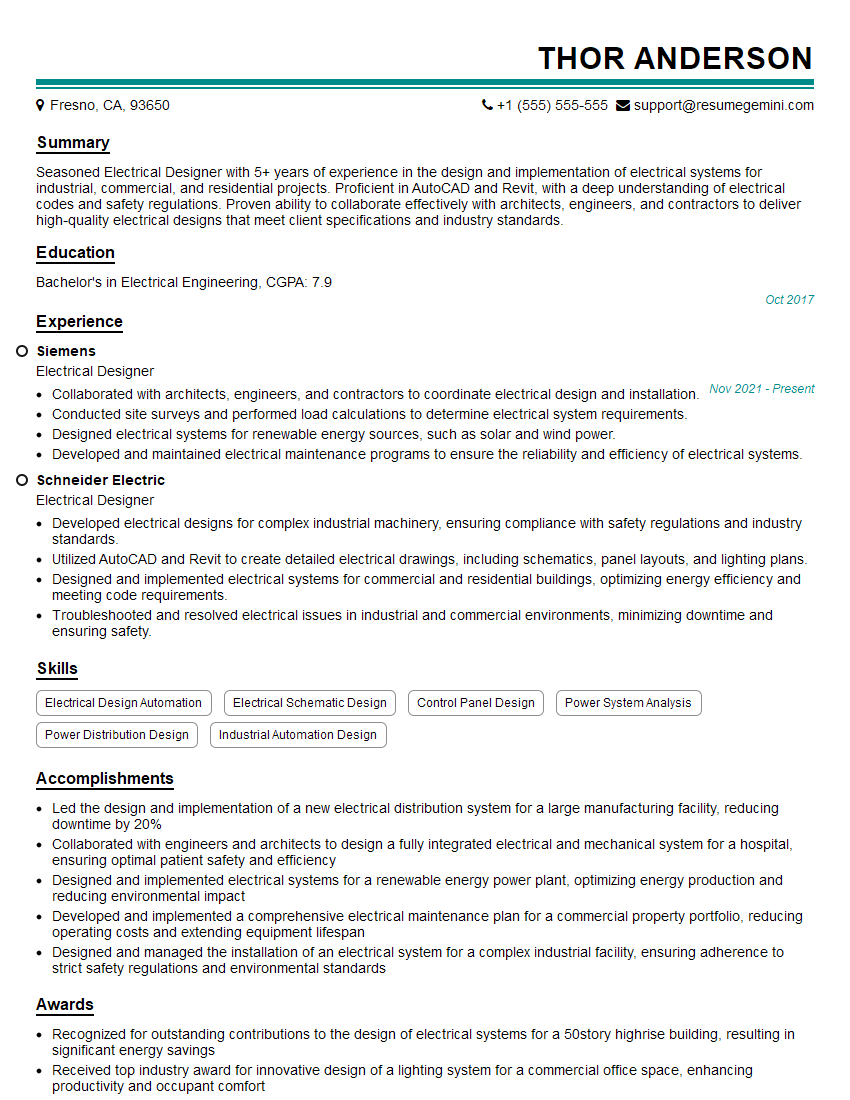
Electrical Designer Resume Sample
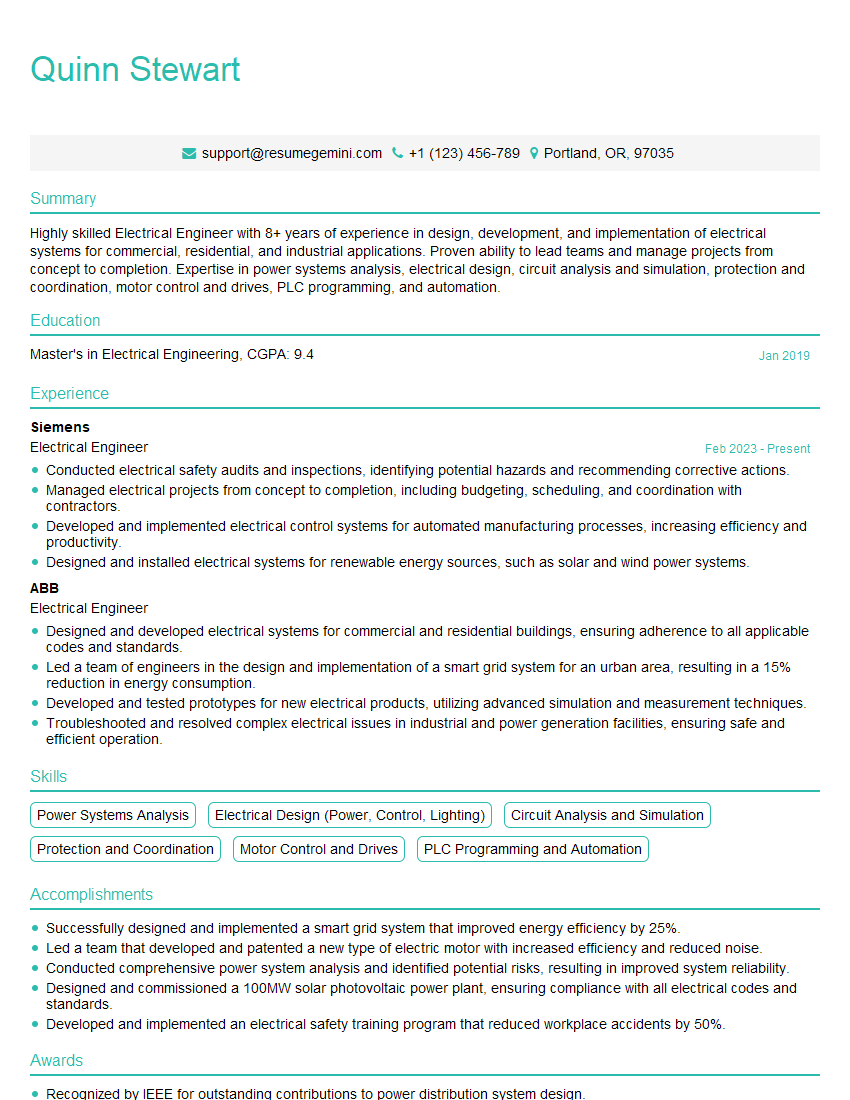
Electrical Engineer Resume Sample

Instrumentation Engineer Resume Sample

Power Systems Engineer Resume Sample

Control Systems Engineer Resume Sample

Electrical Drafter Resume Sample

Construction Electrician Resume Sample

Maintenance Electrician Resume Sample
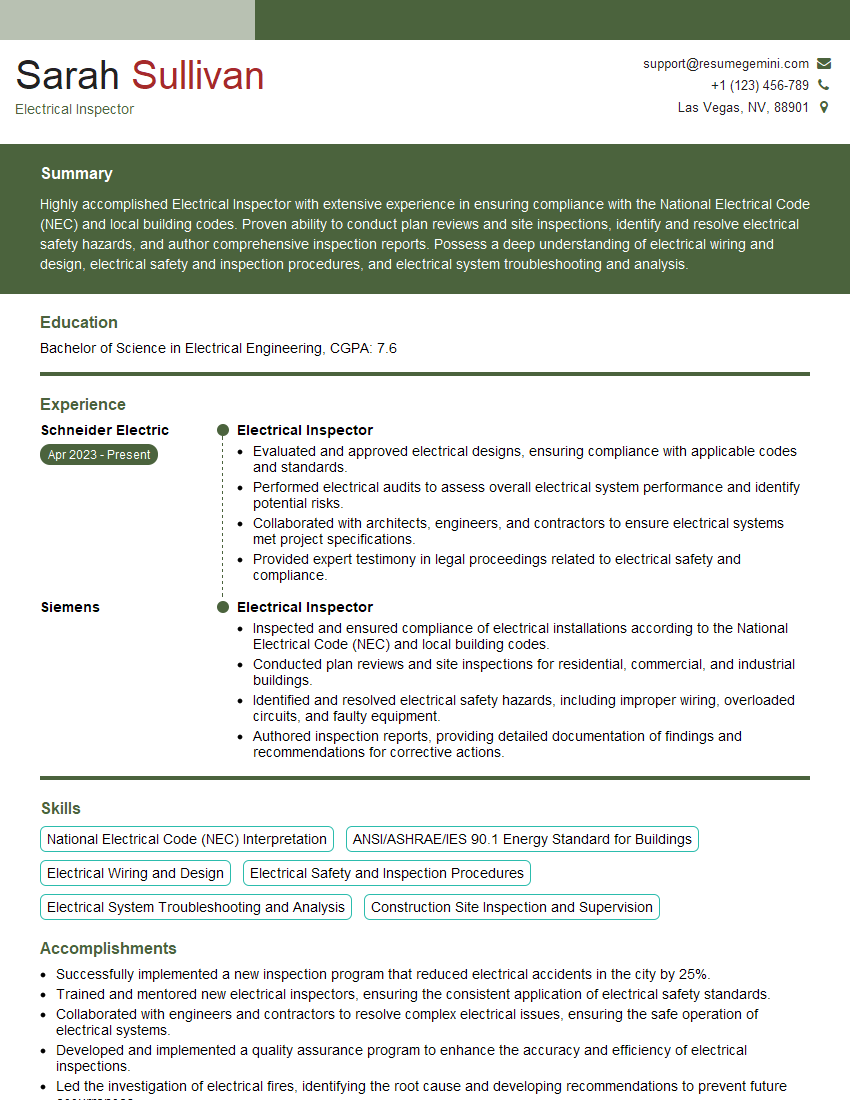
Electrical Inspector Resume Sample
Explore more articles
Users Rating of Our Blogs
Share Your Experience
We value your feedback! Please rate our content and share your thoughts (optional).
What Readers Say About Our Blog
Very informative content, great job.
good