Interviews are opportunities to demonstrate your expertise, and this guide is here to help you shine. Explore the essential Electrical Systems Design for Wind Farms interview questions that employers frequently ask, paired with strategies for crafting responses that set you apart from the competition.
Questions Asked in Electrical Systems Design for Wind Farms Interview
Q 1. Explain the different types of grounding systems used in wind farms.
Grounding systems in wind farms are crucial for safety and efficient operation, protecting equipment and personnel from electrical hazards. The choice of system depends on factors like soil resistivity, the size of the wind farm, and regulatory requirements. Common types include:
- Solid Grounding: This is the most common method, directly connecting the neutral point of the transformer to earth through a low-impedance path. This effectively limits ground fault currents, ensuring quick fault clearing. Think of it like a safety valve, immediately releasing excess electricity into the ground.
- Resistance Grounding: This involves connecting the neutral point to earth through a resistor, limiting the ground fault current to a safe level. This approach can be beneficial in reducing the stress on equipment during ground faults, particularly in systems with high capacitance. Imagine it as a controlled release, slowly dissipating the excess energy.
- Reactance Grounding: This uses a reactor instead of a resistor to limit the fault current. It offers a similar level of protection as resistance grounding but with potentially better control over system stability, especially important for larger wind farms.
- Ungrounded (Isolated) System: While less common, an ungrounded system may be used in specific circumstances. It requires specialized monitoring and protection equipment to detect insulation faults. Think of this as a more sensitive system needing constant vigilance.
The selection of the most appropriate grounding system is a complex process requiring detailed analysis of the electrical system and its environment. Soil resistivity testing is vital to determine the effectiveness of the grounding system.
Q 2. Describe the role of SCADA in wind farm operations.
SCADA, or Supervisory Control and Data Acquisition, is the nervous system of a modern wind farm. It’s a centralized system that monitors and controls all aspects of the wind farm’s operation, from individual turbine performance to overall power output. Think of it as a sophisticated dashboard providing real-time insights and control capabilities.
SCADA’s key roles include:
- Real-time Monitoring: SCADA continuously monitors parameters like wind speed, turbine output, generator temperature, and grid conditions. Any deviations from normal operating parameters are immediately flagged.
- Remote Control: Operators can remotely control turbine operations, such as starting, stopping, or adjusting the pitch angle of the blades. This allows for optimized energy production and rapid response to abnormal situations.
- Data Logging and Analysis: SCADA collects vast amounts of data which can be used for performance analysis, predictive maintenance, and capacity planning. This data helps optimize wind farm operations and reduce downtime.
- Alarm Management: SCADA alerts operators to potential problems, allowing for timely intervention and preventing major equipment failures. This is crucial for ensuring safety and maintaining reliability.
- Grid Integration: SCADA facilitates seamless integration with the power grid, managing power output to meet grid requirements and ensuring stable grid operation. This is vital for reliable power supply and grid stability.
In essence, SCADA is essential for maximizing energy production, minimizing downtime, and ensuring the safe and efficient operation of a wind farm.
Q 3. What are the common challenges in integrating wind farms into the power grid?
Integrating wind farms into the power grid presents several challenges due to the intermittent and variable nature of wind energy. These challenges include:
- Intermittency: Wind speed fluctuates constantly, leading to unpredictable power output. This requires sophisticated grid management strategies to maintain grid stability.
- Voltage Fluctuations: Large-scale wind farms can cause voltage fluctuations on the power grid, requiring reactive power compensation to maintain voltage levels within acceptable limits. Think of it like maintaining the water pressure in a pipe network.
- Frequency Stability: The intermittent nature of wind power can affect grid frequency stability. Advanced control systems are needed to compensate for these fluctuations and maintain the frequency within acceptable bounds.
- Power Quality Issues: Wind turbines can introduce harmonics and other power quality issues into the grid, requiring mitigation strategies such as filters.
- Transmission Infrastructure: Integrating large wind farms often requires upgrading or expanding transmission infrastructure to handle the increased power flow. This can involve significant capital investment.
Addressing these challenges requires a holistic approach involving grid operators, wind farm developers, and equipment manufacturers. Solutions involve advanced control systems, smart grids, and energy storage solutions.
Q 4. How do you ensure the safety of personnel working on high-voltage systems in a wind farm?
Safety is paramount when working on high-voltage systems in wind farms. A multi-layered approach is essential, combining engineering controls, administrative controls, and personal protective equipment (PPE).
- Lockout/Tagout Procedures: Rigorous lockout/tagout procedures ensure that electrical equipment is de-energized and isolated before any work is performed. This prevents accidental energization and electrical shock.
- Permit-to-Work Systems: These systems ensure that all necessary safety checks are completed before work commences, documented clearly and comprehensively. They create a formal record of who did what, when and how.
- Arc Flash Hazard Analysis: This identifies potential arc flash hazards and defines appropriate PPE and safety measures. This ensures workers are protected from the immense energy released in an arc flash incident.
- Training and Competency: Personnel working on high-voltage systems must receive specialized training and demonstrate competency before being allowed to work on these systems. Regular refresher training is essential to maintain competency.
- Personal Protective Equipment (PPE): Workers must use appropriate PPE, such as insulated gloves, safety glasses, and arc flash suits, to protect themselves from electrical hazards. It’s essential that workers know how to properly use and maintain this equipment.
Regular safety audits and inspections are crucial to identify and mitigate potential hazards. A strong safety culture, where safety is prioritized above all else, is essential for preventing accidents.
Q 5. Explain the function of a wind turbine’s protection relay system.
A wind turbine’s protection relay system is its first line of defense against faults and abnormal operating conditions. It’s a critical safety and reliability feature that protects the turbine and the grid from damage.
Key functions of the protection relay system include:
- Overcurrent Protection: This detects excessive current flow, indicating a short circuit or overload, and quickly disconnects the turbine from the grid, limiting damage and preventing fire hazards.
- Ground Fault Protection: This detects ground faults, which can be particularly dangerous. It isolates the faulty section to prevent further damage and electrocution hazards.
- Overvoltage and Undervoltage Protection: This protects against voltage surges or dips that can damage equipment. These relays will take action to prevent component damage and ensure safe operation.
- Over-speed Protection: This prevents the generator from exceeding its maximum rotational speed, preventing mechanical damage to the turbine. It’s an important mechanical safety measure.
- Temperature Protection: Relays monitor the temperature of key components such as the generator and bearings, triggering an alert or shutdown if temperatures exceed safe limits, preventing thermal damage.
Modern protection relay systems often use advanced algorithms and communication protocols to provide enhanced protection and fault diagnostics. They are integral to the safe and reliable operation of a wind turbine.
Q 6. Describe different methods for fault detection and isolation in a wind farm’s electrical system.
Fault detection and isolation in a wind farm’s electrical system are crucial for maintaining reliability and safety. Several methods are used:
- Protective Relays: As discussed earlier, these are the first line of defense, detecting faults and isolating the faulty section of the system.
- SCADA Monitoring: SCADA systems continuously monitor the electrical system, detecting anomalies and alerting operators to potential faults. This allows for early detection and minimizes downtime.
- Power Quality Monitoring: This detects disturbances in power quality, such as harmonics and voltage fluctuations, which can indicate underlying problems within the system.
- Fault Locators: Specialized fault locators are used to pinpoint the precise location of faults along transmission lines or cables, making repairs faster and more efficient.
- Partial Discharge (PD) Detection: This technique detects partial discharges within insulation systems, which can be an early indicator of impending insulation failure.
The use of these methods in combination provides a comprehensive approach to fault detection and isolation, minimizing downtime, reducing repair costs and most importantly, improving the safety of the wind farm operation.
Q 7. What are your experiences with different types of wind turbine generators (e.g., induction, permanent magnet synchronous generators)?
I have extensive experience working with various wind turbine generator (WTG) technologies, including induction generators (IGs) and permanent magnet synchronous generators (PMSGs). Each type offers distinct advantages and disadvantages.
- Induction Generators (IGs): IGs are robust, relatively simple, and inexpensive. They are self-excited and require less complex control systems. However, they are less efficient than PMSGs and have lower power factors, leading to increased energy losses and grid stability issues. They are often used in smaller wind farms or older installations.
- Permanent Magnet Synchronous Generators (PMSGs): PMSGs offer higher efficiency, better power factors, and wider operating ranges compared to IGs. They are also better suited for variable-speed operation, allowing for optimization of power capture across varying wind speeds. They require more sophisticated power electronic converters but offer significant gains in energy efficiency and cost effectiveness over the life cycle of the turbine. However, they can be more expensive to manufacture and are more sensitive to extreme environmental conditions. These are the most common type in larger, newer wind farms.
The choice of generator type depends on factors such as wind farm size, grid conditions, and economic considerations. My experience encompasses the design, installation, and operation of both types, including troubleshooting and maintenance. I’m adept at evaluating the suitability of each generator type based on specific project requirements.
Q 8. How do you design for lightning protection in a wind farm?
Lightning protection in a wind farm is crucial due to the tall structures and exposed location. We employ a multi-layered approach, starting with early design considerations. This involves studying historical lightning strike data for the specific location to assess risk. The design incorporates several key elements:
- Lightning Rods and Down Conductors: Each wind turbine tower is fitted with a lightning rod at its highest point, providing a preferential path for lightning strikes. These rods are connected to a network of robust down conductors running down the tower and into the ground. The materials used – typically copper or galvanized steel – must meet specific conductivity standards.
- Grounding System: A comprehensive grounding system is vital, connecting all down conductors and other metallic components to earth. This requires extensive ground rods driven deep into the soil, often in a grid pattern to minimize ground impedance and ensure effective current dissipation. We carefully consider soil resistivity during design and may use grounding enhancement techniques, such as chemical treatment or specialized grounding rods, in challenging soil conditions.
- Surge Protection Devices (SPDs): SPDs are installed at various points within the electrical system to protect sensitive equipment from voltage surges caused by lightning strikes. These are placed at the turbine base, in the collection substation, and along the transmission lines. They shunt the surge current to ground, limiting its impact on the system. The selection of SPDs depends on the system voltage and expected surge magnitudes.
- Insulation Coordination: We ensure that the insulation levels of all components are sufficient to withstand the stresses caused by lightning-induced transients. This involves careful analysis of the various voltage surges and their potential impact on insulation, using software tools and relevant standards.
For example, in a recent project, we used a combination of copper down conductors, a grid of grounding rods with chemical soil enhancement, and a multi-stage SPD system to protect a 50-turbine wind farm in a region known for high lightning activity. This comprehensive system successfully mitigated lightning-related damage throughout its operational lifespan.
Q 9. Discuss your experience with power system simulation software (e.g., PSCAD, PSS/E).
I have extensive experience with both PSCAD and PSS/E, using them for diverse tasks throughout the wind farm design process. PSCAD is exceptionally well-suited for transient stability studies. I’ve used it to model and analyze the impact of faults and switching events on the wind farm’s electrical system, including the behavior of wind turbines under various fault conditions. For instance, I employed PSCAD to simulate the effects of a three-phase fault close to a wind turbine, assessing the impact on the turbine’s control system and the overall system stability.
PSS/E, on the other hand, is my go-to tool for steady-state analysis, power flow calculations, and short-circuit studies. I use it to determine optimal power flow, voltage profiles, and the system’s response to different operating conditions. For example, I recently used PSS/E to optimize the placement of capacitor banks to improve voltage regulation within a large wind farm, preventing voltage drops during peak demand. I’m proficient in developing custom models for specific wind turbine types and control strategies within both software packages to achieve accurate and reliable simulation results.
Q 10. Explain the importance of harmonic filtering in wind farm electrical systems.
Harmonic filtering is essential in wind farm electrical systems because wind turbines, especially those using power electronic converters, introduce significant harmonic currents into the grid. These harmonics can cause a variety of problems, including:
- Overheating of equipment: Harmonic currents can generate excessive heat in transformers, cables, and other components, leading to premature failure.
- Equipment malfunction: Harmonics can interfere with the operation of sensitive electronic devices and protective relays.
- Increased power losses: Harmonics contribute to increased losses in the transmission and distribution system.
- Resonance issues: Certain harmonic frequencies can resonate with the system’s natural frequencies, leading to amplified harmonic currents and potentially catastrophic failures.
To mitigate these issues, we utilize harmonic filters, typically passive or active filters. Passive filters consist of tuned LC circuits that absorb specific harmonic frequencies, while active filters actively generate compensating currents to neutralize the harmonics. The choice of filter type depends on various factors, such as the harmonic spectrum, cost constraints, and the required level of harmonic mitigation. The design process includes detailed harmonic analysis using software such as PSCAD to determine the appropriate filter design and placement for optimal harmonic reduction.
Think of it like tuning a musical instrument. The wind turbine’s power electronics introduce unwanted ‘noise’ (harmonics) into the ‘music’ (electrical system). Harmonic filters act as a filter, removing the unwanted noise and leaving a cleaner, more stable electrical system.
Q 11. How do you select appropriate cable sizing and types for wind farm applications?
Cable sizing and type selection for wind farm applications is a critical design aspect, influencing system reliability, cost, and performance. Several factors drive these choices:
- Current Carrying Capacity (Ampacity): The cable must be able to carry the expected current without overheating. We use ampacity tables and calculation software to determine the appropriate cable size based on the operating current, ambient temperature, and cable installation method.
- Voltage Drop: Excessive voltage drop along the cable can reduce efficiency and impact the performance of wind turbines and other equipment. Cable sizing ensures voltage drop remains within acceptable limits, often using iterative calculations or specialized software.
- Short Circuit Current: Cables must withstand the high currents associated with short circuits without damage. The cable’s short-circuit withstand capacity is a critical consideration. We use short-circuit calculations to determine the appropriate cable type and size.
- Environmental Factors: Cable selection takes into account environmental factors like temperature range, humidity, UV exposure, and the possibility of direct burial. For example, using UV-resistant cables for overhead lines is crucial.
- Mechanical Strength: Cable selection for overhead lines considers mechanical strength to withstand wind loading and tension. Selecting appropriate materials and constructions is necessary. We often use specialized cable types for underground applications to prevent damage from rodent activity or soil movement.
For instance, in selecting cables for a wind farm’s medium-voltage collection system, we might choose XLPE (Cross-Linked Polyethylene) insulated cables for their superior insulation properties and higher ampacity compared to other materials such as PVC. Appropriate cable sizing software, along with consideration for future expansion capacity is necessary, even if it adds up-front costs.
Q 12. Describe your understanding of different types of transformers used in wind farms.
Wind farms utilize various transformer types, each with its specific purpose:
- Step-up Transformers: These transformers increase the voltage generated by wind turbines (typically 690V) to higher transmission voltages (e.g., 34.5kV, 69kV, or 138kV), which reduces transmission losses. These are usually located near the turbines in the collection substations.
- Step-down Transformers: Located at the wind farm substation or interconnection point to the main grid, these transformers step down the higher transmission voltage to the voltage level required by the grid (e.g., 115kV, 230kV).
- Power Transformers: These transformers might be used to manage power flow and balance load between different parts of the wind farm.
- Instrument Transformers: These transformers include current transformers (CTs) and potential transformers (PTs) used for measurement, protection, and control purposes. These are crucial for monitoring the wind farm’s electrical parameters.
The selection of transformers depends on factors like the capacity of the wind farm, the required voltage levels, the transformer’s impedance, and the efficiency and cooling requirements. We utilize specialized software to design transformers and consider aspects like insulation, cooling systems (oil-filled, dry-type), and maintenance requirements to ensure reliability and longevity. Proper transformer design is essential because transformer failure can severely impact the operation of the entire wind farm, leading to significant financial losses.
Q 13. Explain the process of electrical system design for an offshore wind farm.
Designing the electrical system for an offshore wind farm presents unique challenges compared to onshore projects. The remoteness, harsh marine environment, and the need for underwater cabling add significant complexities:
- Subsea Cable Systems: These cables connect the offshore wind turbines to the onshore substation, requiring specialized designs capable of withstanding the immense pressure and corrosive marine environment. Careful consideration of cable routing, burial methods, and protection against damage are paramount. We use high-performance, armored cables, often with specialized coatings to resist corrosion. Regular maintenance and monitoring of subsea cables is vital.
- Offshore Substations: These platforms house transformers and other key equipment, requiring robust structural design to withstand extreme weather conditions. They need integrated lightning protection and efficient cooling systems.
- Grid Integration: Integrating the offshore wind farm’s electrical system into the onshore grid requires careful planning and coordination with grid operators. This may necessitate additional transformers and switching equipment. Proper synchronization with the grid and avoidance of detrimental harmonics need to be addressed, often with dedicated simulations.
- HVDC Transmission: For long distances, High Voltage Direct Current (HVDC) transmission is frequently used to reduce losses compared to high voltage alternating current (HVAC). This involves specialized converter stations at both the offshore and onshore ends. HVDC systems require specialized expertise in power electronics and control systems.
- Environmental Considerations: Environmental impact assessment is crucial. Cable laying must minimize seabed disturbance, and the design should address potential impacts on marine life. Careful planning and adherence to strict environmental regulations are essential.
The process involves detailed modelling, simulations, and risk assessments throughout the design phase. The use of specialized software for simulating offshore systems is a cornerstone of this process. I find it essential to perform multiple simulations, evaluating diverse scenarios to make the system as robust as possible.
Q 14. What are the key considerations for the design of a wind farm substation?
The design of a wind farm substation is critical for the reliable and efficient operation of the entire wind farm. Key considerations include:
- Voltage Levels: The substation’s voltage level depends on the wind farm’s capacity and the grid connection requirements. It must ensure optimal voltage regulation and minimal transmission losses.
- Transformer Selection: Choosing appropriate transformers with sufficient capacity, impedance, and cooling capabilities is crucial. The considerations discussed previously apply here.
- Protection and Control Systems: These systems are critical for ensuring the safety and reliability of the substation. These include relays, circuit breakers, and other protective equipment, designed to quickly isolate faults and prevent cascading failures.
- Grounding System: A robust grounding system minimizes earth fault currents and ensures the safety of personnel and equipment. The design takes into account soil resistivity and lightning protection.
- Space and Layout: The substation layout must ensure efficient operation, accessibility for maintenance, and compliance with safety standards. Efficient arrangement of equipment minimizes cabling and ensures ease of access for maintenance personnel.
- Expansion Capacity: Substation design should include provisions for future expansion to accommodate potential increases in wind farm capacity. This includes extra space, busbars, and transformer capacity.
- Environmental Considerations: The substation’s design must meet environmental regulations concerning noise, emissions, and land use. Minimizing environmental impact is crucial.
A well-designed substation is the backbone of a successful wind farm. It provides the crucial interface between the wind turbines and the transmission grid, ensuring reliable and efficient power delivery.
Q 15. Describe your experience with various communication protocols used in wind farm monitoring and control.
Wind farm monitoring and control rely on a robust communication network. I’ve extensive experience with various protocols, each offering unique advantages and disadvantages depending on the specific application and the overall architecture.
IEC 61850: This is a widely adopted standard for substation automation. It’s crucial for integrating wind turbines into the grid, enabling seamless data exchange and control across the entire system. I’ve used it extensively in projects involving large-scale wind farms, leveraging its object-oriented approach for efficient management of numerous devices.
Modbus: A simpler, serial communication protocol, Modbus is frequently used for simpler applications and legacy systems. It’s reliable and cost-effective but may not be as scalable as IEC 61850 for very large wind farms. I have employed Modbus in smaller wind farms or for specific sub-systems where its simplicity was beneficial.
Profibus: Another fieldbus protocol often used in industrial automation, Profibus offers real-time capabilities necessary for certain control functions within wind turbines. I’ve utilized Profibus for applications requiring fast and deterministic data transmission, ensuring precise and responsive control mechanisms.
Wireless technologies (e.g., Zigbee, Wi-Fi, Cellular): These are increasingly employed for remote monitoring and SCADA (Supervisory Control and Data Acquisition) systems. However, reliable connectivity and security are crucial considerations, especially in remote locations. I’ve worked on several projects incorporating cellular communication for remote monitoring of turbine performance and status.
Choosing the right protocol requires a careful assessment of factors such as scalability, reliability, cost, security, and the specific needs of the wind farm.
Career Expert Tips:
- Ace those interviews! Prepare effectively by reviewing the Top 50 Most Common Interview Questions on ResumeGemini.
- Navigate your job search with confidence! Explore a wide range of Career Tips on ResumeGemini. Learn about common challenges and recommendations to overcome them.
- Craft the perfect resume! Master the Art of Resume Writing with ResumeGemini’s guide. Showcase your unique qualifications and achievements effectively.
- Don’t miss out on holiday savings! Build your dream resume with ResumeGemini’s ATS optimized templates.
Q 16. How do you ensure compliance with relevant electrical codes and standards in wind farm projects?
Compliance is paramount in wind farm projects. I meticulously ensure adherence to relevant electrical codes and standards throughout the entire project lifecycle, from design to commissioning. This involves a multi-faceted approach:
Thorough code review: We begin by identifying all applicable codes and standards, including IEC, IEEE, and national standards relevant to the location. This often involves IEEE 1428 (Safety of Wind Turbines), IEC 61400 (Wind Turbine Generator Systems), and local grid codes.
Design compliance: Our designs incorporate these standards from the outset. This ranges from selecting appropriate components with necessary certifications to ensuring proper grounding, earthing, protection, and isolation techniques.
Third-party inspections: We engage certified inspection bodies to ensure that our installations meet the requirements and verify compliance at different stages of construction.
Documentation: Comprehensive documentation, including schematics, calculations, and test results, is maintained throughout the project to serve as evidence of compliance.
Continuous monitoring: After commissioning, we monitor the system’s performance to ensure it continues to operate within the safety and regulatory requirements.
Non-compliance can lead to significant financial penalties, safety hazards, and project delays; thus, proactive compliance is integral to project success.
Q 17. Explain your experience with reactive power compensation in wind farms.
Reactive power compensation is vital in wind farms due to the fluctuating nature of wind power generation and the inductive loads of wind turbines themselves. Poor reactive power management can lead to voltage fluctuations, reduced power quality, and increased transmission losses.
My experience involves designing and implementing various reactive power compensation methods:
Static VAR Compensators (SVCs): SVCs are commonly used for larger wind farms to rapidly adjust reactive power injection, maintaining voltage stability. I’ve worked on projects where SVCs were used to control voltage fluctuations caused by the intermittent nature of wind power.
Fixed capacitor banks: These provide a simpler and more cost-effective solution for smaller wind farms or for providing base reactive power compensation. I’ve used them in various projects where the reactive power demand was relatively constant.
Thyristor-switched capacitor banks (TSC): A step up from fixed capacitor banks, offering better controllability than fixed banks, while still being more economical than SVCs in some applications. I have incorporated TSC’s in several projects where there was a need for more dynamic reactive power compensation than fixed capacitors provided, but the cost of SVC’s was prohibitive.
Advanced control strategies: Modern wind farms often utilize advanced control systems to optimize reactive power compensation, taking into account grid conditions and wind turbine operation. I’ve worked with predictive control algorithms to minimize reactive power fluctuations.
The choice of reactive power compensation method depends on several factors, including wind farm size, grid connection requirements, and cost considerations.
Q 18. What are your experiences in commissioning and testing electrical systems in wind farms?
Commissioning and testing are critical stages ensuring the wind farm’s electrical system operates safely and efficiently. My experience encompasses comprehensive testing procedures across all components:
Individual component testing: This involves verifying the functionality of individual components like transformers, circuit breakers, and protection relays according to their specifications.
System integration testing: Once components are installed, integration tests are performed to verify seamless communication and interaction between various parts of the electrical system, including the wind turbines, substation, and grid connection.
Protection system testing: Rigorous testing of protection relays and other safety systems is crucial for ensuring reliable fault detection and isolation. This may include various tests such as overcurrent, differential protection, and earth fault protection.
Performance testing: After commissioning, performance tests evaluate the system’s efficiency, power quality, and overall operational parameters under different load conditions. We often use specialized software and data acquisition systems for collecting and analyzing performance data.
Documentation: All tests and their results are carefully documented, ensuring traceability and compliance.
I have overseen the commissioning of several large wind farms, ensuring a smooth transition from construction to operation and adherence to all safety standards.
Q 19. How do you troubleshoot electrical faults in wind turbines and the associated grid infrastructure?
Troubleshooting electrical faults in wind farms requires a systematic and methodical approach. My process involves:
Data analysis: We start by analyzing data from SCADA systems, protection relays, and other monitoring equipment to pinpoint potential fault locations and causes. This often involves identifying unusual patterns or deviations from normal operating parameters.
Visual inspection: A visual inspection of the affected areas helps identify physical damage, loose connections, or other visible issues.
Testing and measurements: Using specialized testing equipment, we conduct detailed electrical measurements to verify voltages, currents, insulation resistance, and other parameters to confirm the suspected fault.
Systematic isolation: We systematically isolate different parts of the electrical system to pinpoint the precise location of the fault. This might involve switching off sections of the system or utilizing fault locators.
Repair and verification: Once the fault is identified and repaired, we verify the repair and ensure that the system operates as intended before re-energizing it.
Effective troubleshooting requires a deep understanding of the entire electrical system, including its protection schemes, control strategies, and communication protocols. Experience with various diagnostic tools and techniques is essential.
Q 20. Describe your knowledge of different types of power converters used in wind turbine systems.
Wind turbines employ various power converters to efficiently convert the variable DC output of the generator into AC suitable for the grid. The choice of converter depends on the wind turbine’s design and operating conditions.
Pulse Width Modulation (PWM) Rectifiers: These convert the variable DC output from the generator into a stable DC voltage for further processing. They are highly efficient and widely used in modern wind turbines.
Inverters: Inverters convert the stable DC voltage into grid-compatible AC voltage at the required frequency and voltage level. Various topologies exist, including Voltage Source Inverters (VSIs) and Current Source Inverters (CSIs), each with its own characteristics and applications. VSIs are more common in modern wind farms.
Back-to-back converters: These are used for doubly fed induction generator (DFIG) based wind turbines. They enable independent control of active and reactive power flow.
I have worked extensively with various converter topologies, understanding their strengths, weaknesses, control strategies, and their impact on overall system efficiency, reliability, and power quality. The selection is guided by factors such as power rating, grid requirements, and cost-effectiveness.
Q 21. Explain the difference between onshore and offshore wind farm electrical system design.
Onshore and offshore wind farm electrical system design differ significantly due to the vastly different environments and challenges:
Environmental conditions: Offshore wind farms face harsher environmental conditions (salt spray, high winds, waves, etc.), requiring robust and corrosion-resistant equipment. Onshore designs need to consider factors such as extreme temperatures, lightning strikes, and wildlife.
Grid connection: Offshore wind farms often require long-distance subsea cable connections to the onshore grid, posing challenges in terms of voltage drop, cable sizing, and fault protection. Onshore connections are generally simpler.
Accessibility: Maintenance and repair of offshore wind farms are significantly more complex and expensive due to the remoteness and need for specialized vessels. This influences design choices towards increased reliability and remote diagnostics.
Regulations: Offshore wind farms are subject to more stringent regulations due to the environmental sensitivities of marine ecosystems.
Substation design: Offshore substations need to be specially designed to withstand harsh marine conditions, often using more robust and specialized equipment. Onshore substations typically have less stringent environmental requirements.
In summary, offshore wind farm designs prioritize robustness, reliability, and remote operability, while onshore designs focus on cost-effectiveness and accessibility, adapting to local environmental conditions and grid codes.
Q 22. Discuss your experience with the integration of energy storage systems into wind farms.
Integrating energy storage systems (ESS) into wind farms is crucial for enhancing grid stability and maximizing renewable energy utilization. ESS, typically using batteries or pumped hydro, buffer the intermittent nature of wind power. My experience involves designing and implementing ESS solutions, focusing on system sizing, power conversion, and grid integration. For example, I worked on a project where we integrated a 10MWh battery system into a 50MW wind farm. This system helped to smooth out power fluctuations, providing frequency regulation services to the grid and increasing the farm’s dispatch capability during peak demand periods. The integration involved careful consideration of battery chemistry, thermal management, safety systems, and the development of sophisticated control algorithms to optimize energy flow between the wind turbines, the ESS, and the grid. This included selecting appropriate battery inverters capable of handling the high power demands and ensuring seamless communication between the ESS and the wind farm’s supervisory control and data acquisition (SCADA) system.
A key aspect was modeling the system’s performance using power flow simulations to predict its behavior under various operating conditions. This predictive modeling allowed us to optimize the size and configuration of the ESS, ensuring it met the project’s specific goals while minimizing costs. We also designed robust protection schemes to prevent overcharging, over-discharging, and other potential hazards associated with ESS operation.
Q 23. What are the environmental considerations related to the electrical design of a wind farm?
Environmental considerations in wind farm electrical design are paramount. Minimizing the environmental impact requires careful selection of materials and technologies. For instance, using recycled materials in the construction of substations and choosing environmentally friendly insulating fluids for transformers are vital. The design should minimize land disturbance and habitat fragmentation. Careful routing of underground cables avoids disrupting ecosystems. Electromagnetic field (EMF) emissions from high-voltage lines need to be assessed to meet regulatory limits and protect wildlife and nearby human populations. I’ve been involved in several projects where we conducted comprehensive EMF studies, employing mitigation strategies such as optimized cable routing and shielding where necessary. Noise pollution from electrical equipment is another key factor, requiring soundproofing and strategic placement of substations and transformers to reduce noise levels to acceptable limits. The entire lifecycle of the equipment, including manufacturing, operation, and decommissioning, needs to be evaluated through a Life Cycle Assessment (LCA) to ensure minimal environmental burden.
Q 24. Explain your understanding of the impact of different grid codes on wind farm design.
Grid codes are a set of technical requirements and standards that govern the connection of distributed generation, including wind farms, to the electricity grid. These codes vary significantly from country to country and even between different regions within a country. Understanding these codes is essential for designing compliant wind farms. For example, some grid codes specify strict limits on voltage fluctuations, frequency deviations, and harmonic distortion. Others may mandate the provision of reactive power support or fast-acting protection systems. My experience has included working with several different grid codes, including those in North America, Europe, and Asia. This requires a detailed understanding of each code’s specific requirements and adapting the design accordingly. This might involve selecting specific types of generators, transformers, and protection equipment, and implementing advanced control strategies to meet the grid code’s requirements. Non-compliance can lead to significant penalties and delays in project completion, underscoring the importance of thorough grid code analysis early in the design process.
Q 25. How do you handle challenges related to voltage fluctuations in a wind farm?
Voltage fluctuations in wind farms are a common challenge, primarily due to the intermittent nature of wind power and the long distances involved in transmitting power. My approach involves a multi-pronged strategy. First, I use sophisticated power flow and fault analysis software to model the system’s behavior and identify potential voltage issues. This helps in optimizing the placement of voltage regulation equipment such as voltage regulators on transformers and Static VAR Compensators (SVCs) or STATCOMs, which actively control reactive power injection to maintain voltage stability. Second, I design the system with appropriate protection and control mechanisms, including over/under voltage relays and automatic voltage regulators. These ensure that the system remains within acceptable voltage limits even under disturbances. For instance, under-voltage load shedding schemes can be implemented to prevent widespread outages during severe voltage dips. Finally, I work closely with the grid operator to coordinate voltage control strategies, ensuring seamless integration of the wind farm into the overall grid system. This collaboration helps optimize the efficiency and stability of both the wind farm and the grid.
Q 26. Describe your familiarity with different types of circuit breakers and their application in wind farms.
Wind farms utilize various types of circuit breakers, each tailored to different voltage levels and fault current characteristics. At the low voltage (LV) level, we typically employ molded case circuit breakers (MCCBs) for protection of individual wind turbines or smaller components. Medium voltage (MV) applications often utilize air-insulated or gas-insulated switchgear with vacuum or SF6 circuit breakers. The choice depends on the specific fault current levels and environmental conditions. High voltage (HV) systems require SF6 gas-insulated circuit breakers or vacuum circuit breakers with enhanced interrupting capabilities. My experience involves selecting and specifying the appropriate circuit breakers based on factors like fault current ratings, interrupting capacity, operating speed, and maintenance requirements. I always prioritize safety and reliability, and ensure that the selected circuit breakers comply with all relevant safety standards and grid codes. For example, in a recent project, we used vacuum circuit breakers for their environmental friendliness and superior performance compared to SF6 alternatives.
Q 27. Explain your experience in designing for different levels of voltage (LV, MV, HV).
Designing for different voltage levels (LV, MV, HV) in wind farms demands a deep understanding of the trade-offs and limitations of each voltage level. Low voltage (LV) is typically used within the wind turbine itself, medium voltage (MV) for collection and distribution within the wind farm, and high voltage (HV) for interconnection to the transmission grid. My experience covers all three levels. For LV design, considerations focus on efficient power distribution and protection from short circuits and overloads within the individual turbines. MV design is critical for efficient power collection and minimizes transmission losses. This involves careful selection of cables, transformers, and switchgear. HV design requires in-depth knowledge of grid code requirements, protection schemes, and the specific characteristics of the transmission system. Each voltage level presents unique challenges related to insulation, conductor sizing, protection coordination, and electromagnetic compatibility (EMC). My approach involves meticulous planning, careful selection of components, and rigorous simulation to ensure safe and reliable operation across all voltage levels. I’ve successfully managed the design and implementation of several wind farms spanning all three voltage levels.
Q 28. How do you ensure the reliability and maintainability of a wind farm’s electrical system?
Ensuring reliability and maintainability is crucial for the long-term success of a wind farm. My approach emphasizes proactive design and maintenance strategies. This starts with selecting high-quality, reliable components from reputable manufacturers. Redundancy in critical systems, such as protection relays and communication networks, is incorporated to minimize downtime in case of failures. A robust SCADA system is essential for real-time monitoring of the entire electrical system, allowing for early detection and prevention of potential issues. Preventive maintenance programs, including regular inspections and testing of equipment, are implemented to extend the lifespan of the components and reduce the risk of unexpected failures. The design also includes considerations for ease of access to equipment for maintenance and repairs. Clear documentation, including detailed schematics, operating manuals, and maintenance procedures, is crucial to ensure that maintenance personnel can effectively perform their duties. Furthermore, the design should incorporate modularity to allow for easy replacement or upgrading of individual components without requiring extensive downtime for the entire system. A well-designed and well-maintained electrical system is vital for ensuring the long-term profitability and sustainability of a wind farm.
Key Topics to Learn for Electrical Systems Design for Wind Farms Interview
- Power Collection Systems: Understanding the design and operation of collector systems, including cabling, transformers, and switchgear. Consider practical applications like choosing appropriate cable sizes based on current and voltage drop calculations.
- Grid Integration: Explore the methods of connecting wind farms to the electrical grid, including power flow analysis and protection schemes. Focus on practical problem-solving related to reactive power compensation and voltage regulation.
- Protection and Control Systems: Master the design and implementation of protection relays, SCADA systems, and other control mechanisms to ensure the safe and reliable operation of the wind farm. Consider practical applications such as fault detection and isolation strategies.
- Electrical Safety and Regulations: Familiarize yourself with relevant safety standards and regulations for electrical systems in wind farms. Understand the implications of these regulations on design choices and maintenance procedures.
- Renewable Energy Integration: Understand the unique challenges and opportunities presented by integrating renewable energy sources, such as wind power, into the broader energy landscape. Consider the impact on grid stability and the role of energy storage systems.
- Power System Analysis Techniques: Develop proficiency in using software tools and analytical methods to model and analyze power system behavior under various operating conditions. This includes steady-state and transient analysis techniques.
- HVDC Transmission: Gain a fundamental understanding of High Voltage Direct Current (HVDC) transmission systems and their role in efficiently transmitting power from offshore wind farms to the onshore grid.
Next Steps
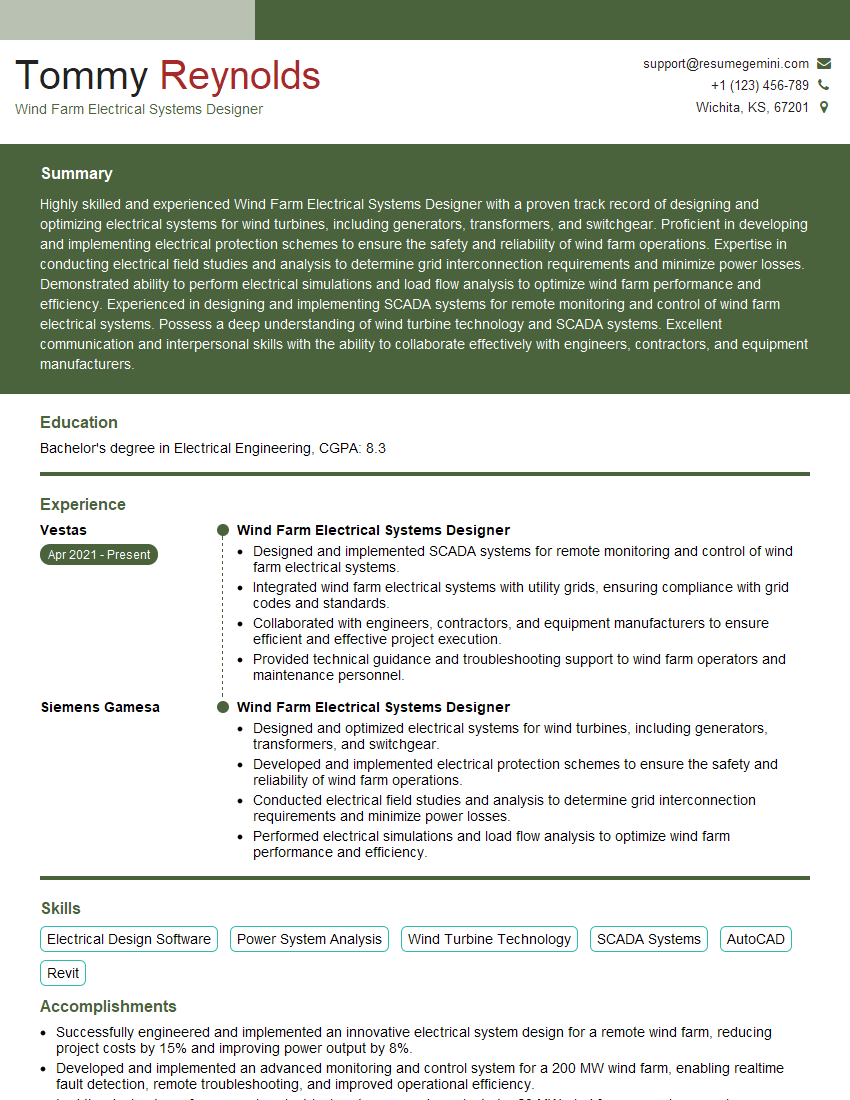
Mastering Electrical Systems Design for Wind Farms opens doors to exciting career opportunities in a rapidly growing sector. To maximize your job prospects, create an ATS-friendly resume that highlights your skills and experience effectively. ResumeGemini is a trusted resource for building professional resumes that get noticed. They provide examples of resumes tailored to Electrical Systems Design for Wind Farms, helping you present yourself in the best possible light. Invest time in crafting a compelling resume – it’s your first impression with potential employers.
Explore more articles
Users Rating of Our Blogs
Share Your Experience
We value your feedback! Please rate our content and share your thoughts (optional).
What Readers Say About Our Blog
Very informative content, great job.
good