Unlock your full potential by mastering the most common Electronic Attack Planning interview questions. This blog offers a deep dive into the critical topics, ensuring you’re not only prepared to answer but to excel. With these insights, you’ll approach your interview with clarity and confidence.
Questions Asked in Electronic Attack Planning Interview
Q 1. Explain the difference between Electronic Support Measures (ESM), Electronic Attack (EA), and Electronic Protection (EP).
Electronic Warfare (EW) encompasses three core disciplines: Electronic Support Measures (ESM), Electronic Attack (EA), and Electronic Protection (EP). Think of it like a military triad. Each plays a vital role in achieving battlefield dominance.
ESM (Electronic Support Measures): This is the ‘listening’ aspect. ESM systems passively detect, intercept, locate, identify, and analyze enemy radar and communications emissions. Imagine it as having highly advanced ears on the battlefield, identifying threats before they become visible. A classic example is a SIGINT (Signals Intelligence) system that identifies the type of radar used by an enemy aircraft.
EA (Electronic Attack): This is the ‘offensive’ aspect. EA actively employs energy to disrupt, deceive, or deny enemy use of the electromagnetic spectrum. This involves jamming, spoofing, and other techniques to neutralize enemy systems. Think of it as the ‘jamming’ and ‘disruption’ component, effectively blinding or confusing the enemy’s sensors. For instance, using a jammer to prevent an enemy missile guidance system from locking onto a friendly aircraft.
EP (Electronic Protection): This is the ‘defensive’ aspect. EP focuses on protecting friendly forces from enemy EA. It involves techniques and technologies to reduce the vulnerability of friendly systems to enemy electronic attacks. Imagine this as the ‘shield’ that protects friendly systems from the enemy’s electronic attacks. This could include techniques like using low probability of intercept radar (LPI) or deploying chaff to confuse enemy radar systems.
Q 2. Describe the process of developing an Electronic Attack plan.
Developing an EA plan is a meticulous process requiring careful consideration of numerous factors. It typically involves these key steps:
Mission Analysis: Define the specific objectives, constraints, and desired outcomes of the EA operation. What needs to be disrupted? What are the potential risks and consequences?
Target Analysis: Identify and characterize the enemy’s electronic systems. What frequencies do they operate on? What are their vulnerabilities?
Threat Assessment: Evaluate the enemy’s EA capabilities and Electronic Protection (EP) measures. How will they react to our actions? What are their countermeasures?
Resource Allocation: Determine the types and quantities of EA assets required. Do we have sufficient jamming power? What about the personnel and support needed?
Planning and Coordination: Develop detailed plans for the execution of the EA operation. What’s the sequence of events? How do we coordinate our actions with other military operations?
Rehearsal and Debriefing: Conduct rehearsals to identify and resolve potential issues. After the operation, conduct a thorough debrief to assess its success and identify lessons learned.
The entire process is iterative and requires constant refinement based on new intelligence and operational feedback.
Q 3. What are the key considerations when selecting Electronic Attack tactics?
Selecting effective EA tactics requires a deep understanding of the operational environment and the enemy’s capabilities. Key considerations include:
Effectiveness: Will the tactic achieve the desired outcome against the identified targets?
Survivability: Can the EA system survive the enemy’s response, and how do we mitigate potential risks?
Collateral Effects: What are the potential unintended consequences on friendly forces or civilian populations? We must operate within the laws of war and minimize collateral damage.
Detectability: How easily can the enemy detect and locate the EA system? Stealth and deception play a crucial role.
Sustainability: Can the tactic be sustained over time, considering resource consumption and potential enemy countermeasures?
Legal and Ethical Considerations: Does the tactic comply with international laws and our own ethical standards?
The choice of tactics often involves a trade-off between these considerations. For example, a powerful jammer might be very effective, but it is also easily detectable and may draw significant countermeasures.
Q 4. How do you assess the effectiveness of an Electronic Attack?
Assessing the effectiveness of an EA operation involves a multi-faceted approach. We need to collect and analyze various types of data to understand the impact of our actions. Key methods include:
Intelligence Gathering: Monitor enemy communications and actions to assess their reaction to the EA attack. Were they disrupted? Did their operations cease or change significantly?
Damage Assessment: Determine the extent of the damage inflicted on enemy systems. Did we destroy or disable any enemy equipment?
Operational Results: Evaluate the impact on the overall military operation. Did the EA operation contribute to the success of the mission?
Post-Mission Debrief: Gather feedback from personnel involved in the operation to gain valuable insights and identify areas for improvement.
Technical Evaluation: Analyze the performance of the EA systems and identify any technical shortcomings or areas for enhancement.
Combining these different sources of data provides a comprehensive picture of the EA operation’s effectiveness.
Q 5. What are the legal and ethical considerations surrounding Electronic Attack operations?
Electronic attack operations must always adhere to strict legal and ethical standards. International humanitarian law and the laws of armed conflict strictly govern the use of force, including EA. Key considerations include:
Proportionality: The harm caused by the EA operation must be proportionate to the military advantage gained.
Distinction: EA must be directed only against military objectives and must avoid harming civilians or civilian objects.
Precaution: All feasible precautions must be taken to minimize harm to civilians.
Military Necessity: The EA operation must be necessary to achieve a legitimate military objective.
Ethical considerations include the potential for unintended consequences and the need to avoid actions that could cause unnecessary suffering. We must always operate with transparency and accountability. Violations can lead to severe legal and diplomatic repercussions.
Q 6. Describe different types of Electronic Attack jamming techniques.
Jamming techniques vary depending on the target and the desired effect. Some common types include:
Noise Jamming: This involves broadcasting a wideband noise signal that overwhelms the target receiver. It’s like shouting over someone to drown out their voice.
Sweep Jamming: This involves rapidly changing the frequency of the jamming signal to cover a wide range of frequencies. Think of it as a constantly shifting target, making it harder for the enemy to track and lock onto.
Barrage Jamming: This involves broadcasting a high-power jamming signal across a specific frequency band. It’s like firing a barrage of bullets – overwhelming the target with sheer power.
Spot Jamming: This targets a specific frequency used by the enemy system. Think of it as a sniper aiming at a precise target.
Deception Jamming: This involves transmitting false signals to deceive the enemy system. For instance, mimicking the radar return of another object to confuse enemy tracking systems.
The choice of jamming technique depends on factors such as the target’s capabilities, the desired level of disruption, and the available resources.
Q 7. Explain the role of Electronic Attack in modern warfare.
Electronic Attack plays a crucial role in modern warfare, significantly impacting the effectiveness of military operations. It provides:
Information superiority: By disrupting enemy communications and sensors, EA creates an information advantage for friendly forces. It can blind, confuse, and degrade the enemy’s situational awareness.
Force protection: EA enhances force protection by neutralizing enemy threats and protecting friendly assets from attacks.
Enhanced maneuverability: EA can create windows of opportunity for friendly forces to conduct maneuvers and engage targets without being detected or targeted themselves.
Non-kinetic effects: EA achieves military objectives without causing physical destruction, potentially minimizing collateral damage and civilian casualties, thereby reducing human cost and promoting adherence to international law.
With the increasing reliance on electronic systems in modern military operations, the role of EA is only set to become more significant in future conflicts.
Q 8. How do you integrate Electronic Attack with other military operations?
Electronic Attack (EA) isn’t a standalone operation; it’s a crucial enabler for broader military objectives. Successful integration requires meticulous planning and close coordination with other military branches and operations. Imagine EA as a crucial supporting role in a play: it doesn’t take center stage but heavily influences the outcome.
- Intelligence Preparation of the Battlespace (IPB): EA planning begins with understanding the enemy’s electronic capabilities. ELINT (Electronic Intelligence) data informs targeting priorities and helps determine the most effective EA strategies.
- Combined Arms Operations: EA can significantly enhance the effectiveness of other military assets. For instance, suppressing enemy air defenses with EA allows friendly aircraft to operate more freely and effectively.
- Cyber Warfare Integration: Modern EA often overlaps with cyber warfare. Disrupting enemy communication networks can cripple their command and control, creating opportunities for ground forces.
- Information Operations (IO): EA can be used to create confusion and deception, masking friendly movements or creating false intelligence for the adversary.
For example, during a ground offensive, EA could be used to jam enemy communications, blind their targeting systems, and disrupt their coordination, significantly increasing the chances of a successful operation. The success hinges on precise timing and coordination with ground forces’ advances.
Q 9. What are some common Electronic Attack countermeasures?
Enemy forces employ various countermeasures against Electronic Attack. Think of it like a cyber arms race – EA develops new tactics, and the enemy develops counter-tactics.
- Frequency Hopping: Instead of using a single frequency, the enemy system rapidly switches between different frequencies, making it difficult for jamming systems to maintain lock.
- Spread Spectrum Techniques: The signal is spread across a wider range of frequencies, making it more difficult to detect and jam. This is similar to spreading butter thinly on a large piece of bread – it’s harder to pick out and remove.
- Redundancy and Backup Systems: The enemy might use multiple communication channels or systems, so disabling one doesn’t necessarily disrupt their operations entirely.
- Electronic Counter-Countermeasures (ECCM): These are designed to specifically detect and counteract jamming signals. This might involve sophisticated signal processing to identify and filter out jamming signals, allowing for continued communication.
- Geographic Dispersion: Spreading out their assets makes it harder to target them all at once with EA.
Understanding these countermeasures is crucial for effective EA planning. We need to anticipate and adapt to the enemy’s tactics to ensure mission success. Often, a layered approach incorporating multiple EA techniques is necessary to overcome these countermeasures.
Q 10. Describe your experience with Electronic Attack simulation tools.
My experience with EA simulation tools is extensive. These tools are invaluable for planning, training, and evaluating EA capabilities. They allow us to test different scenarios and strategies in a risk-free environment. Think of them as flight simulators for Electronic Warfare.
I’ve worked with various platforms, including high-fidelity models capable of replicating complex electronic environments, and simpler tools used for training purposes. These simulations help us model the effects of different jamming techniques, analyze the enemy’s likely responses, and refine our tactics. We can also use them to explore the potential impact of new technologies or upgrades to existing EA systems.
One particular project involved using a simulation to assess the effectiveness of a new jamming pod against a specific enemy radar system. The simulation allowed us to test different jamming strategies, optimize power levels, and assess the overall impact on the enemy’s operational capabilities. This resulted in significant improvements in the operational effectiveness of the new pod.
Q 11. How do you analyze Electronic Intelligence (ELINT) data?
Analyzing ELINT data is a complex process that requires specialized skills and tools. It’s like piecing together a puzzle to understand the enemy’s electronic capabilities.
- Signal Identification: Determining the type of signal, its source, and its purpose is the first step. This might involve analyzing signal characteristics like frequency, modulation, and bandwidth.
- Geolocation: Pinpointing the location of the emitting source using direction-finding techniques and signal propagation models.
- Signal Parameter Analysis: Examining details of the signal to extract information about the equipment used, its operating mode, and its potential capabilities.
- Data Correlation: Integrating the ELINT data with other intelligence sources to create a more comprehensive picture of the enemy’s situation.
- Database Management: ELINT data is typically stored and managed in large databases. Efficient management and search functionality are crucial for effective analysis.
Sophisticated software tools are essential for this process. These tools help us automate many of the tasks involved in signal processing, analysis, and data management. The output of this analysis provides crucial inputs to EA planning, allowing us to tailor our tactics to achieve maximum effect.
Q 12. Explain the concept of Electronic Order of Battle (EOB).
The Electronic Order of Battle (EOB) is a comprehensive database of an adversary’s electronic systems. Think of it as a detailed inventory of enemy equipment that can be used against electronic systems, but also about the enemy’s capabilities and tactics in the electronic warfare domain.
It provides information on:
- Types of systems: Radars, communications systems, navigation systems, etc.
- Technical characteristics: Frequencies used, modulation techniques, power levels, etc.
- Deployment locations: Where these systems are likely to be deployed.
- Operational doctrine: How the enemy typically employs their electronic systems.
The EOB is a dynamic document, constantly updated as new intelligence is gathered. It’s a vital tool for EA planning, providing the crucial information needed to develop effective jamming strategies and select the right equipment for the job.
Q 13. What are the key performance indicators (KPIs) for Electronic Attack operations?
Key Performance Indicators (KPIs) for EA operations vary depending on the mission objectives, but generally focus on assessing the effectiveness of the attack.
- Target Suppression/Neutralization Rate: Percentage of targets successfully suppressed or neutralized.
- Duration of Suppression: Length of time targets remained suppressed or ineffective.
- Impact on Enemy Operations: How the EA affected the enemy’s overall capabilities or operations. This might be measured through intelligence reports or battlefield observations.
- Collateral Damage: Minimizing unintended effects on friendly forces or civilian infrastructure.
- System Reliability and Availability: Ensuring the EA equipment functions reliably and is available when needed. This indicates successful maintenance and logistical support.
Tracking these KPIs is essential for evaluating the success of EA operations and improving future performance. This data informs training, equipment upgrades, and future mission planning, ensuring continuous improvement.
Q 14. How do you mitigate the risks associated with Electronic Attack operations?
Mitigating risks in EA operations is paramount. These operations often involve delicate balancing acts: achieving mission success while minimizing risks and collateral damage. It requires a multi-layered approach.
- Risk Assessment: Thorough pre-mission analysis identifying potential threats and vulnerabilities. This includes assessing the adversary’s capabilities, potential countermeasures, and the risk of collateral damage.
- Detailed Planning: Meticulous mission planning considers all aspects of the operation, including frequency selection, power levels, and potential consequences of unexpected events.
- Rehearsal and Training: Extensive rehearsal and training help the EA team anticipate potential problems and develop appropriate responses.
- Electronic Protection (EP): Implementing measures to protect friendly forces from enemy EA. This might include using ECCM techniques or employing deceptive measures.
- Contingency Planning: Developing plans for addressing unexpected situations, such as equipment malfunctions or enemy countermeasures. This includes having backup plans in case the primary EA strategy fails.
- Post-Mission Debrief: A critical review of the operation to learn from both successes and failures, identifying areas for improvement in future missions.
By adopting a proactive and comprehensive approach to risk management, we aim to maximize the effectiveness of EA operations while minimizing unintended consequences.
Q 15. Describe your experience with different types of radar systems and their vulnerabilities.
My experience encompasses a wide range of radar systems, from simple pulsed radars to sophisticated phased array systems. Understanding their vulnerabilities is crucial for effective electronic attack planning. Pulsed radars, for instance, are vulnerable to jamming techniques that exploit their predictable pulse repetition interval (PRI). A simple barrage jammer can overwhelm the receiver, while more sophisticated techniques can mimic legitimate radar returns to confuse the system. Phased array radars, while more agile, can be challenged by techniques that exploit their beam-forming characteristics, such as deploying deceptive jamming signals that appear to originate from multiple directions, creating confusion and rendering tracking difficult. I’ve worked extensively with both legacy and modern radar systems, and my understanding extends to their specific signal processing techniques, allowing me to identify optimal points for jamming or deception.
For example, during a recent exercise, we successfully disrupted a long-range air surveillance radar by exploiting its sensitivity to specific frequency bands and using a combination of noise jamming and deceptive jamming techniques. This resulted in the radar losing track of friendly aircraft and misidentifying targets, creating a significant advantage for our forces.
Career Expert Tips:
- Ace those interviews! Prepare effectively by reviewing the Top 50 Most Common Interview Questions on ResumeGemini.
- Navigate your job search with confidence! Explore a wide range of Career Tips on ResumeGemini. Learn about common challenges and recommendations to overcome them.
- Craft the perfect resume! Master the Art of Resume Writing with ResumeGemini’s guide. Showcase your unique qualifications and achievements effectively.
- Don’t miss out on holiday savings! Build your dream resume with ResumeGemini’s ATS optimized templates.
Q 16. Explain the concept of frequency hopping and its use in Electronic Attack.
Frequency hopping is a technique where a transmitter rapidly switches its operating frequency among a predefined set of frequencies. In electronic attack, this is used to make it incredibly difficult for an enemy system to track and jam our signals. Imagine trying to hit a moving target – if the target keeps changing its location rapidly, it becomes much harder to hit it consistently. Similarly, frequency hopping makes it extremely difficult for an enemy to lock onto our signal and effectively jam it because they must constantly adjust their jamming frequency to match our changing transmission.
The effectiveness of frequency hopping depends on several factors, including the hopping rate, the number of frequencies used, and the predictability of the hopping sequence. Well-designed frequency-hopping systems can significantly improve the resilience of communication and radar systems against jamming and interference.
For instance, we once used a frequency-hopping spread-spectrum system to protect a critical communication link in a high-threat environment. The enemy’s jamming attempts were rendered largely ineffective, ensuring consistent communication despite their efforts.
Q 17. How do you coordinate Electronic Attack with friendly forces?
Coordinating electronic attack with friendly forces requires meticulous planning and seamless communication. This involves a deep understanding of the operational environment, friendly force capabilities, and the enemy’s electronic warfare (EW) capabilities. We utilize a layered approach, starting with comprehensive threat analysis. We then integrate electronic attack plans into the overall operational plan, ensuring that our actions support and enhance the effectiveness of friendly forces.
A crucial aspect of coordination is the use of standardized procedures and communication protocols. This allows for rapid exchange of information and facilitates effective collaboration among different units and platforms. Real-time monitoring of the electromagnetic spectrum is also crucial to understand the effects of our actions and to adapt to changing circumstances. We often utilize sophisticated command and control systems to manage the electronic attack assets and coordinate with friendly forces.
A specific example would involve coordinating with friendly fighter aircraft to suppress enemy air defenses. By carefully targeting enemy radar systems with jamming and deception, we would create windows of opportunity for friendly aircraft to penetrate enemy airspace and engage their targets.
Q 18. Describe your experience with Electronic Attack planning software.
My experience with electronic attack planning software encompasses a range of tools, from simple spreadsheet-based planners to sophisticated simulations that model complex electromagnetic environments. These tools are invaluable for optimizing electronic attack plans, predicting the effectiveness of different techniques, and assessing risks. They allow for detailed modeling of the enemy’s systems, propagation effects, and the impact of environmental factors. I’m proficient in using several such software packages, which include capabilities such as signal propagation modeling, threat analysis, and mission planning.
For example, I’ve used software to simulate the effectiveness of different jamming waveforms against a specific enemy radar system, allowing us to optimize our jamming strategy for maximum disruption with minimal risk of detection. The software helped us to choose the optimal jamming power, frequency, and waveform to neutralize the threat.
Q 19. What are the challenges of Electronic Attack in a contested environment?
Electronic attack in a contested environment presents numerous challenges. The high density of electromagnetic emissions makes it difficult to discriminate between friendly and enemy signals, increasing the risk of fratricide. The enemy is likely to employ sophisticated EW countermeasures, making our attack strategies more complex. Furthermore, the dynamic nature of the battlefield demands adaptability and quick reaction times to emerging threats. The availability of accurate and timely intelligence is paramount to successful operations.
Overcoming these challenges necessitates robust situational awareness, advanced signal processing techniques, and close coordination with friendly forces. We employ techniques such as adaptive jamming, which adjusts to the enemy’s countermeasures, and advanced signal analysis to identify friendly signals and prioritize targets. The use of AI and machine learning for automated threat identification and response is also becoming increasingly critical.
Q 20. How do you ensure the electromagnetic compatibility (EMC) of Electronic Attack systems?
Ensuring electromagnetic compatibility (EMC) of electronic attack systems is critical to avoid unintended interference with friendly systems and to maintain the operational integrity of our own equipment. We employ rigorous testing procedures and design principles to minimize the risk of unwanted emissions and susceptibility to interference. This includes careful selection of components, shielding techniques, and filter designs.
The process involves multiple phases, starting with careful design considerations to minimize interference at the component level. Then, system-level testing is conducted to ensure that all components operate harmoniously and within acceptable emission limits. Finally, operational testing in a realistic environment verifies EMC in a complex electromagnetic scenario. Non-compliance can lead to significant disruption of operations and even endanger friendly forces.
Q 21. Explain your experience with different types of antennas used in Electronic Attack systems.
My experience with antennas used in electronic attack systems is extensive, encompassing various types, including dipole antennas, horn antennas, phased array antennas, and wideband antennas. The choice of antenna depends on the specific application and requirements of the mission. Dipole antennas are simple and cost-effective for broad-spectrum jamming, while horn antennas provide focused beamwidths, which is valuable for precise targeting. Phased array antennas provide high agility and allow for rapid beam steering, crucial for tracking and disrupting agile targets. Wideband antennas are necessary to cover a broad range of frequencies, maximizing the effectiveness of jamming or deception operations. In addition to the physical antenna design, the precise placement and orientation of the antenna are vital to maximizing effectiveness and minimizing interference.
For instance, in one operation, we used a phased array antenna to precisely target a specific enemy radar system, ensuring minimal interference to friendly communications.
Q 22. How do you handle unexpected events during an Electronic Attack mission?
Handling unexpected events during an Electronic Attack (EA) mission requires a robust, flexible plan and a team capable of adapting quickly. Our approach centers around pre-mission planning that anticipates potential contingencies and establishes clear protocols for responding to them. This includes identifying potential threats and vulnerabilities, developing fallback plans, and assigning roles and responsibilities within the team.
For example, imagine a scenario where our primary jamming system fails mid-mission. Our pre-planned response would immediately switch to a secondary system, potentially with a slightly reduced capability. Simultaneously, the team would analyze the failure, assess the impact on mission objectives, and potentially request support or adjust the mission parameters. Regular training exercises simulating various failures are crucial in building this adaptability. We use a tiered response system: first, immediate fixes using pre-defined procedures; second, a coordinated assessment of the situation to redefine objectives if necessary; third, escalation to command for broader support if the problem extends beyond our immediate capabilities.
Q 23. Describe your experience with data analysis and reporting in Electronic Attack operations.
Data analysis and reporting are fundamental to successful EA operations. We utilize sophisticated tools to collect, process, and analyze vast amounts of electronic data, identifying patterns, targets, and potential threats. This often involves signal parameter analysis, geolocation, and threat assessment. The data informs real-time tactical decisions and post-mission reports, assessing mission effectiveness and identifying areas for improvement.
For instance, we might analyze intercepted communications to identify enemy command and control structures. We’d then use this intelligence to prioritize targets and adjust our jamming strategies. Post-mission, we generate comprehensive reports detailing the types and frequency of intercepted signals, the effectiveness of our countermeasures, and potential improvements to our techniques. This includes visualizations of signal strengths and locations, statistical analysis of jamming effectiveness, and assessments of potential risks and vulnerabilities.
Q 24. What are the key factors influencing the selection of Electronic Attack platforms?
Selecting EA platforms is a complex process driven by several key factors: mission requirements, operational environment, technological capabilities, and cost-effectiveness. The mission dictates the necessary range, payload, and survivability characteristics. The operational environment influences factors like platform mobility (e.g., airborne, ground-based, naval), stealth capabilities, and resistance to countermeasures.
- Range and Payload: A long-range mission demands a platform with substantial reach and sufficient jamming power.
- Survivability: Operating in a high-threat environment necessitates platforms with advanced electronic counter-countermeasures (ECCM) and robust defenses.
- Platform Type: Airborne platforms offer flexibility and wider coverage, while ground-based systems offer persistent coverage in a specific area.
- Cost: Acquisition, maintenance, and operational costs are critical considerations.
For example, a coastal defense scenario may favor ground-based systems, whereas a large-scale conflict could require a combination of airborne, naval, and potentially space-based platforms.
Q 25. How do you stay current with the latest advancements in Electronic Attack technology?
Staying current in the rapidly evolving field of EA necessitates a multi-pronged approach. We actively participate in professional conferences, workshops, and seminars, engaging with leading experts and researchers. We subscribe to specialized journals and publications, monitoring the latest research and technological developments. Furthermore, we maintain strong relationships with industry partners, participating in testing and evaluations of new systems and technologies.
A crucial element is continuous professional education, involving both formal training courses and self-directed learning through online resources and publications. We also analyze competitor capabilities, constantly assessing advancements and potential threats, helping us to anticipate future challenges and adapt our own technologies and strategies proactively.
Q 26. Describe your experience working with interagency and multinational partners on Electronic Attack operations.
Collaboration with interagency and multinational partners is essential for successful EA operations, especially in complex and multi-domain environments. This involves sharing intelligence, coordinating actions, and establishing interoperability between different systems and platforms. Effective communication and trust-building are paramount. We utilize secure communication channels and standardized procedures to ensure seamless data exchange and coordination.
For instance, in a multinational exercise, we might share intelligence on enemy electronic activity with allied forces, coordinating jamming efforts to maximize effectiveness and avoid interference. This requires establishing clear communication protocols, shared situational awareness, and a deep understanding of each partner’s capabilities and limitations. Successful collaboration hinges on building trust, respecting cultural differences, and establishing clear lines of authority and responsibility.
Q 27. Explain the impact of advanced signal processing techniques on Electronic Attack capabilities.
Advanced signal processing techniques have revolutionized EA capabilities, significantly enhancing our ability to detect, identify, and counter enemy electronic systems. Techniques such as adaptive filtering, beamforming, and machine learning algorithms improve signal detection in noisy environments, enhance target identification accuracy, and enable the development of more effective jamming and deception strategies.
For example, adaptive filtering can help us isolate a specific signal of interest from a background of clutter and interference, allowing for precise targeting. Machine learning algorithms can analyze vast amounts of data to identify patterns and predict enemy behavior, enabling proactive countermeasures. These advancements have drastically increased the effectiveness of EA operations, allowing us to counter increasingly sophisticated threats.
Q 28. How do you evaluate the cost-effectiveness of different Electronic Attack strategies?
Evaluating the cost-effectiveness of different EA strategies requires a comprehensive analysis of several factors: initial investment costs, operational costs, effectiveness, and potential risks. We employ cost-benefit analysis, comparing the projected costs of various strategies against their expected benefits (e.g., reduced enemy capabilities, mission success rate). This includes considering both tangible costs (e.g., equipment, personnel) and intangible costs (e.g., risk to personnel, potential collateral damage).
For example, a high-cost, highly sophisticated EA system may prove cost-effective in a high-stakes scenario, even if the initial investment is significant, while a simpler, less expensive solution might be sufficient for a low-risk mission. We often use simulations and modeling to estimate the effectiveness of different approaches under various scenarios, helping us to make informed decisions that balance cost, risk, and effectiveness.
Key Topics to Learn for Electronic Attack Planning Interview
- Electronic Warfare Fundamentals: Understanding the principles of electronic attack, electronic protection, and electronic support. This includes knowledge of the electromagnetic spectrum and its applications.
- Threat Analysis and Targeting: Developing effective strategies for identifying, analyzing, and prioritizing enemy electronic systems for attack. Practical application includes understanding intelligence gathering and target selection methodologies.
- Planning and Execution: Designing and executing electronic attack missions, considering factors like timing, resources, and potential countermeasures. This involves understanding mission planning software and operational procedures.
- Jamming Techniques and Technologies: Familiarity with various jamming techniques and the technologies used to implement them. Practical applications include understanding the strengths and weaknesses of different jamming methods.
- Effects Assessment and Measurement: Evaluating the effectiveness of electronic attack operations and measuring their impact on enemy capabilities. This includes understanding data analysis and reporting techniques.
- Electronic Order of Battle (EOB): Understanding the process of building and maintaining an EOB, analyzing enemy electronic systems and their capabilities.
- Cyber Warfare Integration: Exploring the synergy between electronic attack and cyber warfare operations. Understanding the role of electronic attack in broader cyber-enabled operations.
- Legal and Ethical Considerations: Understanding the legal and ethical implications of electronic attack operations and adhering to the rules of engagement.
- Problem-Solving and Decision-Making under Pressure: Demonstrating the ability to analyze complex scenarios, make sound judgments, and adapt to rapidly changing situations. This is crucial for practical application in high-stakes environments.
Next Steps
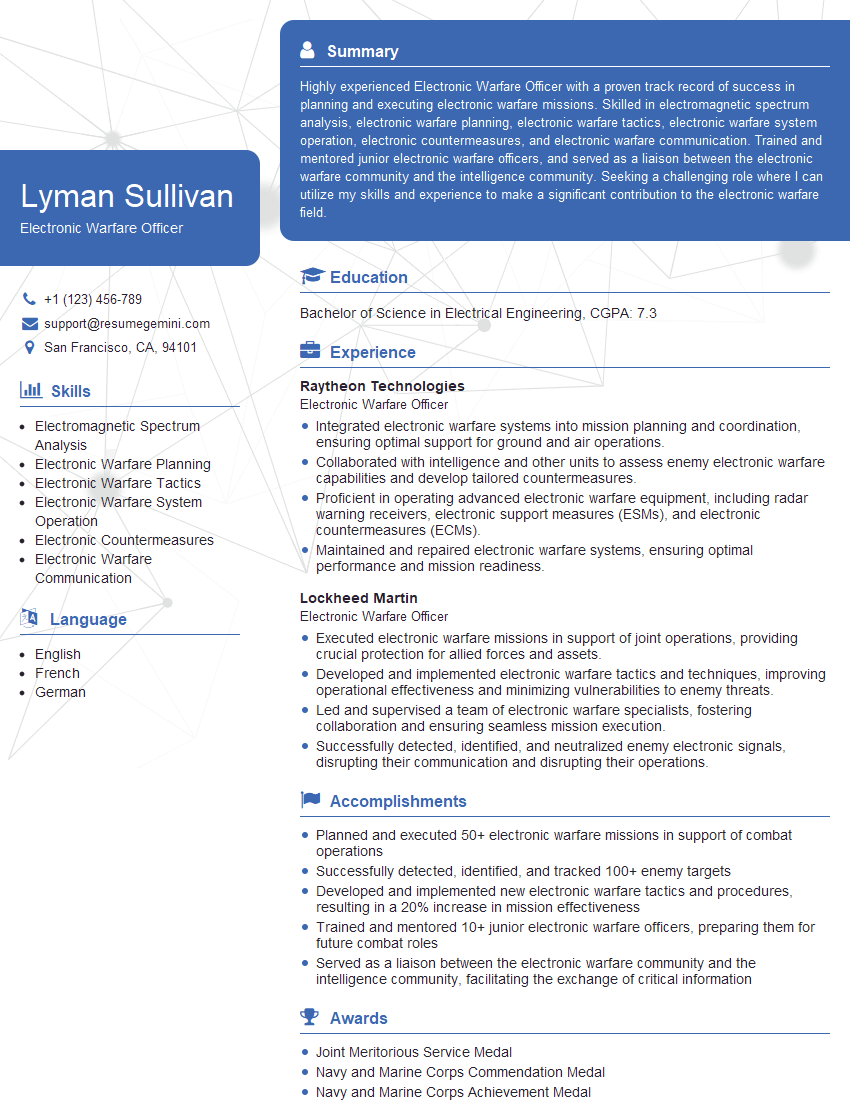
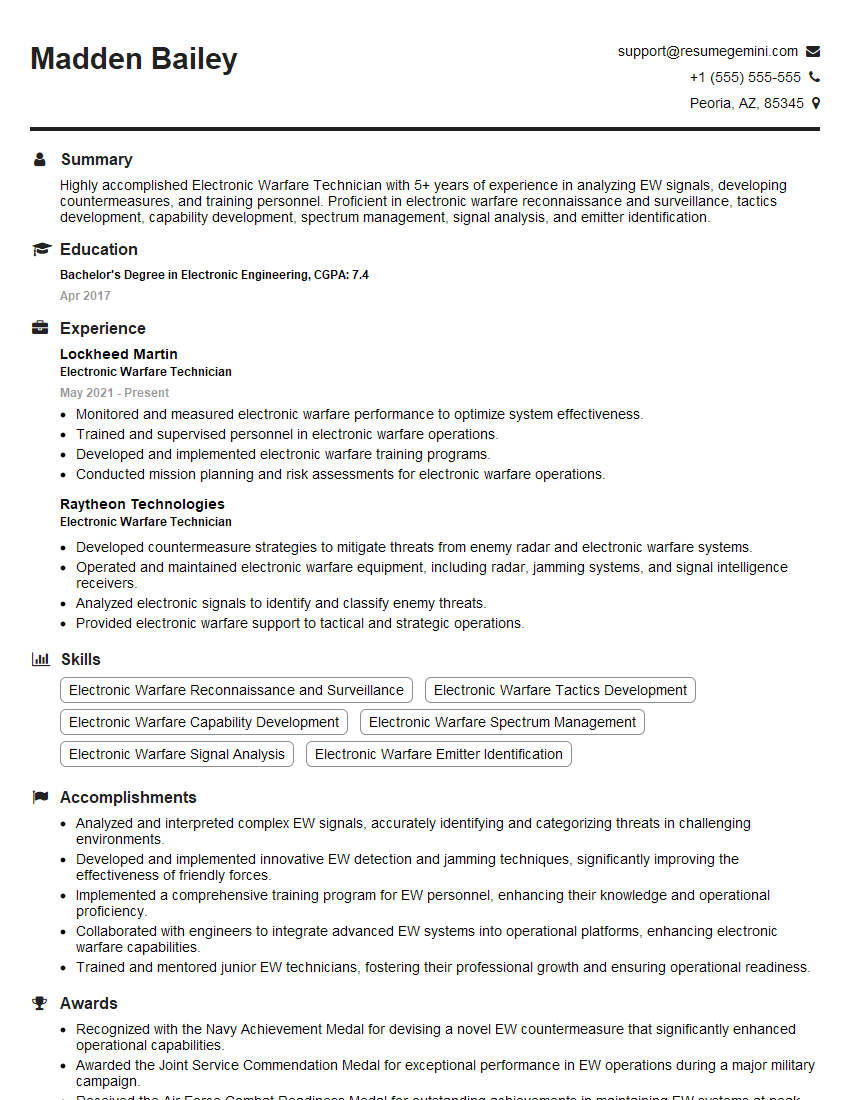
Mastering Electronic Attack Planning opens doors to exciting and impactful careers in defense and intelligence. To maximize your job prospects, it’s crucial to have a resume that effectively showcases your skills and experience. An ATS-friendly resume is essential for getting your application noticed by recruiters and hiring managers. ResumeGemini is a trusted resource that can help you build a professional and impactful resume, ensuring your qualifications stand out. Examples of resumes tailored to Electronic Attack Planning are available to guide you through the process.
Explore more articles
Users Rating of Our Blogs
Share Your Experience
We value your feedback! Please rate our content and share your thoughts (optional).
What Readers Say About Our Blog
Very informative content, great job.
good