Unlock your full potential by mastering the most common Electronic Warfare System Operation interview questions. This blog offers a deep dive into the critical topics, ensuring you’re not only prepared to answer but to excel. With these insights, you’ll approach your interview with clarity and confidence.
Questions Asked in Electronic Warfare System Operation Interview
Q 1. Explain the difference between Electronic Support, Electronic Attack, and Electronic Protection.
Electronic Warfare (EW) is broadly categorized into three core disciplines: Electronic Support (ES), Electronic Attack (EA), and Electronic Protection (EP). Think of it like a military engagement – ES is intelligence gathering, EA is offensive action, and EP is defense.
Electronic Support (ES): This involves passively receiving and analyzing electromagnetic emissions to identify, locate, and characterize emitters. It’s like being a spy, listening in to enemy communications to understand their capabilities and intentions. ES systems include direction finders, signal intelligence (SIGINT) receivers, and spectrum analyzers. A practical application might involve tracking enemy radar systems to pinpoint their location and assess their threat level.
Electronic Attack (EA): This focuses on actively disrupting or denying enemy use of the electromagnetic spectrum. This is the offensive aspect, like jamming enemy communications or blinding their sensors. EA systems include jammers, decoys, and spoofers. For example, a jammer might disrupt an enemy’s GPS signals, preventing them from accurately navigating.
Electronic Protection (EP): This involves protecting friendly forces from enemy EA actions. It’s about shielding yourself from attack, like wearing armor in battle. EP systems include radar warning receivers, countermeasures dispensers, and communication security systems. A practical example would be using a chaff dispenser to create radar decoys, distracting enemy missiles from targeting friendly aircraft.
Q 2. Describe your experience with different types of Electronic Warfare systems (e.g., jamming, deception, surveillance).
My experience encompasses a wide range of EW systems. I’ve worked extensively with various jamming techniques, including broadband noise jamming to disrupt a wide range of frequencies and narrowband jamming to target specific signals. I have practical experience designing and implementing deception systems, such as creating false radar targets using advanced signal processing algorithms. Furthermore, my experience includes working with sophisticated surveillance systems involving the analysis of intercepted communication and radar signals to gather intelligence on enemy capabilities and intentions. One project involved developing a system that could automatically identify and classify different types of radar signals, providing real-time threat assessment to operators.
For example, during a field exercise, we successfully used a combination of narrowband jamming and deception techniques to disrupt an enemy’s communication network and prevent them from coordinating an attack. This involved real-time analysis of their communication patterns and adapting our jamming strategies accordingly.
Q 3. How familiar are you with various EW frequency bands and their applications?
I am very familiar with various EW frequency bands, from the low frequency (LF) used for long-range communication to the extremely high frequency (EHF) used for high-bandwidth satellite communication and advanced radar systems. The application of each band greatly depends on its characteristics. For instance:
HF (High Frequency): Primarily used for long-range communications, often employing techniques like frequency hopping to improve communication reliability.
VHF (Very High Frequency): Commonly utilized for air-to-ground communications and some radar applications.
UHF (Ultra High Frequency): Widely used in satellite communication, radar systems, and tactical data links. Its shorter wavelength allows for more precise targeting.
SHF (Super High Frequency) & EHF (Extremely High Frequency): Often employed in advanced radar systems, satellite communication, and high-resolution imaging.
Understanding the limitations and capabilities of each band is crucial for effective EW operations. For example, the atmospheric attenuation of higher frequencies impacts long-range communication but can be an advantage in some radar applications where you want to limit the detection range.
Q 4. What are the key performance indicators (KPIs) for an Electronic Warfare system?
Key Performance Indicators (KPIs) for an EW system are multifaceted and depend on the specific system and mission objectives. However, some general KPIs include:
Effectiveness of Jamming/Deception: Measured by the percentage of enemy systems successfully disrupted or deceived.
Probability of Detection (Pd): The likelihood that the EW system will detect enemy emissions.
Probability of Kill (Pk): For EA systems, the likelihood of successfully neutralizing or destroying enemy systems.
False Alarm Rate: The frequency of false alarms generated by the system.
System Availability: The percentage of time the system is operational and ready for use.
Mean Time Between Failures (MTBF): A measure of the system’s reliability.
Mean Time To Repair (MTTR): The average time required to repair a system failure.
These KPIs help assess the system’s overall performance, effectiveness, and reliability. Regular monitoring and analysis of these KPIs are critical for optimizing system performance and identifying areas for improvement.
Q 5. Explain the concept of Electronic Order of Battle (EOB).
Electronic Order of Battle (EOB) is a comprehensive database detailing the enemy’s electronic warfare capabilities. It’s essentially an intelligence picture of their EW systems. This includes the types of systems they possess (radars, communications systems, jammers, etc.), their frequencies of operation, geographic locations, and operational patterns. Building an accurate EOB requires careful analysis of intercepted signals, sensor data, and intelligence reports.
Imagine it as a detailed enemy profile, but specifically focusing on their electronic capabilities. This information is crucial for planning effective EW operations, predicting enemy actions, and optimizing the use of friendly EW systems. A comprehensive EOB allows for targeted jamming strategies, optimized deception plans, and better protection of friendly forces.
Q 6. Describe your experience with EW system troubleshooting and maintenance.
My experience with EW system troubleshooting and maintenance is extensive. It often involves a systematic approach, starting with identifying the problem by analyzing system logs, error messages, and performance data. This may involve using specialized diagnostic tools and software. Once the root cause is determined, I follow established maintenance procedures to repair or replace faulty components. This frequently involves working with complex signal processing hardware and software.
One challenging case involved diagnosing intermittent jamming failure in a high-power jammer. By carefully analyzing the signal output and power levels, we were able to pinpoint a faulty high-voltage power supply. Replacing the component solved the issue, highlighting the importance of meticulous diagnostics and component-level troubleshooting.
Q 7. How do you ensure the security and integrity of EW systems?
Ensuring the security and integrity of EW systems is paramount. This involves a multi-layered approach:
Physical Security: Restricting physical access to the systems to authorized personnel only, using secure facilities and employing surveillance systems.
Cybersecurity: Implementing robust cybersecurity measures to protect against unauthorized access, malware, and cyberattacks. This includes using firewalls, intrusion detection systems, and regular security audits.
Data Security: Protecting sensitive data, including intercepted signals and operational parameters, through encryption, access controls, and secure data storage.
Software Updates and Patches: Regularly updating the system software to address vulnerabilities and improve security. This prevents attackers from exploiting known weaknesses.
Personnel Security: Ensuring that personnel with access to the system have undergone proper security clearance and training.
A layered approach provides comprehensive protection, ensuring that the system remains secure and reliable even in the face of sophisticated attacks.
Q 8. Explain your understanding of signal processing techniques used in EW.
Signal processing in Electronic Warfare (EW) is crucial for detecting, identifying, and responding to enemy signals. It involves a range of techniques to extract meaningful information from often noisy and complex electromagnetic environments. Think of it like trying to hear a specific conversation in a crowded room – you need to filter out the background noise and focus on the signal of interest.
Filtering: This removes unwanted frequencies or noise from the received signal. For example, a bandpass filter would isolate a specific frequency range of interest, ignoring others.
Detection: This involves identifying the presence of a signal, often using techniques like energy detection or matched filtering. Matched filtering is particularly powerful as it compares the received signal to a known signal template, maximizing the signal-to-noise ratio for improved detection.
Estimation: Once a signal is detected, its parameters (frequency, amplitude, modulation type, etc.) need to be estimated. This is often done using techniques like Fourier transforms, which decompose the signal into its constituent frequencies, revealing crucial information about the emitter.
Classification: This involves identifying the type of emitter based on its signal characteristics. Machine learning algorithms are increasingly used for this purpose, trained on large datasets of known emitter signals.
These techniques are implemented using specialized hardware and software, often utilizing digital signal processors (DSPs) and sophisticated algorithms. The specific techniques employed depend on the nature of the threat and the EW system’s objectives.
Q 9. How do you analyze EW data to identify threats and vulnerabilities?
Analyzing EW data to identify threats and vulnerabilities is a multi-step process that combines signal processing techniques with intelligence analysis. It’s like being a detective, piecing together clues to build a complete picture.
Signal Characterization: The initial step involves detailed analysis of the intercepted signals using the techniques described above. We examine the frequency, modulation, pulse repetition interval (PRI), and other parameters to create a ‘fingerprint’ of the emitter.
Database Correlation: This fingerprint is then compared against known emitter signatures in a database (e.g., ELINT databases). This helps identify the type of radar, communication system, or other emitter.
Threat Assessment: Once identified, the threat posed by the emitter is assessed considering its capabilities, location, and operational context. This may involve integrating EW data with intelligence from other sources.
Vulnerability Analysis: This involves identifying weaknesses in the emitter’s design or operation that can be exploited. For example, a vulnerability might be a specific frequency or modulation scheme that can be jammed or spoofed.
Sophisticated software tools are employed to automate many aspects of this process, but human expertise remains critical in interpreting the results and making informed decisions.
Q 10. Describe your experience with EW simulation and modeling tools.
My experience with EW simulation and modeling tools spans several platforms, including specialized software like MATLAB, specialized EW simulators, and custom-built models. These tools are essential for designing, testing, and evaluating EW systems without the cost and risk of real-world testing.
For example, I’ve used MATLAB extensively to create models of radar signal propagation, jamming effectiveness, and receiver performance. These models allow us to simulate different scenarios and assess the effectiveness of various EW countermeasures. Specialized EW simulators provide a more comprehensive environment, allowing for the simulation of entire EW systems and their interactions.
I have also worked on the development of custom simulation models using programming languages like C++ for specific applications where off-the-shelf tools were insufficient. This allows for high fidelity simulation of the interactions of specific EW systems in unique environments, improving confidence in the performance of the deployed systems.
Q 11. How do you integrate EW systems with other command and control systems?
Integrating EW systems with other command and control (C2) systems is crucial for effective situational awareness and coordinated action. This involves exchanging information seamlessly between the EW system and other systems, like intelligence platforms, battle management systems, and weapon systems.
This integration typically involves the use of standard communication protocols (e.g., TCP/IP, data link protocols) and data formats. The EW system will often act as a sensor, providing information about enemy emitters to the C2 system. This allows for informed decision-making and coordinated responses, such as directing jamming efforts or targeting enemy assets.
Data fusion techniques are critical in this process, combining data from multiple sources to provide a more comprehensive and reliable picture of the battlespace. This often requires careful consideration of data reliability, accuracy, and timing.
For example, a network-centric EW system might integrate with a friendly air defense system, providing real-time information about enemy radar locations and capabilities to help coordinate defensive measures. This level of collaboration vastly improves operational effectiveness.
Q 12. Explain your knowledge of EW regulations and compliance.
My understanding of EW regulations and compliance is comprehensive. EW operations are subject to both national and international regulations to ensure safety, prevent interference with civilian systems, and avoid escalation. These regulations vary depending on the country and the specific frequency bands involved.
These regulations often specify allowable power levels, operating frequencies, and emission characteristics. Compliance is crucial to avoid legal repercussions and maintain international cooperation. Knowing these regulations is essential for designing and operating EW systems responsibly and legally. Failure to comply can have serious legal and international consequences.
I have extensive experience in ensuring that EW systems are designed and operated in strict accordance with applicable regulations. This includes careful frequency management, power control, and emission monitoring. We regularly conduct spectrum surveys and frequency coordination to minimize potential interference with other systems.
Q 13. Describe a challenging EW system problem you solved and how you approached it.
One challenging problem involved improving the performance of a radar warning receiver (RWR) in a highly cluttered environment. The RWR was struggling to accurately detect and classify enemy radar signals amidst a high density of civilian and friendly signals – akin to trying to find a specific needle in a haystack.
Our approach was multifaceted:
Advanced Signal Processing: We implemented sophisticated digital signal processing algorithms, including adaptive filtering and advanced classification techniques, to improve the RWR’s ability to discriminate between threat and non-threat signals.
Spatial Filtering: We leveraged antenna array technology to improve the direction-finding capabilities of the RWR. This allowed us to focus on signals originating from specific directions, reducing clutter.
Machine Learning: We trained a machine learning model using a large dataset of radar signals, enabling the system to learn and adapt to different clutter environments.
Through these improvements, we significantly enhanced the RWR’s detection performance and reduced the rate of false alarms, ultimately improving the situational awareness and combat effectiveness of the platform.
Q 14. What are the limitations of current EW technologies?
Current EW technologies face several limitations:
Anti-jamming techniques: Sophisticated enemy emitters are constantly developing techniques to resist jamming and deception. This is an ongoing arms race, where both sides continually develop and adapt their technologies.
Electronic Protection: Protecting friendly systems from EW attacks remains a major challenge, particularly against advanced attacks like directed energy weapons.
Spectrum congestion: The increasing use of the radio frequency spectrum by civilian and military systems leads to congestion and makes it more difficult to detect and identify enemy signals.
Cost and complexity: Developing and maintaining advanced EW systems is expensive and requires highly skilled personnel. This creates barriers to widespread adoption and poses logistical challenges.
Artificial Intelligence (AI) and Machine Learning (ML) countermeasures: While AI/ML offer significant advantages to EW systems, they can also be utilized by adversaries making the EW battle space more dynamic and uncertain.
Overcoming these limitations requires continued investment in research and development, focusing on advanced signal processing algorithms, more robust system designs, and improved integration with other C2 systems. This includes the need to develop robust defenses against AI/ML-based attacks on EW systems.
Q 15. How do you stay current with the latest advancements in Electronic Warfare?
Staying current in the rapidly evolving field of Electronic Warfare (EW) requires a multi-pronged approach. It’s not enough to rely solely on formal training; continuous learning is paramount.
- Professional Publications and Journals: I regularly read publications like IEEE Transactions on Aerospace and Electronic Systems, and other specialized journals focusing on EW technologies and strategies. These provide in-depth technical articles on cutting-edge research and development.
- Conferences and Workshops: Attending conferences like the IEEE International Symposium on Phased Array Systems and Technology and other EW-focused events is crucial for networking and learning about the latest advancements directly from researchers and industry leaders. I actively participate in discussions and workshops to deepen my understanding.
- Online Resources and Communities: I leverage online resources such as specialized websites and forums dedicated to EW, where experts share insights and discuss emerging trends. This helps me stay informed about practical applications and real-world challenges.
- Industry Collaboration: Working alongside colleagues and experts from different organizations – both within and outside the military – is incredibly valuable for cross-pollination of ideas and exposure to different perspectives on EW systems and their applications.
- Self-directed Learning: I dedicate time to independent study, researching emerging technologies such as AI and machine learning in EW, and their impact on future warfare. This ensures I am prepared for the future of the field.
This combination of formal and informal learning keeps my knowledge base fresh and relevant, allowing me to effectively contribute to the design, operation, and analysis of complex EW systems.
Career Expert Tips:
- Ace those interviews! Prepare effectively by reviewing the Top 50 Most Common Interview Questions on ResumeGemini.
- Navigate your job search with confidence! Explore a wide range of Career Tips on ResumeGemini. Learn about common challenges and recommendations to overcome them.
- Craft the perfect resume! Master the Art of Resume Writing with ResumeGemini’s guide. Showcase your unique qualifications and achievements effectively.
- Don’t miss out on holiday savings! Build your dream resume with ResumeGemini’s ATS optimized templates.
Q 16. What is your experience with different types of antennas used in EW systems?
My experience encompasses a wide range of antennas used in EW systems, each with its own strengths and weaknesses. The choice of antenna is heavily dependent on the specific EW application and operational requirements.
- Dipole Antennas: Simple, relatively inexpensive, and effective for basic EW tasks, particularly in applications needing broad bandwidth. However, they offer limited gain and directional capability.
- Yagi-Uda Antennas: These provide higher gain and better directionality compared to dipoles, suitable for applications requiring more focused transmission or reception. They’re often used in direction-finding and jamming systems.
- Horn Antennas: Offering good gain and beam shaping, these are useful for applications demanding precise control over the radiated energy, like in specialized jamming or electronic support measures (ESM) systems.
- Phased Array Antennas: These highly sophisticated antennas allow for electronic beam steering, enabling rapid target acquisition, tracking, and jamming. Their adaptability makes them highly valuable in modern EW environments. I’ve had extensive experience working with these antennas, particularly in developing adaptive jamming techniques.
- Microstrip Patch Antennas: Compact and lightweight, these antennas are increasingly utilized in EW systems requiring low profile or conformal mounting, especially on smaller platforms like UAVs.
Choosing the right antenna is crucial for system performance. For instance, a phased array antenna may be ideal for a sophisticated jamming system against a rapidly maneuvering target, while a simple dipole might suffice for basic frequency monitoring in a simpler EW system. The selection always depends on the operational needs and constraints.
Q 17. Explain the concept of Electronic Intelligence (ELINT).
Electronic Intelligence (ELINT) is the process of collecting, identifying, and analyzing electromagnetic emissions from electronic devices. It’s a crucial component of Electronic Warfare, providing critical information on enemy capabilities and intentions.
Think of it like this: Imagine you’re trying to understand an enemy army’s movements. Instead of relying solely on visual observation or human intelligence, ELINT allows you to listen in on their radio communications, radar transmissions, and other electronic signals. This information provides a crucial, often hidden, layer of intel about their position, equipment, and potential plans.
The ELINT process typically involves several key steps:
- Signal Detection and Reception: Specialized antennas and receivers capture electromagnetic emissions across a wide range of frequencies.
- Signal Identification and Classification: Sophisticated signal processing techniques are used to determine the type of emitter (e.g., radar, communication system) and its characteristics (frequency, modulation, power).
- Signal Analysis and Interpretation: The collected data is analyzed to extract meaningful information about the emitter’s location, capabilities, and operational status.
- Reporting and Dissemination: The processed intelligence is then disseminated to relevant parties for decision-making and operational planning.
ELINT is vital for developing effective EW strategies, targeting enemy systems, and gaining a crucial information advantage in any conflict.
Q 18. Describe your understanding of different types of jamming techniques.
Jamming techniques are employed to disrupt or deny the use of enemy electronic systems. Various methods exist, each with its strengths and weaknesses:
- Noise Jamming: This involves broadcasting a broad spectrum of noise to overwhelm the desired signal. It’s a simple but relatively inefficient technique as it can be easily detected and its effects are often easily mitigated.
- Sweep Jamming: The jammer rapidly scans across a frequency band, targeting different channels to disrupt multiple signals simultaneously. This approach is more effective than noise jamming but can be countered with agile frequency-hopping techniques.
- Barrage Jamming: This focuses on a specific frequency band, broadcasting a high-power signal to overpower the target signal. Effective but can be easily detected and requires significant power.
- Spot Jamming: Targets a specific frequency channel, more efficient than barrage jamming since it concentrates power on one specific channel.
- Deception Jamming: Instead of simply overwhelming the target signal, this technique involves injecting false or misleading signals. This is a more sophisticated approach, requiring precise knowledge of the target system.
- Self-Protecting Jamming (SPJ): Designed to protect an EW platform from enemy attacks. SPJ systems often use adaptive techniques to counteract incoming jamming or attack signals.
The selection of jamming technique depends heavily on factors such as the target system, the available resources, and the overall EW strategy. Often a combination of techniques is used to maximize effectiveness.
Q 19. How do you mitigate the effects of jamming on friendly systems?
Mitigating the effects of jamming on friendly systems requires a layered approach encompassing both preventative measures and reactive countermeasures.
- Frequency Hopping: This technique involves rapidly changing the operating frequency of a communication or radar system, making it difficult for a jammer to lock onto and disrupt the signal. Think of it like changing radio channels quickly – the jammer won’t be able to follow every switch.
- Spread Spectrum Techniques: These techniques spread the signal across a wide bandwidth, making it less susceptible to narrowband jamming. This is similar to spreading a secret message across multiple channels; the enemy must listen to all of them to decipher it, making it hard to intercept effectively.
- Adaptive Filtering: Sophisticated signal processing algorithms can be used to identify and filter out jamming signals, isolating the desired signal. This is like cleaning up noisy audio recording to hear the desired sound more clearly.
- Redundancy and Diversity: Using multiple communication paths or employing multiple radar systems enhances resilience. If one system is jammed, others can still function.
- Directed Energy Weapons (DEW): In some cases, directed energy weapons, such as high-power microwave systems, can be used to disable or neutralize enemy jammers.
- Signal Processing Techniques: Advanced signal processing techniques are employed to discriminate between the desired signal and the jamming signal.
The specific mitigation strategy will depend on the type of jamming encountered and the capabilities of the friendly systems. A combination of these techniques often provides the most robust protection.
Q 20. What is your experience with EW system testing and evaluation?
EW system testing and evaluation is a critical process ensuring operational effectiveness and reliability. My experience covers the full spectrum of testing, from initial component-level testing to complete system-level evaluation in realistic operational scenarios.
- Component Testing: Individual components (antennas, receivers, transmitters, etc.) are rigorously tested to verify their performance against specifications.
- Subsystem Testing: Subsystems are then integrated and tested to assess their interaction and functionality.
- System Integration Testing: This involves testing the entire EW system to verify its performance as a complete unit.
- Environmental Testing: Systems are subjected to various environmental conditions (temperature, humidity, vibration, etc.) to ensure their robustness and reliability in diverse operational environments.
- Field Testing: Real-world testing in simulated operational environments is essential to evaluate performance under realistic jamming conditions. This might involve deploying the system in a controlled range setting, simulating various enemy jamming strategies and testing mitigation techniques.
- Performance Metrics: Throughout testing, various performance metrics (e.g., jamming effectiveness, detection range, resistance to countermeasures) are measured and analyzed. Statistical methods are employed to determine confidence in performance evaluations.
Effective testing and evaluation are vital for identifying and resolving any issues before deployment. This ensures the system can effectively meet its operational requirements, providing critical support for military operations.
Q 21. Explain your understanding of the electromagnetic spectrum and its implications for EW.
The electromagnetic spectrum is the range of all possible frequencies of electromagnetic radiation. It’s crucial to EW because all EW systems operate within specific portions of this spectrum.
Understanding the electromagnetic spectrum is fundamental to EW operations because different frequencies have different propagation characteristics and are susceptible to different types of interference and jamming. For example:
- Lower frequencies (e.g., HF, VHF): These tend to propagate over longer distances, making them suitable for long-range communication. However, they are also more susceptible to atmospheric interference and jamming.
- Higher frequencies (e.g., UHF, SHF): These offer higher bandwidth and better precision, ideal for radar and some communication systems. They’re however more susceptible to atmospheric attenuation (signal loss) and are less effective for long-range communication.
The allocation of frequency bands for various applications is strictly regulated internationally. EW systems must operate within these regulations while simultaneously attempting to disrupt or utilize enemy signals within the same spectrum. This necessitates intricate understanding of spectrum management, interference mitigation, and frequency coordination.
Furthermore, the propagation characteristics of the electromagnetic spectrum are impacted by environmental factors like terrain, weather, and atmospheric conditions. These factors significantly affect EW system performance, requiring careful consideration during planning and operation. For instance, a heavy rain storm might impact the effectiveness of a particular type of radar, while mountainous terrain might limit the range of a communication system.
In essence, a thorough understanding of the electromagnetic spectrum and its nuances is indispensable for effective EW system design, operation, and analysis.
Q 22. How do you manage EW system resources effectively during a mission?
Effective EW system resource management hinges on a robust prioritization strategy coupled with real-time situational awareness. Think of it like managing a military unit – you have limited ammunition (power, bandwidth, etc.) and multiple targets (enemy emitters, communication links). We need to allocate resources to achieve mission objectives efficiently.
- Prioritization: This involves analyzing the threat landscape and assigning priorities to targets based on their importance and impact on the mission. For example, neutralizing an enemy radar guiding anti-aircraft fire is a higher priority than jamming a less critical communication link.
- Power Management: EW systems are power-hungry. Effective management involves optimizing power consumption across different subsystems. This might include using lower-power jamming techniques when possible, or cycling certain systems on and off to conserve energy during periods of low threat.
- Frequency Agility: Quickly changing frequencies is crucial to avoid detection and countermeasures. This requires careful planning and coordination to ensure seamless transitions and avoid interference with friendly forces.
- Real-time Monitoring and Adjustment: Continuous monitoring of system performance and the enemy’s response allows for dynamic resource allocation. For instance, if a jamming technique proves ineffective, resources are re-allocated to a more effective method.
In one mission, we faced a situation with multiple enemy radar systems. By prioritizing the most threatening radar first (guiding enemy fighter jets), we successfully suppressed its ability to track our assets, thereby protecting our primary mission objectives before shifting attention to other, less critical emitters.
Q 23. Describe your experience with EW planning and execution.
EW planning and execution is a meticulous process requiring careful coordination between different teams. It starts with thorough intelligence gathering to identify potential threats, their capabilities, and operational patterns. This information forms the basis of our EW strategy.
- Threat Assessment: We analyze the types of radar, communication, and navigation systems the adversary is likely to employ. This includes their frequencies, power levels, and vulnerabilities.
- Strategy Development: Based on the threat assessment, we develop a tailored EW plan detailing the types of electronic warfare techniques to be employed, their timing, and the allocation of resources.
- Coordination: Effective communication and coordination with other forces (e.g., intelligence, air defense) are paramount. We share information and coordinate actions to ensure synergistic effects.
- Execution and Monitoring: During the mission, we closely monitor the effects of our EW actions and adapt the plan as needed. This often involves real-time adjustments based on the enemy’s responses.
For example, during a recent exercise, we successfully disrupted an enemy’s communication network by strategically employing deception and jamming techniques. This involved coordinating actions with other units to create a false picture and overwhelm the enemy’s ability to communicate effectively.
Q 24. What are some ethical considerations related to Electronic Warfare?
Ethical considerations in EW are crucial. While EW is a legitimate military tool, it’s essential to adhere to international law and ethical standards. The primary ethical concern revolves around proportionality and discrimination.
- Proportionality: The use of EW should be proportionate to the military necessity. Excessive or indiscriminate jamming that causes civilian harm is unacceptable.
- Discrimination: EW measures should be targeted at legitimate military objectives, minimizing harm to civilians and civilian infrastructure. Accidental interference with civilian communication systems must be avoided wherever possible.
- Transparency: While operational secrecy is important, there should be transparency regarding the use of EW capabilities, particularly regarding their potential impact on civilian populations.
- Rules of Engagement: Strict adherence to the Rules of Engagement (ROE) is critical. The ROE guides acceptable targets and limitations on the application of EW techniques.
Imagine a scenario where jamming civilian communication networks is needed to prevent an imminent threat. The ethical dilemma would be to weigh the potential loss of civilian life against the disruption of civilian communication. The decision must be made based on strict ROE and proportionality guidelines.
Q 25. Describe your experience with different types of radar systems and their vulnerabilities.
My experience encompasses a wide range of radar systems, from legacy pulse-Doppler radars to modern active electronically scanned array (AESA) systems. Each has its strengths and weaknesses. Understanding these vulnerabilities is critical for developing effective EW countermeasures.
- Pulse-Doppler Radars: These radars are susceptible to various EW techniques like jamming, deception, and spoofing, particularly in their less advanced forms. Their vulnerability often stems from their relatively narrow frequency bandwidths.
- AESA Radars: While more advanced, AESA radars are not immune to EW attacks. However, their agility in terms of frequency hopping and beam steering requires sophisticated EW countermeasures. Exploiting their limitations in instantaneous bandwidth or reaction times can still prove effective.
- Other Radar Types: I’m also familiar with other types such as passive radars, which are harder to detect but still vulnerable to interference and spoofing.
For example, in one exercise, we successfully jammed a pulse-Doppler radar by saturating its receiver with a high-power jamming signal. This temporarily blinded the radar, preventing it from accurately tracking our assets.
Q 26. How familiar are you with different types of communication systems and their susceptibility to EW attacks?
My understanding extends across various communication systems, from HF and VHF radios to satellite communications and modern data links. Each system has unique vulnerabilities depending on its design and operating parameters.
- HF/VHF Radios: These systems are more susceptible to simple jamming techniques due to their reliance on relatively narrow bandwidths and unencrypted communications.
- Satellite Communications: Satellite links are more resistant to jamming due to their inherent high-power transmissions and the use of encryption. However, vulnerabilities can exist in the ground segments or in the use of predictable communication patterns.
- Data Links: Modern data links use sophisticated modulation schemes and encryption. Effective EW attacks require deep knowledge of their protocols to exploit vulnerabilities and potentially decrypt transmissions. However, the potential for jamming or data corruption remains.
For instance, we once successfully disrupted an enemy’s VHF radio communications during a training exercise using a simple, yet effective barrage jamming technique, effectively disrupting their coordination.
Q 27. Explain your understanding of the impact of EW on network security.
EW significantly impacts network security. EW attacks can disrupt network operations, compromise data integrity, and gain unauthorized access. Modern networks are highly reliant on electronic communication, making them vulnerable to a wide array of EW attacks.
- Denial-of-Service (DoS): Jamming or saturating communication links can cause a DoS condition, disrupting normal network operation.
- Data Corruption: Intentional interference can corrupt data packets, leading to inaccurate or unusable information.
- Spoofing: EW attacks can create false network traffic, misleading the network and causing errors.
- Man-in-the-Middle (MitM): Advanced EW techniques could allow an attacker to intercept and manipulate network traffic, eavesdropping on communication or injecting malicious code.
Consider a scenario where a military network relies on satellite communications. An effective EW attack could disrupt communications, disabling the network’s ability to share vital information and coordinate responses.
Q 28. Describe your experience with data analysis and reporting related to EW operations.
Data analysis and reporting are integral to EW operations. We collect and analyze vast amounts of data from various sources, including EW sensors, communication intercepts, and radar data. This data provides valuable insights into enemy capabilities, tactics, and vulnerabilities.
- Data Acquisition: This involves gathering raw data from EW sensors and other sources, ensuring accurate and reliable data collection.
- Data Processing and Analysis: Sophisticated tools and techniques are used to process and analyze the raw data, identifying patterns, and extracting relevant information.
- Reporting: Findings are meticulously documented and presented in clear, concise reports for decision-makers, summarizing effectiveness, potential threats, and recommendations for future operations.
- Intelligence Integration: Data analysis often involves integration of EW data with other intelligence sources for a more complete picture of the operational environment.
For example, after a recent mission, we analyzed intercepted communications and radar data to pinpoint the location and capabilities of an enemy radar system. This information proved invaluable in planning subsequent operations.
Key Topics to Learn for Electronic Warfare System Operation Interview
- EW System Fundamentals: Understanding the basic principles of electronic warfare, including electronic attack (EA), electronic protection (EP), and electronic support (ES). This includes knowledge of the electromagnetic spectrum and signal propagation.
- Specific System Knowledge: Deep dive into the specific EW systems you’ve worked with or are familiar with. Be prepared to discuss their capabilities, limitations, and operational procedures. Include details on any unique features or technologies.
- Signal Processing and Analysis: Demonstrate your understanding of signal detection, identification, and analysis techniques. Be ready to discuss practical applications, such as jamming techniques or identifying emitters.
- Threat Analysis and Response: Show your ability to assess potential threats and develop effective countermeasures. Discuss scenarios where you’ve had to react to unexpected EW situations.
- Data Interpretation and Reporting: Explain how you interpret data from EW systems and translate that into actionable intelligence or reports. Highlight your experience in presenting findings clearly and concisely.
- System Integration and Interoperability: Describe your experience with integrating EW systems into larger operational contexts and ensuring interoperability with other systems.
- Cybersecurity in EW: Discuss the importance of cybersecurity in protecting EW systems from attacks and vulnerabilities. Be prepared to discuss relevant security protocols and best practices.
- Troubleshooting and Problem Solving: Illustrate your ability to diagnose and resolve technical problems related to EW systems. Use the STAR method (Situation, Task, Action, Result) to describe past experiences.
Next Steps
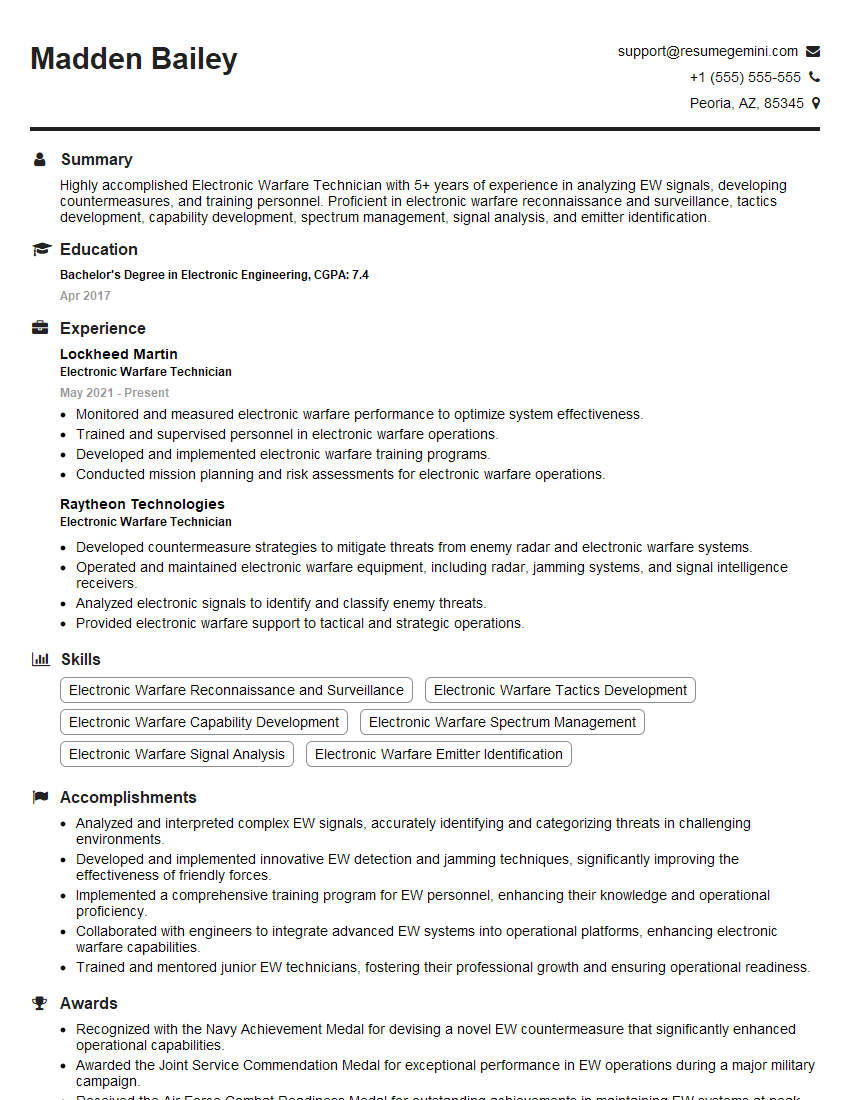
Mastering Electronic Warfare System Operation opens doors to exciting and impactful careers in defense and intelligence. To maximize your job prospects, creating a compelling and ATS-friendly resume is crucial. This ensures your skills and experience are effectively highlighted to potential employers. We highly recommend using ResumeGemini to build a professional and impactful resume tailored to the Electronic Warfare System Operation field. ResumeGemini offers a streamlined process and provides examples of resumes specifically designed for this area, ensuring your application stands out. Take the next step towards your dream career today.
Explore more articles
Users Rating of Our Blogs
Share Your Experience
We value your feedback! Please rate our content and share your thoughts (optional).
What Readers Say About Our Blog
Very informative content, great job.
good