Unlock your full potential by mastering the most common Electrostatic coating interview questions. This blog offers a deep dive into the critical topics, ensuring you’re not only prepared to answer but to excel. With these insights, you’ll approach your interview with clarity and confidence.
Questions Asked in Electrostatic coating Interview
Q 1. Explain the principle of electrostatic coating.
Electrostatic coating leverages the principles of electrostatics to apply a coating material, typically powder or liquid paint, to a substrate. It works by charging the coating particles and the substrate with opposite electrical polarities. This creates an attractive force, drawing the charged coating particles towards the grounded substrate, ensuring even and efficient coating application.
Imagine two magnets: one representing the charged coating particles and the other, the grounded object. The opposite poles attract, just as the charged particles are drawn to the substrate, resulting in a uniform coating layer. This is far more efficient than traditional methods that rely solely on gravity or air pressure.
Q 2. What are the different types of electrostatic coating methods?
Electrostatic coating methods are broadly categorized into two main types: powder coating and liquid electrostatic coating. Within powder coating, we have various application methods, including:
- Electrostatic powder spraying: This is the most common method, using a powder gun to spray finely charged powder onto the substrate.
- Fluidized bed coating: The substrate is immersed in a fluidized bed of powder, creating a uniform coating.
- Electrostatic fluidized bed: Combines fluidization with electrostatic charging for better control and efficiency.
Liquid electrostatic coating involves using electrically charged liquid paint sprayed onto the substrate. This method offers versatility and is suitable for various surfaces and materials.
Q 3. Describe the process of powder coating application.
The powder coating application process typically involves these steps:
- Pre-treatment: The substrate undergoes cleaning and surface preparation, including processes like degreasing, sanding, or chemical etching to improve adhesion.
- Powder application: The pre-treated substrate is then passed through an electrostatic spray booth where the powder is applied. The powder particles are charged using corona discharge, and the grounded substrate attracts them.
- Curing: After coating, the substrate is moved to an oven where the powder is melted and fused to the substrate at high temperatures (typically 350-400°F), forming a durable coating.
- Cooling and post-treatment: Once cured, the coated item is allowed to cool before final inspection and packaging.
For example, a metal chair frame would be cleaned, then electrostatically coated with a polyester powder, before being cured in an oven to create a durable, attractive finish.
Q 4. What are the advantages and disadvantages of electrostatic coating compared to other coating methods?
Electrostatic coating offers several advantages compared to traditional methods like dipping or brushing:
- Higher transfer efficiency: Less material waste due to the electrostatic attraction.
- Uniform coating thickness: Consistent coating across the entire surface, especially in complex shapes.
- Durable finish: Powder coatings are generally more resistant to scratches, chipping, and corrosion.
- Environmentally friendly: Less volatile organic compounds (VOCs) are released compared to liquid paint.
However, there are some drawbacks:
- Higher initial investment: Electrostatic equipment is more expensive than basic painting tools.
- Requires specialized training: Proper operation and maintenance of equipment require specialized skills.
- Limited color options (for some powders): While many colors are available, some specialized effects may be harder to achieve.
Q 5. How does the voltage affect the coating process?
Voltage plays a crucial role in electrostatic coating. A higher voltage increases the electrostatic force, improving the attraction of the powder particles to the substrate and leading to better transfer efficiency and a more uniform coating. However, excessively high voltage can lead to arcing, which can damage the equipment and create uneven coatings. The optimal voltage depends on the type of powder, the distance between the gun and the workpiece, and the substrate material. Typically, voltages range from 60-100 kV.
Think of it like a magnet: a stronger magnet (higher voltage) attracts the object more strongly, improving the coating process. But too strong a magnet might cause damage (arcing).
Q 6. Explain the importance of grounding in electrostatic coating.
Grounding is essential for safety and efficient coating application. The substrate must be properly grounded to provide a path for the electric charge to flow to the earth, preventing the buildup of static electricity on the workpiece. Without grounding, the charge can accumulate, leading to arcing, uneven coating, and potentially dangerous electrical shocks. It also ensures the electrostatic attraction effectively pulls the charged particles toward the substrate.
Grounding is like providing a safe return path for electricity, preventing dangerous buildups and ensuring smooth, safe operation.
Q 7. What are the different types of powder coating resins?
Powder coating resins are the main component that determines the final properties of the coating. Different resin types provide different properties like flexibility, chemical resistance, and gloss. Common types include:
- Polyester: A widely used resin offering excellent durability, UV resistance, and a wide range of colors.
- Epoxy: Known for its excellent corrosion resistance, making it suitable for outdoor applications and metal protection.
- Acrylic: Provides a smooth, glossy finish with good flexibility and color retention.
- Urethane: Offers superior abrasion and chemical resistance, often chosen for high-performance applications.
- Hybrids: Combinations of different resins are also used to tailor the properties to specific needs.
The choice of resin depends on the application, the substrate material, and the desired performance characteristics of the coating.
Q 8. How do you ensure uniform coating thickness?
Achieving a uniform coating thickness in electrostatic coating is crucial for both aesthetics and functionality. Inconsistencies can lead to weak points, poor durability, and an uneven finish. Several factors contribute to achieving uniformity, and careful control is essential.
- Consistent Powder Flow: The powder must flow evenly from the gun. Clogged nozzles or inconsistent air pressure can cause variations. Regular cleaning and maintenance of the powder feed system are paramount. Think of it like using a perfectly calibrated paint sprayer – you need consistent pressure and flow to get an even coat.
- Proper Gun Distance and Speed: Maintaining a consistent distance between the gun and the workpiece, as well as a steady application speed, is vital. Too close and you’ll get runs and drips; too far and the coating will be thin and patchy. Imagine painting a wall – you maintain a constant distance and speed to get even coverage.
- Grounding: The workpiece must be properly grounded to ensure effective electrostatic attraction of the powder. Poor grounding leads to uneven coating buildup, especially in areas furthest from the grounding point. A good analogy is a magnet – if the connection is weak, the attraction won’t be consistent.
- Powder Properties: The powder’s characteristics, including particle size distribution and resin type, significantly influence coating uniformity. Using the wrong powder or a powder that’s poorly formulated will lead to uneven results, regardless of other factors. This is like using the right type of paint for the surface you are painting; using the wrong paint will never give you the desired results.
- Electrostatic Field Control: The strength and distribution of the electrostatic field impact the coating’s evenness. Factors like the voltage and the type of electrode play a significant role. It’s analogous to adjusting the voltage of a magnet; a stronger magnet will pull more powder, but an uneven magnetic field will create uneven attraction.
By carefully managing these variables, we can achieve a consistent, high-quality coating every time.
Q 9. Describe the process of curing the coating.
Curing, the final step in electrostatic coating, transforms the powder coating from a loose powder into a durable, cross-linked polymer film. This process typically involves heat, either through ovens or infrared radiation.
Oven Curing: This is the most common method. Workpieces are conveyed through a carefully controlled oven with specific temperature and dwell time profiles. The temperature is typically in the range of 350-400°F (177-204°C), and the dwell time depends on the powder’s characteristics and the desired film properties. Think of baking a cake – you need the right temperature and time to get the desired outcome. An improperly set temperature or time will lead to defects like a burnt or unbaked cake.
Infrared (IR) Curing: IR curing utilizes infrared radiation to heat the workpiece directly. This method is faster than oven curing and is particularly suitable for large or irregularly shaped objects. It’s like using a focused heat lamp to dry wet paint; it targets the area directly, and you can speed up the process.
During curing, the powder particles melt, flow, and then undergo a chemical reaction, creating a hard, durable, and often chemically resistant coating. The specific curing parameters must be optimized for the powder being used to ensure proper cross-linking, complete fusion, and the avoidance of defects such as blistering or orange peel.
Q 10. What are the common defects found in electrostatic coating, and how are they addressed?
Several defects can occur during electrostatic coating. Identifying and addressing these defects is crucial for producing high-quality parts. Some common defects include:
- Orange Peel: A textured surface resembling an orange peel. This is often caused by improper powder application (e.g., excessive gun distance or inadequate powder flow), incorrect curing parameters (too low temperature or short cure time), or unsuitable powder properties. It is often addressed by adjusting the powder flow rate, maintaining proper gun-to-surface distance and curing temperature.
- Runs and Sags: Excess powder accumulates in certain areas, resulting in thick, uneven coatings that may drip or sag. This is caused by applying too much powder, inadequate pre-treatment, or using the wrong powder for the application. It is remedied by adjusting the powder application settings to reduce the flow rate and improving the pre-treatment process.
- Cratering: Small depressions or holes in the coating surface, often resulting from air bubbles trapped during application or curing. This can be caused by contaminated powder or moisture on the surface being coated. Careful pre-treatment and using clean, dry powder is crucial to eliminate this defect.
- Fisheyes: Small circular defects resembling fish eyes. This defect is usually caused by the presence of contaminants (e.g., silicone, oil) on the surface that prevent proper powder adhesion. Thorough pre-treatment and cleaning are vital to eliminate this issue.
- Blushing: A hazy or milky appearance of the coating. This is usually due to moisture condensation during the curing process. Adjusting the oven humidity and ensuring that the surface being coated is completely dry before application can prevent blushing.
Addressing these defects involves a systematic approach, starting with careful examination of the process parameters, followed by adjustments to the powder application, pre-treatment, and curing conditions. Sometimes, changing the powder itself might be necessary.
Q 11. Explain the role of pre-treatment in electrostatic coating.
Pre-treatment is a critical step before electrostatic coating that ensures proper adhesion and corrosion resistance. It involves cleaning the workpiece’s surface to remove contaminants such as oil, grease, rust, and mill scale, creating a surface that optimally receives and bonds with the powder coating. Think of it like preparing a wall before painting – you need to clean and prime it to ensure the paint adheres well.
Common pre-treatment methods include:
- Degreasing: Removing oils and grease using solvents or alkaline cleaners. Solvents are effective but may have environmental concerns, and alkaline solutions may require careful rinsing.
- Chemical Conversion Coatings: Creating a thin, protective layer on the substrate, enhancing adhesion. Phosphate conversion coatings are common, and they provide a good base for the powder to adhere to.
- Abrasive Blasting: Removing surface imperfections through media blasting. This method is effective in preparing surfaces with heavy rust or mill scale. It is a more aggressive method and may not be appropriate for every application.
The choice of pre-treatment method depends on the substrate material, the desired level of corrosion protection, and the specific application requirements. Proper pre-treatment is essential to achieve a durable and long-lasting electrostatic coating. A poor pre-treatment will result in poor adhesion and early coating failure, regardless of how well the coating is applied.
Q 12. What are the safety precautions involved in electrostatic coating?
Electrostatic coating involves high voltage and flammable powder, necessitating strict safety measures.
- High Voltage Safety: The electrostatic equipment operates at high voltage, posing a significant shock hazard. Operators must be properly trained, wear appropriate personal protective equipment (PPE), and follow lockout/tagout procedures for maintenance. Proper grounding of the equipment and workpieces is critical.
- Fire Safety: The powder is flammable, and the curing process involves high temperatures. The work area should have adequate ventilation, fire suppression systems (e.g., fire extinguishers), and designated no-smoking zones. Regular inspections and maintenance of these systems are also necessary.
- Respiratory Protection: Powder inhalation can cause respiratory problems. Operators should wear appropriate respirators, especially during powder handling and cleanup. Good ventilation in the work area is also key.
- Eye Protection: Eye protection is necessary to safeguard against potential splashes or airborne particles during the process. Safety glasses or goggles should be worn by anyone in the vicinity of the coating process.
- Personal Protective Equipment (PPE): Appropriate PPE, including gloves, protective clothing, and safety footwear should always be worn. Regular inspections and replacements of PPE are crucial for ensuring safety.
Implementing and enforcing these safety measures is crucial for minimizing risks and ensuring a safe working environment for all personnel.
Q 13. How do you maintain and troubleshoot electrostatic coating equipment?
Regular maintenance and troubleshooting are critical to ensure the efficiency and longevity of electrostatic coating equipment. This includes:
- Regular Cleaning: The powder feed system, gun, and other components must be regularly cleaned to prevent clogging and ensure consistent powder flow. This often involves disassembling parts, cleaning with appropriate solvents, and reassembling. Regular cleaning prevents many problems that can lead to defects and production delays.
- Voltage and Current Monitoring: Regular monitoring of the high-voltage power supply is necessary to ensure that it operates within the specified parameters. Any deviations need to be investigated and corrected immediately.
- Air Pressure Checks: Maintaining proper air pressure is crucial for both powder flow and atomization. Air pressure gauges and regulators should be regularly checked and calibrated. Low air pressure may lead to inconsistent coating thickness, while too high air pressure can lead to defects.
- Troubleshooting: Addressing issues such as inconsistent coating thickness, powder buildup, or equipment malfunctions promptly minimizes downtime and ensures consistent product quality. A systematic troubleshooting approach, using flowcharts or diagnostic tools, is essential for efficient problem-solving.
- Calibration and Testing: Regular calibration of equipment and testing of the coating’s properties ensure consistent performance and product quality. Examples include testing the coating thickness, adhesion, and other relevant properties.
Preventative maintenance, such as regular inspections and cleaning, is far more cost-effective than addressing major breakdowns. A well-maintained system will produce high-quality coatings consistently and minimize downtime.
Q 14. What are the environmental considerations of electrostatic coating?
Electrostatic coating, while offering numerous advantages, has environmental implications that need careful consideration.
- Volatile Organic Compound (VOC) Emissions: Some powder coatings may release VOCs during the curing process. Minimizing VOC emissions through the use of low-VOC powders and ensuring proper oven ventilation is essential. Regulations vary widely across locations so it’s imperative to stay informed about current regulations and best practices.
- Waste Management: Overspray powder needs careful management to prevent environmental contamination. Recovery systems for overspray powder can significantly reduce waste and improve sustainability. Disposal of spent powder should follow all local regulations.
- Energy Consumption: The curing process requires significant energy, particularly in large-scale operations. Improving oven efficiency, optimizing curing parameters, and using energy-efficient equipment can significantly reduce energy consumption and the related environmental impact.
- Powder Selection: Choosing powder coatings that are formulated with recycled content, are biodegradable, or have low environmental impact can improve the overall sustainability of the process. Many manufacturers now offer sustainable powder options that meet this criteria.
By adopting sustainable practices and using environmentally friendly materials and technologies, the environmental impact of electrostatic coating can be minimized, leading to a more responsible and sustainable industrial process.
Q 15. How do you select the appropriate powder coating for a given substrate?
Selecting the right powder coating for a substrate is crucial for achieving a durable and aesthetically pleasing finish. It involves considering several key factors. First, you need to identify the substrate material – is it steel, aluminum, plastic, or something else? Different materials have different surface properties and require coatings with compatible adhesion characteristics. For example, a powder coating designed for steel might not adhere well to plastic. Second, consider the intended environment. Will the coated part be exposed to harsh weather conditions, chemicals, or extreme temperatures? This dictates the need for specific properties like UV resistance, chemical resistance, or temperature resistance. Third, think about the desired aesthetic finish – gloss level, texture, and color. Powder coatings offer a vast range of options to meet diverse aesthetic requirements. Finally, regulatory compliance is critical. Certain industries have stringent regulations regarding the types of coatings that can be used. For instance, food-contact applications often require coatings that meet specific FDA standards.
For instance, if you’re coating outdoor furniture, you’ll choose a powder coating with high UV resistance to prevent fading and degradation. Conversely, if you’re coating parts for a food processing plant, you’ll select a coating that’s food-safe and easily cleanable. Proper selection ensures longevity, performance, and compliance.
Career Expert Tips:
- Ace those interviews! Prepare effectively by reviewing the Top 50 Most Common Interview Questions on ResumeGemini.
- Navigate your job search with confidence! Explore a wide range of Career Tips on ResumeGemini. Learn about common challenges and recommendations to overcome them.
- Craft the perfect resume! Master the Art of Resume Writing with ResumeGemini’s guide. Showcase your unique qualifications and achievements effectively.
- Don’t miss out on holiday savings! Build your dream resume with ResumeGemini’s ATS optimized templates.
Q 16. Explain the concept of transfer efficiency in electrostatic coating.
Transfer efficiency in electrostatic powder coating refers to the percentage of powder applied to the spray gun that actually adheres to the workpiece. A high transfer efficiency is desired, as it minimizes waste and reduces costs. It’s essentially a measure of how effectively the electrostatic process charges and deposits the powder onto the target substrate. Several factors influence transfer efficiency, including the type of spray gun, the powder’s characteristics, the grounding of the workpiece, and the operator’s skill. Poor grounding, for example, can lead to significant powder loss. Similarly, improperly configured spray guns can result in inefficient powder deposition.
Imagine throwing darts at a dartboard. High transfer efficiency is like hitting the bullseye almost every time – maximizing the amount of powder that sticks to the part. Low transfer efficiency is like missing the dartboard frequently – wasting powder and incurring unnecessary costs.
Q 17. Describe the different types of spray guns used in electrostatic coating.
Electrostatic spray guns come in various types, each designed for specific applications and powder characteristics. The most common are:
- Conventional Electrostatic Spray Guns: These are the workhorses of the industry, relying on a high-voltage electrode to charge the powder particles and direct them towards the grounded workpiece. They offer good versatility and are suitable for a wide range of applications.
- Rotating Bell Spray Guns: These guns utilize a rotating bell to atomize the powder, resulting in a more uniform coating and potentially higher transfer efficiency than conventional guns. They are often preferred for complex shapes and larger parts.
- Air-Assisted Spray Guns: These guns combine electrostatic charging with compressed air to help atomize the powder further. This can improve the coating quality, especially when dealing with high-viscosity powders or intricate designs.
- Automatic Spray Guns: These are used in automated coating systems and offer precise control over the coating process, resulting in consistent coating thickness and improved transfer efficiency. They’re crucial for high-volume production.
The choice of spray gun depends on factors like the part geometry, the desired coating thickness, the production volume, and the powder characteristics.
Q 18. How do you measure the coating thickness?
Measuring coating thickness is vital for ensuring quality and consistency. Several methods are used:
- Magnetic Gauge: This is a widely used method, particularly for non-ferrous metals. A magnetic probe measures the coating thickness based on the magnetic pull. It’s relatively fast and non-destructive.
- Ultrasonic Gauge: This gauge uses sound waves to measure the coating thickness. It’s suitable for various substrates, including non-magnetic materials like aluminum and plastic. It’s also non-destructive.
- Destructive Testing: This involves cross-sectioning the coated part and measuring the coating thickness using a microscope. This is a more precise method but is destructive and only suitable for quality control testing.
The selection of the appropriate method depends on factors such as substrate material, coating type, required accuracy and whether destructive testing is acceptable. Consistency in measurement techniques is critical for maintaining quality control.
Q 19. What are the quality control procedures for electrostatic coating?
Quality control in electrostatic coating involves rigorous procedures at every stage of the process. This includes:
- Substrate Preparation: Thorough cleaning and surface preparation are critical for ensuring proper adhesion. This might include degreasing, abrasive blasting, or chemical etching.
- Powder Handling and Storage: Maintaining proper storage conditions to prevent moisture absorption and agglomeration of the powder is essential.
- Spray Application: Monitoring the spray gun parameters (voltage, airflow, powder flow) and ensuring consistent coating thickness across the workpiece.
- Curing Process: Controlling the oven temperature and dwell time to ensure complete curing and optimal film properties.
- Post-Cure Inspection: Visual inspection for defects like orange peel, pinholes, or runs. Testing for adhesion, impact resistance, and other relevant properties.
Regular calibration of equipment and adherence to standardized procedures are paramount for consistent quality. Maintaining detailed records and implementing statistical process control (SPC) can significantly enhance quality management.
Q 20. What are the different types of ovens used for curing?
Various ovens are used for curing powder coatings, each with its own advantages and disadvantages:
- Convection Ovens: These ovens use fans to circulate hot air around the parts, providing relatively uniform heating. They are widely used due to their versatility and cost-effectiveness.
- Infrared (IR) Ovens: These ovens use infrared radiation to directly heat the parts, leading to faster curing times compared to convection ovens. They are particularly suitable for high-volume production lines.
- Microwave Ovens: These ovens use microwave energy to heat the coated parts, offering very fast curing times. However, they can be more expensive and may not be suitable for all types of powder coatings and substrates.
- Combination Ovens: Some ovens combine convection and IR heating to optimize both curing speed and uniformity.
The optimal oven choice depends on factors like production volume, required curing time, and the type of powder coating being used.
Q 21. How do you handle electrostatic coating waste?
Handling electrostatic coating waste responsibly is crucial for environmental protection and compliance with regulations. Key aspects include:
- Overspray Collection: Efficient overspray collection systems are essential to minimize powder waste and prevent environmental pollution. This can involve using efficient spray booths equipped with filters and collection hoppers.
- Waste Disposal: Any unusable powder must be disposed of according to local regulations. This might involve specific hazardous waste disposal procedures depending on the powder composition.
- Regular Maintenance: Regular maintenance of the coating equipment and waste collection systems helps to prevent leaks and ensure efficient operation.
Implementing a comprehensive waste management plan is critical for sustainability and compliance, minimizing environmental impact and reducing costs associated with waste disposal.
Q 22. Explain the importance of color matching in electrostatic coating.
Color matching in electrostatic coating is paramount for aesthetic reasons and often for functional ones as well. Imagine a car manufacturer; a slight mismatch between the painted parts would be immediately noticeable and unacceptable. Accurate color matching ensures a uniform, visually appealing finish, enhancing the product’s marketability. In some industries, like medical devices, specific color codes may indicate functionality or safety measures, making precise color matching crucial.
Achieving this accuracy requires careful control throughout the process. This includes:
- Precise pigment selection and formulation: Using spectrophotometers to measure and adjust the color of the coating to meet the exact specifications.
- Consistent coating application: Ensuring even film thickness avoids variations in color intensity.
- Substrate preparation: A properly cleaned and prepared surface allows for optimal adhesion and color reproduction.
- Environmental control: Maintaining stable temperature and humidity during the coating process helps prevent color shifts.
Failure to achieve accurate color matching leads to rejected parts, increased costs, and a damaged brand reputation.
Q 23. Describe the process of cleaning and preparing a substrate for electrostatic coating.
Substrate cleaning and preparation are critical steps, impacting the coating’s adhesion, durability, and overall appearance. Think of it like preparing a wall for painting: if you don’t clean it properly, the paint won’t stick!
The process usually involves several steps:
- Cleaning: This removes dirt, grease, oil, and other contaminants. Methods include solvent cleaning, alkaline cleaning, or abrasive blasting, depending on the substrate and level of contamination. For instance, a degreasing solvent would be used for metal parts, while abrasive blasting might be necessary for heavily rusted surfaces.
- Surface Treatment (optional): This enhances adhesion. Common methods include chemical etching, chromating, or phosphating for metals to create a porous surface for better mechanical bonding with the coating. For plastics, plasma treatment is often used to increase surface energy.
- Rinsing: Thorough rinsing is essential to remove any cleaning agents or residues that could interfere with the coating process.
- Drying: Complete drying prevents moisture from interfering with the electrostatic attraction and coating adhesion. This is usually done by using a heated oven or air drying depending on the material properties
Proper substrate preparation ensures a strong bond between the coating and the substrate, leading to a superior, long-lasting finish. Skipping this step often leads to peeling, blistering, or premature coating failure.
Q 24. What are the different types of corona discharge systems used in electrostatic coating?
Corona discharge systems are used to charge the coating particles in electrostatic coating. They work by ionizing the air, creating a high-voltage field that charges the particles. Several types exist:
- Needle-type corona systems: These use a series of fine needles or wires to generate a corona discharge. They’re relatively simple and inexpensive, often used in smaller applications.
- Roller-type corona systems: These use a high-voltage roller to generate a more uniform corona discharge over a wider area. They’re more efficient and offer better coating uniformity for larger parts.
- Comb-type corona systems: These combine multiple needles in a comb-like configuration to improve efficiency and control over the discharge area.
The choice depends on the application’s size, complexity, and desired coating uniformity. For example, a needle-type system might be suitable for coating small parts, while a roller-type system would be better suited for large, flat panels.
Q 25. Explain the concept of Faraday cage effect in electrostatic coating.
The Faraday cage effect describes how a conductive enclosure shields its interior from external electric fields. In electrostatic coating, it’s a significant consideration. Imagine a hollow metal part being coated. If the part is grounded, the electric field lines will flow around the outside of the part, leaving the interior uncoated.
This can be overcome through several methods:
- Internal charging: Injecting charge into the interior of the part through a specially designed electrode.
- Multiple applicators: Using multiple spray guns from various angles to ensure coverage.
- Designing parts to minimize the Faraday cage effect: Optimizing the part’s geometry to reduce enclosed cavities.
Understanding and mitigating the Faraday cage effect is crucial for achieving complete and uniform coating on complex parts.
Q 26. What are the common issues encountered with electrostatic coating on different substrates (e.g., metals, plastics)?
Electrostatic coating presents unique challenges depending on the substrate material. Metals generally adhere well to most coatings, but issues like poor surface preparation (leading to poor adhesion), inadequate grounding, or uneven coating thickness can still arise. Plastics are more complex. They can exhibit problems like:
- Lower surface energy: Plastics often have a lower surface energy than metals, leading to poor coating adhesion. This requires pre-treatment like plasma treatment to improve surface energy.
- Chemical incompatibility: Some coatings may react with certain plastics, causing degradation or discoloration.
- Electrostatic charging: Plastics can charge statically, affecting the coating process and causing uneven distribution.
For example, a poorly cleaned plastic part may lead to uneven coating distribution due to accumulated contaminants, while using a coating incompatible with the plastic could cause the coating to peel or blister.
Q 27. How would you approach a problem of inconsistent coating thickness?
Inconsistent coating thickness is a common issue. Troubleshooting requires a systematic approach:
- Assess the coating uniformity: Measure the thickness at various points on the coated parts using a film thickness gauge. This helps identify areas of over-coating or under-coating.
- Inspect the spray gun: Check for nozzle wear, clogging, or misalignment. A worn or misaligned nozzle can cause uneven spray patterns.
- Examine the electrostatic field: Ensure the corona discharge is functioning correctly and the workpiece is properly grounded. A weak corona or poor grounding can lead to uneven charging and coating distribution.
- Review the coating parameters: Ensure the spray distance, spray pressure, and coating viscosity are optimized for the application. Incorrect parameters can affect the coating thickness.
- Check the substrate preparation: Verify that the substrate has been properly cleaned and prepared. Contamination or poor surface treatment can affect adhesion and coating uniformity.
Addressing each of these aspects systematically often helps pinpoint the cause and implement corrective actions. For example, replacing a worn spray gun nozzle or adjusting the spray parameters might resolve the issue.
Q 28. Describe your experience with troubleshooting electrostatic coating equipment malfunctions.
Troubleshooting electrostatic coating equipment involves a combination of practical experience and systematic problem-solving. I’ve encountered numerous malfunctions, ranging from simple issues like clogged spray guns to more complex problems like faulty high-voltage power supplies.
My approach always begins with:
- Safety first: Always disconnect the power supply before performing any maintenance or troubleshooting.
- Visual inspection: Carefully inspect all components for visible damage, wear, or loose connections.
- Systematic checks: Follow a logical sequence of checks, starting with the simplest components (spray gun, air supply) and moving towards more complex systems (high-voltage power supply, control system).
- Use of diagnostic tools: Utilize multimeters, high-voltage probes, and other diagnostic tools to measure voltages, currents, and other parameters to identify potential problems. For instance, a low voltage reading on the corona power supply could indicate a faulty component.
- Documentation: Maintaining comprehensive records of troubleshooting steps, findings, and corrective actions is essential for future reference.
One memorable instance involved a faulty high-voltage rectifier in the power supply. By systematically checking the voltage output at each stage of the rectifier, I pinpointed the faulty component, allowing for a quick and efficient repair. This highlights the importance of methodical troubleshooting.
Key Topics to Learn for Electrostatic Coating Interview
- Fundamentals of Electrostatics: Understanding Coulomb’s Law, electric fields, and potential difference is crucial for grasping the underlying principles of electrostatic coating.
- Coating Process Mechanisms: Explore the stages involved – charging the particles, electrostatic attraction, deposition, and curing – and the factors influencing each stage (e.g., voltage, particle size, airflow).
- Types of Electrostatic Coating Equipment: Familiarize yourself with different types of spray guns, applicators, and ovens used in the process, understanding their advantages and limitations.
- Powder Coating vs. Liquid Coating: Understand the differences in materials, application techniques, and resulting finishes for each type of electrostatic coating.
- Material Properties and Selection: Learn how to select appropriate coating materials based on desired properties (e.g., durability, corrosion resistance, aesthetics) and substrate compatibility.
- Quality Control and Troubleshooting: Understand common defects (e.g., orange peel, pinholes, uneven coating) and the methods to identify and resolve them. This demonstrates practical problem-solving skills.
- Safety Procedures and Regulations: Demonstrate awareness of safety protocols related to handling high voltage equipment, working with solvents (if applicable), and adhering to environmental regulations.
- Process Optimization and Efficiency: Discuss strategies to improve coating efficiency, reduce waste, and enhance the overall quality of the finished product.
- Advanced Techniques: Explore specialized techniques like electrostatic fluidized bed coating or tribostatic coating, depending on your target role and experience level.
Next Steps
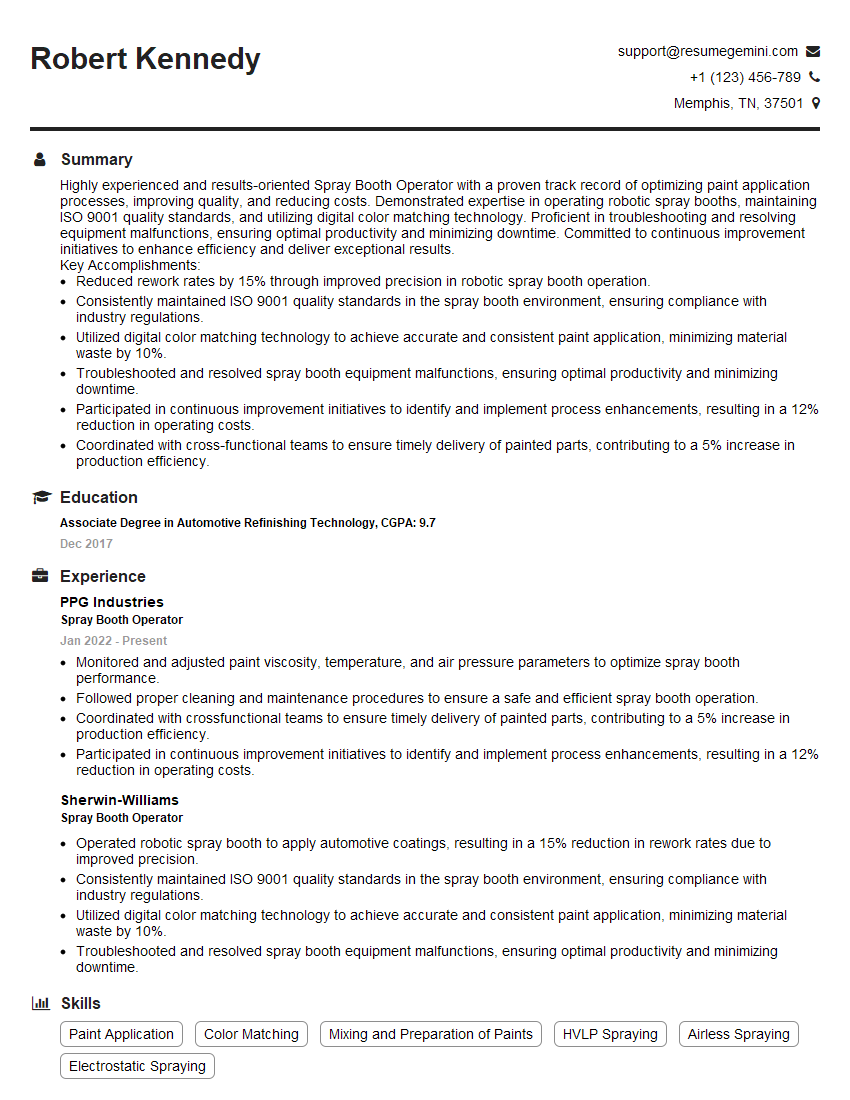
Mastering electrostatic coating opens doors to exciting career opportunities in manufacturing, automotive, aerospace, and many other industries. A strong understanding of this technology showcases your technical expertise and problem-solving abilities, making you a highly desirable candidate. To maximize your job prospects, create a compelling and ATS-friendly resume that effectively highlights your skills and experience. ResumeGemini is a trusted resource to help you build a professional and impactful resume. Examples of resumes tailored specifically for electrostatic coating professionals are available to guide you through the process.


Explore more articles
Users Rating of Our Blogs
Share Your Experience
We value your feedback! Please rate our content and share your thoughts (optional).
What Readers Say About Our Blog
Very informative content, great job.
good