Every successful interview starts with knowing what to expect. In this blog, we’ll take you through the top Elevator Maintenance Software interview questions, breaking them down with expert tips to help you deliver impactful answers. Step into your next interview fully prepared and ready to succeed.
Questions Asked in Elevator Maintenance Software Interview
Q 1. Explain your experience with different elevator maintenance software platforms.
My experience spans several leading elevator maintenance software platforms, including ThinkElev, ElevatorLogic, and Kone Elevator Maintenance Software. Each platform offers unique strengths. For instance, ThinkElev excels in its intuitive interface and robust reporting capabilities, making data analysis straightforward. ElevatorLogic’s strength lies in its integration with various elevator control systems, streamlining data collection. Kone’s software, naturally, integrates seamlessly with their own elevators but is also capable of handling various manufacturers’ equipment, although sometimes requiring more configuration. I’ve worked extensively with all three, leveraging their strengths to optimize maintenance schedules and improve operational efficiency in different client environments. I’ve also had experience with smaller, niche platforms designed for specific elevator types or maintenance needs, broadening my understanding of the available technological options in the market.
Q 2. Describe your proficiency in using elevator maintenance software for preventive maintenance scheduling.
Preventive maintenance scheduling is where elevator maintenance software truly shines. I use these platforms to create customized schedules based on manufacturer recommendations, elevator usage patterns, and historical maintenance data. For example, using ThinkElev, I can set up automated alerts for upcoming inspections or lubrication cycles. The software allows me to categorize elevators based on various factors—age, type, usage frequency—to tailor maintenance tasks. This ensures that critical components receive timely attention, minimizing downtime and maximizing the lifespan of the equipment. I find the ability to visually represent these schedules using calendars and dashboards invaluable for both proactive planning and immediate response to urgent tasks. The software helps anticipate potential issues before they escalate into costly repairs.
Q 3. How do you utilize elevator maintenance software to track and manage repair orders?
Tracking and managing repair orders is a core function of these platforms. When a problem arises, I log the issue, including details such as the elevator’s location, the specific malfunction, and any relevant diagnostic codes. The software automatically generates a work order, assigning it to the appropriate technician and providing them with all necessary information. The system tracks the entire repair lifecycle—from initial reporting to completion and closure. This includes updating the status of the order, recording the parts used, and noting any additional findings. Real-time tracking ensures that management and clients are always informed about the progress of repairs. This reduces response times, minimizes disruption, and simplifies billing processes. For example, if a part is needed, the system can highlight it directly, enabling prompt ordering, saving crucial time.
Q 4. What are the key features you look for in effective elevator maintenance software?
Effective elevator maintenance software needs several key features. First, a user-friendly interface is crucial for efficient daily operations. Second, robust reporting and analytics capabilities are essential for identifying trends and improving maintenance strategies. Third, seamless integration with various elevator control systems is vital for automating data collection and reducing manual input. Fourth, strong mobile accessibility allows technicians to access information and update records on site. Fifth, and just as important, the software should provide features for managing inventory, ensuring prompt ordering and availability of spare parts. Finally, scalability is also a vital factor; the software should be able to handle an increasing number of elevators and users as the business grows.
Q 5. How do you use elevator maintenance software to generate reports and analyze maintenance data?
Generating reports and analyzing maintenance data is a crucial part of optimizing elevator maintenance. The software allows me to create reports on various aspects, including equipment downtime, maintenance costs, and technician performance. For example, I can generate a report showing the total cost of maintenance for a specific building over a year, highlighting areas where cost savings are possible. Data visualization tools, such as charts and graphs, make it easy to identify trends and patterns. This analysis helps in predictive maintenance, allowing for proactive interventions and minimizing unexpected breakdowns. By regularly analyzing this data, we can optimize maintenance schedules, improve resource allocation, and ultimately, reduce operational costs and increase equipment longevity. The goal is data-driven decision making to achieve operational excellence.
Q 6. Explain your experience with different types of elevator control systems and how they integrate with maintenance software.
My experience encompasses a wide range of elevator control systems, including those from Otis, Schindler, ThyssenKrupp, and Mitsubishi. The integration of these systems with maintenance software varies. Some systems offer direct interfaces, allowing for seamless data transfer. Others may require custom integration solutions. For example, a direct interface might allow the software to automatically receive error codes and diagnostic information from the elevator’s control system. This real-time data stream is invaluable for proactive maintenance. In situations requiring custom integration, I leverage my expertise in data communication protocols to ensure that data is accurately and reliably transferred. This includes troubleshooting any communication issues, configuring data mappings, and testing the integration to ensure accuracy and stability. The approach always prioritizes data security and the integrity of the system.
Q 7. How do you troubleshoot issues with elevator maintenance software integration with other building systems?
Troubleshooting integration issues requires a systematic approach. I start by carefully reviewing the system logs and identifying any error messages. This often provides clues about the source of the problem. I then check the network connectivity between the software and the other building systems. Are the appropriate communication protocols enabled? Are there any firewall restrictions? I also examine the data mappings to ensure that the data is being correctly interpreted. Are there any data format inconsistencies? Sometimes, the issue might be related to software bugs or configuration errors. If the problem persists, I may need to consult the documentation of the relevant systems or seek assistance from the software vendor or the building’s IT department. A collaborative effort ensures the problem gets fixed efficiently. The process emphasizes a detailed investigation to determine root cause, ensuring a long-term fix rather than just temporary workarounds.
Q 8. Describe your experience using elevator maintenance software to manage inventory and spare parts.
Managing inventory and spare parts efficiently is crucial in elevator maintenance. I’ve extensively used software that integrates inventory management directly into the maintenance scheduling system. This allows for real-time tracking of parts, predicting low stock levels, and automating reordering processes. For instance, if a specific part for a particular elevator model drops below a pre-defined threshold, the system automatically generates a purchase order. This eliminates manual tracking, reduces the risk of unexpected downtime due to missing parts, and optimizes inventory costs. I’ve also worked with systems that use barcodes or QR codes to scan parts during both incoming inventory and outgoing repairs, ensuring accurate tracking and reducing human error. The software I’ve used also generated reports that analyze parts usage, helping us identify trends and potentially negotiate better pricing with suppliers based on volume.
For example, in one project, we moved from a spreadsheet-based system to a dedicated elevator maintenance software. The transition allowed us to reduce our spare parts inventory by 15% while maintaining a 99% availability rate for parts, saving both storage space and money.
Q 9. How familiar are you with data migration processes related to elevator maintenance software?
Data migration is a critical, yet often complex, aspect of implementing new elevator maintenance software. My experience includes multiple migrations involving various data sources – from legacy systems (even paper-based records!), to different software platforms. A successful migration requires a meticulous plan encompassing data cleansing, transformation, and validation. This often involves careful assessment of the existing data structure, identifying any inconsistencies or gaps, and mapping it to the new software’s requirements. I’m proficient in using ETL (Extract, Transform, Load) tools and processes to efficiently manage this. Crucially, this involves rigorous testing after the migration to verify data integrity and accuracy. I’ve used both automated scripting and manual verification to ensure a seamless transition with minimal disruption to ongoing maintenance operations.
For example, during one migration, we developed a custom script to automatically convert date formats and standardize part numbers from our older system to the new system’s format, significantly speeding up the process and minimizing errors.
Q 10. How do you ensure data accuracy and integrity within elevator maintenance software?
Data accuracy and integrity are paramount in elevator maintenance. Compromised data can lead to incorrect maintenance schedules, missed repairs, and even safety hazards. My approach involves a multi-layered strategy: First, data entry validation through the software itself – preventing illogical inputs. Second, regular data audits comparing software records to physical inspections of elevators and parts. Third, implementing a system of user permissions and access controls to restrict data modification to authorized personnel only. Fourth, using version control within the software itself to track changes and revert to previous versions if necessary. Finally, regular data backups are critical for disaster recovery.
Think of it like a financial ledger – accuracy is paramount. We implement checksums or similar methods to verify data integrity during data transfer and storage. Any discrepancy triggers an alert, prompting immediate investigation and correction.
Q 11. Explain your process for training new technicians on elevator maintenance software.
Training new technicians is a phased approach that balances theoretical knowledge and hands-on practical application. I usually start with online modules covering the software’s basic features, followed by in-person sessions focusing on specific functionalities relevant to their roles. This includes role-based training modules for mechanics, inspectors, and dispatchers. We utilize real-world scenarios and case studies to make the training engaging and relevant. Simulated exercises replicate common tasks, allowing technicians to practice without impacting live data. We utilize a competency-based approach; technicians are assessed at the end of the training to ensure they can effectively utilize the software to perform their duties. Post-training, ongoing support includes access to online resources, FAQs, and direct support from experienced colleagues.
One successful strategy is pairing new technicians with experienced users during their initial assignments, fostering mentorship and reducing the learning curve.
Q 12. Describe your experience with remote diagnostics using elevator maintenance software.
Remote diagnostics is a game-changer in elevator maintenance. The software I’ve used allows technicians to remotely access and monitor elevator systems through connected sensors and controllers. This capability enables proactive identification of potential problems before they escalate into major failures. It reduces response times, minimizing downtime and improving efficiency. For instance, we can remotely monitor vibration levels, motor temperatures, and door operation, and even receive alerts based on pre-defined thresholds. This is incredibly useful for preventative maintenance, allowing us to schedule service calls only when necessary, minimizing unnecessary trips and optimizing technician time.
In one instance, remote diagnostics alerted us to an anomaly in a motor’s temperature several hours before a complete failure occurred, allowing us to schedule a repair and prevent costly downtime.
Q 13. How do you utilize elevator maintenance software to identify recurring maintenance issues?
The software’s reporting and analytics features are crucial for identifying recurring maintenance issues. By analyzing historical data on repairs, service calls, and parts usage, we can easily pinpoint frequently occurring problems. The software often allows for customization of reports, allowing us to focus on specific elevator models, locations, or types of repairs. This helps us to identify patterns and trends, suggesting potential systemic issues that require addressing through preventative maintenance or design modifications.
For example, if a report reveals a high number of door-related issues on a specific model of elevator, we can investigate the root cause – perhaps a design flaw or a needed modification to maintenance procedures.
Q 14. What are your strategies for optimizing the efficiency of elevator maintenance processes using software?
Optimizing elevator maintenance processes through software involves a multifaceted approach. This includes using the software to optimize scheduling, reducing travel time for technicians through efficient route planning features. Automated alerts and notifications for upcoming maintenance tasks streamline workflows. Analyzing data to predict potential failures allows for proactive maintenance, reducing emergency calls. Mobile accessibility enables technicians to access information and update records in real-time. Finally, using the software to generate comprehensive reports helps track key performance indicators (KPIs), providing data-driven insights for continuous improvement.
For instance, implementing a route optimization feature decreased technician travel time by 15%, resulting in increased productivity and reduced labor costs.
Q 15. How do you use elevator maintenance software to comply with safety regulations and codes?
Elevator maintenance software is crucial for ensuring compliance with safety regulations and codes like ASME A17.1. It allows for meticulous tracking of inspections, repairs, and certifications, leaving a clear audit trail. For example, the software can schedule and record mandatory annual inspections, automatically generating reports that demonstrate adherence to local and national codes. Failure to meet these standards can result in hefty fines and operational shutdowns. The software helps prevent this by prompting users for required actions and documenting completion. Imagine a scenario where a critical safety component requires replacement; the software will flag this, prompting the technician to order the part, perform the repair, and record it all within the system. This creates a verifiable record for audits.
Furthermore, many systems integrate with regulatory databases, ensuring the latest codes are automatically applied, eliminating the risk of manual errors. The software aids in managing certifications for all elevator components, ensuring they remain current and compliant with safety standards.
Career Expert Tips:
- Ace those interviews! Prepare effectively by reviewing the Top 50 Most Common Interview Questions on ResumeGemini.
- Navigate your job search with confidence! Explore a wide range of Career Tips on ResumeGemini. Learn about common challenges and recommendations to overcome them.
- Craft the perfect resume! Master the Art of Resume Writing with ResumeGemini’s guide. Showcase your unique qualifications and achievements effectively.
- Don’t miss out on holiday savings! Build your dream resume with ResumeGemini’s ATS optimized templates.
Q 16. Explain your understanding of different elevator maintenance software reporting capabilities.
Modern elevator maintenance software offers a wide array of reporting capabilities. These range from basic operational reports showing elevator usage and downtime to highly sophisticated analytical reports identifying recurring issues and predicting potential failures. For instance, a basic report might show the number of service calls per elevator over a specific period. A more advanced report could analyze this data to highlight specific elevators needing more frequent maintenance or pinpoint specific components prone to failure.
Many systems allow for custom report generation, tailoring the output to specific needs. These reports can include detailed information on maintenance activities, parts used, technician performance, and costs. Some software even offers visual reporting tools, presenting data via charts and graphs for easy interpretation, enabling quick identification of trends and potential problems. Reporting features are crucial for demonstrating compliance, budgeting, and making informed decisions about elevator maintenance strategies.
Q 17. Describe your experience using elevator maintenance software to manage contractor relationships.
Managing contractor relationships effectively is a key benefit of specialized elevator maintenance software. The software allows for centralized communication, scheduling, and performance tracking. For instance, the system can send automated notifications to contractors regarding upcoming maintenance tasks, ensuring timely responses. It can also track the contractor’s arrival time, work performed, and materials used. This creates a transparent record of their activities, making it easy to assess their performance and billing accuracy.
Many systems facilitate the approval of invoices, integrating directly with accounting software. This streamlines the payment process and eliminates the need for manual data entry. Moreover, the software can be used to rate and review contractor performance, aiding in the selection of reliable and efficient partners. This eliminates the guesswork in choosing contractors and keeps everyone accountable. Using a central system fosters improved collaboration and ensures that all parties are aligned on expectations and performance metrics.
Q 18. How do you handle data security and access control within elevator maintenance software?
Data security and access control are paramount concerns in elevator maintenance software. Robust systems employ various security measures, including encryption, access restrictions, and audit trails. Encryption protects data both at rest and in transit, safeguarding sensitive information from unauthorized access. Access control features allow for granular permission levels, ensuring only authorized personnel can access specific data or functions. For example, a technician might only have access to maintenance records for their assigned elevators, while a manager has broader access for reporting and analysis.
Audit trails record all user activities, providing a comprehensive history of data access and modifications. This is crucial for identifying security breaches and ensuring accountability. Many systems comply with industry security standards such as ISO 27001, providing an extra layer of assurance. Regular security updates and penetration testing should also be integral parts of maintaining a secure system.
Q 19. Explain your understanding of the different data formats used in elevator maintenance software.
Elevator maintenance software typically uses a variety of data formats to manage the diverse information it handles. Common formats include relational databases (like MySQL or PostgreSQL) for structured data such as maintenance records, parts inventories, and employee information. These databases are ideal for storing and retrieving information efficiently. XML and JSON are frequently used for data exchange, allowing seamless communication between the software and other systems, such as building management systems or contractor databases.
Images and documents (like inspection reports or schematics) are often stored as file attachments within the system, often using formats like JPEG, PNG, or PDF. The specific formats used depend on the software vendor and the specific needs of the user. The choice of data format is critical for ensuring data integrity, interoperability, and ease of maintenance. A well-designed system uses appropriate formats for each data type, improving performance and data accessibility.
Q 20. How do you use elevator maintenance software to track key performance indicators (KPIs)?
Tracking key performance indicators (KPIs) is a vital function of elevator maintenance software. KPIs help managers assess the efficiency and effectiveness of their maintenance programs and identify areas for improvement. Common KPIs include mean time between failures (MTBF), mean time to repair (MTTR), and the number of service calls per elevator. The software automatically collects this data from maintenance records and presents it in easy-to-understand formats.
For instance, tracking MTBF allows managers to monitor the reliability of their elevators and identify those prone to frequent breakdowns. Similarly, MTTR helps evaluate the speed and efficiency of the maintenance team. By analyzing these KPIs, managers can allocate resources effectively, optimize maintenance schedules, and improve overall elevator performance. The software often allows for the customization of KPI dashboards, allowing users to monitor the metrics most important to their operations.
Q 21. Describe your experience with different elevator maintenance software user interfaces.
My experience encompasses a variety of elevator maintenance software user interfaces, ranging from simple, spreadsheet-like interfaces to sophisticated, visually rich dashboards. Some systems feature intuitive drag-and-drop functionality for scheduling tasks, while others rely on more traditional input methods. The best user interfaces are intuitive, easy to navigate, and adaptable to different user roles and technical skills.
For example, a technician may need a simple, task-oriented interface focusing on scheduling and recording maintenance activities, while a manager might need a more complex dashboard displaying KPIs and detailed reports. A well-designed UI is essential for user adoption and ensures that the software is effectively utilized by all stakeholders. Factors like responsiveness, data visualization capabilities, and overall ease of use greatly impact the effectiveness of the software in daily operations. A poorly designed UI can lead to frustration and decreased productivity.
Q 22. How familiar are you with elevator maintenance software APIs and their functionalities?
Elevator maintenance software APIs are the crucial interfaces that allow different systems to communicate and exchange data. My familiarity encompasses a broad range of functionalities, including data retrieval (fetching maintenance records, inspection reports, equipment details), data manipulation (updating maintenance schedules, adding new equipment, modifying service requests), and integration with other systems (like Building Management Systems or dispatch systems). For instance, I’ve extensively used APIs to automate the generation of service reports, pushing data directly to a client’s dashboard, and integrating with IoT sensors on elevators to receive real-time operational data. I’m proficient in understanding and working with RESTful APIs and various data formats like JSON and XML. A common API call I might use would look something like this:
GET /api/elevators/{elevator_id}/maintenance_historyThis would retrieve the maintenance history for a specific elevator identified by its unique ID. I also understand the importance of API authentication and security, ensuring data integrity and preventing unauthorized access.
Q 23. How do you troubleshoot software-related malfunctions in elevator systems?
Troubleshooting software malfunctions in elevator systems requires a systematic approach. My process typically involves:
- Identifying the Problem: First, I pinpoint the specific issue. Is the software crashing? Are certain features unavailable? Are there errors in the reports generated? Understanding the nature and scope of the problem is critical.
- Checking Logs and Error Messages: Elevator maintenance software usually generates detailed logs. Analyzing these logs, looking for error codes and timestamps, helps isolate the root cause. For example, a recurring ‘database connection error’ might indicate a network problem or a server issue.
- Testing and Reproduction: I’ll try to reproduce the error to understand the conditions that trigger it. This often involves interacting with the software, testing different functionalities, and reviewing user actions around the time of the malfunction.
- Investigating System Components: The issue might not be solely within the software. It could involve database issues, network connectivity problems, or even hardware failures on the elevator itself. I need to investigate the entire system’s health.
- Solutions and Escalation: Once the cause is identified, I apply the appropriate solution, which might involve software updates, database repairs, network configuration changes, or even contacting the software vendor for support if the issue is complex or beyond my expertise.
For example, if an error consistently appears when generating reports for a specific elevator, I would first check the data associated with that elevator in the database. Is there corrupted data? Are there missing fields? Once identified, I might choose to repair, replace or remove said data.
Q 24. Explain your experience with integrating elevator maintenance software with building management systems (BMS).
Integrating elevator maintenance software with Building Management Systems (BMS) is a common task I’ve undertaken many times. This integration often enhances efficiency and provides a central view of building operations. I have experience working with various BMS protocols, including BACnet and Modbus. The integration usually involves configuring data exchange points between the elevator system and the BMS. This can include:
- Real-time Elevator Status: Sending elevator status (e.g., operational, out of service, maintenance required) to the BMS dashboard.
- Alerting and Notifications: Sending alerts from the elevator system to the BMS in case of malfunctions or emergencies.
- Energy Monitoring: Integrating energy consumption data from the elevators into the BMS for energy management purposes.
- Scheduled Maintenance Synchronization: Ensuring scheduled maintenance within the elevator software is reflected in the BMS calendar.
In a practical setting, imagine integrating a Schindler elevator system with a Siemens BMS. I would need to understand the API specifications of both systems and configure the communication protocols to ensure seamless data exchange. This might involve writing custom scripts or utilizing middleware solutions designed for such integrations. The result would be a consolidated view of building operations, offering improved oversight and reducing response times to elevator issues.
Q 25. How would you address a situation where the elevator maintenance software is experiencing downtime?
Downtime in elevator maintenance software is a critical situation. My approach involves a multi-pronged strategy:
- Immediate Assessment: First, I need to understand the extent of the downtime. Which functionalities are affected? Are all elevators impacted? Is it a complete system failure, or a partial outage?
- Communication: It’s crucial to communicate the downtime to stakeholders (building management, tenants, service technicians) immediately. Transparency is key to managing expectations and minimizing disruptions.
- Troubleshooting: Simultaneously, I’ll initiate troubleshooting steps, utilizing logs, monitoring systems, and communication with the software vendor if necessary. This might involve checking server status, network connectivity, database availability, and potentially restoring from backups.
- Workarounds: During downtime, I might implement temporary workarounds, such as using manual logbooks or alternative communication methods to manage maintenance tasks. This minimizes disruption to operations.
- Root Cause Analysis: Once the system is restored, a thorough root cause analysis is performed to prevent future occurrences. This might involve software updates, infrastructure upgrades, or changes to operational processes.
For example, if a database failure causes downtime, I would first attempt to restore from a recent backup. Simultaneously, I’d notify building management and communicate the expected restoration time. Once the database is restored, I’d conduct a full system check and investigate the root cause of the database failure, perhaps finding a need for improved database replication.
Q 26. Describe your experience with customizing reports in elevator maintenance software.
Customizing reports is a key feature in most elevator maintenance software packages. My experience spans various software platforms, and I’m adept at tailoring reports to meet specific needs. This typically involves selecting data fields, applying filters, changing report formats (e.g., PDF, CSV, Excel), and adjusting the presentation style. For example:
- Data Selection: I can choose which specific equipment parameters (e.g., elevator ID, maintenance date, service performed, technician assigned) are included in the report.
- Filtering: I can filter data based on various criteria (e.g., date range, elevator type, maintenance type) to generate focused reports.
- Report Formatting: I can modify report formats (PDF, CSV, Excel) and adjust the layout (e.g., adding company logos, modifying fonts) for better readability and branding.
- Data Aggregation: I can aggregate data to provide summaries and overviews, such as the total number of maintenance requests within a given period or the average time taken for specific types of repairs.
I’ve customized reports to show key performance indicators (KPIs) for building management, such as the average downtime of elevators in a building or the frequency of specific maintenance issues. I’ve also created custom reports for regulatory compliance, providing detailed records of inspections and maintenance activities required by local authorities.
Q 27. How do you maintain the accuracy of equipment information within elevator maintenance software?
Maintaining the accuracy of equipment information is crucial for effective elevator maintenance. My approach incorporates several strategies:
- Data Validation: I employ data validation rules and checks to ensure data entered into the system is accurate and consistent. This might involve using predefined lists for elevator types, manufacturers, and maintenance codes to prevent data entry errors.
- Regular Audits: Periodic audits are performed to compare the information in the software with physical equipment tags and documentation. This helps identify discrepancies and correct any inaccurate data.
- Automated Updates: Where possible, I utilize automated data updates from other systems (like IoT sensors or building management systems) to minimize manual data entry and reduce the chance of errors.
- User Training: Training building staff and maintenance technicians on accurate data entry procedures helps ensure consistent data quality.
- Version Control: Maintaining version control of data allows for tracking changes and reverting to previous versions if errors occur. This is particularly important when dealing with historical maintenance records.
For example, if a new elevator is installed, I would ensure that all relevant information (manufacturer, model number, serial number, installation date) is accurately entered into the software and cross-referenced with physical documentation. This meticulous approach minimizes future issues and maintains the system’s integrity.
Q 28. How familiar are you with different elevator manufacturer’s software integration requirements?
I’m familiar with the integration requirements of several major elevator manufacturers, including Otis, Schindler, Kone, and ThyssenKrupp. Each manufacturer has its own software systems and APIs, and understanding their specific protocols is vital for successful integration. These differences can include:
- Communication Protocols: Different manufacturers may use different communication protocols (e.g., BACnet, Modbus, proprietary protocols) for data exchange.
- API Endpoints: The specific API endpoints and data structures will vary depending on the manufacturer and the version of their software.
- Data Formats: Manufacturers may use different data formats (e.g., JSON, XML, custom formats).
- Authentication and Security: Security mechanisms and authentication methods for API access will differ across manufacturers.
My experience involves adapting integration strategies to each manufacturer’s system. This requires meticulous research of their API documentation, testing different integration approaches, and often involves working with their technical support teams. I’ve successfully integrated elevator maintenance software with several manufacturers’ systems, allowing for centralized management and reporting of diverse elevator fleets.
Key Topics to Learn for Elevator Maintenance Software Interview
- Software Functionality: Understand the core features and functionalities of various Elevator Maintenance Software systems, including preventative maintenance scheduling, work order management, and parts inventory tracking.
- Data Management and Reporting: Learn how to effectively manage and analyze data within the software. Practice generating reports on key performance indicators (KPIs) such as equipment uptime, maintenance costs, and technician efficiency.
- Integration with Other Systems: Explore how Elevator Maintenance Software integrates with other building management systems (BMS) or other relevant enterprise resource planning (ERP) software.
- Troubleshooting and Problem Solving: Develop your ability to troubleshoot common software issues, identify data discrepancies, and propose solutions to optimize system performance. Consider scenarios involving data entry errors or unexpected system behavior.
- User Interface and Experience (UI/UX): Familiarize yourself with different software interfaces and user experiences. Be prepared to discuss the strengths and weaknesses of various designs from a user perspective.
- Mobile Applications (if applicable): If the specific software utilizes mobile applications for field technicians, understand their functionalities and how they contribute to efficient maintenance operations.
- Security and Compliance: Understand data security protocols and compliance requirements related to the software and the sensitive data it manages.
- Maintenance Best Practices: Connect the software’s functionalities with established best practices in elevator maintenance and safety regulations.
Next Steps
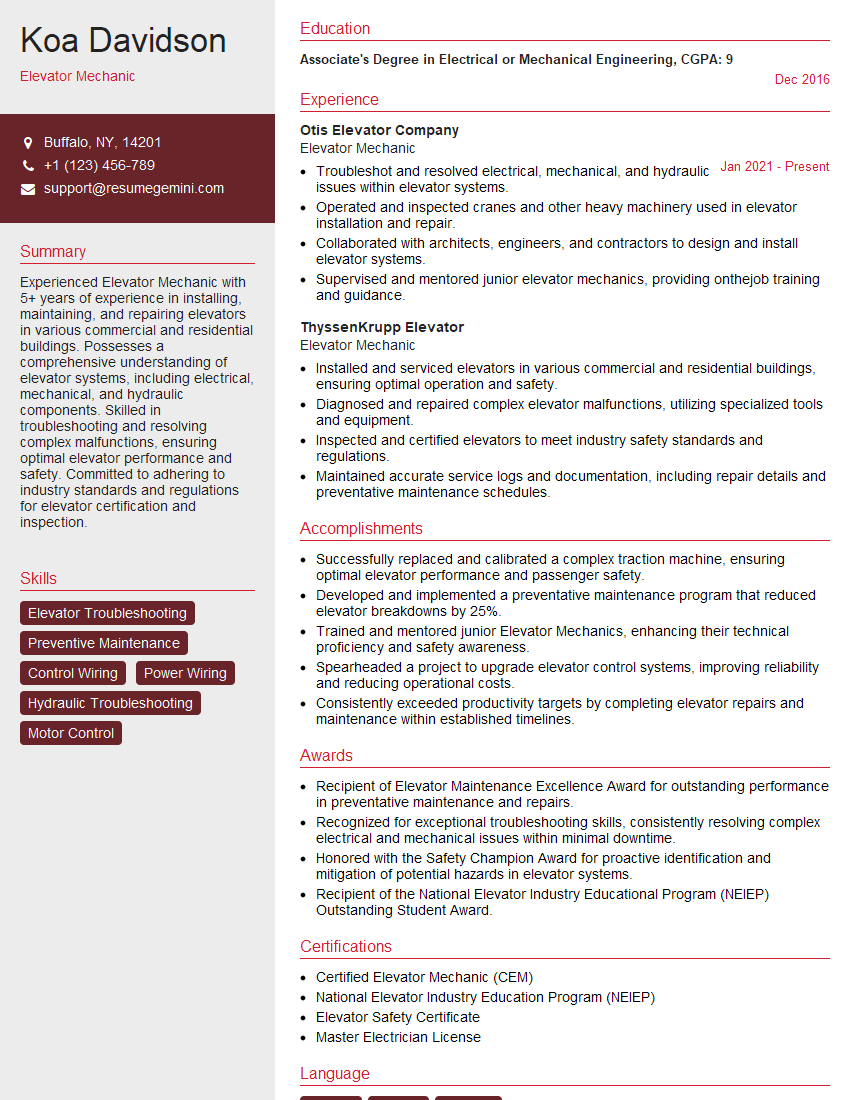
Mastering Elevator Maintenance Software significantly enhances your career prospects in the elevator industry, opening doors to higher-paying roles and increased responsibility. To maximize your chances of landing your dream job, crafting an ATS-friendly resume is crucial. This ensures your application gets noticed by recruiters and hiring managers. We highly recommend using ResumeGemini to build a professional and impactful resume. ResumeGemini provides a user-friendly platform and offers examples of resumes tailored to Elevator Maintenance Software roles, helping you showcase your skills and experience effectively.
Explore more articles
Users Rating of Our Blogs
Share Your Experience
We value your feedback! Please rate our content and share your thoughts (optional).
What Readers Say About Our Blog
Very informative content, great job.
good