Unlock your full potential by mastering the most common Elevator Risk Assessment interview questions. This blog offers a deep dive into the critical topics, ensuring you’re not only prepared to answer but to excel. With these insights, you’ll approach your interview with clarity and confidence.
Questions Asked in Elevator Risk Assessment Interview
Q 1. Describe the different types of hazards associated with elevators.
Elevator hazards encompass a wide range, impacting both passengers and maintenance personnel. These can be broadly categorized into mechanical, electrical, and human factors.
- Mechanical Hazards: These include malfunctioning brakes, cable failures, counterweight issues, door malfunctions (entrapment, shearing), and unexpected falls or drops within the hoistway. Imagine a scenario where worn brake components lead to uncontrolled descent – a catastrophic failure.
- Electrical Hazards: These involve short circuits, electrical shocks, power outages leading to entrapment, and faulty wiring causing fires. Think of the potential for electrocution during maintenance if proper lockout/tagout procedures aren’t followed.
- Human Factors: These are perhaps the most insidious and involve negligence, lack of training, improper maintenance, and inadequate emergency response procedures. For example, a poorly trained operator might fail to recognize a warning sign, delaying necessary repairs.
Understanding these hazard categories is crucial for comprehensive risk assessment and mitigation.
Q 2. Explain the process of conducting a thorough elevator risk assessment.
A thorough elevator risk assessment follows a structured process. It begins with identifying potential hazards, then analyzing their likelihood and severity, and finally implementing control measures.
- Hazard Identification: This involves a detailed inspection of all elevator components, including the hoistway, machinery room, control systems, and safety devices. Walkthroughs, interviews with operators and maintenance staff, and review of maintenance logs are key.
- Risk Analysis: This step quantifies the risk associated with each identified hazard. A common method involves using a risk matrix, plotting the likelihood of occurrence against the severity of the consequences. A high likelihood and high severity combination necessitate immediate action.
- Risk Evaluation: This involves comparing the identified risks to acceptable risk levels defined by regulations and company policies. Are the risks tolerable or do they require further mitigation?
- Risk Control: This involves implementing control measures to reduce or eliminate the identified risks. These controls follow a hierarchy, discussed later.
- Monitoring and Review: The effectiveness of implemented controls should be regularly monitored and the risk assessment reviewed and updated periodically or after significant changes (e.g., repairs, modifications).
Throughout the entire process, meticulous documentation is paramount. This ensures accountability and facilitates future improvements.
Q 3. What are the key legal and regulatory requirements for elevator safety in your region?
Legal and regulatory requirements for elevator safety vary by region but generally align with international standards like those set by organizations such as ASME (American Society of Mechanical Engineers) or equivalent bodies in other countries. These regulations mandate regular inspections, maintenance schedules, certified technicians, and comprehensive safety protocols. Specific requirements might include:
- Regular Inspections: Annual or more frequent inspections by authorized inspectors to ensure compliance with safety standards.
- Maintenance Records: Detailed and up-to-date records of all maintenance activities.
- Emergency Procedures: Clearly defined and regularly practiced emergency procedures for rescuing trapped passengers.
- Operator Training: Proper training for operators and maintenance personnel covering safety procedures and emergency response.
- Safety Devices: The installation and regular testing of safety devices, such as emergency brakes and speed governors.
Failure to comply can result in heavy fines, operational shutdowns, and even legal action in case of accidents resulting from negligence.
Q 4. How do you identify and prioritize hazards during an elevator risk assessment?
Hazard identification and prioritization are crucial. We utilize several techniques.
- Checklists: Pre-defined checklists covering all aspects of the elevator system ensure nothing is overlooked. These are tailored to the specific elevator type and age.
- Inspections: Thorough visual inspections, including detailed examinations of mechanical and electrical components, identify visible defects and potential hazards.
- Risk Matrix: A risk matrix helps prioritize hazards by considering both the likelihood of occurrence (e.g., frequent, occasional, rare) and the severity of potential consequences (e.g., minor injury, serious injury, fatality). Hazards with high likelihood and severity are tackled first.
- Failure Mode and Effects Analysis (FMEA): This systematic approach identifies potential failure modes for each component and assesses the consequences of each failure. This helps anticipate less obvious hazards.
The prioritized list guides the subsequent risk control measures, ensuring resources are allocated effectively to address the most critical risks first.
Q 5. What methods do you use to control risks identified in an elevator assessment?
Risk control utilizes a hierarchy of controls, aiming for the most effective and feasible options. This is discussed in the next question, but generally includes:
- Elimination: Physically removing the hazard (often not feasible with elevators, but may be relevant for certain specific risks).
- Substitution: Replacing a hazardous component with a safer alternative.
- Engineering Controls: Implementing physical safeguards like interlocks, safety devices (e.g., overspeed governors), and improved designs.
- Administrative Controls: Implementing procedures, training, and safety rules (e.g., lockout/tagout procedures during maintenance, regular inspections, and operator training).
- Personal Protective Equipment (PPE): Providing appropriate PPE like safety glasses and gloves for maintenance personnel (this is a last resort).
For instance, replacing old, worn cables with new ones is substitution; implementing regular maintenance schedules is administrative control; and installing an overspeed governor is engineering control.
Q 6. Explain the hierarchy of controls for elevator safety.
The hierarchy of controls prioritizes the most effective methods for minimizing risk. This is a fundamental principle in safety management. The order of preference is:
- Elimination: Remove the hazard entirely.
- Substitution: Replace the hazard with a less hazardous alternative.
- Engineering Controls: Implement physical or technical solutions to isolate people from the hazard.
- Administrative Controls: Introduce safe work practices, training, and procedures.
- Personal Protective Equipment (PPE): Provide equipment to protect individuals from the hazard (least effective, as it relies on individual compliance).
This hierarchy guides decisions on control measures, aiming for the most effective and sustainable solution. Relying solely on PPE is generally avoided unless other controls are impractical or insufficient.
Q 7. How do you document and report the findings of an elevator risk assessment?
Documentation is vital for compliance and continuous improvement. The report should include:
- Elevator Details: Manufacturer, model, serial number, and age of the elevator.
- Inspection Date and Inspector Information: Clearly identify when the assessment was conducted and by whom.
- Identified Hazards: A detailed list of all identified hazards, with clear descriptions.
- Risk Assessment: The likelihood and severity of each hazard, and the resulting risk level.
- Control Measures: The recommended control measures for each hazard, specifying the type of control (elimination, substitution, engineering, administrative, PPE).
- Recommendations: Specific and actionable recommendations for improvements, including timelines and responsibilities.
- Photographs/Videos: Visual evidence supporting the findings (where applicable).
This comprehensive documentation serves as a record of the assessment, facilitating future inspections, maintenance scheduling, and demonstrating compliance with regulatory requirements. The report should be easily accessible to all relevant stakeholders.
Q 8. How would you handle a situation where an elevator is found to have a critical safety issue?
Discovering a critical safety issue in an elevator demands immediate and decisive action. My first step would be to immediately take the elevator out of service, preventing further use and potential harm. This involves clearly marking the elevator as ‘Out of Order’ with prominent signage and, if necessary, physically locking the access doors.
Next, I would initiate a thorough investigation to pinpoint the root cause of the issue. This might involve detailed visual inspections, testing of safety mechanisms, and potentially consulting with elevator mechanics and engineers specializing in the specific system. Documentation is crucial at this stage, recording every finding and action taken.
Once the root cause is identified, a comprehensive repair plan is developed and implemented by qualified technicians. This plan must address not only the immediate problem but also any underlying contributing factors. After repairs, rigorous testing and inspection are conducted to ensure the elevator’s safety and compliance with all relevant regulations before it’s returned to service. Throughout this process, I would maintain open communication with building management, occupants, and regulatory authorities, keeping them informed of the situation and the progress of the remediation.
For example, if a crucial safety switch is found malfunctioning, I wouldn’t simply replace the switch. I’d investigate why it failed – was it due to wear and tear, improper installation, or a larger systemic issue? Addressing the underlying cause is critical for preventing future incidents.
Q 9. What are your experiences with different elevator types (hydraulic, traction, etc.) and their associated risks?
My experience encompasses a broad range of elevator types, including hydraulic, traction, and machine-room-less (MRL) systems. Each type presents unique risks. Hydraulic elevators, for instance, rely on a hydraulic fluid system, posing potential risks of fluid leaks, component failures, and environmental concerns. The risks are further heightened in older systems that might lack modern safety features.
Traction elevators, employing cables and counterweights, have different risks. Cable breakage, counterweight malfunctions, and governor issues can lead to serious accidents. Regular inspections and maintenance are vital to ensure the integrity of these components. The risk profile for MRL elevators, while generally considered safer due to their compactness and reduced mechanical components, can involve risks associated with the compact design and potential lack of access for certain maintenance procedures.
I’ve worked on assessing and mitigating risks in various scenarios, including those involving aging systems needing upgrades to meet current safety standards. For instance, I recently consulted on a project updating the safety systems of a historic building’s hydraulic elevators. This included integrating modern safety features while preserving the building’s architectural integrity.
Q 10. Describe your experience using specific risk assessment methodologies (e.g., HAZOP, FMEA).
I’m proficient in several risk assessment methodologies, including HAZOP (Hazard and Operability Study) and FMEA (Failure Mode and Effects Analysis). HAZOP is particularly useful for identifying potential hazards during the design and operation phases of an elevator system. This involves systematically reviewing each element of the system, considering deviations from its intended behavior and their potential consequences. For example, a HAZOP study of a hydraulic elevator might consider deviations such as ‘hydraulic fluid leakage,’ assessing the potential consequences and recommending mitigating measures.
FMEA focuses on identifying potential failures within a system and analyzing their effects. It allows for the quantification of risk, enabling prioritization of mitigation efforts. Using FMEA, I’ve created detailed spreadsheets outlining potential failure modes, their severity, detection probability, and occurrence rate for various elevator components. This helps to systematically evaluate and rank the risks, focusing resources on the most critical aspects.
I frequently use a combination of these methodologies, tailoring the approach to the specific elevator system and its operational context. This holistic approach ensures a comprehensive and effective risk assessment.
Q 11. What are some common causes of elevator accidents and how can they be prevented?
Common causes of elevator accidents often stem from mechanical failures, inadequate maintenance, misuse by passengers, and insufficient safety measures. Mechanical failures such as cable breaks, door malfunctions, and brake failures highlight the need for thorough and regular inspection and maintenance. Inadequate maintenance is a major contributor. Delayed or insufficient maintenance increases the probability of these mechanical issues escalating into accidents.
Passenger misuse, including overloading the elevator or attempting to force open doors, can also lead to incidents. Clear signage and passenger education are crucial in mitigating these risks. Finally, insufficient or outdated safety measures can significantly increase the risk. Modern safety devices such as emergency brakes, overspeed governors, and safety interlocks should be properly functioning and regularly inspected.
Prevention involves a multi-pronged strategy: robust preventative maintenance programs, regular inspections by qualified technicians, effective safety training for building staff and occupants, clear signage, and upgrades to incorporate modern safety technologies. For example, regularly scheduled inspections can catch minor issues before they become major hazards, saving time and costs in the long run.
Q 12. How do you ensure the accuracy and reliability of your elevator risk assessments?
Ensuring accuracy and reliability in elevator risk assessments requires a meticulous approach. First, the assessment must be based on current industry standards, codes, and best practices. I rely on reputable sources such as the American Society of Mechanical Engineers (ASME) A17.1 safety code and local building codes. Second, the assessment must be conducted by qualified and experienced professionals who thoroughly understand elevator technology and safety protocols.
Using established methodologies such as HAZOP and FMEA ensures a systematic and comprehensive approach, minimizing bias. Documentation plays a vital role. Every finding, assumption, and calculation must be meticulously recorded and documented to ensure transparency and allow for review and verification. Regular audits and reviews of the risk assessment are crucial to keep it up-to-date and relevant, especially with any changes to the elevator system or its operational environment.
For example, a quantitative risk assessment would incorporate statistical data on elevator failures and component lifespans. Such data enables a more accurate assessment of the risk levels and supports informed decision-making regarding mitigation strategies.
Q 13. Describe your experience with elevator maintenance programs and their role in risk mitigation.
Elevator maintenance programs are fundamental to risk mitigation. A well-structured program should incorporate preventative maintenance, predictive maintenance, and corrective maintenance. Preventative maintenance involves scheduled inspections and servicing of elevator components to prevent failures before they occur. This includes lubrication, cleaning, and adjustments. Predictive maintenance employs tools and techniques to predict potential failures based on data analysis and condition monitoring.
Corrective maintenance addresses failures as they occur, restoring the elevator to its safe operating condition. The frequency and scope of maintenance depend on the elevator type, age, usage, and local regulations. A comprehensive program would incorporate detailed records of all maintenance activities, enabling tracking of repairs, inspections, and component lifecycles. These records are invaluable for risk assessment, identifying trends and potential weaknesses in the system. For example, tracking the frequency of certain repairs can reveal underlying issues that require attention.
Effective elevator maintenance programs significantly reduce the probability of accidents and malfunctions, leading to a safer and more reliable elevator system, enhanced passenger safety, and improved operational efficiency.
Q 14. How do you communicate risk assessment findings to non-technical audiences?
Communicating risk assessment findings to non-technical audiences requires clear, concise, and visual communication. Technical jargon should be avoided, and complex concepts should be explained using simple analogies. I often use visual aids such as charts, graphs, and infographics to present data effectively. For instance, a simple bar chart showing the probability of different failure modes would be much easier for a building manager to understand than a complex spreadsheet.
Instead of stating ‘the probability of cable breakage is 0.01,’ I might say ‘there’s a one in a hundred chance of the elevator cables breaking.’ This makes the risk more relatable and understandable. I also focus on the potential consequences of each risk, explaining their impact on safety and operations in plain language. Finally, the communication should highlight the proposed mitigation strategies and their associated costs and benefits, facilitating informed decision-making by non-technical stakeholders.
For example, when presenting findings to a building’s safety committee, I’d avoid technical terms like ‘overspeed governor’ and instead focus on its role in preventing fast descents, using relatable examples to emphasize the importance of the mitigation strategies.
Q 15. How do you stay current with changes in elevator safety regulations and best practices?
Staying current in elevator safety is crucial. I achieve this through a multi-pronged approach. Firstly, I actively subscribe to and regularly review publications from organizations like ASME (American Society of Mechanical Engineers), and relevant government agencies. These publications often announce updates to standards and best practices. Secondly, I participate in professional development courses and conferences specifically focused on elevator safety and risk assessment. These events provide opportunities to network with other experts and learn about emerging trends and challenges. Finally, I maintain a network of colleagues in the elevator industry, sharing knowledge and insights through regular discussions and collaborations. This continuous learning ensures my expertise remains up-to-date and relevant.
Career Expert Tips:
- Ace those interviews! Prepare effectively by reviewing the Top 50 Most Common Interview Questions on ResumeGemini.
- Navigate your job search with confidence! Explore a wide range of Career Tips on ResumeGemini. Learn about common challenges and recommendations to overcome them.
- Craft the perfect resume! Master the Art of Resume Writing with ResumeGemini’s guide. Showcase your unique qualifications and achievements effectively.
- Don’t miss out on holiday savings! Build your dream resume with ResumeGemini’s ATS optimized templates.
Q 16. Explain your understanding of relevant safety standards (e.g., ASME A17.1).
ASME A17.1 is the foundational safety standard for elevators in North America. It outlines comprehensive requirements for design, construction, installation, testing, inspection, and maintenance. My understanding encompasses all aspects of this standard, including the specific requirements for different elevator types (hydraulic, traction, escalators, etc.). I’m particularly familiar with sections concerning emergency procedures, safety devices (such as emergency brakes and speed governors), and the maintenance and testing protocols. For instance, I know that regular inspections must include a thorough examination of the hoisting machinery, safety devices, and electrical systems. Understanding the nuances of ASME A17.1 allows me to conduct effective risk assessments, ensuring compliance and minimizing potential hazards.
Q 17. How do you incorporate human factors into your elevator risk assessment process?
Human factors are paramount in elevator risk assessment. It’s not just about the mechanics; it’s about how people interact with the system. I incorporate human factors by considering several key elements. First, I analyze the potential for human error, such as improper operation by users or inadequate training of maintenance personnel. Second, I assess the clarity and usability of elevator controls and signage, ensuring they’re intuitive and easy to understand for all users, including people with disabilities. Third, I consider the potential for panic and inappropriate responses during emergencies. For example, I might recommend specific design features or emergency procedures that account for potential human reactions in stressful situations. This holistic approach ensures a more comprehensive and effective risk assessment.
Q 18. Describe your experience with conducting audits of elevator safety programs.
I have extensive experience conducting audits of elevator safety programs. My process typically involves a thorough review of all relevant documentation, including maintenance records, inspection reports, and training materials. I then conduct on-site inspections to verify the implementation of safety protocols and identify any discrepancies. For example, I’ve audited organizations that failed to properly document maintenance procedures or lacked adequate training programs for their staff. During one audit, I discovered a company’s failure to perform regular tests on emergency braking systems. This led to recommendations for improved training and implementation of a more rigorous testing schedule, preventing potential accidents. The goal of my audits is not simply to find flaws but to help organizations improve their safety performance.
Q 19. What is your experience with emergency procedures related to elevators?
My experience with elevator emergency procedures is extensive. I’m proficient in various rescue techniques, including using emergency keys and rescue devices. I also understand the importance of communication protocols in emergency situations, ensuring that all stakeholders (building management, emergency services, etc.) are informed and coordinated effectively. For example, I’ve worked on developing emergency response plans for high-rise buildings, which specify clear communication pathways and procedures for rescuing trapped passengers. A crucial aspect of emergency procedures involves regular training drills to familiarize personnel with response protocols and ensure their proficiency in handling emergencies. Effective emergency procedures are critical in mitigating injuries and ensuring passenger safety.
Q 20. How do you assess the competence of elevator maintenance personnel?
Assessing the competence of elevator maintenance personnel is vital. This involves several steps. Firstly, I review their qualifications and certifications, ensuring they possess the necessary licenses and training to perform their duties. Secondly, I observe their work practices, evaluating their adherence to safety protocols and their proficiency in performing maintenance tasks. Thirdly, I examine their work records, looking for any patterns of errors or negligence. I’ve had instances where, during an audit, I found a technician was not adhering to manufacturer’s specified maintenance procedures. This identified a gap in their training and necessitated immediate remedial action. Ensuring competence extends beyond simple compliance; it’s about fostering a culture of safety and meticulous attention to detail.
Q 21. Explain your understanding of elevator control systems and their safety features.
My understanding of elevator control systems and their safety features is thorough. I’m familiar with various types of control systems, including microprocessor-based and relay logic systems. These systems incorporate multiple safety features such as overspeed governors, limit switches, and emergency brakes. For example, an overspeed governor prevents the elevator car from exceeding a safe speed, while limit switches prevent the car from going beyond the designated terminal floors. I understand the importance of regular testing and maintenance of these safety features. I can also analyze control system schematics to identify potential vulnerabilities and recommend improvements to enhance overall safety. A solid understanding of these systems is vital for effective risk assessment and the prevention of accidents.
Q 22. Describe a time you had to deal with a challenging elevator risk assessment situation.
One challenging assessment involved an older high-rise building with a complex elevator system nearing the end of its operational life. The challenge wasn’t just the age of the equipment, but the lack of comprehensive maintenance records. This meant we had to conduct a thorough, hands-on inspection, meticulously documenting every component and its condition. We used a combination of visual inspection, non-destructive testing methods, and reviewing available operational data to identify potential hazards. We discovered several critical issues, including worn cables nearing their service life, questionable emergency braking systems, and a lack of modern safety features. Addressing these issues required a phased approach, prioritizing immediate critical repairs while developing a long-term modernization plan to bring the system to current safety standards. The process highlighted the importance of proactive maintenance and the need for detailed documentation throughout the lifespan of elevator systems.
Q 23. How would you handle disagreements with other stakeholders regarding elevator safety?
Disagreements on elevator safety are common, particularly when balancing safety concerns with budget constraints. My approach is collaborative and data-driven. I start by presenting the assessment findings clearly and objectively, using visual aids and easily understandable language. Then, I involve all stakeholders in a structured discussion, explaining the potential consequences of neglecting safety recommendations in terms of financial risk (liability, downtime), operational disruptions, and, most importantly, potential harm to building occupants. If a disagreement persists, I propose a phased approach, prioritizing critical safety improvements first and exploring alternative solutions that might address budget concerns. Ultimately, I aim for a consensus built on sound engineering principles and a shared understanding of the risks. In cases where resolution remains impossible, I document the dissenting opinions and the reasons for the recommendations made and escalate it through appropriate channels, ensuring all parties understand the potential legal and ethical implications.
Q 24. What are the key performance indicators (KPIs) you would use to monitor elevator safety performance?
Key performance indicators (KPIs) for elevator safety monitoring should be both quantitative and qualitative. Quantitative KPIs might include:
- Mean Time Between Failures (MTBF): Tracking the average time between elevator malfunctions.
- Mean Time To Repair (MTTR): Monitoring how quickly repairs are completed after a failure.
- Number of Incidents/Accidents: Recording any incidents, near misses, or accidents involving elevators.
- Compliance Rate with Scheduled Maintenance: Tracking the percentage of scheduled maintenance tasks completed on time.
Qualitative KPIs might include:
- Maintenance Personnel Training and Certification Levels: Ensuring technicians are adequately trained and certified.
- Effectiveness of Emergency Response Procedures: Evaluating how quickly and efficiently emergency situations are handled.
- Employee and Occupant Satisfaction Surveys: Gathering feedback on elevator reliability and safety.
By combining quantitative and qualitative data, we gain a comprehensive understanding of elevator safety performance and identify areas needing improvement.
Q 25. How do you ensure that your elevator risk assessments are cost-effective?
Cost-effectiveness in elevator risk assessment comes from a well-planned and targeted approach. This involves prioritizing assessments based on risk levels, focusing on elevators with higher usage, older equipment, or a history of issues. Utilizing non-destructive testing techniques where applicable reduces the need for extensive dismantling and therefore minimizes cost. Furthermore, developing a comprehensive preventive maintenance program reduces the likelihood of costly repairs and replacements down the line. This proactive approach is significantly more cost-effective than reactive maintenance after a failure. Regular inspections and efficient documentation also ensure that resources are utilized efficiently by focusing on needed improvements rather than unnecessary inspections. Ultimately, while safety is paramount, a well-structured approach ensures that the budget allocated for assessment and maintenance is used effectively and efficiently.
Q 26. Describe your experience with elevator modernization projects and their safety implications.
Elevator modernization projects present unique safety challenges and opportunities. The process involves replacing outdated components with modern technology, requiring a careful risk assessment throughout. Before starting, a thorough assessment of the existing system is needed, identifying potential hazards during the modernization process itself. For example, managing fall hazards during equipment removal and installation is paramount. Throughout the project, stringent safety protocols must be in place, including proper lockout/tagout procedures, controlled access zones, and regular safety inspections. Modernization often introduces new technologies like advanced control systems and safety features, requiring specialized training for maintenance personnel. The upgrade process provides an opportunity to implement modern safety features, significantly enhancing elevator safety and reducing potential risks in the long run. Proper planning and execution are key to ensuring safety throughout the modernization process and realizing the benefits of increased safety and efficiency.
Q 27. How do you integrate elevator risk assessment into the overall building safety management system?
Integrating elevator risk assessment into the overall building safety management system involves a holistic approach. The elevator system should be viewed as an integral part of the building’s infrastructure, not in isolation. The assessment should align with the building’s overall risk assessment, considering the building’s occupancy, usage patterns, and emergency procedures. Elevator-specific risk assessments should be incorporated into the building’s safety plan, specifying procedures for handling emergencies and maintenance. Regular inspections and maintenance schedules for elevators should be integrated into the building’s overall maintenance schedule. Finally, regular audits and reviews of the effectiveness of the elevator safety management system should be part of the building’s continuous improvement process. This holistic approach ensures that elevator safety is not an isolated concern, but rather a component of a comprehensive and effective building safety management program.
Q 28. Explain your understanding of the role of technology in enhancing elevator safety.
Technology plays a crucial role in enhancing elevator safety. Modern elevator systems incorporate various technological advancements to improve safety and efficiency. These include:
- Advanced Control Systems: These systems monitor elevator performance in real-time, detecting and diagnosing potential problems before they escalate into failures.
- Predictive Maintenance Systems: Using data analytics, these systems predict potential failures, allowing for proactive maintenance to prevent costly breakdowns and safety hazards.
- Emergency Communication Systems: Elevators are equipped with communication systems allowing trapped passengers to contact emergency services directly.
- CCTV and Monitoring Systems: Video surveillance inside and outside elevators helps monitor operations and enhance safety.
- Remote Diagnostics and Monitoring: Allows for real-time monitoring of elevator performance from remote locations, enabling quicker responses to problems.
The integration of these technologies enables more proactive, data-driven safety management, ultimately reducing risks and improving the overall safety of elevator systems.
Key Topics to Learn for Elevator Risk Assessment Interview
- Legislation and Regulations: Understanding relevant safety standards, codes, and legal requirements concerning elevator operation and maintenance. This includes knowing which regulations apply to different elevator types and locations.
- Hazard Identification and Risk Assessment Techniques: Mastering methods for identifying potential hazards associated with elevators (e.g., mechanical failures, entrapment, falls), analyzing their likelihood and severity, and determining appropriate control measures. Practical application involves conducting mock risk assessments using case studies.
- Inspection and Maintenance Procedures: Familiarizing yourself with routine inspection checklists, preventative maintenance schedules, and the importance of accurate record-keeping. This includes understanding the role of different components and their potential failure points.
- Emergency Response and Procedures: Knowing the protocols for responding to various elevator emergencies, including rescue techniques and communication strategies. This requires understanding the limitations of different rescue methods and when to call for specialized assistance.
- Risk Control Measures and Mitigation Strategies: Developing and implementing practical strategies to minimize or eliminate identified risks. This involves understanding the hierarchy of controls (elimination, substitution, engineering controls, administrative controls, PPE).
- Documentation and Reporting: Understanding the importance of thorough and accurate documentation of risk assessments, inspections, and maintenance activities. This includes knowing how to compile and present findings effectively.
- Communication and Teamwork: Effective communication with colleagues, supervisors, and potentially building occupants is critical. This includes explaining technical information clearly and concisely.
Next Steps
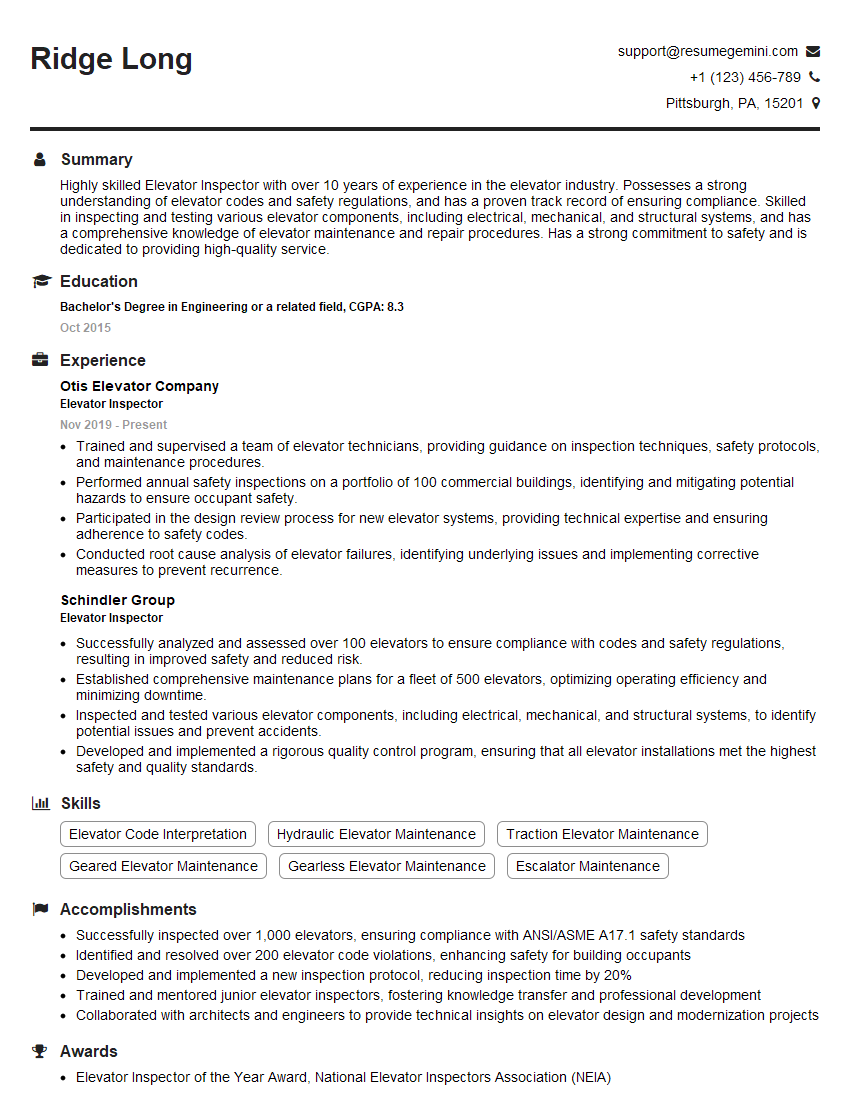
Mastering Elevator Risk Assessment is crucial for advancing your career in building safety and management. A strong understanding of these principles demonstrates your commitment to safety and opens doors to higher-level roles with increased responsibility and earning potential. To maximize your job prospects, focus on crafting an ATS-friendly resume that highlights your relevant skills and experience. ResumeGemini is a trusted resource to help you build a professional and impactful resume. They provide examples of resumes tailored to Elevator Risk Assessment, ensuring your application stands out from the competition.
Explore more articles
Users Rating of Our Blogs
Share Your Experience
We value your feedback! Please rate our content and share your thoughts (optional).
What Readers Say About Our Blog
Very informative content, great job.
good