Every successful interview starts with knowing what to expect. In this blog, we’ll take you through the top Embossing and Die Cutting interview questions, breaking them down with expert tips to help you deliver impactful answers. Step into your next interview fully prepared and ready to succeed.
Questions Asked in Embossing and Die Cutting Interview
Q 1. Explain the difference between embossing and debossing.
Embossing and debossing are both relief printing techniques that create raised or indented designs on a material, but they achieve this in opposite ways. Think of it like pushing a thumb into clay: embossing raises the design, creating a raised texture, while debossing pushes the design inwards, creating a recessed impression.
Embossing: A raised design is created on the surface of the material. Imagine the raised lettering on a high-quality business card – that’s embossing. The pressure applied from the die pushes the material upwards.
Debossing: A recessed design is created, making the design appear indented. Consider the slightly sunken imprint of a company logo on a leather-bound notebook – this is debossing. The die pushes the material downwards.
Both techniques often involve a counter-die to provide even pressure and prevent the material from cracking or tearing.
Q 2. Describe the various types of die-cutting machines you have experience with.
Throughout my career, I’ve worked with a variety of die-cutting machines, ranging from smaller, hand-cranked machines ideal for smaller projects and prototypes to large, automated presses capable of high-volume production. My experience includes:
- Platen Presses: These are versatile machines suitable for both embossing and die-cutting. I’ve used them extensively for various applications, particularly for smaller-scale projects requiring precision.
- Rotary Die Cutters: These high-speed machines are perfect for mass production. I’ve operated both semi-automatic and fully automatic rotary die cutters, each suited to different production volumes and material types.
- Flatbed Die Cutters: These machines offer flexibility for intricate designs and various material thicknesses. I’m adept at operating both manual and automated flatbed systems.
- Laser Cutters: While not strictly a die-cutting machine, laser cutters offer a clean and precise method for creating intricate die cuts, particularly useful for complex designs or delicate materials. I have significant experience using CO2 lasers for this purpose.
My expertise extends to understanding the capabilities and limitations of each machine, allowing me to select the optimal equipment for any given project.
Q 3. How do you ensure accurate die registration?
Accurate die registration is crucial for perfect embossing and die-cutting results; misaligned dies can ruin an entire run. This is achieved through careful setup and precise alignment using several methods:
- Accurate Die Mounting: The die needs to be securely and correctly mounted on the press. Any slight misalignment here will propagate throughout the process.
- Registration Marks: These pre-printed marks on the material act as guides for alignment. The die is adjusted until it perfectly overlays these marks. This is akin to using guidelines when designing a document.
- Microscopes and Magnification: Precise alignment often requires magnification to ensure flawless registration, especially with intricate designs or small details.
- Test Runs: Prior to full production, test runs are essential to check for alignment and make adjustments as needed. This minimizes waste and ensures quality.
- Automated Registration Systems: Advanced machines utilize cameras and sensors for automatic registration, reducing the need for manual adjustments and improving consistency.
A combination of these techniques ensures that every piece is consistently and accurately embossed or die-cut.
Q 4. What are the common problems encountered during embossing and how do you troubleshoot them?
Several problems can occur during embossing. Let’s discuss some common issues and their solutions:
- Uneven Embossing: This often stems from inconsistent pressure application or issues with the die itself. Troubleshooting involves checking the press’s pressure settings, inspecting the die for damage or imperfections, and ensuring the material is evenly fed.
- Material Cracking or Tearing: This is often caused by excessive pressure, improper material selection, or a sharp edge on the die. Solutions involve reducing pressure, using a more suitable material, and potentially polishing the die to eliminate sharp edges.
- Weak Embossing: This may indicate insufficient pressure, a worn die, or incorrect temperature settings (for heat embossing). The remedy might involve adjusting pressure, replacing the die, or correcting the heat settings.
- Inconsistent Impression Depth: This can be caused by inconsistent material thickness or variations in the die itself. Troubleshooting includes examining the material for uniformity and carefully inspecting the die for defects. A possible solution is to use a counter die to apply equal and opposite pressure.
Systematic troubleshooting, starting with the simplest checks, and careful observation are key to resolving these issues.
Q 5. Explain the different types of embossing dies.
Embossing dies come in various types, each suited for different applications and results:
- Rule Dies: These are relatively simple dies featuring straight lines and text. They’re cost-effective and suitable for basic designs.
- Counter Dies: Used in conjunction with embossing dies to create a balanced impression, helping to prevent tearing or cracking and create a crisp, clean impression.
- Photopolymer Dies: Created from a photopolymer material, these dies are excellent for intricate designs and complex textures, allowing for great detail and flexibility. They’re also more cost-effective for low-volume projects compared to metal dies.
- Steel Rule Dies: These are durable and long-lasting, ideal for high-volume production. They’re generally more expensive but offer superior longevity and robustness.
The choice of die type depends on factors like design complexity, required volume, material type, and budget.
Q 6. What materials are commonly used in embossing and die cutting?
A wide range of materials are used in embossing and die cutting, each with its own properties affecting the final outcome:
- Paper: Various types of paper, from cardstock to specialty papers, are common substrates.
- Cardboard: Used for packaging and other applications needing rigidity.
- Leather: Often used for high-end products, it requires careful pressure adjustment during embossing to avoid damage.
- Fabric: Certain fabrics can be embossed and die-cut, although this requires specialized dies and techniques.
- Metals: Thin metals, like foil, can be embossed and die-cut, usually through more specialized equipment and techniques.
- Plastics: Various plastics, including PVC and acrylic, can be embossed and die-cut, each requiring specific pressure and temperature adjustments.
Material selection is critical and significantly influences the final product quality and appearance.
Q 7. How do you determine the appropriate pressure and temperature for embossing?
Determining the appropriate pressure and temperature for embossing requires careful consideration and often involves experimentation. Factors influencing these parameters include:
- Material Type: Thicker and harder materials require higher pressure. Different materials have different heat sensitivities.
- Die Design: Intricate designs may require more precise pressure control to avoid damage.
- Desired Embossing Depth: Deeper embossing generally requires higher pressure.
- Machine Type: Different machines have different pressure and temperature capabilities.
Often, a series of test runs are performed, gradually adjusting pressure and temperature until the desired effect is achieved. This iterative process ensures optimal results and minimizes material waste. Precise monitoring and adjustment are crucial. Consider using specialized tools such as pressure gauges and temperature controllers for more consistent and accurate results.
Q 8. Describe your experience with setting up and operating die-cutting presses.
Setting up and operating die-cutting presses involves a systematic approach, starting with careful die preparation and machine configuration. I’ve extensive experience with various press types, including flatbed and rotary presses. With flatbed presses, I meticulously align the die within the press, ensuring precise registration for clean cuts. Rotary presses require a different approach, focusing on proper die cylinder installation and ensuring the correct pressure and speed settings for the material being processed. This includes understanding the relationship between cutting pressure, material thickness, and die sharpness to achieve optimal results and minimize waste. For instance, I once worked on a project requiring intricate cutting on a delicate material. By meticulously adjusting the pressure and speed on the rotary press and carefully inspecting the die, I avoided material distortion and ensured precision cuts across thousands of units.
Beyond the initial setup, operating the presses involves monitoring the cutting process, making adjustments as needed, and regularly inspecting the machine for signs of wear or malfunction. This proactive approach minimizes downtime and ensures the consistent production of high-quality products. I’m comfortable troubleshooting minor issues and adept at identifying when a more significant repair is necessary.
Q 9. How do you maintain and clean embossing and die-cutting equipment?
Maintaining and cleaning embossing and die-cutting equipment is crucial for both safety and the longevity of the machinery. My routine involves regular cleaning of the press bed, platens, and cutting dies to remove scraps and debris. This is often done using compressed air and appropriate cleaning solvents. For dies specifically, this involves gentle cleaning to avoid damage to the sharp cutting edges. I always follow the manufacturer’s recommendations for cleaning solutions to avoid corrosion or damage. Furthermore, regular lubrication of moving parts is essential to prevent wear and tear. Think of it like servicing your car; preventative maintenance ensures efficiency and reduces the risk of costly repairs.
More significant maintenance tasks include periodic inspections for wear and tear on cutting surfaces, checking for proper alignment and adjusting as necessary, and ensuring the safety mechanisms, such as emergency stops and safety guards, are fully functional. This isn’t just a matter of routine; it’s about anticipating potential problems and preventing accidents. I’ve even developed a preventative maintenance schedule based on usage that helps to track and schedule these maintenance tasks, minimizing unplanned downtime.
Q 10. What are the safety procedures you follow when operating embossing and die-cutting machines?
Safety is paramount when operating embossing and die-cutting machines. Before starting any operation, I always ensure the machine is properly grounded and all safety guards are in place. Loose clothing or jewelry are never worn near the machinery to avoid entanglement. I always wear appropriate personal protective equipment (PPE), including safety glasses, hearing protection, and gloves, depending on the material being processed. I never attempt to make adjustments to the machine while it’s in operation. Instead, I always follow the ‘lockout/tagout’ procedure to ensure the machine is completely shut off and secured before performing any maintenance or adjustments. Regularly checking the emergency stop mechanisms are also crucial to ensure they’re responsive and functional.
This isn’t just a list of rules; it’s a mindset. Safety is ingrained in my approach, and I consistently promote a culture of safety within my work environment. I’ve conducted numerous safety training sessions for colleagues, emphasizing the importance of these procedures and highlighting the consequences of negligence.
Q 11. Explain your experience with different die-cutting techniques (e.g., rotary, flatbed).
My experience encompasses both rotary and flatbed die-cutting techniques. Rotary die-cutting is ideal for high-volume production runs, offering speed and efficiency. It involves using a rotating cylinder with the die mounted onto it, allowing for continuous cutting. I’ve used this for mass-producing items such as business cards and labels. Flatbed die-cutting, on the other hand, is more versatile for smaller runs and intricate designs. It utilizes a stationary die that cuts the material with a press. This is better suited for custom shapes or delicate materials where precise control is required, and I’ve utilized this for creating intricate packaging designs and promotional materials.
The choice between the two techniques depends heavily on the project requirements – production volume, complexity of the design, and the material itself. Understanding these factors and having hands-on experience with both methods allows me to optimize the process for each specific job. For example, for a small order of uniquely shaped greeting cards, flatbed cutting ensured precise detail and avoided waste.
Q 12. How do you inspect finished products for quality and identify defects?
Inspecting finished products involves a thorough and multi-stage process. First, I conduct a visual inspection, checking for any obvious defects such as miscuts, incomplete embossing, or inconsistencies in the foil stamping (if applicable). This often involves using magnification tools for detailed examination. Then, I check for dimensional accuracy, making sure the cuts are precisely to specification. Finally, I might perform functional testing if applicable – for instance, ensuring a box properly folds and seals. I document any defects and report them, initiating corrective action to prevent similar problems in the future.
Identifying defects requires a keen eye for detail and an understanding of the potential causes. For example, a consistent miscut might indicate a problem with the die, while random inconsistencies might suggest an issue with the press setup or the material itself. This problem-solving approach allows me to address root causes rather than simply treating symptoms. Tracking defects also helps me improve overall efficiency and product quality.
Q 13. Describe your experience with different types of embossing effects.
My experience with embossing effects encompasses various techniques, creating a wide range of textures and depths. I’m proficient in creating subtle blind embossing, where the image is raised without any color or foil, to create a textured effect. This works well for adding subtle sophistication to packaging or stationery. I also have expertise in registered embossing, where the embossed image perfectly aligns with a printed design, creating a truly sophisticated look. This is particularly effective for creating high-end product packaging or invitations.
Beyond these, I have extensive experience with debossing, where the image is recessed into the material, offering a different tactile experience. The selection of the embossing technique depends on the desired aesthetic and the material’s characteristics. The thickness of the paper or board greatly impacts the final result, and I have a good understanding of material selection for different embossing techniques.
Q 14. What is your experience with foil stamping in conjunction with embossing?
Foil stamping combined with embossing adds an extra layer of luxury and sophistication to a product. It involves applying metallic foil to the embossed area, creating a striking visual and tactile effect. The process usually requires precise registration between the foil, the die, and the print design to ensure alignment. I’ve worked extensively with various foil types, including gold, silver, and specialty colors, understanding the nuances of each and how they interact with different materials and embossing techniques. The setup for this process is more complex than basic embossing, requiring careful temperature and pressure adjustments to achieve a clean and consistent foil application.
For example, I was involved in a project where we embossed and foil-stamped invitations for a high-profile event. Precise alignment and a flawless foil application were crucial. Through careful attention to detail and meticulous setup, we achieved a high-quality finish that exceeded client expectations. Such projects highlight the importance of not only the technical skill but also the artistic understanding of colour and texture.
Q 15. How do you manage and organize die storage?
Die storage is crucial for maintaining the longevity and accuracy of your cutting dies. Poor organization leads to damage, misplacement, and ultimately, production delays. My approach emphasizes a system of clear labeling, organized storage, and regular maintenance.
I utilize a combination of methods. Dies are categorized first by project, then by type (e.g., embossing dies, rule dies, kiss-cut dies). Each die is carefully cleaned and stored in its own protective case, often custom-fitted for added security. These cases are then stored in labeled drawers or cabinets, with a comprehensive inventory system—both physical and digital—to track their location and usage. This ensures quick retrieval and prevents accidental damage. For example, delicate embossing dies are stored separately from heavier rule dies to avoid damage during handling.
Regular inspections are key. I conduct periodic checks for damage or wear, noting any issues in my inventory system. This allows for timely repairs or replacements, preventing costly production stoppages. This systematic approach ensures efficiency and safeguards against loss or damage.
Career Expert Tips:
- Ace those interviews! Prepare effectively by reviewing the Top 50 Most Common Interview Questions on ResumeGemini.
- Navigate your job search with confidence! Explore a wide range of Career Tips on ResumeGemini. Learn about common challenges and recommendations to overcome them.
- Craft the perfect resume! Master the Art of Resume Writing with ResumeGemini’s guide. Showcase your unique qualifications and achievements effectively.
- Don’t miss out on holiday savings! Build your dream resume with ResumeGemini’s ATS optimized templates.
Q 16. What software or design tools do you use for creating die-cutting designs?
Creating precise die-cutting designs requires sophisticated software. My workflow typically starts with Adobe Illustrator, a vector-based program ideal for creating intricate designs with clean lines. I use Illustrator to design the precise shapes and patterns that will be cut. The high resolution and accuracy of vector graphics are essential for creating dies that perform flawlessly. Once the design is finalized, I often utilize specialized software to convert the Illustrator file into a format suitable for die-making. This process involves generating cutting paths, often with different cutting depths and thicknesses for various effects like partial cuts or embossing.
For more complex projects involving 3D embossing or intricate die layouts, I might use dedicated CAD software designed for die-making. These programs often offer features for simulating the die-cutting process, allowing me to identify potential problems before manufacturing begins. The selection of software depends on the complexity and specifics of the job.
Q 17. Describe your experience working with different substrates (e.g., paper, cardstock, plastic).
Experience with various substrates is paramount in die cutting. Different materials react differently to the cutting and embossing process, requiring adjustments to pressure, speed, and even the die design itself.
Paper and cardstock, for example, require less force compared to plastic sheets. Paper’s variable thickness and absorbency must be carefully considered. I might choose a sharper rule for thin paper to prevent tearing, while a more robust rule would be suited for thicker cardstock.
Working with plastics demands a different approach. The choice of plastic (e.g., PVC, PET) dictates the cutting rule’s properties. Thicker plastics require greater force, and softer plastics might require specialized rules to prevent distortion. Careful consideration of material properties is always necessary to avoid fracturing or uneven cuts. For example, I once worked on a project using a high-density polyethylene plastic. This required adjustments to the machine’s pressure setting to achieve clean cuts without cracking the material. This experience highlighted the importance of understanding the nuances of each substrate.
Q 18. How do you handle production issues and downtime?
Production issues are inevitable, but efficient problem-solving minimizes downtime. My approach is proactive and systematic. I start by thoroughly investigating the source of the problem. Is it a machine malfunction, a faulty die, an issue with the material, or a problem with the setup?
A checklist helps me systematically troubleshoot. If it’s a machine issue, I have a thorough understanding of the machine’s operations and maintenance procedures. If it’s a die problem, I check for damage or wear. If the material is at fault, I may need to consult specifications or find a replacement. In the event of a faulty setup, I carefully check measurements and alignment.
Communication is key. I keep my team informed of the issue and any solutions implemented. Prioritizing tasks and delegating where necessary helps to ensure that other parts of the production process are not severely impacted. Detailed record keeping of issues and their solutions helps me learn and prevent recurrence.
Q 19. How do you ensure consistent quality across large production runs?
Maintaining consistent quality across large production runs is critical. My strategies focus on process control and standardization.
First, thorough quality checks are implemented at every stage. Starting with the die design review, followed by regular checks of the cutting and embossing process itself. I use digital quality control tools to precisely monitor cutting pressure, speed, and material consistency.
Regular calibration and maintenance of the machinery is essential. Clean dies, appropriately sharpened rules, and well-maintained machines help prevent issues. Furthermore, the use of standardized materials and procedures across the run ensures consistency. The same operator will handle the machine whenever possible, and we use pre-batching of materials to prevent inconsistencies from changing stocks. This systematic and vigilant approach ensures high-quality output throughout even the largest production runs.
Q 20. Explain your experience with die-cutting rule design.
Die-cutting rule design is a specialized area requiring both artistic and technical skills. It’s not simply about creating a shape; it’s about understanding how the rule will interact with the material and the cutting machine.
My experience involves designing rules for various applications, from simple shapes to intricate designs with varying cutting depths and levels of detail. I begin by understanding the client’s requirements and specifications. Then I create a vector-based design in Illustrator, meticulously crafting each cutting path and considering factors like kerf (the width of the cut made by the rule) and material thickness.
Understanding the limitations of the die-making process is vital. For example, extremely fine details can be challenging to manufacture. I always aim for a balance between design complexity and manufacturability. This careful planning minimizes potential errors and ensures the final die performs optimally. I always review the rule designs in 3D before manufacturing to detect potential flaws.
Q 21. What are the different types of cutting rules used in die cutting?
Various types of cutting rules are employed in die cutting, each suited to different materials and effects.
- Steel Rule Dies: These are the most common type, made from hardened steel and used for sharp, precise cuts. They’re suitable for a wide range of materials, from paper to thinner plastics.
- Magnetic Dies: These utilize magnetic strips to hold the cutting blades, offering faster setup times and easier modifications. They’re often used for shorter runs or prototyping.
- Kiss-Cut Dies: These only partially cut through the material, creating a score or a partial separation. They’re commonly used to create peel-away labels or packaging components.
- Rotary Dies: These use rotating cylinders with cutting blades for high-volume production. They are exceptionally efficient for long runs, but the initial investment is significantly higher.
- Laser Dies: These are created using laser cutting technology, offering intricate designs and high precision. They are often used for delicate or unusual materials.
The selection of cutting rules depends entirely on the project’s needs, taking into account material type, production volume, design intricacy, and budget considerations.
Q 22. How do you create a cutting die from a design?
Creating a cutting die involves translating a design into a physical tool that precisely cuts material. This process typically begins with digital design software where the cutting lines are meticulously crafted. The design is then sent to a die-making company, or, in some cases, created in-house using a specialized CNC (Computer Numerical Control) machine. The CNC machine uses this digital design to precisely cut the steel rule die. The steel rule die is a highly durable metal plate with precisely shaped blades that cut the material. There are different types of dies such as rule dies (for straight cuts), and kiss-cut dies (for partial cuts through material), which are chosen based on design and material requirements. For example, creating a complex die for a perforated pattern on a greeting card would involve sophisticated software and precise CNC milling.
Think of it like baking a cake – the design is your recipe, the CNC machine is the oven, and the finished steel rule die is your perfectly shaped cake pan. The choice of steel and blade sharpness is crucial for a clean and accurate cut.
Q 23. What is your experience with maintaining die-cutting tools?
Maintaining die-cutting tools is critical for consistent quality and longevity. My experience involves regular inspection for wear and tear, particularly examining the sharpness of the cutting blades. I’m proficient in using sharpening stones and honing tools to maintain the cutting edges. Proper storage is also crucial to prevent damage; I use specialized cases or racks to keep dies organized and protected from impact or corrosion. Lubrication is another key aspect – I use appropriate lubricants to minimize friction and extend the life of the dies. Furthermore, I meticulously clean the dies after each use to remove any debris or adhesive residue, preventing damage and ensuring clean cuts. For example, if we notice the cutting edges are getting dull on a frequently used die, we implement a sharpening schedule to prevent inconsistencies in our output.
Q 24. What are your problem-solving skills when dealing with die-cutting malfunctions?
Troubleshooting die-cutting malfunctions requires a systematic approach. My first step is to carefully observe the problem. Is the cut incomplete? Are there misalignments? This visual inspection often points to the root cause. For example, a dull cutting blade often results in incomplete cuts. I would then check for other potential problems like improper material thickness, incorrect pressure settings on the die-cutting machine, or damage to the die itself. Once identified, the solution might involve sharpening the blades, adjusting machine settings, or even replacing the faulty die. A methodical, step-by-step approach is key, and sometimes, if the issue is complex, seeking assistance from a die-cutting equipment technician is necessary.
I’ve encountered situations where the material was too thick for the die, causing the machine to jam. By carefully examining the materials’ specifications and adjusting machine settings, I was able to resolve the issue without significant downtime.
Q 25. Describe your experience with quality control methods in embossing and die cutting.
Quality control in embossing and die-cutting is paramount. My approach involves multiple checkpoints: first, a thorough inspection of the initial die design to ensure accuracy and feasibility. Then, regular monitoring of the machine’s operation to detect any inconsistencies. Throughout the process, samples are taken and rigorously inspected for defects such as miscuts, incomplete embossing, or material inconsistencies. We use precise measuring tools to verify dimensions, ensuring they meet the specified tolerances. Statistical Process Control (SPC) charts are employed to monitor process parameters over time, identifying trends and potential issues early on. Documenting these inspections allows us to track quality trends, improve efficiency, and maintain high standards. For example, if we find a consistent issue with alignment on a specific embossing die, we immediately investigate and adjust the setup to correct the misalignment. We are also focused on improving operational efficiency and reducing waste.
Q 26. How do you manage waste and optimize material usage?
Waste management and material optimization are crucial for sustainability and cost efficiency. We use advanced software to optimize nesting—arranging multiple die cuts on a single sheet of material—thus minimizing waste. This is done by strategically placing designs to reduce unused material. Careful pre-production planning, accurate cutting estimations, and waste recycling programs are essential. For example, we carefully analyze material usage for each project and seek ways to improve nesting efficiency, sometimes resorting to specialized software to create optimized nesting patterns. We also ensure that our waste is recycled or responsibly disposed of.
Q 27. Explain your experience working with different types of adhesives in relation to die-cutting and embossing.
My experience encompasses a wide range of adhesives used in conjunction with die-cutting and embossing. The choice of adhesive depends on the substrate materials, the intended application and the desired adhesion strength. I’m familiar with pressure-sensitive adhesives (PSAs) for quick bonding, hot melt adhesives for high-speed production, and water-based adhesives for environmentally friendly applications. Understanding the properties of each adhesive type is crucial. For example, when working with delicate materials, a weaker adhesive like a water-based one might be preferred to prevent damage. Experience also teaches the importance of correctly applying the correct type and amount of adhesive to avoid excess or insufficient bonding strength, impacting the overall quality and longevity of the final product.
Q 28. What are your expectations for training and continued development in this role?
My expectations for training and continued development include staying abreast of the latest advancements in die-cutting and embossing technology. I’m eager to learn about new die-cutting materials, software, and machine operation techniques. This role would be the ideal platform to enhance my expertise in process optimization, quality control, and potentially in leading and mentoring others. I also value opportunities for cross-functional collaboration to improve our efficiency and quality as a unit. The specific areas of interest include advanced die-cutting software, sustainable material options, and new approaches to waste reduction. I want to contribute to innovation within the company.
Key Topics to Learn for Embossing and Die Cutting Interview
- Embossing Techniques: Understanding various embossing methods (blind, debossing, registered embossing), their applications, and the materials suitable for each.
- Die Cutting Processes: Familiarize yourself with different die cutting methods (rotary, flatbed, laser), their advantages and limitations, and material compatibility.
- Die Design and Creation: Explore the process of designing and creating dies, including software used, material selection, and considerations for efficient production.
- Material Properties and Selection: Learn how different materials (paper, cardstock, textiles, etc.) react to embossing and die cutting processes, and how to select the optimal material for a specific project.
- Machine Operation and Maintenance: Gain knowledge about the operation and maintenance of embossing and die cutting machinery, including troubleshooting common issues.
- Quality Control and Inspection: Understand quality control procedures, including defect identification and correction, and ensuring consistent product quality.
- Safety Procedures and Regulations: Familiarize yourself with relevant safety procedures and regulations pertaining to embossing and die cutting machinery and materials.
- Production Efficiency and Optimization: Explore strategies for optimizing production processes, including minimizing waste and maximizing throughput.
- Cost Estimation and Budgeting: Learn how to estimate costs associated with embossing and die cutting, considering materials, labor, and machine usage.
- Industry Trends and Innovations: Stay updated on the latest advancements and trends in embossing and die cutting technologies.
Next Steps
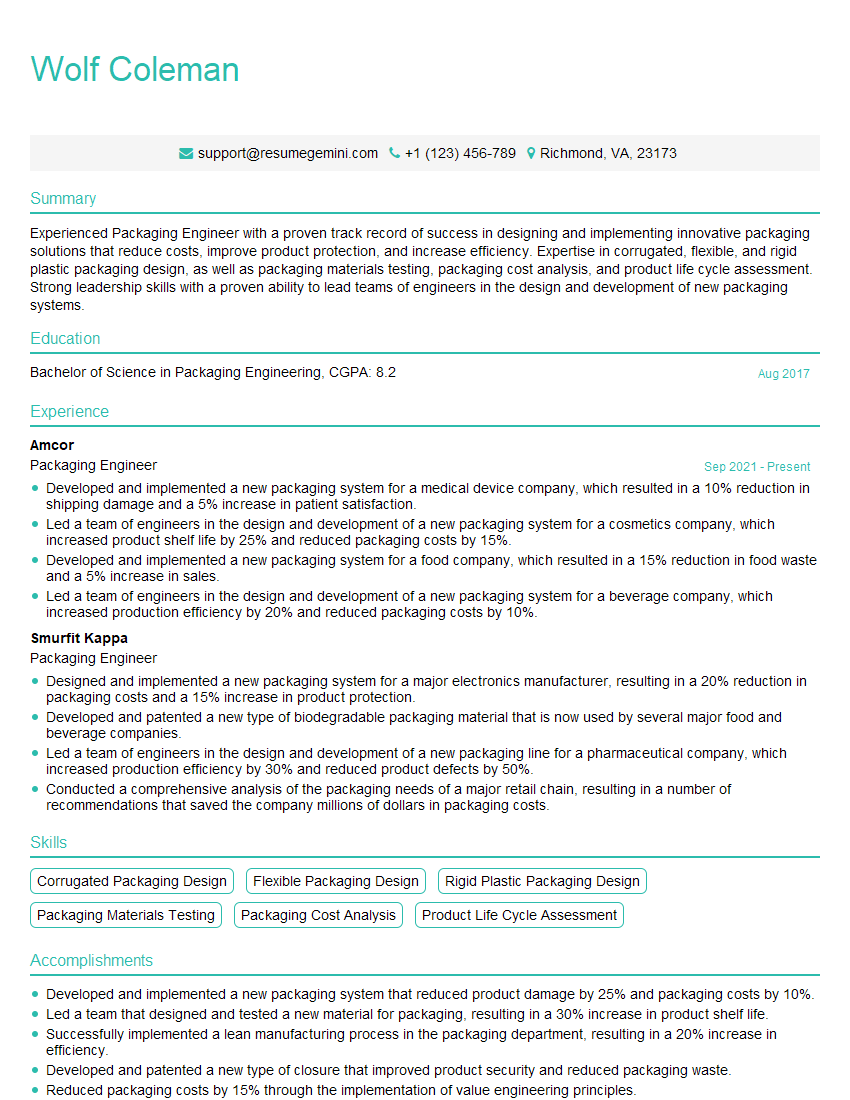
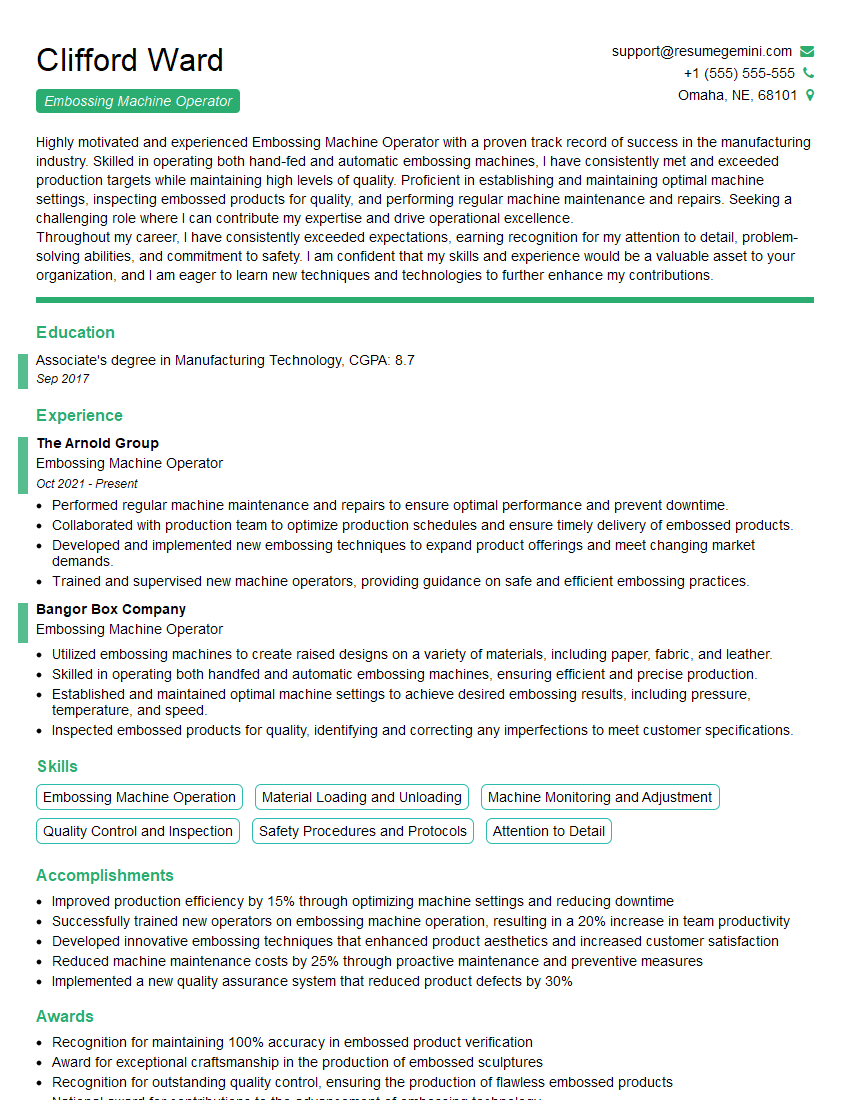
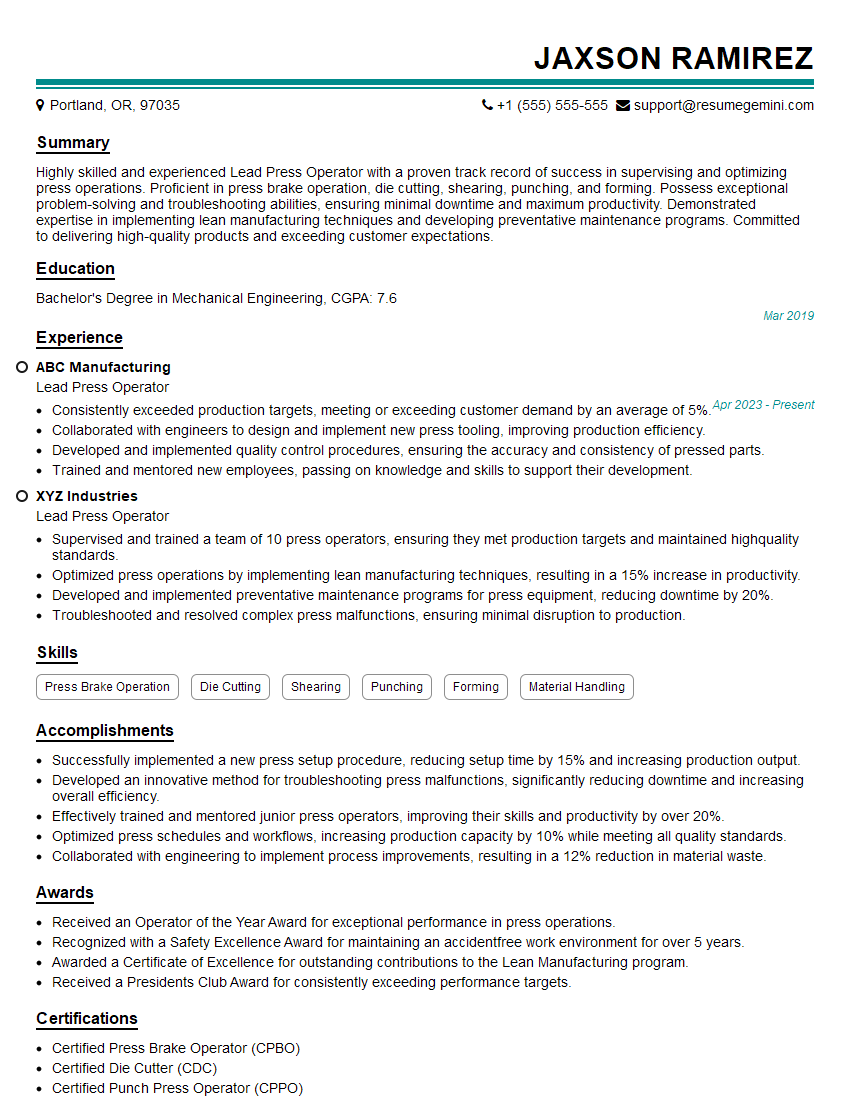
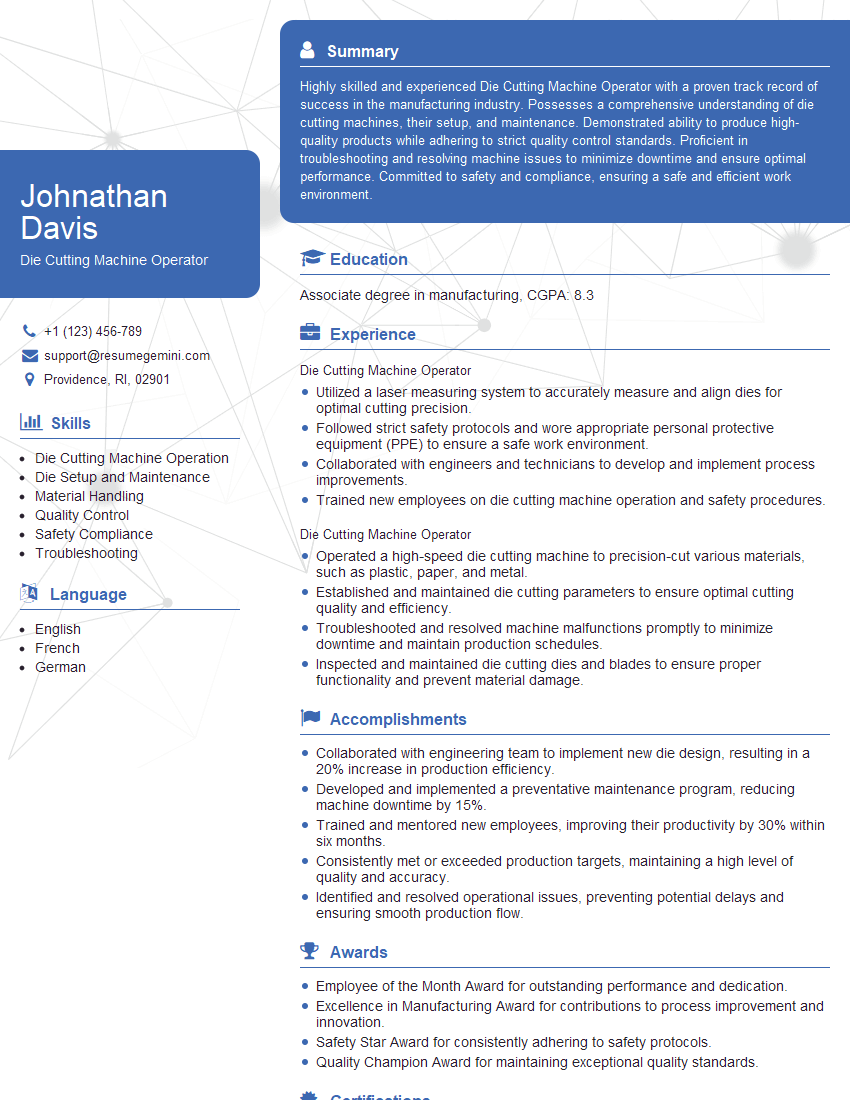
Mastering embossing and die cutting techniques opens doors to exciting career opportunities in packaging, printing, and various creative industries. To stand out, a strong, ATS-friendly resume is crucial. ResumeGemini is a trusted resource that can help you build a professional resume tailored to highlight your skills and experience. Examples of resumes specifically designed for Embossing and Die Cutting professionals are available to guide you through the process.

Explore more articles
Users Rating of Our Blogs
Share Your Experience
We value your feedback! Please rate our content and share your thoughts (optional).
What Readers Say About Our Blog
Very informative content, great job.
good