Interviews are opportunities to demonstrate your expertise, and this guide is here to help you shine. Explore the essential Embroidery Hoop and Needle Selection interview questions that employers frequently ask, paired with strategies for crafting responses that set you apart from the competition.
Questions Asked in Embroidery Hoop and Needle Selection Interview
Q 1. Explain the different types of embroidery hoops and their suitability for various fabrics.
Embroidery hoops come in various types, each best suited for different fabrics and project needs. The choice depends on the fabric’s weight, the design’s complexity, and your personal preference.
- Wooden Hoops: These are classic and widely available, offering good tension control. They’re suitable for most fabrics, from lightweight cotton to heavier linens. However, they can be less comfortable for prolonged use due to their hardness.
- Bamboo Hoops: Lighter than wood, these hoops provide a comfortable grip and are ideal for delicate fabrics because they exert less pressure. They are less durable than wood however and may break more easily.
- Plastic Hoops: These are inexpensive and lightweight, suitable for beginners or small projects. They may not provide the same level of tension control as wood or bamboo, making them less ideal for intricate designs on delicate or slippery fabrics.
- Q-Snap Frames: These are quick and easy to use, clamping onto the fabric without a screw. They are great for larger projects, but tension control can be trickier than with traditional hoops, and they’re not suitable for all fabrics.
For example, I’d use a wooden hoop for a detailed cross-stitch project on linen, a bamboo hoop for delicate silk embroidery, and a Q-Snap frame for a large quilting project.
Q 2. How do you select the appropriate needle size and type for different embroidery threads and fabrics?
Needle selection is crucial for successful embroidery. The right needle size and type prevent fabric damage and create clean stitches. Consider the thread and fabric weight when making your selection.
- Thread Weight: Finer threads (like 6-strand embroidery floss) require finer needles (size 7-10). Heavier threads (like perle cotton) require larger needles (size 3-5).
- Fabric Weight: Lightweight fabrics (like cotton lawn) need fine needles to avoid holes. Heavy fabrics (like canvas or denim) need larger needles to penetrate easily.
- Needle Type: Different needle types are designed for different threads and stitch types.
For example, when working with 6-strand embroidery floss on cotton Aida cloth, I’d use a size 8 sharps needle. But if I were embroidering with perle cotton on linen, I might opt for a size 5 crewel needle to handle the thicker thread and fabric.
Q 3. Describe the process of properly preparing an embroidery hoop for use.
Proper hoop preparation prevents fabric puckering and ensures a smooth stitching experience. The steps are as follows:
- Loosen the hoop: Unscrew the outer ring of the hoop slightly to create enough space to insert the fabric.
- Insert the fabric: Place the fabric over the inner ring and carefully push it into place, ensuring the fabric is taut but not stretched.
- Position the design: Center your design within the hoop.
- Tighten the hoop: Carefully tighten the outer ring until the fabric is smoothly taut across the entire surface. The fabric should be pulled slightly and evenly over the hoop; if there is significant puckering, try again.
- Test the tension: Gently tap the hoop; if the fabric is stretched or there is noticeable ripple, adjust the tension further.
Remember, the goal is even tension. Too tight can cause puckering, and too loose can lead to loose stitches and difficult work.
Q 4. What are the signs of a damaged or worn-out embroidery hoop?
Damaged or worn embroidery hoops can negatively impact your work. Look for these signs:
- Cracks or Splinters (Wood/Bamboo): These can snag the thread and damage the fabric. Replace immediately.
- Loose Joints: If the hoops don’t hold tension well anymore, they need replacing.
- Warped Rings: This prevents even tension and can distort the fabric.
- Broken Plastic (Plastic Hoops): These are generally less durable than wood and prone to breakage, indicating the need for a new hoop.
Using a damaged hoop can lead to frustrated stitches, fabric damage, and uneven tension. It’s essential to replace them promptly to ensure a quality project.
Q 5. How do you adjust hoop tension to prevent fabric puckering or stretching?
Proper hoop tension is vital to prevent fabric puckering or stretching. Achieving this requires practice and attention to detail.
- Start with even tension: Ensure the fabric is smoothly taut across the hoop, not stretched. Avoid too much pressure when tightening.
- Adjust as needed: Throughout the project, periodically check the tension. If puckering or stretching appears, loosen the hoop slightly and re-tighten, ensuring even distribution of tension.
- Work in sections: For large projects, only hoop the area you’re working on to minimize unnecessary strain on the fabric.
- Use a hooping aid: Tools like hooping pliers can assist in even tightening and reduce hand fatigue.
Think of it like tuning a musical instrument – you need the right tension for the best sound (or in this case, the best stitches).
Q 6. What are the consequences of using the wrong needle size for a given fabric?
Using the wrong needle size has significant consequences. Choosing a needle that is too small can result in broken needles, difficult stitching, and damage to the fabric through excessive pressure. A needle that’s too large will create unsightly holes and weaken the fabric.
- Broken Needles: Fine needles break easily when attempting to pierce thick fabrics or use heavy thread.
- Skipped Stitches: Too-small needles can lead to difficulty piercing the fabric, creating inconsistent stitching.
- Fabric Damage: Too-large needles can create large holes that compromise the integrity of the fabric.
- Uneven Stitches: Mismatched needle and thread sizes result in poor-quality embroidery with uneven tension.
Always consider the thread and fabric’s weight and choose a needle size accordingly, for a smooth and professional finish.
Q 7. Explain the differences between sharps, crewel, and tapestry needles.
Sharps, crewel, and tapestry needles are all embroidery needles, but they differ in their design and intended use.
- Sharps: These needles have a fine, sharp point and are ideal for embroidery threads like stranded cotton on even-weave fabrics such as Aida cloth and linen. They’re the most common type used for many embroidery techniques.
- Crewel Needles: These have a slightly longer eye and a blunt point. They are perfect for heavier threads such as crewel wool and are designed to protect heavier fabrics from damage while still enabling smooth stitching.
- Tapestry Needles: These have a blunt point and a large eye, suited for working with tapestry yarns and weaving. The blunt tip prevents snagging the warp threads in tapestry work.
Imagine them as specialized tools for specific jobs: sharps are your everyday driver, crewels handle the heavier-duty tasks, and tapestry needles are for specialized weaving projects.
Q 8. How do you determine the appropriate needle size for different thread weights?
Choosing the right needle size for your thread is crucial for achieving smooth, even stitches and preventing breakage. Think of it like choosing the right tool for the job – a tiny needle for fine thread, a larger one for thicker thread. Generally, finer threads (like 60 wt. or higher) require finer needles (size 70/10 or finer), while thicker threads (like 12 wt.) need larger needles (size 18 or larger).
Needle sizes are often expressed in two systems: European (e.g., 70/10) and American (e.g., 10). A lower number indicates a finer needle. For example, a size 70/10 needle is much finer than a size 18 needle. Consult a needle size chart to match thread weight to needle size – these charts are readily available online and in embroidery supply stores. Experimenting with different combinations is also helpful to find what works best for your specific thread and fabric.
- Example: Using a size 18 needle with a 60-weight thread will likely result in broken needles or difficulty in piercing the fabric.
- Example: Using a size 70/10 needle with a 12-weight thread will be difficult, resulting in a slow and strained stitching experience.
Q 9. What techniques do you use to prevent needle breakage during embroidery?
Needle breakage is a common frustration for embroiderers. Preventing it involves a multi-pronged approach focusing on thread management, needle selection, and technique.
- Choose the right needle: As discussed, matching needle size to thread weight is paramount. Using too fine a needle for thick thread or vice-versa increases stress and breakage.
- Avoid sharp bends: Never force a needle through the fabric. If it resists, try repositioning the needle or using a different approach. Sharp bends in the needle shaft can quickly lead to breakage.
- Maintain even tension: Consistent thread tension prevents unnecessary strain on the needle. Keep your thread tension even throughout your embroidery work, using tensioning devices like screw-down hoops or tension adjusting threaders.
- Use a good quality needle: High-quality embroidery needles are sharper and more durable, reducing the chance of bending or breaking.
- Inspect your needles regularly: Before starting a project, check your needle for any bends or burrs. Replace dull or damaged needles immediately.
Think of your needle as a delicate tool that needs to be treated with care. A little extra attention goes a long way in preventing frustrating needle breakage.
Q 10. How do you handle different types of fabric when using an embroidery hoop?
Embroidery hoops are essential for keeping your fabric taut, creating a smooth surface for stitching. However, different fabrics require different approaches.
- Loosely woven fabrics (linen, cotton lawn): These fabrics can stretch easily. You may need to use several layers of water soluble stabilizer to ensure that the fabric is securely held in the hoop without damage.
- Medium-weight fabrics (cotton, canvas): These usually work well in standard hoops. Ensure that you’re not pulling the fabric too tight, which could cause puckering or damage.
- Thick or stiff fabrics (denim, felt): These can be challenging. You might need to use a larger hoop to accommodate the fabric thickness or use a smaller hoop and work in sections.
- Delicate fabrics (silk, lace): These require extra care. Consider using a smaller hoop, placing a thin layer of water-soluble stabilizer under the fabric, and adjusting tension to prevent pulls or snags. Always handle these fabrics with care to prevent any damage.
Proper hooping is crucial to ensure smooth, even stitching. Experiment and find the right techniques for your fabric type.
Q 11. Describe how to properly thread a needle for embroidery.
Threading a needle efficiently is a fundamental skill. Here’s a step-by-step guide:
- Cut a length of thread, approximately 18-24 inches long.
- Lightly wet the end of the thread to help it pass through the needle’s eye more easily. This simple tip can make threading much easier.
- Use a needle threader (a small tool specifically designed to thread needles) to easily pass the thread through the eye of the needle.
- If you are not using a threader, carefully thread the needle yourself. Use your fingernails or a blunt instrument to help guide the thread.
- Once the thread is through the eye, gently pull the thread through until a tail forms at the needle’s eye.
- Tie a simple knot at the end of the thread, or use a knotting device for a more secure knot.
Practice makes perfect. With a little practice, threading a needle will become second nature.
Q 12. What are the benefits of using a high-quality embroidery hoop?
High-quality embroidery hoops offer several advantages over cheaper alternatives:
- Even Tension: They provide better and more consistent tension on the fabric, resulting in smoother stitching and preventing puckering or distortion. This even tension is really crucial for achieving professional-looking results.
- Durability: They are made from stronger materials (like high-quality wood or reinforced plastic) and are less likely to break or warp over time.
- Comfort: Some high-quality hoops feature ergonomic designs, making them more comfortable to hold and work with for extended periods. This reduces hand fatigue, especially during larger projects.
- Adjustability: Many high-quality hoops offer adjustable screw mechanisms, allowing for precise fabric tension control.
- Finish: They often have a smoother finish, preventing the fabric from snagging or catching.
Investing in a good quality hoop is an investment in the quality of your work and your comfort as an embroiderer. It’s a worthwhile expense that pays off in the long run.
Q 13. How do you maintain and care for your embroidery hoops and needles?
Proper maintenance ensures the longevity of your tools.
- Hoops: After each use, clean your embroidery hoops with a soft, damp cloth. Wipe away any lint, dust, or thread remnants. Avoid using harsh chemicals or abrasive cleaners. For wooden hoops, applying a small amount of wood oil occasionally can help to prevent cracking and maintain their appearance.
- Needles: Store your needles in a designated case or container to prevent damage or loss. Never leave needles loose in your work area, where they could be easily stepped on or become misplaced. Keep them dry.
Regular maintenance is a small investment for greatly extending the life of your embroidery tools.
Q 14. Describe your experience with various embroidery hoop materials (e.g., wood, plastic).
I have experience with both wood and plastic embroidery hoops and each has its pros and cons.
- Wooden hoops: These offer a classic look and feel. They tend to provide excellent tension and stability, particularly the heavier ones. However, they are usually more expensive and require more careful maintenance to avoid cracking or warping.
- Plastic hoops: These are generally more affordable and lightweight, making them easy to transport. However, they might not provide the same level of even tension as wooden hoops, and they can sometimes be less durable, particularly those made from thinner plastic. This can make them more prone to breaking.
The best material depends on your individual preferences and project needs. For example, I often use wooden hoops for fine embroidery work where consistent tension is crucial, while plastic hoops work well for quick projects or when traveling.
Q 15. How do you identify different types of needles based on their appearance?
Identifying different embroidery needles involves looking closely at several key features. The point is crucial – sharp points are for delicate fabrics, while blunt points are better for thicker materials like felt. The eye (where the thread goes) varies in size; larger eyes accommodate thicker threads, while smaller eyes are suitable for finer threads. The shaft (the body of the needle) indicates the needle’s length and material; longer shafts provide more control in dense stitching, and different materials (like steel or titanium) offer different strengths and durability. Finally, the size, typically indicated by a number, directly relates to the needle’s thickness. A smaller number means a finer needle. For example, a size 70 needle is much finer and more delicate than a size 18 needle.
- Sharp needles: Look for a very fine, pointed tip; these are excellent for detailed work on fine fabrics like linen or silk.
- Blunt needles: These have a rounded point, ideal for felt, leather, or other thick materials where a sharp point might damage the fabric.
- Milliner’s needles: These have a long, sharp point for precise work.
Career Expert Tips:
- Ace those interviews! Prepare effectively by reviewing the Top 50 Most Common Interview Questions on ResumeGemini.
- Navigate your job search with confidence! Explore a wide range of Career Tips on ResumeGemini. Learn about common challenges and recommendations to overcome them.
- Craft the perfect resume! Master the Art of Resume Writing with ResumeGemini’s guide. Showcase your unique qualifications and achievements effectively.
- Don’t miss out on holiday savings! Build your dream resume with ResumeGemini’s ATS optimized templates.
Q 16. What are the potential problems that can occur with incorrectly sized needles and hoops?
Using incorrectly sized needles and hoops can lead to several frustrating problems. An improperly sized needle can cause broken threads, difficulty piercing the fabric, or even fabric damage. Too small a needle in thick fabric will bend or break; too large a needle in delicate fabric will create unsightly holes.
Similarly, using a hoop that’s too tight or too loose can result in fabric distortion or slippage. A hoop that’s too tight pulls and wrinkles the fabric, affecting the evenness of your stitches and potentially damaging the material. A hoop that’s too loose allows the fabric to shift, leading to inconsistent tension and uneven stitching.
For instance, using a size 18 needle on delicate silk would cause large holes; conversely, using a size 70 needle on heavy canvas would lead to a bent or broken needle. A hoop too tight might cause puckering and distortion in the delicate lace you’re embroidering, whereas one too loose would leave the fabric to wrinkle and move during stitching, resulting in inconsistent tension.
Q 17. How do you address fabric slippage or distortion while embroidering?
Fabric slippage and distortion are common issues in embroidery, but easily addressed. The key is to maintain even tension on the fabric throughout the process. I address this in several ways:
- Proper Hooping: Ensuring the fabric is smoothly and evenly distributed within the hoop is crucial. Avoid pulling too tightly; the fabric should be taut but not stretched.
- Using a Hoop: Hoops provide consistent tension. I regularly check and adjust the tension in the hoop as I work to ensure the fabric remains taut and prevents distortion.
- Temporary Spray Adhesive: For particularly slippery fabrics, a light mist of temporary spray adhesive can provide added stability without leaving residue.
- Working in Sections: Instead of hooping a large section of fabric, I work in smaller, manageable areas and rehoop as needed to maintain even tension. This is particularly beneficial for large projects or complex designs.
- Pre-washing Fabric: Pre-washing helps fabrics to settle before embroidering, reducing the chance of shrinkage during or after the project.
Q 18. Explain your process for choosing needles for different embroidery stitches.
Needle selection for different embroidery stitches is critical for achieving the desired result. The stitch type directly influences the needle’s characteristics required.
- Fine Stitches (e.g., satin stitch, seed stitch): Require fine needles (sizes 70-80) to create clean, precise lines on fine fabrics.
- Medium Stitches (e.g., cross-stitch, back stitch): Need medium-sized needles (sizes 24-28) to handle moderate fabric thicknesses.
- Heavy Stitches (e.g., chain stitch, stem stitch): Can use slightly thicker needles (sizes 16-22), depending on the fabric and thread.
- Thick Threads (e.g., metallic, bulky yarn): Demand needles with larger eyes (sizes 16-18) to accommodate the increased diameter.
- Delicate Fabrics: Always use sharp needles with smaller sizes to minimize fabric damage.
- Heavy Fabrics: Utilize blunt-pointed needles of appropriate size to prevent breakage.
I always match the needle size and type to both the fabric and the thread to ensure a smooth and professional outcome.
Q 19. How do you handle a broken needle while working on a project?
A broken needle is never fun! The immediate response is always safety first. Remove the broken needle immediately, using tweezers if necessary. Be incredibly careful not to prick yourself on the sharp end. Once the needle is removed, inspect the fabric for any damage and remove any remaining pieces of the broken needle. If the broken piece is embedded deeply, it’s best to cut the surrounding fabric away, rather than risking further damage by trying to extract it.
After assessing the damage, I use a fresh needle of the same size and type to continue my project, seamlessly picking up where I left off. The key is careful attention to detail while reattaching threads and ensuring the stitches continue smoothly.
Q 20. What are the different types of embroidery thread and how do you select the appropriate needle for each?
Embroidery threads come in a wide variety of materials, each demanding a suitable needle. The most common thread types include:
- Cotton: A versatile option, available in various weights. Cotton threads work well with needles ranging from size 70-24.
- Silk: Known for its sheen and softness. It requires finer needles (70-80) to avoid breakage and to keep the stitches even.
- Rayon: Often used for its luster and color vibrancy. Similar to silk, it’s best suited to needles sizes 70-80.
- Metallic: Offers a unique shimmer and sparkle but requires special needles with a larger eye (size 16-18) to prevent the thread from snagging.
- Wool: Suitable for thicker threads, using needles ranging from 18 to 24.
In short, the rule of thumb is to always select a needle with an eye that is slightly larger than the thread for easy threading and to prevent damage to the thread and fabric.
Q 21. Describe your method for ensuring even tension in your embroidery.
Maintaining even tension is the hallmark of beautiful embroidery. My process includes several key steps:
- Consistent Thread Tension: I hold my thread lightly in my hands to prevent pulling and maintain consistent tension on the thread throughout the stitch.
- Avoid Jerking: Gentle, consistent movements are key. Avoiding quick or jerky actions keeps stitches even.
- Regular Checking: I periodically check the tension of the fabric in the hoop, readjusting as necessary. This ensures that the fabric remains taut but not overstretched.
- Correct Needle Size: Using the correct needle size, matched to the fabric and thread, reduces friction and helps maintain a steady tension.
- Practice: Like any skill, consistent practice develops a feel for the right tension, leading to smoother, more even stitches.
By paying close attention to these aspects, I ensure my embroidery projects have a polished and professional finish.
Q 22. What is your experience with different types of embroidery hoops (e.g., Q-snap, scroll hoops)?
My experience with embroidery hoops spans a wide range of types, each with its own advantages and disadvantages. I’ve extensively used Q-snap hoops, known for their ease of use and quick tension adjustment. The simple clamping mechanism makes them ideal for smaller projects and beginners. Scroll hoops, on the other hand, offer superior tension control, particularly for larger projects and delicate fabrics. Their adjustable screw allows for precise tension management. I’ve also worked with wooden hoops, which provide a more traditional feel but require more careful tension management to avoid fabric puckering. Finally, I’ve experimented with magnetic hoops, a newer option that simplifies the hooping process but sometimes lacks the robust tension control of others. The choice of hoop largely depends on the project’s scale, fabric type, and my personal preference for tension adjustment method.
Q 23. How do you choose a hoop size for a particular project?
Selecting the appropriate hoop size is crucial for successful embroidery. It’s not just about fitting the design; it’s about preventing undue stress on the fabric. For smaller designs, a smaller hoop (e.g., 4-inch or 5-inch) suffices. This ensures better control and prevents the fabric from shifting excessively. However, for larger designs, a bigger hoop (e.g., 8-inch or 10-inch) is necessary to accommodate the entire artwork. It’s always better to choose a hoop that is slightly larger than the design to allow for ample working space around the edges. One common mistake is selecting a hoop too small, which can lead to wrinkles and distorted stitching. I often leave at least an inch of fabric beyond the design’s edge when selecting my hoop size. Consider the hoop’s size in relation to the design’s complexity and the fabric’s characteristics for optimal results.
Q 24. Explain how the type of fabric affects the choice of embroidery hoop and needle.
The type of fabric significantly influences both hoop and needle selection. Linen, for example, a relatively sturdy fabric, can be easily handled with a standard wooden hoop and a medium-sized needle. However, delicate fabrics like silk or chiffon require a more gentle approach. I usually opt for a Q-snap hoop or a scroll hoop with very carefully adjusted tension to avoid pulling or distorting the fabric. Furthermore, finer needles are required for these fabrics to prevent holes and damage to the delicate threads. Conversely, a thicker fabric like canvas might need a larger needle and a more robust hoop to avoid undue pressure on the needle. Therefore, a well-informed choice of both hoop and needle is vital to preserve the fabric’s integrity and achieve a neat embroidery finish.
Q 25. Describe your experience working with delicate fabrics and how you adapt your hoop and needle selection.
Working with delicate fabrics demands extra care and precision. My approach involves using a scroll hoop for its superior tension control, allowing me to minimize pulling and stretching. I ensure the fabric is lightly and evenly taut in the hoop, avoiding excessive pressure that might distort the delicate weave. For instance, when working with silk, I may use a soft interfacing material between the fabric and the hoop to provide an extra layer of protection. Needle selection is equally important. I generally choose fine needles (size 7 or 8) with a sharp point to prevent snagging and holes. Sometimes, I’ll even use a specialized needle designed for silk. The process is slower and more meticulous, but it’s crucial for preserving the fabric’s beauty and creating a high-quality result. I always test my hoop and needle choice on a small scrap of the fabric before beginning the actual project.
Q 26. What troubleshooting methods do you use if you experience issues with fabric puckering or needle breakage?
Fabric puckering and needle breakage are common problems in embroidery. Puckering often results from uneven tension in the hoop. My troubleshooting involves loosening the hoop’s tension, ensuring the fabric is smooth and evenly distributed before tightening it again. Sometimes, using a hoop size that’s too small can also cause this issue; selecting a larger hoop usually resolves the problem. If the puckering persists, using a slightly larger needle may help reduce tension on the fabric. Needle breakage, on the other hand, is usually caused by using the wrong needle size for the fabric or attempting to stitch through too many layers. To prevent needle breakage, it is important to always use the appropriate needle size for the fabric and thread. If the needle is bending instead of breaking, it may indicate the need for a stronger or differently designed needle.
Q 27. How do you assess the quality of different brands of embroidery hoops and needles?
Assessing the quality of embroidery hoops and needles involves examining several factors. For hoops, I look for smooth, consistent wood (in wooden hoops), strong clamping mechanisms (in Q-snap hoops), and reliable screw adjustments (in scroll hoops). I avoid hoops with rough edges or loose joints that could snag the fabric. For needles, I examine the point sharpness, consistency of the shaft, and the overall smoothness. High-quality needles are typically made from high-carbon steel, are uniformly smooth, and have a consistent sharp point to smoothly glide through the fabric. I prefer to use needles from reputable brands with a history of producing high-quality embroidery tools. Checking customer reviews and comparing specifications can also be helpful in determining the overall quality and reliability of the product.
Q 28. Describe your experience with different embroidery hoop techniques and their impact on fabric handling.
My experience encompasses various hooping techniques, each affecting fabric handling differently. The traditional method involves stretching the fabric tightly, which can be suitable for robust fabrics but risks damaging delicate ones. I often employ a looser hooping technique for delicate fabrics, ensuring the fabric is taut enough to prevent shifting but not so tight as to cause puckering. I also experimented with the ‘no-hoop’ method, where I secure the fabric using clips or weights. This offers greater flexibility, particularly when working with curved surfaces or unusually shaped designs but needs more precision in fabric management. Each technique demands careful consideration of the fabric’s properties and project requirements. For example, using a large hoop to hoop a small piece of a delicate material may seem easier but can actually introduce undue strain and damage.
Key Topics to Learn for Embroidery Hoop and Needle Selection Interview
- Hoop Types and Their Applications: Understanding the differences between various hoop types (e.g., wood, plastic, metal) and their suitability for different fabrics and embroidery techniques. This includes discussing the pros and cons of each type in relation to fabric tension and project requirements.
- Fabric Tension and Hooping Techniques: Mastering the art of achieving even fabric tension within the hoop to prevent puckering and distortion. This includes practical application of different hooping methods and troubleshooting common tension issues.
- Needle Selection Based on Fabric and Thread: Knowing how to choose the appropriate needle size and type (e.g., sharp, tapestry, embroidery) based on the fabric weight and thread thickness. This involves understanding the impact of needle choice on stitch quality and project longevity.
- Impact of Hoop and Needle Choice on Stitch Quality: Analyzing the direct correlation between hoop type, fabric tension, and needle selection on the final stitch quality, including evenness of stitches, fabric damage, and overall aesthetic appeal.
- Troubleshooting Common Problems: Identifying and resolving issues such as fabric slippage, broken needles, uneven tension, and other challenges encountered during the embroidery process. This includes developing problem-solving strategies based on practical experience.
- Advanced Hooping Techniques (Optional): Exploring more advanced techniques such as using magnetic hoops, Q-snaps, or other specialized hooping methods for specific embroidery projects or fabrics.
Next Steps
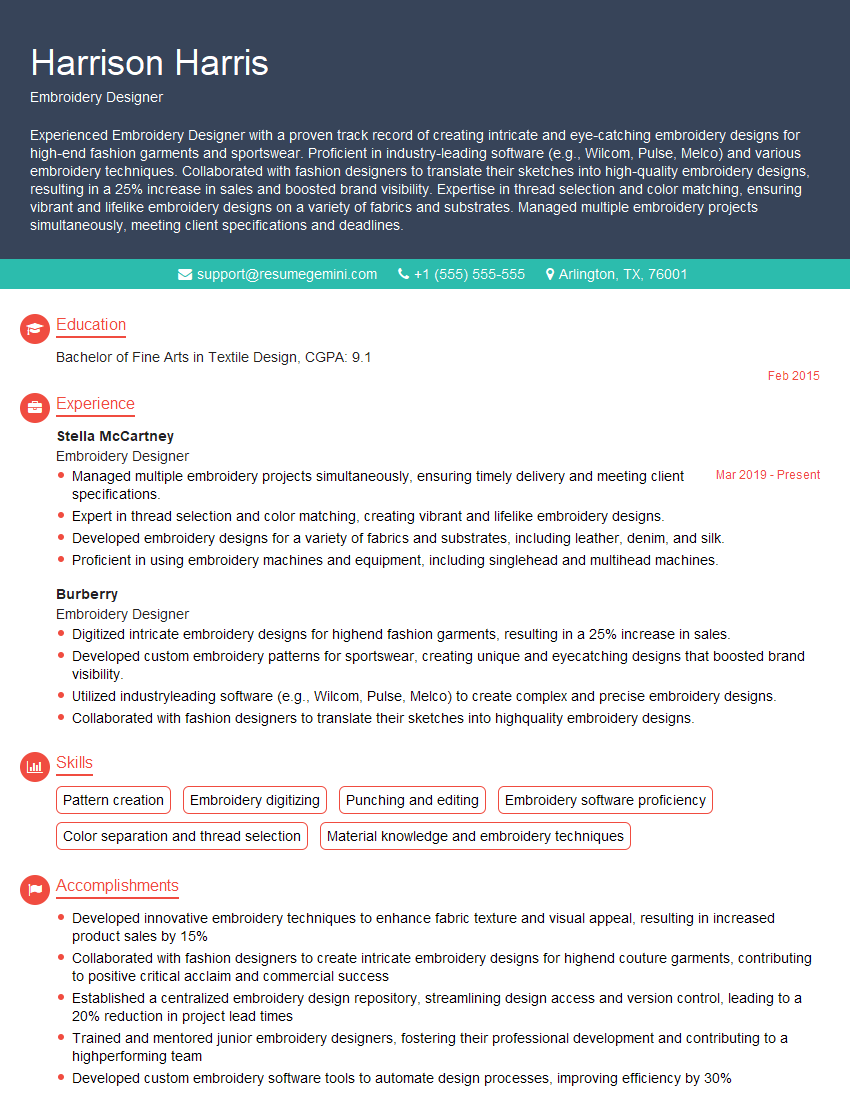
Mastering Embroidery Hoop and Needle Selection is crucial for success in this field, demonstrating a strong foundation in practical skills and attention to detail. This expertise translates to higher quality work, increased efficiency, and ultimately, greater career opportunities. To showcase your skills effectively, invest time in creating an ATS-friendly resume that highlights your proficiency. ResumeGemini is a trusted resource that can help you build a compelling resume tailored to your specific experience. Examples of resumes tailored to showcasing expertise in Embroidery Hoop and Needle Selection are available, allowing you to craft a professional document that makes a lasting impression on potential employers.
Explore more articles
Users Rating of Our Blogs
Share Your Experience
We value your feedback! Please rate our content and share your thoughts (optional).
What Readers Say About Our Blog
Very informative content, great job.
good