Unlock your full potential by mastering the most common Ensemble Performance Preparation interview questions. This blog offers a deep dive into the critical topics, ensuring you’re not only prepared to answer but to excel. With these insights, you’ll approach your interview with clarity and confidence.
Questions Asked in Ensemble Performance Preparation Interview
Q 1. Describe your experience in balancing individual and ensemble needs during rehearsals.
Balancing individual and ensemble needs is crucial for successful ensemble performance. It’s like conducting a delicate orchestra where each instrument, while unique, must blend harmoniously. My approach involves a three-pronged strategy:
Individual Skill Development: I dedicate time to address individual technical challenges. For example, if a violinist struggles with a particular passage, we’ll work on it separately, focusing on fingerings, bowing techniques, and intonation, before bringing it back to the full ensemble.
Ensemble Cohesion: I prioritize exercises and drills that build ensemble unity – things like intonation matching, rhythmic precision, and balance exercises, focusing on listening and responding to each other. We might use a simple phrase and have each section play it separately, then together, gradually building a unified sound.
Open Communication: Fostering a supportive and communicative environment is vital. I encourage open dialogue – performers are asked to voice their challenges and suggestions. This ensures everyone feels heard, contributing to a more collaborative and enjoyable rehearsal experience. For instance, we might have a dedicated session for feedback, allowing ensemble members to constructively critique their own parts and those of fellow musicians.
Q 2. How do you address performance anxiety within an ensemble?
Performance anxiety is a common challenge in ensembles. I address it using a multifaceted approach that blends technical preparation, mental strategies, and emotional support.
Thorough Preparation: The best antidote to anxiety is confidence, which stems from mastering the repertoire. We meticulously work through challenging passages until they become second nature, building self-assurance among the performers.
Positive Reinforcement: I create a supportive environment free of judgment, encouraging risk-taking and celebrating achievements, both large and small. This fosters a culture of trust and mutual support, reducing individual performance pressures.
Relaxation Techniques: We incorporate breathing exercises and mindfulness techniques into rehearsals to help manage pre-performance jitters. Simple practices like deep breathing and focusing on the present moment can significantly reduce anxiety.
Performance Simulations: We simulate performance conditions in rehearsal, such as playing with stage lighting or to a simulated audience (even just recording our playing), to help acclimate the musicians to the pressure of a live performance.
Q 3. What strategies do you employ for effective score study and preparation?
Effective score study is the cornerstone of a successful performance. My approach involves:
Individual Analysis: Each musician thoroughly analyzes their individual part, identifying rhythmic complexities, melodic contours, and harmonic relationships. This independent study forms a crucial foundation.
Section Rehearsals: Sectionals allow focused attention on individual instrument groups, resolving technical and interpretative issues within the sections before integrating them into the full ensemble.
Full Ensemble Rehearsals: In full ensemble rehearsals, we build upon the individual and sectional work, weaving the parts together and identifying ensemble balance, blend and overall stylistic coherence.
Contextual Understanding: We explore the historical and stylistic context of the music, which helps musicians understand the composer’s intent and approach interpretation with informed decisions.
Dynamic Range and Phrasing: Careful attention is given to dynamic contrasts, phrasing, articulation, and overall expression, aiming for a unified artistic statement.
Q 4. Explain your approach to selecting repertoire for an ensemble.
Selecting repertoire is a critical decision that shapes the ensemble’s artistic identity and trajectory. My approach involves:
Ensemble Skill Level: The chosen repertoire must align with the technical capabilities and musical maturity of the ensemble members. Choosing music that’s too challenging can lead to frustration and discouragement, while overly simplistic pieces can stifle growth.
Musical Variety: I strive for a balanced program that includes a diverse range of styles, periods, and composers, exposing musicians to different musical idioms and enriching their experience.
Audience Engagement: I consider the intended audience and select pieces that will resonate with them while also challenging their perceptions. The goal is to deliver a program that is both stimulating and enjoyable.
Ensemble Goals: The repertoire should also support the ensemble’s short-term and long-term goals, whether it’s mastering a particular technique, performing a specific type of music, or building a specific reputation.
Q 5. How do you manage time effectively during the rehearsal process?
Effective time management in rehearsals is crucial. I utilize a structured approach:
Detailed Rehearsal Plan: Before each rehearsal, I create a detailed plan outlining specific goals and objectives for each segment, allocating time effectively to achieve these goals.
Prioritization: I prioritize the most challenging or crucial passages, dedicating more time to those areas that require the most attention.
Clear Objectives: I clearly communicate the rehearsal goals to the ensemble members, ensuring everyone is focused and working towards a common objective.
Flexibility: While a plan is essential, I’m flexible enough to adjust the schedule based on the ensemble’s progress and needs during the rehearsal. Sometimes unexpected challenges arise requiring more time than anticipated.
Breaks: I incorporate regular breaks to avoid fatigue and maintain focus, ensuring the rehearsal remains productive and engaging.
Q 6. Describe your method for providing constructive feedback to ensemble members.
Providing constructive feedback is essential for growth. My approach emphasizes positivity and specificity:
Focus on Specifics: Rather than general criticism, I point out specific aspects that need improvement, such as intonation in a particular phrase or rhythmic accuracy in a certain passage.
Positive Framing: I always begin with positive feedback, highlighting aspects of the performance that are already working well, before moving on to areas needing improvement. This creates a receptive atmosphere.
Solution-Oriented Feedback: I don’t just point out problems; I offer suggestions and solutions to help musicians address their challenges. This could involve demonstrating a technique or suggesting alternative approaches.
Individual and Private Feedback: While some feedback is useful for the whole ensemble, I often provide individual or small-group feedback for more personal and detailed guidance.
Open Dialogue: I encourage questions and dialogue, creating a collaborative environment where musicians feel comfortable asking for clarification or expressing concerns.
Q 7. How do you adapt your rehearsal techniques to different musical styles and ensemble sizes?
Adapting to different musical styles and ensemble sizes requires flexibility and a deep understanding of musical nuances. My approach centers on:
Style-Specific Techniques: My rehearsal techniques vary based on the music. For example, a Baroque ensemble might require a focus on historical performance practices, articulation, and ornamentation, whereas a contemporary ensemble might demand a different approach to improvisation and rhythmic complexity.
Ensemble Size Considerations: Rehearsals with larger ensembles necessitate a different organizational approach than those with smaller groups. Larger groups often require more sectionals and careful management of balance and blend.
Individualized Attention: Despite ensemble size, I ensure each musician receives adequate individual attention through sectionals, small-group coaching, and tailored feedback.
Technology Integration: I effectively utilize technology to enhance rehearsals. Software like Sibelius can aid in score analysis and notation, while recording equipment enables objective listening and analysis of rehearsals.
Q 8. How do you handle disagreements among ensemble members?
Disagreements are inevitable in any collaborative art form. My approach focuses on respectful dialogue and finding common ground. I begin by creating a safe space where everyone feels comfortable expressing their opinions. This involves establishing clear communication protocols from the outset, emphasizing active listening, and fostering a culture of mutual respect.
If a disagreement arises, I facilitate a structured discussion. I might ask each member to explain their perspective, focusing on the underlying musical rationale. Then, I guide them towards finding a compromise that honors the artistic vision while respecting individual contributions. Sometimes, a compromise involves experimenting with different approaches, trying both options and then collectively deciding what works best. I believe in collaborative problem-solving; the final decision should be a collective one, owned by the entire ensemble.
For example, in a string quartet, if two players disagree on the phrasing of a particular passage, instead of imposing my own preference, I’d guide them through exploring different interpretations, listening critically to each approach’s effect on the overall musical narrative. Ultimately, their collaboration yields a nuanced, insightful performance.
Q 9. What are your preferred methods for assessing ensemble progress?
Assessing ensemble progress is an ongoing process, relying on both subjective and objective methods. Subjectively, I listen critically to rehearsals, focusing on balance, intonation, phrasing, dynamics, and overall musicality. I pay attention to the ensemble’s energy and emotional connection to the music. Are they engaged? Do they communicate effectively with each other musically?
Objectively, I might use recordings to track progress. Comparing early recordings to later ones allows for a clear assessment of improvement in areas like rhythmic precision, intonation, and dynamic control. I also might employ specific exercises to target weakness, for example, focusing on scales and arpeggios to address intonation issues. Finally, I regularly provide constructive feedback to each musician and the group as a whole, focusing on both strengths and areas needing improvement.
Think of it like training for a marathon. You can’t just run the race; you need regular check-ins to monitor your progress, adjust your training based on your performance, and ensure you’re on the right track. This iterative process is crucial in ensemble preparation.
Q 10. How do you incorporate technology into your ensemble preparation?
Technology plays a significant role in modern ensemble preparation. We utilize recording software to capture rehearsals and performances for later analysis, helping identify areas for improvement. Software like Sibelius or Dorico helps create customized practice materials, including specific exercises to address particular challenges. For example, we might isolate a particularly difficult passage and loop it to practice at slower speeds.
Online platforms facilitate communication and collaboration, even when geographically dispersed. Sharing scores and recordings via cloud storage simplifies sharing and revision. Furthermore, audio and video conferencing allows for remote rehearsals or consultations. This is particularly useful for working with musicians who are not able to attend in-person rehearsals regularly. For example, I’ve used Zoom to provide individual coaching to players in different locations, significantly improving the efficiency of the preparation process.
Q 11. Describe your experience working with diverse musical backgrounds.
My experience working with diverse musical backgrounds has been incredibly enriching. I’ve found that different musical traditions offer unique perspectives and techniques that enhance the ensemble’s overall performance. The key is to recognize and respect these differences while fostering a shared musical language.
For example, working with musicians from diverse backgrounds requires open communication and a willingness to understand different learning styles and cultural perspectives. I create an inclusive environment where everyone feels comfortable sharing their experiences and expertise. Sometimes, this involves tailoring my teaching methods to individual needs, adapting my communication style to ensure understanding, and appreciating the richness each person’s background brings to the ensemble.
I’ve had the privilege of working with ensembles that combined Western classical traditions with elements of jazz, world music, and even folk music. The resulting collaborations have been incredibly innovative and produced uniquely powerful performances.
Q 12. Explain your approach to solving intonation problems within an ensemble.
Intonation problems are common in ensembles. My approach involves a multi-faceted strategy. Firstly, I ensure each musician has a solid individual foundation in intonation, using ear training exercises and technical studies. Secondly, we work on ensemble tuning exercises focusing on intervals and chords. A tuning app can be helpful in this process.
If a specific intonation problem persists within a passage, I break down the problematic section into smaller segments, focusing on each interval individually. This allows us to identify the source of the issue (e.g., a specific player, a harmonic relationship) and work on it systematically. Sometimes, it’s a matter of adjusting the voicing of a chord or re-evaluating the fingering of a specific passage. We listen carefully, identifying the precise pitch discrepancies and adjusting accordingly.
A good analogy is building a house; each individual element (brick, beam, etc.) needs to be perfectly aligned for the structure to be strong and stable. Similarly, each note and each interval need to be carefully tuned to maintain the integrity and beauty of the overall musical structure.
Q 13. How do you address rhythmic discrepancies in a performance?
Addressing rhythmic discrepancies requires precision and patience. I start by identifying the source of the problem: Is it a consistent issue affecting the whole ensemble, or are specific players consistently off-beat? Once identified, we use rhythmic training exercises such as rhythmic dictation, clapping patterns, and counting together to enhance overall rhythmic awareness.
Next, we might employ a metronome, initially at a slower tempo to emphasize rhythmic accuracy, gradually increasing the speed as rhythmic precision improves. Recording the performance and then carefully analyzing it helps to pinpoint the exact location and type of rhythmic issues. We might also utilize conducting patterns that clearly articulate rhythmic subdivisions.
Often, rhythmic discrepancies stem from lack of familiarity with the score or a misinterpretation of the musical notation. Careful study and detailed explanations can help resolve these issues. It’s a process of refinement that requires attentive listening from both the conductor and the ensemble members.
Q 14. How do you foster a positive and collaborative rehearsal environment?
Fostering a positive and collaborative rehearsal environment is crucial for success. I prioritize creating a safe space where musicians feel comfortable taking risks, experimenting, and offering constructive feedback. This involves clear communication, respect for individual perspectives, and celebrating both individual and collective achievements.
I start by setting clear expectations at the beginning of the rehearsal process. We discuss the goals of the rehearsal and agree on a code of conduct emphasizing mutual respect and open communication. I encourage a conversational atmosphere, where questions and suggestions are welcomed and valued. We regularly check in on the emotional well-being of the ensemble, ensuring that everyone feels supported and appreciated.
Positive reinforcement is key. I acknowledge and praise good performances and efforts, focusing on individual strengths and progress. I offer constructive criticism in a supportive and encouraging manner, always maintaining a balance between highlighting strengths and areas that need improvement. Creating a positive environment encourages creativity and collaboration leading to a richer performance experience.
Q 15. What are your strategies for motivating ensemble members?
Motivating ensemble members requires a multifaceted approach focusing on building a positive and collaborative environment. It’s about fostering a sense of shared purpose and individual value.
Shared Goals and Vision: I start by clearly articulating the ensemble’s artistic goals and how each member’s contribution is essential to achieving them. This could involve creating a shared vision statement or discussing the overall artistic interpretation of the piece.
Positive Reinforcement and Feedback: Frequent, constructive feedback is crucial. I focus on praising efforts and improvements, rather than solely criticizing errors. This builds confidence and encourages continued progress. I often use specific examples like, “I loved the energy you brought to that passage, Sarah!” or “The intonation in the second phrase has improved significantly, Mark!”
Individual Attention: Recognizing that every musician has different needs and learning styles, I make sure to provide individual attention and support. This might involve tailored exercises or one-on-one coaching sessions to address specific challenges.
Team Building Activities: Creating a strong team dynamic goes beyond musical rehearsals. I incorporate team-building activities, like informal social gatherings or collaborative problem-solving exercises, to foster camaraderie and trust.
Celebrating Successes: Acknowledging and celebrating accomplishments, both big and small, boosts morale and creates a positive feedback loop. This could involve informal celebrations after a successful rehearsal or a more formal acknowledgment of achievements at a concert.
Career Expert Tips:
- Ace those interviews! Prepare effectively by reviewing the Top 50 Most Common Interview Questions on ResumeGemini.
- Navigate your job search with confidence! Explore a wide range of Career Tips on ResumeGemini. Learn about common challenges and recommendations to overcome them.
- Craft the perfect resume! Master the Art of Resume Writing with ResumeGemini’s guide. Showcase your unique qualifications and achievements effectively.
- Don’t miss out on holiday savings! Build your dream resume with ResumeGemini’s ATS optimized templates.
Q 16. How do you identify and address individual technical challenges within the ensemble?
Identifying and addressing individual technical challenges requires attentive listening and a systematic approach. It’s not just about fixing mistakes, but understanding their root cause.
Careful Listening and Observation: During rehearsals, I pay close attention to each musician’s performance, noting any recurring technical issues, such as intonation problems, rhythmic inaccuracies, or phrasing inconsistencies.
Individual Consultations: I conduct individual consultations to discuss specific technical challenges in a supportive environment. I use a combination of verbal feedback and visual aids like sheet music notation to illustrate the issue and explain the solution.
Targeted Exercises: I design and assign targeted exercises designed to address specific technical weaknesses. This could involve scales, arpeggios, or etudes tailored to the individual’s needs.
Recording and Analysis: Using audio or video recordings allows for objective analysis of the performance, enabling both the musician and myself to identify areas for improvement that might not be immediately apparent during live rehearsal.
Collaboration and Resource Sharing: I encourage collaboration among ensemble members, allowing them to learn from each other’s strengths and experience. If a particular technical problem is widespread, I might invite a specialist, like a vocal coach or instrument specialist, to assist with addressing it.
Q 17. What are your methods for preparing an ensemble for a performance under pressure?
Preparing an ensemble for performance under pressure involves building resilience and confidence through a combination of technical preparation and mental strategies.
Simulate Performance Conditions: I regularly incorporate simulated performance conditions into rehearsals, such as performing in front of an audience, using stage lighting, and managing potential distractions.
Mindfulness and Relaxation Techniques: I introduce mindfulness exercises and breathing techniques to help musicians manage anxiety and build mental resilience. This could include guided meditation or simple breathing exercises before performances.
Positive Self-Talk and Visualization: I encourage positive self-talk and visualization techniques to help musicians focus on their strengths and build confidence. I guide them to visualize successful performances, focusing on positive outcomes and overcoming potential challenges.
Emergency Plans: We develop contingency plans for potential issues like equipment malfunctions or unexpected disruptions. This includes having backup instruments or equipment and establishing clear communication protocols.
Performance Run-throughs: Conducting full run-throughs under simulated performance conditions allows the musicians to experience the piece in its entirety and build stamina and confidence.
Q 18. Describe your experience with sight-reading preparation for an ensemble.
Sight-reading preparation for an ensemble requires a structured approach focused on efficiency and clarity. The key is to balance thoroughness with time constraints.
Individual Preparation: I encourage individual practice of the sight-reading materials beforehand. This includes familiarizing themselves with the key, time signature, and overall style of the music.
Focused Rehearsal: During ensemble rehearsal, I focus on sectional work, starting with smaller sections before putting the entire piece together. This minimizes errors and allows for efficient correction.
Clear Communication: I provide clear instructions and explanations of the musical notation, phrasing, dynamics, and articulation. I emphasize the importance of listening carefully to each other and following the conductor’s cues.
Gradual Increase in Complexity: I progress gradually, starting with simpler pieces before moving to more challenging works. This approach enhances confidence and allows for incremental improvement.
Collaborative Problem-Solving: I foster a collaborative environment where musicians help each other understand the score and overcome challenges collectively. I highlight the success of collaborative problem solving.
Q 19. How do you plan for and manage unexpected challenges during a performance?
Managing unexpected challenges during a performance demands preparedness, adaptability, and calm leadership. It’s about having a plan B, and the ability to execute it under pressure.
Contingency Planning: We anticipate potential problems (instrument malfunctions, forgotten music) and create contingency plans. This might involve having backup instruments or a digital copy of the music.
Clear Communication: Establishing clear communication protocols within the ensemble is crucial. This ensures that musicians can react quickly and effectively to unexpected situations.
Problem-Solving Skills: I emphasize the importance of problem-solving skills among ensemble members. This involves teaching them how to assess the situation, identify solutions, and act decisively.
Flexibility and Adaptability: I encourage flexibility and adaptability by practicing improvisation exercises and adapting to minor variations in the music.
Maintaining Composure: My role as a conductor is also to remain calm and composed under pressure, providing a reassuring presence for the ensemble. This often involves using nonverbal cues to guide the ensemble through unexpected challenges.
Q 20. Explain your understanding of balance and blend within an ensemble context.
Balance and blend are fundamental to a cohesive ensemble sound. Balance refers to the relative loudness of different instrumental parts or vocal sections, while blend refers to the homogeneity of the overall tone.
Dynamic Range Control: Achieving balance involves carefully managing the dynamic range of each instrument or voice, ensuring that no single part overpowers the others. This requires frequent adjustments to volume levels.
Timbral Adjustments: Blending requires careful attention to tone quality. I guide musicians in adjusting their tone color to create a unified and homogenous sound. This often involves subtle adjustments in tone production or articulation.
Sectional Balancing: I frequently use sectional rehearsals to work on balance and blend within individual sections of the ensemble. This allows for focused attention on achieving tonal cohesion within each section.
Listening Skills: The cornerstone of both balance and blend is active listening. I emphasize the importance of musicians listening critically to each other to ensure a cohesive and unified sound.
Spatial Considerations: In live performances, the spatial arrangement of musicians can influence balance. Thoughtful placement can optimize the blend and balance of the sound.
Q 21. How do you utilize sectional rehearsals to improve ensemble performance?
Sectional rehearsals are invaluable for addressing specific challenges and refining individual parts before the full ensemble rehearsal. They allow for targeted improvement and focused attention.
Addressing Technical Challenges: Sectional rehearsals provide a focused environment to address technical issues within individual sections. This allows for individual attention to intonation, rhythm, articulation, and other technical aspects.
Developing Balance and Blend: Sectional rehearsals are crucial for achieving balance and blend within each section, before integrating it into the full ensemble. This helps ensure the overall tonal quality.
Building Confidence: Working in smaller groups often builds individual confidence before performing within a larger ensemble. It offers opportunities for musicians to be heard and receive individual feedback.
Time Efficiency: By focusing on specific sections, sectional rehearsals enhance time efficiency during full ensemble rehearsals, allowing the conductor to focus on larger ensemble dynamics and integration.
Problem Solving Within Sections: Sectional rehearsals promote collaborative problem-solving within the sections, empowering musicians to take ownership of their parts and actively participate in the refinement process.
Q 22. What are your techniques for building musical phrasing and dynamics within an ensemble?
Building musical phrasing and dynamics in an ensemble is a collaborative process that requires careful attention to detail and a deep understanding of musical expression. It’s not just about playing the notes correctly, but about breathing life into the music.
My technique begins with individual coaching. I work with each section, focusing on shaping phrases organically. Think of a phrase like a sentence – it needs to have a beginning, a middle, and a satisfying end. We explore the subtle nuances of articulation, legato vs. staccato, and the relationship between dynamics and rhythm to create a unified and expressive sound.
Then, I work with the full ensemble, focusing on balance and blend. We build dynamic contrasts gradually, starting with small gradations and slowly expanding the range. I might use imagery, like visualizing a sunrise, to guide the gradual crescendo. A common issue is ensemble players being afraid to really shape their lines due to fears of disrupting the balance. I address this by creating a culture of trust and encouraging risk-taking within a supportive framework. I might also use recording sessions and playback to help the ensemble hear themselves objectively and identify areas for improvement in balance and dynamic nuance.
For example, in a piece with a quiet passage followed by a powerful climax, we’d carefully craft the transition, ensuring a smooth, gradual build-up of tension, not a sudden jump. We might experiment with different articulation and rhythmic nuances in the quieter section to build anticipation. Regular sectional rehearsals are crucial for achieving this.
Q 23. Describe your approach to working with composers or arrangers.
My approach to working with composers or arrangers is one of open communication and mutual respect. I believe that a successful collaboration requires a clear understanding of the composer’s vision and the ensemble’s capabilities. I start by thoroughly studying the score, identifying potential challenges and opportunities for interpretation.
I then engage the composer in a dialogue, seeking clarification on specific passages or intentions. It is crucial to discuss the balance between the composer’s intentions and the ensemble’s interpretive abilities. I might suggest minor adjustments to the score to improve playability or enhance the musical impact, always ensuring that the essence of the work remains intact. It is not uncommon to encounter technical issues that may require a bit of negotiation, especially if the score is pushing the boundaries of the ensemble’s technical capabilities. In such a case, I will present the issues honestly and propose creative solutions that maintain the essence of the composer’s work.
For example, I once worked with a composer whose score required some technically demanding passages for the string section. After carefully analyzing the passage, I suggested a slight simplification of some rhythmic figures that would ease the technical strain but would not compromise the composer’s intended effect.
Q 24. How do you ensure the artistic integrity of the performance is maintained throughout the rehearsal process?
Maintaining artistic integrity throughout the rehearsal process requires a multifaceted approach. Firstly, I establish a clear understanding of the composer’s intentions and the stylistic context of the piece. I encourage the ensemble to delve deep into the historical and cultural background of the music to understand its significance and meaning.
I foster a collaborative environment where musicians are encouraged to express their insights and interpretations, always grounded in the foundational text. This means establishing clear communication channels, allowing for respectful debate, and encouraging a spirit of open inquiry. Individual sections get their time to explore their part’s interpretation. Then, we bring this together. Through the process, I strive to prevent creative interpretations from becoming idiosyncratic and instead strive for artistic consistency. I avoid imposing my personal interpretations, but rather guide the ensemble toward a shared understanding.
Regular performance evaluations where we listen back to the recordings are critical. These allow for objective reflection on progress and identification of any deviations from the artistic vision. If a deviation has occurred, we investigate how to bring the musical integrity back to center. Documenting musical interpretations from the start is also helpful for consistency.
Q 25. Explain your familiarity with various rehearsal methodologies.
My familiarity with rehearsal methodologies is extensive, drawing from various approaches to suit different ensembles and repertoire. I adapt my technique based on the individual needs of the group and the specific challenges of the piece. My toolbox includes elements from several methodologies:
- Traditional Rehearsal Techniques: This involves structured rehearsals with a clear agenda, focused on individual sections, then gradually building to full ensemble playing.
- Kodály Method: This emphasizes aural skills and the development of musicianship through singing and movement.
- Dalcroze Eurythmics: This uses movement and improvisation to improve rhythm, coordination, and musicality.
- Suzuki Method: While primarily known for instrumental instruction, the emphasis on rote learning and repetition has useful applications for ensemble work, particularly with less experienced players.
- Collaborative Rehearsal: This prioritizes open communication and shared decision-making among the ensemble members, fostering ownership of the performance.
I often integrate elements of these approaches, tailoring them to the specific needs of the ensemble and the repertoire. For example, I might use Kodály techniques for vocal warm-ups, then move to traditional sectional work, before employing collaborative rehearsal to refine the final interpretation.
Q 26. How do you assess the technical proficiency of an ensemble?
Assessing the technical proficiency of an ensemble involves a multi-stage process. It’s not just about individual skill, but also about how well those skills integrate into a cohesive whole. I begin with aural assessments, focusing on intonation, rhythm, and balance.
I then observe the ensemble playing selected excerpts from the planned repertoire. I pay attention to individual technique, noting areas of strength and weakness. But importantly, I assess ensemble unity, evaluating things like the precision of entrances, the quality of the blend, and the overall clarity of the texture. I’ll also consider individual players’ responsiveness to cues, dynamics, and phrasing. I look for patterns in technical issues, as it might point to underlying problems within the ensemble or individual player’s capabilities. For example, recurring rhythmic issues might indicate a need for more rhythmic training exercises. Finally, I supplement this with written assessments, utilizing formal or informal tests and evaluations, and providing written feedback which will improve performance and identify players in need of additional technical practice.
This allows for a more well-rounded assessment of the ensemble’s capabilities and allows for targeted interventions to address any identified weaknesses.
Q 27. Describe your experience in conducting auditions for ensemble members.
Conducting auditions for ensemble members requires a fair and efficient process that ensures the selection of the most suitable candidates. I begin by creating a clear audition rubric, outlining the criteria for assessment. This includes technical skills, musicality, sight-reading ability, and the ability to blend with other musicians. The rubric should explicitly list each criteria with defined scoring metrics.
I design the audition materials carefully, choosing excerpts that effectively assess the required skills. I might include a variety of musical styles and tempos to evaluate versatility. The process must be consistent across all candidates to ensure fairness and prevent bias. I always provide feedback to each candidate, both those selected and those not, ensuring that every candidate leaves with a learning experience.
For example, I may have candidates sight-read a short excerpt to evaluate their quick-thinking and adaptability. Or, I may use pre-selected pieces that evaluate particular scales or rhythmic proficiency within the genre we are looking to showcase. Video recording the auditions is helpful for later review to ensure consistency.
Q 28. How do you create a program that is both musically stimulating and accessible to the audience?
Creating a program that is both musically stimulating and accessible to the audience requires careful consideration of the repertoire and the target audience. It’s about finding a balance between challenging the listeners and providing them with an enjoyable experience.
I begin by identifying a central theme or idea for the program. This might be a specific composer, a particular historical period, or a unifying emotional arc. The selection of pieces should logically flow, considering factors like dynamics, tempo, and mood. I’ll aim for variety in style and texture, to avoid listener fatigue. The program notes should provide the audience with context and insight into the selected pieces. Including a brief history of the composers or the stylistic era enhances the listener’s enjoyment.
For example, a program might explore the evolution of the string quartet through pieces from Haydn, Beethoven, and Shostakovich. Careful sequencing is important; a program might start with a lighter, more accessible work to draw the audience in, then progress to more challenging or emotionally intense pieces, concluding with a celebratory or reflective work. Pre-concert talks or Q&A sessions are also effective ways to engage the audience and enhance their understanding of the music.
Key Topics to Learn for Ensemble Performance Preparation Interview
- Understanding Collaborative Dynamics: Explore the nuances of group dynamics, communication styles, and conflict resolution within an ensemble setting. Consider how different personalities and skillsets contribute to a unified performance.
- Technical Proficiency & Synchronization: Demonstrate a thorough understanding of the technical aspects of your chosen performance art. This includes mastering individual skills and coordinating them seamlessly with others. Be prepared to discuss techniques for achieving precise timing and unified execution.
- Adaptability and Problem-Solving: Discuss instances where you had to adapt to unexpected challenges during rehearsals or performances. Highlight your problem-solving skills in navigating technical difficulties, creative disagreements, or schedule conflicts within the ensemble.
- Rehearsal Techniques and Processes: Illustrate your knowledge of effective rehearsal strategies, including efficient time management, constructive feedback mechanisms, and methods for refining ensemble performance.
- Creative Collaboration and Interpretation: Explain your approach to collaboratively interpreting a piece, considering different artistic perspectives and finding common ground to create a cohesive and compelling performance. Discuss your role in shaping the artistic vision of the ensemble.
- Leadership and Followership: Showcase your understanding of both leadership roles and the importance of effective followership within a collaborative environment. Discuss situations where you demonstrated leadership or effectively followed direction to achieve a shared goal.
Next Steps
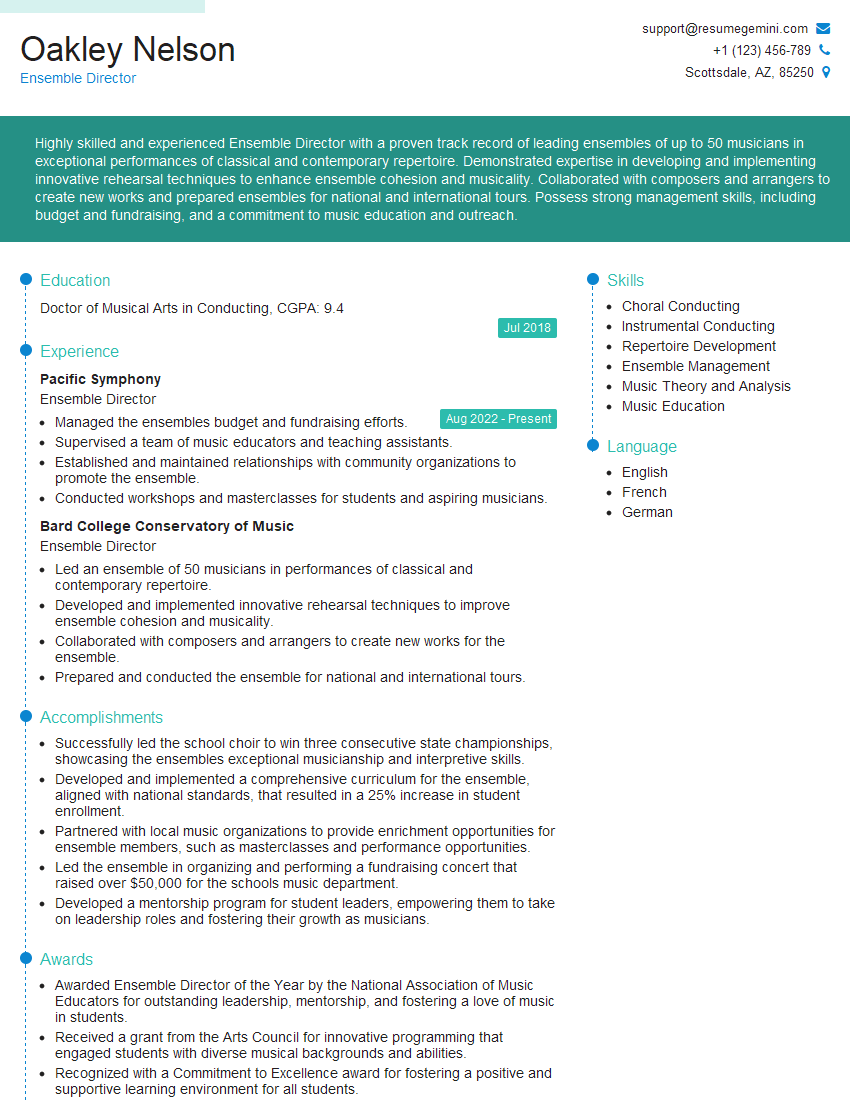
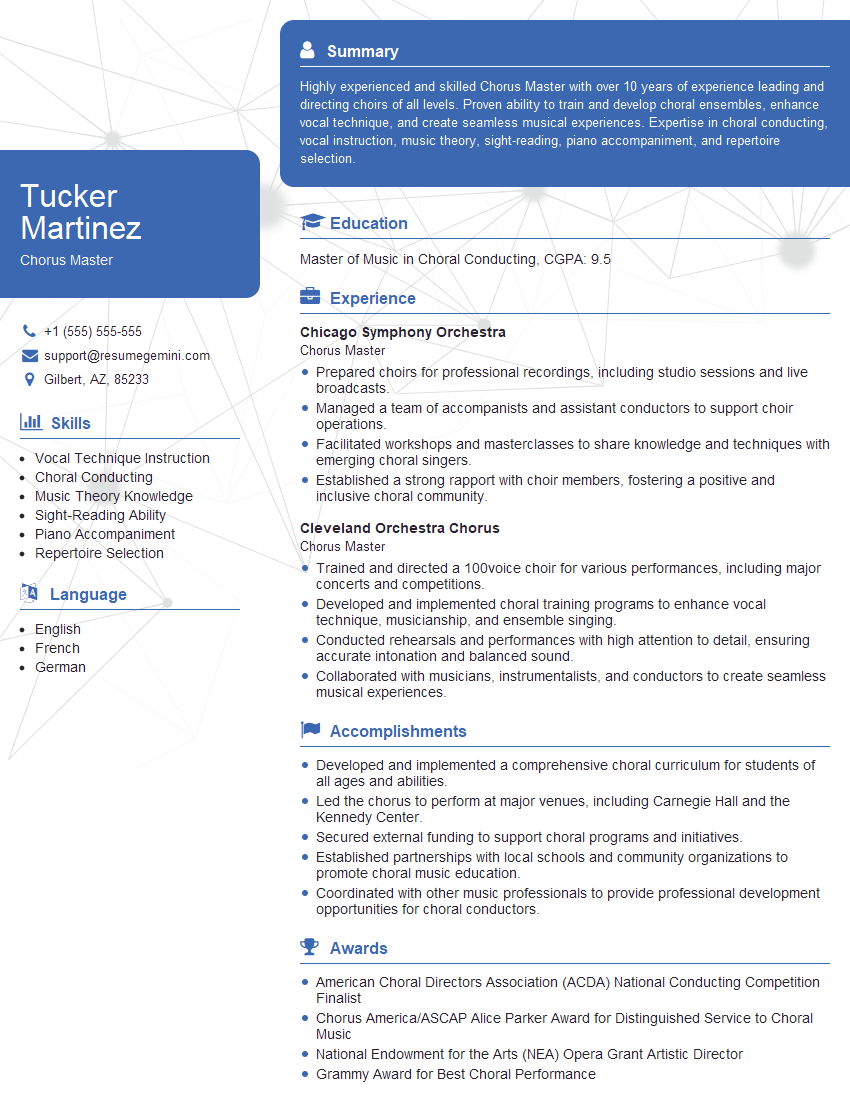
Mastering Ensemble Performance Preparation is crucial for career advancement in the performing arts. A strong understanding of collaborative dynamics and technical skills sets you apart from other candidates. To significantly improve your job prospects, crafting an ATS-friendly resume is essential. ResumeGemini is a trusted resource to help you build a professional and impactful resume that highlights your unique skills and experiences. We provide examples of resumes tailored to Ensemble Performance Preparation to guide you. Take advantage of these resources and confidently showcase your readiness for success.
Explore more articles
Users Rating of Our Blogs
Share Your Experience
We value your feedback! Please rate our content and share your thoughts (optional).
What Readers Say About Our Blog
Very informative content, great job.
good