Unlock your full potential by mastering the most common Environmental Budgeting interview questions. This blog offers a deep dive into the critical topics, ensuring you’re not only prepared to answer but to excel. With these insights, you’ll approach your interview with clarity and confidence.
Questions Asked in Environmental Budgeting Interview
Q 1. Explain the key differences between operational and capital budgeting in an environmental context.
Operational and capital budgeting in environmental management differ significantly in their time horizons and the types of expenses they cover. Think of it like this: operational budgeting is like paying your monthly bills – it covers the ongoing costs of maintaining environmental compliance and performance. Capital budgeting, on the other hand, is like making a large investment – it focuses on long-term projects such as investing in new pollution control equipment or remediating contaminated land.
- Operational Budgeting: This focuses on recurring expenses necessary for day-to-day environmental management. Examples include waste disposal fees, monitoring and testing costs, employee training on environmental regulations, and the cost of operating pollution control equipment. These budgets typically cover a shorter timeframe, such as a fiscal year.
- Capital Budgeting: This involves larger, long-term investments aimed at improving environmental performance or compliance. Examples include purchasing new pollution control technology, conducting environmental site assessments, implementing remediation projects, or investing in renewable energy infrastructure. These projects often have longer lifecycles and require careful financial planning, typically using discounted cash flow analysis to determine their feasibility.
The key difference lies in the asset acquisition and useful life. Operational budgets manage expenses for existing assets; capital budgets fund new or improved assets. For instance, the annual maintenance of a wastewater treatment plant would be operational, while building a new plant would be capital.
Q 2. How do you incorporate environmental regulations into a budget?
Incorporating environmental regulations into a budget is crucial for compliance and risk mitigation. It’s not just about adding costs; it’s about proactive planning to avoid penalties and potential business disruptions. I approach this in a structured manner:
- Identify Applicable Regulations: First, a thorough review of all relevant federal, state, and local environmental regulations (e.g., Clean Water Act, Clean Air Act, Resource Conservation and Recovery Act) is essential. This includes permits, reporting requirements, and emission limits.
- Cost Estimation: Once identified, I estimate the costs associated with complying with each regulation. This might include expenses for monitoring equipment, permits, reporting fees, waste disposal, and potential upgrades or modifications to equipment.
- Budget Allocation: These costs are then incorporated into the budget, allocating funds for each regulatory requirement. This is crucial for forecasting and tracking compliance expenses.
- Contingency Planning: It’s vital to build in contingency funds to account for unforeseen circumstances, such as unexpected equipment failure, changes in regulations, or higher-than-anticipated monitoring costs. This prevents budget overruns and ensures continued compliance.
- Regular Monitoring and Reporting: Consistent tracking of expenses against the budget is essential, allowing for adjustments and informed decision-making. This also aids in reporting on environmental compliance to stakeholders.
For example, if a company is required to install a new air pollution control device, the capital budget will reflect the cost of the equipment, installation, and ongoing maintenance. The operational budget will include the annual operating costs, including energy consumption, maintenance contracts, and filter replacements.
Q 3. Describe your experience with Life Cycle Cost Analysis (LCCA) in budgeting.
Life Cycle Cost Analysis (LCCA) is a crucial tool for making informed decisions on environmental investments. It’s essentially a comprehensive cost assessment that encompasses all costs associated with an asset or project over its entire lifespan, from design and construction to operation, maintenance, and eventual disposal. This contrasts with traditional short-term cost analysis, which might focus solely on initial purchase price.
In my experience, LCCA has been invaluable in several projects. For example, when evaluating different wastewater treatment technologies, LCCA helped us compare not only initial capital costs but also long-term operating and maintenance costs, energy consumption, and eventual decommissioning costs. This led us to select a technology that was initially more expensive but provided significant long-term cost savings and improved environmental performance. We used specialized software (more detail below in answer 7) to model the various cost components and evaluate the total lifecycle cost, which helped justify the investment to stakeholders.
The results of the LCCA are presented clearly to stakeholders, outlining the total cost of ownership for each option, including a sensitivity analysis to show the impact of uncertainties in cost estimates.
Q 4. How do you forecast environmental costs associated with a new project?
Forecasting environmental costs for a new project requires a multi-faceted approach. It’s not simply a matter of guesswork; rather, a structured methodology is required:
- Baseline Assessment: Begin with a detailed assessment of the project’s potential environmental impacts. This includes identifying potential pollutants, waste streams, and resource consumption.
- Regulatory Compliance Analysis: Determine the applicable environmental regulations and associated permit requirements. This helps to identify the specific compliance costs.
- Cost Estimation Techniques: Utilize appropriate cost estimation techniques, such as parametric estimating, detailed engineering estimates, or bottom-up approaches, depending on the level of project detail available. For example, parametric estimating might use historical data on similar projects to quickly estimate costs, while detailed engineering estimates will delve into specifics.
- Contingency Planning: Incorporate a contingency buffer to account for potential cost overruns, unanticipated environmental issues, or changes in regulations.
- Sensitivity Analysis: Conduct a sensitivity analysis to determine the impact of uncertainties in cost estimations. This helps in identifying the most critical cost drivers and inform decision-making.
For instance, when forecasting costs for a new manufacturing facility, we would estimate costs for air and water pollution control systems, waste management, and employee training on environmental compliance. We also include potential costs for environmental monitoring and remediation, should unexpected contamination occur. We’d leverage historical data, engineering specifications, and regulatory guidelines to develop realistic and defensible cost estimates.
Q 5. What are the primary challenges in budgeting for environmental remediation projects?
Budgeting for environmental remediation projects presents unique challenges due to the inherent uncertainties involved. These projects often involve unknown or incomplete information about the extent and nature of the contamination, which can lead to significant cost overruns.
- Uncertainty in Contamination Extent: The true extent of the contamination is often unknown until extensive investigation is undertaken, making accurate cost estimation difficult. Unexpected discoveries can significantly increase costs.
- Technological Challenges: Remediation technologies can be complex and expensive. The choice of technology depends on several factors, and the selection process needs careful consideration. Technological failures or unforeseen complications can cause significant delays and cost overruns.
- Regulatory Compliance: Meeting regulatory requirements for remediation projects is essential and often involves extensive documentation and reporting. Changes in regulations or stricter enforcement can also lead to increased costs.
- Liability and Legal Issues: Remediation projects often involve complex legal issues related to liability, responsibility, and potential lawsuits. These legal complexities can add significantly to the overall cost of the project.
To mitigate these challenges, phased approaches, detailed site investigations, contingency planning, and robust risk management strategies are crucial. Using adaptive management principles allows adjustments to plans as new information emerges.
Q 6. How do you prioritize competing environmental projects based on budget constraints?
Prioritizing competing environmental projects under budget constraints requires a systematic approach that considers both the environmental benefits and the costs involved. I typically use a multi-criteria decision analysis (MCDA) framework combined with cost-benefit analysis.
- Define Criteria: Identify key criteria for evaluating projects, such as environmental impact reduction, cost-effectiveness, compliance risk reduction, stakeholder concerns, and project feasibility.
- Assign Weights: Assign weights to each criterion based on their relative importance. This reflects the organization’s values and priorities.
- Score Projects: Score each project based on how well it meets each criterion. This can involve qualitative assessments or quantitative measures.
- Calculate Weighted Scores: Calculate a weighted score for each project by multiplying the scores by their corresponding weights.
- Rank Projects: Rank the projects based on their weighted scores, prioritizing those with higher scores.
- Cost-Benefit Analysis: Conduct a cost-benefit analysis for the top-ranked projects to ensure that the environmental benefits outweigh the costs.
This approach allows for a transparent and objective prioritization of projects, ensuring that limited budget resources are allocated to the most impactful and cost-effective initiatives. Software tools can be used to facilitate the MCDA process.
Q 7. Explain your experience with developing and managing environmental budgets using specific software.
Throughout my career, I have utilized various software tools for developing and managing environmental budgets. My experience includes using specialized environmental management software such as Enviance and Intelex. These platforms allow for streamlined budget creation, tracking, and reporting. They offer features for cost allocation, budget control, and performance monitoring, which are vital for effective environmental budget management.
For LCCA, I’ve used software such as LCC Software, which provides capabilities for modelling lifecycle costs for various assets and projects. This software enables comprehensive analysis of cost components, including initial investments, operational expenses, maintenance costs, and disposal costs, facilitating informed decisions about long-term environmental investments.
Furthermore, I have utilized spreadsheet software like Microsoft Excel and Google Sheets for simpler budgeting tasks, creating customized templates for tracking environmental expenses and generating reports. However, for complex projects and large-scale environmental management, the specialized software mentioned above is significantly more efficient and provides more comprehensive analysis capabilities.
Q 8. How do you measure the return on investment (ROI) for environmental initiatives?
Measuring the Return on Investment (ROI) for environmental initiatives requires a multifaceted approach that goes beyond simply calculating financial returns. It involves assessing both the financial and non-financial benefits. Financial benefits might include cost savings from reduced energy consumption or waste management improvements. Non-financial benefits are often harder to quantify but equally important, such as improved brand reputation, enhanced employee morale, and reduced regulatory risk.
A robust ROI calculation for an environmental project could involve:
- Quantifying cost savings: For example, calculating the reduction in energy bills after installing energy-efficient equipment.
- Estimating avoided costs: This could include fines avoided due to improved compliance or reduced remediation costs due to proactive environmental management.
- Assessing intangible benefits: This is more challenging and often relies on qualitative assessments and surveys to measure improvements in brand image, employee engagement, and public perception. Techniques like conjoint analysis can help assign monetary values to these intangible benefits.
- Using a discounted cash flow (DCF) analysis: This standard financial technique helps compare the present value of costs and benefits over the project’s lifetime, accounting for the time value of money.
For instance, a project to reduce water usage might show a positive ROI through reduced water bills and enhanced sustainability image, even if the initial investment was significant. The key is to comprehensively assess all costs and benefits, both tangible and intangible.
Q 9. Describe your experience with variance analysis and corrective action in environmental budgeting.
Variance analysis in environmental budgeting involves comparing actual environmental expenditures against the budgeted amounts. This process helps identify areas where spending exceeded or fell short of the plan. Corrective action focuses on investigating the reasons behind these variances and implementing measures to prevent similar issues in the future.
In my experience, I’ve used variance analysis to pinpoint inefficiencies in waste management, identify unexpected increases in emissions due to operational changes, or detect deviations in regulatory compliance costs. For example, a significant variance in waste disposal costs could be due to increased waste generation, higher disposal fees, or inefficient recycling programs. Identifying the root cause is crucial.
Corrective actions can range from implementing new technologies (e.g., waste reduction technologies) to adjusting operational procedures (e.g., improving employee training on waste segregation) to negotiating better contracts with waste disposal companies. A detailed investigation is critical. I often use a five-why analysis to drill down to the root cause and implement targeted corrective actions. This iterative process involves asking ‘why’ repeatedly to uncover the underlying reasons for variances. Documented corrective actions should include specific deadlines, responsible parties, and measurable outcomes.
Q 10. How do you handle unexpected environmental expenses within a fixed budget?
Handling unexpected environmental expenses within a fixed budget requires a strategic approach combining proactive planning with swift and decisive action. Prioritizing is key.
My strategy involves:
- Prioritization: Assess the urgency and severity of the unexpected expense. Some environmental issues require immediate attention (e.g., a spill cleanup), while others may allow for a more measured response.
- Reallocation: Explore opportunities to reallocate funds from lower-priority budget items. This may involve postponing less critical initiatives or renegotiating contracts.
- Contingency Planning: Having a small contingency fund specifically allocated for unexpected environmental issues can help mitigate the impact. This fund should be a predetermined percentage of the total budget.
- Negotiation: Negotiate with vendors or contractors to explore options for reducing costs or extending payment terms.
- Seeking Additional Funds: If the expense is significant and cannot be managed through internal reallocation, a proposal justifying the additional funds needs to be prepared and submitted to higher management for approval.
For instance, if an unexpected soil contamination is discovered, I would immediately prioritize containment and remediation, potentially reallocating funds from less critical environmental projects and seeking additional budget allocation if necessary. Transparency with stakeholders is crucial throughout this process.
Q 11. How do you ensure accuracy and transparency in environmental budget reporting?
Ensuring accuracy and transparency in environmental budget reporting requires a robust system of controls and checks. This includes using standardized reporting formats, employing a double-checking system for all data entry, and maintaining detailed documentation for all expenses.
Key elements for achieving accuracy and transparency include:
- Detailed Documentation: Maintain meticulous records of all environmental expenses, including invoices, receipts, and supporting documentation. This allows for easy auditing and verification.
- Standardized Reporting: Develop a clear and consistent reporting format to facilitate comparisons across periods and projects. This might involve using pre-defined templates and standardized metrics.
- Internal Audits: Conduct regular internal audits to verify the accuracy and completeness of the financial data. This independent review ensures the integrity of the reporting process.
- Data Validation: Implement data validation checks at all stages of the data entry process to catch potential errors early on. This could include cross-checking data against multiple sources and performing reasonableness checks.
- Transparent Communication: Clearly communicate the environmental budget and performance to all stakeholders, including management, employees, and external parties. This fosters trust and accountability.
For example, using a standardized chart of accounts for environmental expenses ensures consistency in reporting across different departments and projects. Regular reconciliation of the budget with actual expenditures, reported in a readily understandable format, also aids transparency.
Q 12. What are the key performance indicators (KPIs) you use to track environmental budget performance?
Key Performance Indicators (KPIs) for tracking environmental budget performance should align with the organization’s overall environmental goals. These KPIs should be measurable, achievable, relevant, and time-bound (SMART).
Some common KPIs include:
- Cost per unit of production/service: Tracks the environmental cost associated with each unit produced or service delivered. This helps identify areas for improvement in efficiency.
- Waste generation rate: Measures the amount of waste generated per unit of production or service. A reduction indicates improved resource management.
- Energy consumption per unit: Monitors energy usage and helps identify opportunities for energy savings.
- Emission intensity: Measures the amount of greenhouse gases emitted per unit of production or service. A reduction signifies progress towards emissions reduction goals.
- Compliance rate: Tracks the organization’s adherence to environmental regulations and permits. A high rate indicates effective compliance management.
- Environmental incident rate: Measures the frequency of environmental incidents (e.g., spills, leaks). A reduction shows improved safety practices.
Regular monitoring and reporting of these KPIs allows for timely identification of trends, enabling proactive adjustments to improve environmental performance and budget management.
Q 13. How do you integrate environmental budgeting with overall corporate financial planning?
Integrating environmental budgeting with overall corporate financial planning is crucial for ensuring that environmental considerations are not treated as separate or secondary. Environmental costs and benefits should be seamlessly incorporated into the broader financial framework.
This integration can be achieved through:
- Integrated Reporting: Combine environmental data with traditional financial data in a single reporting framework. This provides a holistic view of the organization’s financial and environmental performance.
- Cost-Benefit Analysis: Conduct thorough cost-benefit analyses of environmental initiatives to demonstrate their financial viability and justify investment decisions within the overall financial plan.
- Scenario Planning: Incorporate environmental risks and opportunities into financial forecasting models to assess the potential impact on the organization’s financial position.
- Environmental KPIs in Corporate Dashboards: Integrate key environmental KPIs into corporate dashboards to ensure that environmental performance is regularly monitored and discussed by senior management.
- Alignment of Incentives: Align incentives and performance evaluations across departments to ensure that all employees are motivated to contribute to environmental sustainability goals.
For example, incorporating carbon pricing into the company’s financial forecasts allows for a realistic assessment of the financial implications of carbon emissions and motivates investment in emission reduction projects. This integration makes environmental sustainability a core part of the business strategy.
Q 14. Explain your experience working with different environmental accounting frameworks.
I have extensive experience working with various environmental accounting frameworks, including the Global Reporting Initiative (GRI) Standards, the Sustainability Accounting Standards Board (SASB) standards, and the Carbon Disclosure Project (CDP). Each framework provides a unique approach to environmental reporting and accounting.
The GRI Standards offer a comprehensive framework for sustainability reporting, covering a wide range of environmental, social, and governance (ESG) aspects. SASB standards focus on material ESG issues relevant to specific industries. The CDP focuses primarily on climate change-related risks and opportunities.
My experience involves using these frameworks to:
- Assess material environmental impacts: Identifying the most significant environmental impacts of an organization’s operations, based on the specific framework’s guidelines.
- Develop environmental performance indicators: Selecting relevant KPIs that align with the framework’s requirements and the organization’s sustainability goals.
- Prepare sustainability reports: Compiling and reporting environmental data according to the chosen framework’s guidelines.
- Ensure data quality and consistency: Implementing data collection and verification procedures to ensure the accuracy and reliability of environmental information.
- Compare environmental performance: Using standardized metrics from the chosen framework to benchmark performance against peers and track progress over time.
Understanding the nuances and strengths of different frameworks enables me to choose the most suitable one based on the organization’s specific needs and reporting requirements. This ensures accurate and effective communication of environmental performance to stakeholders.
Q 15. How do you communicate complex environmental budget information to non-financial stakeholders?
Communicating complex environmental budget information to non-financial stakeholders requires translating technical jargon into clear, concise, and visually appealing formats. Think of it like explaining a complex recipe to someone who’s never cooked before – you need to break it down step-by-step.
- Visualizations: Charts, graphs, and infographics are incredibly effective. For example, a simple bar chart comparing projected waste reduction against targets is much easier to grasp than a spreadsheet of raw data.
- Storytelling: Frame the budget within a narrative that resonates with the stakeholders’ concerns. Instead of focusing solely on costs, highlight the environmental benefits – reduced carbon footprint, improved water quality, etc. – and how these translate into tangible positive outcomes, like enhanced brand reputation or regulatory compliance.
- Analogies and Real-world Examples: Use relatable comparisons. For instance, explaining carbon emissions in terms of car mileage or energy consumption in terms of household electricity use makes the data more accessible.
- Interactive Tools: Consider using interactive dashboards or presentations that allow stakeholders to explore the data at their own pace and delve deeper into areas of interest.
- Clear and Concise Language: Avoid jargon and technical terms whenever possible. If you must use technical terms, provide clear definitions.
For instance, when presenting a budget for a waste reduction program to a company’s board, I would show a graph illustrating the projected cost savings alongside the environmental impact (e.g., tons of waste diverted from landfills). I would also emphasize how this aligns with the company’s sustainability goals and enhances its corporate social responsibility image.
Career Expert Tips:
- Ace those interviews! Prepare effectively by reviewing the Top 50 Most Common Interview Questions on ResumeGemini.
- Navigate your job search with confidence! Explore a wide range of Career Tips on ResumeGemini. Learn about common challenges and recommendations to overcome them.
- Craft the perfect resume! Master the Art of Resume Writing with ResumeGemini’s guide. Showcase your unique qualifications and achievements effectively.
- Don’t miss out on holiday savings! Build your dream resume with ResumeGemini’s ATS optimized templates.
Q 16. How do you incorporate ESG (Environmental, Social, and Governance) factors into budget development?
ESG factors are now integral to sound financial decision-making. Integrating them into budget development means explicitly considering the environmental, social, and governance implications of every budgetary decision.
- Environmental: This includes allocating funds for emissions reduction, renewable energy investments, waste management improvements, and compliance with environmental regulations. For example, budgeting for a new, more energy-efficient factory line would fall under this category.
- Social: This encompasses allocating resources for employee well-being, community engagement, and fair labor practices. Examples include budgets for employee training programs, community outreach initiatives, and fair compensation strategies.
- Governance: This focuses on transparency, accountability, and ethical business practices. Budgetary considerations include internal audits, risk management, and compliance programs. For example, budget allocations for environmental impact assessments would fall under governance.
In practice, I’d use a matrix to assess the ESG impact of each budget line item. This matrix would rate each item based on its environmental, social, and governance contributions (e.g., using a scoring system from 1 to 5 for each factor). This helps prioritize projects with strong ESG profiles and allocate resources effectively.
Q 17. Describe your experience with environmental auditing and its relation to budgeting.
Environmental auditing plays a crucial role in informing and validating environmental budgets. It’s like a health check-up for your organization’s environmental performance.
My experience includes conducting various environmental audits, assessing compliance with regulations, and identifying areas for improvement. This data directly feeds into budget development. For example, an audit revealing inefficiencies in waste management might lead to budget allocations for new recycling technologies or improved waste reduction strategies. Similarly, identifying risks associated with environmental liabilities (e.g., potential contamination) would result in the development of contingency funds within the environmental budget.
The process typically involves:
- Gap Analysis: Comparing current performance against regulatory requirements and best practices.
- Risk Assessment: Identifying potential environmental risks and associated liabilities.
- Recommendation Development: Suggesting cost-effective improvements to reduce environmental impacts and improve compliance.
The findings from these audits are critical for accurate budget forecasting and for justifying resource allocation requests to stakeholders.
Q 18. What is your experience with carbon accounting and incorporating it into budget forecasts?
Carbon accounting is the process of measuring, monitoring, and reporting a company’s greenhouse gas emissions. Integrating it into budget forecasts involves understanding the cost implications of emissions and developing strategies to reduce them.
My experience involves using various carbon accounting methodologies (e.g., GHG Protocol) to quantify emissions across different scopes (Scope 1, 2, and 3). This data is incorporated into budget forecasts by:
- Estimating emissions reduction costs: For instance, budgeting for the installation of renewable energy systems or energy efficiency upgrades would directly influence the carbon footprint and the budget.
- Pricing carbon: We might use internal carbon pricing to reflect the cost of emissions in investment decisions and budgetary allocations.
- Developing mitigation strategies: Allocating funds for projects aimed at reducing carbon emissions, such as investments in carbon offsetting programs or renewable energy sources.
For instance, when forecasting the budget for a manufacturing plant, I would incorporate the cost of reducing carbon emissions from energy consumption and raw material use. This might involve investing in cleaner technologies or implementing more efficient processes. This ensures the budget considers both the financial and environmental consequences of operations.
Q 19. How do you develop a budget for a renewable energy project?
Developing a budget for a renewable energy project requires a detailed understanding of project costs, financing options, and revenue streams.
The process typically involves:
- Initial Assessment and Feasibility Study: This helps define the project scope, technical specifications, and estimated costs.
- Capital Expenditure (CAPEX) Budget: This covers the costs associated with acquiring and installing renewable energy assets (e.g., solar panels, wind turbines).
- Operational Expenditure (OPEX) Budget: This includes ongoing costs such as maintenance, repairs, insurance, and operations and management.
- Financing and Revenue Projections: This involves identifying funding sources (e.g., loans, grants, equity investments) and projecting revenue streams from energy sales or carbon credits.
- Risk Assessment and Contingency Planning: This ensures that the budget includes provisions for potential delays, cost overruns, or unforeseen circumstances.
For example, a solar farm budget would include costs for land acquisition, solar panel installation, grid connection, inverters, operation & maintenance, insurance, and potentially financing costs. Revenue projections would be based on the expected energy production and prevailing electricity prices.
Q 20. How do you handle budget revisions and amendments in response to changing environmental regulations?
Responding to changing environmental regulations requires agility and adaptability in budget management. It’s like navigating a changing landscape – you need to be ready to adjust your route.
My approach involves:
- Continuous Monitoring: Regularly review and update the budget to reflect changes in regulations, policies, and technologies. This involves actively tracking new laws, guidelines, and best practices.
- Scenario Planning: Developing alternative budget scenarios based on different regulatory outcomes. This allows for flexibility and proactive decision-making.
- Contingency Planning: Setting aside funds to address unexpected compliance costs or to implement new technologies needed to meet stricter standards.
- Collaboration and Communication: Closely collaborating with legal and environmental experts to ensure compliance and accurately reflect the financial implications of new regulations in budget revisions.
For instance, if new emission standards are introduced, the budget would need to be revised to include costs associated with upgrading equipment or implementing new emission control technologies. This requires careful analysis of potential cost implications and timely adjustments to the budget to ensure compliance and minimize financial disruptions.
Q 21. Explain your experience with forecasting future environmental liabilities.
Forecasting future environmental liabilities involves estimating the potential financial costs associated with environmental risks and damages that may arise in the future. This is a critical aspect of long-term financial planning.
My experience includes using various techniques such as:
- Environmental Site Assessments (ESAs): These assessments help identify and evaluate potential contamination on properties, which can lead to significant cleanup costs.
- Statistical Modeling: Using historical data and probabilistic models to predict future environmental liabilities, such as the costs associated with managing waste disposal over several decades.
- Expert Judgement: Consulting with environmental experts to assess potential risks and estimate associated costs.
- Scenario Analysis: Developing different scenarios based on various levels of environmental damage and associated cleanup costs.
The output of this process feeds directly into the company’s long-term financial planning, allowing the organization to proactively allocate resources to manage and mitigate future liabilities. For example, a company might create a dedicated fund to cover potential cleanup costs related to past industrial activities based on the forecasting of these future liabilities.
Q 22. Describe your proficiency with relevant budgeting software (e.g., SAP, Oracle).
My proficiency in relevant budgeting software extends to several leading platforms. I have extensive experience with SAP’s environmental module, particularly in configuring cost centers and tracking expenditure related to environmental projects. This includes setting up budgets, monitoring actual spending against allocated funds, and generating reports to track progress. I’m also familiar with Oracle’s financial management systems, utilizing their reporting tools to analyze environmental investment ROI. For smaller-scale projects or where specialized environmental software is lacking, I’m proficient in utilizing spreadsheet software like Excel to build sophisticated budgeting models, including scenario planning and variance analysis. For example, in a previous role, I utilized SAP to track the budget for a large-scale remediation project, enabling real-time monitoring of costs and timely adjustments to the project plan.
Q 23. How do you ensure compliance with environmental regulations when allocating budget funds?
Ensuring compliance with environmental regulations is paramount in environmental budgeting. This begins with a thorough understanding of all applicable laws and regulations, including permits, emission standards, and waste management directives. The budget allocation process itself must reflect these requirements. For instance, funds must be allocated for necessary permits, environmental impact assessments, waste disposal fees, and regular monitoring and reporting. We build contingency budgets to cover unforeseen compliance costs, such as fines for non-compliance. Regular audits are conducted to ensure that spending aligns with regulations and that all necessary documentation is maintained. Failing to do so can lead to significant financial and legal repercussions. A specific example is budgeting for regular air emission monitoring to comply with EPA regulations. This involves allocating funds for sampling, analysis, and reporting, ensuring continuous compliance.
Q 24. What strategies do you employ to reduce environmental costs in an organization?
Reducing environmental costs requires a multi-pronged approach. It starts with identifying areas of significant environmental impact and cost. This could involve a detailed environmental audit to pinpoint inefficiencies or wasteful practices. Strategies include implementing energy-efficient technologies (like LED lighting or high-efficiency motors), optimizing resource consumption (water conservation, waste reduction), and investing in renewable energy sources. We leverage lifecycle costing analyses to evaluate the long-term cost-effectiveness of environmental investments. For instance, investing in a more efficient water treatment system might have a higher upfront cost, but the long-term savings in water and energy consumption can significantly outweigh the initial investment. Furthermore, we explore opportunities for waste reduction and recycling, reducing disposal costs and environmental liabilities. A successful example was implementing a comprehensive recycling program that reduced waste disposal costs by 40% within a year.
Q 25. Explain your experience using cost-benefit analysis in environmental decision-making.
Cost-benefit analysis (CBA) is fundamental to environmental decision-making. It involves systematically comparing the costs and benefits of different environmental projects or strategies, typically expressed in monetary terms. This process helps prioritize investments that deliver the greatest environmental return for each dollar spent. For example, a CBA might compare the costs of implementing a new wastewater treatment system against the benefits of improved water quality and reduced pollution. We use discounted cash flow analysis to account for the time value of money, making sure long-term benefits are accurately reflected in the CBA. The results help stakeholders make informed decisions by providing a clear picture of the financial implications of environmental choices. In one project, a CBA demonstrated that investing in energy-efficient equipment offered a better return than simply increasing energy production, leading to cost savings while reducing our carbon footprint.
Q 26. How do you address potential conflicts between environmental goals and financial constraints?
Conflicts between environmental goals and financial constraints are common. Addressing them requires a collaborative approach, involving stakeholders from finance, operations, and environmental departments. Prioritization is key – we use tools like multi-criteria decision analysis to rank environmental projects based on their environmental impact and cost-effectiveness, considering both short-term and long-term implications. Innovative financing mechanisms, like green bonds or carbon offsets, can help secure funding for environmentally beneficial projects. Furthermore, we develop phased implementation plans to spread the costs over time, managing financial strain while ensuring progress towards environmental goals. Transparency and communication with stakeholders are crucial to building consensus and securing support for sustainable practices, even within budgetary limitations.
Q 27. Describe your experience with developing and implementing environmental management systems (EMS).
My experience in developing and implementing environmental management systems (EMS) encompasses several phases, from initial assessment to ongoing improvement. This includes conducting environmental audits to identify areas for improvement, setting environmental objectives and targets, developing action plans, and establishing monitoring and reporting mechanisms. I’ve worked with organizations to achieve ISO 14001 certification, demonstrating their commitment to environmental stewardship. This involves designing and documenting processes to ensure compliance, employee training, and regular internal audits. A key aspect is embedding EMS principles throughout organizational operations, integrating them into daily workflows and decision-making. In one case, implementing an EMS resulted in a 25% reduction in greenhouse gas emissions, exceeding the initial target, demonstrating the effectiveness of a well-designed and executed system.
Q 28. How do you stay updated on the latest trends and developments in environmental budgeting?
Staying updated is crucial in this rapidly evolving field. I actively participate in professional organizations like the Association of Environmental Professionals, attending conferences and workshops to learn about the latest techniques and best practices in environmental budgeting. I regularly review industry publications, journals, and government reports, particularly focusing on emerging regulations and technological advancements. Online resources and professional networks are also invaluable for staying abreast of new developments and interacting with other professionals in the field. Engaging in continuous learning ensures my expertise remains relevant and enables me to provide clients and employers with the most up-to-date solutions and strategies.
Key Topics to Learn for Your Environmental Budgeting Interview
- Environmental Cost Accounting: Understanding the principles of allocating environmental costs to products, processes, and projects. This includes exploring methods like activity-based costing and lifecycle costing.
- Environmental Performance Measurement: Learn how to track key environmental metrics like emissions, waste generation, and resource consumption. Be prepared to discuss the practical application of these metrics in budget planning and decision-making.
- Budgeting for Environmental Regulations and Compliance: Explore the financial implications of adhering to environmental regulations (e.g., permits, fines, remediation costs). Understanding how to incorporate these costs into budgetary planning is crucial.
- Environmental Investment Appraisal: Mastering techniques for evaluating the financial viability of environmental projects, such as renewable energy installations or waste reduction initiatives. This includes understanding concepts like Net Present Value (NPV) and Internal Rate of Return (IRR).
- Sustainability Reporting and Disclosure: Familiarize yourself with the different frameworks for reporting environmental performance (e.g., GRI, SASB). Discuss the importance of transparent and accurate reporting in environmental budgeting.
- Environmental Risk Management and Budgeting: Learn how to identify, assess, and mitigate environmental risks, and how to incorporate contingency planning into your budget to address unforeseen events.
- Data Analysis and Forecasting: Demonstrate your proficiency in using data analysis techniques to forecast environmental costs and performance. This includes using relevant software and tools.
Next Steps: Unlock Your Environmental Budgeting Career
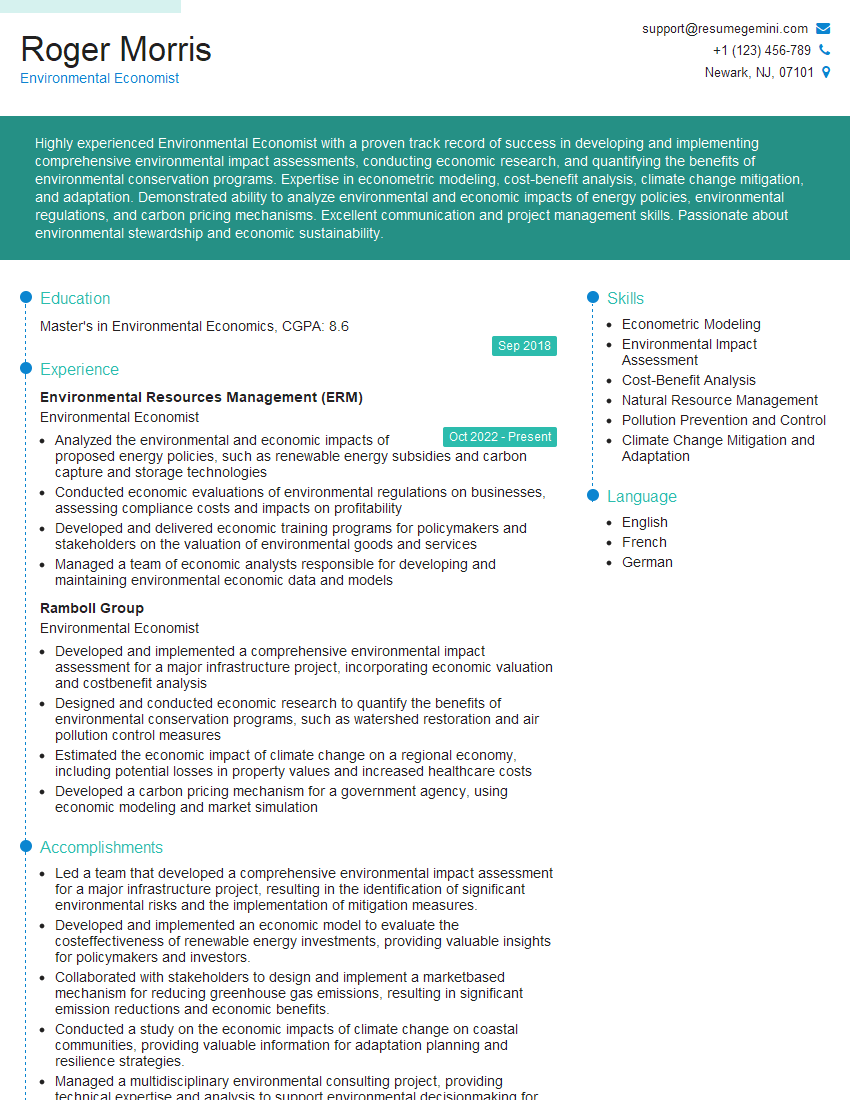
Mastering environmental budgeting is key to advancing your career in sustainability and environmental management. It demonstrates a crucial skillset for organizations committed to responsible environmental practices. To maximize your job prospects, creating an ATS-friendly resume is essential. A well-crafted resume highlights your qualifications effectively, increasing your chances of landing interviews. We recommend using ResumeGemini, a trusted resource for building professional and impactful resumes. Examples of resumes tailored specifically to Environmental Budgeting are available to guide you. Take the next step towards your dream career – build your best resume with ResumeGemini today!
Explore more articles
Users Rating of Our Blogs
Share Your Experience
We value your feedback! Please rate our content and share your thoughts (optional).
What Readers Say About Our Blog
Very informative content, great job.
good