Feeling uncertain about what to expect in your upcoming interview? We’ve got you covered! This blog highlights the most important Equipment Reliability interview questions and provides actionable advice to help you stand out as the ideal candidate. Let’s pave the way for your success.
Questions Asked in Equipment Reliability Interview
Q 1. Explain the difference between preventive, predictive, and corrective maintenance.
The three main types of maintenance—preventive, predictive, and corrective—differ significantly in their approach to equipment upkeep. Think of it like car maintenance: you wouldn’t wait for your car to completely break down before addressing issues.
- Preventive Maintenance (PM): This is scheduled maintenance performed at predetermined intervals to prevent failures. It’s like changing your car’s oil every 3,000 miles – proactive to avoid bigger problems later. Examples include lubricating equipment, replacing filters, and inspecting components for wear and tear. It’s cost-effective in the long run by reducing the frequency of unexpected breakdowns.
- Predictive Maintenance (PdM): This uses data and advanced analytics to predict when equipment will likely fail, allowing for timely interventions. Imagine using sensors in your car to monitor oil degradation and predict when an oil change is actually needed, rather than following a fixed schedule. PdM techniques include vibration analysis, oil analysis, and thermal imaging to detect anomalies before they escalate into failures.
- Corrective Maintenance (CM): This is reactive maintenance performed after equipment fails. It’s akin to waiting for your car to break down on the side of the road before fixing it. CM is the most expensive and disruptive type of maintenance as it usually involves unplanned downtime, emergency repairs, and potential safety risks.
Ideally, a balanced approach utilizing all three types is best, leveraging preventive maintenance as a baseline, predictive maintenance for optimization, and corrective maintenance only when necessary.
Q 2. Describe your experience with Reliability Centered Maintenance (RCM).
Reliability Centered Maintenance (RCM) is a systematic process for determining the best maintenance tasks to ensure equipment reliability while minimizing maintenance costs. It’s not about just fixing things; it’s about understanding why things fail and implementing the most effective strategies to prevent those failures.
In my experience, applying RCM involves a structured approach:
- Functional Failure Analysis: Identifying all potential failure modes of each equipment component and its impact on the overall system.
- Failure Mode Analysis: Determining the causes of each potential failure mode.
- Consequence Analysis: Assessing the severity of each failure, considering safety, environmental impact, and production downtime.
- Maintenance Task Selection: Based on the failure modes, consequences, and cost-effectiveness, choosing the most appropriate preventive, predictive, or corrective maintenance task.
- Implementation and Monitoring: Implementing the selected maintenance tasks and regularly monitoring their effectiveness.
I’ve successfully implemented RCM in various settings, including manufacturing plants and power generation facilities, leading to significant reductions in downtime and maintenance costs. For example, in one project, by focusing on the critical functions of a production line and applying RCM principles, we reduced unplanned downtime by 30% within six months.
Q 3. What are the key performance indicators (KPIs) you use to measure equipment reliability?
Measuring equipment reliability requires a comprehensive set of Key Performance Indicators (KPIs). These metrics provide insights into equipment performance and areas for improvement. Some of the key KPIs I regularly use include:
- Mean Time Between Failures (MTBF): The average time between equipment failures. A higher MTBF indicates higher reliability.
- Mean Time To Repair (MTTR): The average time taken to repair a failed equipment. A lower MTTR indicates faster recovery and reduced downtime.
- Availability: The percentage of time the equipment is available for operation. This considers both MTBF and MTTR.
- Overall Equipment Effectiveness (OEE): A holistic measure that combines availability, performance, and quality. It provides a comprehensive picture of equipment efficiency.
- Failure Rate: The number of failures per unit of time. Helps identify trends and potential issues.
I also track specific metrics relevant to the individual equipment and its critical functions within the overall system. Regular monitoring and analysis of these KPIs are crucial for effective reliability management.
Q 4. How do you perform root cause analysis (RCA) on equipment failures?
Root Cause Analysis (RCA) is a systematic process for identifying the underlying cause of equipment failures, not just the symptoms. A thorough RCA prevents recurring failures and improves overall reliability.
I typically employ the 5 Whys technique, a simple yet effective method where you repeatedly ask ‘Why?’ to delve deeper into the cause of the failure. I also utilize more sophisticated methods such as:
- Fishbone Diagram (Ishikawa Diagram): This visual tool helps to brainstorm potential causes grouped by categories (materials, methods, manpower, machinery, environment, management).
- Fault Tree Analysis (FTA): A top-down, deductive approach used to graphically represent the various combinations of events that can lead to a particular system failure.
- Failure Mode and Effects Analysis (FMEA): A proactive approach to identify potential failure modes and their effects, allowing for preventive measures.
Regardless of the chosen method, documenting the analysis and implementing corrective actions based on the identified root causes are critical steps. In my experience, thorough RCA not only fixes the immediate problem but also prevents similar issues from occurring in the future.
Q 5. What are some common failure modes and effects analysis (FMEA) techniques?
Failure Mode and Effects Analysis (FMEA) is a crucial proactive technique to anticipate and mitigate potential equipment failures. Several techniques enhance the FMEA process:
- Basic FMEA: This involves identifying potential failure modes, their effects, and severity, and assigning risk priority numbers (RPNs) based on severity, occurrence, and detection. A higher RPN indicates higher risk.
- System FMEA: This focuses on the entire system and its interactions, analyzing how failures in one component might affect other parts of the system.
- Design FMEA (dFMEA): Conducted during the design phase of a product or system to identify potential failures and implement preventative measures before production.
- Process FMEA (pFMEA): Used to analyze potential failures in manufacturing processes.
Software tools can significantly assist in conducting and managing FMEAs, allowing for efficient data tracking and analysis. The key is to involve cross-functional teams with diverse expertise to ensure a comprehensive analysis. Regular review and updates to the FMEA are essential to reflect changes in the system or process.
Q 6. Explain the concept of Mean Time Between Failures (MTBF) and Mean Time To Repair (MTTR).
Mean Time Between Failures (MTBF) and Mean Time To Repair (MTTR) are fundamental metrics in equipment reliability. They provide insights into equipment performance and the effectiveness of maintenance strategies.
- MTBF: This is the average time between consecutive failures of a piece of equipment. A higher MTBF suggests higher reliability. For example, an MTBF of 1000 hours means the equipment is expected to operate for 1000 hours on average before failing. MTBF is calculated by dividing the total operating time by the number of failures.
- MTTR: This is the average time taken to repair a failed piece of equipment and restore it to operational status. A lower MTTR indicates faster recovery and reduced downtime. For example, an MTTR of 2 hours means, on average, it takes 2 hours to fix a failed equipment. MTTR is calculated by dividing the total repair time by the number of repairs.
Both MTBF and MTTR are critical in determining the overall availability of equipment. A high MTBF and a low MTTR are indicators of high equipment reliability and minimal operational disruptions.
Q 7. How do you use data analysis to improve equipment reliability?
Data analysis is the cornerstone of modern equipment reliability improvement. By collecting, analyzing, and interpreting data from various sources, we can identify patterns, predict failures, and optimize maintenance strategies.
My approach involves several key steps:
- Data Collection: Gathering data from various sources, including CMMS systems, sensor data, and operational logs.
- Data Cleaning and Preprocessing: Cleaning the data to remove errors and inconsistencies and transforming it into a suitable format for analysis.
- Exploratory Data Analysis (EDA): Using visual and statistical techniques to understand data patterns and identify potential correlations.
- Predictive Modeling: Using statistical techniques such as regression analysis or machine learning algorithms to predict future failures based on historical data.
- Actionable Insights: Transforming the findings into actionable insights to optimize maintenance strategies and improve equipment reliability.
For instance, through analyzing vibration sensor data from a pump, I identified a specific frequency pattern preceding failures. This enabled the implementation of a predictive maintenance strategy based on vibration analysis, significantly reducing unexpected downtime.
Q 8. What are some common reliability improvement methodologies you’ve used?
Improving equipment reliability involves a multifaceted approach. I’ve extensively used several methodologies, each tailored to specific needs. Failure Mode and Effects Analysis (FMEA) is a cornerstone, allowing us to systematically identify potential failure points, their effects, and the severity of those effects. This helps prioritize preventative actions. For instance, in a food processing plant, FMEA helped us identify a critical failure point in a conveyor belt—a broken bearing leading to production downtime. By implementing a predictive maintenance program targeting bearing vibration, we significantly reduced the risk. Root Cause Analysis (RCA), such as the ‘5 Whys’ method, is crucial for understanding the underlying reasons behind failures. When a pump repeatedly failed, the ‘5 Whys’ revealed a lack of proper lubrication as the root cause, leading to improved maintenance procedures. Finally, Reliability-Centered Maintenance (RCM) is vital for optimizing maintenance strategies. It helps determine the most effective maintenance tasks based on their impact on equipment reliability and safety. For example, we used RCM to transition from a time-based maintenance schedule for a critical compressor to a condition-based approach using vibration sensors, maximizing uptime and minimizing unnecessary maintenance.
Q 9. Describe your experience with Computerized Maintenance Management Systems (CMMS).
My experience with Computerized Maintenance Management Systems (CMMS) is extensive. I’ve worked with several platforms, including [Mention specific CMMS software – e.g., IBM Maximo, SAP PM]. CMMS is integral to managing maintenance activities efficiently. It allows for scheduling, tracking work orders, managing inventory, and generating reports on equipment performance and maintenance costs. In a previous role, we implemented a CMMS to replace a paper-based system, resulting in a 20% reduction in maintenance costs and a 15% increase in equipment uptime. Specific features I utilize include preventative maintenance scheduling, where we set schedules based on manufacturer recommendations or historical data; work order management, enabling efficient task assignment and tracking; and reporting and analytics, providing valuable insights into equipment reliability and maintenance performance. For example, the CMMS facilitated data analysis to reveal a pattern of failures in a specific machine type during peak production hours, leading to targeted improvements in operational procedures.
Q 10. How do you prioritize maintenance tasks to maximize equipment uptime?
Prioritizing maintenance tasks requires a strategic approach balancing urgency and impact. I utilize a risk-based prioritization system, considering factors such as the criticality of the equipment, the potential consequences of failure (financial losses, safety hazards, production downtime), and the probability of failure. This often involves using a matrix or scoring system. For instance, equipment crucial for continuous production, with a high probability of catastrophic failure, would rank highest. I also use the concept of ‘criticality’ analysis to determine how dependent other equipment is on a given component’s functioning. A failed component that takes down an entire production line would rate higher than an isolated issue. Regularly reviewing the maintenance backlog, incorporating real-time data from sensors or condition monitoring, and adapting to changing operational demands are also critical. Think of it like a hospital emergency room – the most critical patients get seen first. We apply the same principle to our equipment to ensure maximum uptime and minimize disruption.
Q 11. Explain your understanding of Weibull analysis and its application in reliability.
Weibull analysis is a statistical method used to model the time-to-failure of equipment. It’s particularly useful for understanding the failure patterns of components and predicting their remaining useful life. The Weibull distribution has two key parameters: the shape parameter (β) and the scale parameter (η). The shape parameter describes the failure pattern (e.g., constant failure rate, increasing failure rate, decreasing failure rate). The scale parameter represents the characteristic life of the component. In a real-world scenario, we used Weibull analysis to determine the failure rate of pumps in a chemical plant. The analysis revealed a decreasing failure rate, indicating that the pumps had a high initial failure rate that decreased over time. This finding allowed us to tailor maintenance strategies, shifting from frequent preventative maintenance early in the pump’s life to less frequent interventions later on. The analysis also helped to estimate the remaining useful life of the pumps, allowing for planned replacements before critical failures occurred.
Q 12. How do you assess the risk associated with equipment failures?
Assessing equipment failure risk involves a combination of qualitative and quantitative methods. I employ Failure Mode and Effects Analysis (FMEA), as previously mentioned, to identify potential failure modes and their consequences. Then, I assign severity, probability, and detectability ratings to each failure mode. These ratings are combined to calculate a risk priority number (RPN), helping to prioritize risk mitigation efforts. For example, a high-severity, high-probability, and low-detectability failure would have a very high RPN and require immediate attention. Beyond FMEA, I also consider the criticality of the equipment, its age, its operating environment, and historical failure data. A quantitative method like Fault Tree Analysis (FTA) can be used to model complex systems and identify the combination of events that could lead to a specific failure. Combining these methods allows for a comprehensive risk assessment, enabling proactive measures to mitigate the potential impact of equipment failures.
Q 13. Describe your experience with vibration analysis or other predictive maintenance techniques.
I have significant experience in vibration analysis and other predictive maintenance techniques. Vibration analysis is a powerful tool for detecting developing mechanical problems in rotating equipment like motors, pumps, and compressors. By analyzing the frequency and amplitude of vibrations, we can identify imbalances, misalignments, bearing wear, and other issues before they lead to catastrophic failures. In one project, vibration analysis on a large industrial fan identified a developing bearing fault. The corrective action was scheduled before any significant damage occurred, preventing costly downtime and repairs. Other predictive maintenance techniques I use include oil analysis (examining lubricant condition for signs of wear and contamination), thermography (detecting overheating components), and ultrasonic testing (detecting leaks and corrosion). These techniques, coupled with CMMS, enable condition-based maintenance, optimizing maintenance scheduling and reducing downtime.
Q 14. How do you handle conflicting priorities in a maintenance schedule?
Handling conflicting priorities in a maintenance schedule requires a structured approach. The first step is to clearly define the priorities, considering the criteria mentioned earlier (criticality, consequences, probability of failure). Often, this involves a collaborative process, involving operations, production, and maintenance teams. A prioritization matrix can help visualize the competing demands, clarifying trade-offs. Once priorities are defined, I use techniques like resource leveling (optimizing resource allocation to minimize delays) and critical path analysis (identifying the sequence of tasks that determines the overall duration of a maintenance project). In situations where it’s impossible to avoid delays, I strive for transparency and clear communication, keeping stakeholders informed of any potential impacts. Compromises may involve adjusting maintenance schedules (e.g., shifting a lower priority task) or allocating additional resources to expedite critical tasks. The key is proactive communication and collaboration to ensure the most critical maintenance needs are met while minimizing overall disruption.
Q 15. What are some techniques for improving communication and collaboration within a maintenance team?
Improving communication and collaboration within a maintenance team is crucial for effective equipment reliability. Think of it like a well-oiled machine – each part needs to work seamlessly with the others. This involves several key strategies:
Regular Team Meetings: Daily stand-up meetings, weekly progress reviews, and monthly planning sessions are vital for information sharing, problem identification, and task coordination. These meetings should have a clear agenda and defined outcomes.
Effective Communication Tools: Utilizing platforms like shared online calendars, project management software (e.g., Asana, Trello), or even simple communication apps (like Slack or Microsoft Teams) enhances transparency and allows for quick updates and issue escalation.
Training and Skill Development: Ensuring all team members have the necessary skills and knowledge fosters confidence and reduces misunderstandings. Cross-training can create a more adaptable and resilient team.
Open and Honest Feedback: Creating a culture of open communication, where team members feel comfortable expressing their concerns and providing constructive feedback, is essential for continuous improvement. Regular feedback sessions, both formal and informal, should be encouraged.
Clear Roles and Responsibilities: Assigning clear responsibilities with well-defined boundaries minimizes confusion and ensures accountability. A robust RACI matrix (Responsible, Accountable, Consulted, Informed) can be extremely helpful.
For instance, in a previous role, we implemented a daily stand-up meeting where each technician briefly reported their progress, challenges, and planned activities. This simple change significantly reduced bottlenecks and improved overall efficiency.
Career Expert Tips:
- Ace those interviews! Prepare effectively by reviewing the Top 50 Most Common Interview Questions on ResumeGemini.
- Navigate your job search with confidence! Explore a wide range of Career Tips on ResumeGemini. Learn about common challenges and recommendations to overcome them.
- Craft the perfect resume! Master the Art of Resume Writing with ResumeGemini’s guide. Showcase your unique qualifications and achievements effectively.
- Don’t miss out on holiday savings! Build your dream resume with ResumeGemini’s ATS optimized templates.
Q 16. How do you develop and implement a reliability improvement plan?
Developing and implementing a reliability improvement plan involves a systematic approach. It’s like building a house – you need a solid foundation and a well-defined plan before construction begins.
Data Collection and Analysis: The first step is to gather data on equipment failures, downtime, and maintenance costs. This data can be analyzed to identify the root causes of reliability issues using techniques like Pareto analysis (identifying the vital few issues contributing to the majority of problems) and Failure Mode and Effects Analysis (FMEA).
Prioritization: Based on the data analysis, prioritize the most critical issues impacting reliability. This often involves considering the impact of failure on production, safety, and cost.
Implementation of Corrective Actions: Develop and implement corrective actions to address the prioritized issues. This might involve improvements to maintenance procedures, equipment modifications, operator training, or procurement of more reliable components.
Monitoring and Evaluation: Continuously monitor the effectiveness of the implemented actions by tracking key reliability indicators (KRIs) like Mean Time Between Failures (MTBF), Mean Time To Repair (MTTR), and overall equipment effectiveness (OEE). Regular reviews are needed to adjust the plan as needed.
For example, at a previous manufacturing plant, we identified a significant number of bearing failures in a key piece of equipment. After analyzing the data, we discovered the root cause was inadequate lubrication. By implementing a new lubrication schedule and operator training, we significantly reduced bearing failures and improved overall equipment reliability.
Q 17. How do you handle emergency equipment failures?
Handling emergency equipment failures requires a well-defined process to minimize downtime and prevent further damage. Think of it as a fire drill – you need a plan and trained personnel to respond effectively.
Immediate Response: The first step involves initiating the emergency response plan. This often includes notifying relevant personnel, isolating the affected equipment, and ensuring the safety of personnel.
Troubleshooting and Diagnosis: Quickly diagnose the cause of the failure. This might involve visual inspection, using diagnostic tools, or consulting technical documentation.
Temporary Repair or Workaround: If possible, implement a temporary repair or workaround to restore partial or full functionality. This could involve using a backup system, rerouting processes, or replacing a critical component.
Permanent Repair: After addressing the immediate issue, initiate a thorough investigation to identify the root cause of the failure and implement permanent corrective actions to prevent future occurrences. This may require ordering spare parts and scheduling a proper repair.
Documentation: Meticulously document all aspects of the failure, including the cause, the actions taken, the downtime incurred, and the cost of repair.
In one instance, a critical compressor failed during peak production. Our immediate response team quickly isolated the equipment, implemented a temporary workaround using a backup compressor, and then initiated a thorough root cause analysis. This prevented significant production loss and identified a faulty pressure relief valve as the root cause.
Q 18. What is your experience with spare parts management?
Effective spare parts management is essential for minimizing downtime and maintaining equipment reliability. It’s like having a well-stocked toolbox – you need the right tools at the right time.
Inventory Control: Implement a robust inventory control system to track spare parts, monitor stock levels, and ensure timely replenishment. This can involve using a computerized maintenance management system (CMMS) or enterprise resource planning (ERP) system.
Demand Forecasting: Accurately forecast the demand for spare parts based on historical data, equipment failure rates, and planned maintenance activities.
Vendor Management: Establish strong relationships with reliable vendors to ensure timely delivery of spare parts. This includes negotiating favorable pricing and delivery terms.
Storage and Handling: Properly store and handle spare parts to prevent damage or deterioration. This might involve using climate-controlled storage facilities or specialized containers.
Obsolete Parts Management: Regularly review inventory to identify and dispose of obsolete or slow-moving parts.
In my experience, we used ABC analysis to categorize spare parts based on their criticality and consumption rate. This allowed us to focus our efforts on managing critical parts effectively, while streamlining the management of less critical items.
Q 19. How do you measure the effectiveness of your reliability programs?
Measuring the effectiveness of reliability programs requires the use of key performance indicators (KPIs) and regular monitoring. It’s like tracking your fitness progress – you need to measure your results to see if your training is working.
Mean Time Between Failures (MTBF): Measures the average time between equipment failures. A higher MTBF indicates improved reliability.
Mean Time To Repair (MTTR): Measures the average time it takes to repair equipment after a failure. A lower MTTR indicates faster and more efficient repairs.
Overall Equipment Effectiveness (OEE): A comprehensive measure of equipment productivity that considers availability, performance, and quality. A higher OEE indicates better utilization and efficiency.
Maintenance Costs: Tracking maintenance costs helps assess the effectiveness of preventative maintenance programs. A reduction in maintenance costs can indicate improved reliability.
Downtime Costs: Monitoring downtime costs provides an understanding of the financial impact of equipment failures. A reduction in downtime costs signifies improved reliability.
By tracking these KPIs over time, we can assess the impact of reliability improvement initiatives and make data-driven decisions to further enhance equipment performance.
Q 20. Explain your understanding of Total Productive Maintenance (TPM).
Total Productive Maintenance (TPM) is a philosophy that aims to maximize equipment effectiveness by involving all employees in maintenance activities. It’s like a team sport – everyone works together to achieve a common goal.
Key aspects of TPM include:
Autonomous Maintenance: Empowering operators to perform basic maintenance tasks, fostering ownership and reducing reliance on specialized maintenance personnel.
Planned Maintenance: Implementing a systematic approach to preventative maintenance, reducing unexpected failures and maximizing equipment lifespan.
Preventive Maintenance: Proactive maintenance measures implemented to prevent equipment breakdowns and failures.
Improvement Activities: Continuous improvement efforts focused on eliminating losses and enhancing equipment performance.
Training and Education: Providing training and education to all employees involved in equipment maintenance.
Successful TPM implementation requires a strong commitment from management and active participation from all employees. It is a cultural shift that promotes proactive maintenance and continuous improvement across the organization.
Q 21. What is your experience with Six Sigma or Lean methodologies in reliability?
Six Sigma and Lean methodologies offer powerful tools for improving reliability. They’re like precision instruments, allowing you to fine-tune your processes for optimal performance.
Six Sigma: A data-driven approach focused on reducing variation and defects in processes. Six Sigma tools such as DMAIC (Define, Measure, Analyze, Improve, Control) can be used to systematically identify and eliminate the root causes of equipment failures.
Lean: A methodology focused on eliminating waste and improving efficiency. Lean principles, such as Value Stream Mapping, can be used to optimize maintenance processes and reduce downtime.
In a previous project, we used Six Sigma’s DMAIC methodology to address recurring failures in a critical production line. Through detailed data analysis, we identified a poorly designed component as the root cause. By redesigning the component and implementing stricter quality control measures, we significantly reduced failures and improved the overall reliability of the production line. Lean principles helped us streamline the maintenance process, reducing unnecessary steps and improving overall efficiency.
Q 22. How do you incorporate safety considerations into your reliability practices?
Safety is paramount in equipment reliability. It’s not just about preventing failures; it’s about preventing failures that could lead to injury, environmental damage, or significant financial loss. We integrate safety considerations at every stage, from design and procurement to operation and maintenance.
- Hazard Identification and Risk Assessment (HIRA): Before any equipment is installed or a process is implemented, a thorough HIRA is conducted. This identifies potential hazards and assesses the likelihood and severity of incidents. This informs the selection of safety features and maintenance procedures.
- Safety Instrumented Systems (SIS): For critical equipment, SIS are implemented. These are independent safety systems designed to shut down or mitigate hazards if a primary system fails. Regular testing and verification of these systems are crucial.
- Lockout/Tagout (LOTO) Procedures: Strict LOTO procedures are enforced during maintenance activities to prevent accidental energy release. This ensures technicians’ safety during repairs or inspections.
- Training and Competency: Operators and maintenance personnel receive comprehensive training on safe operating procedures, emergency response, and the use of personal protective equipment (PPE). Competency assessments ensure they’re equipped to handle tasks safely.
- Regular Safety Audits: Safety audits are performed to identify potential hazards and ensure compliance with safety regulations and best practices. These audits provide continuous improvement opportunities.
For example, in a chemical processing plant, a safety instrumented system might automatically shut down a reactor if pressure exceeds a predetermined limit, preventing a potential explosion. This is a critical reliability element directly tied to safety.
Q 23. Describe a time you had to troubleshoot a complex equipment failure.
I once worked on troubleshooting a complex failure in a high-speed bottling line. The line inexplicably stopped, resulting in significant production loss. Initial diagnostics pointed to the main control system, but after extensive checks, the problem remained elusive.
My approach involved a systematic investigation. First, I meticulously reviewed the operational logs and alarm history to identify any unusual patterns. Then, I collaborated with the electricians and mechanical technicians to physically inspect all components, starting with the most likely candidates. We used vibration analysis tools to detect any mechanical issues in the motors and conveyor system. This proved crucial because it revealed a bearing failure in one of the high-speed conveyor motors, which wasn’t initially obvious. The subtle vibration initially was missed due to the noise of the equipment.
Replacing the faulty bearing restored the line’s operation. The incident highlighted the importance of employing a methodical troubleshooting process, utilizing diverse diagnostic tools, and having effective interdisciplinary collaboration. We also implemented vibration monitoring as part of our predictive maintenance strategy after this incident.
Q 24. What software or tools do you use for reliability analysis?
The software and tools I use for reliability analysis are varied and depend on the specific application and data available. My toolkit typically includes:
- Reliability modeling software: Such as Weibull++ and Reliasoft, for statistical analysis of failure data, performing reliability predictions, and creating life cycle models.
- Data analysis software: Like Minitab or R, for statistical analysis of collected data, including failure modes, effects and criticality analysis (FMECA) and root cause analysis (RCA).
- Computerized Maintenance Management Systems (CMMS): Such as SAP PM or IBM Maximo, to track equipment maintenance activities, spare parts inventory, and downtime. These systems facilitate data-driven decision making in reliability efforts.
- Vibration analysis software: For analyzing vibration data from machinery to detect early signs of wear, imbalance, or misalignment.
- Thermographic imaging software: Analyzing thermal images helps identify overheating components, indicating potential failure points.
Choosing the right tools depends on the type of analysis needed. For instance, Weibull++ is excellent for analyzing time-to-failure data, while CMMS are essential for managing maintenance and operational data.
Q 25. How do you stay current with the latest advances in equipment reliability?
Staying current in equipment reliability requires continuous learning. I utilize several strategies:
- Professional Organizations: Active membership in organizations like the Society for Reliability Engineering (SRE) and attending their conferences provides access to the latest research, best practices, and networking opportunities.
- Industry Publications and Journals: Regularly reading journals like Reliability Engineering & System Safety and industry-specific publications keeps me abreast of new techniques and technologies.
- Online Courses and Webinars: Platforms like Coursera and LinkedIn Learning offer courses on various aspects of reliability engineering, allowing me to expand my knowledge and skills.
- Industry Conferences and Workshops: Attending conferences and workshops allows me to learn from experts and network with peers. It’s a great way to keep my skills current and learn from others’ experiences.
- Mentorship and Collaboration: Regular interactions with experienced reliability professionals provide valuable insights and guidance on emerging trends.
Continuous learning is essential because the field is constantly evolving, with new technologies and techniques emerging regularly. Keeping updated ensures I can utilize the most effective methods to enhance equipment reliability.
Q 26. Describe your experience working with cross-functional teams on reliability initiatives.
Cross-functional collaboration is crucial for successful reliability initiatives. My experience involves working with teams comprising engineers, maintenance technicians, operations personnel, and procurement specialists. Effective teamwork requires clear communication, shared goals, and respect for each team member’s expertise.
In one project involving improving the reliability of a complex manufacturing system, I facilitated workshops to identify key failure modes and their root causes. By bringing together the perspectives of operators (who understood the daily challenges), maintenance technicians (who understood the equipment limitations), and engineers (who understood the design and specifications), we developed a comprehensive improvement plan. This collaborative approach significantly reduced downtime and improved overall equipment effectiveness (OEE).
Successfully navigating cross-functional teams requires excellent communication, active listening, and conflict resolution skills. It’s about fostering a collaborative environment where all voices are heard and contribute to the solution.
Q 27. How do you manage and communicate equipment reliability metrics to stakeholders?
Managing and communicating reliability metrics to stakeholders requires a clear and concise approach. Key metrics include:
- Mean Time Between Failures (MTBF): Indicates the average time between equipment failures.
- Mean Time To Repair (MTTR): Shows the average time required to repair a failed piece of equipment.
- Overall Equipment Effectiveness (OEE): Measures the overall productivity of equipment, considering availability, performance, and quality.
- Failure Rates: The frequency of failures for specific equipment or components.
I use various methods to communicate these metrics:
- Regular Reports: Concise reports with key metrics, charts, and graphs provide a clear overview of equipment reliability performance to management and other stakeholders.
- Dashboards: Interactive dashboards allow real-time monitoring of key metrics, facilitating proactive decision-making.
- Presentations: Visual presentations clearly illustrate the reliability performance and highlight key areas for improvement.
- One-on-One Meetings: Direct communication allows for detailed discussions and addresses specific concerns.
It’s important to present information in a readily understandable format and avoid technical jargon whenever possible. The goal is to inform stakeholders and gain their support for reliability improvement initiatives.
Q 28. What is your experience with developing and implementing maintenance standards?
Developing and implementing maintenance standards is a critical aspect of equipment reliability. It involves creating a structured framework to ensure consistent and effective maintenance practices.
My approach involves:
- Identifying Critical Equipment: Prioritize equipment based on its criticality to operations and potential impact of failure.
- Developing Preventive Maintenance Schedules: Create detailed schedules outlining necessary inspections, lubrication, and other preventive tasks based on manufacturer recommendations, industry best practices, and historical failure data.
- Establishing Corrective Maintenance Procedures: Develop clear, step-by-step procedures for troubleshooting and repairing equipment failures to minimize downtime and ensure consistent repairs.
- Implementing a CMMS: Leverage a CMMS to track maintenance activities, manage spare parts inventory, and generate reports on maintenance effectiveness.
- Training and Competency: Train maintenance personnel on the new standards and ensure they possess the necessary skills and knowledge to perform tasks effectively and safely.
- Continuous Improvement: Regularly review and update maintenance standards based on performance data, technological advancements, and best practices.
For instance, I developed a new maintenance standard for a critical compressor in a refinery. This involved analyzing historical failure data to identify common failure modes, establishing a preventive maintenance schedule with specific tasks and frequencies, and developing standardized corrective maintenance procedures. This resulted in significant improvement in compressor reliability and a reduction in unplanned downtime.
Key Topics to Learn for Equipment Reliability Interview
- Reliability Fundamentals: Understanding key concepts like Mean Time Between Failures (MTBF), Mean Time To Repair (MTTR), and availability. Explore different reliability models and their applications.
- Predictive Maintenance Strategies: Learn about various predictive maintenance techniques, including vibration analysis, oil analysis, and thermography. Be prepared to discuss their practical implementation and cost-benefit analyses.
- Failure Modes and Effects Analysis (FMEA): Understand the process of identifying potential failure modes, their effects, and implementing mitigation strategies. Practice conducting FMEAs and interpreting their results.
- Root Cause Analysis (RCA): Master different RCA methodologies like 5 Whys, Fishbone diagrams, and Fault Tree Analysis. Be ready to explain how to effectively identify and address the root causes of equipment failures.
- Data Analysis for Reliability: Discuss your experience with statistical analysis techniques relevant to reliability data, including descriptive statistics, probability distributions, and reliability modeling software.
- Reliability-Centered Maintenance (RCM): Understand the principles of RCM and its application in optimizing maintenance strategies to improve equipment reliability and reduce costs.
- Maintenance Management Systems (CMMS): Familiarity with CMMS software and its role in tracking maintenance activities, managing spare parts, and analyzing maintenance data.
- Risk Assessment and Management: Discuss your understanding of risk assessment methodologies and how they contribute to proactive equipment reliability management.
Next Steps
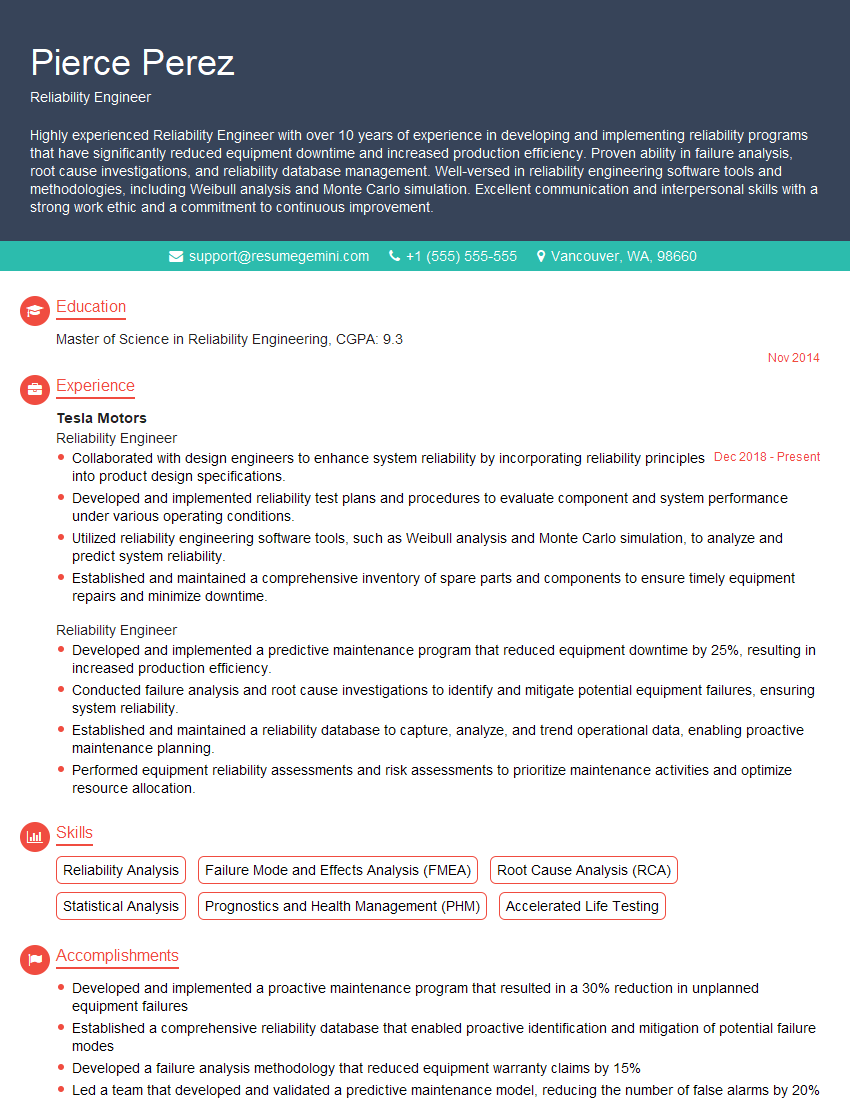
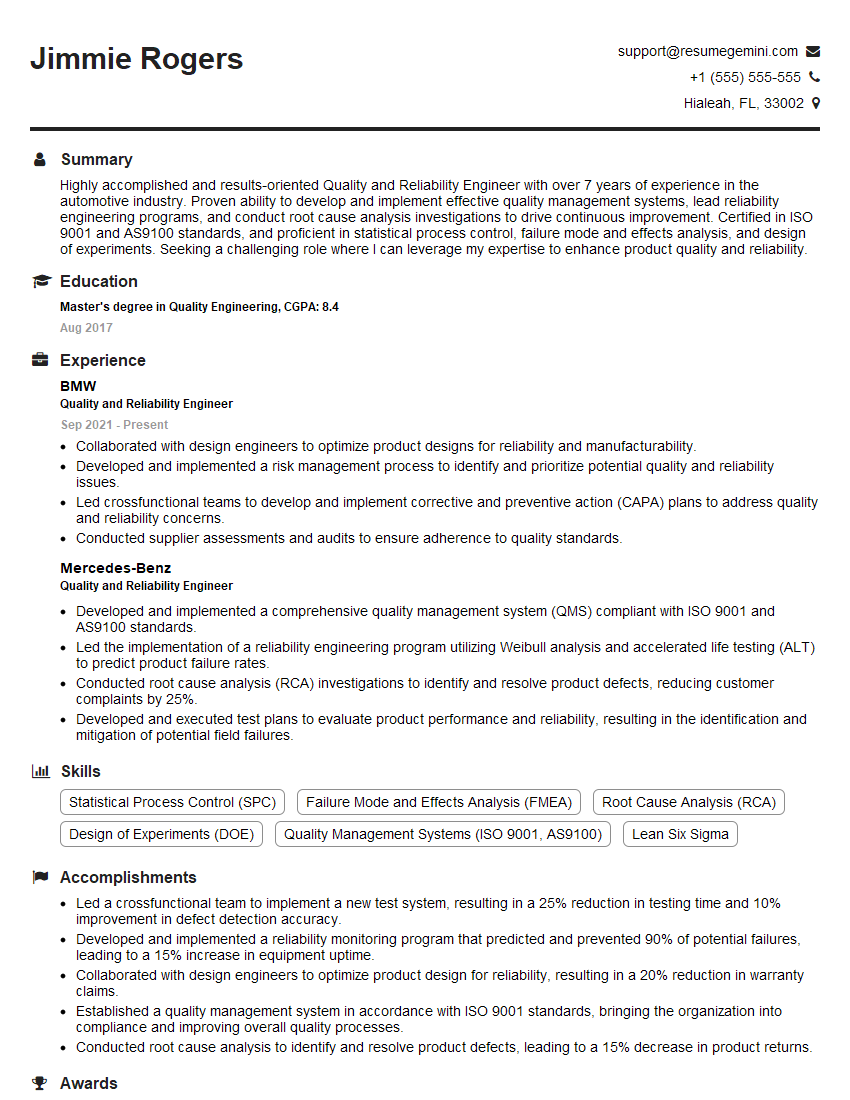
Mastering Equipment Reliability is crucial for career advancement in many industries, opening doors to specialized roles and increased earning potential. A strong resume is your first step towards securing your dream job. Creating an ATS-friendly resume is essential to navigate Applicant Tracking Systems and get your application noticed. We recommend using ResumeGemini, a trusted resource, to build a professional and impactful resume that showcases your skills and experience effectively. ResumeGemini provides examples of resumes tailored to Equipment Reliability to help you craft a compelling application that stands out.
Explore more articles
Users Rating of Our Blogs
Share Your Experience
We value your feedback! Please rate our content and share your thoughts (optional).
What Readers Say About Our Blog
Very informative content, great job.
good